

The DOI matches its Crossref record; 33 of the 34 references it cites were found in a registry or an index.
GENCODE 2021
Open accessAbstract
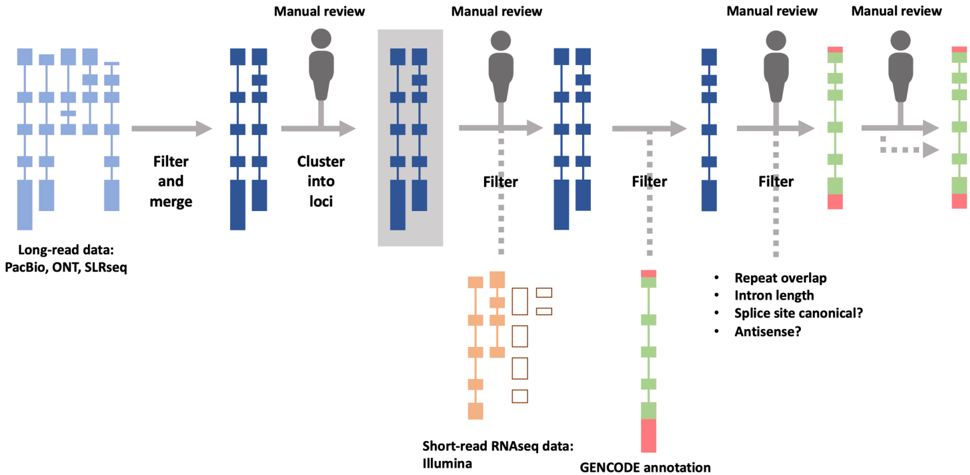
The GENCODE project annotates human and mouse genes and transcripts supported by experimental data with high accuracy, providing a foundational resource that supports genome biology and clinical genomics. GENCODE annotation processes make use of primary data and bioinformatic tools and analysis generated both within the consortium and externally to support the creation of transcript structures and the determination of their function. Here, we present improvements to our annotation infrastructure, bioinformatics tools, and analysis, and the advances they support in the annotation of the human and mouse genomes including: the completion of first pass manual annotation for the mouse reference genome; targeted improvements to the annotation of genes associated with SARS-CoV-2 infection; collaborative projects to achieve convergence across reference annotation databases for the annotation of human and mouse protein-coding genes; and the first GENCODE manually supervised automated annotation of lncRNAs. Our annotation is accessible via Ensembl, the UCSC Genome Browser and https://www.gencodegenes.org.
Overview
The claims and statistics of this paper haven’t been checked yet.
Free: it reads the open-access text and checks the first 5 claims that cite a source we can check. Create a free account to check every claim.
Integrity signals
Registry
Cites
Statistics
Figures
Verification
Claims the paper makes
The claims and statistics of this paper haven’t been checked yet.
Free: it reads the open-access text and checks the first 5 claims that cite a source we can check. Create a free account to check every claim.
Claims other papers make about this one
Each is checked against this paper’s own text: does it say what the citing paper says it does?
The source backs part of the claim, not all of it — or backs it for a different population, condition or comparison.
In the citing paper
“We used the human GENCODE V38 (Ensembl 104) gene annotation (22), which implies that each gene is intact in Boreoeutheria”
From Integrating gene annotation with orthology inference at scale (2023) · cites this paper as [22]
Experimental — accuracy not yet measuredThe cited source says what the claim attributes to it.
In the citing paper
“As a homology-based method, TOGA benefits from the quality and comprehensiveness of the human and mouse input annotation (21, 22).”
From Integrating gene annotation with orthology inference at scale (2023) · cites this paper as [22]
The cited source says what the claim attributes to it.
In the citing paper
“Second, we used TOGA with the mouse GENCODE M25 annotation (22) as the reference. This resulted in a higher BUSCO completeness for 98.5% (Ensembl) and 64% (NCBI) of the species (Fig. 3A,B, Tables S6–S7).”
From Integrating gene annotation with orthology inference at scale (2023) · cites this paper as [22]
The check wasn’t confident either way, so it gives no verdict — never disputed.
In the citing paper
“TOGA annotations have a higher completeness score for 97% (Ensembl) and 91.5% (NCBI) of the species (Fig. 3A,B, Tables S6–S7), increasing annotation completeness of conserved genes by an average of 4.1% or ~377 genes (Ensembl) and 0.7% or ~64 genes (NCBI) (fig. S30).”
From Integrating gene annotation with orthology inference at scale (2023) · cites this paper as [22]
Experimental — accuracy not yet measured
Self-check
Percentages, sums and reported differences re-computed from the paper’s own numbers.
The self-check needs the paper’s full text.
Citations
Cites
The Human Genome Browser at UCSC
Kent, W. J., Sugnet, C. W., Furey, T. S., Roskin, K. M., Pringle, T. H., Zahler, A. M., & Haussler, A. D. (2002) · Genome Research · doi:10.1101/gr.229102 · Cited by 10,400 · cited 3×
“Each release is versioned and made available immediately upon release from Ensembl (6) and https // www.gencodegenes.org with release on the UCSC Genome Browser (33) normally following shortly thereafter.”
BackgroundUniProt: a worldwide hub of protein knowledge
The UniProt Consortium (2019) · Nucleic Acids Research · doi:10.1093/nar/gky1049 · Cited by 7,698
Perez-Riverol, Y., Csordas, A., Bai, J., Bernal-Llinares, M., Hewapathirana, S., Kundu, D. J., Inuganti, A., Griss, J., Mayer, G., Eisenacher, M., et al. (2019) · Nucleic Acids Research · doi:10.1093/nar/gky1106 · Cited by 6,693 · cited 2×
“To support the automated analysis of proteomics data for genome annotation we collaborated with the PRIDE (25) proteomics repository at EMBL-EBI to build a reprocess-”
MethodO'Leary, N. A., Wright, M. W., Brister, J. R., Ciufo, S., Haddad, D., McVeigh, R., Rajput, B., Robbertse, B., Smith-White, B., Ako-Adjei, D., et al. (2016) · Nucleic Acids Research · doi:10.1093/nar/gkv1189 · Cited by 6,357
GENCODE: The reference human genome annotation for The ENCODE Project
Harrow, J., Frankish, A., Gonzalez, J. M., Tapanari, E., Diekhans, M., Kokocinski, F., Aken, B. L., Barrell, D., Zadissa, A., Searle, S., et al. (2012) · Genome Research · doi:10.1101/gr.135350.111 · Cited by 4,585
Self-citationA SARS-CoV-2 protein interaction map reveals targets for drug repurposing
Gordon, D. E., Jang, G. M., Bouhaddou, M., Xu, J., Obernier, K., White, K. M., O’Meara, M. J., Rezelj, V. V., Guo, J. Z., Swaney, D. L., et al. (2020) · Nature · doi:10.1038/s41586-020-2286-9 · Cited by 4,405 · cited 1×
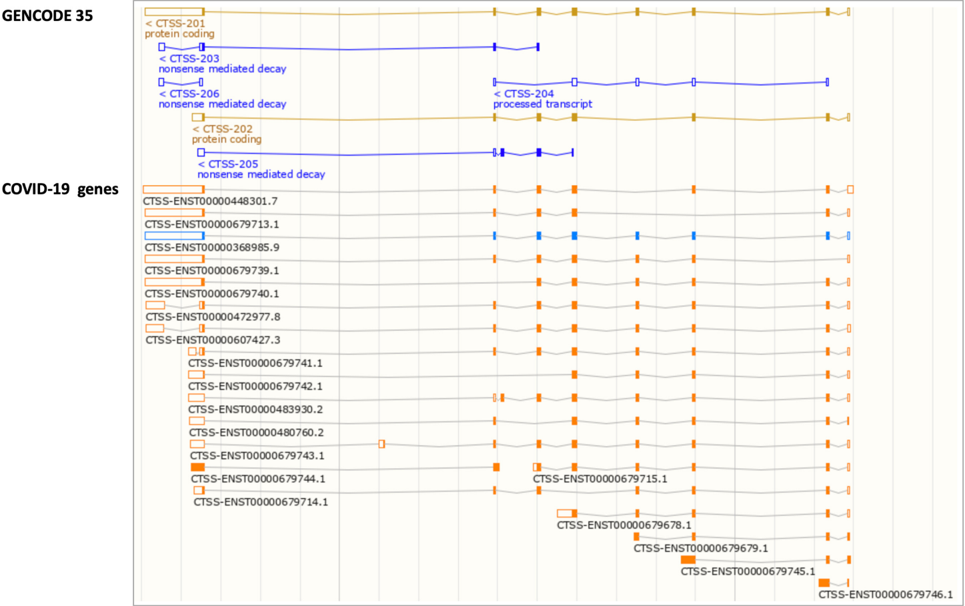
“Our list of genes for reannotation comes from several sources including recently published drug re-purposing studies identifying host proteins associated with other related coronaviruses (14) and human proteins found to physically associate with SARS-CoV-2 viral proteins in the cell (15).”
BackgroundSelf-citationThe landscape of long noncoding RNAs in the human transcriptome
Iyer, M. K., Niknafs, Y. S., Malik, R., Singhal, U., Sahu, A., Hosono, Y., Barrette, T. R., Prensner, J. R., Evans, J. R., Zhao, S., et al. (2015) · Nature Genetics · doi:10.1038/ng.3192 · Cited by 2,738 · cited 1×
“miTranscriptome (28), NONCODE (29), FANTOM CAT (30)).”
Network-based drug repurposing for novel coronavirus 2019-nCoV/SARS-CoV-2
Zhou, Y., Hou, Y., Shen, J., Huang, Y., Martin, W., & Cheng, F. (2020) · Cell Discovery · doi:10.1038/s41421-020-0153-3 · Cited by 1,597 · cited 1×
“Our list of genes for reannotation comes from several sources including recently published drug repurposing studies identifying host proteins associated with other related coronaviruses (14) and human proteins found to physically associate with SARS-CoV-2 viral proteins in the cell (15).”
BackgroundInterferon-stimulated genes and their antiviral effector functions
Schoggins, J. W., & Rice, C. M. (2011) · Current Opinion in Virology · doi:10.1016/j.coviro.2011.10.008 · Cited by 1,289 · cited 1×
“We also included genes curated by UniProt (4) and the Human Cell Atlas project (16) as well as interferonstimulated genes with known antiviral activity (17).”
MethodYates, A. D., Achuthan, P., Akanni, W., Allen, J., Allen, J., Alvarez-Jarreta, J., Amode, M. R., Armean, I. M., Azov, A. G., Bennett, R., et al. (2019) · Nucleic Acids Research · doi:10.1093/nar/gkz966 · Cited by 1,152 · cited 2×
“The Ensembl / GENCODE geneset is a merge of the manual gene annotation created by the Ensembl-HAVANA team (methods and validation described in 6–8) and the automated annotation produced by the Ensembl Geneb-uild team (9,10).”
MethodSelf-citationThe Ensembl gene annotation system
Aken, B. L., Ayling, S., Barrell, D., Clarke, L., Curwen, V., Fairley, S., Fernandez Banet, J., Billis, K., García Girón, C., Hourlier, T., et al. (2016) · Database · doi:10.1093/database/baw093 · Cited by 1,086 · cited 1×
“The Ensembl/GENCODE geneset is a merge of the manual gene annotation created by the Ensembl-HAVANA team (methods and validation described in 6–8) and the automated annotation produced by the Ensembl Genebuild team (9,10).”
MethodSelf-citationPhyloCSF: a comparative genomics method to distinguish protein-coding and non-coding regions
Lin, M., Jungreis, I., & Kellis, M. (2010) · Nature Precedings · doi:10.1038/npre.2010.4784.1 · Cited by 1,016 · cited 6×
“We have completed the first pass manual annotation of the mouse reference genome based on experiences on completing the human annotation in 2013 and have used whole genome PhyloCSF (1) analysis to generate ranked lists of candidate coding regions for investigation by expert human annotators.”
MethodInfluentialSelf-citationAn atlas of human long non-coding RNAs with accurate 5′ ends
Hon, C.-C., Ramilowski, J. A., Harshbarger, J., Bertin, N., Rackham, O. J. L., Gough, J., Denisenko, E., Schmeier, S., Poulsen, T. M., Severin, J., et al. (2017) · Nature · doi:10.1038/nature21374 · Cited by 1,007 · cited 2×
“miTranscriptome (28), NONCODE (29), FANTOM CAT (30)).”
GENCODE: producing a reference annotation for ENCODE
Harrow, J., Denoeud, F., Frankish, A., Reymond, A., Chen, C.-K., Chrast, J., Lagarde, J., Gilbert, J. G., Storey, R., Swarbreck, D., et al. (2006) · Genome Biology · doi:10.1186/gb-2006-7-s1-s4 · Cited by 648 · cited 14×
“Finally, we developed a pipeline based on UniProt (4), APPRIS (26), PhyloCSF (1), Ensembl gene trees (10), RNA-seq, MS and variation data to identify annotated protein-coding genes with weak or no support.”
InfluentialSelf-citationThe Human Cell Atlas: from vision to reality
Rozenblatt-Rosen, O., Stubbington, M. J. T., Regev, A., & Teichmann, S. A. (2017) · Nature · doi:10.1038/550451a · Cited by 638 · cited 1×
“We also included genes curated by UniProt (4) and the Human Cell Atlas project (16) as well as interferonstimulated genes with known antiviral activity (17).”
MethodThe Translational Landscape of the Human Heart
van Heesch, S., Witte, F., Schneider-Lunitz, V., Schulz, J. F., Adami, E., Faber, A. B., Kirchner, M., Maatz, H., Blachut, S., Sandmann, C.-L., et al. (2019) · Cell · doi:10.1016/j.cell.2019.05.010 · Cited by 626 · cited 1×
“A recent survey of heart ORFs (19), has so far resulted in the annotation of 12 additional human protein-coding genes.”
BackgroundProgressive Cactus is a multiple-genome aligner for the thousand-genome era
Armstrong, J., Hickey, G., Diekhans, M., Fiddes, I. T., Novak, A. M., Deran, A., Fang, Q., Xie, D., Feng, S., Stiller, J., et al. (2020) · Nature · doi:10.1038/s41586-020-2871-y · Cited by 586 · cited 1×
“For example, we have used Cactus to create a 600-way vertebrate whole genome alignment incorporating data from the 200 Mammals and Bird 10K projects as the basis of a single base-pair resolution map of evolutionary selection (20).”
MethodSelf-citationNONCODEV5: a comprehensive annotation database for long non-coding RNAs
Fang, S., Zhang, L., Guo, J., Niu, Y., Wu, Y., Li, H., Zhao, L., Li, X., Teng, X., Sun, X., et al. (2018) · Nucleic Acids Research · doi:10.1093/nar/gkx1107 · Cited by 552 · cited 2×
“miTranscriptome (28), NONCODE (29), FANTOM CAT (30)).”
Raney, B. J., Dreszer, T. R., Barber, G. P., Clawson, H., Fujita, P. A., Wang, T., Nguyen, N., Paten, B., Zweig, A. S., Karolchik, D., et al. (2014) · Bioinformatics · doi:10.1093/bioinformatics/btt637 · Cited by 415
Self-citationPertea, M., Shumate, A., Pertea, G., Varabyou, A., Breitwieser, F. P., Chang, Y.-C., Madugundu, A. K., Pandey, A., & Salzberg, S. L. (2018) · Genome Biology · doi:10.1186/s13059-018-1590-2 · Cited by 335 · cited 1×
“For example, we examined the novel protein-coding genes reported in the CHESS gene annotation set (18), adding five protein-coding genes, 16 pseudogenes and 37 lncRNAs.”
BackgroundHigh-Efficiency Full-Length cDNA Cloning by Biotinylated CAP Trapper
Carninci, P., Kvam, C., Kitamura, A., Ohsumi, T., Okazaki, Y., Itoh, M., Kamiya, M., Shibata, K., Sasaki, N., Izawa, M., et al. (1996) · Genomics · doi:10.1006/geno.1996.0567 · Cited by 299 · cited 1×
“We have made improvements to the Capture Long Sequencing (CLS) lab protocol (5), including a 5′ cap selection step (‘CapTrap’) (27), which increases the proportion of sequenced full-length transcripts and the use of Spiked-in RNA Variant Control Mixes (SIRVs).”
MethodLilue, J., Doran, A. G., Fiddes, I. T., Abrudan, M., Armstrong, J., Bennett, R., Chow, W., Collins, J., Collins, S., Czechanski, A., et al. (2018) · Nature Genetics · doi:10.1038/s41588-018-0223-8 · Cited by 267 · cited 2×
“lated mouse strains from the Mouse Genomes Project (31) to create orthology relationships for the conserved annotations and the identification of patterns of pseudogene gain and loss between strains (32) and give a prototype for work annotating human pseudogenes leveraging variation across the human population.”
BackgroundSelf-citationHigh-throughput annotation of full-length long noncoding RNAs with capture long-read sequencing
Lagarde, J., Uszczynska-Ratajczak, B., Carbonell, S., Pérez-Lluch, S., Abad, A., Davis, C., Gingeras, T. R., Frankish, A., Harrow, J., Guigo, R., et al. (2017) · Nature Genetics · doi:10.1038/ng.3988 · Cited by 267 · cited 2×
“We have also improved the annotation of lncRNAs via the discovery of novel loci and novel transcripts at existing loci primarily based on incorporating long transcriptomic sequence data generated using the CLS protocol (5).”
MethodSelf-citationAPPRIS 2017: principal isoforms for multiple gene sets
Rodríguez, J. M., Rodriguez-Rivas, J., Domenico, T. D., Vázquez, J., Valencia, A., & Tress, M. L. (2017) · Nucleic Acids Research · doi:10.1093/nar/gkx997 · Cited by 144 · cited 1×
“Finally, we developed a pipeline based on UniProt (4), APPRIS (26), PhyloCSF (1), Ensembl gene trees (10), RNA-seq, MS and variation data to identify annotated protein-coding genes with weak or no support.”
MethodSelf-citationMudge, J. M., Jungreis, I., Hunt, T., Gonzalez, J. M., Wright, J. C., Kay, M., Davidson, C., Fitzgerald, S., Seal, R., Tweedie, S., et al. (2019) · Genome Research · doi:10.1101/gr.246462.118 · Cited by 80 · cited 1×
“The PhyloCSF pipeline has also been run on the each new release of the human and mouse genome annotations to facilitate the discovery of additional novel coding genes, novel pseudogenes, and novel coding sequence (21).”
Self-citationLoughran, G., Jungreis, I., Tzani, I., Power, M., Dmitriev, R. I., Ivanov, I. P., Kellis, M., & Atkins, J. F. (2018) · Journal of Biological Chemistry · doi:10.1074/jbc.m117.818526 · Cited by 79 · cited 1×
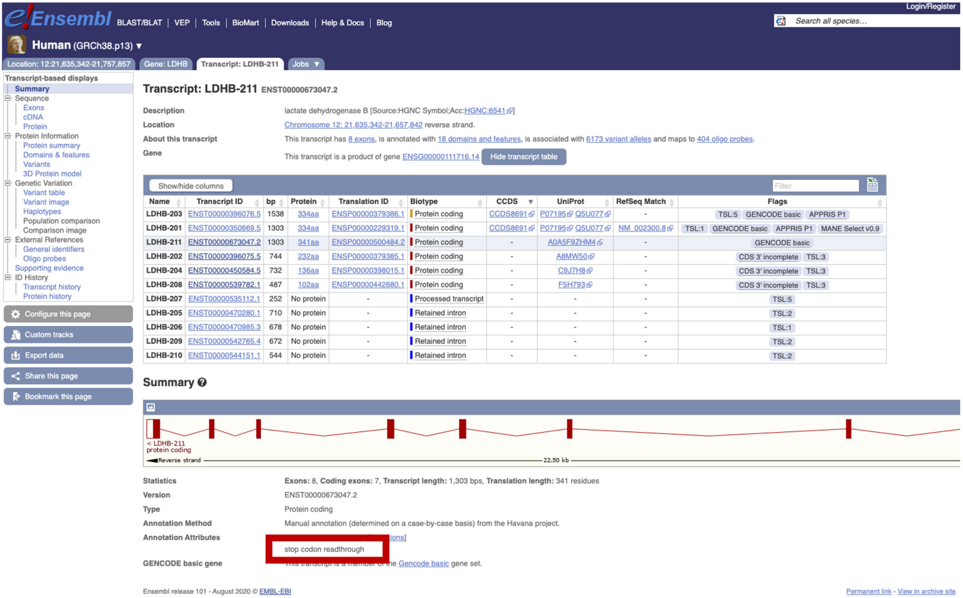
“PhyloCSF has also been used to identify candidate ribosomal stop codon readthrough events in human and mouse (22,23).”
MethodSelf-citationEvolutionary Dynamics of Abundant Stop Codon Readthrough
Jungreis, I., Chan, C. S., Waterhouse, R. M., Fields, G., Lin, M. F., & Kellis, M. (2016) · Molecular Biology and Evolution · doi:10.1093/molbev/msw189 · Cited by 75 · cited 1×
“PhyloCSF has also been used to identify candidate ribosomal stop codon readthrough events in human and mouse (22,23).”
MethodSelf-citationBarnes, I., Ibarra-Soria, X., Fitzgerald, S. F., González, J. M., Davidson, C., Hardy, M. P., Manthravadi, D., Gerven, L. V., Jorissen, M., Zeng, Z., et al. (2020) · BMC Genomics · doi:10.1186/s12864-020-6583-3 · Cited by 66 · cited 1×
“During this period we have completed the first pass annotation of the mouse reference genome and conducted a number of tightly focussed annotation projects including the human and mouse olfactory receptor repertoire (12) and a reannotation of developmental and epileptic encephalopathyassociated genes (13).”
MethodSelf-citationCombining RT-PCR-seq and RNA-seq to catalog all genic elements encoded in the human genomePreprint
Howald, C., Andrea Tanzer, A., Chrast, J., Kokocinski, F., Derrien, T., Walters, N., González, J. M., Frankish, A., Aken, B. L., Hourlier, T., et al. (2012) · Genome Research · doi:10.1101/gr.134478.111 · Cited by 62 · cited 1×
“The Ensembl / GENCODE geneset is a merge of the manual gene annotation created by the Ensembl-HAVANA team (methods and validation described in 6–8) and the automated annotation produced by the Ensembl Geneb-uild team (9,10).”
MethodSelf-citationSteward, C. A., Roovers, J., Suner, M., González, J. M., Uszczyńska-Ratajczak, B., Pervouchine, D. D., Fitzgerald, S. F., Viola, M., Stamberger, H., Hamdan, F. F., et al. (2019) · npj Genomic Medicine · doi:10.1038/s41525-019-0106-7 · Cited by 40 · cited 1×
“During this period we have completed the first pass annotation of the mouse reference genome and conducted a number of tightly focussed annotation projects including the human and mouse olfactory receptor repertoire (12) and a reannotation of developmental and epileptic encephalopathyassociated genes (13).”
MethodSelf-citationTranscriptional activity and strain-specific history of mouse pseudogenes
Sisu, C., Muir, P., Frankish, A., Fiddes, I. T., Diekhans, M., Thybert, D., Odom, D. T., Flicek, P., Keane, T., Hubbard, T., et al. (2020) · Nature Communications · doi:10.1038/s41467-020-17157-w · Cited by 40 · cited 1×
“lated mouse strains from the Mouse Genomes Project (31) to create orthology relationships for the conserved annotations and the identification of patterns of pseudogene gain and loss between strains (32) and give a prototype for work annotating human pseudogenes leveraging variation across the human population.”
BackgroundSelf-citationEvidence for a novel overlapping coding sequence in POLG initiated at a CUG start codon
Khan, Y. A., Jungreis, I., Wright, J. C., Mudge, J. M., Choudhary, J. S., Firth, A. E., & Kellis, M. (2020) · BMC Genetics · doi:10.1186/s12863-020-0828-7 · Cited by 33
Self-citationAnnoTrack - a tracking system for genome annotation
Kokocinski, F., Harrow, J., & Hubbard, T. (2010) · BMC Genomics · doi:10.1186/1471-2164-11-538 · Cited by 9 · cited 1×
“This software allows manual annotators to rapidly visualise, browse through and, via connection to the Annotrack annotation issuetracking database (11), record decisions for large numbers of gene annotations and QC flags.”
MethodSelf-citation
Cited by
Long non-coding RNAs: definitions, functions, challenges and recommendations
Mattick, J. S., Amaral, P. P., Carninci, P., Carpenter, S., Chang, H. Y., Chen, L.-L., Chen, R., Dean, C., Dinger, M. E., Fitzgerald, K. A., et al. (2023) · Nature Reviews Molecular Cell Biology · doi:10.1038/s41580-022-00566-8 · Cited by 2,356
Self-citationCunningham, F., Allen, J. E., Allen, J., Alvarez-Jarreta, J., Amode, M. R., Armean, I. M., Austine-Orimoloye, O., Azov, A. G., Barnes, I., Bennett, R., et al. (2022) · Nucleic Acids Research · doi:10.1093/nar/gkab1049 · Cited by 1,923
Self-citationHu, C., Li, T., Xu, Y., Zhang, X., Li, F., Bai, J., Chen, J., Jiang, W., Yang, K., Ou, Q., et al. (2023) · Nucleic Acids Research · doi:10.1093/nar/gkac947 · Cited by 1,261
Self-citationA draft human pangenome reference.
Liao, W.-W., Asri, M., Ebler, J., Doerr, D., Haukness, M., Hickey, G., Lu, S., Lucas, J. K., Monlong, J., Abel, H. J., et al. (2023) · Nature · doi:10.1038/s41586-023-05896-x · Cited by 1,129
Self-citationMartin, F. J., Amode, M. R., Aneja, A., Austine-Orimoloye, O., Azov, A. G., Barnes, I., Becker, A., Bennett, R., Berry, A., Bhai, J., et al. (2023) · Nucleic Acids Research · doi:10.1093/nar/gkac958 · Cited by 1,023
Self-citation
Metadata
- Authors
- Frankish, A., Diekhans, M., Jungreis, I., Lagarde, J., Loveland, J. E., Mudge, J. M., Sisu, C., Wright, J. C., Armstrong, J., Barnes, I., Berry, A., Bignell, A., Boix, C., Carbonell Sala, S., Cunningham, F., Di Domenico, T., Donaldson, S., Fiddes, I. T., García Girón, C., Gonzalez, J. M., Grego, T., Hardy, M., Hourlier, T., Howe, K. L., Hunt, T., Izuogu, O. G., Johnson, R., Martin, F. J., Martínez, L., Mohanan, S., Muir, P., Navarro, F. C. P., Parker, A., Pei, B., Pozo, F., Riera, F. C., Ruffier, M., Schmitt, B. M., Stapleton, E., Suner, M.-M., Sycheva, I., Uszczynska-Ratajczak, B., Wolf, M. Y., Xu, J., Yang, Y. T., Yates, A., Zerbino, D., Zhang, Y., Choudhary, J. S., Gerstein, M., Guigó, R., Hubbard, T. J. P., Kellis, M., Paten, B., Tress, M. L., & Flicek, P.
- Affiliations
- European Bioinformatics Institute (GB)
- University of California, Santa Cruz (US)
- Broad Institute (US)
- Barcelona Institute of Science and Technology (ES)
- Yale University (US)
- Institute of Cancer Research (GB)
- Centre for Genomic Regulation (CRG), The Barcelona Institute for Science and Technology, Dr. Aiguader 88, Barcelona, E-08003 Catalonia, Spain
- Bioinformatics Unit, Spanish National Cancer Research Centre (CNIO), Madrid, Spain
- European Molecular Biology Laboratory, European Bioinformatics Institute, Wellcome Genome Campus, Hinxton, Cambridge CB10 1SD, UK
- University of Bern (CH)
- Department of Molecular Biophysics and Biochemistry, Yale University, New Haven, CT 06520, USA
- Spanish National Cancer Research Centre (ES)
- Centre of New Technologies, University of Warsaw, Warsaw, Poland
- Harvard University (US)
- Universitat Pompeu Fabra (ES)
- Guy's Hospital (GB)
- Corresponding author
- Flicek, Paul
- ORCID
- Frankish, Adam
- Diekhans, Mark
- Jungreis, Irwin
- Lagarde, Julien
- Loveland, Jane E
- Mudge, Jonathan M
- Sisu, Cristina
- Wright, James C
- Armstrong, Joel
- Barnes, If
- Berry, Andrew
- Bignell, Alexandra
- Boix, Carles
- Cunningham, Fiona
- Donaldson, Sarah
- Fiddes, Ian T
- García Girón, Carlos
- Grego, Tiago
- Hardy, Matthew
- Hourlier, Thibaut
- Howe, Kevin L
- Hunt, Toby
- Izuogu, Osagie G
- Johnson, Rory
- Martin, Fergal J
- Mohanan, Shamika
- Pozo, Fernando
- Ruffier, Magali
- Schmitt, Bianca M
- Suner, Marie-Marthe
- Yang, Yucheng T
- Yates, Andrew
- Zerbino, Daniel
- Zhang, Yan
- Choudhary, Jyoti S
- Gerstein, Mark
- Guigó, Roderic
- Hubbard, Tim J P
- Kellis, Manolis
- Paten, Benedict
- Tress, Michael L
- Flicek, Paul
- Venue
- Nucleic Acids Research
- Publisher
- Oxford University Press (OUP)
- Published
- 2020-12-03
- Volume
- 49
- Issue
- D1
- Pages
- D916-D923
- ISSN
- 0305-1048 (ISSN-L)
- 1362-4962
- PMC
- PMC7778937
- OpenAlex
- W3111061871
- Cited by
- 1,334
- References
- 34
- Citations by year
- 2026: 181 · 2025: 264 · 2024: 365 · 2023: 302 · 2022: 171 · 2021: 47 · 2020: 1
- FWCI
- 44.45
- Type
- journal article
- Language
- en
- Open access
- gold
- doi.org
- Licence
- Locations
- Nucleic Acids Research (publishedVersion, cc-by)
- PubMed Central (publishedVersion, cc-by)
- PubMed (publishedVersion)
- Repositori digital de la UPF (Universitat Pompeu Fabra) (submittedVersion, other-oa)
- Bern Open Repository and Information System (University of Bern) (submittedVersion, cc-by)
- Brunel University Research Archive (BURA) (Brunel University London) (submittedVersion)
- DSpace@MIT (Massachusetts Institute of Technology) (submittedVersion, cc-by-nc)
- Research Portal (King's College London) (submittedVersion, other-oa)
- Funders
- National Institutes of Health (U41HG007234)
- Wellcome Trust (WT108749/Z/15/Z, WT200990/Z/16/Z)
- European Molecular Biology Laboratory
- Swiss National Science Foundation
- University of Bern
- Topics
- Life Sciences › Biochemistry, Genetics and Molecular Biology › Molecular Biology › Genomics and Phylogenetic Studies
- Life Sciences › Biochemistry, Genetics and Molecular Biology › Molecular Biology › RNA Research and Splicing
- Life Sciences › Biochemistry, Genetics and Molecular Biology › Molecular Biology › Genomics and Chromatin Dynamics
- Keywords
- GENCODE, genome annotation, transcript annotation, human genome, mouse genome, SARS-CoV-2, protein-coding genes, Ensembl, UCSC Genome Browser
- MeSH terms
- COVID-19, SARS-CoV-2, Animals, Humans, Pseudogenes, Transcription, Genetic, Computational Biology, Internet, Genomics, Databases, Genetic, Mice, Epidemics, Molecular Sequence Annotation, RNA, Long Noncoding
About these checks
Registry, retraction, Cites and statistics results are computed, not judged, with one exception: a printed reference that no index lists is read once by a model before it counts as a citation error. Claims are extracted by a model and kept only when their quote appears verbatim in the text; each cited source is then checked, with a model’s help, for whether it says what the claim relies on. Those verdicts can be wrong — read the claim’s quote and the cited source before relying on one.
Statistics and arithmetic are recomputed, not judged.
Confidence bands are shown only for fields calibrated on our annotated test set. None is calibrated yet, so no band is shown.
What counts as a claim ›How we measure confidence ›How we check this ›
Are you an author, or do you see a problem with this page? Request a review
Data sources
Bibliographic data: Semantic Scholar, OpenAlex, Crossref.
Contains information from the Semantic Scholar Academic Graph Datasets, made available under the ODC Attribution License (ODC-BY 1.0).
Semantic Scholar’s data is described in: Kinney, R., et al. (2023). The Semantic Scholar Open Data Platform. arXiv:2301.10140.
