

The DOI matches its Crossref record; 28 of the 29 references it cites were found in a registry or an index.
Vectors expressing efficient RNA decoys achieve the long-term suppression of specific microRNA activity in mammalian cells
Open accessAbstract
Whereas the strong and stable suppression of specific microRNA activity would be essential for the functional analysis of these molecules, and also for the development of therapeutic applications, effective inhibitory methods to achieve this have not yet been fully established. In our current study, we tested various RNA decoys which were designed to efficiently expose indigestible complementary RNAs to a specific miRNA molecule. These inhibitory RNAs were at the same time designed to be expressed in lentiviral vectors and to be transported into the cytoplasm after transcription by RNA polymerase III. We report the optimal conditions that we have established for the design of such RNA decoys (we term these molecules TuD RNAs; tough decoy RNAs). We finally demonstrate that TuD RNAs induce specific and strong biological effects and also show that TuD RNAs achieve the efficient and long-term-suppression of specific miRNAs for over 1 month in mammalian cells.
Overview
The claims and statistics of this paper haven’t been checked yet.
Run the check — free, no account needed. It reads the open-access text and checks the sources it cites.
Integrity signals
Registry
Cites
Statistics
Figures
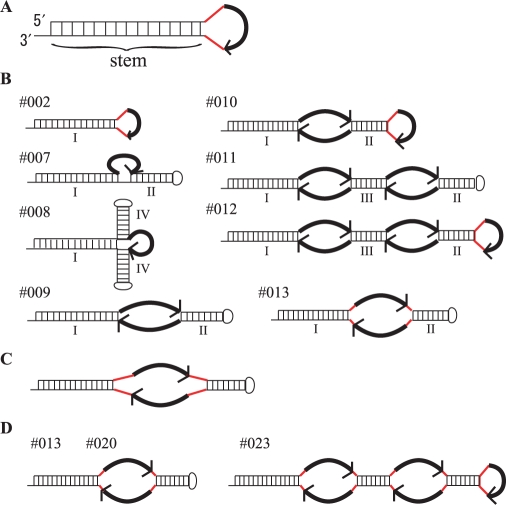
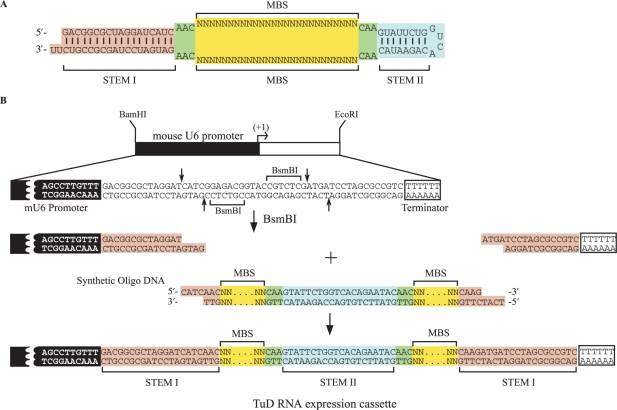
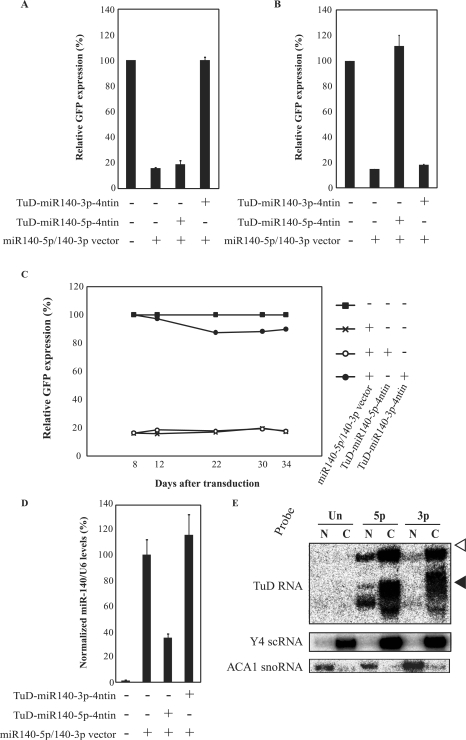
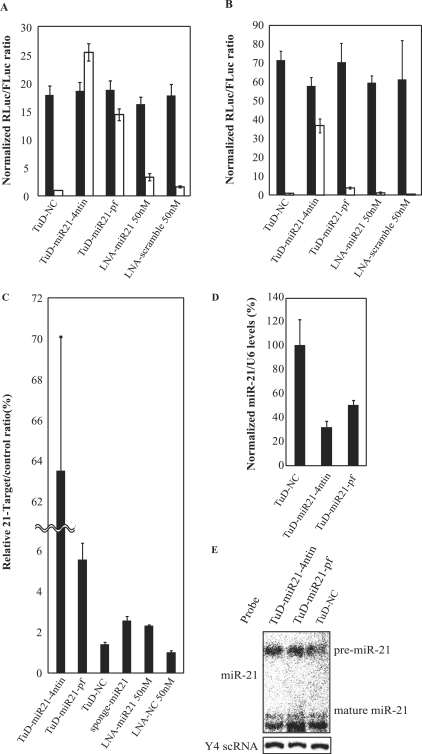
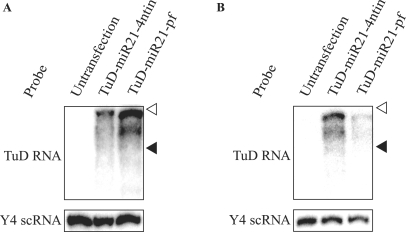
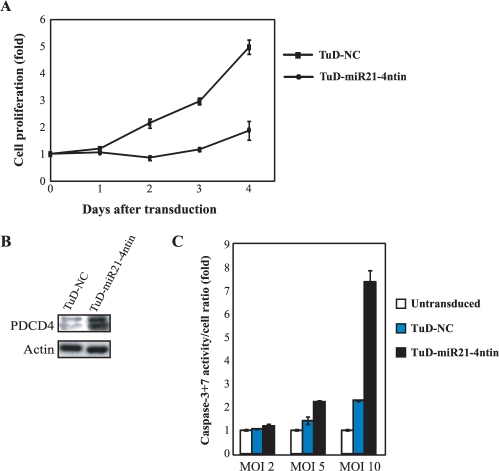
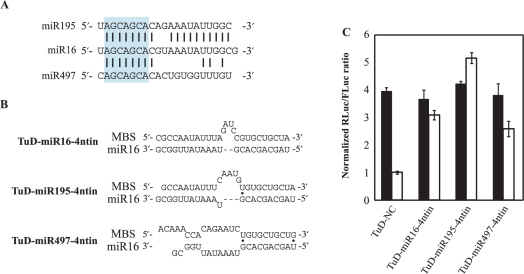
Verification
Claims the paper makes
The claims and statistics of this paper haven’t been checked yet.
Run the check — free, no account needed. It reads the open-access text and checks the sources it cites.
Claims other papers make about this one
Each is checked against this paper’s own text: does it say what the citing paper says it does?
The cited source says what the claim attributes to it.
In the citing paper
“The sponge construct are designed to bind its complementary miRNA(s) or their seed sequences, and hence block the binding of the miRNA to its biological targets (29–31).”
From Potential Therapeutic Effects of Exosomes Packed With a miR-21-Sponge Construct in a Rat Model of Glioblastoma (2019) · cites this paper as [31]
The cited source says what the claim attributes to it.
In the citing paper
“It has already been shown that miRNA inhibition using decoy or sponge-like constructs have a potential therapeutic benefit.”
From Potential Therapeutic Effects of Exosomes Packed With a miR-21-Sponge Construct in a Rat Model of Glioblastoma (2019) · cites this paper as [31]
The cited source says what the claim attributes to it.
In the citing paper
“Using decoy or sponge-like constructs for miRNA inhibition have been already shown before with good effect in binding to its complementary miRNA(s) or their seed sequences and blocking their effects (29–31, 56, 57).”
From Potential Therapeutic Effects of Exosomes Packed With a miR-21-Sponge Construct in a Rat Model of Glioblastoma (2019) · cites this paper as [31]
Self-check
Percentages, sums and reported differences re-computed from the paper’s own numbers.
The self-check needs the paper’s full text.
Citations
Cites
MicroRNA expression profiles classify human cancers
Lü, J., Getz, G. A., Miska, E. A., Alvarez-Saavedra, E., Lamb, J., Peck, D., Sweet-Cordero, A., Ebert, B. L., Mak, R. H., Ferrando, A. A., et al. (2005) · Nature · doi:10.1038/nature03702 · Cited by 9,637
MicroRNA genes are transcribed by RNA polymerase II
Lee, Y., Kim, M., Han, J., Yeom, K.-H., Lee, S., Baek, S. H., & Kim, V. N. (2004) · The EMBO Journal · doi:10.1038/sj.emboj.7600385 · Cited by 4,556
Silencing of microRNAs in vivo with ‘antagomirs’
Krützfeldt, J., Rajewsky, N., Braich, R., Rajeev, K. G., Tuschl, T., Manoharan, M., & Stoffel, M. (2005) · Nature · doi:10.1038/nature04303 · Cited by 3,949
A Mammalian microRNA Expression Atlas Based on Small RNA Library Sequencing
Landgraf, P., Rusu, M., Sheridan, R., Sewer, A., Iovino, N., Aravin, A., Pfeffer, S., Rice, A., Kamphorst, A. O., Landthaler, M., et al. (2007) · Cell · doi:10.1016/j.cell.2007.04.040 · Cited by 3,626
Nagai, T., Ibata, K., Park, E. S., Kubota, M., Mikoshiba, K., & Miyawaki, A. (2002) · Nature Biotechnology · doi:10.1038/nbt0102-87 · Cited by 2,769
MicroRNA-21 Is an Antiapoptotic Factor in Human Glioblastoma Cells
Chan, J. A., Krichevsky, A. M., & Kosik, K. S. (2005) · Cancer Research · doi:10.1158/0008-5472.can-05-0137 · Cited by 2,557
MicroRNA sponges: competitive inhibitors of small RNAs in mammalian cells
Ebert, M. S., Neilson, J. R., & Sharp, P. A. (2007) · Nature Methods · doi:10.1038/nmeth1079 · Cited by 2,108
Asangani, I. A., Rasheed, S. A. K., Nikolova, D. A., Leupold, J. H., Colburn, N. H., Post, S., & Allgayer, H. (2008) · Oncogene · doi:10.1038/sj.onc.1210856 · Cited by 1,882
miR-181a Is an Intrinsic Modulator of T Cell Sensitivity and Selection
Li, Q.-J., Chau, J., Ebert, P. J. R., Sylvester, G., Min, H., Liu, G., Braich, R. S., Manoharan, M., Soutschek, J., Skare, P., et al. (2007) · Cell · doi:10.1016/j.cell.2007.03.008 · Cited by 1,165
Frankel, L. B., Christoffersen, N. R., Jacobsen, A., Lindow, M., Krogh, A., & Lund, A. H. (2008) · Journal of Biological Chemistry · doi:10.1074/jbc.m707224200 · Cited by 1,141
Cited by
Sorted by citations
The multilayered complexity of ceRNA crosstalk and competition
Tay, Y., Rinn, J., & Pandolfi, P. P. (2014) · Nature · doi:10.1038/nature12986 · Cited by 3,910
Endogenous microRNA sponges: evidence and controversy
Thomson, D. W., & Dinger, M. E. (2016) · Nature Reviews Genetics · doi:10.1038/nrg.2016.20 · Cited by 2,185
Diversifying microRNA sequence and function
Ameres, S. L., & Zamore, P. D. (2013) · Nature Reviews Molecular Cell Biology · doi:10.1038/nrm3611 · Cited by 1,175
MicroRNA sponges: Progress and possibilities
Ebert, M. S., & Sharp, P. A. (2010) · RNA · doi:10.1261/rna.2414110 · Cited by 762
Experimental strategies for microRNA target identification
Thomson, D. W., Bracken, C. P., & Goodall, G. J. (2011) · Nucleic Acids Research · doi:10.1093/nar/gkr330 · Cited by 544
Metadata
- Authors
- Haraguchi, T., Ozaki, Y., & Iba, H.
- Affiliations
- Institute of Medical Science, The University of Tokyo (JP)
- Corresponding author
- Iba, Hideo
- ORCID
- Haraguchi, Takeshi
- Venue
- Nucleic Acids Research
- Publisher
- Oxford University Press (OUP)
- Published
- 2009-02-17
- Volume
- 37
- Issue
- 6
- Pages
- e43-e43
- ISSN
- 0305-1048 (ISSN-L)
- 1362-4962
- PMC
- PMC2665227
- OpenAlex
- W2128520557
- Cited by
- 305
- References
- 29
- Citations by year
- 2026: 6 · 2025: 8 · 2024: 15 · 2023: 6 · 2022: 14 · 2021: 10 · 2020: 20 · 2019: 18 · 2018: 21 · 2017: 27 · 2016: 29 · 2015: 24 · 2014: 33 · 2013: 23 · 2012: 23
- FWCI
- 5.59
- Type
- journal article
- Language
- en
- Open access
- gold
- doi.org
- Licence
- Locations
- Nucleic Acids Research (publishedVersion, cc-by-nc)
- PubMed Central (publishedVersion, cc-by-nc)
- PubMed (publishedVersion)
- Topics
- Life Sciences › Biochemistry, Genetics and Molecular Biology › Cancer Research › MicroRNA in disease regulation
- Life Sciences › Biochemistry, Genetics and Molecular Biology › Molecular Biology › RNA Interference and Gene Delivery
- Life Sciences › Biochemistry, Genetics and Molecular Biology › Cancer Research › Cancer-related molecular mechanisms research
- Keywords
- microRNA inhibition, RNA decoys, lentiviral vectors, RNA polymerase III transcription, mammalian cells
- MeSH terms
- Binding Sites, Cell Line, Genetic Vectors, Humans, Nucleic Acid Conformation, Transduction, Genetic, Lentivirus, Genes, Reporter, RNA, Untranslated, MicroRNAs
About these checks
Registry, retraction, Cites and statistics results are computed, not judged, with one exception: a printed reference that no index lists is read once by a model before it counts as a citation error. Claims are extracted by a model and kept only when their quote appears verbatim in the text; each cited source is then checked, with a model’s help, for whether it says what the claim relies on. Those verdicts can be wrong — read the claim’s quote and the cited source before relying on one.
Statistics and arithmetic are recomputed, not judged.
Confidence bands are shown only for fields calibrated on our annotated test set. None is calibrated yet, so no band is shown.
What counts as a claim ›How we measure confidence ›How we check this ›
Are you an author, or do you see a problem with this page? Request a review
