

ConsensusPathDB: toward a more complete picture of cell biology
Open accessThe DOI matches its Crossref record; 32 of the 32 references it cites were found in a registry or an index.
Abstract
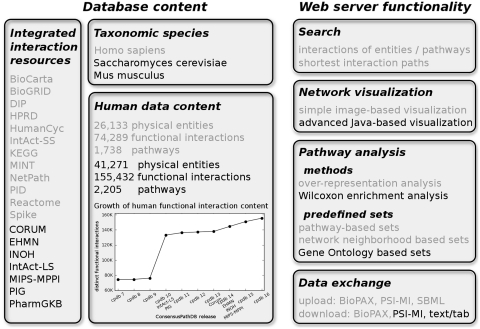
ConsensusPathDB is a meta-database that integrates different types of functional interactions from heterogeneous interaction data resources. Physical protein interactions, metabolic and signaling reactions and gene regulatory interactions are integrated in a seamless functional association network that simultaneously describes multiple functional aspects of genes, proteins, complexes, metabolites, etc. With 155,432 human, 194,480 yeast and 13,648 mouse complex functional interactions (originating from 18 databases on human and eight databases on yeast and mouse interactions each), ConsensusPathDB currently constitutes the most comprehensive publicly available interaction repository for these species. The Web interface at http://cpdb.molgen.mpg.de offers different ways of utilizing these integrated interaction data, in particular with tools for visualization, analysis and interpretation of high-throughput expression data in the light of functional interactions and biological pathways.
Overview
The claims and statistics of this paper haven’t been checked yet.
Free: it reads the open-access text and checks the first 5 claims that cite a source we can check. Create a free account to check every claim.
Integrity signals
Registry
Cites
Statistics
Figures
Verification
Claims the paper makes
The claims and statistics of this paper haven’t been checked yet.
Free: it reads the open-access text and checks the first 5 claims that cite a source we can check. Create a free account to check every claim.
Claims other papers make about this one
Each is checked against this paper’s own text: does it say what the citing paper says it does?
The check wasn’t confident either way, so it gives no verdict — never disputed.
In the citing paper
“Among the main gene ontology (GO) pathways [19, 20] showing altered in senescent cells, “chromatin organization,” “DNA repair,” “membrane trafficking,” and “activation of NF-kappaB” were notable for their known links to senescence and aging (Figure 1C) (Figure 1C) [1, 10, 21, 22].”
From Unmasking Transcriptional Heterogeneity in Senescent Cells (2017) · cites this paper as [20]
Experimental — accuracy not yet measured
Self-check
Percentages, sums and reported differences re-computed from the paper’s own numbers.
The self-check needs the paper’s full text.
Citations
Cites
Cytoscape: A software Environment for integrated models of biomolecular interaction networks
Shannon, P., Markiel, A., Ozier, O., Baliga, N. S., Wang, J. T., Ramage, D., Amin, N., Schwikowski, B., & Ideker, T. (2003) · Genome Research · doi:10.1101/gr.1239303 · Cited by 51,888
Hanahan, D., & Weinberg, R. A. (2000) · Cell · doi:10.1016/s0092-8674(00)81683-9 · Cited by 29,219
KEGG for representation and analysis of molecular networks involving diseases and drugs
Kanehisa, M., Goto, S., Furumichi, M., Tanabe, M., & Hirakawa, M. (2010) · Nucleic Acids Research · doi:10.1093/nar/gkp896 · Cited by 2,322 · cited 5×
“However, KEGG’s signaling pathways are stored in ConsensusPathDB in the form of gene lists for use in the context of gene expression analyses described below.”
InfluentialThe Database of Interacting Proteins: 2004 update
Salwinski, L. (2004) · Nucleic Acids Research · doi:10.1093/nar/gkh086 · Cited by 2,271
Rhodes, D. R., Kalyana-Sundaram, S., Mahavisno, V., Varambally, R., Yu, J., Briggs, B. B., Barrette, T. R., Anstet, M. J., Kincead-Beal, C., Kulkarni, P., et al. (2007) · Neoplasia · doi:10.1593/neo.07112 · Cited by 2,060
Loss of the Suv39h Histone Methyltransferases Impairs Mammalian Heterochromatin and Genome Stability
Peters, A. H. F. M., O'Carroll, D., Scherthan, H., Mechtler, K., Sauer, S., Schöfer, C., Weipoltshammer, K., Pagani, M., Lachner, M., Kohlmaier, A., et al. (2001) · Cell · doi:10.1016/s0092-8674(01)00542-6 · Cited by 1,766
Network‐based classification of breast cancer metastasis
Chuang, H., Lee, E., Liu, Y., Lee, D., & Ideker, T. (2007) · Molecular Systems Biology · doi:10.1038/msb4100180 · Cited by 1,431 · cited 1×
“To conclude, our results support previous findings (27) that utilizing functional interaction data can substantially improve expression data interpretation and can point to disease genes that do not come up on the gene expression analysis level alone.”
ResultCORUM: the comprehensive resource of mammalian protein complexes—2009
Ruepp, A., Waegele, B., Lechner, M., Brauner, B., Dunger-Kaltenbach, I., Fobo, G., Frishman, G., Montrone, C., & Mewes, H.-W. (2010) · Nucleic Acids Research · doi:10.1093/nar/gkp914 · Cited by 1,310
The Universal Protein Resource (UniProt) in 2010
The UniProt Consortium (2010) · Nucleic Acids Research · doi:10.1093/nar/gkp846 · Cited by 1,257
The BioGRID interaction database: 2013 update
Chatr-aryamontri, A., Breitkreutz, B.-J., Heinicke, S., Boucher, L., Winter, A., Stark, C., Nixon, J., Ramage, L., Kolas, N., O’Donnell, L., et al. (2012) · Nucleic Acids Research · doi:10.1093/nar/gks1158 · Cited by 1,017
Cited by
Items 101–200 of 683
Zhavoronkov, A. A., Buzdin, A. A., Garazha, A., Borisov, N., & Moskalev, A. (2014) · Frontiers in Genetics · doi:10.3389/fgene.2014.00049 · Cited by 57
“226 genes of 315 from our set were subjected to over-representation pathway analysis in (Kamburov et al., 2011).”
MethodYan, B., Chen, Q., Shimada, K., Tang, M., Li, H., Gurumurthy, A., Khoury, J. D., Xu, B., Huang, S., & Qiu, Y. (2018) · Leukemia · doi:10.1038/s41375-018-0279-6 · Cited by 60
Maynard, A., Bible, J. M., Pespeni, M. H., Sanford, E., & Evans, T. G. (2018) · Molecular Ecology · doi:10.1111/mec.14863 · Cited by 73
Rodrigues, D., de Souza, T. M., Coyle, L., Piazza, M., Herpers, B., Ferreira, S., Zhang, M., Vappiani, J., Sévin, D. C., Gábor, A., et al. (2021) · Archives of Toxicology · doi:10.1007/s00204-021-03092-2 · Cited by 61
“Subsequently, pathway overrepresentation analysis (ORA) was performed with Consensus Path Database (CPDB) (Kamburov et al.”
MethodInfluentialMukherjee, S., Kar, A., Khatun, N., Datta, P., Biswas, A., & Barik, S. (2021) · Cells · doi:10.3390/cells10081917 · Cited by 60
“integrating different types of functional interactions between individual cellular entities as well as pathway-based gene sets [23,24].”
BackgroundRöhr, C., Kerick, M., Fischer, A., Kühn, A., Kashofer, K., Timmermann, B., Daskalaki, A., Meinel, T., Drichel, D., Börno, S. T., et al. (2013) · PLoS ONE · doi:10.1371/journal.pone.0067461 · Cited by 55
Self-citationTranscriptomic responses generated by hepatocarcinogens in a battery of liver-based in vitro models
Doktorova, T. Y., Yildirimman, R., Vinken, M., Vilardell, M., Vanhaecke, T., Gmuender, H., Bort, R., Brolén, G., Holmgren, G., Li, R., et al. (2013) · Carcinogenesis · doi:10.1093/carcin/bgt054 · Cited by 57
“As pathway source, the ConsensusPathDB comprising of 2144 predefined human pathways was used (20).”
MethodSelf-citationLin, Y., Wu, P., Tsai, Y., Hsu, Y., Wang, H. Y., Kuo, M., Kuo, P., & Hwang, S. (2019) · Journal of Clinical Medicine · doi:10.3390/jcm8020191 · Cited by 67
“de) [35] and Ingenuity Pathway Analysis (IPA, QIAGEN Redwood City; www.”
BackgroundHenriques, A., Huebecker, M., Blasco, H., Keime, C., Andres, C. R., Corcia, P., Priestman, D. A., Platt, F. M., Spedding, M., & Loeffler, J.-P. (2017) · Scientific Reports · doi:10.1038/s41598-017-05313-0 · Cited by 53
Rodríguez, A., Mundy, N. I., Ibáñez, R., & Pröhl, H. (2020) · BMC Genomics · doi:10.1186/s12864-020-6719-5 · Cited by 54
“Additionally, to characterize the functional significance of the entire set of DE genes we performed a Gene Ontology (GO) term over-representation analysis of these genes using ConsensusPathDB-human [83].”
Methodvon Eichborn, J., Dunkel, M., Gohlke, B. O., Preissner, S. C., Hoffmann, M. F., Bauer, J. M. J., Armstrong, J. D., Schaefer, M. H., Andrade-Navarro, M. A., Le Novere, N., et al. (2012) · Nucleic Acids Research · doi:10.1093/nar/gks1040 · Cited by 52
“Automatic text mining and Web-resources [see (16) for a list] were used to generate a PPI network, which can be evaluated by a normalized quality scoring scheme (10).”
MethodCurry, E. W., Zeller, C., Masrour, N., Patten, D. K., Gallon, J., Wilhelm-Benartzi, C. S., Ghaem‐Maghami, S., Bowtell, D. D. L., & Brown, R. E. (2018) · Cancer Research · doi:10.1158/0008-5472.can-17-1650 · Cited by 55
“To suggest key pathways affected by the epigenetic change during chemotherapy and relapse, we computed the average change in promoter methylation and gene expression across all bivalently-marked genes in pathways from the Consensus Pathway Database (31), from primary to relapse samples.”
BackgroundWang, L.-J., Chen, C., Lee, Y., Ng, P., Chang, G., Pao, Y., Lo, H., Peng, C.-H., Cheong, M.-L. J., & Chen, H. (2022) · Nature Communications · doi:10.1038/s41467-022-29312-6 · Cited by 57
Genomic and Genetic Approaches to Deciphering Acute Respiratory Distress Syndrome Risk and Mortality
Lynn, H., Sun, X., Casanova, N. G., Gonzalez‐Garay, M. L., Bime, C., & Garcia, J. G. N. (2019) · Antioxidants and Redox Signaling · doi:10.1089/ars.2018.7701 · Cited by 52
“These studies were performed on the Max Planck Institute for Molecular Genetics consensus pathway database (CPDB) across three pathway sources with the most relevance (Reactome and Wikipathways) (Table 1) (88, 102, 103).”
MethodImmunologic Profiling of the Atlantic Salmon Gill by Single Nuclei Transcriptomics
West, A. C., Mizoro, Y., Wood, S. H., Ince, L. M., Iversen, M., Jørgensen, E. H., Nome, T., Sandve, S. R., Martín, S., Loudon, A. S. I., et al. (2021) · Frontiers in Immunology · doi:10.3389/fimmu.2021.669889 · Cited by 61
“Human genome nomenclature consortium (HGNC) identifiers were then used to infer gene ontology to Atlantic salmon genes cohorts using the Consensus Path Database over-representation analysis adjusted to a background list of all genes expressed in the analysis (39).”
MethodProteogenomic insights into the biology and treatment of pancreatic ductal adenocarcinoma
Tong, Y., Sun, M., Chen, L., Wang, Y., Yan, L., Li, L., Zhang, X., Cai, Y., Qie, J., Pang, Y., et al. (2022) · Journal of Hematology & Oncology · doi:10.1186/s13045-022-01384-3 · Cited by 57
Lin, K.-T., Shann, Y.-J., Chau, G.-Y., Hsu, C.-N., & Huang, C.-Y. F. (2013) · Oncogene · doi:10.1038/onc.2013.424 · Cited by 53
Bélteky, J., Agnvall, B., Bektic, L., Höglund, A., Jensen, P., & Guerrero‐Bosagna, C. (2018) · Genetics Selection Evolution · doi:10.1186/s12711-018-0384-z · Cited by 58
Transcriptomic landscape of blood platelets in healthy donors
Supernat, A. M., Popęda, M., Pastuszak, K., Best, M. G., Grešner, P., Veld, S. G. J. G. I. ‘., Siek, B., Bednarz‐Knoll, N., Rondina, M. T., Stokowy, T., et al. (2021) · Scientific Reports · doi:10.1038/s41598-021-94003-z · Cited by 62
Lulli, V., Buccarelli, M., Martini, M., Signore, M., Biffoni, M., Giannetti, S., Morgante, L., Marziali, G., Ilari, R., Pagliuca, A., et al. (2015) · Oncotarget · doi:10.18632/oncotarget.5925 · Cited by 52
“Also, when the downregulated transcripts were analyzed for pathway enrichment through the web-based ConsensusPathDB [31], transcripts belonging to the extracellular matrix set emerged as the category more enriched.”
Maguire, S. L., Peck, B., Wai, P. T., Campbell, J., Barker, H. E., Gulati, A., Daley, F. M., Vyse, S., Huang, P. H., Lord, C. J., et al. (2016) · The Journal of Pathology · doi:10.1002/path.4778 · Cited by 60
“Pathway enrichment was performed with ConsensusPathDB [50].”
A Mendelian Randomization Study of Metabolite Profiles, Fasting Glucose, and Type 2 Diabetes
Liu, J., van Klinken, J. B., Semiz, S., van Dijk, K. W., Verhoeven, A., Hankemeier, T., Harms, A. C., Sijbrands, E. J. G., Sheehan, N. A., van Duijn, C. M., et al. (2017) · Diabetes · doi:10.2337/db17-0199 · Cited by 56
“Next, for each gene we gathered protein-related knowledge from UniProtKB (31) and affected pathways from ConsensusPathDB (32).”
MethodHDAC5 catalytic activity suppresses cardiomyocyte oxidative stress and NRF2 target gene expression
Hu, T., Schreiter, F. C., Bagchi, R. A., Tatman, P. D., Hannink, M., & McKinsey, T. A. (2019) · Journal of Biological Chemistry · doi:10.1074/jbc.ra118.007006 · Cited by 54
“Pathway analysis was performed using GSEA and databases available through the MSig database via the Broad Institute and the ConsensusPathDB provided by the Max Planck Institute (37, 38).”
MethodAltered astrocytic function in experimental neuroinflammation and multiple sclerosis
das Neves, S. P., Sousa, J. C., Sousa, N., Cerqueira, J. J., & Marques, F. (2021) · Glia · doi:10.1002/glia.23940 · Cited by 49
ApoC-III is a novel inducer of calcification in human aortic valves
Schlotter, F., de Freitas, R. C. C., Rogers, M. A., Blaser, M. C., Wu, P.-J., Higashi, H., Halu, A., Iqbal, F., Andraski, A. B., Rodia, C. N., et al. (2021) · Journal of Biological Chemistry · doi:10.1074/jbc.ra120.015700 · Cited by 49
“The genes belonging to CAVD-related pathways were extracted from the ConsensusPathDB.”
MethodWang, Z., Zhao, Y., Phipps‐Green, A. J., Liu‐Bryan, R., Čeponis, A., Boyle, D. L., Wang, J., Merriman, T. R., Wang, W., & Terkeltaub, R. A. (2020) · Arthritis & Rheumatology · doi:10.1002/art.41173 · Cited by 53
Hauck, S. M., Hofmaier, F., Dietter, J., Swadzba, M. E., Blindert, M., Amann, B., Behler, J., Kremmer, E., Ueffing, M., & Deeg, C. A. (2012) · Journal of Proteomics · doi:10.1016/j.jprot.2012.04.052 · Cited by 49
Lee, W., Lee, H., Jang, H. B., Kim, H., Ban, H., Kim, K. Y., Nam, M. S., Choi, J. S., Lee, K., Cho, S. B., et al. (2018) · Scientific Reports · doi:10.1038/s41598-018-20549-0 · Cited by 49
Identifying Crohn’s disease signal from variome analysis
Wang, Y., Miller, M., Astrakhan, Y., Petersen, B., Schreiber, S., Franke, A., & Bromberg, Y. (2019) · Genome Medicine · doi:10.1186/s13073-019-0670-6 · Cited by 50
Vasilevich, A. S., Vermeulen, S., Kamphuis, M. M. J., Roumans, N. J. T., Eroumé, K. S., Hebels, D. G. A. J., van de Peppel, J., Reihs, R., Beijer, N. R. M., Carlier, A., et al. (2020) · Scientific Reports · doi:10.1038/s41598-020-76019-z · Cited by 52
Lopes, T. J. S., Schaefer, M. H., Shoemaker, J. E., Matsuoka, Y., Fontaine, J., Neumann, G., Andrade-Navarro, M. A., Kawaoka, Y., & Kitano, H. (2011) · Bioinformatics · doi:10.1093/bioinformatics/btr414 · Cited by 53
“Pathway and Gene Ontology enrichment analysis were performed with DAVID (Huang et al., 2008) and ConsensusPath DB (Kamburov et al., 2011) using the default parameters values.”
Zhou, H., Jin, J., Zhang, H., Yi, B., Woźniak, M., & Wong, L. (2012) · BMC Systems Biology · doi:10.1186/1752-0509-6-s2-s2 · Cited by 55
“For example, ConsensusPathDB [13] integrates different types of functional interactions from heterogeneous interaction data resources and pathway databases for three organisms(human, yeast and mouse).”
BackgroundInfluentialDiesch, J., Bywater, M. J., Sanij, E., Cameron, D. P., Schierding, W. S., Brajanovski, N., Son, J., Sornkom, J., Hein, N., Evers, M., et al. (2019) · Communications Biology · doi:10.1038/s42003-019-0284-y · Cited by 56
Genome-wide genetic links between amyotrophic lateral sclerosis and autoimmune diseases
Li, C. Y., Yang, T. M., Ou, R. W., Wei, Q. Q., & Shang, H. F. (2021) · BMC Medicine · doi:10.1186/s12916-021-01903-y · Cited by 48
“sociated with ALS and autoimmune disorders, we used ConsensusPathDB [39] for functional interaction ana-”
MethodInfluentialDysregulation of cancer genes by recurrent intergenic fusions
Yun, J. W., Yang, L., Park, H.-Y., Lee, C., Cha, H., Shin, H., Noh, K., Choi, Y., Park, W., & Park, P. J. (2020) · Genome biology · doi:10.1186/s13059-020-02076-2 · Cited by 53
“For the 444 genes with a q value < 0.05 (|r| > 0.627, Pearson correlation), an overrepresentation analysis (ORA) based on Fisher’s exact test was performed using ConsensusPathDB (http://consensuspathdb.org/), which contained curated interaction networks from genetic, metabolic, gene regulatory, and other interactions…”
BackgroundMethodInfluentialExplainable Multilayer Graph Neural Network for cancer gene prediction
Chatzianastasis, M., Vazirgiannis, M., & Zhang, Z. (2023) · Bioinformatics · doi:10.1093/bioinformatics/btad643 · Cited by 61
“Interactions with a score higher than 0.5 in CPDB and 0.85 in STRING-db were included.”
MethodInfluentialGoldberg, L., Tirosh‐Wagner, T., Vardi, A., Abbas, H., Pillar, N., Shomron, N., Nevo‐Caspi, Y., & Paret, G. (2018) · Journal of Cardiovascular Translational Research · doi:10.1007/s12265-018-9814-0 · Cited by 49
“database [20] and plotted using the ggplot2 package (H.”
MethodIntegrated molecular drivers coordinate biological and clinical states in melanoma
Conway, J. R., Dietlein, F., Taylor-Weiner, A. N., AlDubayan, S. H., Vokes, N. I., Keenan, T. E., Reardon, B. M., He, M. X., Margolis, C. A., Weirather, J. L., et al. (2020) · Nature Genetics · doi:10.1038/s41588-020-00739-1 · Cited by 45
IntScore: a web tool for confidence scoring of biological interactions
Kamburov, A., Stelzl, U., & Herwig, R. (2012) · Nucleic Acids Research · doi:10.1093/nar/gks492 · Cited by 54
“The key difference to the GO semantic similarity measure is that the pathway annotation basis is ConsensusPathDB (instead of GO), which currently contains 3281 curated pathways from 12 public pathway databases.”
MethodInfluentialSelf-citationLi, R., Yin, Y., Ji, X.-L., Liu, X., Li, J., & Qu, Y.-Q. (2021) · Frontiers in Molecular Biosciences · doi:10.3389/fmolb.2021.644620 · Cited by 51
PTEN deficiency promotes pathological vascular remodeling of human coronary arteries
Moulton, K. S., Li, M., Strand, K. A., Burgett, S., McClatchey, P., Tucker, R. M., Furgeson, S. B., Lu, S., Kirkpatrick, B. E., Cleveland, J. C., et al. (2018) · JCI Insight · doi:10.1172/jci.insight.97228 · Cited by 49
Verheijen, M. C. T., Schrooders, Y., Gmuender, H., Nudischer, R., Clayton, O., Hynes, J., Niederer, S., Cordes, H., Kuepfer, L., Kleinjans, J. C. S., et al. (2018) · Toxicology Letters · doi:10.1016/j.toxlet.2018.05.029 · Cited by 46
“6 Biological interpretation For each dose and time point, lists of DEGs (depleted of ribosomal genes) were used as input for pathway over-representation analysis (ORA) using CPDB release 32 [27].”
MethodBuffalo milk transcriptome: A comparative analysis of early, mid and late lactation
Arora, R., Sharma, A., Sharma, U., Girdhar, Y., Kaur, M., Kapoor, P., Ahlawat, S., & Vijh, R. K. (2019) · Scientific Reports · doi:10.1038/s41598-019-42513-2 · Cited by 49
Copy Number Variants in Short Children Born Small for Gestational Age
Wit, J. M., van Duyvenvoorde, H. A., van Klinken, J. B., Caliebe, J., Bosch, C. A. J., Lui, J. C. K., Gijsbers, A. C. J., Bakker, E., Breuning, M. H., Oostdijk, W., et al. (2014) · Hormone Research in Paediatrics · doi:10.1159/000367712 · Cited by 45
Blunder, S., Kõks, S., Kõks, G., Reimann, E., Hackl, H., Gruber, R. W., Moosbrugger‐Martinz, V., Schmuth, M., & Dubrac, S. (2017) · Journal of Investigative Dermatology · doi:10.1016/j.jid.2017.08.036 · Cited by 45
“GO and pathways analyses were performed using the tool DAVID (Huang da et al., 2009) and ConsensusPathDB (Kamburov et al., 2011).”
MethodEdematous severe acute malnutrition is characterized by hypomethylation of DNA
Schulze, K., Swaminathan, S., Howell, S., Jajoo, A., Lie, N. C., Brown, O., Sadat, R., Hall, N. J., Zhao, L., Marshall, K., et al. (2019) · Nature Communications · doi:10.1038/s41467-019-13433-6 · Cited by 48
Ma, F., Zhang, S., Song, L., Wang, B., Wei, L., & Zhang, F. (2021) · Cell & Bioscience · doi:10.1186/s13578-021-00635-z · Cited by 51
Moreno‐Navarrete, J. M., Jové, M., Ortega, F. J., Xifra, G., Ricart, W., Òbis, È., Pamplona, R., Portero‐Otín, M., & Fernández‐Real, J. M. (2016) · Diabetologia · doi:10.1007/s00125-016-3863-1 · Cited by 48
The Vitamin D Receptor Regulates Glycerolipid and Phospholipid Metabolism in Human Hepatocytes
Martínez-Sena, T., Soluyanova, P., Guzmán, C., Valdivielso, J. M., Castell, J. V., & Jover, R. (2020) · Biomolecules · doi:10.3390/biom10030493 · Cited by 45
“Analysis of the 298 VitD-regulated genes in terms of functional annotation and gene ontology enrichment (ConsensusPathDB [18]) revealed 106 enriched gene ontology-based sets (over-representation in levels 4 and 5 of the category of Biological Processes, p < 0.”
BackgroundGenetic underpinning of the comorbidity between type 2 diabetes and osteoarthritis
Arruda, A. L., Hartley, A. E., Katsoula, G., Smith, G. D., Morris, A. P., & Zeggini, E. (2023) · The American Journal of Human Genetics · doi:10.1016/j.ajhg.2023.06.010 · Cited by 52
“gene set by testing their enrichment among curated networks in humans.(28) We used the networks from Reactome,(29) KEGG,(30) WikiPathways(31) and Gene Ontology.”
MethodSimultaneous Quantification of the Acetylome and Succinylome by ‘One‐Pot’ Affinity Enrichment
Basisty, N., Meyer, J. G., Wei, L., Gibson, B. W., & Schilling, B. (2018) · PROTEOMICS · doi:10.1002/pmic.201800123 · Cited by 41
Gao, C., Zhuang, J., Li, H., Liu, C., Zhou, C., Liu, L., & Sun, C. (2018) · Cancer Cell International · doi:10.1186/s12935-018-0691-z · Cited by 41
Shani, O., Raz, Y., Monteran, L., Scharff, Y., Levi-Galibov, O., Megides, O., Shacham, H., Cohen, N., Silverbush, D., Avivi, C., et al. (2021) · eLife · doi:10.7554/elife.60745 · Cited by 44
hiPathDB: a human-integrated pathway database with facile visualization
Yu, N., Seo, J.-W., Rho, K., Jang, Y., Park, J., Kim, W., & Lee, S. (2011) · Nucleic Acids Research · doi:10.1093/nar/gkr1127 · Cited by 44
“Currently, ConsensusPathDB (CPDB) is the only pathway database in this category, but their graphical interface is too complicated for facile interpretation (15).”
BackgroundMeta-analysis of Positive and Negative Symptoms Reveals Schizophrenia Modifier Genes: Table 1.
Edwards, A. C., Bigdeli, T. B., Docherty, A. R., Bacanu, S., Lee, D., de Candia, T. R., Moscati, A., Thiselton, D. L., Maher, B. S., Wormley, B., et al. (2015) · Schizophrenia Bulletin · doi:10.1093/schbul/sbv119 · Cited by 45
Kin, K., Maziarz, J. D., Chavan, A. R., Kamat, M., Vasudevan, S., Birt, A., Emera, D., Lynch, V. J., OTT, T. L., Pavličev, M., et al. (2016) · Genome Biology and Evolution · doi:10.1093/gbe/evw168 · Cited by 41
“6B and supplementary table S3, Supplementary Material online).”
BackgroundXu, W., Han, S., Zhang, C. M., Li, J., Wang, Y., Tan, C., Li, H.-Q., Dong, Q., Mei, C., Tan, L., et al. (2020) · Science Advances · doi:10.1126/sciadv.abb3063 · Cited by 42
Seifert, M., Abou‐El‐Ardat, K., Friedrich, B., Klink, B., & Deutsch, A. (2014) · PLoS ONE · doi:10.1371/journal.pone.0100295 · Cited by 59
“sponding pathway genes based on ConsensusPathDB [54].”
BackgroundKuperstein, I., Grieco, L., Cohen, D., Thieffry, D., Zinovyev, A. Y., & Barillot, E. (2015) · Mutagenesis · doi:10.1093/mutage/geu078 · Cited by 42
“This made popular the pathway resources that collect computationally or predicted by text mining molecular and functional interactions such as STRING (13), BioGRID (14), HumanNet (15) or compilations of many databases together, such as PathwayCommons (16) or ConsensusPathDB (17).”
BackgroundDNA methylation signatures of Prostate Cancer in peripheral T-cells
Mehdi, A., Cheishvili, D., Arakelian, A., Bismar, T. A., Szyf, M., & Rabbani, S. A. (2020) · BMC Cancer · doi:10.1186/s12885-020-07078-8 · Cited by 39
Genome-wide analysis revealed sex-specific gene expression in asthmatics
Gautam, Y., Afanador, Y., Abebe, T., López, J. E., & Baye, T. M. (2019) · Human Molecular Genetics · doi:10.1093/hmg/ddz074 · Cited by 45
“In an effort to understand potential mechanisms driving sex differences in asthma, we compared the enriched KEGG pathways and gene ontology (GO) terms using the Consensus Path DB (36) in males and females.”
MethodThe transcriptional repressor BCL11A promotes breast cancer metastasis
Seachrist, D. D., Hannigan, M. M., Ingles, N. N., Webb, B. M., Weber-Bonk, K. L., Yu, P., Bebek, G., Singh, S., Sizemore, S. T., Varadan, V., et al. (2020) · Journal of Biological Chemistry · doi:10.1074/jbc.ra120.014018 · Cited by 45
“Pathway analysis was performed using the ConsensusPathDb database (69, 70) using overrepresentation analysis and all expressed genes in the MDA-MB-231 cell line as a background list.”
MethodWang, Y., Luo, R., Zhang, X., Xiang, H., Yang, B., Feng, J., Deng, M., Ran, P., Sujie, A., Zhang, F., et al. (2023) · Nature Communications · doi:10.1038/s41467-023-36005-1 · Cited by 49
“However, as proteomic data re fl ect cell functions more directly, we employed a consensus clustering 44 based on proteins expression ranks in the tumor samples, and identi fi ed three subgroups among the 187 glioma tumors (Fig.”
RetractedGomes, P., Bodo, C., Nogueras‐Ortiz, C. J., Samiotaki, M. K., Chen, M., Soares‐Cunha, C., Silva, J. M., Coimbra, B., Stamatakis, G. M., Santos, L. D. S., et al. (2023) · Cell Communication and Signaling · doi:10.1186/s12964-023-01045-z · Cited by 41
“Finally, we used ConsensusPathDB [22, 23] and DAVID [24, 25] to detect significant cellular component GO categories for the abundant proteins found previously.”
MethodRole of autophagy in the maintenance and function of cancer stem cells
Vitale, I., Manic, G., Dandrea, V., & Maria, R. D. (2015) · The International Journal of Developmental Biology · doi:10.1387/ijdb.150082iv · Cited by 40
Georgiadis, P., Hebels, D. G. A. J., Valavanis, I. K., Liampa, I., Bergdahl, I. A., Johansson, A., Palli, D., Chadeau‐Hyam, M., Chatziioannou, A. A., Jennen, D. G. J., et al. (2016) · Scientific Reports · doi:10.1038/srep20544 · Cited by 41
The genetics of congenitally small brains
Duerinckx, S., & Abramowicz, M. (2017) · Seminars in Cell and Developmental Biology · doi:10.1016/j.semcdb.2017.09.015 · Cited by 42
Carter, C. J. (2013) · Pathogens and Disease · doi:10.1111/2049-632x.12077 · Cited by 38
“A P-value is calculated according to the hypergeometric test based on the number of physical entities present in both the predefined set (total number of genes in each pathway) and the list of interactome genes (Kamburov et al., 2011).”
MethodHamdeh, S. A., Ciuculete, D. M., Sarkisyan, D., Bakalkin, G. Y., Ingelsson, M., Schiöth, H. B., & Marklund, N. (2020) · Journal of Neurotrauma · doi:10.1089/neu.2020.7283 · Cited by 37
“34 The analysis was run under the default settings and a q value 0.05 was considered significant.”
InfluentialMachine learning methods for prediction of cancer driver genes: a survey paper
de Andrades, R. S., & Recamonde‐Mendoza, M. (2022) · Briefings in Bioinformatics · doi:10.1093/bib/bbac062 · Cited by 47
Raimondi, D., Gazzo, A. M., Rooman, M. J., Lenaerts, T., & Vranken, W. (2016) · Bioinformatics · doi:10.1093/bioinformatics/btw094 · Cited by 38
Nuclear and Mitochondrial DNA Methylation Patterns Induced by Valproic Acid in Human Hepatocytes
Wolters, J. E. J., van Breda, S. G., Caiment, F., Claessen, S. M. H., de Kok, T. M. C. M., & Kleinjans, J. C. S. (2017) · Chemical Research in Toxicology · doi:10.1021/acs.chemrestox.7b00171 · Cited by 40
“35 ConsensusPathDB 36 was used to identify and visualize the involvement of the unique genes in biological processes that may be a ff ected on the level of pathways by selecting signi fi cant pathways with a p -value 0.01 from a gene enrichment analysis.”
InfluentialDicer, a new regulator of pluripotency exit and LINE ‐1 elements in mouse embryonic stem cells
Bodak, M., Cirera‐Salinas, D., Yu, J., Ngondo, R. P., & Ciaudo, C. (2017) · FEBS Open Bio · doi:10.1002/2211-5463.12174 · Cited by 41
Making sense of genomes of parasitic worms: Tackling bioinformatic challenges
Korhonen, P. K., Young, N. D., & Gasser, R. B. (2016) · Biotechnology Advances · doi:10.1016/j.biotechadv.2016.03.001 · Cited by 39
Graph Convolutional Networks Improve the Prediction of Cancer Driver Genes
Schulte-Sasse, R., Budach, S., Hnisz, D., & Marsico, A. (2019) · Lecture notes in computer science · doi:10.1007/978-3-030-30493-5_60 · Cited by 41
Teruel, M., Barturen, G., Martínez‐Bueno, M., Castellini-Pérez, O., Barroso‐Gil, M., Povedano, E., Kerick, M., Català‐Moll, F., Makowska, Z., Buttgereit, A., et al. (2021) · Scientific Reports · doi:10.1038/s41598-021-01324-0 · Cited by 40
Tang, X., Urvalek, A. M., Osei-Sarfo, K., Zhang, T., Scognamiglio, T., & Gudas, L. J. (2015) · Oncotarget · doi:10.18632/oncotarget.4420 · Cited by 35
“We then conducted a gene ontology (GO) enrichment analysis on a web GO analysis tool ConsensusPathDB [12] using level 3 of the “Biological Process” domain (p 0.00001).”
InfluentialProteogenomics of clear cell renal cell carcinoma response to tyrosine kinase inhibitor
Zhang, H., Bai, L., Wu, X., Tian, X., Feng, J., Wu, X., Shi, G., Pei, X., Lyu, J., Yang, G., et al. (2023) · Nature Communications · doi:10.1038/s41467-023-39981-6 · Cited by 40
“The DEPs were then subjected to overrepresentationanalysisinConsensusPathDB(http://cpdb.molgen. mpg.de/) 64 .”
Welinder, C., Pawłowski, K., Szász, A. M., Yakovleva, M., Sugihara, Y., Malm, J., Jönsson, G. B., Ingvar, C., Lundgren, L., Baldetorp, B., et al. (2017) · PLoS ONE · doi:10.1371/journal.pone.0176167 · Cited by 39
Arora, R., Naveen Kumar, S., Sudarshan, S., Fairoze, M. N., Kaur, M., Sharma, A., Girdhar, Y., Sreesujatha, R. M., Devatkal, S. K., Ahlawat, S., et al. (2019) · PLoS ONE · doi:10.1371/journal.pone.0217461 · Cited by 46
Gul, N., Karlsson, J. W., Tängemo, C., Linsefors, S., Tuyizere, S., Perkins, R., Ala, C., Zou, Z. V., Larsson, E., Bergö, M. O., et al. (2019) · Scientific Reports · doi:10.1038/s41598-019-51205-w · Cited by 35
Molecular mechanisms of hepatotoxic cholestasis by clavulanic acid: Role of NRF2 and FXR pathways
Petrov, P., Soluyanova, P., Sánchez‐Campos, S., Castell, J. V., & Jover, R. (2021) · Food and Chemical Toxicology · doi:10.1016/j.fct.2021.112664 · Cited by 42
Practical aspects of genome-wide association interaction analysis
Gusareva, E. S., & Steen, K. V. (2014) · Human Genetics · doi:10.1007/s00439-014-1480-y · Cited by 39
“…of a large cross-organism compendium of functional predictions and networks are Cytoscape (Shannon et al. 2003), CPDB (ConsensusPathDB-human) (Kamburov et al. 2009, 2011, 2013; Pentchev et al. 2010), GeneMANIA (Warde-Farley et al. 2010), BioGraph (Liekens et al. 2011), Integrative…”
BackgroundEbola virus encodes a miR-155 analog to regulate importin-α5 expression
Liu, Y., Sun, J., Zhang, H., Wang, M., Gao, G. F., & Li, X. (2016) · Cellular and Molecular Life Sciences · doi:10.1007/s00018-016-2215-0 · Cited by 36
Toll-Like Receptor 3 Mediates Aortic Stenosis Through a Conserved Mechanism of Calcification
Gollmann‐Tepeköylü, C., Graber, M., Hirsch, J., Mair, S., Naschberger, A., Pölzl, L., Nägele, F., Kirchmair, E., Degenhart, G., Demetz, E., et al. (2023) · Circulation · doi:10.1161/circulationaha.122.063481 · Cited by 38
Winckelmans, E., Vrijens, K., Tsamou, M., Janssen, B. G., Saenen, N. D., Roels, H. A., Kleinjans, J. C. S., Lefebvre, W., Vanpoucke, C., de Kok, T. M. C. M., et al. (2017) · Environmental Health · doi:10.1186/s12940-017-0264-y · Cited by 34
“org/) [31] of the Max Planck Institute for Molecular Genetics, to identify pathways associated with PM2.”
BackgroundConstructing a robust protein-protein interaction network by integrating multiple public databases
Martha, V. S., Liu, Z., Guo, L., Su, Z., Ye, Y., Fang, H., Ding, D., Tong, W., & Xu, X. (2011) · BMC Bioinformatics · doi:10.1186/1471-2105-12-s10-s7 · Cited by 36
“However, most research focuses on constructing and evaluating PPI networks based on a single source of PPI data or by using simple unions of multiple PPI databases [3,4].”
BackgroundDipali, S. S., King, C. D., Rose, J., Burdette, J. E., Campisi, J., Schilling, B., & Duncan, F. E. (2023) · Aging · doi:10.18632/aging.205190 · Cited by 53
“An over-representation analysis (ORA) was performed using Consensus Path DB-mouse (Release MM11, 14.10.2021), developed by the bioinformatics group at the Max Planck Institute for Molecular Genetics (Berlin, Germany) [91, 92].”
MethodInfluentialMesquita, D., Barros-Silva, J. D., Santos, J., Skotheim, R. I., Lothe, R. A., Paulo, P., & Teixeira, M. R. (2015) · Oncotarget · doi:10.18632/oncotarget.2847 · Cited by 38
Genes2FANs: connecting genes through functional association networks
Dannenfelser, R., Clark, N. R., & Ma’ayan, A. (2012) · BMC Bioinformatics · doi:10.1186/1471-2105-13-156 · Cited by 32
“; licensee BioMed C Creative Commons Attribution License (http:/ distribution, and reproduction in any medium analyzed using software tools and databases that map genes to known pathways or construct subnetworks that connect input lists of genes using known protein-protein or other types of molecular interactions [1-1…”
MethodEgoNet: identification of human disease ego-network modules
Yang, R., Bai, Y., Qin, Z. S., & Yu, T. (2014) · BMC Genomics · doi:10.1186/1471-2164-15-314 · Cited by 40
“The ego-network model has been used for network module over-representation analysis in ConsensusPathDB [24].”
MethodPerez, M., Jaundoo, R., Hilton, K., Alamo, A. D., Gemayel, K. T., Klimas, N. G., Craddock, T. J. A., & Nathanson, L. (2019) · Frontiers in Pediatrics · doi:10.3389/fped.2019.00206 · Cited by 39
Dey, K. K., Gazal, S., van de Geijn, B., Kim, S. S., Nasser, J., Engreitz, J., & Price, A. L. (2022) · Cell Genomics · doi:10.1016/j.xgen.2022.100145 · Cited by 39
The 2021 update of the EPA’s adverse outcome pathway database
Mortensen, H. M., Senn, J., Levey, T., Langley, P., & Williams, A. J. (2021) · Scientific Data · doi:10.1038/s41597-021-00962-3 · Cited by 36
Chakraborty, C., George, C., Chen, L., & Zhu, H. (2014) · Current Protein and Peptide Science · doi:10.2174/1389203715666140724090153 · Cited by 34
Multiple haplotype-resolved genomes reveal population patterns of gene and protein diplotypes
Hoehe, M. R., Church, G. M., Lehrach, H., Kroslak, T., Palczewski, S., Nowick, K., Schulz, S., Suk, E.-K., & Huebsch, T. (2014) · Nature Communications · doi:10.1038/ncomms6569 · Cited by 30
Self-citationPurhonen, J., Rajendran, J., Mörgelin, M., Uusi-Rauva, K., Katayama, S., Krjutškov, K., Einarsdóttir, E., Velagapudi, V., Kere, J., Jauhiainen, M., et al. (2017) · Scientific Reports · doi:10.1038/s41598-017-01109-4 · Cited by 36
Ng, H.-I., Tuong, Z. K., Fernando, G. J. P., Depelsenaire, A. C. I., Meliga, S. C., Frazer, I. H., & Kendall, M. A. F. (2019) · npj Vaccines · doi:10.1038/s41541-019-0134-4 · Cited by 31
Gong, C., Tsoi, H., Mok, K. C., Cheung, J. T. K., Man, E. P. S., Fujino, K., Wong, A., Lam, E. W. ‐., & Khoo, U. (2020) · Oncogene · doi:10.1038/s41388-020-1210-y · Cited by 34
Breda, S. G. J. V., Mathijs, K., Pieters, H., Sági‐Kiss, V., Kuhnle, G., Georgiadis, P., Saccani, G., Parolari, G., Virgili, R., Sinha, R. R., et al. (2021) · Molecular Nutrition & Food Research · doi:10.1002/mnfr.202001214 · Cited by 31
Metadata
- Authors
- Kamburov, A., Pentchev, K., Galicka, H., Wierling, C., Lehrach, H., & Herwig, R.
- Affiliations
- Max Planck Society (DE)
- Max Planck Institute for Molecular Genetics (DE)
- Corresponding author
- Kamburov, Atanas
- Venue
- Nucleic Acids Research
- Publisher
- Oxford University Press (OUP)
- Published
- 2010-11-11
- Volume
- 39
- Issue
- suppl_1
- Pages
- D712-D717
- ISSN
- 0305-1048 (ISSN-L)
- 1362-4962
- PMC
- PMC3013724
- OpenAlex
- W2017138237
- Cited by
- 671
- References
- 32
- Citations by year
- 2026: 21 · 2025: 36 · 2024: 36 · 2023: 42 · 2022: 79 · 2021: 69 · 2020: 58 · 2019: 55 · 2018: 62 · 2017: 44 · 2016: 43 · 2015: 45 · 2014: 23 · 2013: 28 · 2012: 18
- FWCI
- 7.42
- Type
- journal article
- Language
- en
- Open access
- gold
- doi.org
- Licence
- Locations
- Nucleic Acids Research (publishedVersion, cc-by-nc)
- PubMed Central (publishedVersion, cc-by-nc)
- PubMed (publishedVersion)
- MPG.PuRe (Max Planck Society) (submittedVersion, other-oa)
- Max Planck Institute for Plasma Physics (submittedVersion)
- Funders
- European Commission (200767)
- Max-Planck-Gesellschaft
- International Max Planck Research School for Advanced Methods in Process and Systems Engineering
- Topics
- Life Sciences › Biochemistry, Genetics and Molecular Biology › Molecular Biology › Bioinformatics and Genomic Networks
- Health Sciences › Medicine › Health Informatics › Biomedical Text Mining and Ontologies
- Life Sciences › Biochemistry, Genetics and Molecular Biology › Molecular Biology › Gene Regulatory Network Analysis
- Keywords
- functional interaction networks, protein-protein interaction, metabolic interactions, gene regulatory interactions, protein complexes, metabolites, metadata database, pathway analysis
- MeSH terms
- Animals, Humans, User-Computer Interface, Signal Transduction, Gene Expression, Databases, Factual, Internet, Protein Interaction Mapping, Databases, Genetic, Mice, Gene Regulatory Networks, Metabolic Networks and Pathways
About these checks
Registry, retraction, Cites and statistics results are computed, not judged, with one exception: a printed reference that no index lists is read once by a model before it counts as a citation error. Claims are extracted by a model and kept only when their quote appears verbatim in the text; each cited source is then checked, with a model’s help, for whether it says what the claim relies on. Those verdicts can be wrong — read the claim’s quote and the cited source before relying on one.
Statistics and arithmetic are recomputed, not judged.
Confidence bands are shown only for fields calibrated on our annotated test set. None is calibrated yet, so no band is shown.
What counts as a claim ›How we measure confidence ›How we check this ›
Are you an author, or do you see a problem with this page? Request a review
Data sources
Bibliographic data: Semantic Scholar, OpenAlex, Crossref.
Contains information from the Semantic Scholar Academic Graph Datasets, made available under the ODC Attribution License (ODC-BY 1.0).
Semantic Scholar’s data is described in: Kinney, R., et al. (2023). The Semantic Scholar Open Data Platform. arXiv:2301.10140.
