

ConsensusPathDB: toward a more complete picture of cell biology
Open accessThe DOI matches its Crossref record; 32 of the 32 references it cites were found in a registry or an index.
Abstract
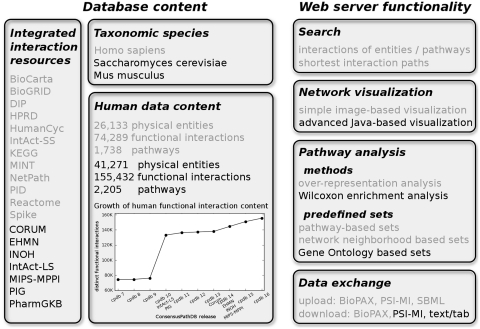
ConsensusPathDB is a meta-database that integrates different types of functional interactions from heterogeneous interaction data resources. Physical protein interactions, metabolic and signaling reactions and gene regulatory interactions are integrated in a seamless functional association network that simultaneously describes multiple functional aspects of genes, proteins, complexes, metabolites, etc. With 155,432 human, 194,480 yeast and 13,648 mouse complex functional interactions (originating from 18 databases on human and eight databases on yeast and mouse interactions each), ConsensusPathDB currently constitutes the most comprehensive publicly available interaction repository for these species. The Web interface at http://cpdb.molgen.mpg.de offers different ways of utilizing these integrated interaction data, in particular with tools for visualization, analysis and interpretation of high-throughput expression data in the light of functional interactions and biological pathways.
Overview
The claims and statistics of this paper haven’t been checked yet.
Free: it reads the open-access text and checks the first 5 claims that cite a source we can check. Create a free account to check every claim.
Integrity signals
Registry
Cites
Statistics
Figures
Verification
Claims the paper makes
The claims and statistics of this paper haven’t been checked yet.
Free: it reads the open-access text and checks the first 5 claims that cite a source we can check. Create a free account to check every claim.
Claims other papers make about this one
Each is checked against this paper’s own text: does it say what the citing paper says it does?
The check wasn’t confident either way, so it gives no verdict — never disputed.
In the citing paper
“Among the main gene ontology (GO) pathways [19, 20] showing altered in senescent cells, “chromatin organization,” “DNA repair,” “membrane trafficking,” and “activation of NF-kappaB” were notable for their known links to senescence and aging (Figure 1C) (Figure 1C) [1, 10, 21, 22].”
From Unmasking Transcriptional Heterogeneity in Senescent Cells (2017) · cites this paper as [20]
Experimental — accuracy not yet measured
Self-check
Percentages, sums and reported differences re-computed from the paper’s own numbers.
The self-check needs the paper’s full text.
Citations
Cites
Cytoscape: A software Environment for integrated models of biomolecular interaction networks
Shannon, P., Markiel, A., Ozier, O., Baliga, N. S., Wang, J. T., Ramage, D., Amin, N., Schwikowski, B., & Ideker, T. (2003) · Genome Research · doi:10.1101/gr.1239303 · Cited by 51,888
Hanahan, D., & Weinberg, R. A. (2000) · Cell · doi:10.1016/s0092-8674(00)81683-9 · Cited by 29,219
KEGG for representation and analysis of molecular networks involving diseases and drugs
Kanehisa, M., Goto, S., Furumichi, M., Tanabe, M., & Hirakawa, M. (2010) · Nucleic Acids Research · doi:10.1093/nar/gkp896 · Cited by 2,322 · cited 5×
“However, KEGG’s signaling pathways are stored in ConsensusPathDB in the form of gene lists for use in the context of gene expression analyses described below.”
InfluentialThe Database of Interacting Proteins: 2004 update
Salwinski, L. (2004) · Nucleic Acids Research · doi:10.1093/nar/gkh086 · Cited by 2,271
Rhodes, D. R., Kalyana-Sundaram, S., Mahavisno, V., Varambally, R., Yu, J., Briggs, B. B., Barrette, T. R., Anstet, M. J., Kincead-Beal, C., Kulkarni, P., et al. (2007) · Neoplasia · doi:10.1593/neo.07112 · Cited by 2,060
Loss of the Suv39h Histone Methyltransferases Impairs Mammalian Heterochromatin and Genome Stability
Peters, A. H. F. M., O'Carroll, D., Scherthan, H., Mechtler, K., Sauer, S., Schöfer, C., Weipoltshammer, K., Pagani, M., Lachner, M., Kohlmaier, A., et al. (2001) · Cell · doi:10.1016/s0092-8674(01)00542-6 · Cited by 1,766
Network‐based classification of breast cancer metastasis
Chuang, H., Lee, E., Liu, Y., Lee, D., & Ideker, T. (2007) · Molecular Systems Biology · doi:10.1038/msb4100180 · Cited by 1,431 · cited 1×
“To conclude, our results support previous findings (27) that utilizing functional interaction data can substantially improve expression data interpretation and can point to disease genes that do not come up on the gene expression analysis level alone.”
ResultCORUM: the comprehensive resource of mammalian protein complexes—2009
Ruepp, A., Waegele, B., Lechner, M., Brauner, B., Dunger-Kaltenbach, I., Fobo, G., Frishman, G., Montrone, C., & Mewes, H.-W. (2010) · Nucleic Acids Research · doi:10.1093/nar/gkp914 · Cited by 1,310
The Universal Protein Resource (UniProt) in 2010
The UniProt Consortium (2010) · Nucleic Acids Research · doi:10.1093/nar/gkp846 · Cited by 1,257
The BioGRID interaction database: 2013 update
Chatr-aryamontri, A., Breitkreutz, B.-J., Heinicke, S., Boucher, L., Winter, A., Stark, C., Nixon, J., Ramage, L., Kolas, N., O’Donnell, L., et al. (2012) · Nucleic Acids Research · doi:10.1093/nar/gks1158 · Cited by 1,017
Cited by
Items 501–600 of 683
Göv, E., & Gul, A. (2025) · OMICS A Journal of Integrative Biology · doi:10.1177/15578100251387873 · Cited by 2
Causes and consequences of mitochondrial proteome size variation in animals
Muthye, V., & Lavrov, D. V. (2020) · Mitochondrion · doi:10.1016/j.mito.2020.02.007 · Cited by 2
Plant data visualisation using network graphs
Mohamad-Matrol, A. A., Chang, S., & Abu, A. (2018) · PeerJ · doi:10.7717/peerj.5579 · Cited by 2
“Consensus PathDB ( Kamburov et al., 2011 ) is a database that integrates different types of functional interactions between physical entities in the cell and uses network graphs to show the interactions between proteins.”
BackgroundBig Data and Databases for Metabolic Phenotyping
Ebbels, T. M. D., Pearce, J. T. M., Sadawi, N., Gao, J., & Glen, R. C. (2018) · Elsevier eBooks · doi:10.1016/b978-0-12-812293-8.00011-6 · Cited by 2
BENviewer: a gene interaction network visualization server based on graph embedding model
Liu, Y., Zhu, Y., He, C., & Lu, Z. (2021) · Database · doi:10.1093/database/baab033 · Cited by 2
“BENviewer is based on three pathway interaction databases: ConsensusPathDB (8), Reactome (9) and RegNetwork (10).”
MethodAdaptive Weighted Morphology Detection Algorithm of Plane Object in Docking Guidance System
Yan-ying, G., Yang, G., & Li-Hui, J. (2010) · InTech eBooks · doi:10.5772/8606 · Cited by 2
Kang, C., Huh, S., Nam, D., Kim, H., Hong, J., Hwang, D., & Lee, S. (2022) · Analytical Chemistry · doi:10.1021/acs.analchem.2c02641 · Cited by 4
Exploring the Transcriptome Dynamics of In Vivo Theileria annulata Infection in Crossbred Cattle
Ahlawat, S., Choudhary, V., Arora, R., Kumar, A., Kaur, M., Chhabra, P., & Vijh, R. K. (2022) · Genes · doi:10.3390/genes14091663 · Cited by 3
“DAVID [11,12], Reactome [13] and Consensus Pathway Data Base [14,15] were used for the functional annotation and pathway analysis of the differentially expressed genes.”
MethodInfluentialKelesoglu, N., Kori, M., Karademir-Yilmaz, B., Duru, Ö. A., & Arğa, K. Y. (2023) · Cancer Medicine · doi:10.1002/cam4.6804 · Cited by 1
“27 An adjusted p < 0.05 was used to describe statistical significance.”
MethodInfluentialIntegrating Biological Context into the Analysis of Gene Expression Data
Perscheid, C., & Uflacker, M. (2019) · Advances in intelligent systems and computing · doi:10.1007/978-3-319-99608-0_41 · Cited by 2
Teruel, M., Barturen, G., Martínez‐Bueno, M., Barroso, M., Castelli, O., Povedano, E., Kerick, M., Català‐Moll, F., Makowska, Z., Buttgereit, A., et al. (2020) · medRxiv · doi:10.1101/2020.09.14.20192211 · Cited by 2
Computationally scalable regression modeling for ultrahigh-dimensional omics data with ParProxPreprint
Ko, S., Li, G. X., Choi, H., & Won, J. (2021) · bioRxiv (Cold Spring Harbor Laboratory) · doi:10.1101/2021.01.10.426142 · Cited by 2
Integration of Pathway Data as Prior Knowledge into Methods for Network Reconstruction
Krämer, F. (2014) · eDiss (Georg-August-Universität Göttingen) · doi:10.53846/goediss-4729 · Cited by 3
Higareda‐Almaraz, J. C., Valtierra-Gutiérrez, I. A., Hernández‐Ortíz, M., Contreras, S., Hernandez, E., & Encarnación‐Guevara, S. (2013) · PLoS ONE · doi:10.1371/annotation/b212d5e5-7c4b-48c1-80ff-ba0d4ce87cfc · Cited by 2
Bons, J., Rose, J., Zhang, R., Burton, J. B., Carrico, C., Verdin, E. M., & Schilling, B. (2022) · bioRxiv (Cold Spring Harbor Laboratory) · doi:10.1101/2022.08.06.503046 · Cited by 2
“2021) [53, 54] to determine which gene ontology (GO) terms were significantly enriched.”
Yin, L., Lin, Y., Lui, S. S. Y., & So, H. (2023) · medRxiv · doi:10.1101/2023.03.01.23286610 · Cited by 2
Transcriptome analysis in osteoarthritis primary tissues identifies high-confidence effector genesPreprint
Katsoula, G., Arruda, A. L., Tutino, M., Reimann, E., Kreitmaier, P., Shah, K. M., Swift, D., Southam, L., Suutre, S., Silva, G. L. V., et al. (2024) · medRxiv · doi:10.1101/2024.12.04.24318411 · Cited by 2
Shalev, I., Somekh, J., & Eran, A. (2021) · Journal of Medical Genetics · doi:10.1136/jmedgenet-2021-108193 · Cited by 1
Predicting Cancer Driver Genes: Leveraging Graph Convolutional Networks and Ensemble Learning
de Andrades, R. S., & Recamonde‐Mendoza, M. (2024) · IEEE Conference on Computational Intelligence in Bioinformatics and Computational Biology (CIBCB) · doi:10.1109/cibcb58642.2024.10702130 · Cited by 1
“…various sources such as NCG 7.0, Tier 2 from the CGC, cancer-related gene lists obtained from Bushman Lab and OncoKB (excluding annotated TSGs and OGs), cancer pathways in Consensus Path DB (CPDB) [13], and genes associated with other diseases in the Online Mendelian Inheritance in Man (OMIM) [14].”
MethodInfluentialLee, J., Ustione, A., Wilkerson, E., Balakrishnan, R., Thurmond, D. C., Goldfarb, D., & Piston, D. W. (2025) · Diabetes · doi:10.2337/db24-1003 · Cited by 5
Statistical analysis of DNA methylation patterns of tumor suppressor genes in breast cancer
Sun, S., Pritchard, A., McFall, E., & Tian, C. (2025) · Epigenetics Insights · doi:10.48130/epi-0025-0003 · Cited by 1
Lee, H. M., Zheng, Z., Sorokin, A. V., Wong, C. W., Napolitano, S., Chowdhury, S., Marie, P. K., Singh, A. K., Kochat, V., Bristow, C. A., et al. (2026) · Clinical Cancer Research · doi:10.1158/1078-0432.ccr-25-4370 · Cited by 4
Proteogenomic Analysis Identifies Clinically Relevant Subgroups of Collecting Duct Carcinoma
Qu, Y., Pei, X., Feng, J., Yan, X., Zhang, L., Wang, J., Yao, X., Bian, J., Gan, Y., Gan, H., et al. (2025) · Research · doi:10.34133/research.0859 · Cited by 3
de Estíbariz, I. M., Illarregi, U., Sinnett, D., Gutiérrez-Camino, Á., López-López, E., Zaldumbide, L., Laura Zaldumbide, M. G.-A., Alaña, L., Callado, L. F., Bilbao‐Aldaiturriaga, N., et al. (2025) · Neuro-Oncology Advances · doi:10.1093/noajnl/vdaf194 · Cited by 1
Jaśkiewicz, K., Wysocka, A., Maleszka-Kurpiel, M., Matuszewska, E., Wozniak, J., Płoski, R., Matysiak, J., Rydzanicz, M., & Gajęcka, M. (2025) · Investigative Ophthalmology & Visual Science · doi:10.1167/iovs.66.13.52 · Cited by 1
“Over-representation analysis using ConsensusPathDB 39 was performed to identify biological pathways/processes or gene sets that were significantly overrepresented in the given gene list.”
Renal transcriptome-wide analyses in association with kidney black carbon load
Rasking, L., Callemeyn, J., Wang, C., Alfano, R., Plusquin, M., Naesens, M., Nawrot, T. S., & Vusser, K. D. (2025) · Particle and Fibre Toxicology · doi:10.1186/s12989-025-00646-5 · Cited by 1
“…< 0.05 of all 54,675 genes were uploaded into the online overrepre-sentation analysis (ORA) tool ConsensusPathDB ( h t t p : / / c o n s e n s u s p a t h d b . o r g ) [25], developed at the Max Planck Institute for Molecular Genetics to identify pathways or GO terms influenced by BC exposure.”
InfluentialPredicting Cancer Driver Genes via Contrastive Graph Diffusion and Dynamic Weighting
Peng, W., Xu, X.-P., Dai, W., Zhou, Z.-N., Fu, X.-D., Liu, L., & Liu, L.-J. (2025) · Journal of Computer Science and Technology · doi:10.1007/s11390-025-4999-6 · Cited by 1
Multi-omics reveals FAT10 as an immunometabolic survival factor rewiring global metabolism in cancer
Loh, J. Y., Ching, J., Kovalik, J., Liu, S., Lim, L. J., Chong, S. S., & Lee, C. G. L. (2025) · Cell Communication and Signaling · doi:10.1186/s12964-025-02513-4 · Cited by 1
“Proteins were categorized into various pathways and visualized in interaction networks using the Consensus-PathDB meta-database, which integrates multiple source databases [36].”
GeneAgent: An Interpretable Oncogene Prediction and Evidence-Based Question-Answering Framework
Xu, B., Yu, J., Li, H., Zhu, Q., Bai, Z., & Yuan, C. (2025) · IEEE International Conference on Bioinformatics and Biomedicine (BIBM) · doi:10.1109/bibm66473.2025.11356038 · Cited by 1
“This study employs eight biological network datasets: CPDB [18], a high-quality human consensus protein–protein interaction (PPI) network comprising 13,627 genes and over 250,000 edges; STRING-db [19], a canonical human PPI resource encompassing 13,179 genes and 337,000 edges; two releases of…”
Clark, S. L., Ramachandruni, S., Schettini, G. P., Carreras-Gallo, N., Dwaraka, V. B., Smith, R., & van den Oord, E. J. C. G. (2026) · Molecular Psychiatry · doi:10.1038/s41380-026-03477-8 · Cited by 2
Integrating multiple sources of genomic data by multiplex network reconstruction
Gao, S. B., Zou, W., Liu, Y., Wang, X. W., Zhuang, Y., Wei, X., & Alhajj, R. (2015) · IEEE International Conference on Bioinformatics and Biomedicine (BIBM) · doi:10.1109/bibm.2015.7359926 · Cited by 2
“We collected biological pathway and protein-protein inter action data from multiple databases using ConsensusPathDB ([16]).”
MethodModelling Molecular Mechanisms of Cancer Pathogenesis: Virtual Patients, Real Opportunities
Lehrach, H., Kessler, T., Ogilvie, L. A., Schütte, M., & Wierling, C. (2017) · Springer eBooks · doi:10.1007/978-3-319-53661-3_16 · Cited by 1
Self-citationLiew, T. O., Mishra, R., & Lahiri, C. (2020) · Lecture notes in computer science · doi:10.1007/978-3-030-45385-5_21 · Cited by 1
Tehrani, J. M., Kennedy, E. M., Tian, F., Everson, T. M., Deyssenroth, M. A., Burt, A., Hermetz, K. E., Hao, K., Chen, J., Koestler, D. C., et al. (2022) · Journal of Developmental Origins of Health and Disease · doi:10.1017/s2040174422000319 · Cited by 3
“24,32,33 CPDB utilizes 12 separate biological pathway databases, and calculates an enrichment p -value from the hypergeometric distribution of genes in the list of miRNA targets and the pathway gene set.”
InfluentialA feature extraction framework for discovering pan‐cancer driver genes based on multi‐omics data
Xue, X., Li, F., Shang, J., Dai, L.-Y., Ge, D., & Ren, Q. (2024) · Quantitative Biology · doi:10.1002/qub2.40 · Cited by 1
“We only considered the interactions of high ‐ confidence protein interaction networks, including CPDB [38], STRING ‐ db [39], Multinet [40], older versions of IRefIndex (v.9.0) [41], the latest version of IRefIndex (v.15.0), and PCNet [42].”
InfluentialGumusoglu, S. B., Blaine, B., Bertolli, A. X., Weber, M. A., Kamal, M., Hazzard, H., Schickling, B., Lauffer, M., Zhang, Y., Taylor, R., et al. (2025) · Neuroscience · doi:10.1016/j.neuroscience.2025.05.301 · Cited by 2
Identification of personalized driver genes for individuals using graph convolution network
Peng, W., Yu, P., Dai, W., Fu, X., Liu, L., & Pan, Y. (2022) · IEEE International Conference on Bioinformatics and Biomedicine (BIBM) · doi:10.1109/bibm55620.2022.9994850 · Cited by 1
“The protein-protein interaction data were from ConsensusPathDB(CPDB)[24].”
Application of Machine Learning on a Genome-Wide Association Studies Dataset
Nielsen, A. M. (2015) · KTH Publication Database DiVA (KTH Royal Institute of Technology) · Cited by 2
Visualization of Biological Networks Using NetBioV
Tripathi, S., Moutari, S., Dehmer, M., & Emmert‐Streib, F. (2016) · Wiley eBooks · doi:10.1002/9783527694365.ch11 · Cited by 1
Anirudh, C. S., Pathak, A. K., Sinha, P., Jainarayanan, A. K., Jain, S., & Brahmachari, S. (2018) · bioRxiv · doi:10.1101/369090 · Cited by 1
Shamsuzzaman, M., Rahman, N., Gregory, B., Bruno, V. M., & Lindahl, L. (2020) · bioRxiv (Cold Spring Harbor Laboratory) · doi:10.1101/2020.10.15.341230 · Cited by 1
Deficiency of the splicing factor RBM10 limits EGFR inhibitor response in EGFR mutant lung cancerPreprint
Nanjo, S., Wu, W., Karachaliou, N., Blakely, C. M., Suzuki, J., Ali, S. M., Kerr, D. L., Olivas, V. R., Shue, J., Rotow, J. K., et al. (2020) · bioRxiv (Cold Spring Harbor Laboratory) · doi:10.1101/2020.10.26.356352 · Cited by 1
Khoshbakht, S., Jamalkandi, S. A., & Masudi-Nejad, A. (2020) · doi:10.21203/rs.3.rs-32145/v1 · Cited by 1
Genomic hallmarks of cellular dormancy in cancer and therapeutic implicationsPreprint
Secrier, M., Wiecek, A. J., Cutty, S. J., Kornai, D., Parreno-Centeno, M., Gourmet, L. E., Tagliazucchi, G. M., Jacobson, D. H., Zhang, P., Xiong, L., et al. (2021) · Research Square · doi:10.21203/rs.3.rs-1104031/v1 · Cited by 3
Characteristics of jaundice and cholestasis in a Finnish population.
Pasanen, P., Partanen, K. P. L., Pikkarainen, P. H., & ALHAVA, E. M. (1992) · PubMed · Cited by 1
Stratton, M. S., Lopez-Dominguez, J. A., Canella, A., Ramsey, J. J., & Cortopassi, G. A. (2022) · bioRxiv (Cold Spring Harbor Laboratory) · doi:10.1101/2022.02.22.481437 · Cited by 1
Khoshbakht, S., Jamalkandi, S. A., & Masudi-Nejad, A. (2020) · doi:10.21203/rs.3.rs-74787/v1 · Cited by 1
Role of genomic variants in the response to biologics targeting common autoimmune disorders
Lenert, G. (2016) · Carleton University's Institutional Repository (MacOdrum Library, Carleton University) · doi:10.22215/etd/2016-11456 · Cited by 1
Liu, R., & Krishnan, A. (2023) · bioRxiv (Cold Spring Harbor Laboratory) · doi:10.1101/2023.01.10.523485 · Cited by 1
“ConsensusPathDB [46] (Free for academic use, see http://cpdb.molgen.mpg.de/ for more Licensing info) integrates protein interaction evidence (binary protein interaction, protein complex interaction, genetic interaction, metabolic, signaling, etc.) from 31 public databases, in addition to…”
BackgroundAnalysis of evolutionary dynamics and clonal architecture in prostate cancerPreprint
Conway, J. R., Tewari, A. K., Camp, S. Y., Han, S., Crowdis, J. P., He, M. X., Nyame, Y. A., AlDubayan, S. H., Schultz, N. D., Szállási, Z., et al. (2023) · bioRxiv (Cold Spring Harbor Laboratory) · doi:10.1101/2023.03.23.533974 · Cited by 1
“We ran CPDB on December 3rd, 2019 with default parameters for pathway-based sets.”
MethodDiscrete Correlate Summation Clustering of a Dopamine-Angiotensin NetworkPreprint
Westwood, B. M., Yamaleyeva, L. M., & Chen, R. (2024) · bioRxiv (Cold Spring Harbor Laboratory) · doi:10.1101/2024.06.22.600163 · Cited by 1
Lee, J., Ustione, A., Wilkerson, E., Balakrishnan, R., Thurmond, D. C., Goldfarb, D., & Piston, D. W. (2024) · bioRxiv (Cold Spring Harbor Laboratory) · doi:10.1101/2024.08.30.610490 · Cited by 1
Konkin, D. J. F. (2013) · University Library - University of Saskatchewan (University of Saskatchewan)
Functional Context Network of T2DM
Thormann, A., & Rasche, A. (2011) · InTech eBooks · doi:10.5772/24700
“For further analysis we take advantage of ConsensusPathDB (Kamburov et al. 2009; Kamburov et al. 2011), a resource joining various human molecular interaction networks including protein-protein, metabolic, signaling and gene regulatory interaction networks.”
MethodBalasa, M. (2013) · Dipòsit Digital de la Universitat de Barcelona (Universitat de Barcelona)
Protein Network for Associating Genes with Dementia
Gupta, B., & Mishra, R. B. (2013) · International Journal of Computer Applications · doi:10.5120/14486-2795
Eschen, C. (2013) · Universitätsbibliothek der FU Berlin Hochschulschriftenstelle u. Dokumentenserver · doi:10.17169/refubium-10863 · Cited by 1
Did we learn something new on pemphigoid autoimmune blistering diseases?
Tickotsky, N. (2015) · Clinical Oral Investigations · doi:10.1007/s00784-015-1666-2
Original article: TESTING CHEMICAL CARCINOGENICITY BY USING A TRANSCRIPTOMICS HEPARG-BASED MODEL?
Doktorova, T. Y., Yildirimman, R., Ceelen, L. M., Vilardell, M., Vinken, M., Ates, G., Heymans, A., Gmuender, H., Corvi, R., Phrakonkham, P., et al. (2016)
Self-citationModeling temporally-regulated effects on distributions
Mueller, J. W. (2015) · DSpace@MIT (Massachusetts Institute of Technology)
Modeling Trends in DistributionsPreprint
Mueller, J. W., Jaakkola, T., & Gifford, D. K. (2015) · arXiv (Cornell University)
Kuo, Y.-L., Chang, P. M., Liu, Y., Chen, P., & Lee, P.-Y. (2012) · Journal of Cancer Science & Therapy · doi:10.4172/scientificreports.101
Xenobiotic Metabolism Activation as a Biomarker of Cigarette Smoke Exposure Response
Iskandar, A. R. (2015) · Methods in pharmacology and toxicology · doi:10.1007/978-1-4939-2778-4_12
Genome wide methylation analysis and obesity related traits
Nilsson, E. (2015) · Uppsala University Publications (Uppsala University)
Wu, J., Jia, Q., Li, Y., Cao, F.-F., Zhang, X., & Liu, C. (2016) · Computational Biology and Chemistry · doi:10.1016/j.compbiolchem.2016.09.017
“It had been used for investigating module over-representation analysis in ConsensusPathDB (Kamburov et al., 2011), which validates the feasibility of this method.”
MethodRondeau, G., & Welsh, J. (2016) · bioRxiv (Cold Spring Harbor Laboratory) · doi:10.1101/079590
“(11, 21-23) and include data from multiple sources.”
BackgroundMethodInfluentialIn vitro toxicity testing using human pluripotent stem cell derivatives
Holmgren, G. (2016) · Gothenburg University Publications Electronic Archive (Gothenburg University)
Graph based fusion of high-dimensional gene- and microRNA expression data
Gade, S. (2013) · eDiss (Georg-August-Universität Göttingen) · doi:10.53846/goediss-3367
Shamsuzzaman, M., Gregory, B., Bruno, V. M., & Lindahl, L. (2017) · bioRxiv (Cold Spring Harbor Laboratory) · doi:10.1101/203356
Global analysis of alternative splicing in human cells of myeloid origin
Alberto, L. P. (2018) · DR-NTU (Nanyang Technological University) · doi:10.32657/10356/74234
Bodero, M. (2019) · doi:10.18174/464314
“Palytoxins (PlTX) Complex polyhydroxylated compounds Osteoptisis spp, Palythoa spp Palytoxin poisoning Modification of NA/K ATPase ion pump [25, 26]”
BackgroundVerheijen, M. C. T. (2019) · Research Publications (Maastricht University) · doi:10.26481/dis.20190517mv · Cited by 2
Recessive genetic effects on type 2 diabetes-related metabolites in a consanguineous populationPreprint
Demirkan, A., Liu, J., Amin, N., van Klinken, J. B., van Dijk, K. W., & van Duijn, C. M. (2019) · bioRxiv (Cold Spring Harbor Laboratory) · doi:10.1101/619262
Accelerated construction of kinetic models for cell metabolism
Yap, C. F. (2019) · Research Explorer (The University of Manchester)
Making Big Data Available: Integrating Technologies for Toxicology Applications
Jeliazkova, N., & Jeliazkov, V. (2019) · Royal Society of Chemistry eBooks · doi:10.1039/9781782623656-00166
Pharmacogenetic biomarkers for chemotherapy-induced adverse drug reactions
Björn, N. (2019) · Linköping University medical dissertations · doi:10.3384/diss.diva-162138
Investigating prenatal stress in a stem cell model of human neuronal development
Papst, L. (2019) · Elektronische Hochschulschriften der LMU München (Ludwig-Maximilians-Universität München) · doi:10.5282/edoc.25120
Modelling molecular processes in weight loss: Regulation of metabolic flexibility
Tareen, S. H. K. (2020) · Research Publications (Maastricht University) · doi:10.26481/dis.20200325st
Sitte, M. (2020) · eDiss (Georg-August-Universität Göttingen) · doi:10.53846/goediss-7972
Functional Prediction of Long Noncoding RNAs in Cutaneous Melanoma Using a Systems Biology Approach
Shahmoradi, M., & Rezvani, Z. (2021) · Bioinformatics and Biology Insights · doi:10.1177/1177932220988508
Variation in Placental microRNA Expression Associates with Familial Cardiovascular DiseasePreprint
Tehrani, J. M., Kennedy, E. M., Tian, F., Everson, T. M., Deyssenroth, M. A., Burt, A., Hermetz, K. E., Hao, K., Chen, J., Koestler, D. C., et al. (2021) · bioRxiv (Cold Spring Harbor Laboratory) · doi:10.1101/2021.02.01.429202
A Proteogenomic Atlas of Clear Cell Renal Cell Carcinoma in a Chinese PopulationPreprint
Ding, C., Qu, Y., Feng, J., Wu, X., Bai, L., Xu, W., Zhu, L., Liu, Y., Xu, F., Zhang, X., et al. (2021) · Research Square · doi:10.21203/rs.3.rs-221123/v1
Jiang, X., Qiu, J., Chen, J., Li, H., & Zhang, Y. (2020) · Research Square · doi:10.21203/rs.3.rs-121196/v1
Monterrosa, I. A., Soria, D. A., Tomat, A. L., Elesgaray, R., Arranz, C. T., & Caniffi, C. (2021) · Revista Argentina de Cardiología · doi:10.7775/rac.es.v89.i1.19666 · Cited by 2
Profiling of microRNA from skeletal muscle of Bandur sheep using RNA sequencing
Kaur, M., Ashish, K., Naveen Kumar, S., NADEEM, F. M., Ahlawat, S., KUMAR, V. R., ANITA, Y., & REENA, A. (2021) · The Indian Journal of Animal Sciences · doi:10.56093/ijans.v90i8.109253
“The target genes were used for Gene Ontology predictions using DAVID (Huang et al. 2008a, 2009) and Consensus Pathway Database (Kamburov et al. 2009, 2010).”
MethodComputational Tools and Resources for Integrative Modeling in Systems Biology
Wierling, C., & Hache, H. (2013) · Springer eBooks · doi:10.1007/978-94-007-6803-1_14
Self-citationLinking the epigonome and transcriptome: Integration and visualization of omics data
Kuijpers, T. (2021) · Research Publications (Maastricht University) · doi:10.26481/dis.20211201tk
Placental microRNAs associate with early childhood growth characteristicsPreprint
Kennedy, E. M., Hermetz, K. E., Burt, A., Pei, D., Koestler, D. C., Hao, K., Chen, J., Gilbert‐Diamond, D., Ramakrishnan, U., Karagas, M. R., et al. (2022) · medRxiv · doi:10.1101/2022.02.03.22270310
Monterrosa, I. A., Soria, D. A., Tomat, A. L., Elesgaray, R., Arranz, C., & Caniffi, C. (2021) · Revista Argentina de Cardiología · doi:10.7775/rac.v89.i1.19666
Unal, U., & Göv, E. (2022) · Research Square · doi:10.21203/rs.3.rs-1697373/v1
Rodrigues, D. (2022) · Research Publications (Maastricht University) · doi:10.26481/dis.20220713dr
Nguyen, N. (2022) · Research Publications (Maastricht University) · doi:10.26481/dis.20221122tn
Predictive Network Analysis Identifies JMJD6 and Other Novel Key Drivers in Alzheimer’s DiseasePreprint
Merchant, J. P., Zhu, K., Henrion, M., Zaidi, S. A. J., Branden, L., Moein, S., Alamprese, M., Pearse, R., Bennett, D. A., Ertekin-Taner, N., et al. (2022) · bioRxiv · doi:10.1101/2022.10.19.512949 · Cited by 1
“To examine the biological processes that are dysregulated in AD cases versus controls as reflected in the DE signatures, we performed pathway enrichment analysis on the MAYO-neuron and ROSMAP-neuron gene sets using Human ConsensusPathDB (CPDB)[81-85].”
MethodInfluentialÖktem, E. K. (2023) · Afyon Kocatepe University Journal of Sciences and Engineering · doi:10.35414/akufemubid.1173072
Evaluation of Cell Biology and Genetics using VIKOR Method
Ranjani, T. S., & Ramadevi, C. (2023) · doi:10.46632/abfs/2/1/1
Metadata
- Authors
- Kamburov, A., Pentchev, K., Galicka, H., Wierling, C., Lehrach, H., & Herwig, R.
- Affiliations
- Max Planck Society (DE)
- Max Planck Institute for Molecular Genetics (DE)
- Corresponding author
- Kamburov, Atanas
- Venue
- Nucleic Acids Research
- Publisher
- Oxford University Press (OUP)
- Published
- 2010-11-11
- Volume
- 39
- Issue
- suppl_1
- Pages
- D712-D717
- ISSN
- 0305-1048 (ISSN-L)
- 1362-4962
- PMC
- PMC3013724
- OpenAlex
- W2017138237
- Cited by
- 671
- References
- 32
- Citations by year
- 2026: 21 · 2025: 36 · 2024: 36 · 2023: 42 · 2022: 79 · 2021: 69 · 2020: 58 · 2019: 55 · 2018: 62 · 2017: 44 · 2016: 43 · 2015: 45 · 2014: 23 · 2013: 28 · 2012: 18
- FWCI
- 7.42
- Type
- journal article
- Language
- en
- Open access
- gold
- doi.org
- Licence
- Locations
- Nucleic Acids Research (publishedVersion, cc-by-nc)
- PubMed Central (publishedVersion, cc-by-nc)
- PubMed (publishedVersion)
- MPG.PuRe (Max Planck Society) (submittedVersion, other-oa)
- Max Planck Institute for Plasma Physics (submittedVersion)
- Funders
- European Commission (200767)
- Max-Planck-Gesellschaft
- International Max Planck Research School for Advanced Methods in Process and Systems Engineering
- Topics
- Life Sciences › Biochemistry, Genetics and Molecular Biology › Molecular Biology › Bioinformatics and Genomic Networks
- Health Sciences › Medicine › Health Informatics › Biomedical Text Mining and Ontologies
- Life Sciences › Biochemistry, Genetics and Molecular Biology › Molecular Biology › Gene Regulatory Network Analysis
- Keywords
- functional interaction networks, protein-protein interaction, metabolic interactions, gene regulatory interactions, protein complexes, metabolites, metadata database, pathway analysis
- MeSH terms
- Animals, Humans, User-Computer Interface, Signal Transduction, Gene Expression, Databases, Factual, Internet, Protein Interaction Mapping, Databases, Genetic, Mice, Gene Regulatory Networks, Metabolic Networks and Pathways
About these checks
Registry, retraction, Cites and statistics results are computed, not judged, with one exception: a printed reference that no index lists is read once by a model before it counts as a citation error. Claims are extracted by a model and kept only when their quote appears verbatim in the text; each cited source is then checked, with a model’s help, for whether it says what the claim relies on. Those verdicts can be wrong — read the claim’s quote and the cited source before relying on one.
Statistics and arithmetic are recomputed, not judged.
Confidence bands are shown only for fields calibrated on our annotated test set. None is calibrated yet, so no band is shown.
What counts as a claim ›How we measure confidence ›How we check this ›
Are you an author, or do you see a problem with this page? Request a review
Data sources
Bibliographic data: Semantic Scholar, OpenAlex, Crossref.
Contains information from the Semantic Scholar Academic Graph Datasets, made available under the ODC Attribution License (ODC-BY 1.0).
Semantic Scholar’s data is described in: Kinney, R., et al. (2023). The Semantic Scholar Open Data Platform. arXiv:2301.10140.
