

ConsensusPathDB: toward a more complete picture of cell biology
Open accessThe DOI matches its Crossref record; 32 of the 32 references it cites were found in a registry or an index.
Abstract
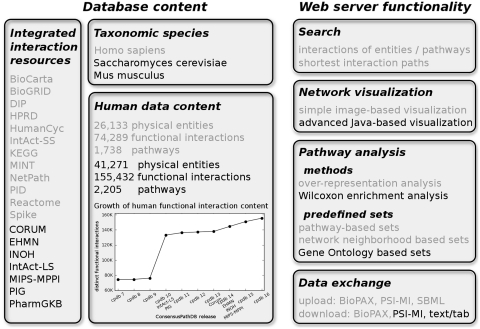
ConsensusPathDB is a meta-database that integrates different types of functional interactions from heterogeneous interaction data resources. Physical protein interactions, metabolic and signaling reactions and gene regulatory interactions are integrated in a seamless functional association network that simultaneously describes multiple functional aspects of genes, proteins, complexes, metabolites, etc. With 155,432 human, 194,480 yeast and 13,648 mouse complex functional interactions (originating from 18 databases on human and eight databases on yeast and mouse interactions each), ConsensusPathDB currently constitutes the most comprehensive publicly available interaction repository for these species. The Web interface at http://cpdb.molgen.mpg.de offers different ways of utilizing these integrated interaction data, in particular with tools for visualization, analysis and interpretation of high-throughput expression data in the light of functional interactions and biological pathways.
Overview
The claims and statistics of this paper haven’t been checked yet.
Free: it reads the open-access text and checks the first 5 claims that cite a source we can check. Create a free account to check every claim.
Integrity signals
Registry
Cites
Statistics
Figures
Verification
Claims the paper makes
The claims and statistics of this paper haven’t been checked yet.
Free: it reads the open-access text and checks the first 5 claims that cite a source we can check. Create a free account to check every claim.
Claims other papers make about this one
Each is checked against this paper’s own text: does it say what the citing paper says it does?
The check wasn’t confident either way, so it gives no verdict — never disputed.
In the citing paper
“Among the main gene ontology (GO) pathways [19, 20] showing altered in senescent cells, “chromatin organization,” “DNA repair,” “membrane trafficking,” and “activation of NF-kappaB” were notable for their known links to senescence and aging (Figure 1C) (Figure 1C) [1, 10, 21, 22].”
From Unmasking Transcriptional Heterogeneity in Senescent Cells (2017) · cites this paper as [20]
Experimental — accuracy not yet measured
Self-check
Percentages, sums and reported differences re-computed from the paper’s own numbers.
The self-check needs the paper’s full text.
Citations
Cites
Cytoscape: A software Environment for integrated models of biomolecular interaction networks
Shannon, P., Markiel, A., Ozier, O., Baliga, N. S., Wang, J. T., Ramage, D., Amin, N., Schwikowski, B., & Ideker, T. (2003) · Genome Research · doi:10.1101/gr.1239303 · Cited by 51,888
Hanahan, D., & Weinberg, R. A. (2000) · Cell · doi:10.1016/s0092-8674(00)81683-9 · Cited by 29,219
KEGG for representation and analysis of molecular networks involving diseases and drugs
Kanehisa, M., Goto, S., Furumichi, M., Tanabe, M., & Hirakawa, M. (2010) · Nucleic Acids Research · doi:10.1093/nar/gkp896 · Cited by 2,322 · cited 5×
“However, KEGG’s signaling pathways are stored in ConsensusPathDB in the form of gene lists for use in the context of gene expression analyses described below.”
InfluentialThe Database of Interacting Proteins: 2004 update
Salwinski, L. (2004) · Nucleic Acids Research · doi:10.1093/nar/gkh086 · Cited by 2,271
Rhodes, D. R., Kalyana-Sundaram, S., Mahavisno, V., Varambally, R., Yu, J., Briggs, B. B., Barrette, T. R., Anstet, M. J., Kincead-Beal, C., Kulkarni, P., et al. (2007) · Neoplasia · doi:10.1593/neo.07112 · Cited by 2,060
Loss of the Suv39h Histone Methyltransferases Impairs Mammalian Heterochromatin and Genome Stability
Peters, A. H. F. M., O'Carroll, D., Scherthan, H., Mechtler, K., Sauer, S., Schöfer, C., Weipoltshammer, K., Pagani, M., Lachner, M., Kohlmaier, A., et al. (2001) · Cell · doi:10.1016/s0092-8674(01)00542-6 · Cited by 1,766
Network‐based classification of breast cancer metastasis
Chuang, H., Lee, E., Liu, Y., Lee, D., & Ideker, T. (2007) · Molecular Systems Biology · doi:10.1038/msb4100180 · Cited by 1,431 · cited 1×
“To conclude, our results support previous findings (27) that utilizing functional interaction data can substantially improve expression data interpretation and can point to disease genes that do not come up on the gene expression analysis level alone.”
ResultCORUM: the comprehensive resource of mammalian protein complexes—2009
Ruepp, A., Waegele, B., Lechner, M., Brauner, B., Dunger-Kaltenbach, I., Fobo, G., Frishman, G., Montrone, C., & Mewes, H.-W. (2010) · Nucleic Acids Research · doi:10.1093/nar/gkp914 · Cited by 1,310
The Universal Protein Resource (UniProt) in 2010
The UniProt Consortium (2010) · Nucleic Acids Research · doi:10.1093/nar/gkp846 · Cited by 1,257
The BioGRID interaction database: 2013 update
Chatr-aryamontri, A., Breitkreutz, B.-J., Heinicke, S., Boucher, L., Winter, A., Stark, C., Nixon, J., Ramage, L., Kolas, N., O’Donnell, L., et al. (2012) · Nucleic Acids Research · doi:10.1093/nar/gks1158 · Cited by 1,017
Cited by
Items 401–500 of 683
Higareda‐Almaraz, J. C., Valtierra-Gutiérrez, I. A., Hernández‐Ortíz, M., Contreras, S., Hernandez, E., & Encarnación‐Guevara, S. (2013) · PLoS ONE · doi:10.1371/journal.pone.0065433 · Cited by 12
“Set size refers to the number of entities that have a Uniprot ID as stated in the corresponding KEGG pathway-based set at the ConsensusPathDB site.”
MethodInfluentialKundu, S., Ali, M. A., Handin, N., Padhan, N., Larsson, J., Karoutsou, M., Ban, K. H.-K., Wiśniewski, J. R., Artursson, P., He, L., et al. (2018) · Genome Medicine · doi:10.1186/s13073-017-0511-4 · Cited by 11
“Genes from pathways relevant to either RAS or glucose metabolism were collected from the ConsensusPathDB version 31 [22, 23] from the COAD dataset mentioned above and from the gene family RAB (RAS oncogene GTPases) and RABL (RAB like GTPases) from HGNC [24].”
MethodProfiling Cellular Processes in Adipose Tissue during Weight Loss Using Time Series Gene Expression
Tareen, S. H. K., Adriaens, M. E., Arts, I. C. W., de Kok, T. M. C. M., Vink, R., Roumans, N. J. T., van Baak, M. A., Mariman, E. C. M., Evelo, C. T., & Kutmon, M. (2018) · Genes · doi:10.3390/genes9110525 · Cited by 9
“3.2 in Cytoscape was used for GO enrichment, and ConsensusPathDB [25,26] version 31 was used for the pathway enrichment.”
InfluentialPak, K., Suh, S., Goh, T. S., Kim, S., Oh, S., Seok, J. W., Kim, I. J., & Kim, Y. H. (2018) · Clinical Endocrinology · doi:10.1111/cen.13928 · Cited by 8
Intronic miRNA mediated gene expression regulation controls protein crowding inside the cell
Sinha, P., Jaiswal, P., Jainarayanan, A., & Brahmachari, S. K. (2018) · Gene · doi:10.1016/j.gene.2018.08.082 · Cited by 18
Molecular phenomics of a high-calorie diet-induced porcine model of prepubertal obesity
Jové, M., Tibau, J., Serrano, J. C. E., Berdún, R., Rodríguez-Palmero, M., Font‐i‐Furnols, M., Cassanyé, A., Rodríguez-Mortera, R., Sol, J., Rassendren, H., et al. (2020) · The Journal of Nutritional Biochemistry · doi:10.1016/j.jnutbio.2020.108393 · Cited by 8
Chen, Y., Wang, J., Zhou, H., Huang, Z., Li, Q., & Shi, W. (2021) · BioMed Research International · doi:10.1155/2021/6628391 · Cited by 10
Tian, F., Kennedy, E. M., Hermetz, K. E., Burt, A., Everson, T. M., Punshon, T., Jackson, B. P., Hao, K., Chen, J., Karagas, M. R., et al. (2021) · Epigenetics · doi:10.1080/15592294.2021.2003044 · Cited by 10
“For enrichment analysis, we searched the putative target mRNAs in the pathway-based gene sets and the Gene Ontology (GO)-based sets using the over-representation analysis approach in the ConsensusPathDB [36].”
MethodAbnormalities in the migration of neural precursor cells in familial bipolar disorder
Sukumaran, S. K., Paul, P., Guttal, V., Holla, B., Vemula, A., Bhatt, H., Bisht, P., Mathew, K., Nadella, R. K., Varghese, A. M., et al. (2022) · Disease Models & Mechanisms · doi:10.1242/dmm.049526 · Cited by 9
“The gene list was extracted from the ConsensusPathDB analysis (Release 34) (Kamburov et al., 2011, 2009) (keywords ‘ migration ’ and ‘ motility ’ ).”
Placental microRNAs relate to early childhood growth trajectories
Kennedy, E. M., Hermetz, K. E., Burt, A., Pei, D., Koestler, D. C., Hao, K., Chen, J., Gilbert‐Diamond, D., Ramakrishnan, U., Karagas, M. R., et al. (2022) · Pediatric Research · doi:10.1038/s41390-022-02386-0 · Cited by 9
Wang, B., Yang, W., Tong, Y., Sun, M., Quan, S., Zhu, J., Zhang, Q., Qin, Z., Ni, Y., Zhao, Y., et al. (2023) · Journal of Medical Virology · doi:10.1002/jmv.29219 · Cited by 9
Deferme, L., Wolters, J. E. J., Claessen, S. M. H., Theunissen, D. H. J., van den Beucken, T., Wagner, J. R., van Breda, S. G., Kleinjans, J. C. S., & Briedé, J. J. (2016) · Chemical Research in Toxicology · doi:10.1021/acs.chemrestox.6b00090 · Cited by 8
SLIDE – a web-based tool for interactive visualization of large-scale – omics data
Ghosh, S., Datta, A., Tan, K. S., & Choi, H. (2018) · Bioinformatics · doi:10.1093/bioinformatics/bty534 · Cited by 9
Koh, H. W. L., Fermin, D., Choi, K. P., Ewing, R. M., & Choi, H. (2018) · bioRxiv (Cold Spring Harbor Laboratory) · doi:10.1101/374520 · Cited by 8
Kim, H., Huh, S., Park, J., Han, Y., Ahn, K.-G., Noh, Y., Lee, S.-J., Chu, H., Kim, S., Jung, H., et al. (2024) · Molecular & Cellular Proteomics · doi:10.1016/j.mcpro.2024.100824 · Cited by 8
“Gene set enrichment analysis (GSEA) was performed using Con-sensusPathDB (22).”
MethodIntegrating Genomics and Phenomics in Agricultural Breeding: A Comprehensive Review
Shakshi, Srivastava, R. P., Yadav, S., & Singh, M. (2024) · Asian Research Journal of Agriculture · doi:10.9734/arja/2024/v17i4506 · Cited by 11
Park, J. Y., Ha, E. S., Lee, J.-M., Brun, P., Kim, Y., Chung, S. S., Hwang, D., Lee, S., & Park, K. S. (2025) · Experimental & Molecular Medicine · doi:10.1038/s12276-025-01411-6 · Cited by 8
“To identify the pathways represented by the DEGs, enrichment analysis of cellular pathways was performed via ConsensusPathDB 35 .”
Pancancer network analysis reveals key master regulators for cancer invasiveness
Jethalia, M., Jani, S. P., Ceccarelli, M., & Mall, R. (2023) · Journal of Translational Medicine · doi:10.1186/s12967-023-04435-6 · Cited by 10
Halu, A., Chelvanambi, S., Decano, J. L., Matamalas, J. T., Whelan, M. C., Asano, T., Kalicharran, N., Singh, S. A., Loscalzo, J., & Aikawa, M. (2025) · Genome Medicine · doi:10.1186/s13073-025-01431-x · Cited by 9
Asthma MicroRNA Regulome Development Using Validated miRNA-Target Interaction Visualization
Fekonja, S., Korošec, P., Rijavec, M., Jeseničnik, T., & Kunej, T. (2018) · OMICS A Journal of Integrative Biology · doi:10.1089/omi.2018.0112 · Cited by 8
“ConsensusPathDB (CPDB) (http://cpdb.molgen.mpg.de) (Kamburov et al., 2011) was used to analyze common pathways for obtained central molecules.”
Surratt, J. D., Lin, Y.-H., Arashiro, M., Vizuete, W., Zhang, Z., Gold, A. R., Jaspers, I., & Fry, R. C. (2019) · PubMed Central · Cited by 16
Peng, W., Yu, P., Dai, W., Fu, X., Liu, L., & Pan, Y. F. (2023) · IEEE Transactions on NanoBioscience · doi:10.1109/tnb.2023.3277316 · Cited by 7
“The protein-protein interaction data used in the study were obtained from the ConsensusPathDB (CPDB) database [31].”
Efficient and Powerful Method for Combining P-Values in Genome-Wide Association Studies
Vilor‐Tejedor, N., González, J. R., & Calle, M. L. (2015) · IEEE Transactions on Computational Biology and Bioinformatics · doi:10.1109/tcbb.2015.2509977 · Cited by 7
“(Table S1, available in the online supplemental material), we assessed the induced functional network by application of ConsensusPathDB [26], [27].”
MethodSahu, M., & Mallick, B. (2016) · Computational Biology and Chemistry · doi:10.1016/j.compbiolchem.2016.07.006 · Cited by 8
“Further, detected k-clique subnetworks were annotated using publicly available pathway databases such as KEGG [35], REACTOME [36], Wikipathways [37] and NetPath [38] through CPDB [39] and also was cross verified with overrepresented clusters predicted earlier.”
MethodCarboni, L., Nguyen, T., & Caberlotto, L. (2016) · PROTEOMICS - CLINICAL APPLICATIONS · doi:10.1002/prca.201500149 · Cited by 8
“For identifying and visualizing enriched GO terms, we used the ConsensuspathDB [40] and the REVIGO [41] tools.”
MethodDRUGPATH: The Drug Gene Pathway Meta-Database
Jaundoo, R., & Craddock, T. J. A. (2020) · International Journal of Molecular Sciences · doi:10.3390/ijms21093171 · Cited by 7
“Pathway CPDB [15,16] provided the gene-pathway interactions found in column 9.”
BackgroundMethodInfluentialIntegrating embeddings of multiple gene networks to prioritize complex disease-associated genes
Wu, M., Zeng, W., Liu, W., Zhang, Y., Chen, T., & Jiang, R. (2017) · IEEE International Conference on Bioinformatics and Biomedicine (BIBM) · doi:10.1109/bibm.2017.8217651 · Cited by 8
“the ConsensusPathDB tool [41].”
Genomic hallmarks and therapeutic implications of G0 cell cycle arrest in cancerPreprint
Wiecek, A. J., Cutty, S. J., Kornai, D., Parreno-Centeno, M., Gourmet, L. E., Tagliazucchi, G. M., Jacobson, D. H., Zhang, P., Xiong, L., Bond, G. L., et al. (2021) · bioRxiv (Cold Spring Harbor Laboratory) · doi:10.1101/2021.11.12.468410 · Cited by 7
Genomic insights into the comorbidity between type 2 diabetes and schizophrenia
Arruda, A. L., Khandaker, G. M., Morris, A. P., Smith, G. D., Huckins, L. M., & Zeggini, E. (2024) · Schizophrenia · doi:10.1038/s41537-024-00445-5 · Cited by 9
“On the derived genes showing evidence of involvement in both type 2 diabetes and schizophrenia, we performed gene set enrichment analysis using the human resources and the enrichment software from the Consensus-PathDB (http://cpdb.molgen.mpg.de/) 55 (Table S8).”
BackgroundMethodTranscriptomic profile of human iPSC-derived podocyte-like cells exposed to a panel of xenobiotics
Murphy, C., Jennings, P., & Wilmes, A. (2024) · Toxicology in Vitro · doi:10.1016/j.tiv.2024.105804 · Cited by 7
A Streamlined Approach to Pathway Analysis from RNA-Sequencing Data
Bow, A. J. (2021) · Methods and Protocols · doi:10.3390/mps4010021 · Cited by 7
Cuellar-Vite, L., Weber-Bonk, K. L., Abdul‐Karim, F. W., Booth, C. N., & Keri, R. A. (2022) · Cancers · doi:10.3390/cancers14143374 · Cited by 7
“All pathway analyses were performed in ConsensusPathDb using over-representation analysis [36,37].”
MethodOommen, A. M., Roberts, K. J., Joshi, L., & Cunningham, S. (2023) · International Journal of Molecular Sciences · doi:10.3390/ijms24021200 · Cited by 8
Koch, B., Shehata, M., Müller, C., Gouda, S. A., Wetzstein, N., Patyna, S., Scholz, A., Schmid, T., Dietrich, U., Münch, C., et al. (2024) · Frontiers in Cellular and Infection Microbiology · doi:10.3389/fcimb.2024.1363407 · Cited by 6
“All results were investigated for pathway over-representation at the gene level (cut off: at least 2 genes in pathway annotation and p < 0.01) by ConsensusPathDB (Kamburov et al., 2011) (http:// cpdb.molgen.mpg.de/, Release 35, database = 05.06.2021) employing “ Kyoto Encyclopedia of Genes and Genomes (KEGG) ” (Kanehi…”
InfluentialNewton, R., & Wernisch, L. (2014) · PLoS ONE · doi:10.1371/journal.pone.0105522 · Cited by 7
“We then looked at enriched Gene Ontology (GO) annotations in the lists of predicted targets (plus their proposed regulator) using ConsensusPathDB [81–83].”
MethodDreher, F., Kamburov, A., & Herwig, R. (2012) · Evolutionary Bioinformatics · doi:10.4137/ebo.s8552 · Cited by 6
Self-citationShifting patterns of genomic variation in the somatic evolution of papillary thyroid carcinoma
Rubinstein, J. C., Brown, T. C., Christison-Lagay, E. R., Zhang, Y., Kunstman, J. W., Juhlin, C. C., Nelson-Williams, C. J., Goh, G., Quinn, C., Callender, G. G., et al. (2016) · BMC Cancer · doi:10.1186/s12885-016-2665-7 · Cited by 6
“ConsensusPathDB [20, 21] pathway enrichment analysis was performed for each subset using all genes containing at least one nonsynonymous, stopgain, or stoploss variant.”
MethodRodgers, M. L., Serafin, J., Sepúlveda, M. S., & Griffitt, R. J. (2020) · Comparative Biochemistry and Physiology Part D Genomics and Proteomics · doi:10.1016/j.cbd.2020.100753 · Cited by 6
Dyszkiewicz-Konwińska, M., Nawrocki, M. J., Huang, Y. H., Bryja, A., Celichowski, P., Jankowski, M., Błochowiak, K. J., Mehr, K., Bruska, M., Nowicki, M. O., et al. (2018) · International Journal of Molecular Sciences · doi:10.3390/ijms19041027 · Cited by 6
“This database integrates interaction networks in Homo sapiens including binary and complex protein-protein, genetic, metabolic, signaling, gene regulatory and drug-target interactions, as well as biochemical pathways from 32 public resources [50].”
BackgroundHemimethylation Patterns in Breast Cancer Cell Lines
Sun, S., Lee, Y. R., & Enfield, B. (2019) · Cancer Informatics · doi:10.1177/1176935119872959 · Cited by 6
Xiong, B., Liu, W., Liu, Y., Chen, T., Lin, A., Song, J., Qu, L., Luo, P., Jiang, A., & Wang, L. (2024) · Biomedicines · doi:10.3390/biomedicines12102171 · Cited by 6
“P1 [21].”
ProfileDB: A resource for proteomics and cross-omics biomarker discovery
Bauer, C., Glintschert, A., & Schuchhardt, J. (2013) · Biochimica et Biophysica Acta (BBA) - Proteins and Proteomics · doi:10.1016/j.bbapap.2013.11.007 · Cited by 5
Jean-Pierre, M., Michalovicz, L. T., Kelly, K. A., O'Callaghan, J. P., Nathanson, L., Klimas, N. G., & Craddock, T. J. A. (2022) · Computational and Structural Biotechnology Journal · doi:10.1016/j.csbj.2022.11.006 · Cited by 5
RETRACTED: Non-invasive STEMI-related biomarkers based on meta-analysis and gene prioritization
Goharrizi, M. A. S. B., Ghodsi, S., Mokhtari, M., & Moravveji, S. S. (2023) · Computers in Biology and Medicine · doi:10.1016/j.compbiomed.2023.106997 · Cited by 6
RetractedBenoit, S., Henry, M. S., Fneich, S., Mathou, A., Xia, L., Foury, A., Jouin, M., Junien, C., Capuron, L., Jouneau, L., et al. (2023) · Frontiers in Nutrition · doi:10.3389/fnut.2023.1190392 · Cited by 6
“Another analysis was realized using ConsensusPathDB-mouse (38), with the differentially expressed gene list vs. the mus musculus database.”
InfluentialPrecision Subtypes of T Cell-Mediated Rejection Identified by Molecular Profiles
Kadota, P. O., Hajjiri, Z., Finn, P. W., & Perkins, D. L. (2015) · Frontiers in Immunology · doi:10.3389/fimmu.2015.00536 · Cited by 5
DNA Methylation Heterogeneity Patterns in Breast Cancer Cell Lines
Tian, S., Bertelsmann, K., Yu, L. C., & Sun, S. (2016) · Cancer Informatics · doi:10.4137/cin.s40300 · Cited by 5
Aberration hubs in protein interaction networks highlight actionable targets in cancer
Karimzadeh, M., Jandaghi, P., Papadakis, A. I., Trainor, S., Rung, J., Gonzàlez-Porta, M., Scélo, G., Vasudev, N. S., Brāzma, A., Huang, S., et al. (2018) · Oncotarget · doi:10.18632/oncotarget.25382 · Cited by 6
“We used ConsensusPathDB [50] for pathway enrichment analysis and used the significance cutoff of 0.”
MethodInfluentialMuthye, V., Kandoi, G., & Lavrov, D. V. (2020) · Mitochondrion · doi:10.1016/j.mito.2020.01.001 · Cited by 4
Cunill, J., Marquillas, C. B., dos Santos, L. A., Serrano, J. C. E., Jové, M., Martin‐Garí, M., & Portero‐Otín, M. (2020) · Nutrients · doi:10.3390/nu12092699 · Cited by 7
“Pathway analyses were produced according to these putatively annotated compounds by employing the ConsensusPathDataBase platform [19].”
MethodChellappa, S. A., Pathak, A. K., Sinha, P., Jainarayanan, A., Jain, S., & Brahmachari, S. K. (2019) · Journal of Genetics · doi:10.1007/s12041-019-1101-6 · Cited by 7
Poluri, K. M., Gulati, K., & Sarkar, S. (2021) · Springer eBooks · doi:10.1007/978-981-16-1594-8_6 · Cited by 5
Modulation of specific cell cycle phases in human embryonic stem cells by lncRNA RNA decoys
Sahu, M., & Mallick, B. (2018) · Journal of Molecular Recognition · doi:10.1002/jmr.2763 · Cited by 5
Data on novel DNA methylation changes induced by valproic acid in human hepatocytes
Wolters, J. E. J., Breda, S. G. J. V., Claessen, S. M. H., de Kok, T. M. C. M., & Kleinjans, J. C. S. (2017) · Data in Brief · doi:10.1016/j.dib.2017.11.031 · Cited by 5
“ConsensusPathDB [13] was used to identify and visualize the involvement of the unique genes in biological processes that have been derived from affected pathways, by selecting significant pathways with a p-value o 0.01 from a gene enrichment analysis.”
MethodInfluentialShani, O., Raz, Y., Monteran, L., Megides, O., Shacham, H., Cohen, N., Silverbush, D., Levi-Galibov, O., Avivi, C., Sharan, R., et al. (2019) · bioRxiv (Cold Spring Harbor Laboratory) · doi:10.1101/778936 · Cited by 5
“To address this question, we performed further analysis of the selected genes in each stage by using the over-representation enrichment analysis of the Consensus Path DB (CPDB) platform (Kamburov et al., 2011).”
MethodXu, S., Yu, K., Liu, L., Wang, Q., Wu, X., Chen, Y., Li, G., Zhang, X., Wei, B., Fu, Z., et al. (2025) · Advanced Science · doi:10.1002/advs.202513086 · Cited by 5
Explainable deep learning for stratified medicine in inflammatory bowel disease
Verplaetse, N., Fariselli, P., Moreau, Y., & Raimondi, D. (2025) · Genome biology · doi:10.1186/s13059-025-03692-6 · Cited by 4
“…we also tested different NN biosparse architectures whose sparsification has been obtained by using different biological databases such as the gene-pathway connections from ConsensusPathDB [32], the gene-gene interactions from Interactome [33] and the gene-gene interactions from UCSC [34].”
Sharma, S., Ali, R., Bouska, A. C., Jochum, D. T., Kesireddy, M., Mahov, S., Lownik, J. C., Zhang, W., Lone, W., Soma, M. A., et al. (2025) · Nature Communications · doi:10.1038/s41467-025-64666-7 · Cited by 7
“Functional annotation of differential genes was performed using ConsensusPathDB 68,69 .”
Lu, Y., Tang, W., Wang, X., Kang, X., You, J., & Chen, L. (2021) · International Journal of General Medicine · doi:10.2147/ijgm.s341771 · Cited by 4
“de) online software.(10) The P-value <0.”
Agarwal, M., Sharma, A., Kagoo, A., & Bhargava, A. (2023) · Scientific Reports · doi:10.1038/s41598-023-33145-8 · Cited by 5
SSCI: Self-Supervised Deep Learning Improves Network Structure for Cancer Driver Gene Identification
Xu, J., Hao, J., Liao, X., Shang, X., & Li, X. (2024) · International Journal of Molecular Sciences · doi:10.3390/ijms251910351 · Cited by 5
“The PPI network is collected from ConsensusPathDB (CPDB, http://consensuspathdb. org, accessed on 14 September 2024) [45].”
MethodStatistical and bioinformatic analysis of hemimethylation patterns in non-small cell lung cancer
Sun, S., Zane, A., Fulton, C., & Philipoom, J. (2021) · BMC Cancer · doi:10.1186/s12885-021-07990-7 · Cited by 6
Graphical Data Representation and Analytics to Link the Potential Interaction for Lung Cancer Genes
Aloufi, B. H., & Alshammari, A. M. (2022) · International Journal Of Pharmaceutical Research And Allied Sciences · doi:10.51847/vmnq3k5omn · Cited by 4
Singh, S., Zheng, Y., Jagadeeswaran, G., Ebron, J. S., Sikand, K., Gupta, S., Sunker, R., & Shukla, G. C. (2015) · Cancer Letters · doi:10.1016/j.canlet.2015.10.038 · Cited by 5
Identifying DNA Methylation Variation Patterns to Obtain Potential Breast Cancer Biomarker Genes
Xu, L., & Mitra Behura, S. (2015) · International Journal of Biomedical Data Mining · doi:10.4172/2090-4924.1000115 · Cited by 4
“We visualize genetic pathway (or network) with the ConsensusPathDB (CPDB) software [28-31].”
MethodIdentification of significant ego networks and pathways in rheumatoid arthritis
Yuan, H., Zhou, W.-Z., & Miao, L.-G. (2018) · Journal of Cancer Research and Therapeutics · doi:10.4103/0973-1482.189250 · Cited by 4
Computationally scalable regression modeling for ultrahigh-dimensional omics data with ParProx
Ko, S., Li, G. X., Choi, H., & Won, J. (2021) · Briefings in Bioinformatics · doi:10.1093/bib/bbab256 · Cited by 6
“…‘small n , large p ’ data example, we use biological pathways and GO terms as variable groups with arbitrary degree of overlap and nesting [33, 34], and show that the latent group lasso regression model optimized by ParProx identifies a sparse prognostic gene signature enriched with specific…”
Profiling muscle transcriptome in mice exposed to microgravity using gene set enrichment analysis
Oommen, A. M., Stafford, P., & Joshi, L. (2024) · npj Microgravity · doi:10.1038/s41526-024-00434-z · Cited by 6
Meijer, T., ter Braak, B., Wolters, L., Kunnen, S. J., Islam, B., Suciu, I., Gardner, I. B., Hatley, O. J. D., Currie, R. A., Hardy, B. J., et al. (2025) · Toxicology in Vitro · doi:10.1016/j.tiv.2025.106010 · Cited by 5
Ren, Y., Zhang, T., Liu, J., Ma, F., Chen, J., Li, P., Xiao, G., Sun, C., & Zhang, Y. (2025) · Experimental Biology and Medicine · doi:10.3389/ebm.2025.10399 · Cited by 4
Integrating brain imaging features and genomic profiles for the subtyping of major depression
Yin, L., Lin, Y., Qiu, J., Xiang, Y., Li, M., Xiao, X., Lui, S. S. Y., & So, H. (2025) · Psychological Medicine · doi:10.1017/s0033291725001096 · Cited by 3
Lee, J. W., Lim, A. J. W., Wang, C., Neo, J. H., Lim, L. J., Chong, S. S., & Lee, C. G. L. (2025) · Journal of Translational Medicine · doi:10.1186/s12967-025-07100-2 · Cited by 4
Apolipoprotein L1 is a tumor suppressor in clear cell renal cell carcinoma metastasis
Le, L. N.-H., Choi, C.-W., Han, J., Kim, E.-B., Trinh, V. N., Kim, Y., & Ryu, S. (2024) · Frontiers in Oncology · doi:10.3389/fonc.2024.1371934 · Cited by 4
Exploiting YES1-Driven EGFR Expression Improves the Efficacy of EGFR Inhibitors
Cuellar-Vite, L., Donaubauer, E. M., Weber-Bonk, K. L., Bobbitt, J. R., Ingles, N. N., Brzozowski, T. L., Abdul‐Karim, F. W., Booth, C. N., & Keri, R. A. (2025) · Molecular Cancer Research · doi:10.1158/1541-7786.mcr-24-0309 · Cited by 3
Chen, Y., Li, G., Liu, T., Zhou, R., Mao, Y., Wu, J., Liu, J., Hu, H., Wu, K., & Zhu, Q. (2025) · IEEE Transactions on Computational Biology and Bioinformatics · doi:10.1109/tcbbio.2025.3574337 · Cited by 4
“For biological networks, we integrate PPI data from STRING [23], CPDB [24], and BioPlex [25] via NDEx [26].”
Brown, R. E., Fuchter, M. J., Curry, E. W., Green, I. A., Kandil, S., Cherblanc, F., Payne, L., Chapman‐Rothe, N., Shamsaei, E., Srimongkolpithak, N., et al. (2014) · European Journal of Cancer · doi:10.1016/s0959-8049(14)70680-x · Cited by 3
Rasool, D., Burban, A., Sharanek, A., Madrigal, A., Hu, J., Yan, K., Qu, D., Voss, A. K., Slack, R. S., Thomas, T., et al. (2024) · EMBO Reports · doi:10.1038/s44319-024-00082-0 · Cited by 5
“GO term enrichment analysis was performed using CPDB (Kamburov et al, 2011).”
MethodInfluentialArora, R., Kaur, M., Kumar, A., Chhabra, P., Mir, M. A., Ahlawat, S., Singh, M. K., Sharma, R., & Gera, R. (2024) · International Journal of Biometeorology · doi:10.1007/s00484-024-02708-3 · Cited by 5
Dallavilla, T., Galié, S., Sambruni, G., Borin, S., Fazio, N., Romario, U. F., Manzo, T., Nezi, L., & Schaefer, M. H. (2024) · Biochimica et Biophysica Acta (BBA) - Molecular Basis of Disease · doi:10.1016/j.bbadis.2024.167311 · Cited by 3
“GO analyses were performed using ConsensusPathDB [28].”
Soyer, S. M., Özbek, P., & Kasavi, C. (2024) · OMICS A Journal of Integrative Biology · doi:10.1089/omi.2024.0121 · Cited by 3
Analysis of a shark reveals ancient, Wnt-dependent, habenular asymmetries in vertebrates
Lanoizelet, M., Michel, L., Lagadec, R., Mayeur, H., Guichard, L., Logeux, V., Séverac, D., Martin, K. J., Klopp, C., Marcellini, S., et al. (2024) · Nature Communications · doi:10.1038/s41467-024-54042-2 · Cited by 5
“Left versus right habenulae GO term enrichment gene analysis was carried out using the ConsensusPathDB online tool (http://cpdb. molgen.mpg.de/) 69,70 against the whole list of genes in the catshark gene model reference.”
Identifying Significant Features in Cancer Methylation Data Using Gene Pathway Segmentation
Hira, Z. M., & Gillies, D. F. (2016) · Cancer Informatics · doi:10.4137/cin.s39859 · Cited by 3
“31–34 The ConsensusPath database integrates different types of information, including protein interactions, genetic interactions signaling, metabolism, gene regulation, and drug target interactions in humans.”
BackgroundMethodAhlawat, S., Vijh, R. K., Sharma, A., Sharma, U., Girdhar, Y., Kaur, M., Chhabra, P., Kumar, A., & Arora, R. (2020) · Molecular Biology Reports · doi:10.1007/s11033-020-05764-1 · Cited by 4
“DAVID [14, 15] and Consensus Pathway Data Base [16, 17] were used for the functional annotation and pathway analysis of the differentially expressed genes.”
MethodVilardell, M., Civit, S., & Herwig, R. (2013) · Biology Open · doi:10.1242/bio.20134408 · Cited by 3
“We have also checked the INTEGRIN CELL SURFACE INTERACTIONS which is the unique pathway in ConsensusPathDB that contains FBN1 as an integrand because of its clear significance in the meta-analysis and although the number of overlapping genes between both DS studies is high (Table 1) no significance was reached in the…”
MethodInfluentialSelf-citationChen, X. Y., Chen, Y. H., Zhang, L. J., Wang, Y., & Tong, Z. C. (2017) · Brazilian Journal of Medical and Biological Research · doi:10.1590/1414-431x20165793 · Cited by 3
“The EgoNet algorithm has been used for investigating module over-representation analysis in ConsensusPathDB (14), which validates the feasibility of this method.”
MethodCostarelli, L., Giacconi, R., Piacenza, F., Basso, A., Pacetti, D., Balzano, M., Gagliardi, R., Frega, N. G., Mocchegiani, E., Provinciali, M., et al. (2017) · Mediators of Inflammation · doi:10.1155/2017/3868545 · Cited by 3
“de) [20] and Partek Pathway software (Partek, St Louis, MO, USA).”
MethodUsing Pathway Covering to Explore Connections among Metabolites
Midford, P. E., Latendresse, M., O’Maille, P. E., & Karp, P. D. (2019) · Metabolites · doi:10.3390/metabo9050088 · Cited by 4
Modeling Persistent Trends in Distributions
Mueller, J. W., Jaakkola, T., & Gifford, D. K. (2018) · DSpace@MIT (Massachusetts Institute of Technology) · Cited by 3
Lim, L. J., Ling, L. H., Neo, Y. P., Chung, A. Y. F., Goh, B. K. P., Chow, P. K. H., Chan, C. Y., Cheow, P. C., Lee, S. Y., Lim, T. K. H., et al. (2021) · Journal of Cancer · doi:10.7150/jca.56340 · Cited by 4
“ConsensusPathDB [36, 37] software was employed for Gene Ontology and Pathway analyses based on Reactome [38] and the Kyoto Encyclopedia of Genes and Genomes (KEGG) [39] databases.”
MethodHaikala, H. M., Klefström, J. T., Eilers, M., & Wiese, K. E. (2016) · Cell Cycle · doi:10.1080/15384101.2015.1121351 · Cited by 3
“over-represented terms in a concept overlap graph using ConsensusPathDB.(26,27) Consistent with our previous observations,”
ResultWinckelmans, E., Vrijens, K., Tsamou, M., Janssen, B. G., Saenen, N. D., Roels, H. A., Kleinjans, J. C. S., Lefebvre, W., Vanpoucke, C., de Kok, T. M. C. M., et al. (2016) · ISEE Conference Abstracts · doi:10.1289/isee.2016.3536 · Cited by 3
Lee, K. K., Zhang, Y., Tirado-Magallanes, R., Rajagopalan, D., Bhatia, S. S., Ng, L., Desi, N., Tham, C. Y., Teo, W. S., Hoppe, M. M., et al. (2020) · bioRxiv (Cold Spring Harbor Laboratory) · doi:10.1101/2020.06.10.145193 · Cited by 5
“Chromatin immunoprecipitation (ChIP) ChIP was performed as described earlier (Jha et al, 2010; Karnani et al, 2007).”
MethodData-driven formulation of natural laws by recursive-LASSO-based symbolic regressionPreprint
Iwasaki, Y., & Ishida, M. (2021) · arXiv (Cornell University) · doi:10.48550/arxiv.2102.09210 · Cited by 7
Identifying Cancer Driver Genes Using a Neural Network Framework With Cross-Attention Mechanism
Zhou, R., Li, G., Mao, Y., Liu, T., Chen, Y., Wu, J., Liu, J., Hu, H., Wu, K., & Zhu, Q. (2025) · IEEE Transactions on Computational Biology and Bioinformatics · doi:10.1109/tcbbio.2025.3588156 · Cited by 3
“The PPI networks derive from three different databases, namely STRING [24], CPDB [25] and PathNet [26].”
Zhang, Y., Zheng, W., Dai, R., Ma, T., Li, Z., Li, J., & Shen, J. (2025) · Discover Oncology · doi:10.1007/s12672-025-03253-0 · Cited by 2
“Molecular interaction networks were reconstructed through ConsensusPathDB (v34) [33, 34] integrating multi-omic evidence (genetic, post-transcriptional, and metabolic interactions; minimum overlap P-score > 5), with module detection via edge-betweenness clustering (resolution = 0.8).”
InfluentialHur, B., Lim, S., Chae, H., Seo, S., Lee, S., Kang, J., & Kim, S. (2016) · Biology Direct · doi:10.1186/s13062-016-0158-x · Cited by 3
“PPI and pathway information are both networks from the documented biological knowledge to consider gene-gene relationships [6].”
BackgroundModeling Persistent Trends in Distributions
Mueller, J. W., Jaakkola, T., & Gifford, D. K. (2018) · Journal of the American Statistical Association · doi:10.1080/01621459.2017.1341412 · Cited by 6
Yoon, K.-H., Chu, H., Kim, H., Huh, S., Kim, E., Kang, U., & Shin, H.-C. (2024) · Annals of Surgical Treatment and Research · doi:10.4174/astr.2024.106.4.195 · Cited by 2
DGCL: A Contrastive Learning Method for Predicting Cancer Driver Genes Based on Graph Diffusion
Peng, W., Zhou, Z., Dai, W., Xu, X., Fu, X., Liu, L., & Liu, L. (2024) · Lecture notes in computer science · doi:10.1007/978-981-97-5131-0_30 · Cited by 2
MiNEApy: enhancing enrichment network analysis in metabolic networks
Pandey, V. (2025) · Bioinformatics · doi:10.1093/bioinformatics/btaf077 · Cited by 3
“…this problem is gene set enrichment analysis, which divides a long list of genes into a smaller list of more interpretable pathways or groups of genes that share common biological functions (Subramanian et al. 2005, Kamburov et al. 2011a, 2011b, V € aremo et al. 2013, Reimand et al. 2019).”
Metadata
- Authors
- Kamburov, A., Pentchev, K., Galicka, H., Wierling, C., Lehrach, H., & Herwig, R.
- Affiliations
- Max Planck Society (DE)
- Max Planck Institute for Molecular Genetics (DE)
- Corresponding author
- Kamburov, Atanas
- Venue
- Nucleic Acids Research
- Publisher
- Oxford University Press (OUP)
- Published
- 2010-11-11
- Volume
- 39
- Issue
- suppl_1
- Pages
- D712-D717
- ISSN
- 0305-1048 (ISSN-L)
- 1362-4962
- PMC
- PMC3013724
- OpenAlex
- W2017138237
- Cited by
- 671
- References
- 32
- Citations by year
- 2026: 21 · 2025: 36 · 2024: 36 · 2023: 42 · 2022: 79 · 2021: 69 · 2020: 58 · 2019: 55 · 2018: 62 · 2017: 44 · 2016: 43 · 2015: 45 · 2014: 23 · 2013: 28 · 2012: 18
- FWCI
- 7.42
- Type
- journal article
- Language
- en
- Open access
- gold
- doi.org
- Licence
- Locations
- Nucleic Acids Research (publishedVersion, cc-by-nc)
- PubMed Central (publishedVersion, cc-by-nc)
- PubMed (publishedVersion)
- MPG.PuRe (Max Planck Society) (submittedVersion, other-oa)
- Max Planck Institute for Plasma Physics (submittedVersion)
- Funders
- European Commission (200767)
- Max-Planck-Gesellschaft
- International Max Planck Research School for Advanced Methods in Process and Systems Engineering
- Topics
- Life Sciences › Biochemistry, Genetics and Molecular Biology › Molecular Biology › Bioinformatics and Genomic Networks
- Health Sciences › Medicine › Health Informatics › Biomedical Text Mining and Ontologies
- Life Sciences › Biochemistry, Genetics and Molecular Biology › Molecular Biology › Gene Regulatory Network Analysis
- Keywords
- functional interaction networks, protein-protein interaction, metabolic interactions, gene regulatory interactions, protein complexes, metabolites, metadata database, pathway analysis
- MeSH terms
- Animals, Humans, User-Computer Interface, Signal Transduction, Gene Expression, Databases, Factual, Internet, Protein Interaction Mapping, Databases, Genetic, Mice, Gene Regulatory Networks, Metabolic Networks and Pathways
About these checks
Registry, retraction, Cites and statistics results are computed, not judged, with one exception: a printed reference that no index lists is read once by a model before it counts as a citation error. Claims are extracted by a model and kept only when their quote appears verbatim in the text; each cited source is then checked, with a model’s help, for whether it says what the claim relies on. Those verdicts can be wrong — read the claim’s quote and the cited source before relying on one.
Statistics and arithmetic are recomputed, not judged.
Confidence bands are shown only for fields calibrated on our annotated test set. None is calibrated yet, so no band is shown.
What counts as a claim ›How we measure confidence ›How we check this ›
Are you an author, or do you see a problem with this page? Request a review
Data sources
Bibliographic data: Semantic Scholar, OpenAlex, Crossref.
Contains information from the Semantic Scholar Academic Graph Datasets, made available under the ODC Attribution License (ODC-BY 1.0).
Semantic Scholar’s data is described in: Kinney, R., et al. (2023). The Semantic Scholar Open Data Platform. arXiv:2301.10140.
