

ConsensusPathDB: toward a more complete picture of cell biology
Open accessThe DOI matches its Crossref record; 32 of the 32 references it cites were found in a registry or an index.
Abstract
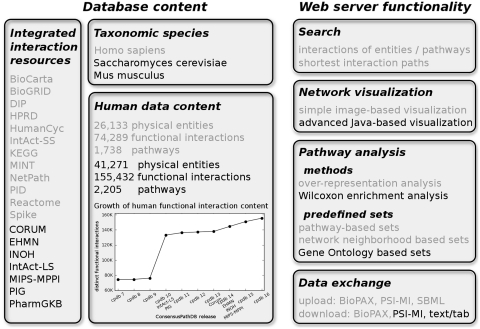
ConsensusPathDB is a meta-database that integrates different types of functional interactions from heterogeneous interaction data resources. Physical protein interactions, metabolic and signaling reactions and gene regulatory interactions are integrated in a seamless functional association network that simultaneously describes multiple functional aspects of genes, proteins, complexes, metabolites, etc. With 155,432 human, 194,480 yeast and 13,648 mouse complex functional interactions (originating from 18 databases on human and eight databases on yeast and mouse interactions each), ConsensusPathDB currently constitutes the most comprehensive publicly available interaction repository for these species. The Web interface at http://cpdb.molgen.mpg.de offers different ways of utilizing these integrated interaction data, in particular with tools for visualization, analysis and interpretation of high-throughput expression data in the light of functional interactions and biological pathways.
Overview
The claims and statistics of this paper haven’t been checked yet.
Free: it reads the open-access text and checks the first 5 claims that cite a source we can check. Create a free account to check every claim.
Integrity signals
Registry
Cites
Statistics
Figures
Verification
Claims the paper makes
The claims and statistics of this paper haven’t been checked yet.
Free: it reads the open-access text and checks the first 5 claims that cite a source we can check. Create a free account to check every claim.
Claims other papers make about this one
Each is checked against this paper’s own text: does it say what the citing paper says it does?
The check wasn’t confident either way, so it gives no verdict — never disputed.
In the citing paper
“Among the main gene ontology (GO) pathways [19, 20] showing altered in senescent cells, “chromatin organization,” “DNA repair,” “membrane trafficking,” and “activation of NF-kappaB” were notable for their known links to senescence and aging (Figure 1C) (Figure 1C) [1, 10, 21, 22].”
From Unmasking Transcriptional Heterogeneity in Senescent Cells (2017) · cites this paper as [20]
Experimental — accuracy not yet measured
Self-check
Percentages, sums and reported differences re-computed from the paper’s own numbers.
The self-check needs the paper’s full text.
Citations
Cites
Cytoscape: A software Environment for integrated models of biomolecular interaction networks
Shannon, P., Markiel, A., Ozier, O., Baliga, N. S., Wang, J. T., Ramage, D., Amin, N., Schwikowski, B., & Ideker, T. (2003) · Genome Research · doi:10.1101/gr.1239303 · Cited by 51,888
Hanahan, D., & Weinberg, R. A. (2000) · Cell · doi:10.1016/s0092-8674(00)81683-9 · Cited by 29,219
KEGG for representation and analysis of molecular networks involving diseases and drugs
Kanehisa, M., Goto, S., Furumichi, M., Tanabe, M., & Hirakawa, M. (2010) · Nucleic Acids Research · doi:10.1093/nar/gkp896 · Cited by 2,322 · cited 5×
“However, KEGG’s signaling pathways are stored in ConsensusPathDB in the form of gene lists for use in the context of gene expression analyses described below.”
InfluentialThe Database of Interacting Proteins: 2004 update
Salwinski, L. (2004) · Nucleic Acids Research · doi:10.1093/nar/gkh086 · Cited by 2,271
Rhodes, D. R., Kalyana-Sundaram, S., Mahavisno, V., Varambally, R., Yu, J., Briggs, B. B., Barrette, T. R., Anstet, M. J., Kincead-Beal, C., Kulkarni, P., et al. (2007) · Neoplasia · doi:10.1593/neo.07112 · Cited by 2,060
Loss of the Suv39h Histone Methyltransferases Impairs Mammalian Heterochromatin and Genome Stability
Peters, A. H. F. M., O'Carroll, D., Scherthan, H., Mechtler, K., Sauer, S., Schöfer, C., Weipoltshammer, K., Pagani, M., Lachner, M., Kohlmaier, A., et al. (2001) · Cell · doi:10.1016/s0092-8674(01)00542-6 · Cited by 1,766
Network‐based classification of breast cancer metastasis
Chuang, H., Lee, E., Liu, Y., Lee, D., & Ideker, T. (2007) · Molecular Systems Biology · doi:10.1038/msb4100180 · Cited by 1,431 · cited 1×
“To conclude, our results support previous findings (27) that utilizing functional interaction data can substantially improve expression data interpretation and can point to disease genes that do not come up on the gene expression analysis level alone.”
ResultCORUM: the comprehensive resource of mammalian protein complexes—2009
Ruepp, A., Waegele, B., Lechner, M., Brauner, B., Dunger-Kaltenbach, I., Fobo, G., Frishman, G., Montrone, C., & Mewes, H.-W. (2010) · Nucleic Acids Research · doi:10.1093/nar/gkp914 · Cited by 1,310
The Universal Protein Resource (UniProt) in 2010
The UniProt Consortium (2010) · Nucleic Acids Research · doi:10.1093/nar/gkp846 · Cited by 1,257
The BioGRID interaction database: 2013 update
Chatr-aryamontri, A., Breitkreutz, B.-J., Heinicke, S., Boucher, L., Winter, A., Stark, C., Nixon, J., Ramage, L., Kolas, N., O’Donnell, L., et al. (2012) · Nucleic Acids Research · doi:10.1093/nar/gks1158 · Cited by 1,017
Cited by
Items 301–400 of 683
PathNER: a tool for systematic identification of biological pathway mentions in the literature
Wu, C., Schwartz, J., & Nenadić, G. (2013) · BMC Systems Biology · doi:10.1186/1752-0509-7-s3-s2 · Cited by 20
“A number of databases have been built to store the details of curated pathways, including KEGG [8], Path-way Interaction Database (PID) [9], WikiPathways [10], MetaCyc [11], Reactome [12] and integrative databases like Pathway Commons [13] and ConsensusPathDB [14].”
MethodWolters, J. E. J., van Herwijnen, M. H. M., Theunissen, D. H. J., Jennen, D. G. J., den Hof, W. F. P. M. V., de Kok, T. M. C. M., Schaap, F. G., van Breda, S. G., & Kleinjans, J. C. S. (2016) · Chemical Research in Toxicology · doi:10.1021/acs.chemrestox.6b00337 · Cited by 18
A rare variant in the FHL1 gene associated with X-linked recessive hypoparathyroidism
Pillar, N., Pleniceanu, O., Fang, M., Ziv, L., Lahav, E., Botchan, S., Cheng, L., Dekel, B., & Shomron, N. (2017) · Human Genetics · doi:10.1007/s00439-017-1804-9 · Cited by 18
“1 3 Induced network and gene ontology analysis ConsensusPathDB (Kamburov et al. 2011), which agglomerated the contents of 32 major public repositories for human molecular interactions of heterogeneous types including Gene Ontology, pathway annotations, and protein–protein interaction (PPI) network was used for functio…”
BackgroundMethodInfluentialBagewadi, S., Raschka, T., Naz, M., Simoes, R. D. M., Senger, P., & Hofmann‐Apitius, M. (2017) · Journal of Alzheimer s Disease · doi:10.3233/jad-170011 · Cited by 24
“Hs.eg.db [50], we mapped the gene symbols to Entrez gene identifiers obtained from CPDB. Fig.”
MethodInfluentialKhoshbakht, S., Jamalkandi, S. A., & Masudi-Nejad, A. (2021) · BMC Medical Genomics · doi:10.1186/s12920-021-01112-9 · Cited by 18
Reiner, G., Dreher, F., Drungowski, M., Hoeltig, D., Bertsch, N., Selke, M., Willems, H., Gerlach, G.-F., Probst, I., Tuemmler, B., et al. (2014) · Mammalian Genome · doi:10.1007/s00335-014-9536-9 · Cited by 17
“The gene sets that were used for the analysis originated from the default database of the GSEA tool (MSigDB) and the pathway sets provided by ConsensusPathDB (Kamburov et al. 2011).”
MethodSelf-citationKonstorum, A., Lynch, M. L., Torti, S. V., Torti, F. M., & Laubenbacher, R. (2018) · OMICS A Journal of Integrative Biology · doi:10.1089/omi.2018.0060 · Cited by 18
“…activity have been shown to be increased in liver and muscle during iron overload (Pigeon et al., 2001; Rodriguez et al., 2007); it was downregulated in livers of rats fed an iron-deficient diet (Kamei et al., 2010), but it was downregulated in heart after iron overload (Rodriguez et al., 2007).”
BackgroundXu, L., Qi, X., Zhu, C., & Wan, L. (2018) · Neuropsychiatric Disease and Treatment · doi:10.2147/ndt.s188210 · Cited by 18
Methylome-wide association study of anxiety disorders
Hettema, J. M., van den Oord, E. J. C. G., Zhao, M., Xie, L. Y., Copeland, W., Penninx, B. W. J. H., Åberg, K. A., & Clark, S. L. (2023) · Molecular Psychiatry · doi:10.1038/s41380-023-02205-w · Cited by 20
“To replicate existing ANX methylation fi ndings, we compiled a list of published array-based ANX methylation studies (Table S1).”
MethodA distance-based test of association between paired heterogeneous genomic data
Minas, C., Curry, E. W., & Montana, G. (2013) · Bioinformatics · doi:10.1093/bioinformatics/btt450 · Cited by 23
Najgebauer, H., Liloglou, T., Jithesh, P. V., Giger, O., Varró, A., & Sanderson, C. M. (2019) · Carcinogenesis · doi:10.1093/carcin/bgz001 · Cited by 18
“To investigate how DNA methylation changes in gastric and oesophageal CAMs may affect common pathways and processes, 2223 common differentially methylated genes were subjected to IPA and ConsensusPathDB (25) over-representation analysis (Enriched KEGG and Reactome pathways are reported in Supplementary File 6, availab…”
MethodLee, K. K., Rajagopalan, D., Bhatia, S. S., Tirado-Magallanes, R., Chng, W. J., & Jha, S. (2021) · Cell Death Discovery · doi:10.1038/s41420-021-00479-z · Cited by 20
MiRNA–gene network embedding for predicting cancer driver genes
Peng, W., Wu, R., Dai, W., Ning, Y., Fu, X., Liu, L., & Liu, L. (2023) · Briefings in Functional Genomics · doi:10.1093/bfgp/elac059 · Cited by 16
Tabassum, R., Sivadas, A., Agrawal, V., Tian, H., Arafat, D., & Gibson, G. C. (2015) · Genome Medicine · doi:10.1186/s13073-015-0209-4 · Cited by 16
“enriched by gene ontology analysis using the ConsensusPathDB server [35, 36] to query KEGG, Reactome, Wikipathway, and other gene sets.”
MethodLüchtenborg, A., Metzger, P., Cosenza‐Contreras, M., Oria, V. O., Biniossek, M. L., Lindner, F., Fröhlich, K., Mályi, A., Erbes, T., Gensch, N., et al. (2022) · Breast Cancer Research · doi:10.1186/s13058-022-01562-8 · Cited by 21
A Bayesian framework that integrates heterogeneous data for inferring gene regulatory networks
Santra, T. (2014) · Frontiers in Bioengineering and Biotechnology · doi:10.3389/fbioe.2014.00013 · Cited by 17
“Step 1: First, TFBS information are collected from multiple external sources, e.g. public databases such as HTRIDB (Bovolenta et al., 2012), ENCODE (Hughes et al., 2000), KEGG (Ogata et al., 1999), ConsensusPathDB (Kamburov et al., 2011), etc., published literature (Ernst et al., 2010), computational TFBS prediction s…”
BackgroundInfluentialCarter, C. (2019) · Neurochemistry International · doi:10.1016/j.neuint.2019.03.007 · Cited by 21
“The statistics from the Consensus path (CDPD) or Molecular signatures database (MSigDb) or from Funrich in relation to the various gene inputs (206 autism susceptibility genes or N genes from the autism toddler microarray study) are generated online by CPDB or MSigDb.”
MethodInfluentialLiu, Y., Horning, A. M., Lieberman, B., Kim, M., Lin, C.-K., Hung, C., Chou, C., Wang, C., Lin, C.-L., Kirma, N. B., et al. (2019) · Cancers · doi:10.3390/cancers11121910 · Cited by 18
“Enriched pathway analysis was performed based on differentially expressed (DE) genes derived from scRNA-seq2 data using Over-representation Analysis algorithm in ConsensusPath Database [83,84].”
MethodYin, J., Li, Z., Ye, L., Birkin, E., Li, L., Xu, R., Chen, G., Ji, J., Zhang, Z., Jiang, W. G., et al. (2020) · Journal of Cancer · doi:10.7150/jca.38098 · Cited by 15
Nguyen, N., de Souza, T. M., Kleinjans, J. C. S., & Jennen, D. G. J. (2022) · Non-coding RNA Research · doi:10.1016/j.ncrna.2022.01.002 · Cited by 15
“The pathway analysis for these differential expressed genes was performed by using ConsensusPathDB [31] with all detected Ensembl gene IDs as the background gene list.”
MethodKijewska, A., Małachowicz, M., & Wenne, R. (2018) · Scientific Reports · doi:10.1038/s41598-018-29723-w · Cited by 17
Solving the influence maximization problem reveals regulatory organization of the yeast cell cycle
Gibbs, D. L., & Shmulevich, I. (2017) · PLoS Computational Biology · doi:10.1371/journal.pcbi.1005591 · Cited by 18
Björn, N., Sigurgeirsson, B., Svedberg, A., Pradhananga, S., Brandén, E., Koyi, H., Lewensohn, R., Petris, L. D., Apellániz-Ruiz, M., Rodríguez‐Antona, C., et al. (2019) · The Pharmacogenomics Journal · doi:10.1038/s41397-019-0099-8 · Cited by 16
Felgueiras, J., Silva, J. V., & Fardilha, M. (2017) · Journal of Proteomics · doi:10.1016/j.jprot.2017.05.012 · Cited by 15
Machine Learning Identifies a Signature of Nine Exosomal RNAs That Predicts Hepatocellular Carcinoma
Yap, J. Y. Y., Goh, L. S. H., Lim, A. J. W., Chong, S. S., Lim, L. J., & Lee, C. G. L. (2023) · Cancers · doi:10.3390/cancers15143749 · Cited by 14
“Over-representation analysis was performed on the selected predictive features using ConsensusPathDB (release 35) [42,43] to visualize their potential functions and pathways as defined by Reactome [44] and Kyoto Encyclopedia of Genes and Genomes (KEGG) [45].”
Wu, C., Schwartz, J., Brabant, G. E., Peng, S., & Nenadić, G. (2015) · BMC Systems Biology · doi:10.1186/1752-0509-9-s6-s5 · Cited by 19
“2) Curated data : we integrate curated molecular knowledge about pathways into the network as follows: if a gene node A is contained in a pathway C (as specified by ConsensusPathDB), then a new edge <A, C> is added to the edge set.”
BackgroundInfluentialKachroo, P., Szymczak, S., Heinsen, F., Förster, M., Bethune, J., Hemmrich‐Stanisak, G., Baker, L. R., Schrappe, M., Stanulla, M., & Franke, A. (2018) · Epigenomics · doi:10.2217/epi-2017-0080 · Cited by 14
Halu, A., Wang, J., Iwata, H., Mojcher, A., Abib, A. L., Singh, S. A., Aikawa, M., & Sharma, A. (2018) · eLife · doi:10.7554/elife.37059 · Cited by 13
“For the pathway enrichment analysis, we used ConsensusPathDB (Kamburov et al., 2011) (pathway data retrieved from http://consensuspathdb.”
MethodHan, P., Liu, Q., & Xiang, J. (2019) · Oncology Letters · doi:10.3892/ol.2019.11163 · Cited by 16
“de/CPDB, version 34) is an online software integrating interaction networks in Homo sapiens, including binary and complex signaling, gene regulatory and drug‐target interactions, as well as biochemical pathways (13,14).”
BackgroundA Promyelocytic Leukemia Protein–Thrombospondin-2 Axis and the Risk of Relapse in Neuroblastoma
Dvorkina, M., Nieddu, V., Chakelam, S., Pezzolo, A., Cantilena, S., Leite, A. P., Chayka, O., Regad, T., Pistorio, A., Sementa, A. R., et al. (2016) · Clinical Cancer Research · doi:10.1158/1078-0432.ccr-15-2081 · Cited by 16
“Pathways with q value 0.1 for ConsensusPathDB were considered significantly enriched (Supplementary Table S2). www.aacrjournals.org Clin Cancer Res; 22(13) July 1, 2016 3401”
InfluentialKelly, S. A., Zhao, L., Jung, K.-C., Hua, K., Threadgill, D. W., Kim, Y., de Villena, F. P., & Pomp, D. (2017) · Scientific Reports · doi:10.1038/srep43086 · Cited by 19
A Bioinformatic Algorithm for Analyzing Cell Signaling Using Temporal Proteomic Data
Zhang, C., Chen, Y., Mao, X., Huang, Y., Jung, S. Y., Jain, A., Qin, J., & Wang, Y. (2017) · PROTEOMICS · doi:10.1002/pmic.201600425 · Cited by 21
In Silico Databases and Tools for Drug Repurposing
Serçinoğlu, O., & Özbek, P. (2019) · Elsevier eBooks · doi:10.1016/b978-0-12-816125-8.00024-9 · Cited by 16
Aberrant DNA methylation as a diagnostic biomarker of diabetic embryopathy
Schulze, K., Bhatt, A. R., Azamian, M. S., Sundgren, N. C., Zapata, G. E., Hernandez, P. P., Fox, K. A., Kaiser, J. R., Belmont, J. W., & Hanchard, N. A. (2019) · Genetics in Medicine · doi:10.1038/s41436-019-0516-z · Cited by 18
Fotopoulou, A., Angelopoulou, M. T., Pratsinis, H., Mavrogonatou, E., & Kletsas, D. (2024) · Aging Cell · doi:10.1111/acel.14422 · Cited by 15
The Variable Nature of Vitamin C—Does It Help When Dealing with Coronavirus?
Grudlewska‐Buda, K., Wiktorczyk-Kapischke, N., Budzyńska, A., Kwiecińska-Piróg, J., Przekwas, J., Kijewska, A., Sabiniarz, D., Gospodarek-Komkowska, E., & Skowron, K. (2022) · Antioxidants · doi:10.3390/antiox11071247 · Cited by 13
Grützmann, K., Kraft, T. A., Meinhardt, M., Meier, F. E., Westphal, D., & Seifert, M. (2024) · Computational and Structural Biotechnology Journal · doi:10.1016/j.csbj.2024.02.013 · Cited by 30
“This was done for metabolic and signaling pathways based on initial gene lists from [39], which were updated by more recent information from Con-sensusPathDB [51,52].”
MethodConsensus and conflict cards for metabolic pathway databases
Stobbe, M. D., Swertz, M. A., Thiele, I., Rengaw, T., van Kampen, A. H. C., & Moerland, P. D. (2013) · BMC Systems Biology · doi:10.1186/1752-0509-7-50 · Cited by 14
“Other initiatives also provide a web-based interface to browse and search multiple pathway databases [24,25].”
BackgroundGWAS and systems biology analysis of depressive symptoms among smokers from the COPDGene cohort
Heinzman, J. T., Hoth, K. F., Cho, M. H., Sakornsakolpat, P., Regan, E. A., Make, B. J., Kinney, G. L., Wamboldt, F. S., Holm, K. E., Bormann, N. L., et al. (2018) · Journal of Affective Disorders · doi:10.1016/j.jad.2018.09.003 · Cited by 17
Trust Odia, Malherbe, S. T., Meier, S., Maasdorp, E., Kleynhans, L., du Plessis, N., Loxton, A. G., Zak, D. E., Thompson, E. G., Duffy, F. J., et al. (2021) · Frontiers in Immunology · doi:10.3389/fimmu.2020.596173 · Cited by 13
Qazi, S., Sheikh, K., & Raza, K. (2021) · VirusDisease · doi:10.1007/s13337-021-00655-w · Cited by 14
“For the identification of protein interactors of SARS-CoV, we employed ConsensusPathDB [21].”
MethodImmune-related 3-lncRNA signature with prognostic connotation in a multi-cancer setting
Sherif, S., Mall, R., Almeer, H., Naik, A., Homaid, A. A., Thomas, R., Roelands, J. P., Narayanan, S. P., Mohamed, M., Bedri, S. A., et al. (2022) · Journal of Translational Medicine · doi:10.1186/s12967-022-03654-7 · Cited by 14
“Next, we subjected the ranked protein-coding gene list to ConsensusPathDB [33, 34] and visualized the data by the func2vis R package (v.1.0.1) to identify the enriched pathways, and to Ingenuity Pathway Analysis (IPA) to identify enriched diseases and functions.”
MethodInfluentialSimoes, R. D. M., Dalleau, S., Williamson, K. E., & Emmert‐Streib, F. (2015) · BMC Systems Biology · doi:10.1186/s12918-015-0165-z · Cited by 14
“htm), a pathway protein interaction network extracted from the bioconductor package graphite [41] (6,243 genes, 78,201 interactions; KEGG, Reactome, NCI and Spike) and the integrative network from ConsensusPathDB (CPDB) [42] (16,619 genes, 485,277 interactions; version Dec 2014).”
MethodBridging HIV-1 Cellular Latency and Clinical Long-Term Non-Progressor: An Interactomic View
Yang, J., Yang, Z., Lv, H., Lou, Y., Wang, J., & Wu, N. (2013) · PLoS ONE · doi:10.1371/journal.pone.0055791 · Cited by 13
“For latency overexpressed genes, 50/677, 33/693, and 37/738 interactions in the latency network, latency genes-LTNP state network and latency genes-control state network respectively, were found in ConsensusPathDB, which integrates several protein-protein interaction database such as BioGrid, MINT, DIP, et al [21,22].”
BackgroundRefine gene functional similarity network based on interaction networks
Tian, Z., Guo, M., Wang, C., Liu, X., & Wang, S. (2017) · BMC Bioinformatics · doi:10.1186/s12859-017-1969-1 · Cited by 14
“We selected three typical PPI networks based on ConsensusPathDB [28], which are Reactome, DIP and Biogrid.”
MethodJeffrey, M. G., Nathanson, L., Aenlle, K. K., Barnes, Z. M., Baig, M., Broderick, G., Klimas, N. G., FLETCHER, M. A., & Craddock, T. J. A. (2019) · Clinical Therapeutics · doi:10.1016/j.clinthera.2019.01.011 · Cited by 15
Pandey, V., & Hatzimanikatis, V. (2019) · PLoS Computational Biology · doi:10.1371/journal.pcbi.1006760 · Cited by 15
“Although it is a relatively small frequency, it can provide important leads, such as deregulation in metabolic tasks and hypotheses that would have been missed by the commonly used pathway enrichment methods, such as [3, 5].”
MethodInfluentialCastrillo, J. I., Pir, P., & Oliver, S. G. (2012) · Elsevier eBooks · doi:10.1016/b978-0-12-385944-0.00018-6 · Cited by 16
Wu, M., Lin, Z., Ma, S., Chen, T., Jiang, R., & Wong, W. H. (2017) · Journal of Molecular Cell Biology · doi:10.1093/jmcb/mjx059 · Cited by 14
Bons, J., Rose, J., Zhang, R., Burton, J. B., Carrico, C., Verdin, E. M., & Schilling, B. (2022) · PROTEOMICS · doi:10.1002/pmic.202100371 · Cited by 14
“(D, E) Dotplots showing the ConsensusPathDB [54, 55] GO biological processes enriched for SIRT5-regulated malonyl (D) and succinyl (E) proteins.”
Loss of Fgf9 in mice leads to pancreatic hypoplasia and asplenia
Patzek, S. M., Liu, Z., Sean de la, O., Chang, S., Byrnes, L. E., Zhang, X., Ornitz, D. M., & Sneddon, J. B. (2023) · iScience · doi:10.1016/j.isci.2023.106500 · Cited by 11
Lim, L. J., Yu, J. H., Yang, H. H., Chung, A. Y. F., Goh, B. K. P., Chow, P. K. H., Chan, C. Y., Blanks, W. K., Cheow, P. C., Lee, S. Y., et al. (2020) · Scientific Reports · doi:10.1038/s41598-020-67742-8 · Cited by 14
Chen, Y., An, X., Wang, Z., Guan, S., An, H., Huang, Q., Zhang, H., Liang, L., Huang, B., Wang, H., et al. (2021) · Aging · doi:10.18632/aging.202759 · Cited by 12
“To investigate the functions of the DEGs, we identify the enriched gene ontology (GO) terms ( ** p 0.01) based on each drug’s DEGs [19] (Supplementary Table 2).”
InfluentialHan, J., Thurnherr, T., Chung, A. Y. F., Goh, B. K. P., Chow, P. K. H., Chan, C. Y., Cheow, P. C., Lee, S. Y., Lim, T. K. H., Chong, S. S., et al. (2021) · Cancers · doi:10.3390/cancers13112772 · Cited by 13
“Pertinent cancer pathways that these circRNA-mRNA/circRNA-miRNA-mRNA ceRNA networks deregulate were then identified through their significantly correlated genes using ConsensusPathDB [29,30].”
MethodMolecular signature of RV cardiac remodeling associated with Polymerase Gamma mutation
Gorr, M. W., Francois, A., Marcho, L. M., Saldaña, T., McGrail, E., Sun, N., & Stratton, M. S. (2022) · Life Sciences · doi:10.1016/j.lfs.2022.120469 · Cited by 13
Human placental microRNAs dysregulated by cadmium exposure predict neurobehavioral outcomes at birth
Tehrani, J. M., Kennedy, E. M., Tung, P. W., Burt, A., Hermetz, K. E., Punshon, T., Jackson, B. P., Hao, K., Chen, J., Karagas, M. R., et al. (2022) · Pediatric Research · doi:10.1038/s41390-022-02201-w · Cited by 14
“all genes that passed general QC filtering in RICHS whole transcriptome RNA-seq analysis.(34,35,58) CPDB utilizes 12 separate biological pathway databases and calculates an enrichment p value from the hypergeometric distribution of genes in the list of miRNA targets and the pathway gene set.”
Capinha, L., Zhang, Y., Holzer, A., Ückert, A., Zana, M., Carta, G., Murphy, C., Baldovini, J., Mazidi, Z., Grillari, J., et al. (2022) · Archives of Toxicology · doi:10.1007/s00204-022-03436-6 · Cited by 13
“An over-representation analysis using the ConsensusPathDB-human database (CPDB) (http:// cpdb. molgen. mpg. de) (Kamburov et al. 2011) was performed to investigate the stress response pathways over-represented due to 1,2-DCVC exposure.”
MethodBioMiner: Paving the Way for Personalized Medicine
Bauer, C., Stec, K., Glintschert, A., Gruden, K., Schichor, C., Or‐Guil, M., Selbig, J., & Schuchhardt, J. (2015) · Cancer Informatics · doi:10.4137/cin.s20910 · Cited by 13
“For establishing relations between genes and metabolites, we use the combined information of ConsensusPathDB 35 and HMDB. 23 These databases provide information about metabolites (compounds) and associated metabolic enzymes.”
MethodŠalovská, B., Janečková, H., Fabrik, I., Karlíková, R., Čecháková, L., Ondrej, M., Link, M., Friedecký, D., & Tichý, A. (2018) · PLoS ONE · doi:10.1371/journal.pone.0199349 · Cited by 16
“Gene ontology (GO) and signalling pathways over-representation analyses were performed using the ConsensusPathDB over-representation analysis web tool [49,50].”
Li, R. C., Turner, S., & Brautigan, D. L. (2015) · Biochemistry and Biophysics Reports · doi:10.1016/j.bbrep.2015.08.012 · Cited by 13
“A p-value and q-value are calculated for each set, and the involved genes are represented [17,18].”
MethodChromosome 19 amplification correlates with advanced disease in adrenocortical carcinoma
Rubinstein, J. C., Brown, T. C., Goh, G., Juhlin, C. C., Stenman, A., Korah, R. M., & Carling, T. (2015) · Surgery · doi:10.1016/j.surg.2015.09.001 · Cited by 12
John, J. P., Thirunavukkarasu, P., Ishizuka, K., Parekh, P., & Sawa, A. (2019) · npj Systems Biology and Applications · doi:10.1038/s41540-019-0094-3 · Cited by 12
“Using pathway enrichment analysis tools, 49,50 we can determine the multiple pathways regulated by the key TFs, viz., TAL1, TCF3, and STAT3 during neuronal migration.”
MethodComparative Analysis of Techniques Oriented on the Recognition of Ligand Binding Area in Proteins
Alejster, P., Banach, M., Jurkowski, W., Marchewka, D., & Roterman‐Konieczna, I. (2012) · Focus on structural biology · doi:10.1007/978-94-007-5285-6_4 · Cited by 11
Castaneda, A. B. A., Petty, L. E., Scholz, M. R., Jansen, R., Weiß, S., Zhang, X., Schramm, K., Beutner, F., Kirsten, H., Schminke, U., et al. (2021) · Human Molecular Genetics · doi:10.1093/hmg/ddab236 · Cited by 12
“25) with cIMT across the five cohorts that used Illumina arrays (41,87).”
Seyerle, A. A., Sitlani, C. M., Noordam, R., Gogarten, S. M., Li, J., Li, X., Evans, D. S., Sun, F. X., Laaksonen, M. A., Isaacs, A. J., et al. (2017) · The Pharmacogenomics Journal · doi:10.1038/tpj.2017.10 · Cited by 11
“(58) Post-meta-analysis P-values were used as input in the analysis and gene-sets were collected from Ingenuity,(59) Panter,(60) KEGG,(61) and ConsensusPathDB(62, 63) and restricted to biologically motivated pathways involved in the following: ion transport and homeostasis, transcription and translation, renal and car…”
Zayed, H. (2020) · Computers in Biology and Medicine · doi:10.1016/j.compbiomed.2020.103806 · Cited by 12
Patel, K. R., Zhu, K., Henrion, M., Beckmann, N. D., Moein, S., Alamprese, M. L., Allen, M., Wang, X., Chan, G., Pertel, T., et al. (2020) · bioRxiv (Cold Spring Harbor Laboratory) · doi:10.1101/2020.06.09.143529 · Cited by 9
“extracted the downstream sub-network of these three KDs in the ROSMAP- and MAYOmicroglial networks respectively (Figure 4B), and then performed CPDB pathway enrichment analysis[86], which confirmed that both sub-networks are significantly (p<0.”
MethodSkonieczna, M., Adamiec‐Organiściok, M., Hudy, D., Dziedzic, A. M., Los, L. D., Skladaný, Ľ., Grgurević, I., Filipec-Kanižaj, T., Jagodziński, M., Kukla, M., et al. (2022) · Advances in Medical Sciences · doi:10.1016/j.advms.2022.09.003 · Cited by 11
Cai, H., Liao, Y., Zhu, L., Wang, Z., & Song, J. (2023) · IEEE Journal of Biomedical and Health Informatics · doi:10.1109/jbhi.2023.3332640 · Cited by 13
“1) Graph Construction From PPI Datasets: Three PPI public databases provide the constructed gene adjacency matrices for gene expression networks, which are ConsensusPathDB [22], Fig.”
BackgroundAn atlas of cell-type-specific interactome networks across 44 human tumor types
Li, Z., Liu, G., Yang, X., Shu, M., Jin, W., Tong, Y., Liu, X., Wang, Y., Yuan, J., & Yang, Y. (2024) · Genome Medicine · doi:10.1186/s13073-024-01303-w · Cited by 11
“The reference interac-tome networks employed in this study include STRING, ConsensusPathDB, HumanNet, and Reactome [4–6 , 17 ] (Additional file 1: Table In addition, we applied the methodology developed by Huang et al. to compare cell-type-specific networks guided by various reference networks [30].”
MethodProteogenomic insights into the biology and treatment of pan-melanoma
Hang, X., Luo, R., Wang, Y., Yang, B., Xu, S., Huang, W. C., Tang, S., Fang, R., Chen, L., Zhu, N., et al. (2024) · Cell Discovery · doi:10.1038/s41421-024-00688-7 · Cited by 15
“Since the proteomic data directly re fl ect cell functions, we performed consensus clustering 47 based on protein expression ranks in the 137 melanomas; subsequently, we identi fi ed three subgroups (S-I, S-II, and S-III) (Fig.”
Molecular signatures discriminating different types of rejection in human liver transplants
Engel, B., Alaswad, A., Campos-Murguía, A., Zoodsma, M., Klingbeil, A., Ruíz, P., Crespo, G., Chihab, K., Bosselmann, E. A., Heinrich, S., et al. (2025) · Journal of Hepatology · doi:10.1016/j.jhep.2025.06.036 · Cited by 11
A quick guide to biomolecular network studies: Construction, analysis, applications, and resources
Tang, H., Zhong, F., & Xie, H. (2012) · Biochemical and Biophysical Research Communications · doi:10.1016/j.bbrc.2012.06.085 · Cited by 10
Navigating the Multilayered Organization of Eukaryotic Signaling: A New Trend in Data Integration
Santra, T., Kölch, W., & Kholodenko, B. Ν. (2014) · PLoS Computational Biology · doi:10.1371/journal.pcbi.1003385 · Cited by 11
“Although, TranscriptomeBrowser [33,34] encompasses more signaling layers than ConsensusPathDB [32], it uses fewer sources (nine databases) than the latter (31 databases).”
BackgroundMethodInfluentialIntegrative analysis of gene expression and methylation data for breast cancer cell lines
Li, C., Lee, J., Ding, J., & Sun, S. (2018) · BioData Mining · doi:10.1186/s13040-018-0174-8 · Cited by 11
“Because these transcription factors and oncogenes can play such a significant role in cancer development, we further study the interactions of the genes in detail by utilizing the CPDB software [19 – 21] to generate induced network modules.”
MethodAnalysis of Protein-Protein Interaction Networks through Computational Approaches
Han, Y., Cheng, L., & Sun, W. (2019) · Protein and Peptide Letters · doi:10.2174/0929866526666191105142034 · Cited by 11
Seasonal variation in BCG-induced trained immunity
Kılıç, G., Debisarun, P. A., Alaswad, A., Baltissen, M. P. A., Lamers, L. A., de Bree, L. C. J., Benn, C. S., Aaby, P., Dijkstra, H., Lemmers, H., et al. (2024) · Vaccine · doi:10.1016/j.vaccine.2024.07.010 · Cited by 13
Context-based resolution of semantic conflicts in biological pathways
Yoon, S., Jung, J.-M., Yu, H., Kwon, M., Choo, S., Park, K., Jang, D., Kim, S., & Lee, D. (2015) · BMC Medical Informatics and Decision Making · doi:10.1186/1472-6947-15-s1-s3 · Cited by 10
“Some exist as a form of database, usually after confirming the reliability of the information by experts, or manual curation (MC) [1].”
BackgroundComparative Analysis and Modeling of the Severity of Steatohepatitis in DDC-Treated Mouse Strains
Pandey, V., Sultan, M., Kashofer, K., Ralser, M., Amstislavskiy, V. S., Starmann, J., Osprian, I., Grimm, C., Hache, H., Yaspo, M., et al. (2014) · PLoS ONE · doi:10.1371/journal.pone.0111006 · Cited by 11
“A pathway analysis of metabolic profiles and gene expression data was performed with ConsensusPathDB to identify steatohepatitis-specific pathways [29].”
MethodSelf-citationLou, Y., Zhang, Y., Li, R., Gu, P., Xiong, L., Zhong, H., Zhang, W., & Han, B. (2016) · Tumor Biology · doi:10.1007/s13277-015-4702-6 · Cited by 10
Inferring essential proteins from centrality in interconnected multilayer networks
Jin, H., Zhang, C., Ma, M., Gong, Q., Yu, L., Guo, X., Gao, L., & Wang, B. (2020) · Physica A Statistical Mechanics and its Applications · doi:10.1016/j.physa.2020.124853 · Cited by 10
Proteomics of REPLICANT perfusate detects changes in the metastatic lymph node microenvironment
Stevenson, J., Barrow‐McGee, R., Yu, L., Paul, A., Mansfield, D., Owen, J., Woodman, N. L., Natrajan, R., Haider, S., Gillett, C., et al. (2021) · npj Breast Cancer · doi:10.1038/s41523-021-00227-7 · Cited by 10
Kelesoglu, N., Kori, M., Turanlı, B., Arğa, K. Y., Karademir-Yilmaz, B., & Duru, Ö. A. (2022) · OMICS A Journal of Integrative Biology · doi:10.1089/omi.2022.0051 · Cited by 10
Sengupta, S., Johnson, B., Seirup, M., Ardalani, H., Duffin, B., Barrett-Wilt, G. A., Stewart, R., & Thomson, J. A. (2020) · Current Research in Toxicology · doi:10.1016/j.crtox.2020.08.001 · Cited by 9
“Gene enrichment analysis was performed with ConsensusPathDB (Kamburov et al., 2011; Kamburov et al., 2009).”
MethodMCDHGN: heterogeneous network-based cancer driver gene prediction and interpretability analysis
Wang, L., Zhou, J., Wang, X., Wang, Y., & Li, J. (2024) · Bioinformatics · doi:10.1093/bioinformatics/btae362 · Cited by 9
“To represent the interactions be-tween genes, we use protein–protein interaction (PPI) data obtained from the CPDB (Kamburov et al. 2011) database and encode the relationships between proteins as gene–gene interactions, forming a foundational homogenous network.”
Brief Report: A Gene Enrichment Approach Applied to Sleep and Autism
Abel, E. A., Schwichtenberg, A. J., Mannin, O. R., & Marceau, K. (2019) · Journal of Autism and Developmental Disorders · doi:10.1007/s10803-019-03921-5 · Cited by 13
PathPPI: an integrated dataset of human pathways and protein-protein interactions
Tang, H., Zhong, F., Liu, W., He, F., & Xie, H. (2015) · Science China Life Sciences · doi:10.1007/s11427-014-4766-3 · Cited by 11
Glover, K., Chen, Z., Markell, L. K., & Han, X. (2015) · PLoS ONE · doi:10.1371/journal.pone.0139850 · Cited by 10
“The resulting 8-hour gene signature was analyzed using the consensus path database to determine the significantly enriched pathways and the genes found in multiple pathways [17] (Fig 5).”
MethodBoswell, M., Lu, Y., Boswell, W. T., Savage, M. G., Hildreth, K., Salinas, R. Y., Walter, C. A., & Walter, R. B. (2019) · Genes · doi:10.3390/genes10040271 · Cited by 9
Performance Assessment of the Network Reconstruction Approaches on Various Interactomes
Arici, M. K., & Tunçbağ, N. (2021) · Frontiers in Molecular Biosciences · doi:10.3389/fmolb.2021.666705 · Cited by 10
Classification of bladder cancer cell lines according to regulon activity
Eray, A., & Erkek, S. (2021) · TURKISH JOURNAL OF BIOLOGY · doi:10.3906/biy-2107-72 · Cited by 12
“Gene ontology analysis and visualization Gene ontology analysis for the upregulated gene sets was performed using the ConsensusPathDB (CPDB) database of Max Planck Institute (Kamburov et al., 2009; Kamburov et al., 2011).”
MethodThorough statistical analyses of breast cancer co-methylation patterns
Sun, S., Dammann, J., Lai, P., & Tian, C. (2022) · BMC Genomic Data · doi:10.1186/s12863-022-01046-w · Cited by 8
Chung, C.-F., Papillon, J., Navarro‐Betancourt, J. R., Guillemette, J., Bhope, A., Emad, A., & Cybulsky, A. V. (2023) · Frontiers in Medicine · doi:10.3389/fmed.2023.1122328 · Cited by 10
“This database provides the adjusted p-values (hypergeometric test, corrected for multiple comparisons) that we present in this manuscript (22).”
MethodComputational modeling of drug response with applications to neuroscience
Herwig, R. (2014) · Dialogues in Clinical Neuroscience · doi:10.31887/dcns.2014.16.4/rherwig · Cited by 8
Self-citationShi, R., Hu, J., Li, W., Wang, Z., Pan, Y., Bai, M., Mao, W., Wang, X., Zhong, M., Yuan, Y., et al. (2019) · Experimental Cell Research · doi:10.1016/j.yexcr.2019.111613 · Cited by 10
Xie, M.-Y., Zhang, S., Zhang, T., Li, Y., & Cui, X. (2025) · IEEE Transactions on Computational Biology and Bioinformatics · doi:10.1109/tcbbio.2024.3499732 · Cited by 10
“Three biological molecular networks are CPDB network [45], STRING network [46] and PathNet network [47].”
Park, H., Kim, S., Chang, Y., Kim, S., Jee, Y., Lee, A., Jang, I., Park, H., & Min, K. (2018) · Allergy Asthma and Immunology Research · doi:10.4168/aair.2018.10.5.555 · Cited by 8
Herrera-Espejo, S., Santos‐Zorrozúa, B., Alvarez-Gonzalez, P., Martín‐Guerrero, I., de Pancorbo, M. M., García‐Orad, Á., & López-López, E. (2020) · Molecular Neurobiology · doi:10.1007/s12035-020-02103-0 · Cited by 10
Rare Functional Variants Associated with Antidepressant Remission in Mexican-Americans
Wong, M., Arcos‐Burgos, M., Liu, S., Licinio, A. W., Yu, C., Chin, E., Yao, W.-D., Lu, X., Bornstein, S. R., & Licinio, J. (2020) · Journal of Affective Disorders · doi:10.1016/j.jad.2020.10.027 · Cited by 8
“We used ConsensusPathDB (Release 30) (Kamburov et al., 2011; Kamburov et al., 2013), which is a freely available molecular functional interaction database with a web interface, to evaluate potential common ontogenetic or cellular processes and build networks with the list of genes that were significantly associated to…”
MethodMikhaylenko, N., Wahnschaffe, L., Herling, M., Roeder, I., & Seifert, M. (2022) · PLoS ONE · doi:10.1371/journal.pone.0274463 · Cited by 9
“The underlying signaling and metabolic pathways from KEGG/Reactome were updated by more recent information from ConsensusPathDB [74].”
Metadata
- Authors
- Kamburov, A., Pentchev, K., Galicka, H., Wierling, C., Lehrach, H., & Herwig, R.
- Affiliations
- Max Planck Society (DE)
- Max Planck Institute for Molecular Genetics (DE)
- Corresponding author
- Kamburov, Atanas
- Venue
- Nucleic Acids Research
- Publisher
- Oxford University Press (OUP)
- Published
- 2010-11-11
- Volume
- 39
- Issue
- suppl_1
- Pages
- D712-D717
- ISSN
- 0305-1048 (ISSN-L)
- 1362-4962
- PMC
- PMC3013724
- OpenAlex
- W2017138237
- Cited by
- 671
- References
- 32
- Citations by year
- 2026: 21 · 2025: 36 · 2024: 36 · 2023: 42 · 2022: 79 · 2021: 69 · 2020: 58 · 2019: 55 · 2018: 62 · 2017: 44 · 2016: 43 · 2015: 45 · 2014: 23 · 2013: 28 · 2012: 18
- FWCI
- 7.42
- Type
- journal article
- Language
- en
- Open access
- gold
- doi.org
- Licence
- Locations
- Nucleic Acids Research (publishedVersion, cc-by-nc)
- PubMed Central (publishedVersion, cc-by-nc)
- PubMed (publishedVersion)
- MPG.PuRe (Max Planck Society) (submittedVersion, other-oa)
- Max Planck Institute for Plasma Physics (submittedVersion)
- Funders
- European Commission (200767)
- Max-Planck-Gesellschaft
- International Max Planck Research School for Advanced Methods in Process and Systems Engineering
- Topics
- Life Sciences › Biochemistry, Genetics and Molecular Biology › Molecular Biology › Bioinformatics and Genomic Networks
- Health Sciences › Medicine › Health Informatics › Biomedical Text Mining and Ontologies
- Life Sciences › Biochemistry, Genetics and Molecular Biology › Molecular Biology › Gene Regulatory Network Analysis
- Keywords
- functional interaction networks, protein-protein interaction, metabolic interactions, gene regulatory interactions, protein complexes, metabolites, metadata database, pathway analysis
- MeSH terms
- Animals, Humans, User-Computer Interface, Signal Transduction, Gene Expression, Databases, Factual, Internet, Protein Interaction Mapping, Databases, Genetic, Mice, Gene Regulatory Networks, Metabolic Networks and Pathways
About these checks
Registry, retraction, Cites and statistics results are computed, not judged, with one exception: a printed reference that no index lists is read once by a model before it counts as a citation error. Claims are extracted by a model and kept only when their quote appears verbatim in the text; each cited source is then checked, with a model’s help, for whether it says what the claim relies on. Those verdicts can be wrong — read the claim’s quote and the cited source before relying on one.
Statistics and arithmetic are recomputed, not judged.
Confidence bands are shown only for fields calibrated on our annotated test set. None is calibrated yet, so no band is shown.
What counts as a claim ›How we measure confidence ›How we check this ›
Are you an author, or do you see a problem with this page? Request a review
Data sources
Bibliographic data: Semantic Scholar, OpenAlex, Crossref.
Contains information from the Semantic Scholar Academic Graph Datasets, made available under the ODC Attribution License (ODC-BY 1.0).
Semantic Scholar’s data is described in: Kinney, R., et al. (2023). The Semantic Scholar Open Data Platform. arXiv:2301.10140.
