

PCNA directs type 2 RNase H activity on DNA replication and repair substrates
Open accessThe DOI matches its Crossref record; 60 of the 60 references it cites were found in a registry or an index.
Abstract
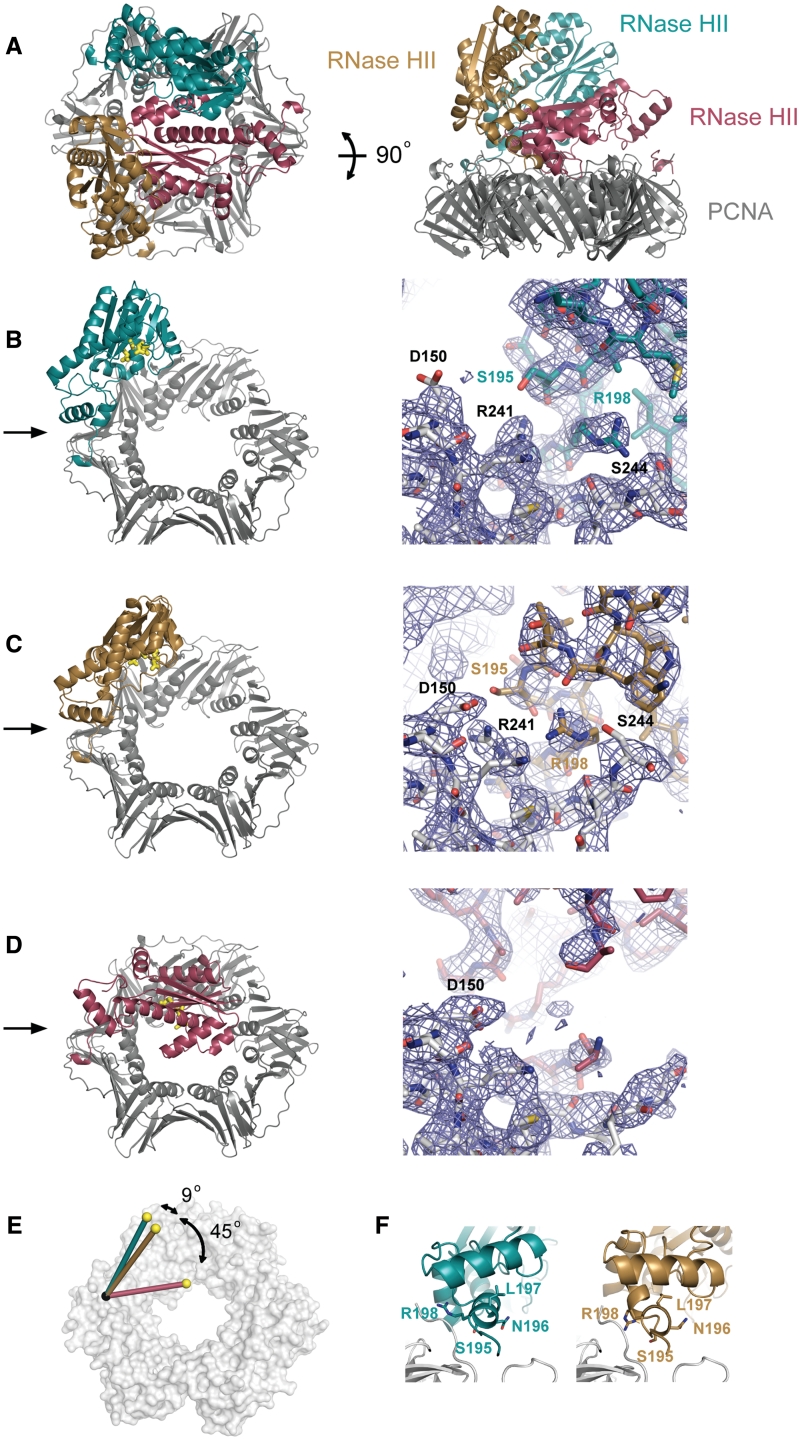
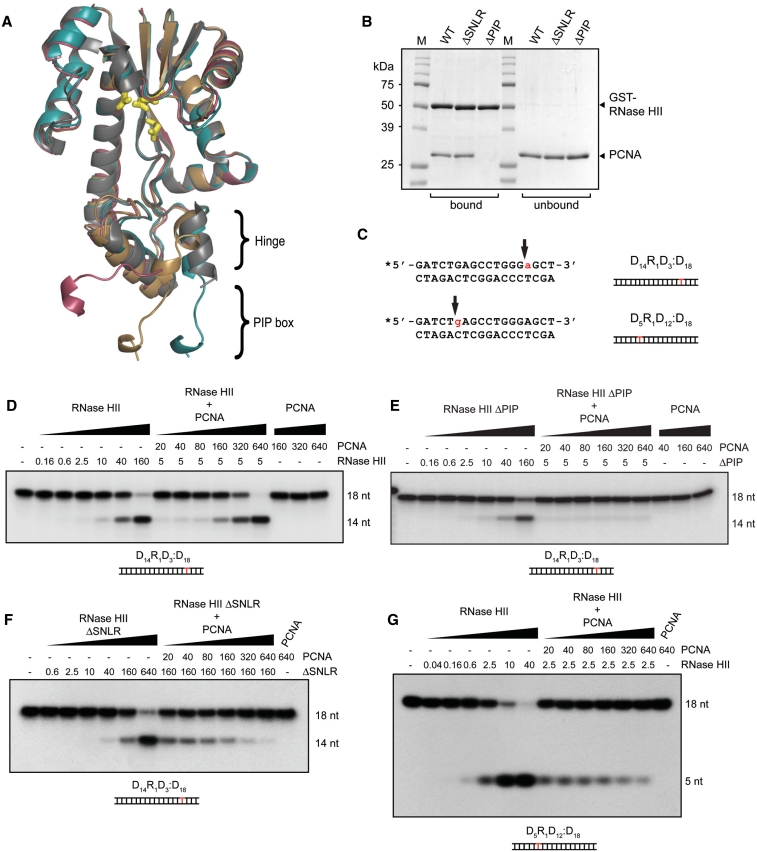
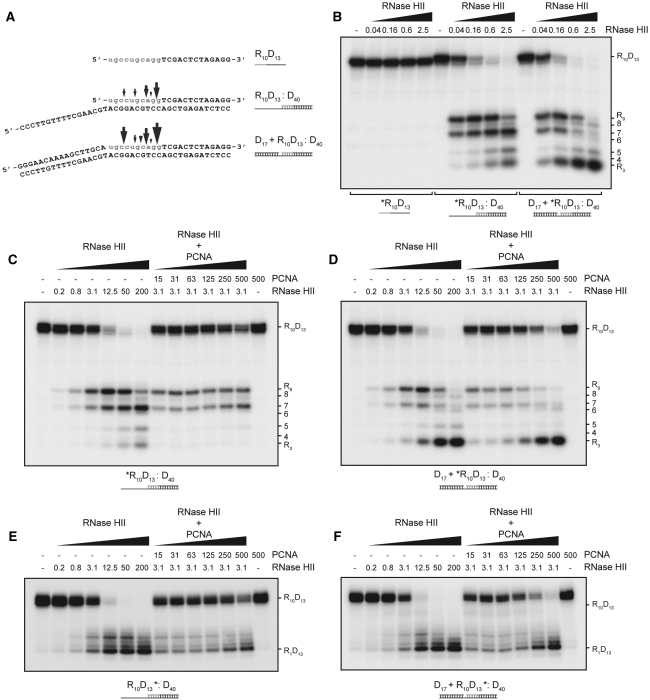
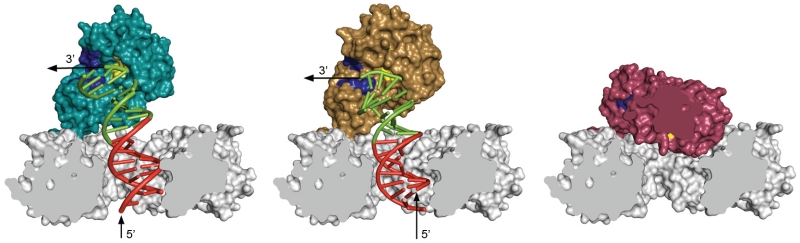
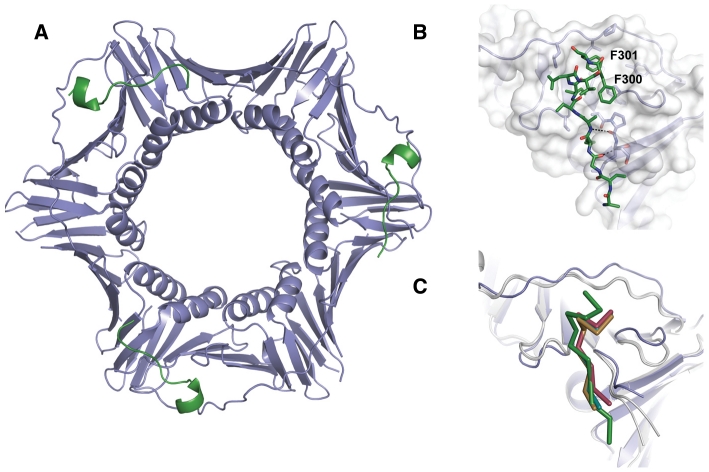
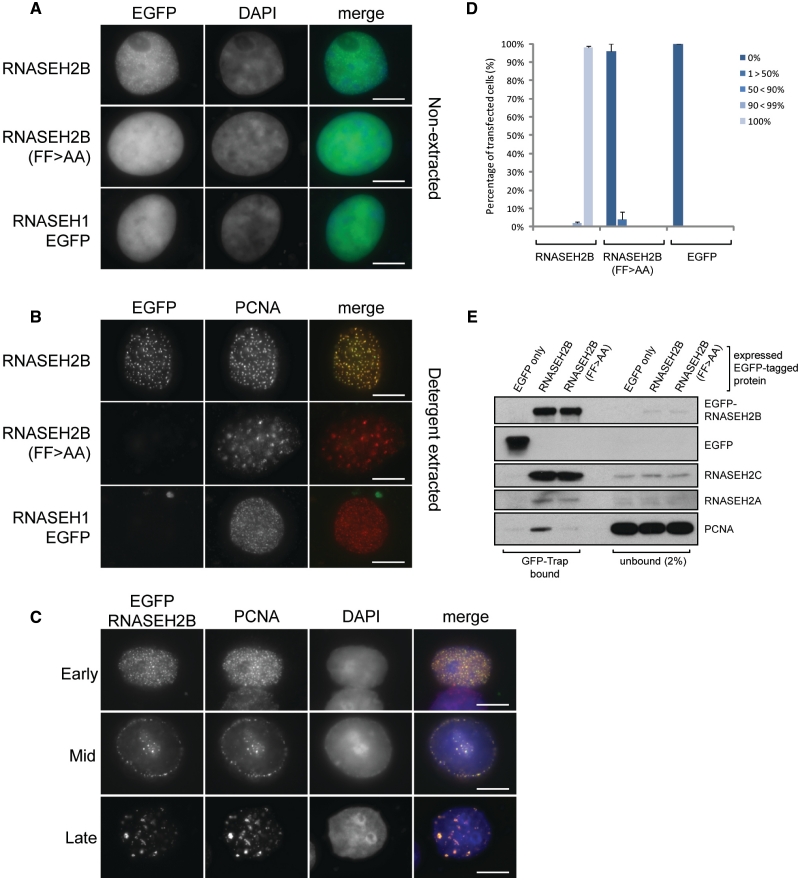
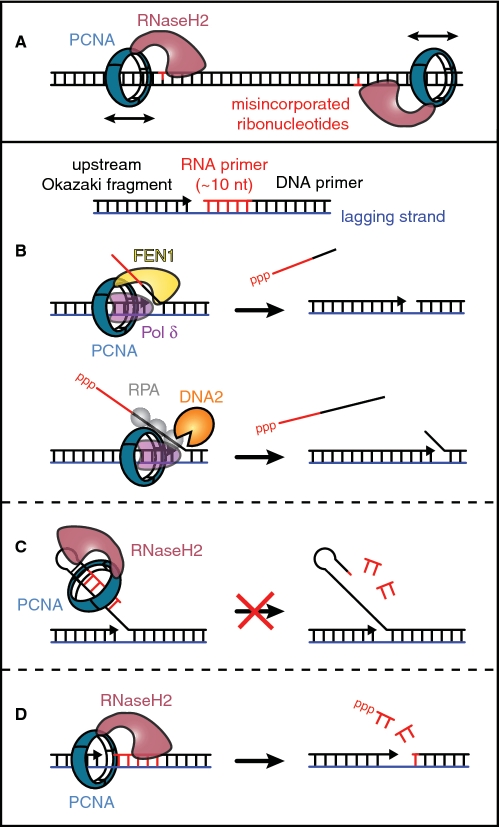
Ribonuclease H2 is the major nuclear enzyme degrading cellular RNA/DNA hybrids in eukaryotes and the sole nuclease known to be able to hydrolyze ribonucleotides misincorporated during genomic replication. Mutation in RNASEH2 causes Aicardi-Goutières syndrome, an auto-inflammatory disorder that may arise from nucleic acid byproducts generated during DNA replication. Here, we report the crystal structures of Archaeoglobus fulgidus RNase HII in complex with PCNA, and human PCNA bound to a C-terminal peptide of RNASEH2B. In the archaeal structure, three binding modes are observed as the enzyme rotates about a flexible hinge while anchored to PCNA by its PIP-box motif. PCNA binding promotes RNase HII activity in a hinge-dependent manner. It enhances both cleavage of ribonucleotides misincorporated in DNA duplexes, and the comprehensive hydrolysis of RNA primers formed during Okazaki fragment maturation. In addition, PCNA imposes strand specificity on enzyme function, and by localizing RNase H2 and not RNase H1 to nuclear replication foci in vivo it ensures that RNase H2 is the dominant RNase H activity during nuclear replication. Our findings provide insights into how type 2 RNase H activity is directed during genome replication and repair, and suggest a mechanism by which RNase H2 may suppress generation of immunostimulatory nucleic acids.
Overview
The claims and statistics of this paper haven’t been checked yet.
Free: it reads the open-access text and checks the first 5 claims that cite a source we can check. Create a free account to check every claim.
Integrity signals
Registry
Cites
Statistics
Figures
Verification
Claims the paper makes
The claims and statistics of this paper haven’t been checked yet.
Free: it reads the open-access text and checks the first 5 claims that cite a source we can check. Create a free account to check every claim.
Claims other papers make about this one
Each is checked against this paper’s own text: does it say what the citing paper says it does?
The cited source says what the claim attributes to it.
In the citing paper
“It has been shown in mammalian cells that this domain, which contains important residues F300 and F301, is essential for RNase H2 localization to the site of replication (Bubeck et al. 2011).”
From Ribonucleotide errors, RNase HII, and ribonucleotide excision repair (2026) · cites this paper as Bubeck et al. 2011
The cited source says what the claim attributes to it.
In the citing paper
“The motif inserts into a hydrophobic groove near the C-terminus of PCNA, stimulating activity of RNase HII on Okazaki fragments and single ribonucleotide errors (Bubeck et al. 2011).”
From Ribonucleotide errors, RNase HII, and ribonucleotide excision repair (2026) · cites this paper as Bubeck et al. 2011
The cited source says what the claim attributes to it.
In the citing paper
“Similar to what has been observed in eukaryotes, archaeal RNase HII can bind PCNA in three different modes via the PIP-box motif (Bubeck et al. 2011).”
From Ribonucleotide errors, RNase HII, and ribonucleotide excision repair (2026) · cites this paper as Bubeck et al. 2011
Self-check
Percentages, sums and reported differences re-computed from the paper’s own numbers.
The self-check needs the paper’s full text.
Citations
Cites
Coot : model-building tools for molecular graphics
Emsley, P., & Cowtan, K. (2004) · Acta Crystallographica Section D Biological Crystallography · doi:10.1107/s0907444904019158 · Cited by 30,571
PHENIX : a comprehensive Python-based system for macromolecular structure solution
Adams, P. D., Afonine, P. V., Bunkóczi, G., Chen, V. B., Davis, I. W., Echols, N., Headd, J. J., Hung, L.-W., Kapral, G. J., Grosse-Kunstleve, R. W., et al. (2010) · Acta Crystallographica Section D Biological Crystallography · doi:10.1107/s0907444909052925 · Cited by 23,716
The CCP4 suite: programs for protein crystallography
Collaborative Computational Project, N. 4. (1994) · Acta Crystallographica Section D Biological Crystallography · doi:10.1107/s0907444994003112 · Cited by 17,270
Inference of Macromolecular Assemblies from Crystalline State
Krissinel, E., & Henrick, K. (2007) · Journal of Molecular Biology · doi:10.1016/j.jmb.2007.05.022 · Cited by 9,984
PHENIX: a comprehensive Python-based system for macromolecular structure solution
Adams, P. D., Afonine, P. V., Bunkóczi, G., Chen, V. B., Davis, I. W., Echols, N., Headd, J. J., Hung, L.-W., Kapral, G. J., Grosse-Kunstleve, R. W., et al. (2012) · International Tables for Crystallography · doi:10.1107/97809553602060000865 · Cited by 7,334
MolProbity: all-atom contacts and structure validation for proteins and nucleic acids
Davis, I. W., Leaver-Fay, A., Chen, V. B., Block, J. N., Kapral, G. J., Wang, X., Murray, L. W., Arendall, W. B., Snoeyink, J., Richardson, J. S., et al. (2007) · Nucleic Acids Research · doi:10.1093/nar/gkm216 · Cited by 3,896
Likelihood-enhanced fast translation functions
McCoy, A. J., Grosse-Kunstleve, R. W., Storoni, L. C., & Read, R. J. (2005) · Acta Crystallographica Section D Biological Crystallography · doi:10.1107/s0907444905001617 · Cited by 1,639
xia2: an expert system for macromolecular crystallography data reduction
Winter, G. (2010) · Journal of Applied Crystallography · doi:10.1107/s0021889809045701 · Cited by 1,413
REFMAC 5 dictionary: organization of prior chemical knowledge and guidelines for its use
Vagin, A. A., Steiner, R. A., Lebedev, A. A., Potterton, L., McNicholas, S., Long, F., & Murshudov, G. N. (2004) · Acta Crystallographica Section D Biological Crystallography · doi:10.1107/s0907444904023510 · Cited by 1,350
Proliferating cell nuclear antigen (PCNA): a dancer with many partners
Maga, G., & Hübscher, U. (2003) · Journal of Cell Science · doi:10.1242/jcs.00653 · Cited by 1,096
Research works printed but not linked: 1
- Smart O Brandl M Flensburg C Keller P Paciorek W Vonrhein C Womack T Bricogne G Abstract TP139 Annual Meeting of the ACA 2008 Knoxville, TN, 137
Cited by
Reijns, M. A. M., Rabe, B., Rigby, R. E., Mill, P., Astell, K. R., Lettice, L. A., Boyle, S., Leitch, A., Keighren, M., Kilanowski, F., et al. (2012) · Cell · doi:10.1016/j.cell.2012.04.011 · Cited by 466
Self-citationRegulation of PCNA–protein interactions for genome stability
Mailand, N., Gibbs-Seymour, I., & Bekker-Jensen, S. (2013) · Nature Reviews Molecular Cell Biology · doi:10.1038/nrm3562 · Cited by 377
Sources, resolution and physiological relevance of R-loops and RNA–DNA hybrids
Petermann, E., Lan, L., & Zou, L. (2022) · Nature Reviews Molecular Cell Biology · doi:10.1038/s41580-022-00474-x · Cited by 372
Alabert, C., Bukowski-Wills, J.-C., Lee, S.-B., Kustatscher, G., Nakamura, K., de Lima Alves, F., Menard, P., Mejlvang, J., Rappsilber, J., & Groth, A. (2014) · Nature Cell Biology · doi:10.1038/ncb2918 · Cited by 353
RNase H2-Initiated Ribonucleotide Excision Repair
Sparks, J. L., Chon, H., Cerritelli, S. M., Kunkel, T. A., Johansson, E., Crouch, R. J., & Burgers, P. M. (2012) · Molecular Cell · doi:10.1016/j.molcel.2012.06.035 · Cited by 339
“The activity of an archaeal form of RNase H2 that also contains a PCNAinteraction motif is stimulated by PCNA (Bubeck et al., 2011).”
Human PCNA Structure, Function and Interactions
González-Magaña, A., & Blanco, F. J. (2020) · Biomolecules · doi:10.3390/biom10040570 · Cited by 286
Balakrishnan, L., & Bambara, R. A. (2013) · Annual Review of Biochemistry · doi:10.1146/annurev-biochem-072511-122603 · Cited by 280
Functions of Replication Protein A as a Sensor of R Loops and a Regulator of RNaseH1
Nguyen, H. D., Yadav, T., Giri, S., Saez, B., Graubert, T. A., & Zou, L. (2017) · Molecular Cell · doi:10.1016/j.molcel.2017.01.029 · Cited by 267
Replication-Coupled DNA Repair
Cortez, D. (2019) · Molecular Cell · doi:10.1016/j.molcel.2019.04.027 · Cited by 245
Mammalian RNase H2 removes ribonucleotides from DNA to maintain genome integrity
Hiller, B., Achleitner, M., Glage, S., Naumann, R., Behrendt, R., & Roers, A. (2012) · Journal of Experimental Medicine · doi:10.1084/jem.20120876 · Cited by 245
“A PCNA–RNase H2 complex was proposed to scan the genome for ribonucleotides (Bubeck et al., 2011).”
BackgroundN6-methyladenosine regulates the stability of RNA:DNA hybrids in human cells
Abakir, A., Giles, T. C., Cristini, A., Foster, J. M., Dai, N., Starczak, M., Rubio-Roldan, A., Li, M., Eleftheriou, M., Crutchley, J., et al. (2020) · Nature Genetics · doi:10.1038/s41588-019-0549-x · Cited by 243
Taylor, M. S., LaCava, J., Mita, P., Molloy, K. R., Huang, C. R. L., Li, D., Adney, E. M., Jiang, H., Burns, K. H., Chait, B. T., et al. (2013) · Cell · doi:10.1016/j.cell.2013.10.021 · Cited by 237
Out of Balance: R-loops in Human Disease
Groh, M., & Gromak, N. (2014) · PLoS Genetics · doi:10.1371/journal.pgen.1004630 · Cited by 200
Genome-wide DNA hypomethylation and RNA:DNA hybrid accumulation in Aicardi–Goutières syndrome
Lim, Y. W., Sanz, L. A., Xu, X., Hartono, S. R., & Chédin, F. (2015) · eLife · doi:10.7554/elife.08007 · Cited by 188
Processing ribonucleotides incorporated during eukaryotic DNA replication
Williams, J. S., Lujan, S. A., & Kunkel, T. A. (2016) · Nature Reviews Molecular Cell Biology · doi:10.1038/nrm.2016.37 · Cited by 188
Ribonucleotides Are Signals for Mismatch Repair of Leading-Strand Replication Errors
Lujan, S. A., Williams, J. S., Clausen, A. R., Clark, A. B., & Kunkel, T. A. (2013) · Molecular Cell · doi:10.1016/j.molcel.2013.03.017 · Cited by 183
“PCNA directs RNaseH2 to replication foci and imposes strand specificity on its function (Bubeck et al., 2011).”
RNases H: Structure and mechanism
Hyjek, M., Figiel, M., & Nowotny, M. (2019) · DNA Repair · doi:10.1016/j.dnarep.2019.102672 · Cited by 160
The PCNA interaction motifs revisited: thinking outside the PIP-box
Prestel, A., Wichmann, N., Martins, J. M., Marabini, R., Kassem, N., Broendum, S. S., Otterlei, M., Nielsen, O., Willemoës, M., Ploug, M., et al. (2019) · Cellular and Molecular Life Sciences · doi:10.1007/s00018-019-03150-0 · Cited by 112
De Biasio, A., de Opakua, A. I., Mortuza, G. B., Molina, R., Cordeiro, T. N., Castillo, F., Villate, M., Merino, N., Delgado, S., Gil-Cartón, D., et al. (2015) · Nature Communications · doi:10.1038/ncomms7439 · Cited by 96
Cristini, A., Tellier, M., Constantinescu, F., Accalai, C., Albulescu, L. O., Heiringhoff, R., Bery, N., Sordet, O., Murphy, S., & Gromak, N. (2022) · Nature Communications · doi:10.1038/s41467-022-30604-0 · Cited by 93
Maneuvers on PCNA Rings during DNA Replication and Repair
Slade, D. (2018) · Genes · doi:10.3390/genes9080416 · Cited by 100
Proliferating Cell Nuclear Antigen Structure and Interactions
Biasio, A. D., & Blanco, F. J. (2013) · Advances in protein chemistry and structural biology · doi:10.1016/b978-0-12-411637-5.00001-9 · Cited by 100
Direct visualization of transcription-replication conflicts reveals post-replicative DNA:RNA hybrids
Stoy, H., Zwicky, K., Kuster, D., Lang, K. S., Krietsch, J., Crossley, M. P., Schmid, J. A., Cimprich, K. A., Merrikh, H., & Lopes, M. (2023) · Nature Structural & Molecular Biology · doi:10.1038/s41594-023-00928-6 · Cited by 90
The Balancing Act of Ribonucleotides in DNA
Cerritelli, S. M., & Crouch, R. J. (2016) · Trends in Biochemical Sciences · doi:10.1016/j.tibs.2016.02.005 · Cited by 82
Li, P., Du, J., Goodier, J. L., Hou, J., Kang, J., Kazazian, H. H., Zhao, K., & Yu, X.-F. (2017) · Nucleic Acids Research · doi:10.1093/nar/gkx178 · Cited by 79
RNase H2, mutated in Aicardi‐Goutières syndrome, promotes LINE‐1 retrotransposition
Benitez‐Guijarro, M., Lopez‐Ruiz, C., Tarnauskaitė, Ž., Murina, O., Mian Mohammad, M., Williams, T. C., Fluteau, A., Sanchez, L., Vilar‐Astasio, R., Garcia‐Canadas, M., et al. (2018) · The EMBO Journal · doi:10.15252/embj.201798506 · Cited by 79
Self-citationPotenski, C. J., & Klein, H. L. (2014) · Nucleic Acids Research · doi:10.1093/nar/gku773 · Cited by 79
Single-stranded nucleic acids promote SAMHD1 complex formation
Tüngler, V., Staroske, W., Kind, B., Dobrick, M., Kretschmer, S., Schmidt, F., Krug, C., Lorenz, M., Chara, O., Schwille, P., et al. (2013) · Journal of Molecular Medicine · doi:10.1007/s00109-013-0995-3 · Cited by 86
Aicardi–Goutières syndrome: a model disease for systemic autoimmunity
Lee‐Kirsch, M. A., Wolf, C., & Günther, C. (2013) · Clinical & Experimental Immunology · doi:10.1111/cei.12160 · Cited by 85
Review: The lord of the rings: Structure and mechanism of the sliding clamp loader
Kelch, B. A. (2016) · Biopolymers · doi:10.1002/bip.22827 · Cited by 73
Marasco, L. E., Dujardin, G., Sousa‐Luís, R., Liu, Y. H., Stigliano, J. N., Nomakuchi, T. T., Proudfoot, N. J., Krainer, A. R., & Kornblihtt, A. R. (2022) · Cell · doi:10.1016/j.cell.2022.04.031 · Cited by 81
Molecular and physiological consequences of faulty eukaryotic ribonucleotide excision repair
Kellner, V., & Luke, B. (2020) · The EMBO Journal · doi:10.15252/embj.2019102309 · Cited by 68
Insights into RNA-processing pathways and associated RNA-degrading enzymes in Archaea
Clouet-d’Orval, B., Batista, M., Bouvier, M., Quentin, Y., Fichant, G. A., Marchfelder, A., & Maier, L. (2018) · FEMS Microbiology Reviews · doi:10.1093/femsre/fuy016 · Cited by 71
RNase H As Gene Modifier, Driver of Evolution and Antiviral Defense
Moelling, K., Broecker, F., Russo, G., & Sunagawa, S. (2017) · Frontiers in Microbiology · doi:10.3389/fmicb.2017.01745 · Cited by 66
Biasio, A. D., de Opakua, A. I., Cordeiro, T. N., Villate, M., Merino, N., Sibille, N., Lelli, M., Diercks, T., Bernadó, P., & Blanco, F. J. (2014) · Biophysical Journal · doi:10.1016/j.bpj.2013.12.046 · Cited by 70
Human DNA Polymerase ϵ Is Able to Efficiently Extend from Multiple Consecutive Ribonucleotides
Göksenin, A. Y., Zahurancik, W., LeCompte, K. G., Taggart, D. J., Suo, Z., & Pursell, Z. F. (2012) · Journal of Biological Chemistry · doi:10.1074/jbc.m112.422733 · Cited by 61
Mechanisms of damage tolerance and repair during DNA replication
Ashour, M. E., & Mosammaparast, N. (2021) · Nucleic Acids Research · doi:10.1093/nar/gkab101 · Cited by 58
Coordination of multiple enzyme activities by a single PCNA in archaeal Okazaki fragment maturation
Beattie, T. R., & Bell, S. D. (2012) · The EMBO Journal · doi:10.1038/emboj.2012.12 · Cited by 61
The Smc5/6 complex regulates the yeast Mph1 helicase at RNA-DNA hybrid-mediated DNA damage
Lafuente-Barquero, J. F., Luke-Glaser, S., Graf, M., Silva, S. D. R., Gómez‐González, B., Lockhart, A., Lisby, M., Aguilera, A., & Luke, B. (2017) · PLoS Genetics · doi:10.1371/journal.pgen.1007136 · Cited by 65
Human RNase H1 Is Associated with Protein P32 and Is Involved in Mitochondrial Pre-rRNA Processing
Wu, H., Sun, H., Liang, X., Lima, W. F., & Crooke, S. T. (2013) · PLoS ONE · doi:10.1371/journal.pone.0071006 · Cited by 60
Liu, B., Hu, J., Wang, J., & Kong, D. (2017) · Journal of Biological Chemistry · doi:10.1074/jbc.m116.758599 · Cited by 62
Luminescent oligonucleotide-based detection of enzymes involved with DNA repair
Leung, C., Zhong, H., He, H., Lu, L., Chan, D. S., & Ma, D. (2013) · Chemical Science · doi:10.1039/c3sc51228b · Cited by 50
A Saccharomyces cerevisiae RNase H2 Interaction Network Functions To Suppress Genome Instability
Allen, S., Martinez, S. L., Putnam, C. D., & Kolodner, R. D. (2014) · Molecular and Cellular Biology · doi:10.1128/mcb.00960-13 · Cited by 48
The sliding clamp tethers the endonuclease domain of MutL to DNA
Pillon, M. C., Babu, V. M. P., Randall, J. R., Cai, J., Simmons, L. A., Sutton, M. D., & Guarné, A. (2015) · Nucleic Acids Research · doi:10.1093/nar/gkv918 · Cited by 52
Aicardi–Goutieres syndrome: from patients to genes and beyond
Chahwan, C., & Chahwan, R. (2012) · Clinical Genetics · doi:10.1111/j.1399-0004.2011.01825.x · Cited by 53
Ribonuclease H2 in health and disease
Reijns, M. A. M., & Jackson, A. P. (2014) · Biochemical Society Transactions · doi:10.1042/bst20140079 · Cited by 45
Self-citationCordeiro, T. N., Chen, P.-C., De Biasio, A., Sibille, N., Blanco, F. J., Hub, J. S., Crehuet, R., & Bernadó, P. (2017) · Nucleic Acids Research · doi:10.1093/nar/gkw1183 · Cited by 42
Molecular machines in archaeal DNA replication
Beattie, T. R., & Bell, S. D. (2011) · Current Opinion in Chemical Biology · doi:10.1016/j.cbpa.2011.07.017 · Cited by 40
p53-dependent R-loop formation and HPV pathogenesis
Templeton, C. W., & Laimins, L. A. (2023) · Proceedings of the National Academy of Sciences · doi:10.1073/pnas.2305907120 · Cited by 38
McDonald, J. P., Vaisman, A., Kuban, W., Goodman, M. F., & Woodgate, R. (2012) · PLoS Genetics · doi:10.1371/journal.pgen.1003030 · Cited by 38
“Previous studies suggest that the 39 cut is made by FEN-1-like proteins [32] and that RNase HII nicking activity is promoted by binding to PCNA [33].”
Kind, B., Muster, B., Staroske, W., Herce, H. D., Sachse, R., Rapp, A., Schmidt, F., Koss, S., Cardoso, M. C., & Lee-Kirsch, M. A. (2014) · Human Molecular Genetics · doi:10.1093/hmg/ddu319 · Cited by 38
Kalhorzadeh, P., Hu, Z., Cools, T., Amiard, S., Willing, E.-M., De Winne, N., Gevaert, K., De Jaeger, G., Schneeberger, K., White, C. I., et al. (2014) · The Plant Cell · doi:10.1105/tpc.114.128108 · Cited by 37
Targeting PCNA with Peptide Mimetics for Therapeutic Purposes
Horsfall, A. J., Abell, A. D., & Bruning, J. B. (2019) · ChemBioChem · doi:10.1002/cbic.201900275 · Cited by 38
Lee, H., Cho, H., Kim, J., Lee, S., Yoo, J., Park, D., & Lee, G. (2021) · Nucleic Acids Research · doi:10.1093/nar/gkab1064 · Cited by 36
p21 Exploits Residue Tyr151 as a Tether for High-Affinity PCNA Binding
Kroker, A. J., & Bruning, J. B. (2015) · Biochemistry · doi:10.1021/acs.biochem.5b00241 · Cited by 37
Current perspectives on mechanisms of ribonucleotide incorporation and processing in mammalian DNA
Sassa, A., Yasui, M., & Honma, M. (2019) · Genes and Environment · doi:10.1186/s41021-019-0118-7 · Cited by 36
Mentegari, E., Crespan, E., Bavagnoli, L., Kiššová, M., Bertoletti, F., Sabbioneda, S., Imhof, R., Sturla, S. J., Nilforoushan, A., Hübscher, U., et al. (2016) · Nucleic Acids Research · doi:10.1093/nar/gkw1275 · Cited by 44
Hogg, M., & Johansson, E. (2012) · Sub-cellular biochemistry/Subcellular biochemistry · doi:10.1007/978-94-007-4572-8_13 · Cited by 38
Proliferating Cell Nuclear Antigen (PCNA) Interactions in Solution Studied by NMR
Biasio, A. D., Campos‐Olivas, R., Sánchez, R., López-Alonso, J. P., Pantoja‐Uceda, D., Merino, N., Villate, M., Martin-Garcia, J. M., Castillo, F., Luque, I., et al. (2012) · PLoS ONE · doi:10.1371/journal.pone.0048390 · Cited by 40
PSIP1/LEDGF reduces R-loops at transcription sites to maintain genome integrity
Jayakumar, S., Patel, M., Boulet, F., Aziz, H., Brooke, G. N., Tummala, H., & Pradeepa, M. M. (2024) · Nature Communications · doi:10.1038/s41467-023-44544-w · Cited by 34
Balachander, S., Gombolay, A. L., Yang, T., Xu, P., Newnam, G., Keskin, H., El-Sayed, W. M. M., Bryksin, A. V., Tao, S., Bowen, N. E., et al. (2020) · Nature Communications · doi:10.1038/s41467-020-16152-5 · Cited by 29
Tannous, E., Kanaya, E. N., & Kanaya, S. (2015) · Scientific Reports · doi:10.1038/srep09969 · Cited by 34
RNase H2 degrades toxic RNA:DNA hybrids behind stalled forks to promote replication restart
Heuzé, J., Kemiha, S., Barthe, A., Torán-Vilarrubias, A., Aouadi, E., Aiello, U., Libri, D., Lin, Y., Lengronne, A., Poli, J., et al. (2023) · The EMBO Journal · doi:10.15252/embj.2022113104 · Cited by 31
Briggs, E. M., Crouch, K., Lemgruber, L., Hamilton, G. M., Lapsley, C. T., & McCulloch, R. (2019) · Nucleic Acids Research · doi:10.1093/nar/gkz644 · Cited by 32
Mottaghi-Dastjerdi, N., Soltany‐Rezaee‐Rad, M., Sepehrizadeh, Z., Roshandel, G., Ebrahimifard, F., & Setayesh, N. (2014) · Human & Experimental Toxicology · doi:10.1177/0960327114532386 · Cited by 26
Behrendt, R., & Roers, A. (2013) · Clinical & Experimental Immunology · doi:10.1111/cei.12147 · Cited by 27
Real time monitoring of junction ribonuclease activity of RNase H using chimeric molecular beacons
Liu, B., Xiang, D., Long, Y., & Tong, C. (2013) · The Analyst · doi:10.1039/c3an36414c · Cited by 26
Burkhart, B. W., Cubonova, L., Heider, M. R., Kelman, Z., Reeve, J. N., & Santangelo, T. J. (2017) · Journal of Bacteriology · doi:10.1128/jb.00141-17 · Cited by 25
Fibrillarin Ribonuclease Activity is Dependent on the GAR Domain and Modulated by Phospholipids
Guillén-Chable, F., Rodríguez-Corona, U., Pereira‐Santana, A., Bayona, A., Rodríguez‐Zapata, L. C., Aquino-Perez, C., Šebestová, L., Vitale, N., Hozák, P., & Castaño, E. (2020) · Cells · doi:10.3390/cells9051143 · Cited by 28
Aicardi–Goutières syndrome: clues from the RNase H2 knock-out mouse
Rabe, B. (2013) · Journal of Molecular Medicine · doi:10.1007/s00109-013-1061-x · Cited by 32
A Disease-Causing Variant in PCNA Disrupts a Promiscuous Protein Binding Site
Duffy, C. M., Hilbert, B. J., & Kelch, B. A. (2015) · Journal of Molecular Biology · doi:10.1016/j.jmb.2015.11.029 · Cited by 27
Hilario, E., Li, Y., Nobumori, Y., Liu, X., & Fan, L. (2013) · Acta Crystallographica Section D Biological Crystallography · doi:10.1107/s0907444912045040 · Cited by 31
Transcription-Replication Collisions—A Series of Unfortunate Events
Germain, C. S., Zhao, H., & Barlow, J. H. (2021) · Biomolecules · doi:10.3390/biom11081249 · Cited by 22
Magaña, A. G., de Opakua, A. I., Romano‐Moreno, M., Murciano‐Calles, J., Merino, N., Luque, I., Rojas, A. L., Onesti, S. C. E., Blanco, F. J., & Biasio, A. D. (2019) · Journal of Biological Chemistry · doi:10.1074/jbc.ra118.006391 · Cited by 25
Rice, G. I., Reijns, M. A. M., Coffin, S. R., Forte, G. M. A., Anderson, B. H., Szynkiewicz, M., Gornall, H., Gent, D., Leitch, A., Botella, M. P., et al. (2013) · Human Mutation · doi:10.1002/humu.22336 · Cited by 21
Self-citationRings in the Extreme: PCNA Interactions and Adaptations in the Archaea
Winter, J. A., & Bunting, K. A. (2012) · Archaea · doi:10.1155/2012/951010 · Cited by 26
Flexibility of PCNA-Protein Interface Accommodates Differential Binding Partners
Pedley, A. M., Lill, M. A., & Davisson, V. J. (2014) · PLoS ONE · doi:10.1371/journal.pone.0102481 · Cited by 24
RNA polymerase drives ribonucleotide excision DNA repair in E. coli
Hao, Z., Gowder, M., Proshkin, S., Bharati, B. K., Epshtein, V., Svetlov, V., Shamovsky, I., & Nudler, E. (2023) · Cell · doi:10.1016/j.cell.2023.04.029 · Cited by 19
“Mammalian RNaseH2 has been proposed to interact with the replicativemachineryand/orPCNA,whichmayenable its1Dscanning for rNMPs.(30,31)Our in vivoXLMSanalysis detects no stable or specific interaction between RNaseHII and bacterial replisome or its associated factors, including a PCNA paralog—DnaN beta clamp (Figure 1A…”
R-loops: a key driver of inflammatory responses in cancer
Lee, S. Y., Kwak, M., & Kim, J. J. (2025) · Experimental & Molecular Medicine · doi:10.1038/s12276-025-01495-0 · Cited by 21
ATXR5/6 Forms Alternative Protein Complexes with PCNA and the Nucleosome Core Particle
Davarinejad, H., Joshi, M., Ait-Hamou, N., Munro, K. A., & Couture, J. (2019) · Journal of Molecular Biology · doi:10.1016/j.jmb.2019.02.020 · Cited by 18
Xie, Y., Wang, N., Li, Y., Deng, T., Li, J., Zhang, K., & Yu, R. (2019) · Analytica Chimica Acta · doi:10.1016/j.aca.2019.08.059 · Cited by 18
Wang, T., & Wang, Z. (2025) · Journal of Medicinal Chemistry · doi:10.1021/acs.jmedchem.4c00526 · Cited by 22
Templeton, C. W., & Laimins, L. A. (2024) · PLoS Pathogens · doi:10.1371/journal.ppat.1012454 · Cited by 19
Malfatti, M. C., Henneke, G., Balachander, S., Koh, K. D., Newnam, G., Uehara, R., Crouch, R. J., Storici, F., & Tell, G. (2019) · Journal of Biological Chemistry · doi:10.1074/jbc.ra119.009493 · Cited by 17
“In addition, subunit B contains the proliferating cell nuclear antigen–interacting motif (PIP box) that allows recruitment of the enzyme to the replication fork (25).”
BackgroundThe catalytic mechanism, metal dependence, substrate specificity, and biodiversity of ribonuclease H
Pang, J., Guo, Q., & Lu, Z. (2022) · Frontiers in Microbiology · doi:10.3389/fmicb.2022.1034811 · Cited by 20
PCNA dependent cellular activities tolerate dramatic perturbations in PCNA client interactions
Wilson, R. H. C., Biasutto, A., Wang, L., Fischer, R., Baple, E. L., Crosby, A. H., Mancini, E. J., & Green, C. (2017) · DNA repair · doi:10.1016/j.dnarep.2016.12.003 · Cited by 17
Williams, J. S., Lujan, S. A., Zhou, Z.-X., Burkholder, A., Clark, A. B., Fargo, D. C., & Kunkel, T. A. (2019) · DNA repair · doi:10.1016/j.dnarep.2019.102641 · Cited by 17
Sulfolobus chromatin proteins modulate strand displacement by DNA polymerase B1
Sun, F., & Huang, L. (2013) · Nucleic Acids Research · doi:10.1093/nar/gkt588 · Cited by 21
Zannini, L., Cardano, M., Liberi, G., & Buscemi, G. (2024) · Cellular and Molecular Life Sciences · doi:10.1007/s00018-024-05380-3 · Cited by 18
Shapson-Coe, A., Valeiras, B., Wall, C., & Rada, C. (2019) · PLOS ONE · doi:10.1371/journal.pone.0213553 · Cited by 13
Mechanism of nucleotide discrimination by the translesion synthesis polymerase Rev1
Weaver, T., Click, T. H., Khoang, T. H., Washington, M. T., Agarwal, P. K., & Freudenthal, B. (2022) · Nature Communications · doi:10.1038/s41467-022-30577-0 · Cited by 16
Qian, J., Chen, Y., Xu, Y., Zhang, X., Kang, Z., Jiao, J., & Zhao, J. (2019) · BMC Plant Biology · doi:10.1186/s12870-019-1874-z · Cited by 13
Mayanagi, K., Oki, K., Miyazaki, N., Ishino, S., Yamagami, T., Morikawa, K., Iwasaki, K., Kohda, D., Shirai, T., & Ishino, Y. (2020) · BMC Biology · doi:10.1186/s12915-020-00889-y · Cited by 17
Synergistic action of human RNaseH2 and the RNA helicase-nuclease DDX3X in processing R-loops
Secchi, M., Garbelli, A., Riva, V., Deidda, G., Carolina, S., Formica, T. M., Sabbioneda, S., Crespan, E., & Maga, G. (2024) · Nucleic Acids Research · doi:10.1093/nar/gkae731 · Cited by 14
Mechanistic investigation of human maturation of Okazaki fragments reveals slow kinetics
Raducanu, V., Tehseen, M., Al-Amodi, A. M., Joudeh, L. I., Biasio, A. D., & Hamdan, S. M. (2022) · Nature Communications · doi:10.1038/s41467-022-34751-2 · Cited by 19
Minias, A. E., Brzostek, A. M., Minias, P., & Dziadek, J. (2015) · PLoS ONE · doi:10.1371/journal.pone.0115521 · Cited by 12
Senataxin deficiency disrupts proteostasis through nucleolar ncRNA-driven protein aggregation
Wen, X., Xu, H., Woolley, P. R., Conway, O. M., Yao, J., Matouschek, A. T., Lambowitz, A. M., & Paull, T. T. (2024) · The Journal of Cell Biology · doi:10.1083/jcb.202309036 · Cited by 11
Structural insight into Okazaki fragment maturation mediated by PCNA-bound FEN1 and RNaseH2
Tian, Y., Li, N., Li, Q., & Gao, N. (2024) · The EMBO Journal · doi:10.1038/s44318-024-00296-x · Cited by 14
Rezaei‐Lotfi, S., Vujovic, F., Simonian, M. R., Hunter, N., & Farahani, R. H. (2020) · Genome biology · doi:10.1186/s13059-021-02555-0 · Cited by 8
RTF2 controls replication repriming and ribonucleotide excision at the replisome
Conti, B. A., Ruiz, P. D., Broton, C., Blobel, N. J., Kottemann, M. C., Sridhar, S., Lach, F. P., Wiley, T. F., Sasi, N. K., Carroll, T., et al. (2024) · Nature Communications · doi:10.1038/s41467-024-45947-z · Cited by 8
“RNase H2 has been previously reported to localize to the replication fork through its PCNA-interacting protein-box (PIP-box) in the RNaseH2B subunit 11,12 .”
Influential
Metadata
- Authors
- Bubeck, D., Reijns, M. A. M., Graham, S. C., Astell, K. R., Jones, E. Y., & Jackson, A. P.
- Affiliations
- Centre for Human Genetics (GB)
- Corresponding author
- Jackson, Andrew P.
- Venue
- Nucleic Acids Research
- Publisher
- Oxford University Press (OUP)
- Published
- 2011-01-17
- Volume
- 39
- Issue
- 9
- Pages
- 3652-3666
- ISSN
- 0305-1048 (ISSN-L)
- 1362-4962
- PMC
- PMC3089482
- OpenAlex
- W2117423564
- Cited by
- 144
- References
- 60
- Citations by year
- 2026: 7 · 2025: 10 · 2024: 9 · 2023: 7 · 2022: 8 · 2021: 4 · 2020: 8 · 2019: 16 · 2018: 4 · 2017: 12 · 2016: 8 · 2015: 8 · 2014: 13 · 2013: 16 · 2012: 9
- FWCI
- 5.46
- Type
- journal article
- Language
- en
- Open access
- gold
- doi.org
- Licence
- Locations
- Nucleic Acids Research (publishedVersion, cc-by-nc)
- PubMed Central (publishedVersion, cc-by-nc)
- PubMed (publishedVersion)
- Edinburgh Research Explorer (University of Edinburgh) (submittedVersion, cc-by-nc)
- Funders
- Wellcome Trust (075491, 075491/Z/04,, 090532)
- Diamond Light Source
- Cancer Research UK
- Medical Research Council (MC_EX_G0601852)
- Topics
- Life Sciences › Biochemistry, Genetics and Molecular Biology › Molecular Biology › DNA Repair Mechanisms
- Life Sciences › Biochemistry, Genetics and Molecular Biology › Molecular Biology › DNA and Nucleic Acid Chemistry
- Life Sciences › Biochemistry, Genetics and Molecular Biology › Structural Biology › Enzyme Structure and Function
- Keywords
- PCNA, RNase H2, RNase H1, DNA replication, DNA repair, Aicardi-Goutières syndrome, Archaeoglobus fulgidus, crystal structure, Okazaki fragment maturation, strand specificity, autoinflammatory disease
- MeSH terms
- Crystallography, DNA Replication, Humans, Models, Molecular, Peptides, Ribonuclease H, Proliferating Cell Nuclear Antigen, Archaeoglobus fulgidus, DNA Repair Enzymes
About these checks
Registry, retraction, Cites and statistics results are computed, not judged, with one exception: a printed reference that no index lists is read once by a model before it counts as a citation error. Claims are extracted by a model and kept only when their quote appears verbatim in the text; each cited source is then checked, with a model’s help, for whether it says what the claim relies on. Those verdicts can be wrong — read the claim’s quote and the cited source before relying on one.
Statistics and arithmetic are recomputed, not judged.
Confidence bands are shown only for fields calibrated on our annotated test set. None is calibrated yet, so no band is shown.
What counts as a claim ›How we measure confidence ›How we check this ›
Are you an author, or do you see a problem with this page? Request a review
Data sources
Bibliographic data: Semantic Scholar, OpenAlex, Crossref.
Contains information from the Semantic Scholar Academic Graph Datasets, made available under the ODC Attribution License (ODC-BY 1.0).
Semantic Scholar’s data is described in: Kinney, R., et al. (2023). The Semantic Scholar Open Data Platform. arXiv:2301.10140.
