

The DOI matches its Crossref record; 56 of the 56 references it cites were found in a registry or an index.
Knock-in of large reporter genes in human cells via CRISPR/Cas9-induced homology-dependent and independent DNA repair
Open accessAbstract
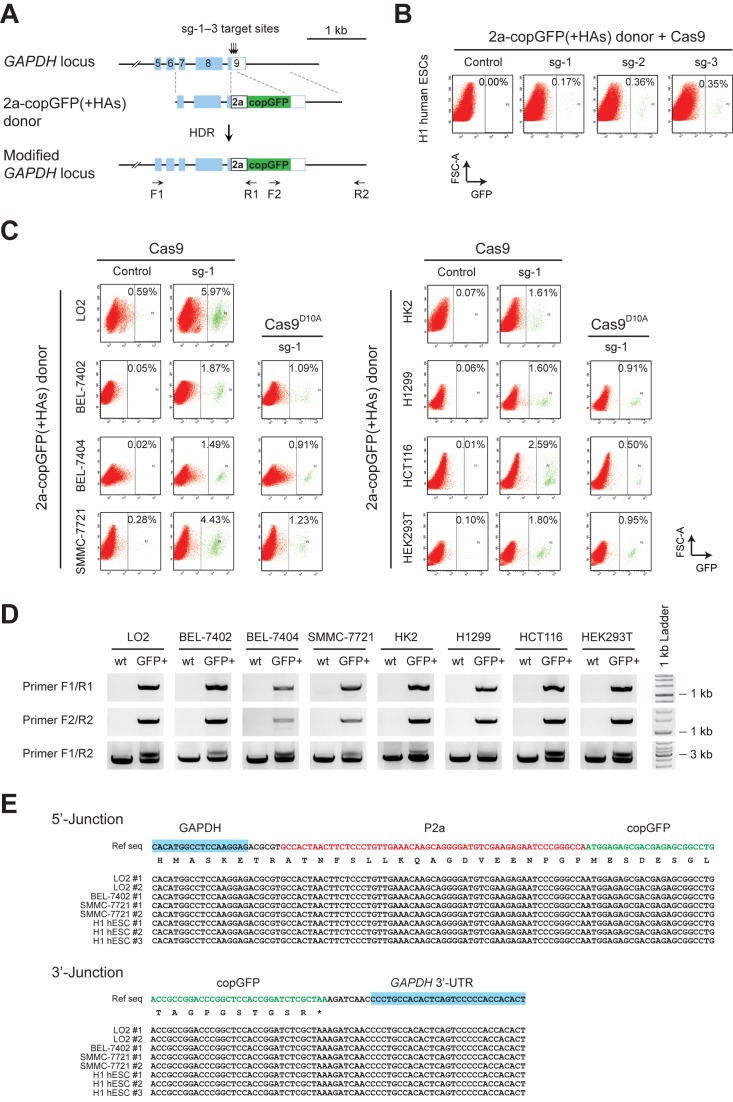
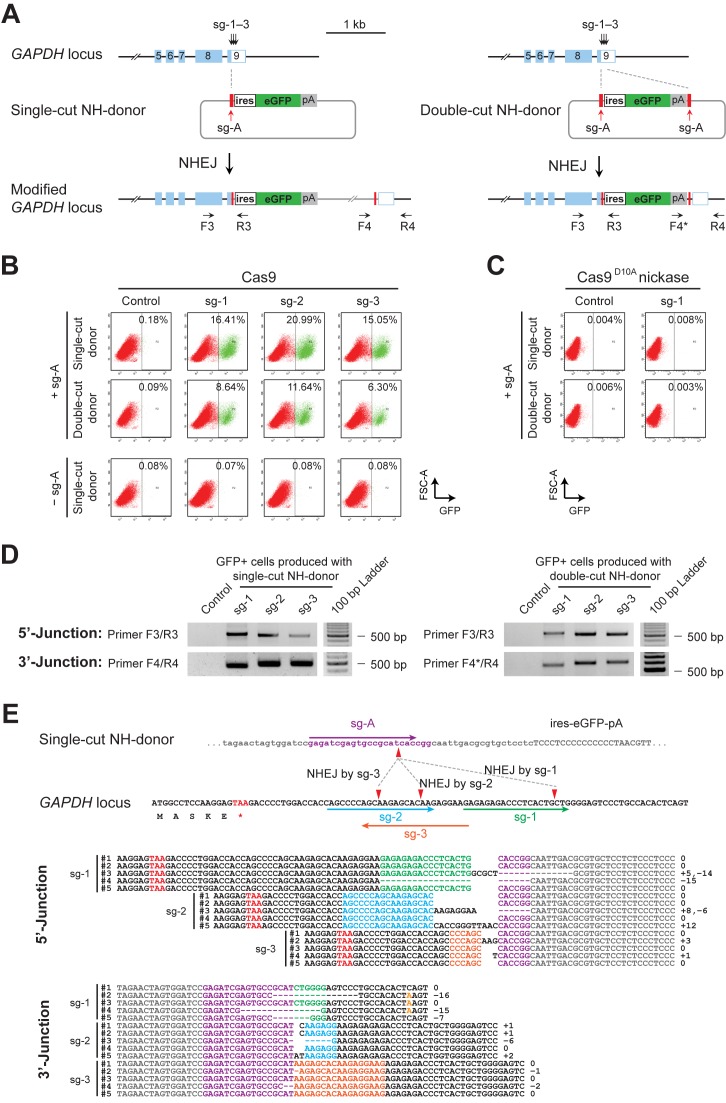
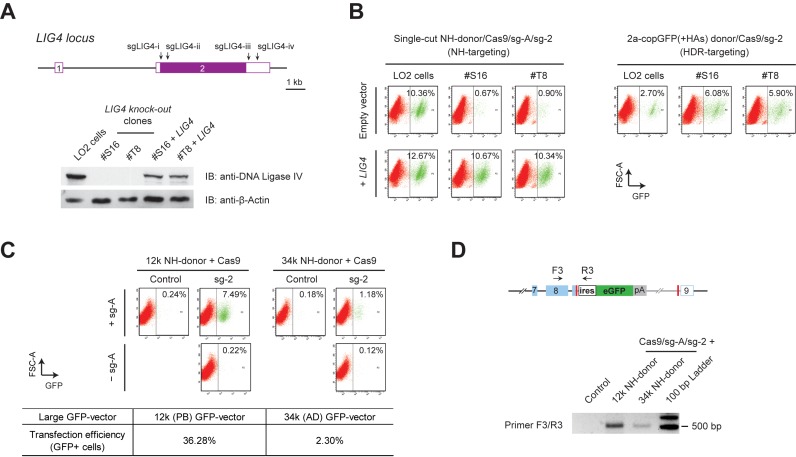
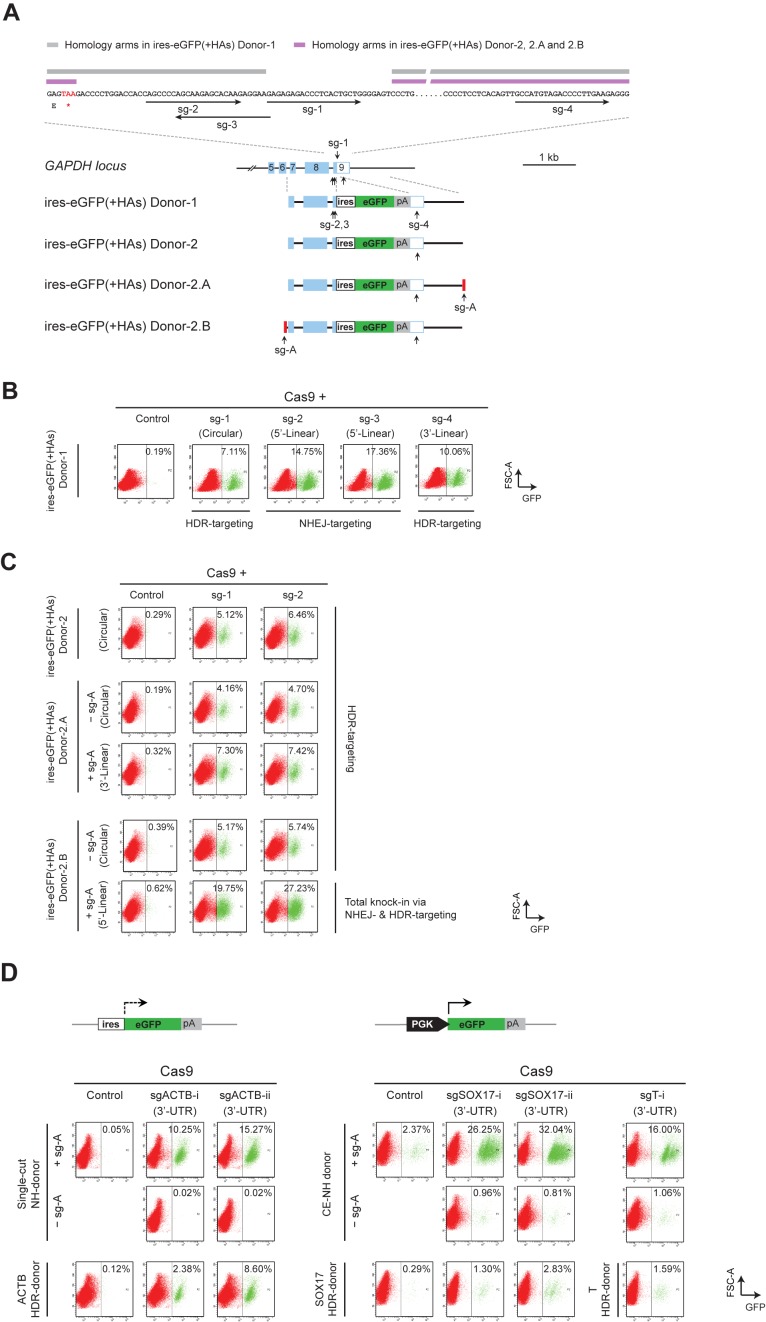
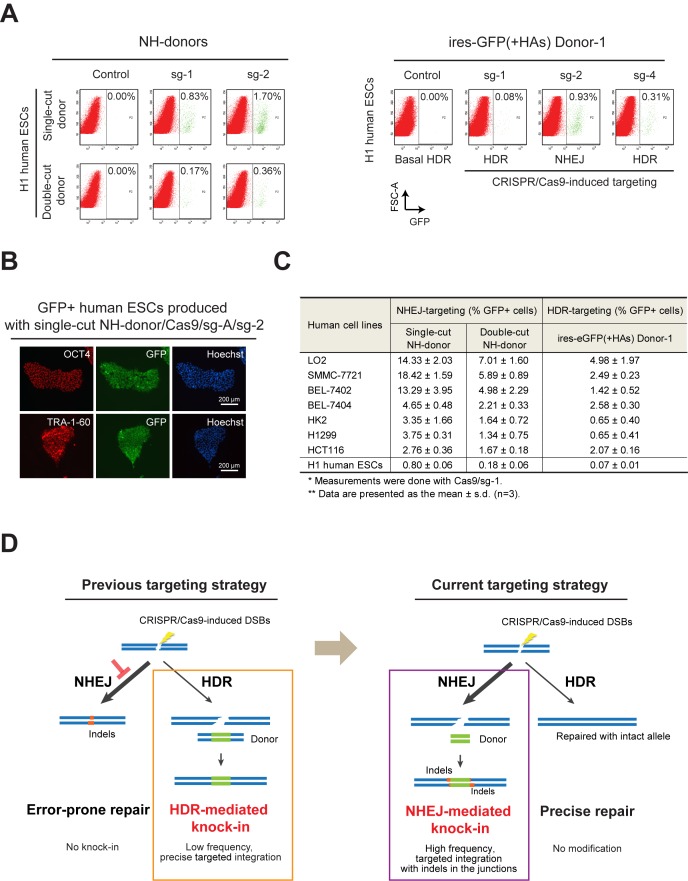
CRISPR/Cas9-induced site-specific DNA double-strand breaks (DSBs) can be repaired by homology-directed repair (HDR) or non-homologous end joining (NHEJ) pathways. Extensive efforts have been made to knock-in exogenous DNA to a selected genomic locus in human cells; which, however, has focused on HDR-based strategies and was proven inefficient. Here, we report that NHEJ pathway mediates efficient rejoining of genome and plasmids following CRISPR/Cas9-induced DNA DSBs, and promotes high-efficiency DNA integration in various human cell types. With this homology-independent knock-in strategy, integration of a 4.6 kb promoterless ires-eGFP fragment into the GAPDH locus yielded up to 20% GFP+ cells in somatic LO2 cells, and 1.70% GFP+ cells in human embryonic stem cells (ESCs). Quantitative comparison further demonstrated that the NHEJ-based knock-in is more efficient than HDR-mediated gene targeting in all human cell types examined. These data support that CRISPR/Cas9-induced NHEJ provides a valuable new path for efficient genome editing in human ESCs and somatic cells.
Overview
The claims and statistics of this paper haven’t been checked yet.
Run the check — free, no account needed. It reads the open-access text and checks the sources it cites.
Integrity signals
Registry
Cites
Statistics
Figures
Verification
Claims the paper makes
The claims and statistics of this paper haven’t been checked yet.
Run the check — free, no account needed. It reads the open-access text and checks the sources it cites.
Claims other papers make about this one
Each is checked against this paper’s own text: does it say what the citing paper says it does?
The source backs part of the claim, not all of it — or backs it for a different population, condition or comparison.
In the citing paper
“Researchers have also developed a homology-independent targeted integration (HITI) strategy as an alternative to HDR, a technique that allows DNA integration in both dividing and non-dividing cells in vitro and in vivo [114,115].”
From CRISPR-Cas: Converting A Bacterial Defence Mechanism into A State-of-the-Art Genetic Manipulation Tool (2019) · cites this paper as [115]
Experimental — accuracy not yet measuredIn the citing paper
“The recently developed HITI strategy exhibits much higher knock-in efficiency than HDR both in vitro and in vivo [86, 87].”
From Non-viral delivery systems for CRISPR/Cas9-based genome editing: challenges and opportunities (2018) · cites this paper as [86]
Self-check
Percentages, sums and reported differences re-computed from the paper’s own numbers.
The self-check needs the paper’s full text.
Citations
Cites
Induction of Pluripotent Stem Cells from Adult Human Fibroblasts by Defined Factors
Takahashi, K., Tanabe, K., Ohnuki, M., Narita, M., Ichisaka, T., Tomoda, K., & Yamanaka, S. (2007) · Cell · doi:10.1016/j.cell.2007.11.019 · Cited by 20,221
A Programmable Dual-RNA–Guided DNA Endonuclease in Adaptive Bacterial Immunity
Jinek, M., Chylinski, K., Fonfara, I., Hauer, M., Doudna, J. A., & Charpentier, E. (2012) · Science · doi:10.1126/science.1225829 · Cited by 17,116
Embryonic Stem Cell Lines Derived from Human Blastocysts
Thomson, J. A., Itskovitz‐Eldor, J., Shapiro, S. S., Waknitz, M. A., Swiergiel, J. J., Marshall, V. S., & Jones, J. M. (1998) · Science · doi:10.1126/science.282.5391.1145 · Cited by 15,947
RNA-Guided Human Genome Engineering via Cas9
Mali, P., Yang, L., Esvelt, K. M., Aach, J., Guell, M., DiCarlo, J. E., Norville, J. E., & Church, G. M. (2013) · Science · doi:10.1126/science.1232033 · Cited by 9,210
The new frontier of genome engineering with CRISPR-Cas9
Doudna, J. A., & Charpentier, E. (2014) · Science · doi:10.1126/science.1258096 · Cited by 7,062
Development and Applications of CRISPR-Cas9 for Genome Engineering
Hsu, P. D., Lander, E. S., & Zhang, F. (2014) · Cell · doi:10.1016/j.cell.2014.05.010 · Cited by 5,762
Wang, H., Yang, H., Shivalila, C. S., Dawlaty, M. M., Cheng, A. W., Zhang, F., & Jaenisch, R. (2013) · Cell · doi:10.1016/j.cell.2013.04.025 · Cited by 3,495
The mechanism of double-strand DNA break repair by the nonhomologous DNA end-joining pathway
Lieber, M. R. (2010) · Annual Review of Biochemistry · doi:10.1146/annurev.biochem.052308.093131 · Cited by 2,882
Rationally engineered Cas9 nucleases with improved specificity
Slaymaker, I. M., Gao, L., Zetsche, B., Scott, D. A., Yan, W. X., & Zhang, F. (2016) · Science · doi:10.1126/science.aad5227 · Cited by 2,414
Improving CRISPR-Cas nuclease specificity using truncated guide RNAs
Fu, Y., Sander, J. D., Reyon, D., Cascio, V. M., & Joung, J. K. (2014) · Nature Biotechnology · doi:10.1038/nbt.2808 · Cited by 1,993 · cited 1×
“Briefly, target sequences (20 bp or 17 bp) starting with guanine and preceding the PAM motif (5′-NGG-3′) were selected from the target genomic regions (8,25).”
Background
Cited by
Sorted by citations
Items 201–300 of 338
Paranthaman, S., Uthaiah, C. A., Md, S., & Alkreathy, H. M. (2025) · Advances in Colloid and Interface Science · doi:10.1016/j.cis.2025.103497 · Cited by 8
Transgene integration in mammalian cells: The tools, the challenges, and the future
Fong, J. H. C., & Ceroni, F. (2025) · Cell Systems · doi:10.1016/j.cels.2025.101426 · Cited by 15
A cleavage-based surrogate reporter for the evaluation of CRISPR–Cas9 cleavage efficiency
Jung, S. B., Lee, C. Y., Lee, K., Heo, K., & Choi, S. H. (2021) · Nucleic Acids Research · doi:10.1093/nar/gkab467 · Cited by 8
“Another surrogate reporter, universal donor as reporter (UDAR), evaluates the efficiency of CRISPR–Cas9 by measuring the expression of EGFP that is integrated into the DSB region of the target gene using the NHEJ-mediated knock-in strategy (12,14,34).”
BackgroundHermantara, R., Richmond, L., Taqi, A. F., Chilaka, S., Jeantet, V., Guerrini, I., West, K. L., & West, A. G. (2024) · Journal of Biomedical Science · doi:10.1186/s12929-024-01020-x · Cited by 11
“The lower integration efficiency might be due to the kinetics of paired Cas9 nickase in generating DNA DSBs in which it requires double targeting at both ends of the target [2, 11, 60, 61].”
BackgroundEndogenous epitope tagging of heat shock protein 70 isoform Hsc70 using CRISPR/Cas9
Nitika, N., & Truman, A. W. (2017) · Cell Stress and Chaperones · doi:10.1007/s12192-017-0845-2 · Cited by 8
Vojnits, K., Nakanishi, M., Porras, D. P., Kim, Y., Feng, Z., Golubeva, D., & Bhatia, M. (2022) · Molecules · doi:10.3390/molecules27082434 · Cited by 10
A genome-wide CRISPR screen maps endogenous regulators of PPARG gene expression in bladder cancer
Tortora, D., Roberts, M. E., Kumar, G., Kotapalli, S. S., Ritch, E. J., Scurll, J., McConeghy, B. J., Sinha, S., Wyatt, A. W., Black, P. C., et al. (2023) · iScience · doi:10.1016/j.isci.2023.106525 · Cited by 8
Çağlayan, E. (2016) · Cell Biology International · doi:10.1002/cbin.10694 · Cited by 10
“In addition, efficient knock-in of exogenous DNA into a desired locus can be performed in human PSCs (He et al., 2016).”
BackgroundMethodGenome reprogramming for synthetic biology
Standage-Beier, K., & Wang, X. (2017) · Frontiers of Chemical Science and Engineering · doi:10.1007/s11705-017-1618-2 · Cited by 8
“NHEJ results in incorporation of the synthetic reporter at the location of sgRNA targeted cleavage [29].”
BackgroundRIPK1 regulates cell function and death mediated by UVB radiation and TNF-α
Zhao, Y., Chen, Y., Li, X., Sun, Y., Shao, Y., Zhang, Y., & Liu, Z. (2021) · Molecular Immunology · doi:10.1016/j.molimm.2021.04.024 · Cited by 8
Naert, T., Yamamoto, T., Han, S., Röck, R., Horn, M., Bethge, P., Vladimirov, N., Voigt, F. F., Figueiro‐Silva, J., Bachmann‐Gagescu, R., et al. (2025) · Nature Biotechnology · doi:10.1038/s41587-025-02771-0 · Cited by 8
The regulation of reporter transgene expression for diverse biological imaging applications
Battison, A. S., Merrill, J. R., Borniger, J. C., & Lyons, S. K. (2025) · npj Imaging · doi:10.1038/s44303-025-00070-6 · Cited by 7
“…that linear DNA can ef fi ciently be used to repair the double-stranded DNA break induced by Cas9, with or without homologous sequence 14,56 , CRISPR has made it feasible to generate precisely targeted reporter transgenes almost at will in a wide variety of cell types, not just murine…”
Live-cell fluorescence imaging of ciliary dynamics
Lü, Q., Zhang, C., & Westlake, C. J. (2021) · Biophysics Reports · doi:10.52601/bpr.2021.210005 · Cited by 7
Efficient and rapid fluorescent protein knock-in with universal donors in mouse embryonic stem cells
Shi, Y., Kopparapu, N., Ohler, L. S., & Dickinson, D. J. (2023) · Development · doi:10.1242/dev.201367 · Cited by 7
Lin, G., Zhang, K., Peng, R., Han, Y., Xie, J., & Li, J. (2018) · Journal of Molecular Diagnostics · doi:10.1016/j.jmoldx.2018.02.002 · Cited by 7
Yan, D., Meng, Y., Zhang, N., Zhao, Y., Ning, C., Zhu, L., Liu, Y., Wang, J., Li, C., Shen, X., et al. (2025) · Cell Reports · doi:10.1016/j.celrep.2025.116508 · Cited by 6
Dai, L., Yu, P., Fan, H., Xia, W., Zhao, Y., Zhang, P., Zhang, J. Z. H., Zhang, H., & Chen, Y. (2024) · International Journal of Molecular Sciences · doi:10.3390/ijms25147982 · Cited by 6
“We applied an established reporter system targeting the GAPDH locus in the human genome [30].”
MethodWang, Y., Jiang, J., Shang, K., Xu, X., & Sun, J. (2025) · Molecular Therapy · doi:10.1016/j.ymthe.2025.02.028 · Cited by 6
Edited course of biomedical research: leaping forward with CRISPR
Collins, P. J., Hale, C. M., & Xu, H. (2017) · Pharmacological Research · doi:10.1016/j.phrs.2017.09.008 · Cited by 6
Kararoudi, M. N., Likhite, S. B., Elmas, E., Schwartz, M., Meyer, K., & Lee, D. A. (2019) · bioRxiv (Cold Spring Harbor Laboratory) · doi:10.1101/743377 · Cited by 6
Li, J., Huang, S., & Chen, H. (2025) · Biology · doi:10.3390/biology14050521 · Cited by 5
Microcell-mediated chromosome transfer between non-identical human iPSCs
Uno, N., Miyamoto, H., Yamazaki, K., Egawa, M., Kobayashi, H., Kazuki, K., Osaki, M., Suzuki, T., Hamamichi, S., Oshimura, M., et al. (2024) · Molecular Therapy — Nucleic Acids · doi:10.1016/j.omtn.2024.102382 · Cited by 5
“33,34 Moreover, a comprehensive analysis was not performed for trisomy hPSC model cells with human chromosomes 8, 13, 18, and 21 generated by A9 libraries.”
Seo, Y., Tamari, K., Takahashi, Y., Minami, K., Tatekawa, S., Isohashi, F., Сузукі, О., Akino, Y., & Ogawa, K. (2021) · International Journal of Radiation Biology · doi:10.1080/09553002.2022.2020357 · Cited by 5
“We followed a method described by He et al. He et al. (2016) with minor modifications.”
MethodSuzuki, S., Chosa, K., Barillá, C., Yao, M., Zuffardi, O., Kai, H., Shuto, T., Suico, M. A., Kan, Y. W., Sargent, R. G., et al. (2022) · Frontiers in Genome Editing · doi:10.3389/fgeed.2022.843885 · Cited by 5
“…including insertion of whole targeting plasmid DNA, [PITCh (Microhomology-mediated end-joining, MMEJ) (Nakade et al., 2014), ObLiGaRe (NHEJ) (Maresca et al., 2013)], homologyindependent targeted integration (HITI) (Keiichiro Suzuki et al., 2016) and insertion in ESCs [NHEJ (He et al., 2016)].”
BackgroundMladenov, E., Paul‐Konietzko, K., Mladenova, V., Stuschke, M., & Iliakis, G. E. (2022) · International Journal of Molecular Sciences · doi:10.3390/ijms23169180 · Cited by 5
Generation of Hutat2:Fc Knockin Primary Human Monocytes Using CRISPR/Cas9
Wang, B., Zuo, J., Kang, W., Wei, Q., Li, J., Wang, C., Liu, Z., Lu, Y., Zhuang, Y., Dang, B., et al. (2018) · Molecular Therapy — Nucleic Acids · doi:10.1016/j.omtn.2018.01.012 · Cited by 5
CRISPR–Cas Gene Editing for Neurological Disease
Simpson, B. P., & Davidson, B. L. (2019) · Elsevier eBooks · doi:10.1016/b978-0-12-813997-4.00018-9 · Cited by 5
Mahmood, M., Taufiq, I., Mazhar, S., Hafeez, F., Malik, K. A., & Afzal, S. (2024) · Personalized Medicine · doi:10.1080/17410541.2024.2341610 · Cited by 4
Design of Large-Scale Reporter Construct Arrays for Dynamic, Live Cell Systems Biology
Decker, J. T., Hall, M. S., Bernabé, B. P., Blaisdell, R. B., Liebman, L. N., Jeruss, J. S., & Shea, L. D. (2018) · ACS Synthetic Biology · doi:10.1021/acssynbio.8b00236 · Cited by 4
Kim, S.-Y., Kim, G.-Y., You, H.-J., & Kang, M. (2021) · Animal Bioscience · doi:10.5713/ab.21.0117 · Cited by 4
“5% to 20% [7-9] since the frequency of gene targeting by HR is 1,000-fold lower than NHEJ [10].”
BackgroundBorg, A. M., & Baker, J. E. (2021) · Synthetic Biology · doi:10.1093/synbio/ysab023 · Cited by 5
Ciulla, D. A., Dranchak, P. K., Pezzullo, J. L., Mancusi, R. A., Psaras, A. M., Rai, G., Giner, J., Inglese, J., & Callahan, B. P. (2022) · Journal of Biological Chemistry · doi:10.1016/j.jbc.2022.102705 · Cited by 4
“CRISPR/Cas9–targeted gene insertion (37) was used to integrate the two reporter constructs into HEK293 cells (Experimental procedures).”
MethodUsing the CRISPR/Cas9 system to understand neuropeptide biology and regulation
Hay, E. A., Knowles, C., Kolb, A. F., & MacKenzie, A. (2016) · Neuropeptides · doi:10.1016/j.npep.2016.11.010 · Cited by 4
Thakur, V. S., & Welford, S. M. (2020) · PLoS ONE · doi:10.1371/journal.pone.0240256 · Cited by 4
“A recent study showed that homology independent high knock-in events mediated by NHEJ, were able to knock-in DNA as big as 34 kilobases with much higher efficiency than using HDR [9].”
BackgroundMethodInfluentialGeneration of endogenously tagged E-cadherin cells using gene editing via non-homologous end joining
Rimmer, N., Liang, C.-Y., Coelho, R., López, M. N., & Jacob, F. (2023) · STAR Protocols · doi:10.1016/j.xpro.2023.102305 · Cited by 3
“In regard to gene knock-ins, homology-directed repair (HDR) is the preferred way to integrate large single- and double-stranded oligonucleotide sequences, however, it seems to be difficult to generate due to low efficiency.(3,4) In contrast to HDR generated knock-ins, NHEJ has been suggested to be more efficient for g…”
BackgroundMethodShirk, B. D., Rodriguez, C. Z., Pacheco, M. O., McTyer, J. B., Shirk, P. D., & Stoppel, W. L. (2025) · Biochemical Engineering Journal · doi:10.1016/j.bej.2025.109906 · Cited by 3
Re-balancing immunity with CRISPR-Cas9: Novel strategies for cancer and autoimmune disorders
Ren, X., Zhou, Z., Kong, L., Guo, Y., Liu, Y., Li, J., Gu, X., Jiang, C., & Wu, J. (2026) · Biotechnology Advances · doi:10.1016/j.biotechadv.2026.108921 · Cited by 3
Gene insertion in Saccharomyces cerevisiae using the CRISPR/Cas9 system
Guo, X., Wang, Y., Wu, M., Hu, J., Wang, X., Yu, M., & Tang, H. (2021) · 3 Biotech · doi:10.1007/s13205-021-02648-4 · Cited by 3
“2015), and humans (He et al. 2016) in just a few years since it was proved to be applicable for eukaryotic gene editing in 2013.”
BackgroundFehér, A., Schnúr, A., Muenthaisong, S., Bellák, T., Ayaydin, F., Várady, G., Kemter, E., Wolf, E., & Dinnyés, A. (2022) · Scientific Reports · doi:10.1038/s41598-022-12956-1 · Cited by 3
Chen, G., & Obal, D. (2023) · Frontiers in Endocrinology · doi:10.3389/fendo.2023.1179600 · Cited by 3
Generation of Amber Suppression Cell Lines Using CRISPR-Cas9
Meineke, B., & Elsässer, S. J. (2023) · Methods in molecular biology · doi:10.1007/978-1-0716-3251-2_12 · Cited by 3
Engineered IRES-mediated promoter-free insulin-producing cells reverse hyperglycemia
Li, Y., Younis, D. A., He, C., Ni, C., Liu, R., Zhou, Y., Sun, Z., Lin, H., Xiao, Z., & Sun, B. (2024) · Frontiers in Endocrinology · doi:10.3389/fendo.2024.1439351 · Cited by 3
“We selected two different sgRNA sequences targeting the human GAPDH locus from a previously published report (45).”
Yang, W., Zhang, J., Dai, J., Guo, M., Lu, X., Gao, R., Liu, K., Gu, M., Hu, S., Liu, X., et al. (2024) · Poultry Science · doi:10.1016/j.psj.2024.104335 · Cited by 3
Endonuclease mediated genome editing in drug discovery and development: promises and challenges
Prabhu, V., & Xu, H. (2016) · Drug Discovery Today Technologies · doi:10.1016/j.ddtec.2016.09.007 · Cited by 3
Genome Editing in Human Neural Stem and Progenitor Cells
Bressan, R. B., & Pollard, S. M. (2018) · Results and problems in cell differentiation · doi:10.1007/978-3-319-93485-3_7 · Cited by 3
Xie, K., Starzyk, J., Majumdar, I., Rincones, K., Tran, T. T. D., Lee, D., Niemi, S., Famiglietti, J., Suter, B., Shan, R., et al. (2022) · bioRxiv (Cold Spring Harbor Laboratory) · doi:10.1101/2022.12.01.518578 · Cited by 5
“Accumulating evidence suggests that genome integration with the existing CRISPR/Cas9-mediated HDR technology in engineered cells is often mono-allelic (He et al., 2016; Wang et al., 2016; Ye et al., 2014).”
BackgroundRamyasoma, H. P. B. K. D., Ah, Y., & Scott, M. J. (2025) · Insect Molecular Biology · doi:10.1111/imb.70001 · Cited by 2
“However, the transformation efficiency may have been lower than obtained with piggyBac given the sizes of the constructs (up to 6.6 kb) (He et al., 2016).”
InfluentialAlston, C. I. (2022) · Digital Archive @ GSU · doi:10.57709/8994924 · Cited by 2
Technological advances in integrating multi-kilobase DNA sequences into genomes
Gurumurthy, C. B., & Pérez‐Piñera, P. (2018) · Current Opinion in Biomedical Engineering · doi:10.1016/j.cobme.2018.08.004 · Cited by 2
Zhang, L., Cui, H., Zhu, M., & Zhao, K. (2021) · Iranian Journal of Science and Technology Transactions A Science · doi:10.1007/s40995-021-01232-y · Cited by 2
CRISPR Manipulations in Stem Cell Lines
Chang, Y., Cui, X., Levi, S. R., Jenny, L. A., & Tsang, S. H. (2022) · Methods in molecular biology · doi:10.1007/978-1-0716-2651-1_23 · Cited by 2
β-catenin mediates endodermal commitment of human ES cells via distinct transactivation functions
Ma, X., Dai, L., Tan, C., Li, J., He, X., Wang, Y., Xue, J., Huang, M., Ren, J., Xia, Y. Y., et al. (2024) · Cell & Bioscience · doi:10.1186/s13578-024-01279-5 · Cited by 2
“The CRISPR-mediated NHEJ-based insertional disruption of CTNNB1 or CDH1 gene in H1 hESCs and in HEK293T cells were performed as described previously [20, 21].”
MethodInfluentialIdentification of Site in the UTY Gene as Safe Harbor Locus on the Y Chromosome of Pig
Chen, X., Yang, G., Ji, P., Liu, G., & Zhang, L. (2024) · Genes · doi:10.3390/genes15081005 · Cited by 2
“To knock EGFP into the pig genome, the px459 plasmid and the targeting donor plasmid were co-transfected into cells at a ratio of 1:1.5 according to previous publication [27].”
MethodInfluentialCRISPR/Cas9 Gene Editing and its Potential to Treat Common Diseases
Bonner, A. B. (2018) · Biomedical Journal of Scientific & Technical Research · doi:10.26717/bjstr.2018.05.0001142 · Cited by 2
“Current studies are underway to optimize this knock-in process using CRISPR technology [13-16].”
BackgroundMethodResearch progress of gene editing technology CRISPR/Cas9 system in animal gene editing
Fan, F., Mengna, K., Xiaolan, Z., Weiping, C., & Wenlina, X. (2018) · International Journal of Veterinary Science and Research · doi:10.17352/ijvsr.000030 · Cited by 2
“7% on human cells and embryonic stem cells, respectively, and the NHEJ approach is demonstrated more effi cient than the HDR approach [40], however, the cytotoxicity problems that may be caused by the NHEJ pathway have not been evaluated.”
BackgroundEnrichment Reporter System of Genome Editing Positive Cells
ZHANG, L.-X., Wang, Q., Cao, Y., Ye, C., Chen, Z., Xu, Q.-J., Zou, B., Song, Q., & Zhou, G. (2020) · Chinese Journal of Analytical Chemistry · doi:10.1016/s1872-2040(19)61206-5 · Cited by 2
New CRISPR Technology for Creating Cell Models of Lipoprotein Assembly and Secretion
Anaganti, N., Chattopadhyay, A., Filippo, M. D., & Hussain, M. M. (2023) · Current Atherosclerosis Reports · doi:10.1007/s11883-023-01095-1 · Cited by 2
CRISPR Toolbox for Mammalian Cell Engineering
Sergeeva, D., Karottki, K. J. L. C., Lee, J. S., & Kildegaard, H. F. (2019) · Wiley eBooks · doi:10.1002/9783527811410.ch8 · Cited by 3
Using Lentivirus and CRISPR to Modify Cattle Embryonic Genes
Upton, J. (2020) · doi:10.26686/wgtn.17145884.v1 · Cited by 2
The method of choice to knock-in large inserts via CRISPRPreprint
Marks, D., Bachmann, L., Villarejo, L. G., Geidies, A., Heinen, N., Anstatt, J., & Müller, T. (2021) · bioRxiv (Cold Spring Harbor Laboratory) · doi:10.1101/2021.07.01.450700 · Cited by 2
“efficiency in HDR-induced knock-in, although the reasons remain unclear (He et al., 2016).”
BackgroundMethodInfluentialZuo, Q., Xu, W., Wan, Y., Feng, D., He, C., Lin, C., Huang, D., Chen, F., Liya, H., Sun, Q., et al. (2022) · Biomedicine & Pharmacotherapy · doi:10.1016/j.biopha.2022.113243 · Cited by 1
Li, J., Zhang, K., Han, Y., Peng, R., Li, L., Li, J., & Lin, G. (2024) · Microbiology Spectrum · doi:10.1128/spectrum.00837-24 · Cited by 1
“While NHEJ repair is commonly employed for targeted gene knock-out, it has been demonstrated to effectively facilitate the insertion of lengthy exogenous DNA fragments in vitro (36).”
BackgroundInfluentialWang, L., Hu, Y., Qiu, Y., Lin, H., Li, X. O., Fu, S., Zeng, Y.-Y., Ghouse, M., Long, C., Liu, Y., et al. (2025) · Journal of genetics and genomics/Journal of Genetics and Genomics · doi:10.1016/j.jgg.2025.03.001 · Cited by 1
Basic enables selection-free efficient knockin of large DNA in primary human T cells
Wang, K., Li, X., Li, J., Yu, Z., Li, P., Xie, Y., Liu, J., Huang, H., Zhang, S., Zhang, M., et al. (2026) · Molecular Therapy · doi:10.1016/j.ymthe.2025.12.064 · Cited by 2
Genome engineering in human pluripotent stem cells
Parekh, U., Yusupova, M., & Mali, P. (2017) · Current Opinion in Chemical Engineering · doi:10.1016/j.coche.2016.12.002 · Cited by 2
“Alternatively, NHEJmediated knock-in might also be employed, where the donor vector is composed of a reporter sandwiched between sgRNA target sites without any homology arms [77].”
BackgroundResearch progress on non-viral vectors of CRISPR/Cas9 system
Liu, Q., Zhang, Z., & Liu, Y. (2019) · Scientia Sinica Chimica · doi:10.1360/n032018-00233 · Cited by 1
Bandyopadhyay, S., Douglass, J., Kapell, S., Khan, N., Feitosa-Suntheimer, F., Klein, J. A., Temple, J., Brown-Culbertson, J., Tavares, A. H., Saeed, M., et al. (2021) · G3 Genes Genomes Genetics · doi:10.1093/g3journal/jkab169 · Cited by 1
Nagamoto, S., Agawa, M., Tsuchitani, E., Akimoto, K., Matsushima, S. K., & Kanegae, Y. (2021) · Scientific Reports · doi:10.1038/s41598-021-03803-w · Cited by 1
Xu, W., Zuo, Q., Feng, D., He, C., Lin, C., Huang, D., Wan, Y., Chen, F., Mo, G., Sun, Q., et al. (2022) · Current Issues in Molecular Biology · doi:10.3390/cimb44040116 · Cited by 1
“After introducing a similar reporter targeting human GAPDH in HCT116 SMMC-7721 and LO2 cells, EGFP fluorescence expression was detectable 5 days after transfection [12,36].”
Reprogramming of Human B Cells from Secreting IgG to IgM by Genome Editing
Lin, G., Zhang, K., Han, Y., Peng, R., Zhang, J., Li, D., & Li, J. (2022) · The CRISPR Journal · doi:10.1089/crispr.2021.0093 · Cited by 1
“8 CRISPR-Cas9 delivery and knock-in frequencies may be improved by using retro-viruses or lentiviruses, although they are much more complicated.”
CRISPR/Cas for PET Reporter Gene Engineering
Chung, T., Merrill, J. R., & Lyons, S. K. (2023) · Methods in molecular biology · doi:10.1007/978-1-0716-3499-8_17 · Cited by 1
Sinaga, D. S., Huang, P.-Y., Huang, C., Lu, C.-A., & Huang, L. (2025) · Applied Microbiology and Biotechnology · doi:10.1007/s00253-025-13549-4 · Cited by 1
“…DNA (dsDNA) or single-stranded DNA (ssDNA), the desired gene can be knocked into a target genome site via the CRISPR/Cas9 system through non-homologous end joining (NHEJ) or homology-directed repair (HDR) mechanisms (Han et al. 2023; He et al. 2016; Li et al. 2017; SawatSub-aShi et al. 2018).”
Engineering of Human-Induced Pluripotent Stem Cells for Precise Disease Modeling
Lisowski, P. (2018) · Springer eBooks · doi:10.1007/978-3-319-90695-9_15 · Cited by 1
INSIGHT INTO CRISPR SYSTEM IN EUKARYOTIC MICROALGAE, A REVIEW
Bilal, I., Butnariu, M., & Bilal, E. (2019) · EurasianUnionofScientists · doi:10.31618/esu.2413-9335.2019.3.59.37-48 · Cited by 1
“The selection vector called Vec–2 do not contain any sequence matching the cutting site region thus, they concluded that the insertion was NHEJ–repair mediated [66].”
BackgroundEnhancing targeted transgene knock‐in by donor recruitment
Jiao, G., Wang, C., Chen, Y., Dai, M., Zhang, Y., & Li, W. (2021) · Cell Proliferation · doi:10.1111/cpr.13163
Shafei, A., Matboli, M., ALI, M. A. M., Nagy, Z., Reda, M., Salah, M., Hamdy, A., Abdelgawad, M., Ashry, A. M., Tarek, M., et al. (2018) · bioRxiv (Cold Spring Harbor Laboratory) · doi:10.1101/288381 · Cited by 1
“There are several genetic tools available for this purpose, including zinc finger nuclease (ZFN) and transcription activation like element nuclease (TALEN) [16] Recently, a novel genetic engineering tool called clustered regularly interspaced short palindromic repeats (CRISPR)/CRISPR‐associated (Cas) system is more ad…”
BackgroundAn adaptable plasmid scaffold for CRISPR-based endogenous taggingPreprint
Philip, R., Sharma, A., Matellan, L., Erpf, A. C., Hsu, W.-H., Tkach, J. M., Wyatt, H. D. M., & Pelletier, L. (2023) · bioRxiv (Cold Spring Harbor Laboratory) · doi:10.1101/2023.11.01.565029 · Cited by 1
Batjargal, K., Togashi, T., Kashiwakura, Y., Baatartsogt, N., Tsuchida, K., Sato, T., Hayakawa, M., Tsukida, K., Muramatsu, K., Hoshino, A., et al. (2025) · bioRxiv (Cold Spring Harbor Laboratory) · doi:10.1101/2025.07.30.667771 · Cited by 1
Identification and characterisation of genes which are critical for murine gastrulation
Alzahrani, A. (2017) · ANU Open Research (Australian National University) · doi:10.25911/5d70f090cffb2
“179 Table 4.7: Genome-wide low-resolution mapping of N1 and N2 carrier females for pedigree 18- 22……………………………………………………………………………………………………………………………………….. 184 Table 4.8: Chromosomal location of the ENU-induced mutations in the gastrulation screens………………………………………………………………………………………………………………………………… 190 xvi Table 5.1: Valida…”
BackgroundInfluentialEnhancing the Efficiency of CRISPR/Cas9 Precise Gene Editing for Cystic Fibrosis Gene Therapy
Seigel, K. E. (2018) · TSpace (University of Toronto)
B�ch (2018) · doi:10.26481/dis.20181218lb
Generation of reporter cell lines by genome editing to probe p53 activity
Tolay, N. (2018) · Sabanci University
Taşkıran, H. (2018) · Sabanci University
Zaini, M. N. (2019) · Apollo (University of Cambridge) · doi:10.17863/cam.41223
The Effect of rs77275268 on Gene Expression at the Transcriptional Hub at 6q25.1
Mackie, S. (2020) · Otago University Research Archive (University of Otago)
Mayers, J. G. (2019) · TSpace (University of Toronto)
Constructing roadmaps towards functional cell types using organoids
Beumer, J. (2020) · Utrecht University Repository (Utrecht University) · doi:10.33540/125
Fast and reliable sgRNA efficiency testing using HIReffPreprint
Marks, D., Anstatt, J., Bachmann, L., Villarejo, L. G., Geidies, A., & Müller, T. (2021) · bioRxiv (Cold Spring Harbor Laboratory) · doi:10.1101/2021.09.15.460502
“Researchers aiming to use HIReff in this direction, need to take notice that triplet InDels might occur due to the error-prone NHEJ, which is used as integration strategy, and accordingly, sequencing of the fusion protein sequence is mandatory, which is, anyway, part of best lab practice.”
BackgroundNagamoto, S., Agawa, M., Tsuchitani, E., Akimoto, K., Kondo, S., & Kanegae, Y. (2021) · Research Square · doi:10.21203/rs.3.rs-900410/v1
Chernoff, J. (2020) · Faculty Opinions – Post-Publication Peer Review of the Biomedical Literature · doi:10.3410/f.737237039.793577281
NUDT16L1 (TIRR) knockdown increases genome editing efficacy
Anuchina, A. A., Smirnikhina, S., Zaynitdinova, M. I., Demchenko, A. G., Сергеевна, М. О., & Лавров, А. В. (2021) · Nauchno-prakticheskii zhurnal «Medicinskaia genetika» · doi:10.25557/2073-7998.2021.08.3-10
Gene Editing Through CRISPR-Based Technology
Zhang, Z., Wang, P., & Liu, J. (2022) · Springer eBooks · doi:10.1007/978-981-16-8504-0_2
Genome Editing in Cellular Disease Models
Theurey, P., Thiam, K., Chérifi, Y., Fraichard, A., & Rezza, A. (2022) · Wiley eBooks · doi:10.1002/9781119671404.ch6
Suh, Y. (2020) · Faculty Opinions – Post-Publication Peer Review of the Biomedical Literature · doi:10.3410/f.737237039.793579895
Conboy, I. M. (2018) · Faculty Opinions – Post-Publication Peer Review of the Biomedical Literature · doi:10.3410/f.732200116.793553952
Efficient and rapid fluorescent protein knock-in with universal donors in mammalian stem cellsPreprint
Shi, Y., Kopparapu, N., Ohler, L. S., & Dickinson, D. J. (2022) · bioRxiv (Cold Spring Harbor Laboratory) · doi:10.1101/2022.10.10.511307
Rossmiller, B. P., & Bagheri, M. (2023) · doi:10.14293/s2199-1006.1.sor-.ppbjpmo.v1
Rossmiller, B. P., & Bagheri, M. (2023) · doi:10.14293/s2199-1006.1.sor-.ppbjpmo.v2
Yupanqui-Celestino, M., Azañero-Huaynacari, L. K., Pesantes-Rojas, C. R., Aguilar-Luna-Victoria, M. A., Durán, D. E. C., & Ramírez-Viena, L. (2024) · Bionatura journal : · doi:10.21931/rb/2024.09.01.33
Metadata
- Authors
- He, X., Tan, C., Wang, F., Wang, Y., Zhou, R., Cui, D., You, W., Zhao, H., Ren, J., & Feng, B.
- Affiliations
- Chinese University of Hong Kong (HK)
- Corresponding author
- Feng, Bo
- ORCID
- Venue
- Nucleic Acids Research
- Publisher
- Oxford University Press (OUP)
- Published
- 2016-02-04
- Volume
- 44
- Issue
- 9
- Pages
- e85-e85
- ISSN
- 0305-1048 (ISSN-L)
- 1362-4962
- PMC
- PMC4872082
- OpenAlex
- W2267596434
- Cited by
- 338
- References
- 56
- Citations by year
- 2026: 4 · 2025: 18 · 2024: 29 · 2023: 25 · 2022: 36 · 2021: 42 · 2020: 56 · 2019: 35 · 2018: 43 · 2017: 35 · 2016: 15
- FWCI
- 22.17
- Type
- journal article
- Language
- en
- Open access
- gold
- doi.org
- Licence
- Locations
- Nucleic Acids Research (publishedVersion, cc-by-nc)
- Europe PMC (PubMed Central) (publishedVersion, cc-by-nc)
- PubMed Central (publishedVersion, cc-by-nc)
- PubMed (publishedVersion)
- HighWire Press Open Archive (submittedVersion)
- Funders
- National Natural Science Foundation of China (T13-607/12R, 2015CB964700, NSFC 31171433, JCYJ20140425184428469)
- Chinese University of Hong Kong
- Hong Kong University of Science and Technology
- National Key Research and Development Program of China (2015CB964700)
- Topics
- Life Sciences › Biochemistry, Genetics and Molecular Biology › Molecular Biology › CRISPR and Genetic Engineering
- Life Sciences › Biochemistry, Genetics and Molecular Biology › Molecular Biology › DNA Repair Mechanisms
- Life Sciences › Biochemistry, Genetics and Molecular Biology › Molecular Biology › RNA regulation and disease
- Keywords
- CRISPR/Cas9, non-homologous end joining, homology-directed repair, knock-in, DNA double-strand breaks, human embryonic stem cells, somatic cells, genome editing efficiency
- MeSH terms
- Human Embryonic Stem Cells, Gene Editing, RNA, Guide, CRISPR-Cas Systems, DNA, Humans, Genes, Reporter, Glyceraldehyde-3-Phosphate Dehydrogenase (Phosphorylating), HCT116 Cells, Cell Line, Tumor, Green Fluorescent Proteins, DNA Breaks, Double-Stranded, Gene Knock-In Techniques, HEK293 Cells, DNA End-Joining Repair, Recombinational DNA Repair, Clustered Regularly Interspaced Short Palindromic Repeats, CRISPR-Cas Systems
About these checks
Registry, retraction, Cites and statistics results are computed, not judged, with one exception: a printed reference that no index lists is read once by a model before it counts as a citation error. Claims are extracted by a model and kept only when their quote appears verbatim in the text; each cited source is then checked, with a model’s help, for whether it says what the claim relies on. Those verdicts can be wrong — read the claim’s quote and the cited source before relying on one.
Statistics and arithmetic are recomputed, not judged.
Confidence bands are shown only for fields calibrated on our annotated test set. None is calibrated yet, so no band is shown.
What counts as a claim ›How we measure confidence ›How we check this ›
Are you an author, or do you see a problem with this page? Request a review
