

The DOI matches its Crossref record; 56 of the 56 references it cites were found in a registry or an index.
Knock-in of large reporter genes in human cells via CRISPR/Cas9-induced homology-dependent and independent DNA repair
Open accessAbstract
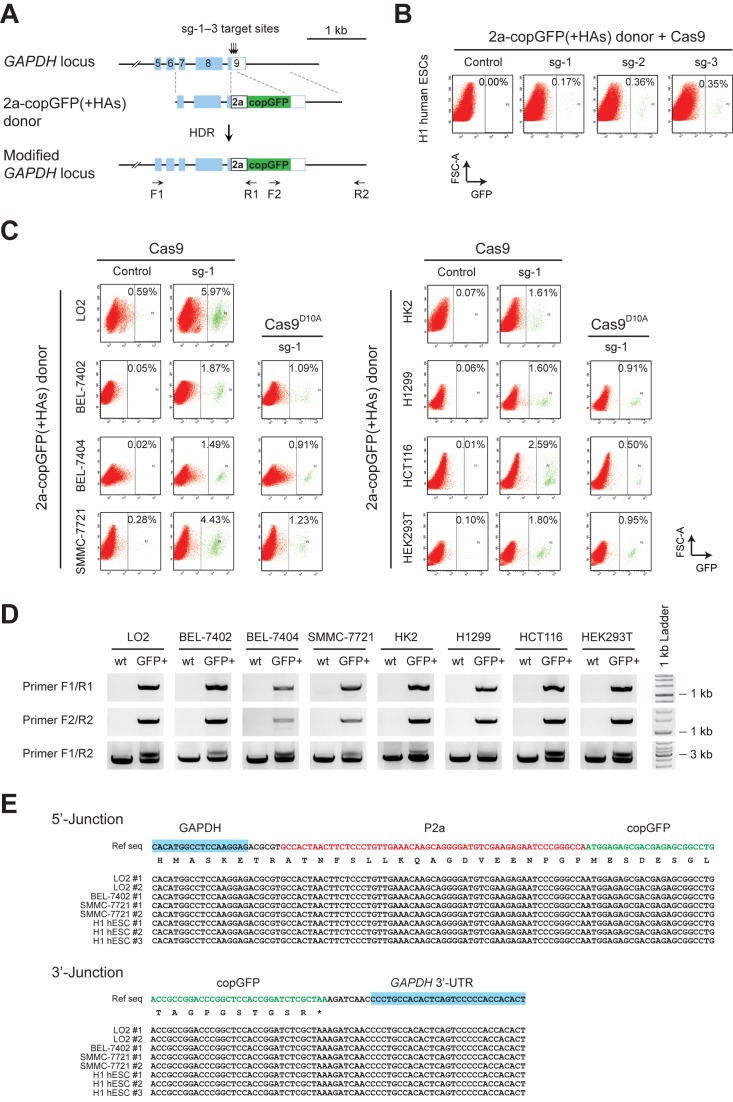
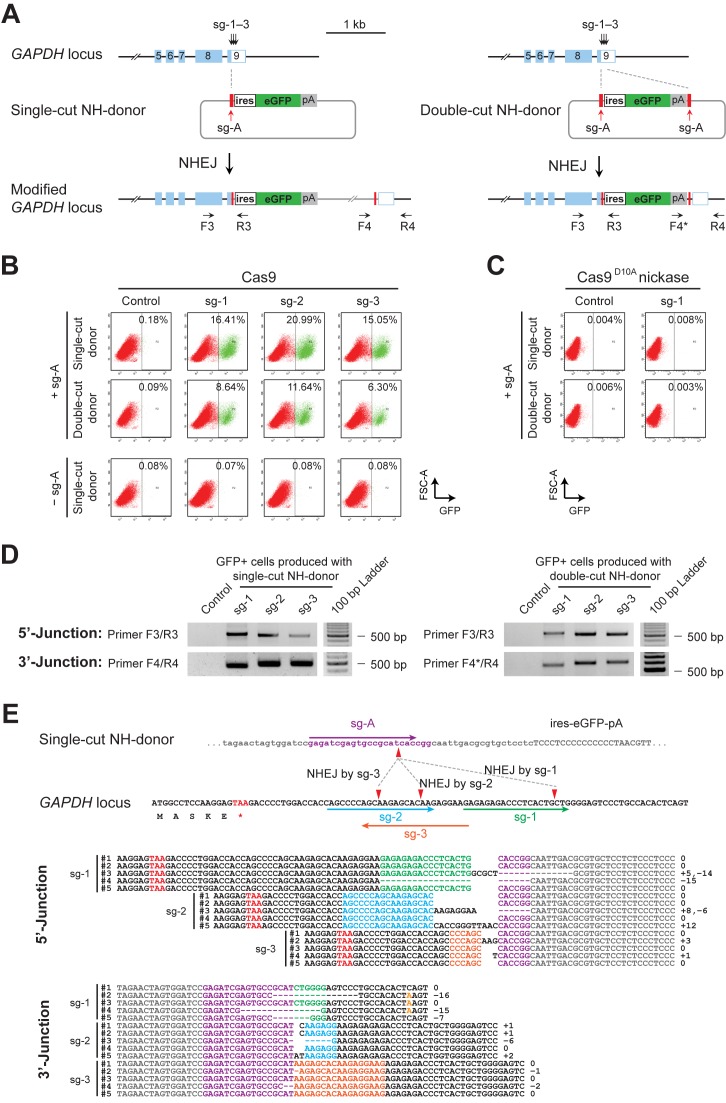
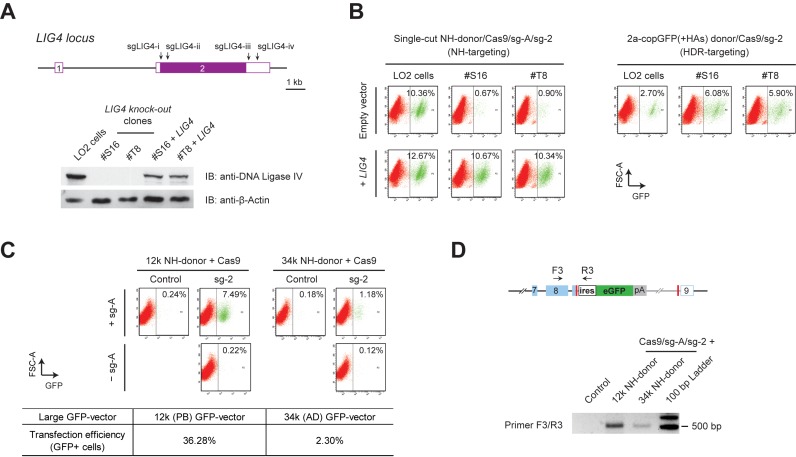
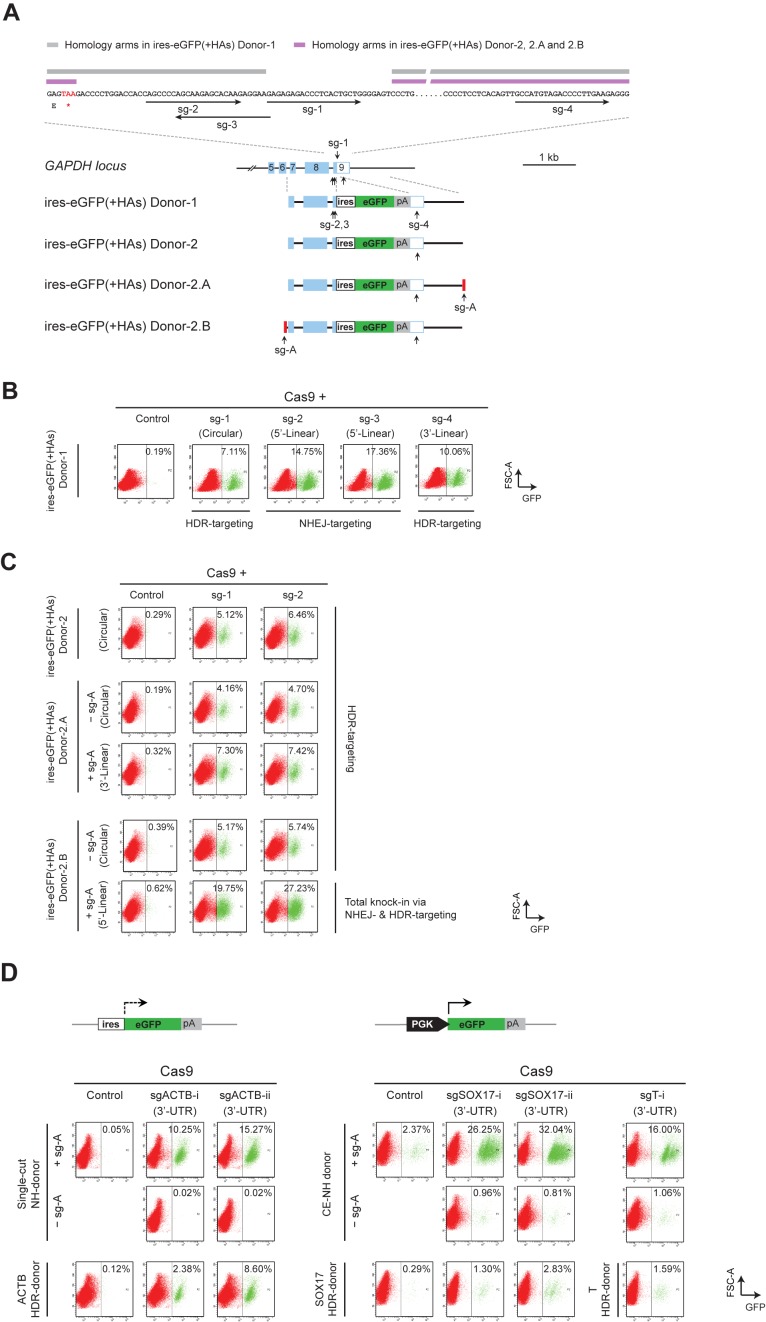
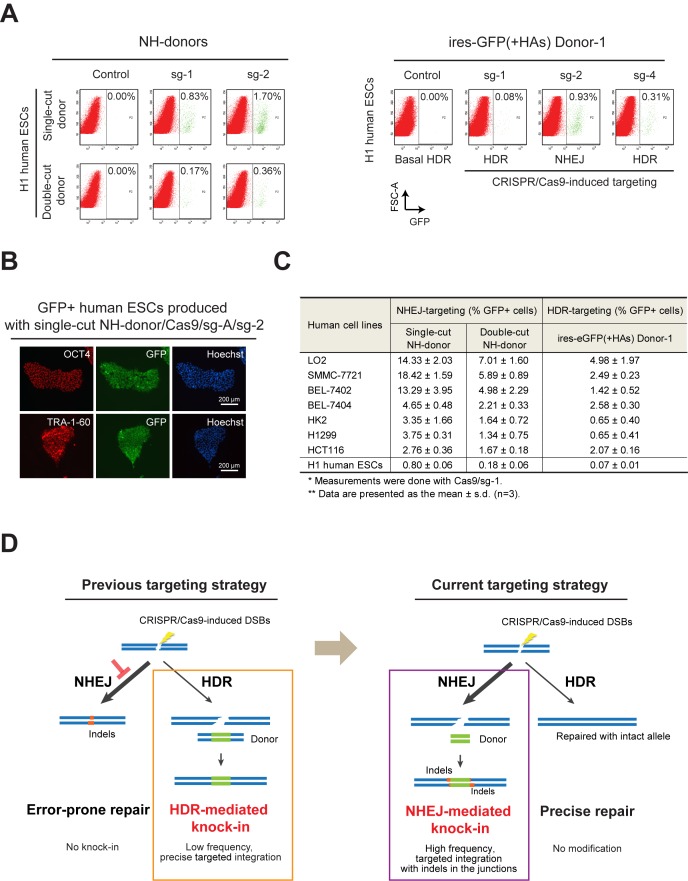
CRISPR/Cas9-induced site-specific DNA double-strand breaks (DSBs) can be repaired by homology-directed repair (HDR) or non-homologous end joining (NHEJ) pathways. Extensive efforts have been made to knock-in exogenous DNA to a selected genomic locus in human cells; which, however, has focused on HDR-based strategies and was proven inefficient. Here, we report that NHEJ pathway mediates efficient rejoining of genome and plasmids following CRISPR/Cas9-induced DNA DSBs, and promotes high-efficiency DNA integration in various human cell types. With this homology-independent knock-in strategy, integration of a 4.6 kb promoterless ires-eGFP fragment into the GAPDH locus yielded up to 20% GFP+ cells in somatic LO2 cells, and 1.70% GFP+ cells in human embryonic stem cells (ESCs). Quantitative comparison further demonstrated that the NHEJ-based knock-in is more efficient than HDR-mediated gene targeting in all human cell types examined. These data support that CRISPR/Cas9-induced NHEJ provides a valuable new path for efficient genome editing in human ESCs and somatic cells.
Overview
The claims and statistics of this paper haven’t been checked yet.
Run the check — free, no account needed. It reads the open-access text and checks the sources it cites.
Integrity signals
Registry
Cites
Statistics
Figures
Verification
Claims the paper makes
The claims and statistics of this paper haven’t been checked yet.
Run the check — free, no account needed. It reads the open-access text and checks the sources it cites.
Claims other papers make about this one
Each is checked against this paper’s own text: does it say what the citing paper says it does?
The source backs part of the claim, not all of it — or backs it for a different population, condition or comparison.
In the citing paper
“Researchers have also developed a homology-independent targeted integration (HITI) strategy as an alternative to HDR, a technique that allows DNA integration in both dividing and non-dividing cells in vitro and in vivo [114,115].”
From CRISPR-Cas: Converting A Bacterial Defence Mechanism into A State-of-the-Art Genetic Manipulation Tool (2019) · cites this paper as [115]
Experimental — accuracy not yet measuredIn the citing paper
“The recently developed HITI strategy exhibits much higher knock-in efficiency than HDR both in vitro and in vivo [86, 87].”
From Non-viral delivery systems for CRISPR/Cas9-based genome editing: challenges and opportunities (2018) · cites this paper as [86]
Self-check
Percentages, sums and reported differences re-computed from the paper’s own numbers.
The self-check needs the paper’s full text.
Citations
Cites
Induction of Pluripotent Stem Cells from Adult Human Fibroblasts by Defined Factors
Takahashi, K., Tanabe, K., Ohnuki, M., Narita, M., Ichisaka, T., Tomoda, K., & Yamanaka, S. (2007) · Cell · doi:10.1016/j.cell.2007.11.019 · Cited by 20,221
A Programmable Dual-RNA–Guided DNA Endonuclease in Adaptive Bacterial Immunity
Jinek, M., Chylinski, K., Fonfara, I., Hauer, M., Doudna, J. A., & Charpentier, E. (2012) · Science · doi:10.1126/science.1225829 · Cited by 17,116
Embryonic Stem Cell Lines Derived from Human Blastocysts
Thomson, J. A., Itskovitz‐Eldor, J., Shapiro, S. S., Waknitz, M. A., Swiergiel, J. J., Marshall, V. S., & Jones, J. M. (1998) · Science · doi:10.1126/science.282.5391.1145 · Cited by 15,947
RNA-Guided Human Genome Engineering via Cas9
Mali, P., Yang, L., Esvelt, K. M., Aach, J., Guell, M., DiCarlo, J. E., Norville, J. E., & Church, G. M. (2013) · Science · doi:10.1126/science.1232033 · Cited by 9,210
The new frontier of genome engineering with CRISPR-Cas9
Doudna, J. A., & Charpentier, E. (2014) · Science · doi:10.1126/science.1258096 · Cited by 7,062
Development and Applications of CRISPR-Cas9 for Genome Engineering
Hsu, P. D., Lander, E. S., & Zhang, F. (2014) · Cell · doi:10.1016/j.cell.2014.05.010 · Cited by 5,762
Wang, H., Yang, H., Shivalila, C. S., Dawlaty, M. M., Cheng, A. W., Zhang, F., & Jaenisch, R. (2013) · Cell · doi:10.1016/j.cell.2013.04.025 · Cited by 3,495
The mechanism of double-strand DNA break repair by the nonhomologous DNA end-joining pathway
Lieber, M. R. (2010) · Annual Review of Biochemistry · doi:10.1146/annurev.biochem.052308.093131 · Cited by 2,882
Rationally engineered Cas9 nucleases with improved specificity
Slaymaker, I. M., Gao, L., Zetsche, B., Scott, D. A., Yan, W. X., & Zhang, F. (2016) · Science · doi:10.1126/science.aad5227 · Cited by 2,414
Improving CRISPR-Cas nuclease specificity using truncated guide RNAs
Fu, Y., Sander, J. D., Reyon, D., Cascio, V. M., & Joung, J. K. (2014) · Nature Biotechnology · doi:10.1038/nbt.2808 · Cited by 1,993 · cited 1×
“Briefly, target sequences (20 bp or 17 bp) starting with guanine and preceding the PAM motif (5′-NGG-3′) were selected from the target genomic regions (8,25).”
BackgroundMali, P., Aach, J., Stranges, P. B., Esvelt, K. M., Moosburner, M., Kosuri, S., Yang, L., & Church, G. M. (2013) · Nature Biotechnology · doi:10.1038/nbt.2675 · Cited by 1,752
Yang, H., Wang, H., Shivalila, C. S., Cheng, A. W., Shi, L., & Jaenisch, R. (2013) · Cell · doi:10.1016/j.cell.2013.08.022 · Cited by 1,596
Therapeutic genome editing: prospects and challenges
Cox, D. B. T., Platt, R. J., & Zhang, F. (2015) · Nature Medicine · doi:10.1038/nm.3793 · Cited by 1,336
Chu, V. T., Weber, T., Wefers, B., Wurst, W., Sander, S., Rajewsky, K., & Kühn, R. (2015) · Nature Biotechnology · doi:10.1038/nbt.3198 · Cited by 1,210
FLASH assembly of TALENs for high-throughput genome editing
Reyon, D., Tsai, S. Q., Khayter, C., Foden, J. A., Sander, J. D., & Joung, J. K. (2012) · Nature Biotechnology · doi:10.1038/nbt.2170 · Cited by 1,171
Genetic engineering of human pluripotent cells using TALE nucleases
Hockemeyer, D. F., Wang, H., Kiani, S., Lai, C. S., Gao, Q., Cassady, J. P., Cost, G. J., Zhang, L., Santiago, Y., Miller, J. C., et al. (2011) · Nature Biotechnology · doi:10.1038/nbt.1927 · Cited by 1,161
Maruyama, T., Dougan, S. K., Truttmann, M. C., Bilate, A. M., Ingram, J. R., & Ploegh, H. L. (2015) · Nature Biotechnology · doi:10.1038/nbt.3190 · Cited by 1,137
Chemically modified guide RNAs enhance CRISPR-Cas genome editing in human primary cells
Hendel, A., Bak, R. O., Clark, J. T., Kennedy, A. B., Ryan, D. E., Roy, S., Steinfeld, I., Lunstad, B. D., Kaiser, R. J., Wilkens, A. B., et al. (2015) · Nature Biotechnology · doi:10.1038/nbt.3290 · Cited by 1,090
Regulation of Homologous Recombination in Eukaryotes
Heyer, W.-D., Ehmsen, K. T., & Liu, J. (2010) · Annual Review of Genetics · doi:10.1146/annurev-genet-051710-150955 · Cited by 1,066
Hockemeyer, D. F., Soldner, F., Beard, C., Gao, Q., Mitalipova, M. M., DeKelver, R. C., Katibah, G. E., Amora, R., Boydston, E. A., Zeitler, B., et al. (2009) · Nature Biotechnology · doi:10.1038/nbt.1562 · Cited by 1,064
CRISPR-Cas Systems in Bacteria and Archaea: Versatile Small RNAs for Adaptive Defense and Regulation
Bhaya, D., Davison, M., & Barrangou, R. (2011) · Annual Review of Genetics · doi:10.1146/annurev-genet-110410-132430 · Cited by 914
Lombardo, A., Genovese, P., Beausejour, C. M., Colleoni, S., Lee, Y.-L., Kim, K. A., Ando, D., Urnov, F. D., Galli, C., Gregory, P. D., et al. (2007) · Nature Biotechnology · doi:10.1038/nbt1353 · Cited by 845
Maeder, M. L., Thibodeau-Beganny, S., Osiak, A., Wright, D. A., Anthony, R. M., Eichtinger, M., Jiang, T., Foley, J. E., Winfrey, R. J., Townsend, J. A., et al. (2008) · Molecular Cell · doi:10.1016/j.molcel.2008.06.016 · Cited by 727
Gene targeting in mice: functional analysis of the mammalian genome for the twenty-first century
Capecchi, M. (2005) · Nature reviews genetics · doi:10.1038/nrg1619 · Cited by 723
Comparison of nonhomologous end joining and homologous recombination in human cells
Mao, Z., Bozzella, M. J., Seluanov, A., & Gorbunova, V. A. (2008) · DNA repair · doi:10.1016/j.dnarep.2008.06.018 · Cited by 673
Highly efficient CRISPR/Cas9-mediated knock-in in zebrafish by homology-independent DNA repair
Auer, T. O., Duroure, K., De Cian, A., Concordet, J.-P., & Del Bene, F. (2014) · Genome Research · doi:10.1101/gr.161638.113 · Cited by 631
Harnessing the potential of induced pluripotent stem cells for regenerative medicine
Wu, S. M., & Hochedlinger, K. (2011) · Nature Cell Biology · doi:10.1038/ncb0511-497 · Cited by 515
Reprogramming of fibroblasts into induced pluripotent stem cells with orphan nuclear receptor Esrrb
Feng, B., Jiang, J., Kraus, P., Ng, J.-H., Heng, J.-C. D., Chan, Y.-S., Yaw, L. P., Zhang, W., Loh, Y., Han, J., et al. (2009) · Nature Cell Biology · doi:10.1038/ncb1827 · Cited by 487
A genome-wide RNAi screen reveals determinants of human embryonic stem cell identity
Chia, N., Chan, Y.-S., Feng, B., Lu, X., Orlov, Y. L., Moreau, D., Kumar, P., Yang, L., Jiang, J., Lau, M.-S., et al. (2010) · Nature · doi:10.1038/nature09531 · Cited by 461
Is Non-Homologous End-Joining Really an Inherently Error-Prone Process?
Bétermier, M., Bertrand, P., & López, B. S. (2014) · PLoS Genetics · doi:10.1371/journal.pgen.1004086 · Cited by 420
Optimization of scarless human stem cell genome editing
Yang, L., Güell, M., Byrne, S., Yang, J. L., Angeles, A. D. L., Mali, P., Aach, J., Kim-Kiselak, C., Briggs, A. W., Rios, X., et al. (2013) · Nucleic Acids Research · doi:10.1093/nar/gkt555 · Cited by 384
Kimura, Y., Hisano, Y., Kawahara, A., & Higashijima, S. (2014) · Scientific Reports · doi:10.1038/srep06545 · Cited by 333
Manipulating the mammalian genome by homologous recombination
Vásquez, K. M., Marburger, K., Intödy, Z., & Wilson, J. H. (2001) · Proceedings of the National Academy of Sciences · doi:10.1073/pnas.111009698 · Cited by 310
Maresca, M., Lin, V. G., Guo, N., & Yang, Y. (2012) · Genome Research · doi:10.1101/gr.145441.112 · Cited by 310
Precise and efficient genome editing in zebrafish using the CRISPR/Cas9 system
Irion, U., Krauß, J., & Nüsslein‐Volhard, C. (2014) · Development · doi:10.1242/dev.115584 · Cited by 303
Precise in-frame integration of exogenous DNA mediated by CRISPR/Cas9 system in zebrafish
Hisano, Y., Sakuma, T., Nakade, S., Ohga, R., Ota, S., Okamoto, H., Yamamoto, T., & Kawahara, A. (2015) · Scientific Reports · doi:10.1038/srep08841 · Cited by 239
Koller, B. H., Hagemann, L. J., Doetschman, T., Hagaman, J. R., Huang, S., Williams, P. J., First, N. L., Maeda, N., & Smithies, O. (1989) · Proceedings of the National Academy of Sciences · doi:10.1073/pnas.86.22.8927 · Cited by 223
Orlando, S. J., Santiago, Y., DeKelver, R. C., Freyvert, Y., Boydston, E. A., Moehle, E. A., Choi, V. M., Gopalan, S. M., Lou, J. F., Li, J., et al. (2010) · Nucleic Acids Research · doi:10.1093/nar/gkq512 · Cited by 174
Modeling Disease in Human ESCs Using an Efficient BAC-Based Homologous Recombination System
Song, H., Chung, S.-K., & Xu, Y. (2010) · Cell stem cell · doi:10.1016/j.stem.2009.11.016 · Cited by 165
In vivo cleavage of transgene donors promotes nuclease‐mediated targeted integration
Cristea, S., Freyvert, Y., Santiago, Y., Holmes, M. C., Urnov, F. D., Gregory, P. D., & Cost, G. J. (2013) · Biotechnology and Bioengineering · doi:10.1002/bit.24733 · Cited by 165
Merkle, F. T., Neuhausser, W. M., Santos, D., Valen, E., Gagnon, J. A., Maas, K., Sandoe, J., Schier, A. F., & Eggan, K. (2015) · Cell Reports · doi:10.1016/j.celrep.2015.04.007 · Cited by 152
Genome maintenance in pluripotent stem cells
Weissbein, U., Benvenisty, N., & Ben‐David, U. (2014) · The Journal of Cell Biology · doi:10.1083/jcb.201310135 · Cited by 149
Direct activation of human and mouse Oct4 genes using engineered TALE and Cas9 transcription factors
Hu, J., Lei, Y., Wong, W.-K., Liu, S., Lee, K.-C., He, X., You, W., Zhou, R., Guo, J., Chen, X., et al. (2014) · Nucleic Acids Research · doi:10.1093/nar/gku109 · Cited by 145
Li, J., Zhang, B., Ren, Y., Gu, S., Xiang, Y., Huang, C., & Du, J. (2015) · Cell Research · doi:10.1038/cr.2015.43 · Cited by 140
Transcription enhances intrachromosomal homologous recombination in mammalian cells.
Nickoloff, J. A. (1992) · Molecular and Cellular Biology · doi:10.1128/mcb.12.12.5311 · Cited by 132
Capture of DNA Sequences at Double-Strand Breaks in Mammalian Chromosomes
Lin, Y., & Waldman, A. S. (2001) · Genetics · doi:10.1093/genetics/158.4.1665 · Cited by 113
The role of DNA repair in the pluripotency and differentiation of human stem cells
Rocha, C. R. R., Lerner, L. K., Okamoto, O. K., Marchetto, M. C., & Menck, C. F. M. (2012) · Mutation Research/Reviews in Mutation Research · doi:10.1016/j.mrrev.2012.09.001 · Cited by 94
Gottipati, P., & Helleday, T. (2009) · Mutagenesis · doi:10.1093/mutage/gen072 · Cited by 75
Rong, Z., Zhu, S., Xu, Y., & Fu, X. (2014) · Protein & Cell · doi:10.1007/s13238-014-0032-5 · Cited by 73
A versatile reporter system for CRISPR-mediated chromosomal rearrangements
Li, Y., Park, A. I., Mou, H., Colpan, C., Bizhanova, A., Akama‐Garren, E. H., Joshi, N., Hendrickson, E. A., Feldser, D. M., Yin, H., et al. (2015) · Genome biology · doi:10.1186/s13059-015-0680-7 · Cited by 64
Heritable CRISPR/Cas9‐mediated targeted integration in Xenopus tropicalis
Shi, Z., Wang, F., Cui, Y., Liu, Z., Guo, X., Zhang, Y., Deng, Y., Zhao, H., & Chen, Y. (2015) · The FASEB Journal · doi:10.1096/fj.15-273425 · Cited by 58
Transcription Enhances Intrachromosomal Homologous Recombination in Mammalian Cells
Nickoloff, J. A. (1992) · Molecular and Cellular Biology · doi:10.1128/mcb.12.12.5311-5318.1992 · Cited by 55
The Mechanism of Gene Targeting in Human Somatic Cells
Kan, Y., Ruis, B. L., Lin, S. G., & Hendrickson, E. A. (2014) · PLoS Genetics · doi:10.1371/journal.pgen.1004251 · Cited by 50
Thomson, A., Marques, M. G., & McWhir, J. (2019) · Bioscientifica Proceedings · doi:10.1530/biosciprocs.5.036 · Cited by 32
Repair of chromosomal double-strand breaks by precise ligation in human cells
Lin, W. Y., Wilson, J. H., & Lin, Y. (2013) · DNA repair · doi:10.1016/j.dnarep.2013.04.024 · Cited by 30
Marques, M. M., Thomson, A., McCreath, K., & Mcwhir, J. (2006) · Journal of Biotechnology · doi:10.1016/j.jbiotec.2006.03.009 · Cited by 14
Cited by
Sorted by citations
p53 inhibits CRISPR–Cas9 engineering in human pluripotent stem cells
Ihry, R. J., Worringer, K. A., Salick, M. R., Frias, E., Ho, D., Theriault, K., Kommineni, S., Chen, J., Sondey, M., Ye, C., et al. (2018) · Nature Medicine · doi:10.1038/s41591-018-0050-6 · Cited by 978
Zhang, J., Li, X., Li, G., Chen, W., Arakaki, C., Botimer, G. D., Baylink, D. J., Zhang, L., Wen, W., Fu, Y.-W., et al. (2017) · Genome biology · doi:10.1186/s13059-017-1164-8 · Cited by 493
“With promising results obtained in the 293 T reporter system, we attempted to edit a human iPSC line [43], because of its significance in regenerative medicine and well-known difficulty in editing human iPSCs in comparison to 293 T cells [26].”
InfluentialCornerstones of CRISPR–Cas in drug discovery and therapy
Fellmann, C., Gowen, B. G., Lin, P., Doudna, J. A., & Corn, J. E. (2016) · Nature Reviews Drug Discovery · doi:10.1038/nrd.2016.238 · Cited by 452
CRISPR/Cas9-induced knockout and knock-in mutations in Chlamydomonas reinhardtii
Shin, S.-E., Lim, J., Koh, H. G., Kim, E. K., Kang, N. K., Jeon, S., Kwon, S., Shin, W.-S., Lee, B., Hwangbo, K., et al. (2016) · Scientific Reports · doi:10.1038/srep27810 · Cited by 438
Non-viral delivery systems for CRISPR/Cas9-based genome editing: challenges and opportunities
Li, L., Hu, S., & Chen, X. (2018) · Biomaterials · doi:10.1016/j.biomaterials.2018.04.031 · Cited by 415
“For example, homology-independent targeted integration (HITI) strategy has been developed as an alternative approach for CRISPR/Cas9-mediated gene repair in recent studies [86, 87].”
BackgroundMethod
Metadata
- Authors
- He, X., Tan, C., Wang, F., Wang, Y., Zhou, R., Cui, D., You, W., Zhao, H., Ren, J., & Feng, B.
- Affiliations
- Chinese University of Hong Kong (HK)
- Corresponding author
- Feng, Bo
- ORCID
- Venue
- Nucleic Acids Research
- Publisher
- Oxford University Press (OUP)
- Published
- 2016-02-04
- Volume
- 44
- Issue
- 9
- Pages
- e85-e85
- ISSN
- 0305-1048 (ISSN-L)
- 1362-4962
- PMC
- PMC4872082
- OpenAlex
- W2267596434
- Cited by
- 338
- References
- 56
- Citations by year
- 2026: 4 · 2025: 18 · 2024: 29 · 2023: 25 · 2022: 36 · 2021: 42 · 2020: 56 · 2019: 35 · 2018: 43 · 2017: 35 · 2016: 15
- FWCI
- 22.17
- Type
- journal article
- Language
- en
- Open access
- gold
- doi.org
- Licence
- Locations
- Nucleic Acids Research (publishedVersion, cc-by-nc)
- Europe PMC (PubMed Central) (publishedVersion, cc-by-nc)
- PubMed Central (publishedVersion, cc-by-nc)
- PubMed (publishedVersion)
- HighWire Press Open Archive (submittedVersion)
- Funders
- National Natural Science Foundation of China (T13-607/12R, 2015CB964700, NSFC 31171433, JCYJ20140425184428469)
- Chinese University of Hong Kong
- Hong Kong University of Science and Technology
- National Key Research and Development Program of China (2015CB964700)
- Topics
- Life Sciences › Biochemistry, Genetics and Molecular Biology › Molecular Biology › CRISPR and Genetic Engineering
- Life Sciences › Biochemistry, Genetics and Molecular Biology › Molecular Biology › DNA Repair Mechanisms
- Life Sciences › Biochemistry, Genetics and Molecular Biology › Molecular Biology › RNA regulation and disease
- Keywords
- CRISPR/Cas9, non-homologous end joining, homology-directed repair, knock-in, DNA double-strand breaks, human embryonic stem cells, somatic cells, genome editing efficiency
- MeSH terms
- Human Embryonic Stem Cells, Gene Editing, RNA, Guide, CRISPR-Cas Systems, DNA, Humans, Genes, Reporter, Glyceraldehyde-3-Phosphate Dehydrogenase (Phosphorylating), HCT116 Cells, Cell Line, Tumor, Green Fluorescent Proteins, DNA Breaks, Double-Stranded, Gene Knock-In Techniques, HEK293 Cells, DNA End-Joining Repair, Recombinational DNA Repair, Clustered Regularly Interspaced Short Palindromic Repeats, CRISPR-Cas Systems
About these checks
Registry, retraction, Cites and statistics results are computed, not judged, with one exception: a printed reference that no index lists is read once by a model before it counts as a citation error. Claims are extracted by a model and kept only when their quote appears verbatim in the text; each cited source is then checked, with a model’s help, for whether it says what the claim relies on. Those verdicts can be wrong — read the claim’s quote and the cited source before relying on one.
Statistics and arithmetic are recomputed, not judged.
Confidence bands are shown only for fields calibrated on our annotated test set. None is calibrated yet, so no band is shown.
What counts as a claim ›How we measure confidence ›How we check this ›
Are you an author, or do you see a problem with this page? Request a review
