

The DOI matches its Crossref record; 56 of the 56 references it cites were found in a registry or an index.
Knock-in of large reporter genes in human cells via CRISPR/Cas9-induced homology-dependent and independent DNA repair
Open accessAbstract
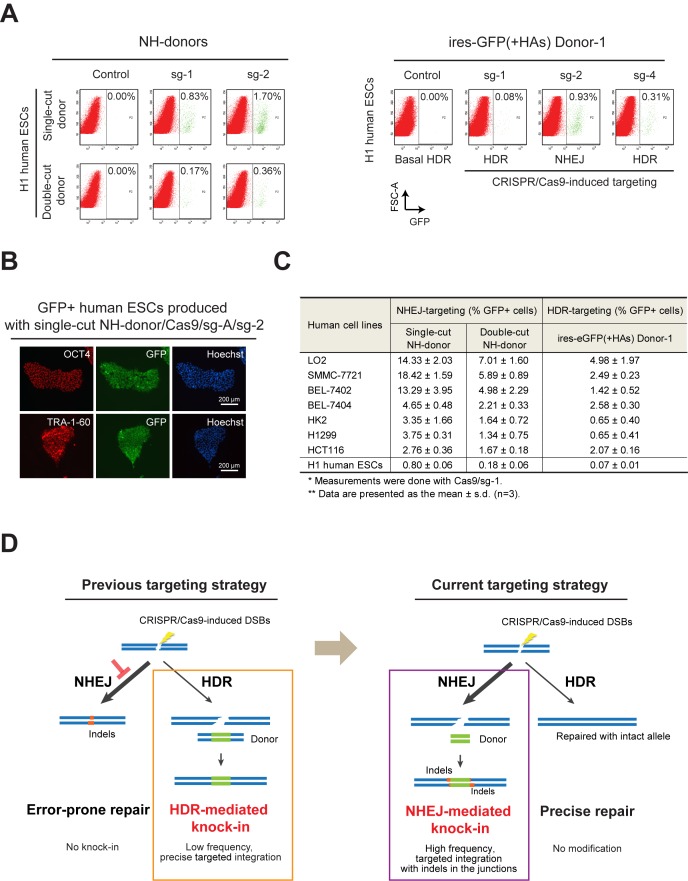
CRISPR/Cas9-induced site-specific DNA double-strand breaks (DSBs) can be repaired by homology-directed repair (HDR) or non-homologous end joining (NHEJ) pathways. Extensive efforts have been made to knock-in exogenous DNA to a selected genomic locus in human cells; which, however, has focused on HDR-based strategies and was proven inefficient. Here, we report that NHEJ pathway mediates efficient rejoining of genome and plasmids following CRISPR/Cas9-induced DNA DSBs, and promotes high-efficiency DNA integration in various human cell types. With this homology-independent knock-in strategy, integration of a 4.6 kb promoterless ires-eGFP fragment into the GAPDH locus yielded up to 20% GFP+ cells in somatic LO2 cells, and 1.70% GFP+ cells in human embryonic stem cells (ESCs). Quantitative comparison further demonstrated that the NHEJ-based knock-in is more efficient than HDR-mediated gene targeting in all human cell types examined. These data support that CRISPR/Cas9-induced NHEJ provides a valuable new path for efficient genome editing in human ESCs and somatic cells.
Overview
The claims and statistics of this paper haven’t been checked yet.
Run the check — free, no account needed. It reads the open-access text and checks the sources it cites.
Integrity signals
Registry
Cites
Statistics
Figures
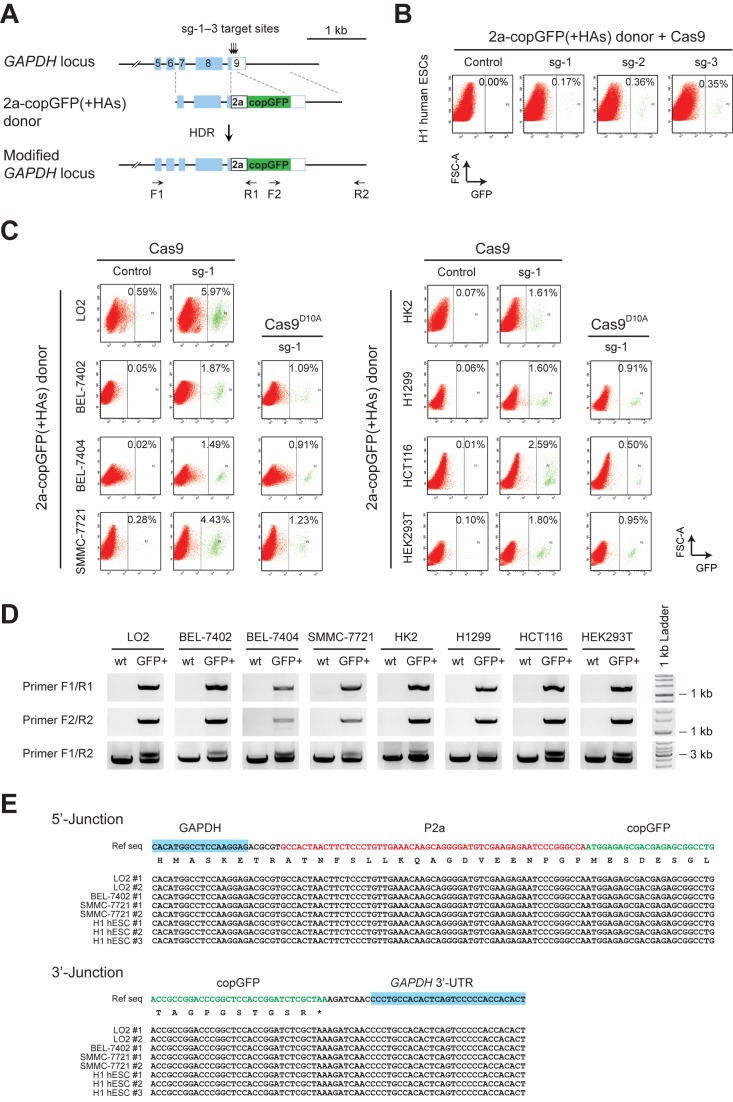
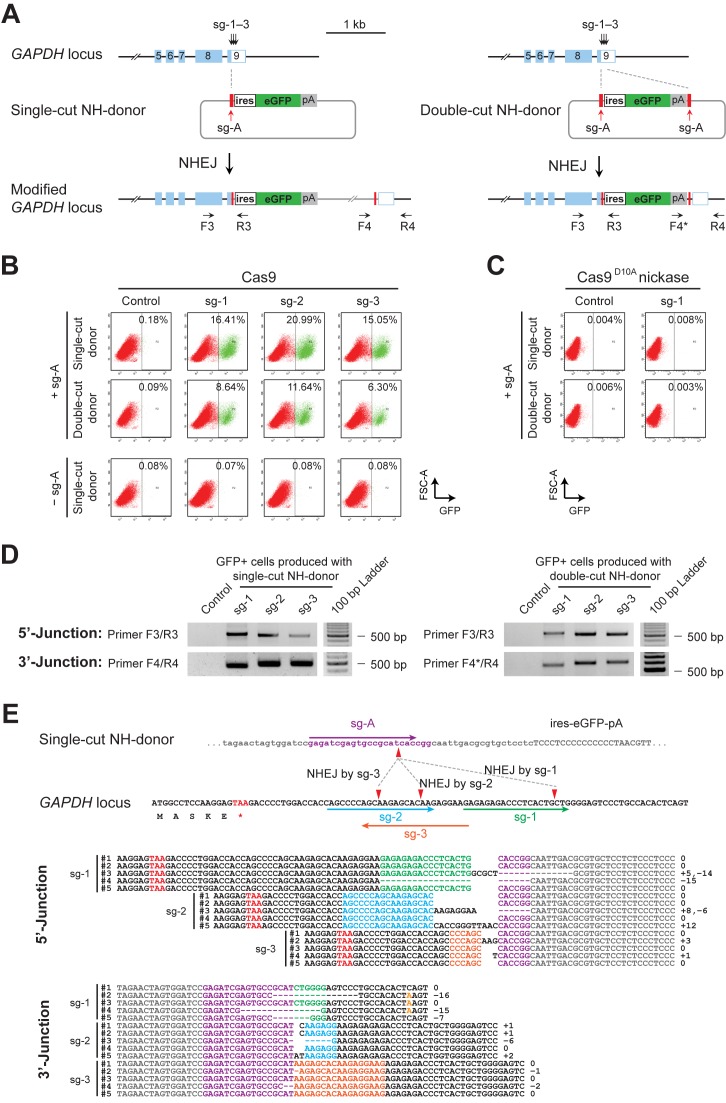
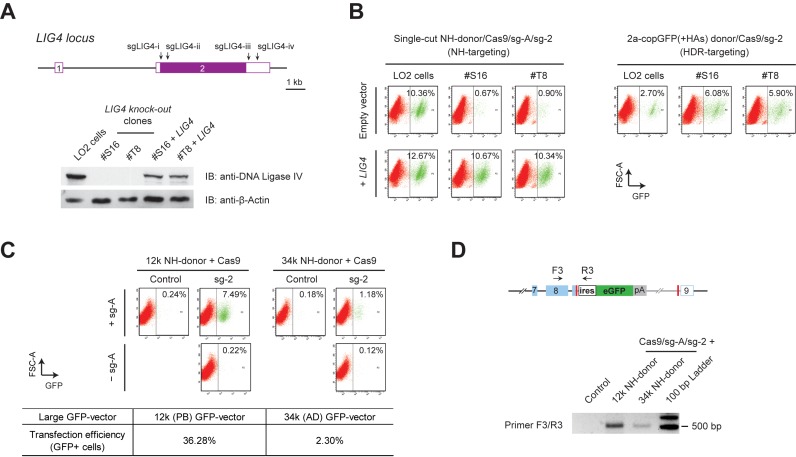
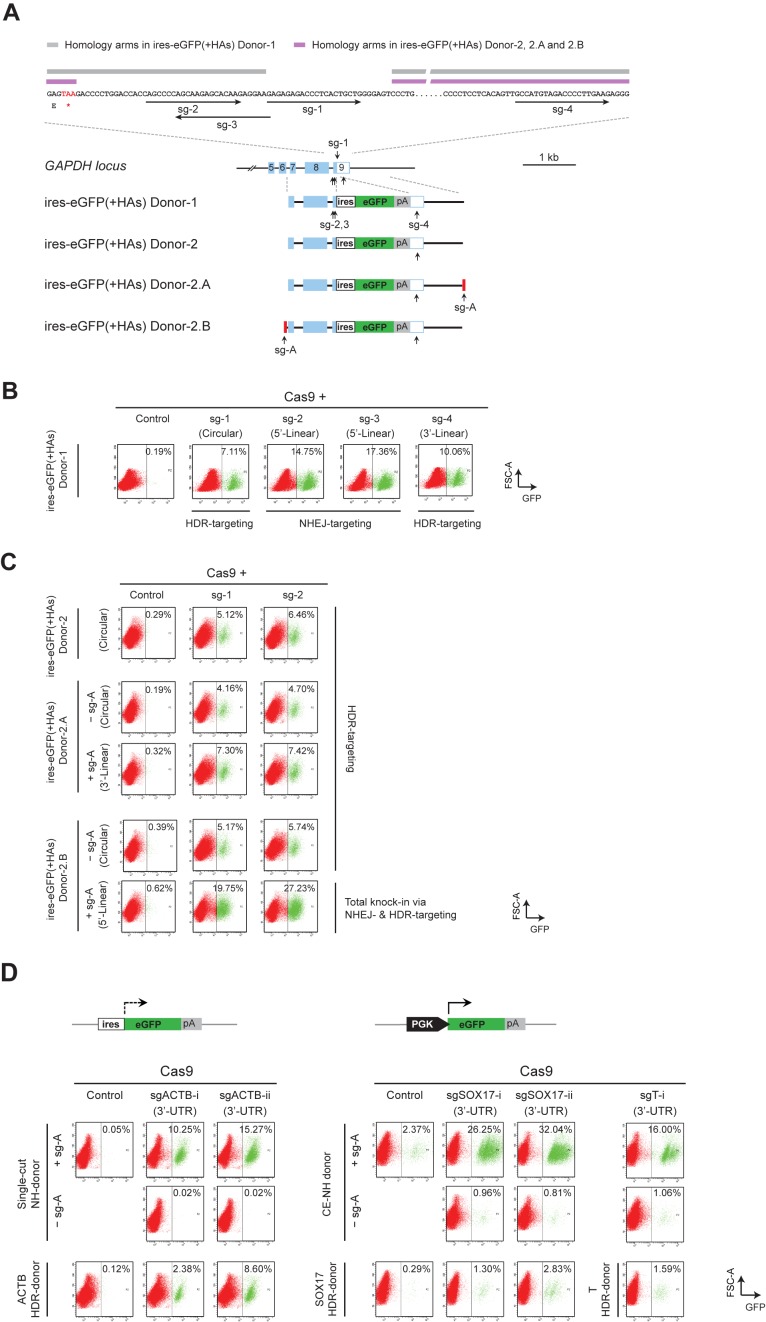
Verification
Claims the paper makes
The claims and statistics of this paper haven’t been checked yet.
Run the check — free, no account needed. It reads the open-access text and checks the sources it cites.
Claims other papers make about this one
Each is checked against this paper’s own text: does it say what the citing paper says it does?
The source backs part of the claim, not all of it — or backs it for a different population, condition or comparison.
In the citing paper
“Researchers have also developed a homology-independent targeted integration (HITI) strategy as an alternative to HDR, a technique that allows DNA integration in both dividing and non-dividing cells in vitro and in vivo [114,115].”
From CRISPR-Cas: Converting A Bacterial Defence Mechanism into A State-of-the-Art Genetic Manipulation Tool (2019) · cites this paper as [115]
Experimental — accuracy not yet measuredIn the citing paper
“The recently developed HITI strategy exhibits much higher knock-in efficiency than HDR both in vitro and in vivo [86, 87].”
From Non-viral delivery systems for CRISPR/Cas9-based genome editing: challenges and opportunities (2018) · cites this paper as [86]
Self-check
Percentages, sums and reported differences re-computed from the paper’s own numbers.
The self-check needs the paper’s full text.
Citations
Cites
Induction of Pluripotent Stem Cells from Adult Human Fibroblasts by Defined Factors
Takahashi, K., Tanabe, K., Ohnuki, M., Narita, M., Ichisaka, T., Tomoda, K., & Yamanaka, S. (2007) · Cell · doi:10.1016/j.cell.2007.11.019 · Cited by 20,221
A Programmable Dual-RNA–Guided DNA Endonuclease in Adaptive Bacterial Immunity
Jinek, M., Chylinski, K., Fonfara, I., Hauer, M., Doudna, J. A., & Charpentier, E. (2012) · Science · doi:10.1126/science.1225829 · Cited by 17,116
Embryonic Stem Cell Lines Derived from Human Blastocysts
Thomson, J. A., Itskovitz‐Eldor, J., Shapiro, S. S., Waknitz, M. A., Swiergiel, J. J., Marshall, V. S., & Jones, J. M. (1998) · Science · doi:10.1126/science.282.5391.1145 · Cited by 15,947
RNA-Guided Human Genome Engineering via Cas9
Mali, P., Yang, L., Esvelt, K. M., Aach, J., Guell, M., DiCarlo, J. E., Norville, J. E., & Church, G. M. (2013) · Science · doi:10.1126/science.1232033 · Cited by 9,210
The new frontier of genome engineering with CRISPR-Cas9
Doudna, J. A., & Charpentier, E. (2014) · Science · doi:10.1126/science.1258096 · Cited by 7,062
Development and Applications of CRISPR-Cas9 for Genome Engineering
Hsu, P. D., Lander, E. S., & Zhang, F. (2014) · Cell · doi:10.1016/j.cell.2014.05.010 · Cited by 5,762
Wang, H., Yang, H., Shivalila, C. S., Dawlaty, M. M., Cheng, A. W., Zhang, F., & Jaenisch, R. (2013) · Cell · doi:10.1016/j.cell.2013.04.025 · Cited by 3,495
The mechanism of double-strand DNA break repair by the nonhomologous DNA end-joining pathway
Lieber, M. R. (2010) · Annual Review of Biochemistry · doi:10.1146/annurev.biochem.052308.093131 · Cited by 2,882
Rationally engineered Cas9 nucleases with improved specificity
Slaymaker, I. M., Gao, L., Zetsche, B., Scott, D. A., Yan, W. X., & Zhang, F. (2016) · Science · doi:10.1126/science.aad5227 · Cited by 2,414
Improving CRISPR-Cas nuclease specificity using truncated guide RNAs
Fu, Y., Sander, J. D., Reyon, D., Cascio, V. M., & Joung, J. K. (2014) · Nature Biotechnology · doi:10.1038/nbt.2808 · Cited by 1,993 · cited 1×
“Briefly, target sequences (20 bp or 17 bp) starting with guanine and preceding the PAM motif (5′-NGG-3′) were selected from the target genomic regions (8,25).”
Background
Cited by
Sorted by citations
Items 301–338 of 338
Brookhouser, N., Nguyen, T., Tekel, S. J., Standage-Beier, K., Wang, X., & Brafman, D. A. (2020) · Figshare · doi:10.6084/m9.figshare.13467915
Balke‐Want, H., Keerthi, V., Gkitsas-Long, N., Mancini, A. G., Kurgan, G., Fowler, C., Xu, P., Liu, X., Asano, K., Patel, S., et al. (2023) · Figshare · doi:10.6084/m9.figshare.23583513
Liu, Z., Zhao, Y. M., Wu, S., Qi, S., Qiu, Y., & Lian, Z. (2024) · International Journal of Molecular Sciences · doi:10.3390/ijms252011320
“In addition, the traditional integration strategy usually uses NHEJ or homologous directed repair (HDR) to achieve target gene integration [12,13].”
MethodYupanqui-Celestino, M. (2024) · Bionatura journal : · doi:10.70099/bj/2024.01.01.35
Implementing CRISPR/Cas9 into the Study of Anticancer Drug Resistance
Terrones, M., de Beeck, K. O., Camp, G. V., & Vandeweyer, G. (2024) · Interdisciplinary cancer research · doi:10.1007/16833_2024_404
Crispr-Cas Technology: Targeted Genome Editing in Plant Physiology
Habibi, M. M. (2024) · BENTHAM SCIENCE PUBLISHERS eBooks · doi:10.2174/9789815305845124020013
Albarran, E., Fushiki, A., Nelson, A., Ng, D., Chaimowitz, C., Nikoobakht, L., Sippy, T., Peterka, D. S., & Costa, R. M. (2025) · bioRxiv (Cold Spring Harbor Laboratory) · doi:10.1101/2025.06.15.659794
Tao, J., Murray, J., Tu, H.-F., Fan, D., Tsai, Y.-C., Hu, M., Wu, A. A., Xing, D., Hung, C., & Wu, T. ‐. (2025) · Cell & Bioscience · doi:10.1186/s13578-025-01427-5
Albarran, E., Fushiki, A., Nelson, A., Ng, D., Chaimowitz, C., Nikoobakht, L., Sippy, T., Peterka, D. S., & Costa, R. M. (2025) · eLife · doi:10.7554/elife.108458.1
Albarran, E., Fushiki, A., Nelson, A., Ng, D., Chaimowitz, C., Nikoobakht, L., Sippy, T., Peterka, D. S., & Costa, R. M. (2025) · eLife · doi:10.7554/elife.108458
Brookhouser, N., Nguyen, T., Tekel, S. J., Standage-Beier, K., Wang, X., & Brafman, D. A. (2020) · Figshare · doi:10.6084/m9.figshare.13467917
Brookhouser, N., Nguyen, T., Tekel, S. J., Standage-Beier, K., Wang, X., & Brafman, D. A. (2020) · Figshare · doi:10.6084/m9.figshare.13467891
Brookhouser, N., Nguyen, T., Tekel, S. J., Standage-Beier, K., Wang, X., & Brafman, D. A. (2020) · Figshare · doi:10.6084/m9.figshare.13467897
Brookhouser, N., Nguyen, T., Tekel, S. J., Standage-Beier, K., Wang, X., & Brafman, D. A. (2020) · Figshare · doi:10.6084/m9.figshare.13467923
Brookhouser, N., Nguyen, T., Tekel, S. J., Standage-Beier, K., Wang, X., & Brafman, D. A. (2020) · Figshare · doi:10.6084/m9.figshare.13467929
Brookhouser, N., Nguyen, T., Tekel, S. J., Standage-Beier, K., Wang, X., & Brafman, D. A. (2020) · Figshare · doi:10.6084/m9.figshare.13467927
Brookhouser, N., Nguyen, T., Tekel, S. J., Standage-Beier, K., Wang, X., & Brafman, D. A. (2020) · Figshare · doi:10.6084/m9.figshare.13467913
Brookhouser, N., Nguyen, T., Tekel, S. J., Standage-Beier, K., Wang, X., & Brafman, D. A. (2020) · Figshare · doi:10.6084/m9.figshare.13467919
Brookhouser, N., Nguyen, T., Tekel, S. J., Standage-Beier, K., Wang, X., & Brafman, D. A. (2020) · Figshare · doi:10.6084/m9.figshare.13467901
Ma, X., Dai, L., Tan, C., Li, J., He, X., Wang, Y., Xue, J., Huang, M., Ren, J., Xia, Y., et al. (2024) · Figshare · doi:10.6084/m9.figshare.26753212
Brookhouser, N., Nguyen, T., Tekel, S. J., Standage-Beier, K., Wang, X., & Brafman, D. A. (2020) · Figshare · doi:10.6084/m9.figshare.13467905
Brookhouser, N., Nguyen, T., Tekel, S. J., Standage-Beier, K., Wang, X., & Brafman, D. A. (2020) · Figshare · doi:10.6084/m9.figshare.13467909
Brookhouser, N., Nguyen, T., Tekel, S. J., Standage-Beier, K., Wang, X., & Brafman, D. A. (2020) · Figshare · doi:10.6084/m9.figshare.13467889
Brookhouser, N., Nguyen, T., Tekel, S. J., Standage-Beier, K., Wang, X., & Brafman, D. A. (2020) · Figshare · doi:10.6084/m9.figshare.13467893
Brookhouser, N., Nguyen, T., Tekel, S. J., Standage-Beier, K., Wang, X., & Brafman, D. A. (2020) · Figshare · doi:10.6084/m9.figshare.13467925
Brookhouser, N., Nguyen, T., Tekel, S. J., Standage-Beier, K., Wang, X., & Brafman, D. A. (2020) · Figshare · doi:10.6084/m9.figshare.13467887
Brookhouser, N., Nguyen, T., Tekel, S. J., Standage-Beier, K., Wang, X., & Brafman, D. A. (2020) · Figshare · doi:10.6084/m9.figshare.13467907
Hermantara, R., Richmond, L., Taqi, A. F., Chilaka, S., Jeantet, V., Guerrini, I., West, K. L., & West, A. G. (2024) · Figshare · doi:10.6084/m9.figshare.26698220
Brookhouser, N., Nguyen, T., Tekel, S. J., Standage-Beier, K., Wang, X., & Brafman, D. A. (2020) · Figshare · doi:10.6084/m9.figshare.13467931
Brookhouser, N., Nguyen, T., Tekel, S. J., Standage-Beier, K., Wang, X., & Brafman, D. A. (2020) · Figshare · doi:10.6084/m9.figshare.13467899
Brookhouser, N., Nguyen, T., Tekel, S. J., Standage-Beier, K., Wang, X., & Brafman, D. A. (2020) · Figshare · doi:10.6084/m9.figshare.13467921
Balke‐Want, H., Keerthi, V., Gkitsas-Long, N., Mancini, A. G., Kurgan, G., Fowler, C., Xu, P., Liu, X., Asano, K., Patel, S., et al. (2023) · Figshare · doi:10.6084/m9.figshare.23583510
Brookhouser, N., Nguyen, T., Tekel, S. J., Standage-Beier, K., Wang, X., & Brafman, D. A. (2020) · Figshare · doi:10.6084/m9.figshare.13467895
Brookhouser, N., Nguyen, T., Tekel, S. J., Standage-Beier, K., Wang, X., & Brafman, D. A. (2020) · Figshare · doi:10.6084/m9.figshare.13467911
Brookhouser, N., Nguyen, T., Tekel, S. J., Standage-Beier, K., Wang, X., & Brafman, D. A. (2020) · Figshare · doi:10.6084/m9.figshare.13467903
Li, Z., Wang, X., Liu, J., Janssen, J. M., Hoeben, R. C., & Gonçalves, M. A. F. V. (2026) · Trends in biotechnology · doi:10.1016/j.tibtech.2026.01.006
Aloufi, B. H. (2026) · Journal of Pure and Applied Microbiology · doi:10.22207/jpam.20.3.39
Metadata
- Authors
- He, X., Tan, C., Wang, F., Wang, Y., Zhou, R., Cui, D., You, W., Zhao, H., Ren, J., & Feng, B.
- Affiliations
- Chinese University of Hong Kong (HK)
- Corresponding author
- Feng, Bo
- ORCID
- Venue
- Nucleic Acids Research
- Publisher
- Oxford University Press (OUP)
- Published
- 2016-02-04
- Volume
- 44
- Issue
- 9
- Pages
- e85-e85
- ISSN
- 0305-1048 (ISSN-L)
- 1362-4962
- PMC
- PMC4872082
- OpenAlex
- W2267596434
- Cited by
- 338
- References
- 56
- Citations by year
- 2026: 4 · 2025: 18 · 2024: 29 · 2023: 25 · 2022: 36 · 2021: 42 · 2020: 56 · 2019: 35 · 2018: 43 · 2017: 35 · 2016: 15
- FWCI
- 22.17
- Type
- journal article
- Language
- en
- Open access
- gold
- doi.org
- Licence
- Locations
- Nucleic Acids Research (publishedVersion, cc-by-nc)
- Europe PMC (PubMed Central) (publishedVersion, cc-by-nc)
- PubMed Central (publishedVersion, cc-by-nc)
- PubMed (publishedVersion)
- HighWire Press Open Archive (submittedVersion)
- Funders
- National Natural Science Foundation of China (T13-607/12R, 2015CB964700, NSFC 31171433, JCYJ20140425184428469)
- Chinese University of Hong Kong
- Hong Kong University of Science and Technology
- National Key Research and Development Program of China (2015CB964700)
- Topics
- Life Sciences › Biochemistry, Genetics and Molecular Biology › Molecular Biology › CRISPR and Genetic Engineering
- Life Sciences › Biochemistry, Genetics and Molecular Biology › Molecular Biology › DNA Repair Mechanisms
- Life Sciences › Biochemistry, Genetics and Molecular Biology › Molecular Biology › RNA regulation and disease
- Keywords
- CRISPR/Cas9, non-homologous end joining, homology-directed repair, knock-in, DNA double-strand breaks, human embryonic stem cells, somatic cells, genome editing efficiency
- MeSH terms
- Human Embryonic Stem Cells, Gene Editing, RNA, Guide, CRISPR-Cas Systems, DNA, Humans, Genes, Reporter, Glyceraldehyde-3-Phosphate Dehydrogenase (Phosphorylating), HCT116 Cells, Cell Line, Tumor, Green Fluorescent Proteins, DNA Breaks, Double-Stranded, Gene Knock-In Techniques, HEK293 Cells, DNA End-Joining Repair, Recombinational DNA Repair, Clustered Regularly Interspaced Short Palindromic Repeats, CRISPR-Cas Systems
About these checks
Registry, retraction, Cites and statistics results are computed, not judged, with one exception: a printed reference that no index lists is read once by a model before it counts as a citation error. Claims are extracted by a model and kept only when their quote appears verbatim in the text; each cited source is then checked, with a model’s help, for whether it says what the claim relies on. Those verdicts can be wrong — read the claim’s quote and the cited source before relying on one.
Statistics and arithmetic are recomputed, not judged.
Confidence bands are shown only for fields calibrated on our annotated test set. None is calibrated yet, so no band is shown.
What counts as a claim ›How we measure confidence ›How we check this ›
Are you an author, or do you see a problem with this page? Request a review
