

The DOI matches its Crossref record; 82 of the 83 references it cites were found in a registry or an index.
Visualization of self-delivering hydrophobically modified siRNA cellular internalization
Open accessAbstract
siRNAs are a new class of therapeutic modalities with promising clinical efficacy that requires modification or formulation for delivery to the tissue and cell of interest. Conjugation of siRNAs to lipophilic groups supports efficient cellular uptake by a mechanism that is not well characterized. Here we study the mechanism of internalization of asymmetric, chemically stabilized, cholesterol-modified siRNAs (sd-rxRNAs®) that efficiently enter cells and tissues without the need for formulation. We demonstrate that uptake is rapid with significant membrane association within minutes of exposure followed by the formation of vesicular structures and internalization. Furthermore, sd-rxRNAs are internalized by a specific class of early endosomes and show preferential association with epidermal growth factor (EGF) but not transferrin (Tf) trafficking pathways as shown by live cell TIRF and structured illumination microscopy (SIM). In fixed cells, we observe ∼25% of sd-rxRNA co-localizing with EGF and <5% with Tf, which is indicative of selective endosomal sorting. Likewise, preferential sd-rxRNA co-localization was demonstrated with EEA1 but not RBSN-containing endosomes, consistent with preferential EGF-like trafficking through EEA1-containing endosomes. sd-rxRNA cellular uptake is a two-step process, with rapid membrane association followed by internalization through a selective, saturable subset of the endocytic process. However, the mechanistic role of EEA1 is not yet known. This method of visualization can be used to better understand the kinetics and mechanisms of hydrophobic siRNA cellular uptake and will assist in further optimization of these types of compounds for therapeutic intervention.
Overview
The claims and statistics of this paper haven’t been checked yet.
Run the check — free, no account needed. It reads the open-access text and checks the sources it cites.
Integrity signals
Registry
Cites
Statistics
Figures
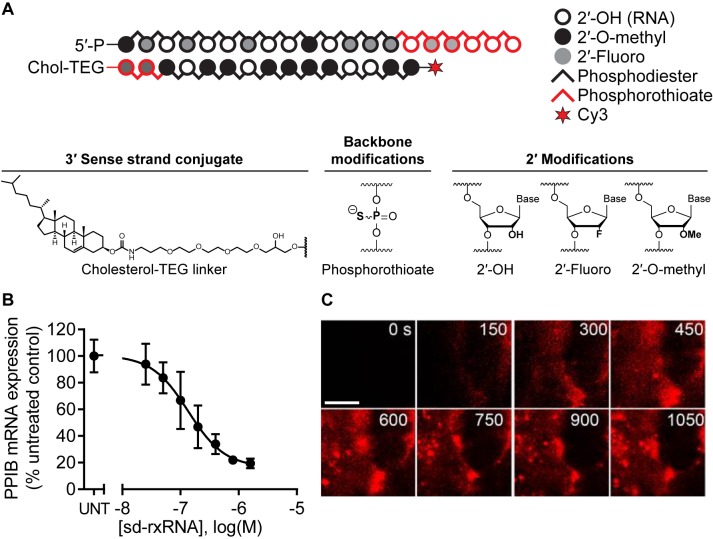
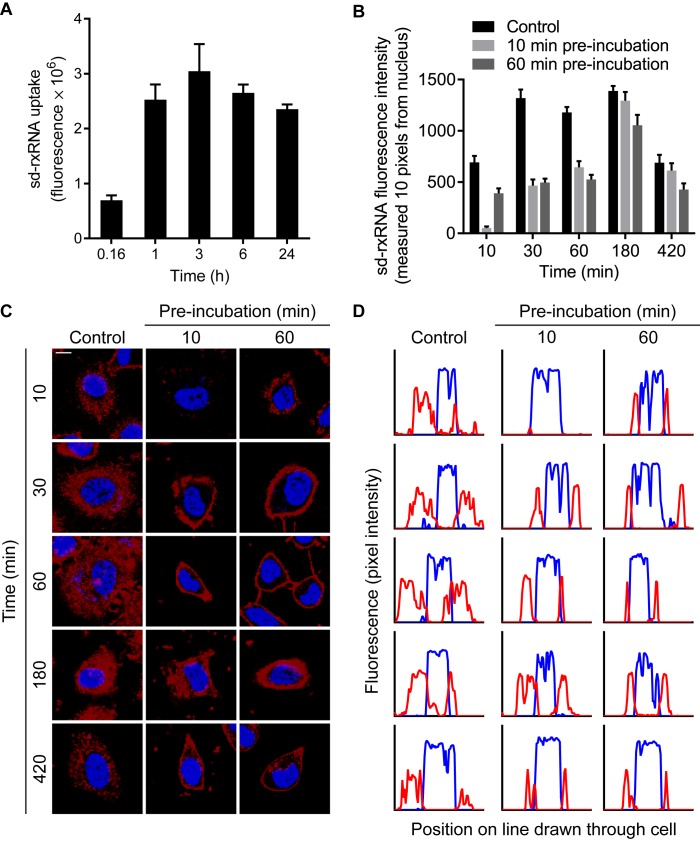
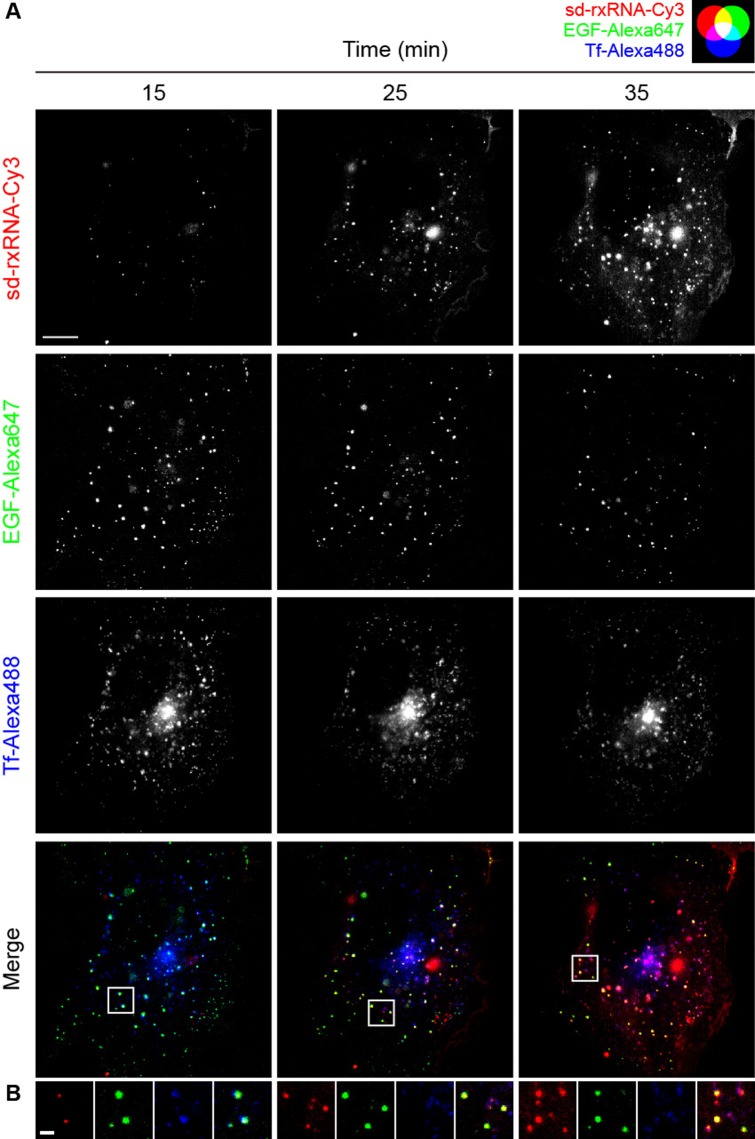
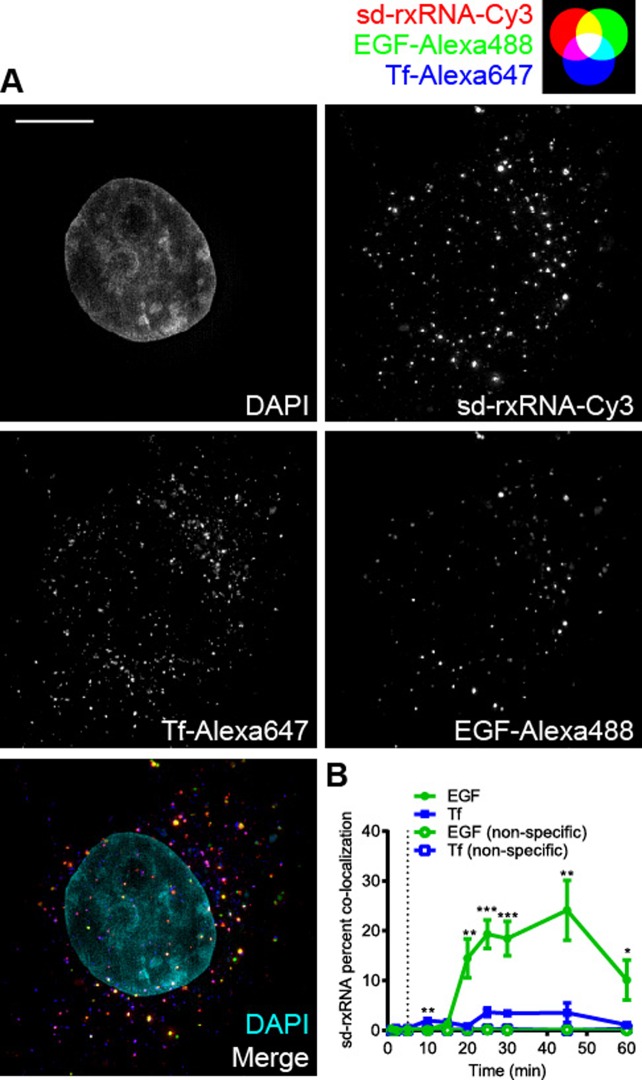
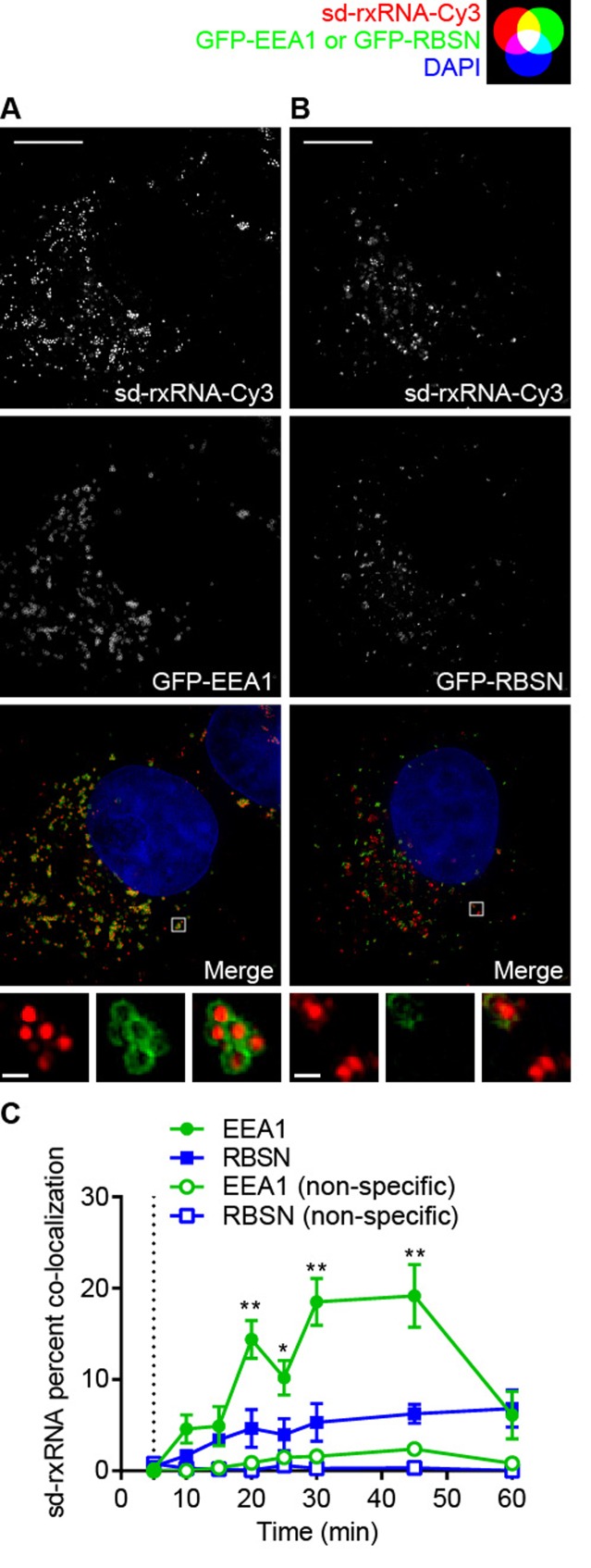
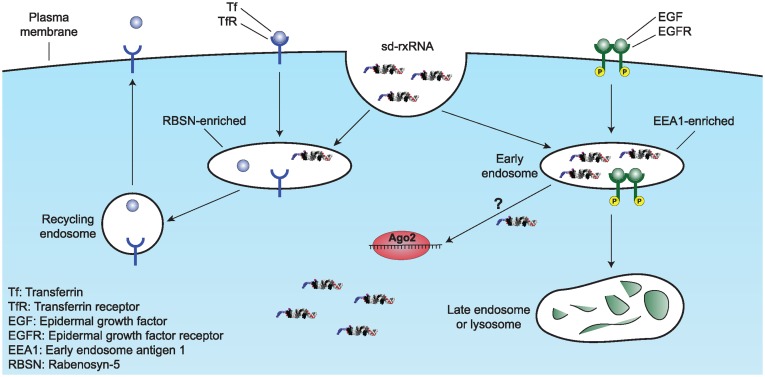
Verification
Claims the paper makes
The claims and statistics of this paper haven’t been checked yet.
Run the check — free, no account needed. It reads the open-access text and checks the sources it cites.
Claims other papers make about this one
Each is checked against this paper’s own text: does it say what the citing paper says it does?
The source backs part of the claim, not all of it — or backs it for a different population, condition or comparison.
In the citing paper
“Intracellular distribution followed a perinuclear localization pattern that is characteristic of oligonucleotides11.”
From A divalent siRNA chemical scaffold for potent and sustained modulation of gene expression throughout the central nervous system (2019) · cites this paper as [11]
Experimental — accuracy not yet measured
Self-check
Percentages, sums and reported differences re-computed from the paper’s own numbers.
The self-check needs the paper’s full text.
Citations
Cites
Huang, D. W., Sherman, B. T., & Lempicki, R. A. (2009) · Nucleic Acids Research · doi:10.1093/nar/gkn923 · Cited by 14,108
Knocking down barriers: advances in siRNA delivery
Whitehead, K. A., Langer, R., & Anderson, D. G. (2009) · Nature Reviews Drug Discovery · doi:10.1038/nrd2742 · Cited by 3,115
Therapeutic silencing of an endogenous gene by systemic administration of modified siRNAs
Soutschek, J., Akinc, A., Bramlage, B., Charissé, K., Constien, R., Donoghue, M., Elbashir, S. M., Geick, A., Hadwiger, P., Harborth, J., et al. (2004) · Nature · doi:10.1038/nature03121 · Cited by 2,206
Rational design of cationic lipids for siRNA delivery
Semple, S. C., Akinc, A., Chen, J., Sandhu, A. P., Mui, B. L., Cho, C. K., Sah, D. W. Y., Stebbing, D., Crosley, E. J., Yaworski, E., et al. (2010) · Nature Biotechnology · doi:10.1038/nbt.1602 · Cited by 1,822 · cited 1×
“Despite years of exploration, only a limited number of formulations and conjugates have progressed to the clinic: lipid nanoparticles (LNPs) (16,17), dynamic polyconjugates (18), dextrins (19), N-acetylgalactosamine (GalNAc) (8) and cholesterol (9).”
BackgroundDelivery materials for siRNA therapeutics
Kanasty, R., Dorkin, J. R., Vegas, A., & Anderson, D. (2013) · Nature Materials · doi:10.1038/nmat3765 · Cited by 1,800
Gilleron, J., Querbes, W., Zeigerer, A., Borodovsky, A., Marsico, G., Schubert, U., Manygoats, K., Seifert, S., Andree, C., Stöter, M., et al. (2013) · Nature Biotechnology · doi:10.1038/nbt.2612 · Cited by 1,681
Endosomal escape pathways for delivery of biologicals
Varkouhi, A. K., Scholte, M., Storm, G., & Haisma, H. J. (2011) · Journal of Controlled Release · doi:10.1016/j.jconrel.2010.11.004 · Cited by 1,561
A new vital stain for visualizing vacuolar membrane dynamics and endocytosis in yeast.
Vida, T. A., & Emr, S. D. (1995) · The Journal of Cell Biology · doi:10.1083/jcb.128.5.779 · Cited by 1,364
Nair, J. K., Willoughby, J. L. S., Chan, A., Charisse, K., Alam, M. R., Wang, Q., Hoekstra, M., Kandasamy, P., Kel’in, A. V., Milstein, S., et al. (2014) · Journal of the American Chemical Society · doi:10.1021/ja505986a · Cited by 1,141
Gibbings, D., Ciaudo, C., Erhardt, M., & Voinnet, O. (2009) · Nature Cell Biology · doi:10.1038/ncb1929 · Cited by 1,037
Cited by
Sorted by citations
The current state and future directions of RNAi-based therapeutics
Setten, R. L., Rossi, J. J., & Han, S.-P. (2019) · Nature Reviews Drug Discovery · doi:10.1038/s41573-019-0017-4 · Cited by 1,443
Detection of immunogenic cell death and its relevance for cancer therapy
Fucikova, J., Kepp, O., Kasikova, L., Petroni, G., Yamazaki, T., Liu, P., Zhao, L., Spisek, R., Kroemer, G., & Galluzzi, L. (2020) · Cell Death & Disease · doi:10.1038/s41419-020-03221-2 · Cited by 1,138
Translation and functional roles of circular RNAs in human cancer
Lei, M., Zheng, G., Ning, Q., Zheng, J., & Dong, D. (2020) · Molecular Cancer · doi:10.1186/s12943-020-1135-7 · Cited by 814
Chemistry, mechanism and clinical status of antisense oligonucleotides and duplex RNAs
Shen, X., & Corey, D. R. (2017) · Nucleic Acids Research · doi:10.1093/nar/gkx1239 · Cited by 654
Emerging role of tumor-related functional peptides encoded by lncRNA and circRNA
Wu, P., Mo, Y., Miao, P., Tang, T. F., Zhong, Y. M., Deng, X., Xiong, F., Guo, C. J., Wu, X., Li, Y., et al. (2020) · Molecular Cancer · doi:10.1186/s12943-020-1147-3 · Cited by 538
Metadata
- Authors
- Ly, S., Navaroli, D. M., Didiot, M.-C., Cardia, J., Pandarinathan, L., Alterman, J. F., Fogarty, K., Standley, C., Lifshitz, L. M., Bellve, K. D., Prot, M., Echeverria, D., Corvera, S., & Khvorova, A.
- Affiliations
- University of Massachusetts Chan Medical School (US)
- Phio Pharmaceuticals (United States) (US)
- Corresponding author
- Khvorova, Anastasia
- ORCID
- Venue
- Nucleic Acids Research
- Publisher
- Oxford University Press (OUP)
- Published
- 2016-11-28
- Volume
- 45
- Issue
- 1
- Pages
- 15-25
- ISSN
- 0305-1048 (ISSN-L)
- 1362-4962
- PMC
- PMC5224471
- OpenAlex
- W2557242880
- Cited by
- 132
- References
- 83
- Citations by year
- 2026: 4 · 2025: 13 · 2024: 13 · 2023: 14 · 2022: 9 · 2021: 9 · 2020: 19 · 2019: 22 · 2018: 21 · 2017: 8
- FWCI
- 8.84
- Type
- journal article
- Language
- en
- Open access
- gold
- doi.org
- Licence
- Locations
- Nucleic Acids Research (publishedVersion, cc-by)
- PubMed Central (publishedVersion, cc-by)
- PubMed (publishedVersion)
- The Journal of the American Medical Association (JAMA) Network (American Medical Association) (submittedVersion, cc-by)
- HighWire Press Open Archive (submittedVersion)
- Funders
- University of Massachusetts (DK32520)
- University of Oxford
- National Institutes of Health (1s10od020012-01)
- National Institute of General Medical Sciences (R01GM108803, R25GM113686)
- Topics
- Life Sciences › Biochemistry, Genetics and Molecular Biology › Molecular Biology › RNA Interference and Gene Delivery
- Life Sciences › Biochemistry, Genetics and Molecular Biology › Cell Biology › Cellular transport and secretion
- Physical Sciences › Materials Science › Biomaterials › Nanoparticle-Based Drug Delivery
- Keywords
- siRNA delivery, cellular uptake, endocytosis, early endosomes, transferrin receptor, EEA1, membrane association
- MeSH terms
- Animals, Biological Transport, Chlorocebus aethiops, Cholesterol, Endocytosis, Epidermal Growth Factor, HeLa Cells, Humans, Microscopy, Fluorescence, Endosomes, Transferrin, Gene Expression, COS Cells, Cyclophilins, Vesicular Transport Proteins, RNA, Small Interfering, Hydrophobic and Hydrophilic Interactions
About these checks
Registry, retraction, Cites and statistics results are computed, not judged, with one exception: a printed reference that no index lists is read once by a model before it counts as a citation error. Claims are extracted by a model and kept only when their quote appears verbatim in the text; each cited source is then checked, with a model’s help, for whether it says what the claim relies on. Those verdicts can be wrong — read the claim’s quote and the cited source before relying on one.
Statistics and arithmetic are recomputed, not judged.
Confidence bands are shown only for fields calibrated on our annotated test set. None is calibrated yet, so no band is shown.
What counts as a claim ›How we measure confidence ›How we check this ›
Are you an author, or do you see a problem with this page? Request a review
