

Updates in Rhea—An expert curated resource of biochemical reactions
Open accessThe DOI matches its Crossref record; 26 of the 26 references it cites were found in a registry or an index.
Abstract
Rhea (http://www.rhea-db.org) is a comprehensive and non-redundant resource of expert-curated biochemical reactions designed for the functional annotation of enzymes and the description of metabolic networks. Rhea describes enzyme-catalyzed reactions covering the IUBMB Enzyme Nomenclature list as well as additional reactions, including spontaneously occurring reactions, using entities from the ChEBI (Chemical Entities of Biological Interest) ontology of small molecules. Here we describe developments in Rhea since our last report in the database issue of Nucleic Acids Research. These include the first implementation of a simple hierarchical classification of reactions, improved coverage of the IUBMB Enzyme Nomenclature list and additional reactions through continuing expert curation, and the development of a new website to serve this improved dataset.
Overview
The claims and statistics of this paper haven’t been checked yet.
Free: it reads the open-access text and checks the first 5 claims that cite a source we can check. Create a free account to check every claim.
Integrity signals
Registry
Cites
Statistics
Figures
Verification
Claims the paper makes
The claims and statistics of this paper haven’t been checked yet.
Free: it reads the open-access text and checks the first 5 claims that cite a source we can check. Create a free account to check every claim.
Claims other papers make about this one
Each is checked against this paper’s own text: does it say what the citing paper says it does?
The check wasn’t confident either way, so it gives no verdict — never disputed.
In the citing paper
“to date, the automatic simultaneous use of more than one database is an unresolved challenge”
From Traceability, reproducibility and wiki-exploration for “à-la-carte” reconstructions of genome-scale metabolic models (2018) · cites this paper as [59]
Experimental — accuracy not yet measured
Self-check
Percentages, sums and reported differences re-computed from the paper’s own numbers.
The self-check needs the paper’s full text.
Citations
Cites
KEGG as a reference resource for gene and protein annotation
Kanehisa, M., Sato, Y., Kawashima, M., Furumichi, M., & Tanabe, M. (2016) · Nucleic Acids Research · doi:10.1093/nar/gkv1070 · Cited by 7,387
The Reactome pathway Knowledgebase
Fabregat, A., Sidiropoulos, K., Garapati, P., Gillespie, M., Hausmann, K., Haw, R., Jassal, B., Jupe, S., Korninger, F., McKay, S., et al. (2016) · Nucleic Acids Research · doi:10.1093/nar/gkv1351 · Cited by 5,605
Caspi, R., Billington, R., Ferrer, L., Foerster, H., Fulcher, C. A., Keseler, I. M., Kothari, A., Krummenacker, M., Latendresse, M., Mueller, L. A., et al. (2016) · Nucleic Acids Research · doi:10.1093/nar/gkv1164 · Cited by 3,395
Bairoch, A. (2000) · Nucleic Acids Research · doi:10.1093/nar/28.1.304 · Cited by 1,129
ChEBI in 2016: Improved services and an expanding collection of metabolites
Hastings, J., Owen, G., Dekker, A., Ennis, M., Kale, N., Muthukrishnan, V., Turner, S., Swainston, N., Mendes, P., & Steinbeck, C. (2016) · Nucleic Acids Research · doi:10.1093/nar/gkv1031 · Cited by 1,083
Phylogenetic-based propagation of functional annotations within the Gene Ontology consortium
Gaudet, P., Livstone, M. S., Lewis, S. E., & Thomas, P. D. (2011) · Briefings in Bioinformatics · doi:10.1093/bib/bbr042 · Cited by 901 · cited 1×
“It can be used to annotate extant members of this orthologous group as well as ancestral functions in phylogenetic trees (20) at a greater level of precision than the generic ‘aldehyde lyase’ annotation EC 4.”
MethodThe BioPAX community standard for pathway data sharing
Demir, E., Cary, M. P., Paley, S., Fukuda, K., Lemer, C., Vastrik, I., Wu, G., D'Eustachio, P., Schaefer, C., Luciano, J., et al. (2010) · Nature Biotechnology · doi:10.1038/nbt.1666 · Cited by 745 · cited 3×
“Reaction data in BioPax2 (24), RXN (25) and CMLReact (26) formats can also be obtained using RESTful web services at http://www.rhea-db. org/webservice.”
MethodHaug, K., Salek, R. M., Conesa, P., Hastings, J., de Matos, P., Rijnbeek, M., Mahendraker, T., Williams, M., Neumann, S., Rocca-Serra, P., et al. (2013) · Nucleic Acids Research · doi:10.1093/nar/gks1004 · Cited by 651 · cited 1×
“Knowledgebases that use Rhea for the annotation of enzyme and metabolite data include the SwissLipids knowledgebase for lipid biology (7), the EBI Enzyme portal (8), the MetaboLights repository of metabolomics data (9) and IntEnz (5).”
MethodDalby, A., Nourse, J. G., Hounshell, W. D., Gushurst, A. K. I., Grier, D. L., Leland, B. A., & Laufer, J. (1992) · Journal of Chemical Information and Computer Sciences · doi:10.1021/ci00007a012 · Cited by 642 · cited 4×
“Reaction data in BioPax2 (24), RXN (25) and CMLReact (26) formats can also be obtained using RESTful web services at http://www.rhea-db. org/webservice.”
MethodInfluentialVallenet, D., Belda, E., Calteau, A., Cruveiller, S., Engelen, S., Lajus, A., Le Fèvre, F., Longin, C., Mornico, D., Roche, D., et al. (2013) · Nucleic Acids Research · doi:10.1093/nar/gks1194 · Cited by 385 · cited 1×
“Resources that use Rhea for the annotation of metabolic networks and models include MetaNetX (10,11) and Microscope (12).”
MethodExplorEnz: the primary source of the IUBMB enzyme list
McDonald, A. G., Boyce, S., & Tipton, K. F. (2009) · Nucleic Acids Research · doi:10.1093/nar/gkn582 · Cited by 248 · cited 2×
“Rhea covers reactions of the hierarchical enzyme classification of the Enzyme Nomenclature committee of the IUBMB (hereafter referred to as the ‘EC’) (2,3) as represented by the ENZYME (4) and IntEnz (5) resources as well as additional enzymatic and transport reactions and spontaneously occurring reactions described i…”
BackgroundMethodIntEnz, the integrated relational enzyme database
Fleischmann, A. (2004) · Nucleic Acids Research · doi:10.1093/nar/gkh119 · Cited by 178 · cited 3×
“Knowledgebases that use Rhea for the annotation of enzyme and metabolite data include the SwissLipids knowledgebase for lipid biology (7), the EBI Enzyme portal (8), the MetaboLights repository of metabolomics data (9) and IntEnz (5).”
MethodMoretti, S., Martin, O., Van Du Tran, T., Bridge, A., Morgat, A., & Pagni, M. (2016) · Nucleic Acids Research · doi:10.1093/nar/gkv1117 · Cited by 162 · cited 2×
“Resources that use Rhea for the annotation of metabolic networks and models include MetaNetX (10,11) and Microscope (12).”
MethodSelf-citationThe SwissLipids knowledgebase for lipid biology
Aimo, L., Liechti, R., Hyka-Nouspikel, N., Niknejad, A., Gleizes, A., Götz, L., Kuznetsov, D., David, F. P. A., van der Goot, F. G., Riezman, H., et al. (2015) · Bioinformatics · doi:10.1093/bioinformatics/btv285 · Cited by 155
Self-citationSphingosine-phosphate Lyase Enhances Stress-induced Ceramide Generation and Apoptosis
Reiss, U., Oskouian, B., Zhou, J., Gupta, V., Sooriyakumaran, P., Kelly, S., Wang, E., Merrill, A. H., & Saba, J. D. (2004) · Journal of Biological Chemistry · doi:10.1074/jbc.m309646200 · Cited by 147 · cited 1×
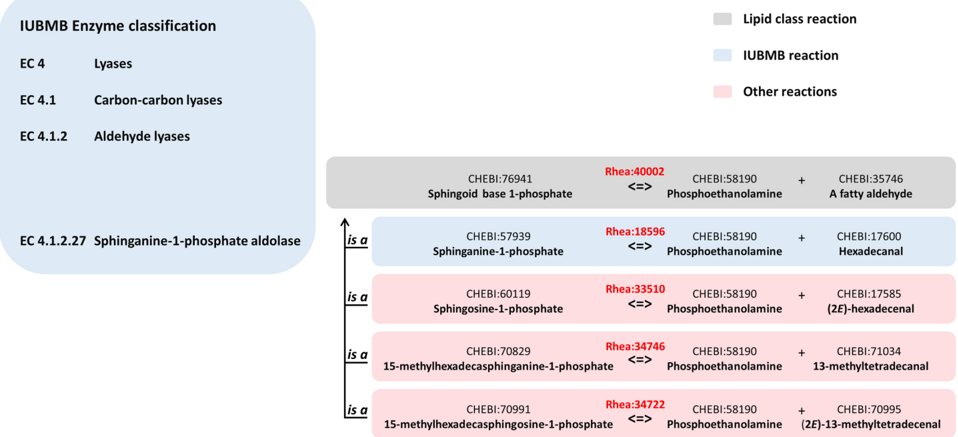
“The representative reaction of the IUBMB for this enzyme is ‘sphinganine 1-phosphate = phosphoethanolamine + palmitaldehyde’ (RHEA:18596), which is catalyzed by the enzyme SGPL1 of Homo sapiens as well as orthologous enzymes in other species (17).”
BackgroundEC-BLAST: a tool to automatically search and compare enzyme reactions
Rahman, S. A., Cuesta, S. M., Furnham, N., Holliday, G. L., & Thornton, J. M. (2014) · Nature Methods · doi:10.1038/nmeth.2803 · Cited by 129
Fifty‐five years of enzyme classification: advances and difficulties
McDonald, A. G., & Tipton, K. F. (2014) · The FEBS Journal · doi:10.1111/febs.12530 · Cited by 116 · cited 1×
“Rhea covers reactions of the hierarchical enzyme classification of the Enzyme Nomenclature committee of the IUBMB (hereafter referred to as the ‘EC’) (2,3) as represented by the ENZYME (4) and IntEnz (5) resources as well as additional enzymatic and transport reactions and spontaneously occurring reactions described i…”
MethodRhea—a manually curated resource of biochemical reactions
Alcántara, R., Axelsen, K. B., Morgat, A., Belda, E., Coudert, E., Bridge, A., Cao, H., de Matos, P., Ennis, M., Turner, S., et al. (2012) · Nucleic Acids Research · doi:10.1093/nar/gkr1126 · Cited by 113 · cited 1×
“More information about Rhea reactions and their use can be found in our previous publications (1,16).”
BackgroundSelf-citationReaction Decoder Tool (RDT): extracting features from chemical reactions
Rahman, S. A., Torrance, G., Baldacci, L., Cuesta, S. M., Fenninger, F., Gopal, N., Choudhary, S., May, J. W., Holliday, G. L., Steinbeck, C., et al. (2016) · Bioinformatics · doi:10.1093/bioinformatics/btw096 · Cited by 98
Brizuela, L., Ader, I., Mazerolles, C., Bocquet, M., Malavaud, B. A., & Cuvillier, O. (2012) · Molecular Cancer Therapeutics · doi:10.1158/1535-7163.mct-12-0227 · Cited by 76 · cited 1×
“Additional related reactions (not mentioned by the EC reference list (3)) feature other members of this class such as sphingosine-1-phosphate (18) (RHEA:33510), the main phosphorylated sphingoid base in H.”
BackgroundChemical Markup, XML, and the World Wide Web. 6. CMLReact, an XML Vocabulary for Chemical Reactions
Holliday, G. L., Murray‐Rust, P., & Rzepa, H. S. (2005) · Journal of Chemical Information and Modeling · doi:10.1021/ci0502698 · Cited by 70 · cited 2×
“Reaction data in BioPax2 (24), RXN (25) and CMLReact (26) formats can also be obtained using RESTful web services at http://www.rhea-db. org/webservice.”
MethodReconciliation of metabolites and biochemical reactions for metabolic networks
Bernard, T., Bridge, A., Morgat, A., Moretti, S., Xenarios, I., & Pagni, M. (2014) · Briefings in Bioinformatics · doi:10.1093/bib/bbs058 · Cited by 69 · cited 2×
“Resources that use Rhea for the annotation of metabolic networks and models include MetaNetX (10,11) and Microscope (12).”
MethodSelf-citationSphingosine Phosphate Lyase Expression Is Essential for Normal Development in Caenorhabditis elegans
Mendel, J., Heinecke, K., Fyrst, H., & Saba, J. D. (2003) · Journal of Biological Chemistry · doi:10.1074/jbc.m302857200 · Cited by 65 · cited 1×
“sapiens, as well as 15-methylhexadecasphinganine-1-phosphate (RHEA:34746) and 15-methylhexadecasphingosine-1phosphate (RHEA:34722) (19), two phosphorylated sphingoid bases of Caenorhabditis elegans and the presumed substrates for the C.”
BackgroundUpdates in Rhea—a manually curated resource of biochemical reactions
Morgat, A., Axelsen, K. B., Lombardot, T., Alcántara, R., Aimo, L., Zerara, M., Niknejad, A., Belda, E., Hyka-Nouspikel, N., Coudert, E., et al. (2015) · Nucleic Acids Research · doi:10.1093/nar/gku961 · Cited by 48 · cited 4×
“In the following sections we summarize recent developments in Rhea since our last publication (1).”
BackgroundInfluentialSelf-citationRxnSim: a tool to compare biochemical reactions
Giri, V., Sivakumar, T. V., Cho, K. M., Kim, T. Y., & Bhaduri, A. (2015) · Bioinformatics · doi:10.1093/bioinformatics/btv416 · Cited by 24
Alcántara, R., Onwubiko, J., Cao, H., de Matos, P., Cham, J. A., Jacobsen, J., Holliday, G. L., Fischer, J. D., Rahman, S. A., Jassal, B., et al. (2012) · Nucleic Acids Research · doi:10.1093/nar/gks1112 · Cited by 20 · cited 1×
“Knowledgebases that use Rhea for the annotation of enzyme and metabolite data include the SwissLipids knowledgebase for lipid biology (7), the EBI Enzyme portal (8), the MetaboLights repository of metabolomics data (9) and IntEnz (5).”
MethodSelf-citation
Cited by
UniProt: the universal protein knowledgebase in 2021
The UniProt Consortium, Bateman, A., Martin, M.-J., Orchard, S., Magrane, M., Agivetova, R., Ahmad, S., Alpi, E., Bowler-Barnett, E. H., Britto, R., et al. (2021) · Nucleic Acids Research · doi:10.1093/nar/gkaa1100 · Cited by 6,372
“Rhea (14) uses the chemical ontology ChEBI (Chemical Entities of Biological Interest) (15) to describe reaction participants, their chemical structures and chemical transformations.”
MethodSelf-citationThe Gene Ontology Resource: 20 years and still GOing strong
The Gene Ontology Consortium (2019) · Nucleic Acids Research · doi:10.1093/nar/gky1055 · Cited by 4,747
“GO also maintains cross-references between terms and multiple widelyused external resources, including Reactome (21), The Annotated Reactions Database (Rhea) (22), Enzyme Commission (EC; http://www.”
BackgroundThe Reactome Pathway Knowledgebase
Fabregat, A., Jupe, S., Matthews, L., Sidiropoulos, K., Gillespie, M., Garapati, P., Haw, R., Jassal, B., Korninger, F., May, B., et al. (2018) · Nucleic Acids Research · doi:10.1093/nar/gkx1132 · Cited by 2,855
“A variety of online resources capture aspects of this information at the level of individual reactions such as Rhea (1) or at the level of reaction sequences spanning various domains of biology such as KEGG (2), MetaCyc (3) or PANTHER (4).”
BackgroundEnsembl Genomes 2020—enabling non-vertebrate genomic research
Howe, K. L., Contreras-Moreira, B., De Silva, N., Maslen, G., Akanni, W., Allen, J., Alvarez-Jarreta, J., Barba, M., Bolser, D. M., Cambell, L., et al. (2020) · Nucleic Acids Research · doi:10.1093/nar/gkz890 · Cited by 466
Vallenet, D., Calteau, A., Dubois, M., Amours, P., Bazin, A., Beuvin, M., Burlot, L., Bussell, X., Fouteau, S., Gautreau, G., et al. (2019) · Nucleic Acids Research · doi:10.1093/nar/gkz926 · Cited by 346
“By defining shared semantic standards, RDF is a way to integrate MicroScope data with other complementary databases such as UniProt (13) and Rhea (32) and to support cross-resource queries using a SPARQL endpoint.”
Method
Metadata
- Authors
- Morgat, A., Lombardot, T., Axelsen, K. B., Aimo, L., Niknejad, A., Hyka-Nouspikel, N., Coudert, E., Pozzato, M., Pagni, M., Moretti, S., Rosanoff, S., Onwubiko, J., Bougueleret, L., Xenarios, I., Redaschi, N., & Bridge, A.
- Affiliations
- SIB Swiss Institute of Bioinformatics (CH)
- European Bioinformatics Institute (GB)
- Corresponding author
- Morgat, Anne
- ORCID
- Venue
- Nucleic Acids Research
- Publisher
- Oxford University Press (OUP)
- Published
- 2016-10-26
- Volume
- 45
- Issue
- D1
- Pages
- D415-D418
- ISSN
- 0305-1048 (ISSN-L)
- 1362-4962
- PMC
- PMC5397180
- OpenAlex
- W2543238710
- Cited by
- 65
- References
- 26
- Citations by year
- 2026: 1 · 2025: 3 · 2024: 2 · 2023: 5 · 2022: 5 · 2021: 5 · 2020: 10 · 2019: 16 · 2018: 11 · 2017: 7
- FWCI
- 7.11
- Type
- journal article
- Language
- en
- Open access
- gold
- doi.org
- Licence
- Locations
- Nucleic Acids Research (publishedVersion, cc-by)
- Europe PMC (PubMed Central) (publishedVersion, cc-by)
- PubMed Central (publishedVersion, cc-by)
- PubMed (publishedVersion)
- SERVAL (Université de Lausanne) (publishedVersion, other-oa)
- IRIS (submittedVersion, other-oa)
- HighWire Press Open Archive (submittedVersion)
- Funders
- European Bioinformatics Institute
- Australian Government
- SystemsX.ch
- Staatssekretariat für Bildung, Forschung und Innovation
- Topics
- Life Sciences › Biochemistry, Genetics and Molecular Biology › Molecular Biology › Bioinformatics and Genomic Networks
- Health Sciences › Medicine › Health Informatics › Biomedical Text Mining and Ontologies
- Life Sciences › Biochemistry, Genetics and Molecular Biology › Molecular Biology › Microbial Metabolic Engineering and Bioproduction
- Keywords
- biochemical reactions, enzymatic reactions, expert curation, ChEBI ontology, reaction classification, metabolic networks, database updates
About these checks
Registry, retraction, Cites and statistics results are computed, not judged, with one exception: a printed reference that no index lists is read once by a model before it counts as a citation error. Claims are extracted by a model and kept only when their quote appears verbatim in the text; each cited source is then checked, with a model’s help, for whether it says what the claim relies on. Those verdicts can be wrong — read the claim’s quote and the cited source before relying on one.
Statistics and arithmetic are recomputed, not judged.
Confidence bands are shown only for fields calibrated on our annotated test set. None is calibrated yet, so no band is shown.
What counts as a claim ›How we measure confidence ›How we check this ›
Are you an author, or do you see a problem with this page? Request a review
Data sources
Bibliographic data: Semantic Scholar, OpenAlex, Crossref.
Contains information from the Semantic Scholar Academic Graph Datasets, made available under the ODC Attribution License (ODC-BY 1.0).
Semantic Scholar’s data is described in: Kinney, R., et al. (2023). The Semantic Scholar Open Data Platform. arXiv:2301.10140.
