

BioModels: expanding horizons to include more modelling approaches and formats
Open accessThe DOI matches its Crossref record; 13 of the 13 references it cites were found in a registry or an index.
Abstract
BioModels serves as a central repository of mathematical models representing biological processes. It offers a platform to make mathematical models easily shareable across the systems modelling community, thereby supporting model reuse. To facilitate hosting a broader range of model formats derived from diverse modelling approaches and tools, a new infrastructure for BioModels has been developed that is available at http://www.ebi.ac.uk/biomodels. This new system allows submitting and sharing of a wide range of models with improved support for formats other than SBML. It also offers a version-control backed environment in which authors and curators can work collaboratively to curate models. This article summarises the features available in the current system and discusses the potential benefit they offer to the users over the previous system. In summary, the new portal broadens the scope of models accepted in BioModels and supports collaborative model curation which is crucial for model reproducibility and sharing.
Overview
The claims and statistics of this paper haven’t been checked yet.
Free: it reads the open-access text and checks the first 5 claims that cite a source we can check. Create a free account to check every claim.
Integrity signals
Registry
Cites
Statistics
Figures
Verification
Claims the paper makes
The claims and statistics of this paper haven’t been checked yet.
Free: it reads the open-access text and checks the first 5 claims that cite a source we can check. Create a free account to check every claim.
Claims other papers make about this one
Each is checked against this paper’s own text: does it say what the citing paper says it does?
The cited source says what the claim attributes to it.
In the citing paper
“Two such model repositories currently exist: BioModels25 geared toward cell‐ and molecular‐based systems models and DDMoRE26 for pharmacometrics.”
From Reproducibility of Quantitative Systems Pharmacology Models: Current Challenges and Future Opportunities (2019) · cites this paper as [25]
The cited source says what the claim attributes to it.
In the citing paper
“Model repositories such as BioModels [10, 11], JWS Online [12], or the Physiome Model Repository 2 (PMR2) [13] provide different means to retrieve and use simulation models.”
From Relating simulation studies by provenance—Developing a family of Wnt signaling models (2021) · cites this paper as [11]
Self-check
Percentages, sums and reported differences re-computed from the paper’s own numbers.
The self-check needs the paper’s full text.
Citations
Cites
A pathology atlas of the human cancer transcriptome
Uhlen, M., Zhang, C., Lee, S., Sjöstedt, E., Fagerberg, L., Bidkhori, G., Benfeitas, R., Arif, M., Liu, Z., Edfors, F., et al. (2017) · Science · doi:10.1126/science.aan2507 · Cited by 3,371
CellML: its future, present and past
Lloyd, C. M., Halstead, M. D. B., & Nielsen, P. F. (2004) · Progress in Biophysics and Molecular Biology · doi:10.1016/j.pbiomolbio.2004.01.004 · Cited by 499 · cited 2×
“Key parts of the functionality in the previous system (1), including the curation pipeline and the model display page, are contingent on the model being encoded in standard formats including SBML or CellML.”
MethodBioModels: ten-year anniversary
Chelliah, V., Juty, N., Ajmera, I., Ali, R., Dumousseau, M., Glont, M., Hucka, M., Jalowicki, G., Keating, S., Knight-Schrijver, V., et al. (2015) · Nucleic Acids Research · doi:10.1093/nar/gku1181 · Cited by 281 · cited 2×
“BioModels (1) emerged in 2005 as a response to the needs of the systems biology community for a resource that facilitates the exchange, reuse and repurposing of the models.”
BackgroundSelf-citationHucka, M., Bergmann, F. T., Chaouiya, C., Dräger, A., Hoops, S., Keating, S. M., König, M., Novère, N. L., Myers, C. J., Olivier, B. G., et al. (2019) · Journal of Integrative Bioinformatics · doi:10.1515/jib-2019-0021 · Cited by 258
Self-citationDiscovering and linking public omics data sets using the Omics Discovery Index
Perez-Riverol, Y., Bai, M., da Veiga Leprevost, F., Squizzato, S., Park, Y. M., Haug, K., Carroll, A. J., Spalding, D., Paschall, J., Wang, M., et al. (2017) · Nature Biotechnology · doi:10.1038/nbt.3790 · Cited by 212 · cited 1×
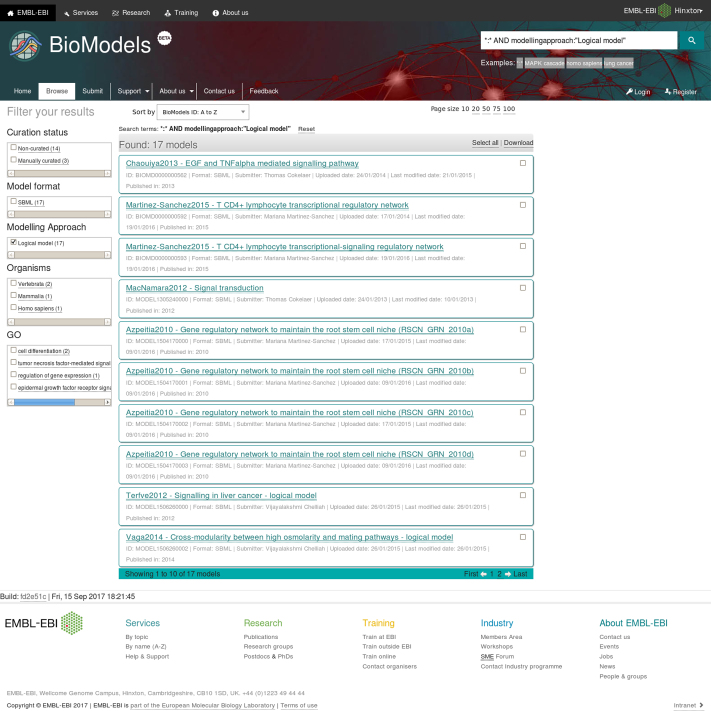
“The upgraded search system, based on the Omics Discovery Index (10) and the EBI search engine (11), retains the in-depth capabilities of the previous system whilst offering a streamlined experience for end users in terms of speed and ease of use.”
MethodSelf-citationIdentifiers.org and MIRIAM Registry: community resources to provide persistent identification
Juty, N., Le Novere, N., & Laibe, C. (2012) · Nucleic Acids Research · doi:10.1093/nar/gkr1097 · Cited by 202
Self-citationCOMBINE archive and OMEX format: one file to share all information to reproduce a modeling project
Bergmann, F. T., Adams, R., Moodie, S., Cooper, J., Glont, M., Golebiewski, M., Hucka, M., Laibe, C., Miller, A. K., Nickerson, D. P., et al. (2014) · BMC Bioinformatics · doi:10.1186/s12859-014-0369-z · Cited by 173 · cited 1×
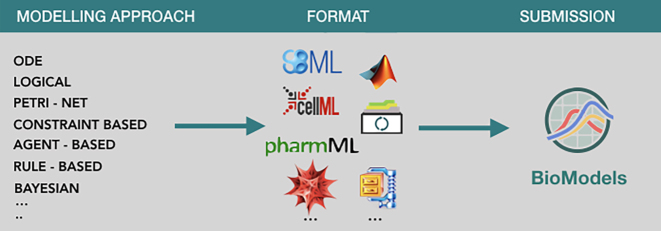
“To foster interoperability and model reuse, the new system offers enhanced technical support for open formats such as SBML, PharmML (7) or COMBINE Archive (8).”
MethodSelf-citationPath2Models: large-scale generation of computational models from biochemical pathway maps
Büchel, F., Rodriguez, N., Swainston, N., Wrzodek, C., Czauderna, T., Keller, R., Mittag, F., Schubert, M., Glont, M., Golebiewski, M., et al. (2013) · BMC Systems Biology · doi:10.1186/1752-0509-7-116 · Cited by 172
Self-citationBioModels.net Web Services, a free and integrated toolkit for computational modelling software
Li, C., Courtot, M., Le Novere, N., & Laibe, C. (2010) · Briefings in Bioinformatics · doi:10.1093/bib/bbp056 · Cited by 51 · cited 1×
“External tools use the web services exposed by the earlier BioModels infrastructure (12) to allow their users to search and retrieve relevant BioModels content remotely.”
MethodSelf-citationThe Systems Biology Markup Language (SBML): Language Specification for Level 3 Version 1 Core
Smith, L., Wilkinson, D., Hucka, M., Bergmann, F., Hoops, S., Keating, S., Sahle, S., & Schaff, J. (2010) · Nature Precedings · doi:10.1038/npre.2010.4959.1 · Cited by 44
The evolution of standards and data management practices in systems biology
Stanford, N. J., Wolstencroft, K., Golebiewski, M., Kania, R., Juty, N., Tomlinson, C., Owen, S., Butcher, S., Hermjakob, H., Le Novère, N., et al. (2015) · Molecular Systems Biology · doi:10.15252/msb.20156053 · Cited by 38 · cited 1×
“Its endorsement for community standards used to encode models and associated metadata, combined with its curation efforts have established it as one of the most widely used repositories of its kind (6).”
BackgroundSelf-citationThe EBI search engine: EBI search as a service—making biological data accessible for all
Park, Y. M., Squizzato, S., Buso, N., Gur, T., & Lopez, R. (2017) · Nucleic Acids Research · doi:10.1093/nar/gkx359 · Cited by 33 · cited 1×
“The upgraded search system, based on the Omics Discovery Index (10) and the EBI search engine (11), retains the in-depth capabilities of the previous system whilst offering a streamlined experience for end users in terms of speed and ease of use.”
MethodPharmML in Action: an Interoperable Language for Modeling and Simulation
Bizzotto, R., Comets, E., Smith, G., Yvon, F., Kristensen, N., & Swat, M. (2017) · CPT: Pharmacometrics & Systems Pharmacology · doi:10.1002/psp4.12213 · Cited by 9 · cited 1×
“To foster interoperability and model reuse, the new system offers enhanced technical support for open formats such as SBML, PharmML (7) or COMBINE Archive (8).”
MethodSelf-citation
Cited by
Benchmarking algorithms for gene regulatory network inference from single-cell transcriptomic data
Pratapa, A., Jalihal, A. P., Law, J. N., Bharadwaj, A., & Murali, T. M. (2020) · Nature Methods · doi:10.1038/s41592-019-0690-6 · Cited by 792
Current status and applications of genome-scale metabolic models
Gu, C., Kim, G. B., Kim, W. J., Kim, H. U., & Lee, S. Y. (2019) · Genome Biology · doi:10.1186/s13059-019-1730-3 · Cited by 785
BioModels—15 years of sharing computational models in life science
Malik-Sheriff, R. S., Glont, M., Nguyen, T. V. N., Tiwari, K., Roberts, M. G., Xavier, A., Vu, M. T., Men, J., Maire, M., Kananathan, S., et al. (2019) · Nucleic Acids Research · doi:10.1093/nar/gkz1055 · Cited by 361
“The technical capabilities significantly improved after switching to the new infrastructure allowing BioModels to accept submissions and host models from diverse modelling approaches and formats (10).”
BackgroundSelf-citationReconstructing organisms in silico: genome-scale models and their emerging applications
Fang, X., Lloyd, C. J., & Palsson, B. O. (2020) · Nature Reviews Microbiology · doi:10.1038/s41579-020-00440-4 · Cited by 292
“Many of them can be found in GEM databases including BiGG Models 63 , BioModels 64 , MetaNetX 65 , MEMOSys 66 and Virtual Metabolic Human 67 .”
BackgroundMetExplore: collaborative edition and exploration of metabolic networks
Cottret, L., Frainay, C., Chazalviel, M., Cabanettes, F., Gloaguen, Y., Camenen, E., Merlet, B., Heux, S., Portais, J.-C., Poupin, N., et al. (2018) · Nucleic Acids Research · doi:10.1093/nar/gky301 · Cited by 134
“Many network repositories like BIGG (23) or BioModels (24) offer to download metabolic networks in that format.”
BackgroundInfluential
Metadata
- Authors
- Glont, M., Nguyen, T. V. N., Graesslin, M., Hälke, R., Ali, R., Schramm, J., Wimalaratne, S. M., Kothamachu, V. B., Rodriguez, N., Swat, M. J., Eils, J., Eils, R., Laibe, C., Malik-Sheriff, R. S., Chelliah, V., Le Novère, N., & Hermjakob, H.
- Affiliations
- European Bioinformatics Institute (GB)
- German Cancer Research Center (DE)
- University of Rostock (DE)
- Babraham Institute (GB)
- Corresponding author
- Hermjakob, Henning
- ORCID
- Venue
- Nucleic Acids Research
- Publisher
- Oxford University Press (OUP)
- Published
- 2017-11-02
- Volume
- 46
- Issue
- D1
- Pages
- D1248-D1253
- ISSN
- 0305-1048 (ISSN-L)
- 1362-4962
- PMC
- PMC5753244
- OpenAlex
- W2765869690
- Cited by
- 89
- References
- 13
- Citations by year
- 2026: 2 · 2025: 8 · 2024: 9 · 2023: 10 · 2022: 8 · 2021: 9 · 2020: 20 · 2019: 17 · 2018: 5 · 2017: 1
- FWCI
- 4.81
- Type
- journal article
- Language
- en
- Open access
- gold
- doi.org
- Licence
- Locations
- Nucleic Acids Research (publishedVersion, cc-by)
- Europe PMC (PubMed Central) (publishedVersion, cc-by)
- PubMed Central (publishedVersion, cc-by)
- PubMed (publishedVersion)
- Funders
- Deutsches Krebsforschungszentrum
- European Molecular Biology Laboratory
- Research Councils UK (BB/J004456/1)
- Directorate for Biological Sciences
- Biotechnology and Biological Sciences Research Council (BB/F010516/1, BB/J004456/1, BB/P013414/1, BB/J019305/1, BB/N019482/1, BB/P013406/1, BB/N019474/1, BB/P013384/1)
- Topics
- Life Sciences › Biochemistry, Genetics and Molecular Biology › Molecular Biology › Gene Regulatory Network Analysis
- Social Sciences › Decision Sciences › Information Systems and Management › Scientific Computing and Data Management
- Life Sciences › Biochemistry, Genetics and Molecular Biology › Molecular Biology › Bioinformatics and Genomic Networks
- Keywords
- biomodels, model sharing, model reuse, SBML, version control, model reproducibility, systems biology modeling
- MeSH terms
- Data Collection, Models, Biological, Software, User-Computer Interface, Internet, Data Curation
About these checks
Registry, retraction, Cites and statistics results are computed, not judged, with one exception: a printed reference that no index lists is read once by a model before it counts as a citation error. Claims are extracted by a model and kept only when their quote appears verbatim in the text; each cited source is then checked, with a model’s help, for whether it says what the claim relies on. Those verdicts can be wrong — read the claim’s quote and the cited source before relying on one.
Statistics and arithmetic are recomputed, not judged.
Confidence bands are shown only for fields calibrated on our annotated test set. None is calibrated yet, so no band is shown.
What counts as a claim ›How we measure confidence ›How we check this ›
Are you an author, or do you see a problem with this page? Request a review
Data sources
Bibliographic data: Semantic Scholar, OpenAlex, Crossref.
Contains information from the Semantic Scholar Academic Graph Datasets, made available under the ODC Attribution License (ODC-BY 1.0).
Semantic Scholar’s data is described in: Kinney, R., et al. (2023). The Semantic Scholar Open Data Platform. arXiv:2301.10140.
