

The DOI matches its Crossref record; 63 of the 63 references it cites were found in a registry or an index.
N1-methyl-pseudouridine in mRNA enhances translation through eIF2α-dependent and independent mechanisms by increasing ribosome density
Open accessAbstract
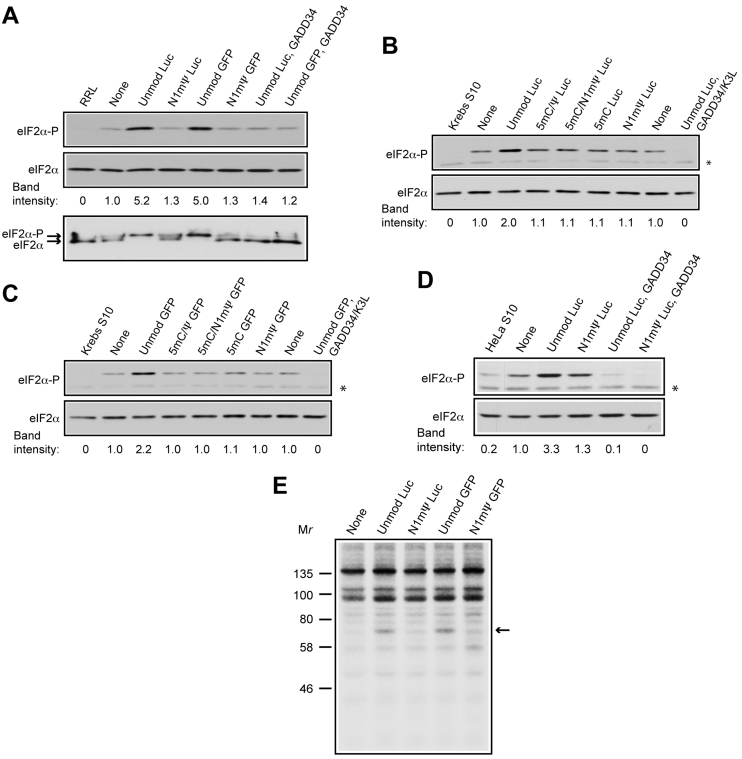
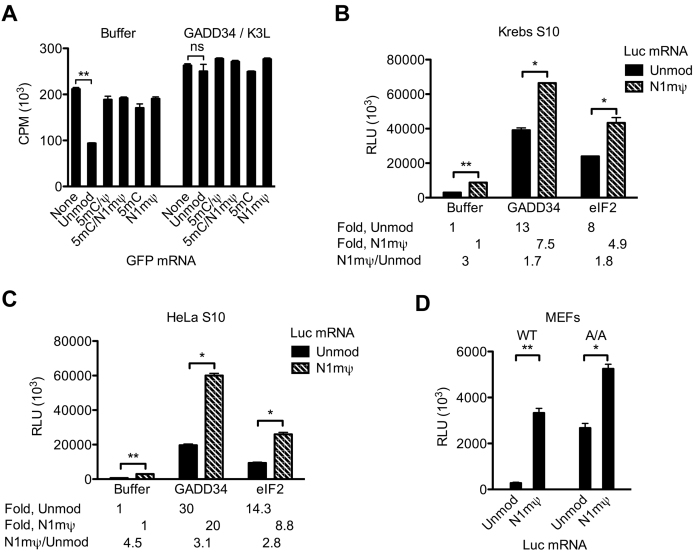
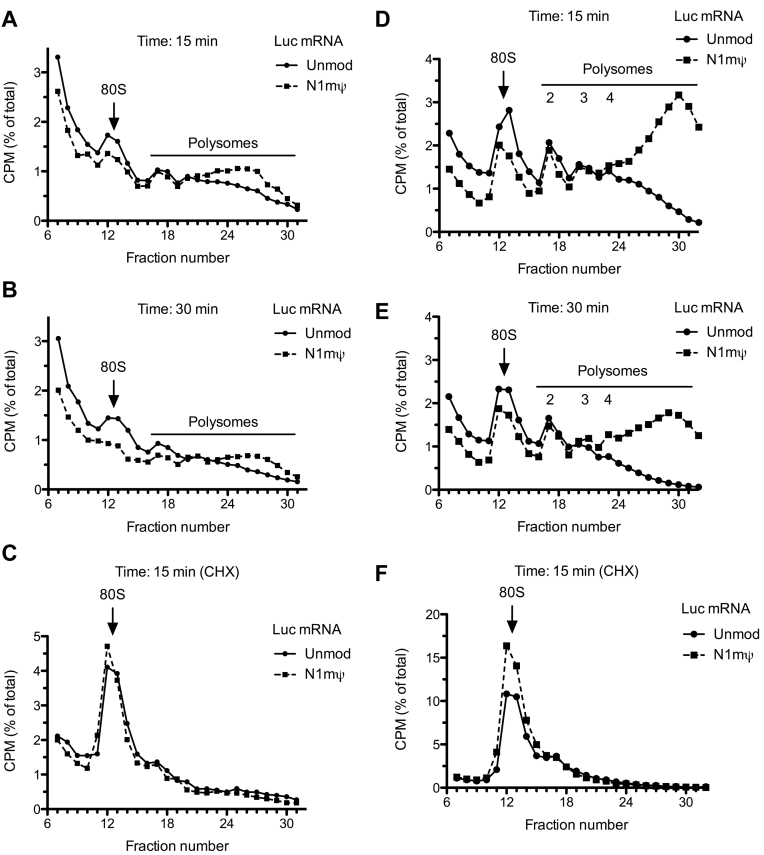
Certain chemical modifications confer increased stability and low immunogenicity to in vitro transcribed mRNAs, thereby facilitating expression of therapeutically important proteins. Here, we demonstrate that N1-methyl-pseudouridine (N1mΨ) outperforms several other nucleoside modifications and their combinations in terms of translation capacity. Through extensive analysis of various modified transcripts in cell-free translation systems, we deconvolute the different components of the effect on protein expression independent of mRNA stability mechanisms. We show that in addition to turning off the immune/eIF2α phosphorylation-dependent inhibition of translation, the incorporated N1mΨ nucleotides dramatically alter the dynamics of the translation process by increasing ribosome pausing and density on the mRNA. Our results indicate that the increased ribosome loading of modified mRNAs renders them more permissive for initiation by favoring either ribosome recycling on the same mRNA or de novo ribosome recruitment.
Overview
The claims and statistics of this paper haven’t been checked yet.
Run the check — free, no account needed. It reads the open-access text and checks the sources it cites.
Integrity signals
Registry
Cites
Statistics
Figures
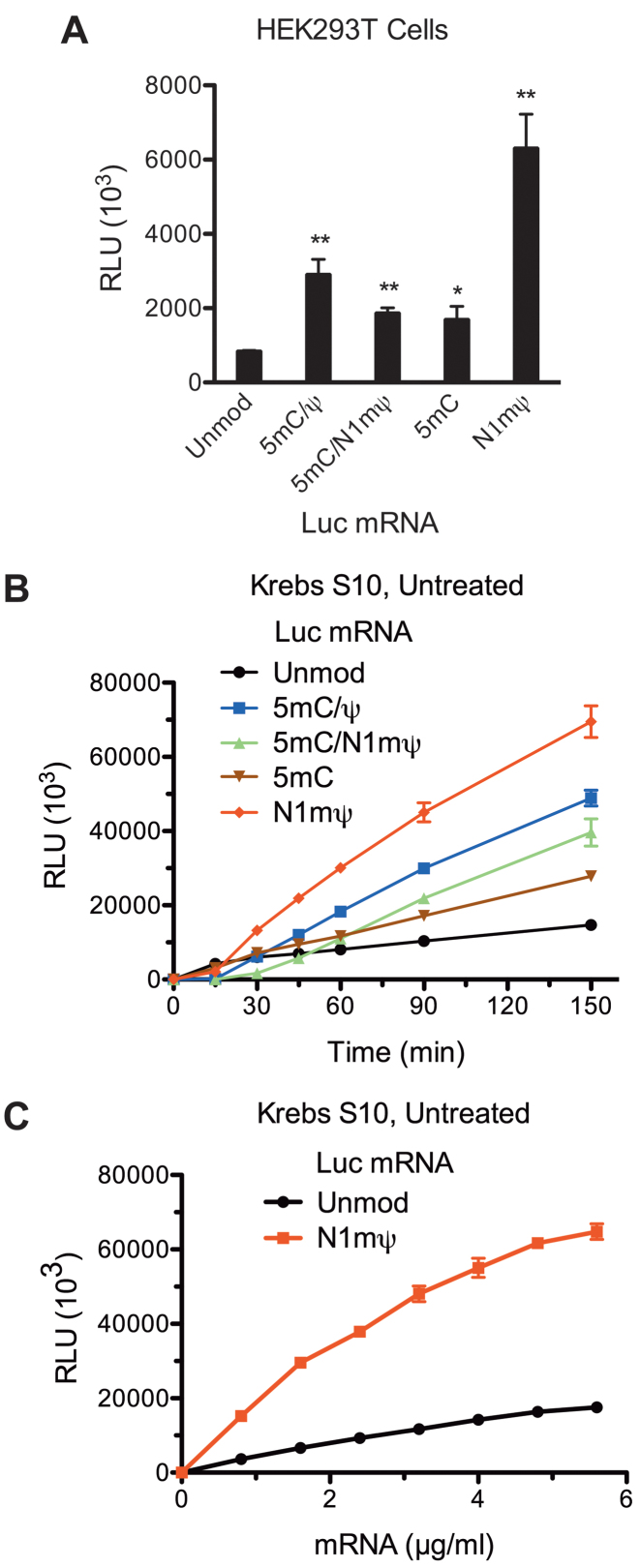
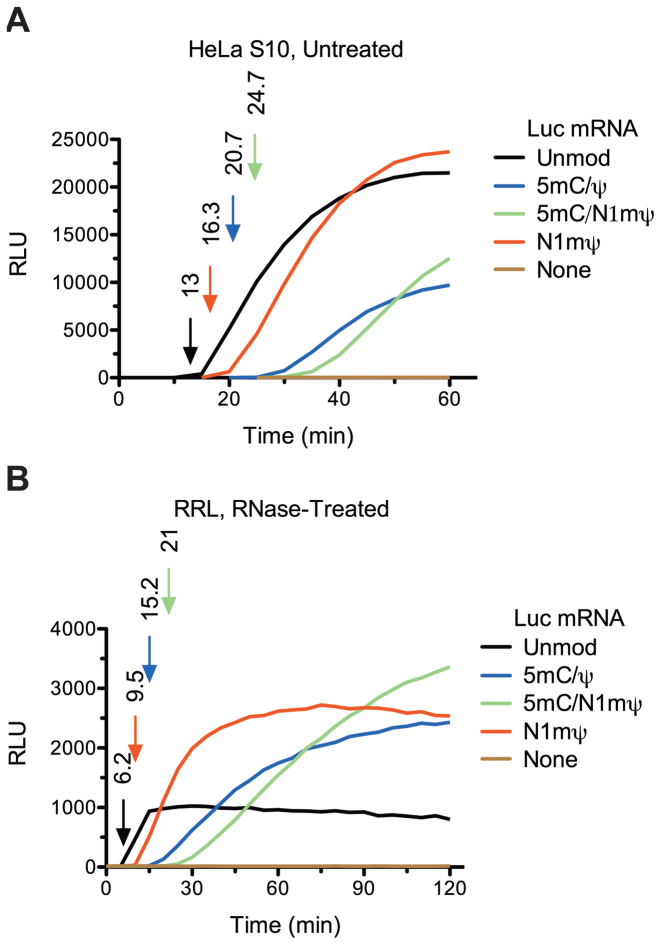
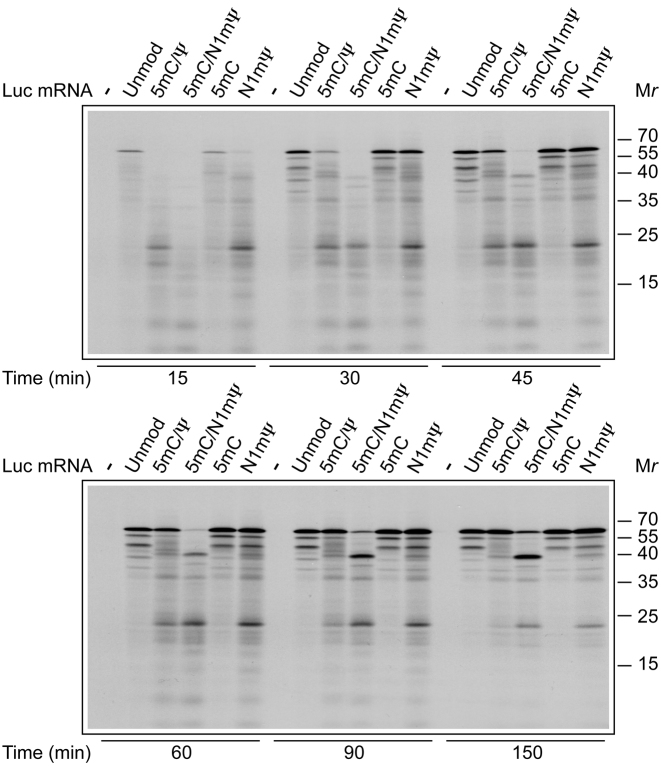
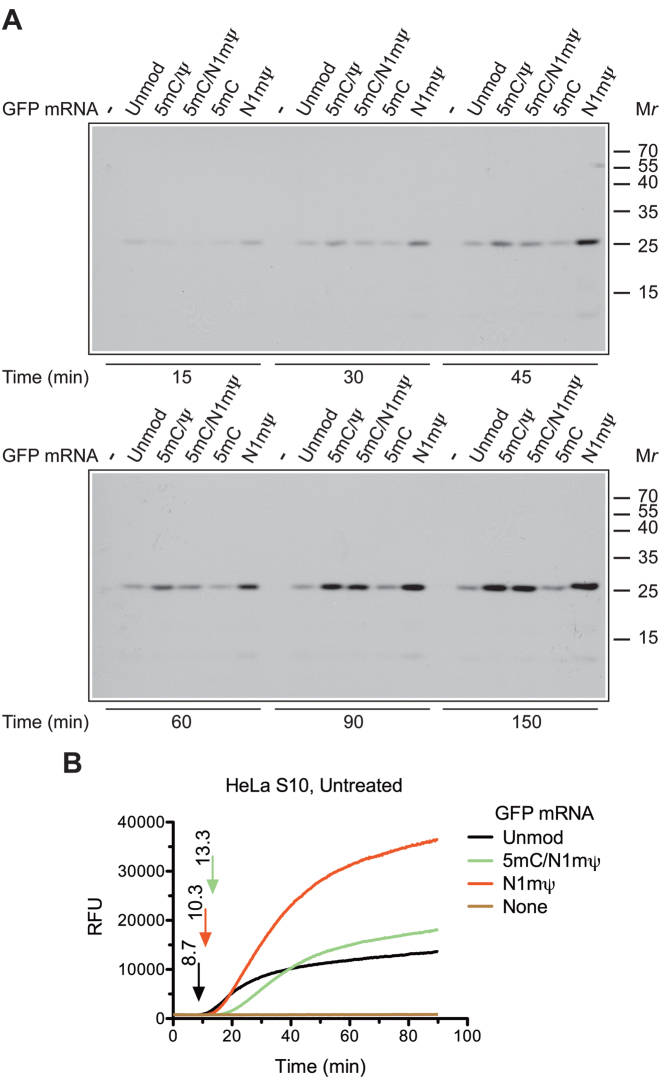
Verification
Claims the paper makes
The claims and statistics of this paper haven’t been checked yet.
Run the check — free, no account needed. It reads the open-access text and checks the sources it cites.
Claims other papers make about this one
Each is checked against this paper’s own text: does it say what the citing paper says it does?
The cited source says what the claim attributes to it.
In the citing paper
“Nucleoside-modified mRNA can reduce the activation of TLRs, retinoic acid-inducible gene I (RIG-I), protein kinase R (PKR), and 2′-5′-oligoadenylate synthetase (OAS). Additionally, nucleoside modification increases translation activity and resistance against RNase L-mediated degradation.54,81,173–176”
From Advances in COVID-19 mRNA vaccine development (2022) · cites this paper as [176]
Self-check
Percentages, sums and reported differences re-computed from the paper’s own numbers.
The self-check needs the paper’s full text.
Citations
Cites
Topology of the human and mouse m6A RNA methylomes revealed by m6A-seq
Dominissini, D., Moshitch-Moshkovitz, S., Schwartz, S., Salmon-Divon, M., Ungar, L., Osenberg, S., Cesarkas, K., Jacob-Hirsch, J., Amariglio, N., Kupiec, M., et al. (2012) · Nature · doi:10.1038/nature11112 · Cited by 4,884
Comprehensive Analysis of mRNA Methylation Reveals Enrichment in 3′ UTRs and near Stop Codons
Meyer, K. D., Saletore, Y., Zumbo, P., Elemento, O., Mason, C. E., & Jaffrey, S. R. (2012) · Cell · doi:10.1016/j.cell.2012.05.003 · Cited by 4,223
Regulation of Translation Initiation in Eukaryotes: Mechanisms and Biological Targets
Sonenberg, N., & Hinnebusch, A. G. (2009) · Cell · doi:10.1016/j.cell.2009.01.042 · Cited by 3,304
Self-citationKarikó, K., Buckstein, M., Ni, H., & Weissman, D. (2005) · Immunity · doi:10.1016/j.immuni.2005.06.008 · Cited by 2,728
Warren, L., Manos, P. D., Ahfeldt, T., Loh, Y.-H., Li, H., Lau, F., Ebina, W., Mandal, P. K., Smith, Z. D., Meissner, A., et al. (2010) · Cell Stem Cell · doi:10.1016/j.stem.2010.08.012 · Cited by 2,662
mRNA-based therapeutics--developing a new class of drugs
Sahin, U., Karikó, K., & Türeci, Ö. (2014) · Nature Reviews Drug Discovery · doi:10.1038/nrd4278 · Cited by 2,474
Ingolia, N. T., Lareau, L. F., & Weissman, J. S. (2011) · Cell · doi:10.1016/j.cell.2011.10.002 · Cited by 2,187
Insights into RNA Biology from an Atlas of Mammalian mRNA-Binding Proteins
Castello, A., Fischer, B., Eichelbaum, K., Horos, R., Beckmann, B. M., Strein, C., Davey, N. E., Humphreys, D. T., Preiss, T., Steinmetz, L. M., et al. (2012) · Cell · doi:10.1016/j.cell.2012.04.031 · Cited by 2,132
5′ UTR m6A Promotes Cap-Independent Translation
Meyer, K. D., Patil, D. P., Zhou, J. L., Zinoviev, A., Skabkin, M. A., Elemento, O., Pestova, T. V., Qian, S., & Jaffrey, S. R. (2015) · Cell · doi:10.1016/j.cell.2015.10.012 · Cited by 1,812
Feedback Inhibition of the Unfolded Protein Response by GADD34-Mediated Dephosphorylation of eIF2α
Novoa, I., Zeng, H., Harding, H. P., & Ron, D. (2001) · The Journal of Cell Biology · doi:10.1083/jcb.153.5.1011 · Cited by 1,434
Cited by
Sorted by citations
Delivering the Messenger: Advances in Technologies for Therapeutic mRNA Delivery
Kowalski, P. S., Rudra, A., Miao, L., & Anderson, D. G. (2019) · Molecular Therapy · doi:10.1016/j.ymthe.2019.02.012 · Cited by 1,127
mRNA-based therapeutics: powerful and versatile tools to combat diseases
Qin, S., Tang, X., Chen, Y., Chen, K., Fan, N., Xiao, W., Zheng, Q., Li, G., Teng, Y., Wu, M., et al. (2022) · Signal Transduction and Targeted Therapy · doi:10.1038/s41392-022-01007-w · Cited by 852
Advances in the delivery of RNA therapeutics: from concept to clinical reality
Kaczmarek, J. C., Kowalski, P. S., & Anderson, D. G. (2017) · Genome Medicine · doi:10.1186/s13073-017-0450-0 · Cited by 656
Ionizable Lipid Nanoparticle-Mediated mRNA Delivery for Human CAR T Cell Engineering
Billingsley, M. M., Singh, N., Ravikumar, P., Zhang, R., June, C. H., & Mitchell, M. J. (2020) · Nano Letters · doi:10.1021/acs.nanolett.9b04246 · Cited by 636
Advances in COVID-19 mRNA vaccine development
Fang, E., Liu, X., Li, M., Zhang, Z., Song, L., Zhu, B., Wu, X., Liu, J., Zhao, D., & Li, Y. (2022) · Signal Transduction and Targeted Therapy · doi:10.1038/s41392-022-00950-y · Cited by 601
Metadata
- Authors
- Svitkin, Y. V., Cheng, Y. M., Chakraborty, T., Presnyak, V., John, M., & Sonenberg, N.
- Affiliations
- Institut du cancer Rosalind & Morris Goodman (CA)
- Moderna Therapeutics (United States) (US)
- Corresponding author
- Svitkin, Yuri V.
- Sonenberg, Nahum
- Venue
- Nucleic Acids Research
- Publisher
- Oxford University Press (OUP)
- Published
- 2017-02-23
- Volume
- 45
- Issue
- 10
- Pages
- 6023-6036
- ISSN
- 0305-1048 (ISSN-L)
- 1362-4962
- PMC
- PMC5449617
- OpenAlex
- W2589945527
- Cited by
- 278
- References
- 63
- Citations by year
- 2026: 38 · 2025: 49 · 2024: 31 · 2023: 32 · 2022: 48 · 2021: 29 · 2020: 22 · 2019: 13 · 2018: 13 · 2017: 2
- FWCI
- 5.58
- Type
- journal article
- Language
- en
- Open access
- gold
- doi.org
- Licence
- Locations
- Nucleic Acids Research (publishedVersion, cc-by-nc)
- Europe PMC (PubMed Central) (publishedVersion, cc-by-nc)
- PubMed Central (publishedVersion, cc-by-nc)
- PubMed (publishedVersion)
- eScholarship@McGill (McGill) (submittedVersion)
- Funders
- Canadian Institutes of Health Research
- Topics
- Life Sciences › Biochemistry, Genetics and Molecular Biology › Molecular Biology › RNA and protein synthesis mechanisms
- Life Sciences › Biochemistry, Genetics and Molecular Biology › Molecular Biology › RNA modifications and cancer
- Life Sciences › Biochemistry, Genetics and Molecular Biology › Molecular Biology › RNA Interference and Gene Delivery
- Keywords
- nucleoside-modified mRNA, translation efficiency, eIF2α phosphorylation, ribosome density, ribosome pausing, ribosome recycling, in vitro translation, in vitro transcribed mRNA
- MeSH terms
- Animals, Cell Line, Cell-Free System, Enzyme Activation, Fibroblasts, HeLa Cells, Humans, Phosphorylation, Polyribosomes, Protein Processing, Post-Translational, Pseudouridine, RNA, RNA, Messenger, Transfection, Protein Biosynthesis, Eukaryotic Initiation Factor-2, eIF-2 Kinase, RNA Stability, Mice, HEK293 Cells
About these checks
Registry, retraction, Cites and statistics results are computed, not judged, with one exception: a printed reference that no index lists is read once by a model before it counts as a citation error. Claims are extracted by a model and kept only when their quote appears verbatim in the text; each cited source is then checked, with a model’s help, for whether it says what the claim relies on. Those verdicts can be wrong — read the claim’s quote and the cited source before relying on one.
Statistics and arithmetic are recomputed, not judged.
Confidence bands are shown only for fields calibrated on our annotated test set. None is calibrated yet, so no band is shown.
What counts as a claim ›How we measure confidence ›How we check this ›
Are you an author, or do you see a problem with this page? Request a review
