

CRISPOR: intuitive guide selection for CRISPR/Cas9 genome editing experiments and screens
Open accessThe DOI matches its Crossref record; 14 of the 14 references it cites were found in a registry or an index.
Abstract
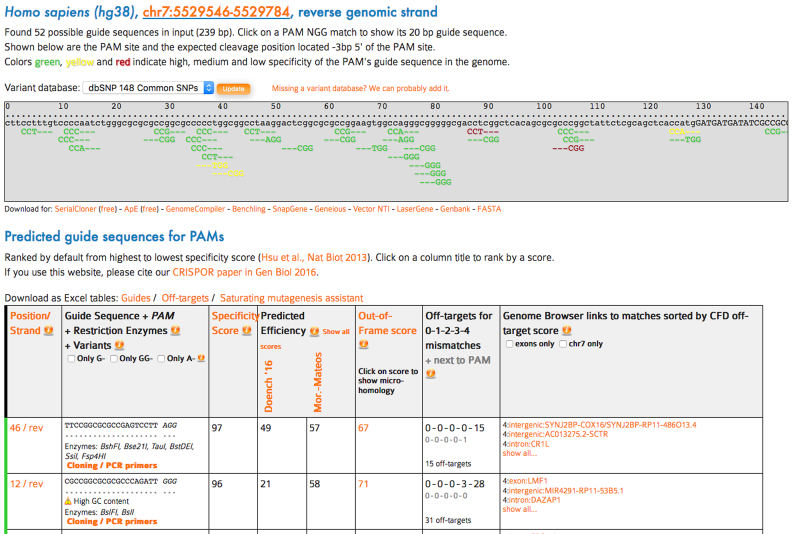
CRISPOR.org is a web tool for genome editing experiments with the CRISPR-Cas9 system. It finds guide RNAs in an input sequence and ranks them according to different scores that evaluate potential off-targets in the genome of interest and predict on-target activity. The list of genomes is continuously expanded, with more 150 genomes added in the last two years. CRISPOR tries to provide a comprehensive solution from selection, cloning and expression of guide RNA as well as providing primers needed for testing guide activity and potential off-targets. Recent developments include batch design for genome-wide CRISPR and saturation screens, creating custom oligonucleotides for guide cloning and the design of next generation sequencing primers to test for off-target mutations. CRISPOR is available from http://crispor.org, including the full source code of the website and a stand-alone, command-line version.
Overview
The claims and statistics of this paper haven’t been checked yet.
Free: it reads the open-access text and checks the first 5 claims that cite a source we can check. Create a free account to check every claim.
Integrity signals
Registry
Cites
Statistics
Figures
Verification
Claims the paper makes
The claims and statistics of this paper haven’t been checked yet.
Free: it reads the open-access text and checks the first 5 claims that cite a source we can check. Create a free account to check every claim.
Self-check
Percentages, sums and reported differences re-computed from the paper’s own numbers.
The self-check needs the paper’s full text.
Citations
Cites
Cpf1 Is a Single RNA-Guided Endonuclease of a Class 2 CRISPR-Cas System
Zetsche, B., Gootenberg, J. S., Abudayyeh, O. O., Slaymaker, I. M., Makarova, K. S., Essletzbichler, P., Volz, S. E., Joung, J., van der Oost, J., Regev, A., et al. (2015) · Cell · doi:10.1016/j.cell.2015.09.038 · Cited by 4,761
Optimized sgRNA design to maximize activity and minimize off-target effects of CRISPR-Cas9
Doench, J. G., Fusi, N., Sullender, M., Hegde, M., Vaimberg, E. W., Donovan, K. F., Smith, I., Tothova, Z., Wilen, C., Orchard, R., et al. (2016) · Nature Biotechnology · doi:10.1038/nbt.3437 · Cited by 4,637 · cited 2×
“Cutting frequency determination (CFD) score is now displayed along potential offtargets because it was shown to more reliably predict offtargets (7).”
BackgroundBae, S., Park, J., & Kim, J.-S. (2014) · Bioinformatics · doi:10.1093/bioinformatics/btu048 · Cited by 2,339
Haeussler, M., Schönig, K., Eckert, H., Eschstruth, A., Mianné, J., Renaud, J.-B., Schneider-Maunoury, S., Shkumatava, A., Teboul, L., Kent, J., et al. (2016) · Genome biology · doi:10.1186/s13059-016-1012-2 · Cited by 1,756 · cited 2×
“While we were developing the website, many design criteria were published, so we compared them, published the comparison (4) and designed CRISPOR such that it recommends scores that are most accurate for a particular assay.”
BackgroundMethodSelf-citationCHOPCHOP: a CRISPR/Cas9 and TALEN web tool for genome editing
Montague, T. G., Cruz, J. M., Gagnon, J. A., Church, G. M., & Valen, E. (2014) · Nucleic Acids Research · doi:10.1093/nar/gku410 · Cited by 1,234
CCTop: An intuitive, flexible and reliable CRISPR/Cas9 target prediction tool
Stemmer, M., Thumberger, T., del Sol Keyer, M., Wittbrodt, J., & Mateo, J. L. (2015) · PLoS ONE · doi:10.1371/journal.pone.0124633 · Cited by 1,088
Horlbeck, M. A., Gilbert, L. A., Villalta, J. E., Adamson, B., Pak, R. A., Chen, Y., Fields, A. P., Park, C. Y., Corn, J. E., Kampmann, M., et al. (2016) · eLife · doi:10.7554/elife.19760 · Cited by 894
The UCSC Genome Browser database: 2018 update
Casper, J., Zweig, A. S., Villarreal, C., Tyner, C., Speir, M. L., Rosenbloom, K. R., Raney, B. J., Lee, C. M., Lee, B. T., Karolchik, D., et al. (2018) · Nucleic Acids Research · doi:10.1093/nar/gkx1020 · Cited by 475
Self-citationAnalyzing CRISPR genome-editing experiments with CRISPResso
Pinello, L., Canver, M. C., Hoban, M. D., Orkin, S. H., Kohn, D. B., Bauer, D. E., & Yuan, G.-C. (2016) · Nature Biotechnology · doi:10.1038/nbt.3583 · Cited by 459
Deep learning improves prediction of CRISPR–Cpf1 guide RNA activity
Kim, H. K., Min, S., Song, M., Jung, S., Choi, J. W., Kim, Y., Lee, S., Yoon, S., & Kim, H. (. (2018) · Nature Biotechnology · doi:10.1038/nbt.4061 · Cited by 382
Cited by
Items 1,001–1,016 of 1,016
Yamada, M., Matsuyama, H. J., Takeda-Kamiya, N., Sato, M., & Toyooka, K. (2025) · Nature Plants · doi:10.1038/s41477-025-01909-x · Cited by 7
Coulon, A., Rabiller, F., Takalo, M., Roy, A., Pelletier, A., Martiskainen, H., Siedlecki-Wullich, D., Lannette-Weimann, N., Majerníková, N., Grenon, A., et al. (2026) · Nature Genetics · doi:10.1038/s41588-026-02709-5 · Cited by 7
Cathepsin X is a conserved cell death protein involved in algal response to environmental stress
Mizrachi, A., Sadeh, M., Ben-Dor, S., Dym, O., Ku, C., Feldmesser, E., Zarfin, A., Brunson, J. K., Allen, A. E., Jinkerson, R. E., et al. (2025) · Current Biology · doi:10.1016/j.cub.2025.03.045 · Cited by 5
Cathepsin X is a conserved cell death protein involved in algal response to environmental stress
Mizrachi, A., Sadeh, M., Ben-Dor, S., Dym, O., Ku, C., Feldmesser, E., Zarfin, A., Brunson, J. K., Allen, A. E., Jinkerson, R. E., et al. (2024) · doi:10.1101/2024.05.15.594278 · Cited by 5
Bamundo, M., Palumbo, S., D'Auria, L., Missero, C., & Di Girolamo, D. (2024) · Current Protocols · doi:10.1002/cpz1.70056 · Cited by 4
Lu, Z., Chen, C., Zhang, H., Li, B., Liu, Y., Guo, J., Xu, R., Shi, K., Ma, Q., Zhang, M., et al. (2025) · Nature Cancer · doi:10.1038/s43018-025-01031-z · Cited by 4
“We designed tiling sgRNAs targeting each element using publicly available filtering tools CRISPOR (http://crispor.gi.ucsc.edu/) 69 , including 7,492 identified differential CREs, 10 positive controls and 70 negative controls.”
Exonic enhancers are a widespread class of dual-function regulatory elements
Mouren, J.-C., Torres, M., van Ouwerkerk, A., Manosalva, I., Gallardo, F., Spicuglia, S., & Ballester, B. (2026) · Nature Communications · doi:10.1038/s41467-026-71220-6 · Cited by 4
Unconventional binding of calmodulin to CHK2 kinase inhibits catalytic activity
(2025) · doi:10.1042/bcj20253431 · Cited by 4
Cheng, C. C. Y., Cheung, M. F., Lee, A. Y., Wu, Q., Chow, S. H.-C., Ang, J. Y. J., Riquelme Medina, I., Lo, G., Wu, H., Yang, W., et al. (2025) · Communications Biology · doi:10.1038/s42003-025-09154-w · Cited by 3
Burton, E. A., Argenziano, M., Cook, K., Ridler, M., Lu, S., Su, C., Manduchi, E., Littleton, S. H., Leonard, M. E., Hodge, K. M., et al. (2024) · doi:10.1101/2024.08.22.609230 · Cited by 3
Cis-regulatory evolution of the recently expanded Ly49 gene family
Fan, C., Xing, X., Murphy, S. J. H., Poursine-Laurent, J., Schmidt, H., Parikh, B. A., Yoon, J., Choudhary, M. N. K., Saligrama, N., Piersma, S. J., et al. (2024) · Nature Communications · doi:10.1038/s41467-024-48990-y · Cited by 3
Endogenous tagging using split mNeonGreen in human iPSCs for live imaging studies
Husser, M. C., Pham, N. P., Law, C., Araujo, F. R., Martin, V. J., & Piekny, A. (2024) · eLife · doi:10.7554/elife.92819.3 · Cited by 1
TFIIS is required for reproductive development and thermal adaptation in barley
(2024) · doi:10.1007/s00299-024-03345-1 · Cited by 1
Endogenous tagging using split mNeonGreen in human iPSCs for live imaging studies
Husser, M. C., Pham, N. P., Law, C., Araujo, F. R. B., Martin, V. J. J., & Piekny, A. (2023) · doi:10.1101/2023.06.28.546942 · Cited by 1
Siles, L., Ruiz-Nogales, S., Méndez-Vendrell, P., & Pomares, E. (2026) · Cells · doi:10.3390/cells15050457
“Cas12 sgRNAs (Synthego, Redwood City, CA, USA) were designed using CRISPOR or CRISPR RGEN Tools [37,38].”
Endogenous tagging using split mNeonGreen in human iPSCs for live imaging studies
Husser, M. C., Pham, N. P., Law, C., Araujo, F. R. B., Martin, V. J. J., & Piekny, A. (2024) · doi:10.7554/elife.92819.2
Metadata
- Authors
- Concordet, J.-P., & Haeussler, M.
- Affiliations
- Centre National de la Recherche Scientifique (FR)
- University of California, Santa Cruz (US)
- Corresponding author
- Haeussler, Maximilian
- Venue
- Nucleic Acids Research
- Publisher
- Oxford University Press (OUP)
- Published
- 2018-05-14
- Volume
- 46
- Issue
- W1
- Pages
- W242-W245
- ISSN
- 0305-1048 (ISSN-L)
- 1362-4962
- PMC
- PMC6030908
- OpenAlex
- W2803479625
- Cited by
- 2,655
- References
- 14
- Citations by year
- 2026: 549 · 2025: 449 · 2024: 537 · 2023: 450 · 2022: 348 · 2021: 198 · 2020: 93 · 2019: 28 · 2018: 2
- FWCI
- 23.07
- Type
- journal article
- Language
- en
- Open access
- gold
- doi.org
- Licence
- Locations
- Nucleic Acids Research (publishedVersion, cc-by)
- Europe PMC (PubMed Central) (publishedVersion, cc-by)
- PubMed (publishedVersion)
- PubMed Central (publishedVersion, cc-by)
- eScholarship (California Digital Library) (submittedVersion, cc-by)
- Funders
- California Institute of Regenerative Medicine (GC1R-06673-C)
- National Institutes of Health (5U54HG007990-04)
- National Human Genome Research Institute (2U41HG002371-18)
- Chan-Zuckerberg (182809)
- Topics
- Life Sciences › Biochemistry, Genetics and Molecular Biology › Molecular Biology › CRISPR and Genetic Engineering
- Life Sciences › Biochemistry, Genetics and Molecular Biology › Molecular Biology › RNA regulation and disease
- Life Sciences › Biochemistry, Genetics and Molecular Biology › Molecular Biology › RNA Interference and Gene Delivery
- Keywords
- CRISPR/Cas9, genome editing, off-target prediction, on-target activity, web-based tool, genome-wide CRISPR screen, oligonucleotide design, primer design
- MeSH terms
- Gene Editing, CRISPR-Associated Protein 9, Base Sequence, Oligonucleotides, RNA, Software, Mutagenesis, Genome, Internet, Gene Knockout Techniques, Workflow, CRISPR-Cas Systems
About these checks
Registry, retraction, Cites and statistics results are computed, not judged, with one exception: a printed reference that no index lists is read once by a model before it counts as a citation error. Claims are extracted by a model and kept only when their quote appears verbatim in the text; each cited source is then checked, with a model’s help, for whether it says what the claim relies on. Those verdicts can be wrong — read the claim’s quote and the cited source before relying on one.
Statistics and arithmetic are recomputed, not judged.
Confidence bands are shown only for fields calibrated on our annotated test set. None is calibrated yet, so no band is shown.
What counts as a claim ›How we measure confidence ›How we check this ›
Are you an author, or do you see a problem with this page? Request a review
Data sources
Bibliographic data: Semantic Scholar, OpenAlex, Crossref.
Contains information from the Semantic Scholar Academic Graph Datasets, made available under the ODC Attribution License (ODC-BY 1.0).
Semantic Scholar’s data is described in: Kinney, R., et al. (2023). The Semantic Scholar Open Data Platform. arXiv:2301.10140.
