

Macroeconomic Effects From Government Purchases and Taxes *
The DOI matches its Crossref record; 34 of the 35 references it cites were found in a registry or an index, and 1 are not checked yet.
Abstract
For U.S. annual data that include World War II, the estimated multiplier for temporary defense spending is 0.4–0.5 contemporaneously and 0.6–0.7 over 2 years. If the change in defense spending is “permanent” (gauged by Ramey's defense news variable), the multipliers are higher by 0.1–0.2. Since all estimated multipliers are significantly less than 1, greater spending crowds out other components of GDP, particularly investment. The lack of good instruments prevents estimation of reliable multipliers for nondefense purchases; multipliers in the literature of two or more likely reflect reverse causation from GDP to nondefense purchases. Increases in average marginal income tax rates (measured by a newly constructed time series) have significantly negative effects on GDP. When interpreted as a tax multiplier, the magnitude is around 1.1. The combination of the estimated spending and tax multipliers implies that the balanced-budget multiplier for defense spending is negative. We have some evidence that tax changes affect GDP mainly through substitution effects, rather than wealth effects.
Overview
The claims and statistics of this paper haven’t been checked yet.
Free: it reads the open-access text and checks the first 5 claims that cite a source we can check. Create a free account to check every claim.
Integrity signals
Registry
Cites
Statistics
Figures
Verification
Claims the paper makes
The claims and statistics of this paper haven’t been checked yet.
Free: it reads the open-access text and checks the first 5 claims that cite a source we can check. Create a free account to check every claim.
Claims other papers make about this one
Each is checked against this paper’s own text: does it say what the citing paper says it does?
The source backs part of the claim, not all of it — or backs it for a different population, condition or comparison.
In the citing paper
“empirically that a cut in τ by 1 percentage point raises the level of per capita GDP by 0.5 percent over the next two years (their table II, columns 1 and 4).”
From Macroeconomic Effects of the 2017 Tax Reform (2018) · cites this paper as Barro and Redlick (2011)
Experimental — accuracy not yet measuredThe cited source says what the claim attributes to it.
In the citing paper
“If they stacked (summed) their GDP level effects between their Ramsey model and their reduced-form model based on that of Barro and Charles Redlick (2011), then the headline, 10th-year GDP that they report in their table 1 would be nearly four times larger-1.55percent instead of 0.4 percent.”
From Macroeconomic Effects of the 2017 Tax Reform (2018) · cites this paper as Barro and Charles Redlick (2011)
The cited source says what the claim attributes to it.
In the citing paper
“Doing so results in a predicted increase in the GDP growth rate for 2018-19 of 0.9 percentage point per year.”
From Macroeconomic Effects of the 2017 Tax Reform (2018) · cites this paper as Barro and Redlick (2011)
In the citing paper
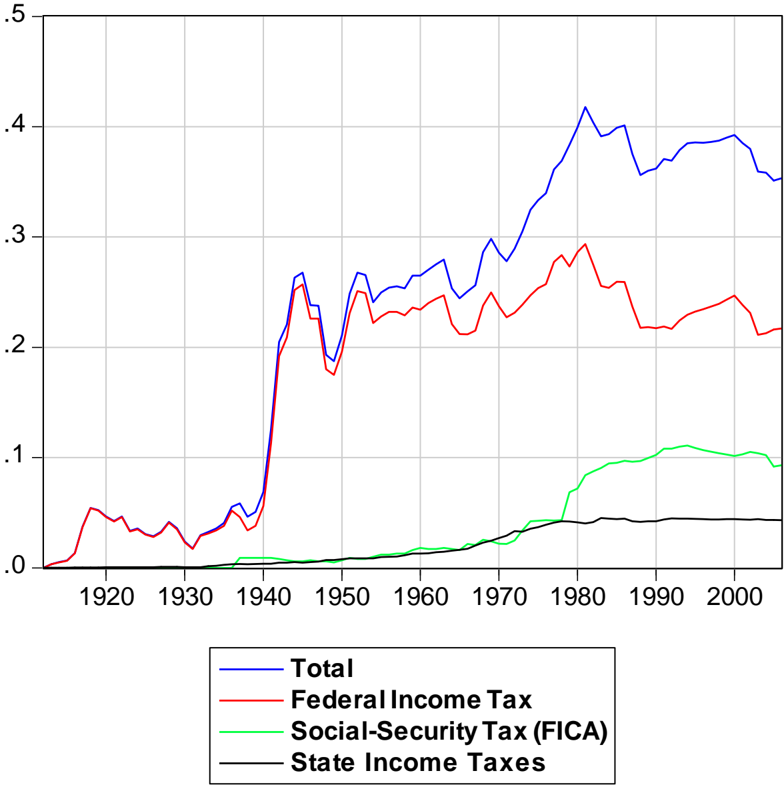
“We take the marginal tax rate in the U.S. from Barro and Redlick (2011), who report a value of 0.353 for 2006.”
From Beyond GDP? Welfare across Countries and Time (2016) · cites this paper as Barro and Redlick (2011)
In the citing paper
“For the same period, Barro and Redlick (2011) report a slightly higher income-weighted average marginal tax rate-around 37%.”
From Optimal Tax Progressivity: An Analytical Framework* (2017) · cites this paper as Barro and Redlick 2011
Self-check
Percentages, sums and reported differences re-computed from the paper’s own numbers.
The self-check needs the paper’s full text.
Citations
Cites
On the Determination of the Public Debt
Barro, R. J. (1979) · Journal of Political Economy · doi:10.1086/260807 · Cited by 3,268
Self-citationBlanchard, O., & Perotti, R. (2002) · The Quarterly Journal of Economics · doi:10.1162/003355302320935043 · Cited by 2,910
The Macroeconomic Effects of Tax Changes: Estimates Based on a New Measure of Fiscal Shocks
Romer, C. D., & Romer, D. H. (2010) · American Economic Review · doi:10.1257/aer.100.3.763 · Cited by 2,139
Blanchard, O., & Perotti, R. (1999) · National Bureau of Economic Research · doi:10.3386/w7269 · Cited by 1,890
Shadow Prices, Market Wages, and Labor Supply
Heckman, J. (1974) · Econometrica · doi:10.2307/1913937 · Cited by 1,852
Identifying Government Spending Shocks: It's all in the Timing*
Ramey, V. A. (2011) · The Quarterly Journal of Economics · doi:10.1093/qje/qjq008 · Cited by 1,661
Forecasting Output and Inflation: The Role of Asset Prices
Stock, J. H., & Watson, M. W. (2003) · Journal of Economic Literature · doi:10.1257/002205103322436197 · Cited by 1,076
Costly capital reallocation and the effects of government spending
Ramey, V. A., & Shapiro, M. D. (1998) · Carnegie-Rochester Conference Series on Public Policy · doi:10.1016/s0167-2231(98)00020-7 · Cited by 1,061
Forecasting Output and Inflation: The Role of Asset Prices
Stock, J. H., & Watson, M. W. (2003) · Journal of Economic Literature · doi:10.1257/jel.41.3.788 · Cited by 862
Output Effects of Government Purchases
Barro, R. J. (1981) · Journal of Political Economy · doi:10.1086/261024 · Cited by 669
Self-citation
Research works printed but not linked: 5
- Barro, R.J. (1984). Macroeconomics , New York, Wiley.
- ———, 1984, Macroeconomics
- Barro, R.J. and J.F. Ursua (2008). 'Consumption Disasters since 1870,' Brookings Papers on Economic Activity , spring, 255-335.
- Kendrick, J.W. (1961). Productivity Trends in the United States , Princeton NJ, Princeton University Press.
- Redlick, C.J. (2009). Average Marginal Tax Rates in the United States: A New Empirical Study of their Predictability and Macroeconomic Effects, 1913-2006 , unpublished undergraduate thesis, Harvard University.
Cited by
Items 301–400 of 1,001
Limoa, W. S., & Weku, C. E. F. (2024) · Advances in Management & Financial Reporting · doi:10.60079/amfr.v2i2.276 · Cited by 22
Fair, R. C. (2020) · Oxford Review of Economic Policy · doi:10.1093/oxrep/graa011 · Cited by 22
The effects of public debt accumulation and business cycle on government spending multipliers
Bentour, E. M. (2021) · Applied Economics · doi:10.1080/00036846.2021.1985721 · Cited by 22
Medium-Term Fiscal Multipliers during Protracted Recessions
Dell’Erba, S., Ribeiro, M. P., & Koloskova, K. (2014) · IMF Working Paper · doi:10.5089/9781498336192.001 · Cited by 22
FISCAL MULTIPLIERS DURING THE GLOBAL FINANCIAL CRISIS: FISCAL AND MONETARY INTERACTION MATTERS
Pyun, J. H., & Rhee, D. (2014) · Contemporary Economic Policy · doi:10.1111/coep.12067 · Cited by 22
Fiscal Policy in an Unemployment Crisis
Rendahl, P. (2012) · London School of Economics and Political Science Research Online (London School of Economics and Political Science) · doi:10.17863/cam.1057 · Cited by 22
Kong, G., & Kong, D. (2020) · China Finance Review International · doi:10.1108/cfri-10-2021-0210 · Cited by 22
Estimating local fiscal multipliers using political connections
Li, R., & Zhou, Y. (2021) · China Economic Review · doi:10.1016/j.chieco.2021.101599 · Cited by 21
Markups and fiscal transmission in a panel of OECD countries
Juessen, F., & Linnemann, L. (2012) · Journal of Macroeconomics · doi:10.1016/j.jmacro.2012.05.005 · Cited by 21
The Effect of Fiscal Policy Shocks on Asset PricesPreprint
Wiegand, C. (2025) · SSRN Electronic Journal · doi:10.2139/ssrn.5269517 · Cited by 21
Sensitivity of Fiscal-Policy Effects to Policy Coordination and Business Cycle ConditionsPreprint
Virén, M. (2013) · SSRN Electronic Journal · doi:10.2139/ssrn.2291928 · Cited by 21
How large is the government spending multiplier? Evidence from World Bank lending
Kraay, A. (2010) · The World Bank Open Knowledge Repository (World Bank) · doi:10.1596/1813-9450-5500 · Cited by 21
Public expenditure multipliers in recessions: Evidence from the EurozonePreprint
Boitani, A., & Perdichizzi, S. (2018) · RePEc: Research Papers in Economics · Cited by 21
Innovation-led growth in a time of debt
Ferraro, D., & Peretto, P. F. (2019) · European Economic Review · doi:10.1016/j.euroecorev.2019.103350 · Cited by 21
Fiscal Multipliers in Advanced and Developing Countries: Evidence from Military Spending
Sheremirov, V., & Spirovska, S. (2019) · Working paper series · doi:10.29412/res.wp.2019.03 · Cited by 20
Talent Market Competition and Firm GrowthPreprint
Chen, A., Zhang, M. B., & Zhang, Z. (2023) · SSRN Electronic Journal · doi:10.2139/ssrn.4597388 · Cited by 20
The Missing Intercept: A Demand Equivalence Approach
Wolf, C. K. (2021) · National Bureau of Economic Research · doi:10.3386/w29558 · Cited by 20
Regional Consumption Responses and the Aggregate Fiscal MultiplierPreprint
Dupor, B., Karabarbounis, M., Kudlyak, M., & Mehkari, M. S. (2018) · SSRN Electronic Journal · doi:10.2139/ssrn.3131248 · Cited by 20
Sovereign Risk and the Effects of Fiscal Retrenchment in Deep Recessions
Corsetti, G., Kuester, K., Meier, A., & Müller, G. J. (2011) · Working paper · doi:10.21799/frbp.wp.2011.43 · Cited by 20
Korea Joins the League of Wealthy Nations
Woo, J. (2022) · Oxford University Press eBooks · doi:10.1093/oso/9780198864424.003.0012 · Cited by 19
US Public Debt and Safe Asset Market Power
Choi, J., Kirpalani, R., & Perez, D. J. (2025) · Journal of Political Economy · doi:10.1086/739824 · Cited by 19
Taxes and Growth: New Narrative Evidence from Interwar Britain
Cloyne, J. S., Dimsdale, N. H., & Postel‐Vinay, N. (2023) · The Review of Economic Studies · doi:10.1093/restud/rdad081 · Cited by 19
Historical evidence for larger government spending multipliers in uncertain times than in slumps
Goemans, P. (2022) · Economic Inquiry · doi:10.1111/ecin.13068 · Cited by 19
Government Spending News and Surprise Shocks: It's The Timing and Persistence
Kang, J., & Kim, S. (2021) · Journal of Macroeconomics · doi:10.1016/j.jmacro.2022.103446 · Cited by 19
Semi-linear optimal control problem on a smooth oscillating domain
Aiyappan, S., Nandakumaran, A. K., & Prakash, R. (2019) · Communications in Contemporary Mathematics · doi:10.1142/s0219199719500299 · Cited by 19
The Dynamics of Growth and Income Inequality under Progressive Taxation
Koyuncu, M., & Turnovsky, S. J. (2016) · Journal of Public Economic Theory · doi:10.1111/jpet.12191 · Cited by 19
State Institutions and Tax Capacity: An Empirical Investigation of Causality
Akanbi, O. A. (2019) · IMF Working Paper · doi:10.5089/9781513509860.001 · Cited by 18
Buy Guns or Buy Roses?: EU Defence Spending Fiscal MultipliersPreprint
García‐Serrador, A., Sarasa, D., & Ulloa, C. A. (2025) · SSRN Electronic Journal · doi:10.2139/ssrn.5338966 · Cited by 18
DO TAX STRUCTURES AFFECT INDONESIA ECONOMIC GROWTH?
Iswahyudi, H. (2019) · Journal of Indonesian Economy and Business · doi:10.22146/jieb.29033 · Cited by 18
Essays on the Economics of Labor Demand and Policy Incidence
Garin, A. (2018) · Upjohn Research (W.E. Upjohn Institute for Employment Research) · Cited by 18
OECD Economic Outlook, Volume 2026 Issue 1: Under Pressure
OECD (2026) · OECD economic outlook · doi:10.1787/2d1956f0-en · Cited by 18
How does government spending news affect interest rates? Evidence from the United States
Yong, C., & Liu, D. (2019) · Journal of Economic Dynamics and Control · doi:10.1016/j.jedc.2019.103747 · Cited by 18
The Regional Economic Effects of Military Base Realignments and Closures
Lee, J. (2016) · Defence and Peace Economics · doi:10.1080/10242694.2016.1170335 · Cited by 18
Tomar, K. S., & Kesharwani, S. (2022) · Cogent Economics & Finance · doi:10.1080/23322039.2021.1999058 · Cited by 18
Fiscal policy in a depressed economy : was there a ‘free lunch’ in 1930s’ Britain?Preprint
Crafts, N. F. R., & Mills, T. C. (2012) · RePEc: Research Papers in Economics · doi:10.82444/warw.33633121 · Cited by 18
Cyclicality of Fiscal Policy in Sub-Saharan Africa: Magnitude and Evolution
Calderón, C., Chuhan-Pole, P., & López-Monti, R. (2017) · World Bank, Washington, DC eBooks · doi:10.1596/1813-9450-8108 · Cited by 18
Sensitivity of fiscal-policy effects to policy coordination and business cycle conditionsPreprint
Virén, M. (2013) · RePEc: Research Papers in Economics · Cited by 18
How taxes affect growth: evidence from cross-country panel data
Kawano, L., Olson, J. S., Slemrod, J., & Hsieh, M. H. (2025) · International Tax and Public Finance · doi:10.1007/s10797-025-09901-z · Cited by 17
Neoclassical Models in Macroeconomics
Hansen, G. D., & Ohanian, L. E. (2016) · Handbook of macroeconomics · doi:10.1016/bs.hesmac.2016.04.010 · Cited by 17
Heterogeneous responses to corporate marginal tax rates: Evidence from small and large firms
Eskandari, R., & Zamanian, M. (2023) · Journal of Applied Econometrics · doi:10.1002/jae.3000 · Cited by 17
Revelli, F., & Bracco, E. (2020) · Cambridge University Press eBooks · doi:10.1017/9781108918039 · Cited by 17
Would Population Aging Change the Output Effects of Fiscal Policy?
Honda, J., & Miyamoto, H. (2020) · IMF Working Paper · doi:10.2139/ssrn.3652510 · Cited by 17
From broken windows to broken bonds: Militarized police and social fragmentation
Insler, M. A., McMurrey, B., & McQuoid, A. F. (2019) · Journal of Economic Behavior & Organization · doi:10.1016/j.jebo.2019.04.012 · Cited by 17
Liquidity and Firms’ Response to Fiscal Stimulus
Acconcia, A., & Cantabene, C. (2017) · The Economic Journal · doi:10.1111/ecoj.12499 · Cited by 17
State-Dependent Macroeconomic Effects of Tax ChangesPreprint
Eskandari, R. (2019) · SSRN Electronic Journal · doi:10.2139/ssrn.3374984 · Cited by 17
Domestic Resource Mobilization and Long Term Economic Growth in Tanzania
Chimilila, C., & Cyril, C. (2018) · AFRICAN JOURNAL OF ECONOMIC REVIEW · doi:10.22004/ag.econ.274748 · Cited by 17
Public investment multipliers and the role of efficiency: new evidence for emerging markets
Ardanaz, M., Llempén, Z., Puig, J., & Valencia, O. (2025) · Journal of Macroeconomics · doi:10.1016/j.jmacro.2025.103705 · Cited by 17
Decomposing the Fiscal MultiplierPreprint
Cloyne, J. S., Jordà, Ò., & Taylor, A. M. (2020) · SSRN Electronic Journal · doi:10.2139/ssrn.3569404 · Cited by 17
Multiplicador del gasto público en Bolivia: una primera aproximación
Puig, J. (2015) · Revista Latinoamericana de Desarrollo Económico · doi:10.35319/lajed.20152469 · Cited by 17
Public investment multipliers: Evidence from stock returns of the road pavement industry in Japan
Kanazawa, N. (2021) · Journal of Economic Dynamics and Control · doi:10.1016/j.jedc.2021.104247 · Cited by 17
The Keynesian IS-MR Model and Military Spending
Alexander, R. R. (2014) · Defence and Peace Economics · doi:10.1080/10242694.2013.857449 · Cited by 17
Non-Linear Effects of Tax Changes on Output: The Role of the Initial Level of Taxation
Gunter, S. R., Riera‐Crichton, D., Végh, C. A., & Vuletin, G. (2018) · World Bank, Washington, DC eBooks · doi:10.1596/1813-9450-8668 · Cited by 17
Market segmentation and spending multipliers
Proebsting, C. (2022) · Journal of Monetary Economics · doi:10.1016/j.jmoneco.2022.02.008 · Cited by 16
Government Spending Multipliers in Developing Countries: Evidence from Lending by Official Creditors
Kraay, A. (2012) · World Bank, Washington, DC eBooks · doi:10.1596/1813-9450-6099 · Cited by 16
EXPANSIONARY VERSUS CONTRACTIONARY GOVERNMENT SPENDING
Makin, A. J. (2014) · Contemporary Economic Policy · doi:10.1111/coep.12051 · Cited by 16
Empirical estimates of fiscal multipliers for South Africa
Kemp, J. H. (2020) · WIDER Working Paper Series · doi:10.35188/unu-wider/2020/848-1 · Cited by 16
Net Fiscal Stimulus during the G reat R ecession
Aizenman, J., & Pasricha, G. K. (2013) · Review of Development Economics · doi:10.1111/rode.12039 · Cited by 16
Sources of borrowing and fiscal multipliersPreprint
Priftis, R., & Zimic, S. (2018) · SSRN Electronic Journal · doi:10.2139/ssrn.3291116 · Cited by 16
Forecasting County-level Real GDP Effects of COVID-19Preprint
Hartley, J., & Makridis, C. A. (2020) · SSRN Electronic Journal · doi:10.2139/ssrn.3559139 · Cited by 16
A Study on the Effects of Tax Reduction Policies on Fiscal Sustainability in China
Liu, Q., & Zhang, X. (2023) · Sustainability · doi:10.3390/su15107831 · Cited by 15
Fiscal opacity and reduction of income inequality through taxation: Effects on economic growth
de Mendonça, H. F., & Baca, A. C. (2021) · The Quarterly Review of Economics and Finance · doi:10.1016/j.qref.2021.11.006 · Cited by 15
The political economy of fiscal procyclicality
Lim, J. J. (2020) · European Journal of Political Economy · doi:10.1016/j.ejpoleco.2020.101930 · Cited by 15
Government size, fiscal policy and the level and growth of output: a review of recent evidence
Gemmell, N., & Au, J. (2013) · Journal of the Asia Pacific Economy · doi:10.1080/13547860.2013.777535 · Cited by 15
The Quantitative Effects of Tax Foresight: Not All States Are Equal
Herrera, A. M., & Rangaraju, S. K. (2017) · Journal of Economic Dynamics and Control · doi:10.1016/j.jedc.2019.103726 · Cited by 15
Goulas, E., & Zervoyianni, A. (2013) · The Quarterly Review of Economics and Finance · doi:10.1016/j.qref.2013.07.005 · Cited by 15
Government Spending During Sudden Stop Crises
Liu, S. (2018) · Journal of International Economics · doi:10.1016/j.jinteco.2022.103571 · Cited by 15
Short-run multiplier effects of military expenditures in NATO's Eastern Flank countries in 1999–2021
Olejnik, Ł. W. (2023) · Journal of Comparative Economics · doi:10.1016/j.jce.2023.05.007 · Cited by 15
Fiscal Rules in Times of Crisis
Bandaogo, M. S. (2020) · World Bank, Washington, DC eBooks · doi:10.1596/34217 · Cited by 15
Government Expenditure and Private Sector Growth in Saudi Arabia: A Markov Switching Model Analysis
Eid, A. G., & Awad, I. L. (2017) · Economic Issues Journal Articles · Cited by 15
Taxes, Incorporation, and Productivity
Barro, R. J., & Wheaton, B. (2020) · Tax Policy and the Economy · doi:10.1086/708171 · Cited by 15
Self-citationBlackley, P. R. (2014) · Journal of Post Keynesian Economics · doi:10.2753/pke0160-3477370106 · Cited by 15
Defence Spending and Unemployment in the USA: Disaggregated Analysis by Gender and Age Groups
Kollias, C., Paleologou, S., & Tzeremes, P. (2020) · Peace Economics Peace Science and Public Policy · doi:10.1515/peps-2018-0052 · Cited by 14
Rambachan, A., & Shephard, N. (2019) · RePEc: Research Papers in Economics · Cited by 14
Estimating the Impact of Welfare Programs on Agricultural Output: Evidence from India
Bahal, G. N. (2019) · American Journal of Agricultural Economics · doi:10.1093/ajae/aaz030 · Cited by 14
Natural Disasters, Government Spending, and the Fiscal MultiplierPreprint
Fidrmuc, J., Ghosh, S., & Yang, W. (2015) · SSRN Electronic Journal · doi:10.2139/ssrn.2722449 · Cited by 14
Lizarazo, S. V., Peralta‐Alva, A., & Puy, D. (2017) · IMF Working Paper · doi:10.5089/9781484316580.001 · Cited by 14
The effectiveness of fiscal and monetary policies in a small open economy – the case of Macedonia
Petrevski, G., Trenovski, B., & Tashevska, B. (2019) · Post-Communist Economies · doi:10.1080/14631377.2019.1607437 · Cited by 14
Why are fiscal multipliers moderate even under monetary accommodation?
Bredemeier, C., Juessen, F., & Schabert, A. (2021) · European Economic Review · doi:10.1016/j.euroecorev.2021.103970 · Cited by 14
Multipliers of taxes and public spending in Colombia: SVAR and local projections approaches
Restrepo-Ángel, S., Rincón-Castro, H., & Ospina-Tejeiro, J. J. (2022) · Latin American Journal of Central Banking · doi:10.1016/j.latcb.2022.100070 · Cited by 14
The economic effects of fiscal policy: Further evidence for Spain
Sosvilla‐Rivero, S., & Rubio-Guerrero, J. J. (2022) · The Quarterly Review of Economics and Finance · doi:10.1016/j.qref.2022.08.002 · Cited by 14
An aggregate model for policy analysis with demographic change
McGrattan, E. R., & Prescott, E. C. (2017) · The Journal of the Economics of Ageing · doi:10.1016/j.jeoa.2017.01.001 · Cited by 14
Relations Among Government Revenues and Gross Domestic Product (GDP) of the Republic Of Croatia
Belullo, A., & Dužman, T. (2011) · Economic Research-Ekonomska Istraživanja · doi:10.1080/1331677x.2011.11517488 · Cited by 14
Economic activity and biodiversity in the United States
Liang, Y., Rudik, I., & Zou, E. (2025) · Journal of Public Economics · doi:10.1016/j.jpubeco.2025.105482 · Cited by 13
The effect of infrastructure and taxation on economic growth: new empirical assessment
de Almeida, J. L., & de Mendonça, H. F. (2019) · Journal of Economic Studies · doi:10.1108/jes-03-2018-0105 · Cited by 13
Uncertainty and nonlinear macroeconomic effects of fiscal policy in the US: a SEIVAR-based analysis
Belke, A. H., & Goemans, P. (2021) · Journal of Economic Studies · doi:10.1108/jes-07-2020-0334 · Cited by 13
Between crime and economic growth: the asymmetric role of public expenditure and unemployment
Basuni, L. E. N., & Khoirunurrofik, K. (2024) · Review of Regional Research · doi:10.1007/s10037-024-00202-2 · Cited by 13
Assessing the Short-Term Effects on Output of Changes in Federal Fiscal Policies
Reichling, F. (2012) · Cited by 13
(Not) Dancing Together: Monetary Policy Stance and the Government Spending Multiplier
Belinga, V., & Ngouana, C. L. (2015) · IMF Working Paper · doi:10.2139/ssrn.2623801 · Cited by 13
Net Exports and the Avoidance of High Unemployment During Reconversion, 1945–1947
Taylor, J. E., Basu, B., & McLean, S. (2011) · The Journal of Economic History · doi:10.1017/s0022050711001598 · Cited by 13
The Economic Effects of Government Spending
Hall, M., & Thapar, A. (2017) · Macroeconomic Dynamics · doi:10.1017/s1365100521000341 · Cited by 13
D’Acunto, F., Hoang, D., & Weber, M. (2018) · National Bureau of Economic Research · doi:10.3386/w24244 · Cited by 13
Does tax reduction have an effect on gross domestic product? An empirical investigation
Seip, K. L. (2019) · Journal of Policy Modeling · doi:10.1016/j.jpolmod.2019.01.005 · Cited by 13
Who gains from corporate tax cuts?
Cloyne, J. S., Kurt, E., & Surico, P. (2024) · Journal of Monetary Economics · doi:10.1016/j.jmoneco.2024.103722 · Cited by 13
GOVERNMENT BUDGET BALANCE AND ECONOMIC GROWTH
Todorova, T. (2019) · RePEc: Research Papers in Economics · Cited by 13
Çamyar, İ. (2014) · The Journal of Politics · doi:10.1017/s0022381614000164 · Cited by 13
Déjà Vu? The Greek Crisis Experience, the 2010s Versus the 1930s. Lessons from HistoryPreprint
Λαζαρέτου, Σ., & Chouliarakis, G. (2014) · SSRN Electronic Journal · doi:10.2139/ssrn.4184601 · Cited by 13
Woldu, G. T., & Kanó, I. S. (2023) · World Economy · doi:10.1111/twec.13405 · Cited by 13
Llempén, Z., Ardanaz, M., Valencia, O., & Puig, J. (2024) · doi:10.18235/0013089 · Cited by 13
Countercyclical Fiscal Policy and Gender Employment: Evidence from the G-7 Countries
Akitoby, B., Honda, J., & Miyamoto, H. (2019) · IMF Working Paper · doi:10.5089/9781484390054.001 · Cited by 13
Metadata
- Authors
- Barro, R. J., & Redlick, C. J.
- Venue
- The Quarterly Journal of Economics
- Publisher
- Oxford University Press (OUP)
- Published
- 2011-02
- Volume
- 126
- Issue
- 1
- Pages
- 51-102
- ISSN
- 0033-5533 (ISSN-L)
- 1531-4650
- OpenAlex
- W2135359744
- Cited by
- 837
- References
- 34
- FWCI
- 155.37
- Type
- journal article
- Language
- en
- Open access
- closed
About these checks
Registry, retraction, Cites and statistics results are computed, not judged, with one exception: a printed reference that no index lists is read once by a model before it counts as a citation error. Claims are extracted by a model and kept only when their quote appears verbatim in the text; each cited source is then checked, with a model’s help, for whether it says what the claim relies on. Those verdicts can be wrong — read the claim’s quote and the cited source before relying on one.
Statistics and arithmetic are recomputed, not judged.
Confidence bands are shown only for fields calibrated on our annotated test set. None is calibrated yet, so no band is shown.
What counts as a claim ›How we measure confidence ›How we check this ›
Are you an author, or do you see a problem with this page? Request a review
Data sources
Bibliographic data: Semantic Scholar, OpenAlex, Crossref.
Contains information from the Semantic Scholar Academic Graph Datasets, made available under the ODC Attribution License (ODC-BY 1.0).
Semantic Scholar’s data is described in: Kinney, R., et al. (2023). The Semantic Scholar Open Data Platform. arXiv:2301.10140.
