

Macroeconomic Effects From Government Purchases and Taxes *
The DOI matches its Crossref record; 34 of the 35 references it cites were found in a registry or an index, and 1 are not checked yet.
Abstract
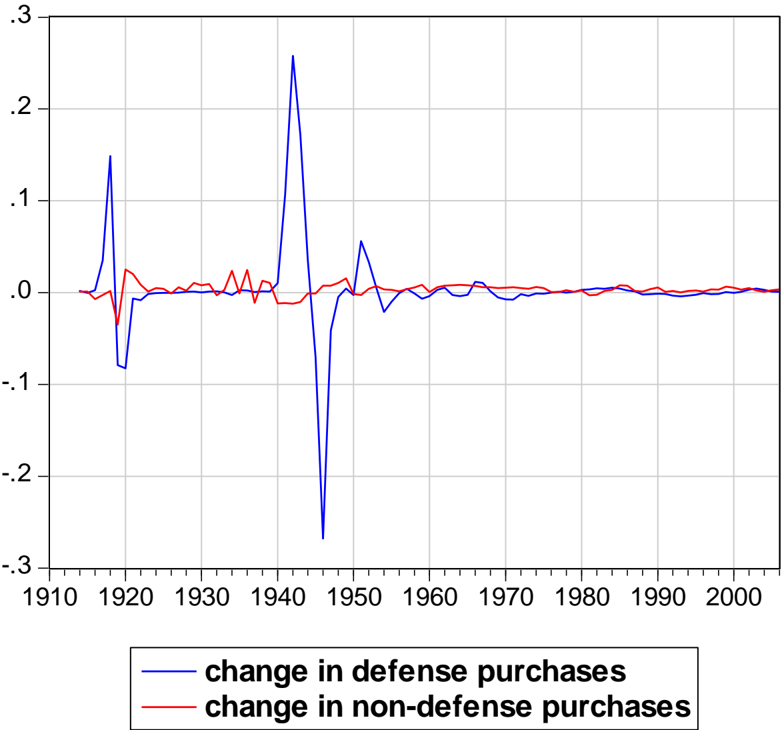
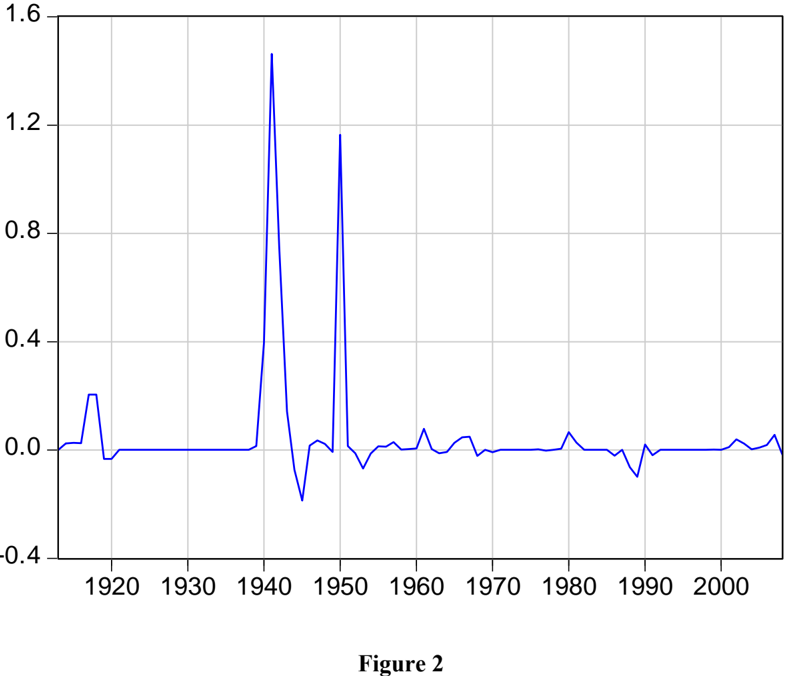
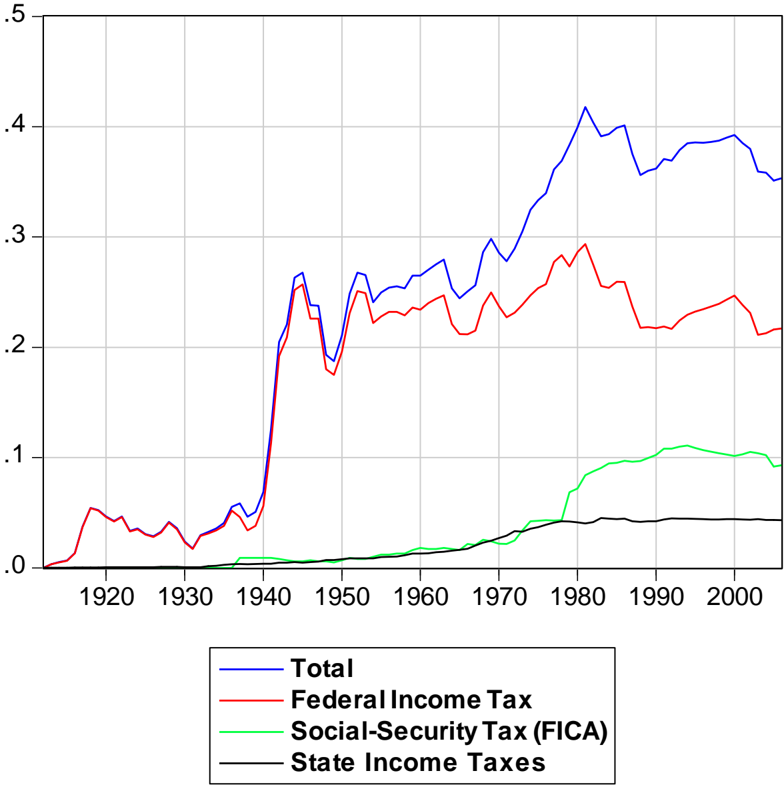
For U.S. annual data that include World War II, the estimated multiplier for temporary defense spending is 0.4–0.5 contemporaneously and 0.6–0.7 over 2 years. If the change in defense spending is “permanent” (gauged by Ramey's defense news variable), the multipliers are higher by 0.1–0.2. Since all estimated multipliers are significantly less than 1, greater spending crowds out other components of GDP, particularly investment. The lack of good instruments prevents estimation of reliable multipliers for nondefense purchases; multipliers in the literature of two or more likely reflect reverse causation from GDP to nondefense purchases. Increases in average marginal income tax rates (measured by a newly constructed time series) have significantly negative effects on GDP. When interpreted as a tax multiplier, the magnitude is around 1.1. The combination of the estimated spending and tax multipliers implies that the balanced-budget multiplier for defense spending is negative. We have some evidence that tax changes affect GDP mainly through substitution effects, rather than wealth effects.
Overview
The claims and statistics of this paper haven’t been checked yet.
Free: it reads the open-access text and checks the first 5 claims that cite a source we can check. Create a free account to check every claim.
Integrity signals
Registry
Cites
Statistics
Figures
Verification
Claims the paper makes
The claims and statistics of this paper haven’t been checked yet.
Free: it reads the open-access text and checks the first 5 claims that cite a source we can check. Create a free account to check every claim.
Claims other papers make about this one
Each is checked against this paper’s own text: does it say what the citing paper says it does?
The source backs part of the claim, not all of it — or backs it for a different population, condition or comparison.
In the citing paper
“empirically that a cut in τ by 1 percentage point raises the level of per capita GDP by 0.5 percent over the next two years (their table II, columns 1 and 4).”
From Macroeconomic Effects of the 2017 Tax Reform (2018) · cites this paper as Barro and Redlick (2011)
Experimental — accuracy not yet measuredThe cited source says what the claim attributes to it.
In the citing paper
“If they stacked (summed) their GDP level effects between their Ramsey model and their reduced-form model based on that of Barro and Charles Redlick (2011), then the headline, 10th-year GDP that they report in their table 1 would be nearly four times larger-1.55percent instead of 0.4 percent.”
From Macroeconomic Effects of the 2017 Tax Reform (2018) · cites this paper as Barro and Charles Redlick (2011)
The cited source says what the claim attributes to it.
In the citing paper
“Doing so results in a predicted increase in the GDP growth rate for 2018-19 of 0.9 percentage point per year.”
From Macroeconomic Effects of the 2017 Tax Reform (2018) · cites this paper as Barro and Redlick (2011)
In the citing paper
“We take the marginal tax rate in the U.S. from Barro and Redlick (2011), who report a value of 0.353 for 2006.”
From Beyond GDP? Welfare across Countries and Time (2016) · cites this paper as Barro and Redlick (2011)
In the citing paper
“For the same period, Barro and Redlick (2011) report a slightly higher income-weighted average marginal tax rate-around 37%.”
From Optimal Tax Progressivity: An Analytical Framework* (2017) · cites this paper as Barro and Redlick 2011
Self-check
Percentages, sums and reported differences re-computed from the paper’s own numbers.
The self-check needs the paper’s full text.
Citations
Cites
On the Determination of the Public Debt
Barro, R. J. (1979) · Journal of Political Economy · doi:10.1086/260807 · Cited by 3,268
Self-citationBlanchard, O., & Perotti, R. (2002) · The Quarterly Journal of Economics · doi:10.1162/003355302320935043 · Cited by 2,910
The Macroeconomic Effects of Tax Changes: Estimates Based on a New Measure of Fiscal Shocks
Romer, C. D., & Romer, D. H. (2010) · American Economic Review · doi:10.1257/aer.100.3.763 · Cited by 2,139
Blanchard, O., & Perotti, R. (1999) · National Bureau of Economic Research · doi:10.3386/w7269 · Cited by 1,890
Shadow Prices, Market Wages, and Labor Supply
Heckman, J. (1974) · Econometrica · doi:10.2307/1913937 · Cited by 1,852
Identifying Government Spending Shocks: It's all in the Timing*
Ramey, V. A. (2011) · The Quarterly Journal of Economics · doi:10.1093/qje/qjq008 · Cited by 1,661
Forecasting Output and Inflation: The Role of Asset Prices
Stock, J. H., & Watson, M. W. (2003) · Journal of Economic Literature · doi:10.1257/002205103322436197 · Cited by 1,076
Costly capital reallocation and the effects of government spending
Ramey, V. A., & Shapiro, M. D. (1998) · Carnegie-Rochester Conference Series on Public Policy · doi:10.1016/s0167-2231(98)00020-7 · Cited by 1,061
Forecasting Output and Inflation: The Role of Asset Prices
Stock, J. H., & Watson, M. W. (2003) · Journal of Economic Literature · doi:10.1257/jel.41.3.788 · Cited by 862
Output Effects of Government Purchases
Barro, R. J. (1981) · Journal of Political Economy · doi:10.1086/261024 · Cited by 669
Self-citation
Research works printed but not linked: 5
- Barro, R.J. (1984). Macroeconomics , New York, Wiley.
- ———, 1984, Macroeconomics
- Barro, R.J. and J.F. Ursua (2008). 'Consumption Disasters since 1870,' Brookings Papers on Economic Activity , spring, 255-335.
- Kendrick, J.W. (1961). Productivity Trends in the United States , Princeton NJ, Princeton University Press.
- Redlick, C.J. (2009). Average Marginal Tax Rates in the United States: A New Empirical Study of their Predictability and Macroeconomic Effects, 1913-2006 , unpublished undergraduate thesis, Harvard University.
Cited by
The Macroeconomic Effects of Tax Changes: Estimates Based on a New Measure of Fiscal Shocks
Romer, C. D., & Romer, D. H. (2010) · American Economic Review · doi:10.1257/aer.100.3.763 · Cited by 2,139
Identifying Government Spending Shocks: It's all in the Timing*
Ramey, V. A. (2011) · The Quarterly Journal of Economics · doi:10.1093/qje/qjq008 · Cited by 1,661
Government Spending Multipliers in Good Times and in Bad: Evidence from US Historical Data
Ramey, V. A., & Zubairy, S. (2018) · Journal of Political Economy · doi:10.1086/696277 · Cited by 1,425
How big (small?) are fiscal multipliers?
Ilzetzki, E., Mendoza, E. G., & Végh, C. A. (2013) · Journal of Monetary Economics · doi:10.1016/j.jmoneco.2012.10.011 · Cited by 1,385
The Dynamic Effects of Personal and Corporate Income Tax Changes in the United States
Mertens, K., & Ravn, M. O. (2013) · American Economic Review · doi:10.1257/aer.103.4.1212 · Cited by 1,019
Macroeconomic Shocks and Their Propagation
(2016) · Handbook of Macroeconomics · doi:10.1016/bs.hesmac.2016.03.003 · Cited by 1,001
Fiscal Volatility Shocks and Economic Activity
Fernández-Villaverde, J., Guerrón-Quintana, P., Kuester, K., & Rubio-Ramírez, J. (2015) · American Economic Review · doi:10.1257/aer.20121236 · Cited by 938
Fiscal Stimulus in a Monetary Union: Evidence from US Regions
Nakamura, E., & Steinsson, J. (2014) · American Economic Review · doi:10.1257/aer.104.3.753 · Cited by 911
Fiscal Policy in a Depressed Economy
Delong, J. B., & Summers, L. H. (2012) · Brookings Papers on Economic Activity · doi:10.1353/eca.2012.0000 · Cited by 820
Can Government Purchases Stimulate the Economy?
Ramey, V. A. (2011) · Journal of Economic Literature · doi:10.1257/jel.49.3.673 · Cited by 772
Optimal Tax Progressivity: An Analytical Framework*
Heathcote, J., Storesletten, K., & Violante, G. L. (2017) · The Quarterly Journal of Economics · doi:10.1093/qje/qjx018 · Cited by 595
Beyond GDP? Welfare across Countries and Time
Jones, C. I., & Klenow, P. J. (2016) · American Economic Review · doi:10.1257/aer.20110236 · Cited by 583
Effects of Fiscal Stimulus in Structural Models
Coenen, G., Erceg, C. J., Freedman, C., Furceri, D., Kumhof, M., Lalonde, R., Laxton, D., Lindé, J., Mourougane, A., Muir, D., et al. (2012) · American Economic Journal: Macroeconomics · doi:10.1257/mac.4.1.22 · Cited by 571
What Determines Government Spending Multipliers?
Corsetti, G., Meier, A., & Müller, G. J. (2012) · Economic Policy · doi:10.2139/ssrn.2127041 · Cited by 557
The Time for Austerity: Estimating the Average Treatment Effect of Fiscal Policy
Jordà, Ò., & Taylor, A. M. (2016) · The Economic Journal · doi:10.1111/ecoj.12332 · Cited by 548
Owyang, M. T., Ramey, V., & Zubairy, S. (2013) · American Economic Review · doi:10.1257/aer.103.3.129 · Cited by 516
By How Much Does GDP Rise if the Government Buys More Output?
Hall, R. (2009) · National Bureau of Economic Research · doi:10.3386/w15496 · Cited by 506
Ten Years After the Financial Crisis: What Have We Learned from the Renaissance in Fiscal Research?
Ramey, V. A. (2019) · Journal of Economic Perspectives · doi:10.1257/jep.33.2.89 · Cited by 485
Identification in Macroeconomics
Nakamura, E., & Steinsson, J. (2018) · Journal of Economic Perspectives · doi:10.1257/jep.32.3.59 · Cited by 419
Output Spillovers from Fiscal Policy
Auerbach, A. J., & Gorodnichenko, Y. (2013) · American Economic Review · doi:10.1257/aer.103.3.141 · Cited by 384
A reconciliation of SVAR and narrative estimates of tax multipliers
Mertens, K., & Ravn, M. O. (2013) · Journal of Monetary Economics · doi:10.1016/j.jmoneco.2013.04.004 · Cited by 347
By How Much Does GDP Rise If the Government Buys More Output?
Hall, R. E. (2009) · Brookings Papers on Economic Activity · doi:10.1353/eca.0.0069 · Cited by 343
Chodorow-Reich, G., Feiveson, L., Liscow, Z., & Woolston, W. G. (2012) · American Economic Journal: Economic Policy · doi:10.1257/pol.4.3.118 · Cited by 329
The output effect of fiscal consolidation plans
Alesina, A., Favero, C., & Giavazzi, F. (2015) · Journal of International Economics · doi:10.1016/j.jinteco.2014.11.003 · Cited by 314
From Great Depression to Great Credit Crisis: similarities, differences and lessons
Almunia, M., Bénétrix, A., Eichengreen, B., O’Rourke, K. H., & Rua, G. (2010) · Economic Policy · doi:10.1111/j.1468-0327.2010.00242.x · Cited by 283
Identifying Government Spending Shocks: It's All in the Timing
Ramey, V. (2009) · National Bureau of Economic Research · doi:10.3386/w15464 · Cited by 281
Monetary Policy, Real Activity, and Credit Spreads: Evidence from Bayesian Proxy SVARs
Caldara, D., & Herbst, E. (2019) · American Economic Journal: Macroeconomics · doi:10.1257/mac.20170294 · Cited by 280
State-dependent effects of fiscal policy
Fazzari, S. M., Morley, J., & Panovska, I. (2014) · Studies in Nonlinear Dynamics and Econometrics · doi:10.1515/snde-2014-0022 · Cited by 272
Estimating Local Fiscal Multipliers
Suárez Serrato, J. C., & Wingender, P. (2016) · doi:10.3386/w22425 · Cited by 270
Successful Austerity in the United States, Europe and Japan
Callegari, G., Melina, G., & Batini, N. (2012) · IMF Working Paper · doi:10.5089/9781475505382.001 · Cited by 268
WHICH FISCAL MULTIPLIERS ARE REGIME‐DEPENDENT? A META‐REGRESSION ANALYSIS
Gechert, S., & Rannenberg, A. (2018) · Journal of Economic Surveys · doi:10.1111/joes.12241 · Cited by 261
Fiscal Spending Jobs Multipliers: Evidence from the 2009 American Recovery and Reinvestment Act
Wilson, D. J. (2012) · American Economic Journal: Economic Policy · doi:10.1257/pol.4.3.251 · Cited by 250
Fiscal Stimulus and Distortionary Taxation
Drautzburg, T., & Uhlig, H. (2011) · SSRN Electronic Journal · doi:10.2139/ssrn.1856165 · Cited by 246
News Shocks in Open Economies: Evidence from Giant Oil Discoveries*
Arezki, R., Ramey, V. A., & Sheng, L. (2017) · The Quarterly Journal of Economics · doi:10.1093/qje/qjw030 · Cited by 246
Mafia and Public Spending: Evidence on the Fiscal Multiplier from a Quasi-Experiment
Acconcia, A., Corsetti, G., & Simonelli, S. (2014) · American Economic Review · doi:10.1257/aer.104.7.2185 · Cited by 244
“In line with recent literature (see e.g. Barro and Redlick 2011), we estimate the spending multiplier relating the growth of per-capita value added in a province (Yi,t) to the year-on-year change in per-capita spending on infrastructure in the same province (Gi,t).”
InfluentialMarginal Tax Rates and Income: New Time Series Evidence
Mertens, K., & Olea, J. L. M. (2013) · The Quarterly Journal of Economics · doi:10.1093/qje/qjy008 · Cited by 243
The End of the Great Depression 1939-41: Policy Contributions and Fiscal Multipliers
Gordon, R. J., & Krenn, R. (2010) · National Bureau of Economic Research · doi:10.3386/w16380 · Cited by 240
Government Spending Multipliers under the Zero Lower Bound: Evidence from Japan
Miyamoto, W., Nguyen, T. L., & Sergeyev, D. (2018) · American Economic Journal Macroeconomics · doi:10.1257/mac.20170131 · Cited by 224
The Analytics of SVARs: A Unified Framework to Measure Fiscal Multipliers
Caldara, D., & Kamps, C. (2017) · The Review of Economic Studies · doi:10.1093/restud/rdx030 · Cited by 222
Fiscal Policy Multipliers on Subnational Government Spending
Clemens, J., & Miran, S. (2012) · American Economic Journal: Economic Policy · doi:10.1257/pol.4.2.46 · Cited by 218
Federal regulation and aggregate economic growth
Dawson, J. W., & Seater, J. J. (2013) · Journal of Economic Growth · doi:10.1007/s10887-013-9088-y · Cited by 214
Government Spending Multipliers in Good Times and in Bad: Evidence from U.S. Historical Data
Ramey, V., & Zubairy, S. (2014) · National Bureau of Economic Research · doi:10.3386/w20719 · Cited by 213
Is Economics Research Replicable? Sixty Published Papers from Thirteen Journals Say "Usually Not"
Chang, A. C., & Li, P. (2015) · Finance and Economics Discussion Series · doi:10.17016/feds.2015.083 · Cited by 211
Targeted transfers and the fiscal response to the great recession
Oh, H., & Reis, R. (2012) · Journal of Monetary Economics · doi:10.1016/j.jmoneco.2012.10.025 · Cited by 211
“For di↵erent particular parameter configurations, it nests three well-known models: the neoclassical growth model with government spending of Baxter and King (1993), the incomplete-markets model of Aiyagari (1994), and the sticky-information model of Mankiw and Reis (2002).”
Tax Cuts for Whom? Heterogeneous Effects of Income Tax Changes on Growth and Employment
Zidar, O. M. (2018) · Journal of Political Economy · doi:10.1086/701424 · Cited by 207
Unemployment fiscal multipliers
Monacelli, T., Perotti, R., & Trigari, A. (2010) · Journal of Monetary Economics · doi:10.1016/j.jmoneco.2010.05.009 · Cited by 203
Leduc, S., & Wilson, D. (2013) · NBER Macroeconomics Annual · doi:10.1086/669173 · Cited by 197
“These four features make public infrastructure spending unique and, in particular, different from the type of government spending often analyzed in the literature on fiscal policy, which frequently focuses on the effects of military spending (see, Ramey and Shapiro (1998), Edelberg, Eichenbaum, and Fisher (1999), Fish…”
BackgroundResultExpansionary Austerity New International Evidence
Leigh, D., Pescatori, A., & Guajardo, J. (2011) · IMF Working Paper · doi:10.5089/9781455294695.001 · Cited by 193
Kraay, A. (2013) · American Economic Association eBooks · doi:10.1257/mac.6.4.170 · Cited by 190
Estimating Fiscal Multipliers: News from a Non‐linear World
Caggiano, G., Castelnuovo, E., Colombo, V., & Nodari, G. (2015) · The Economic Journal · doi:10.1111/ecoj.12263 · Cited by 190
Can Corporate Income Tax Cuts Stimulate Innovation?
Atanassov, J., & Liu, X. (2020) · Journal of Financial and Quantitative Analysis · doi:10.1017/s0022109019000152 · Cited by 189
The Effects of Fiscal Consolidations: Theory and Evidence
Alesina, A., Barbiero, O., Favero, C. A., Giavazzi, F., & Paradisi, M. (2017) · National Bureau of Economic Research · doi:10.3386/w23385 · Cited by 189
Fiscal Multipliers: Liquidity Traps and Currency Unions
Farhi, E., & Werning, I. (2012) · National Bureau of Economic Research · doi:10.3386/w18381 · Cited by 187
Effects of Income Tax Changes on Economic Growth
Gale, W. G., & Samwick, A. (2014) · Oxford University Press eBooks · doi:10.1093/acprof:oso/9780190619725.003.0002 · Cited by 186
How large is the Government Spending Multiplier? Evidence from World Bank Lending
Kraay, A. (2012) · The Quarterly Journal of Economics · doi:10.1093/qje/qjs008 · Cited by 185
“By way of comparison, the standard errors are not too much larger than those reported in Barro and Redlick (2010) who estimate similar specifications using data over the past century for the United States, and obtain standard errors for the estimated coefficient on defense spending ranging from…”
BackgroundFiscal Multipliers: Size, Determinants, and Use in Macroeconomic Projections
Batini, N., Eyraud, L., Forni, L., Weber, A., NBatini@imf.org, LEyraud@imf.org, LForni@imf.org, & AWeber@imf.org (2014) · Technical Notes and Manuals · doi:10.5089/9781498382458.005 · Cited by 183
Procyclical and countercyclical fiscal multipliers: Evidence from OECD countries
Riera‐Crichton, D., Végh, C. A., & Vuletin, G. (2014) · Journal of International Money and Finance · doi:10.1016/j.jimonfin.2014.11.011 · Cited by 182
Income taxation of U.S. households: Facts and parametric estimates
Guner, N., Kaygusuz, R., & Ventura, G. (2014) · Review of Economic Dynamics · doi:10.1016/j.red.2014.01.003 · Cited by 178
The Cyclical Behavior of the Price-Cost Markup
Nekarda, C., & Ramey, V. (2013) · National Bureau of Economic Research · doi:10.3386/w19099 · Cited by 176
“The VAR also includes log real government spending, log real GDP, the three-month treasury bill rate, the Barro and Redlick (2011) average marginal tax rate, and the log of the markup.18 We estimate the aggregate monetary shock using a standard VAR where shocks to the federal funds rate are the…”
InfluentialUnderstanding the Size of the Government Spending Multiplier: It’s in the Sign
Barnichon, R., Debortoli, D., & Matthes, C. (2021) · The Review of Economic Studies · doi:10.1093/restud/rdab029 · Cited by 165
Feyrer, J., & Sacerdote, B. (2011) · National Bureau of Economic Research · doi:10.3386/w16759 · Cited by 161
How Is Tax Policy Conducted Over the Business Cycle?
Vegh, C. A., & Vuletin, G. (2015) · American Economic Journal: Economic Policy · doi:10.1257/pol.20120218 · Cited by 159
“Unfortunately and leaving aside a few studies focusing on individual countries such as Barro (1990), Huang and Lin (1993), Strazicich (1997), Barro and Redlick (2011), and Romer and Romer (2010) for the United States, Maihos and Sosa (2000) for Uruguay, and 2Even cyclically-adjusted revenues have…”
BackgroundChronicle of A War Foretold: The Macroeconomic Effects of Anticipated Defence Spending Shocks
Zeev, N. B., & Pappa, E. (2017) · The Economic Journal · doi:10.1111/ecoj.12349 · Cited by 159
The American Recovery and Reinvestment Act: Solely a government jobs program?
Conley, T. G., & Dupor, B. (2013) · Journal of Monetary Economics · doi:10.1016/j.jmoneco.2013.04.011 · Cited by 155
Natural Experiments in Macroeconomics
Fuchs‐Schündeln, N., & Hassan, T. A. (2015) · Handbook of macroeconomics · doi:10.1016/bs.hesmac.2016.03.008 · Cited by 154
Measuring the Output Responses to Fiscal Policy
Auerbach, A. J., & Gorodnichenko, Y. (2010) · National Bureau of Economic Research · doi:10.3386/w16311 · Cited by 154
Inequality, Business Cycles, and Monetary‐Fiscal Policy
Bhandari, A., Evans, D., Golosov, M., & Sargent, T. J. (2021) · Econometrica · doi:10.3982/ecta16414 · Cited by 152
Government Debt and the Returns to Innovation
Croce, M. M., Nguyen, T. T., Raymond, S., & Schmid, L. (2016) · Journal of Financial Economics · doi:10.1016/j.jfineco.2018.11.010 · Cited by 151
Fiscal Volatility Shocks and Economic Activity
Fernández‐Villaverde, J., Guerron-Quintana, P. A., Kuester, K., & Rubio-Ramírez, J. F. (2011) · National Bureau of Economic Research · doi:10.3386/w17317 · Cited by 146
Macroeconomic Shocks and Their PropagationPreprint
Ramey, V. (2016) · RePEc: Research Papers in Economics · Cited by 143
Fiscal multipliers in turbulent times: the case of Spain
de Cos, P. H., & Moral‐Benito, E. (2015) · Empirical Economics · doi:10.1007/s00181-015-0969-0 · Cited by 137
Fiscal Stimulus in a Monetary Union: Evidence from U.S. Regions
Nakamura, E., & Steinsson, J. (2011) · National Bureau of Economic Research · doi:10.3386/w17391 · Cited by 137
Income Inequality, Tax Policy, and Economic Growth*
Biswas, S., Chakraborty, I., & Hai, R. (2017) · The Economic Journal · doi:10.1111/ecoj.12485 · Cited by 136
Optimal Tax Progressivity: An Analytical Framework
Heathcote, J., Storesletten, K., & Violante, G. L. (2014) · National Bureau of Economic Research · doi:10.3386/w19899 · Cited by 133
From Great Depression to Great Credit Crisis: Similarities, Differences and Lessons
Almunia, M., Bénétrix, A. S., Eichengreen, B. J., O’Rourke, K., & Rua, G. (2009) · National Bureau of Economic Research · doi:10.3386/w15524 · Cited by 133
A Simple Method to Compute Fiscal Multipliers
Batini, N., Eyraud, L., & Weber, A. (2014) · IMF Working Paper · doi:10.2139/ssrn.2468020 · Cited by 133
Miyamoto, W., Nguyen, T. L., & Sheremirov, V. (2018) · Journal of International Economics · doi:10.1016/j.jinteco.2018.11.009 · Cited by 132
Angrist, J. D., & Pischke, J. (2010) · National Bureau of Economic Research · doi:10.3386/w15794 · Cited by 132
Fiscal Policy in an Unemployment Crisis
Rendahl, P. (2016) · The Review of Economic Studies · doi:10.1093/restud/rdv058 · Cited by 131
Output Spillovers from Fiscal Policy
Auerbach, A. J., & Gorodnichenko, Y. (2012) · National Bureau of Economic Research · doi:10.3386/w18578 · Cited by 130
A Model of the Consumption Response to Fiscal Stimulus Payments
Kaplan, G., & Violante, G. L. (2011) · National Bureau of Economic Research · doi:10.3386/w17338 · Cited by 128
Thuemmel, U. (2022) · Journal of the European Economic Association · doi:10.1093/jeea/jvac062 · Cited by 122
Fiscal Spending Jobs Multipliers: Evidence from the 2009 American Recovery and Reinvestment Act
Francisco, F. R. B. O. S., & Wilson, D. J. (2011) · Federal Reserve Bank of San Francisco, Working Paper Series · doi:10.24148/wp2010-17 · Cited by 120
Local and aggregate fiscal policy multipliers
Dupor, B., & Guerrero, R. (2017) · Journal of Monetary Economics · doi:10.1016/j.jmoneco.2017.07.007 · Cited by 120
The Intellectual Spoils of War? Defense R&D, Productivity and International Spillovers
Moretti, E., Steinwender, C., & Reenen, J. M. V. (2019) · National Bureau of Economic Research · doi:10.3386/w26483 · Cited by 119
The Young, the Old, and the Government: Demographics and Fiscal Multipliers
Basso, H. S., & Rachedi, O. (2021) · American Economic Journal Macroeconomics · doi:10.1257/mac.20190174 · Cited by 116
Fiscal Policy and Debt Management with Incomplete Markets*
Bhandari, A., Evans, D., Golosov, M., & Sargent, T. J. (2016) · The Quarterly Journal of Economics · doi:10.1093/qje/qjw041 · Cited by 114
THE OUTPUT AND WELFARE EFFECTS OF GOVERNMENT SPENDING SHOCKS OVER THE BUSINESS CYCLE
Sims, E., & Wolff, J. (2018) · International Economic Review · doi:10.1111/iere.12308 · Cited by 113
Heterogeneity and Government revenues: Higher taxes at the top?
Guner, N., Lopez-Daneri, M., & Ventura, G. (2016) · Journal of Monetary Economics · doi:10.1016/j.jmoneco.2016.05.002 · Cited by 111
The Long-Run Effects of Government Spending
Antolin-Diaz, J. D., & Surico, P. (2025) · American Economic Review · doi:10.1257/aer.20231278 · Cited by 110
Fiscal Policy and Economic Recovery: The Case of the 1936 Veterans' Bonus
Hausman, J. K. (2016) · American Economic Review · doi:10.1257/aer.20130957 · Cited by 109
Bălăşoiu, N., Chifu, I., & Oancea, M. (2023) · Sustainability · doi:10.3390/su15097146 · Cited by 108
The Output Effect of Fiscal Consolidations
Alesina, A., Favero, C. A., & Giavazzi, F. (2012) · National Bureau of Economic Research · doi:10.3386/w18336 · Cited by 108
Macroeconomic Effects of the 2017 Tax Reform
Barro, R. J., & Furman, J. (2018) · Brookings Papers on Economic Activity · doi:10.1353/eca.2018.0003 · Cited by 107
Self-citationThe Macroeconomic Effects of Income and Consumption Tax Changes
Nguyen, A. D. M., Onnis, L., & Rossi, R. (2021) · American Economic Journal Economic Policy · doi:10.1257/pol.20170241 · Cited by 105
Sweat Equity in U.S. Private Business*
Bhandari, A., & McGrattan, E. R. (2020) · The Quarterly Journal of Economics · doi:10.1093/qje/qjaa041 · Cited by 105
Born, B., Müller, G. J., & Pfeifer, J. (2019) · The Review of Economics and Statistics · doi:10.1162/rest_a_00844 · Cited by 104
Fiscal policy, pricing frictions and monetary accommodation
Canova, F., & Pappa, E. (2011) · Economic Policy · doi:10.1111/j.1468-0327.2011.00272.x · Cited by 104
Is Economics Research Replicable? Sixty Published Papers from Thirteen Journals Say 'Usually Not'
Chang, A. C., & Li, P. (2015) · doi:10.2139/ssrn.2669564 · Cited by 217
To Cut or Not to Cut? On the Impact of Corporate Taxes on Employment and Income
Ljungqvist, A. P., & Smolyansky, M. (2014) · National Bureau of Economic Research · doi:10.3386/w20753 · Cited by 103
Metadata
- Authors
- Barro, R. J., & Redlick, C. J.
- Venue
- The Quarterly Journal of Economics
- Publisher
- Oxford University Press (OUP)
- Published
- 2011-02
- Volume
- 126
- Issue
- 1
- Pages
- 51-102
- ISSN
- 0033-5533 (ISSN-L)
- 1531-4650
- OpenAlex
- W2135359744
- Cited by
- 837
- References
- 34
- FWCI
- 155.37
- Type
- journal article
- Language
- en
- Open access
- closed
About these checks
Registry, retraction, Cites and statistics results are computed, not judged, with one exception: a printed reference that no index lists is read once by a model before it counts as a citation error. Claims are extracted by a model and kept only when their quote appears verbatim in the text; each cited source is then checked, with a model’s help, for whether it says what the claim relies on. Those verdicts can be wrong — read the claim’s quote and the cited source before relying on one.
Statistics and arithmetic are recomputed, not judged.
Confidence bands are shown only for fields calibrated on our annotated test set. None is calibrated yet, so no band is shown.
What counts as a claim ›How we measure confidence ›How we check this ›
Are you an author, or do you see a problem with this page? Request a review
Data sources
Bibliographic data: Semantic Scholar, OpenAlex, Crossref.
Contains information from the Semantic Scholar Academic Graph Datasets, made available under the ODC Attribution License (ODC-BY 1.0).
Semantic Scholar’s data is described in: Kinney, R., et al. (2023). The Semantic Scholar Open Data Platform. arXiv:2301.10140.
