

Workplace Heterogeneity and the Rise of West German Wage Inequality*
The DOI matches its Crossref record; 144 of the 147 references it cites were found in a registry or an index, and 1 are not checked yet; none of the 8 sources its claims cite is checked for support yet.
Abstract
We study the role of establishment-specific wage premiums in generating recent increases in West German wage inequality. Models with additive fixed effects for workers and establishments are fit into four subintervals spanning the period from 1985 to 2009. We show that these models provide a good approximation to the wage structure and can explain nearly all of the dramatic rise in West German wage inequality. Our estimates suggest that the increasing dispersion of West German wages has arisen from a combination of rising heterogeneity between workers, rising dispersion in the wage premiums at different establishments, and increasing assortativeness in the assignment of workers to plants. In contrast, the idiosyncratic job-match component of wage variation is small and stable over time. Decomposing changes in mean wages between different education groups, occupations, and industries, we find that increasing plant-level heterogeneity and rising assortativeness in the assignment of workers to establishments explain a large share of the rise in inequality along all three dimensions.
Checked 2026-11-19 · 1 reference not checked yet
Overview
CoChat Summary
TL;DR
Using West German administrative data from 1985–2009, the paper shows that models with additive person and establishment fixed effects explain nearly all of the rise in wage inequality. The increase is driven by rising worker-effect variance, rising establishment-premium variance, and increased assortative matching of high-wage workers to high-wage plants.
Key findings
- In the AKM variance decomposition, total log-wage variance rose from 0.137 in interval 1 (1985–1991) to 0.249 in interval 4 (2002–2009). The variance of person effects rose from 0.084 to 0.127 and contributed 39% of the total rise; establishment-effect variance rose from 0.025 to 0.053 and contributed 25%; the covariance term rose from 0.003 to 0.041 and contributed 34%.
- Assortative matching increased: the correlation between person and establishment effects rose from 0.034 in interval 1 to 0.249 in interval 4. Counterfactuals imply that holding sorting constant would have produced 69% of the actual variance rise, while holding establishment-effect variance constant would have produced 64%.
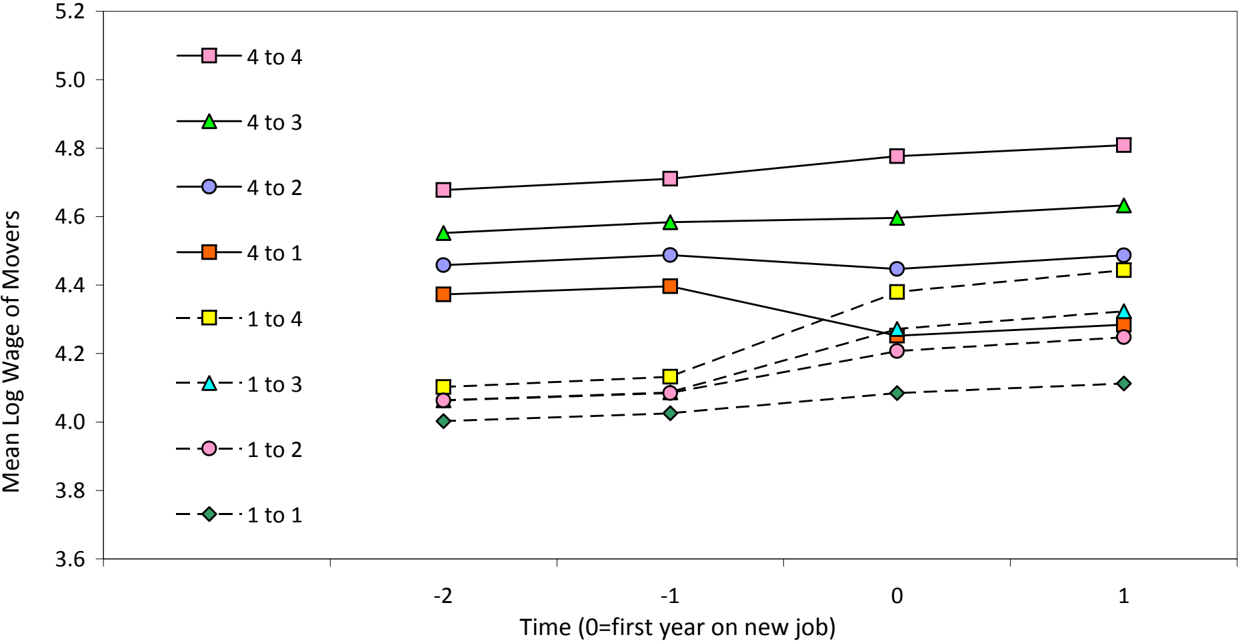
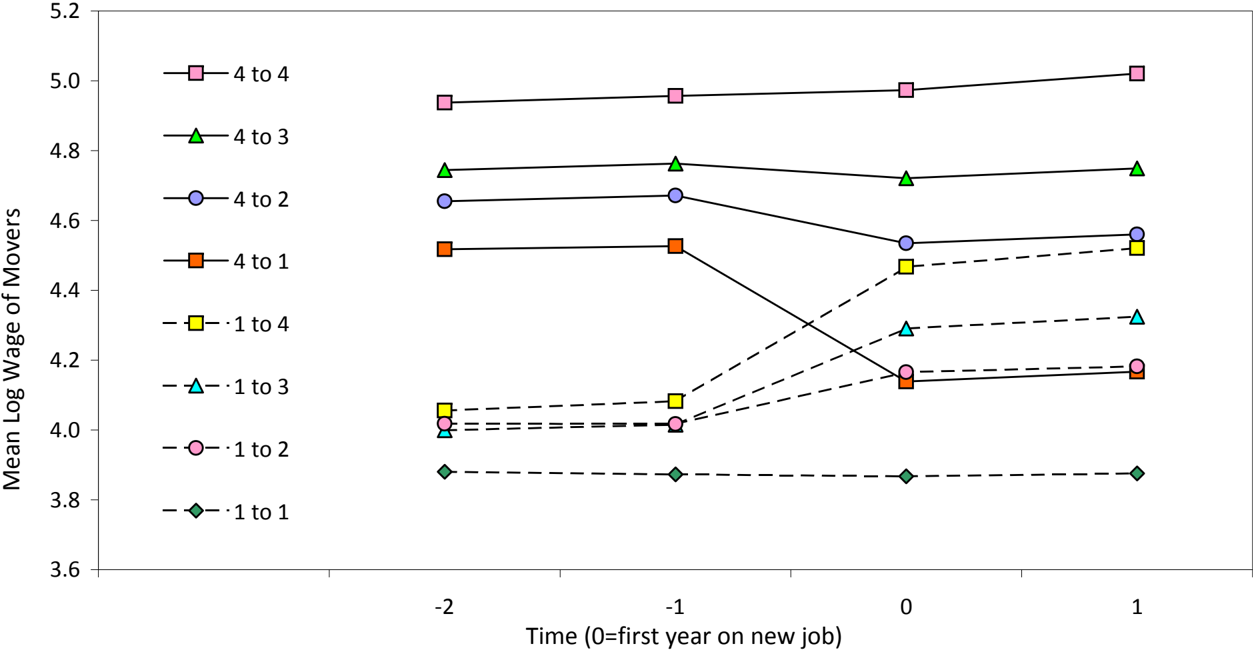
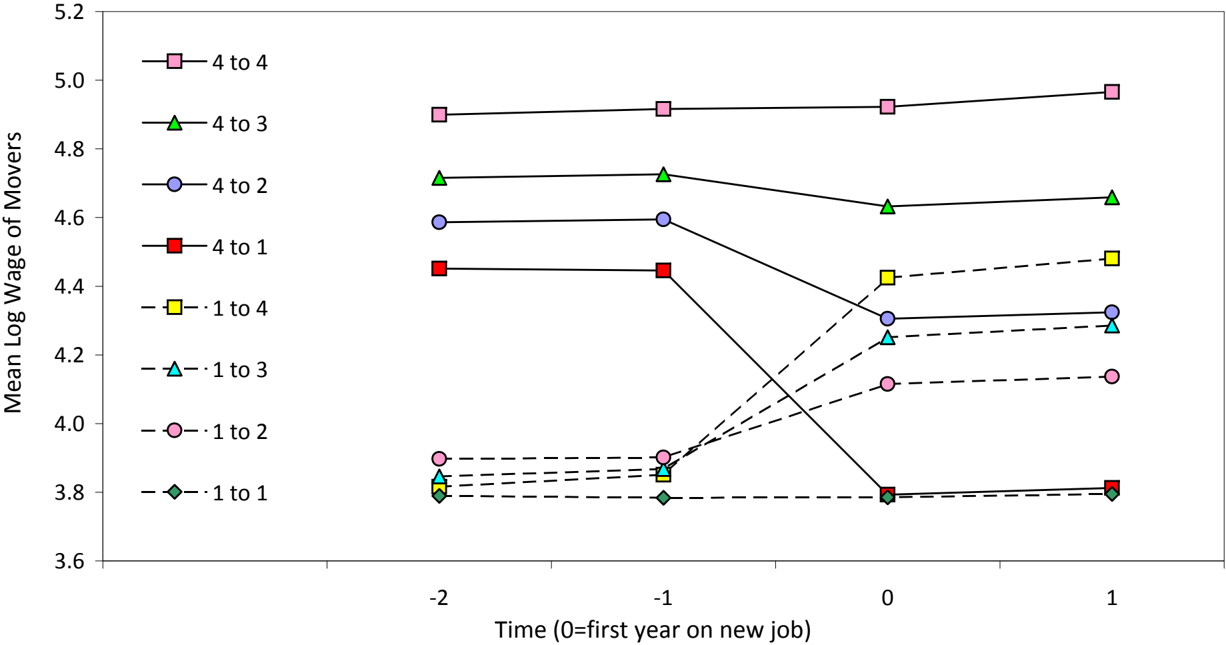
- Job-mobility event studies show growing establishment premia: a trend-adjusted move from quartile 1 to quartile 4 co-worker-wage establishments was associated with a 23 log-point gain in 1985–1991 versus 47 log points in 2002–2009; the reverse move yielded losses of 22 versus 43 log points.
- Between-group decompositions attribute 70% of the relative rise in university-educated men’s wages and 80% of the relative fall for workers with no/missing qualifications to establishment effects. For occupations, 42% of the rise in between-occupation variance is from person–establishment covariance, 28% from establishment variance, and about 30% from person variance; for industries, 44% is person variance, 19% establishment variance, and 42% sorting.
Methods
- Data: German Social Security records from the IEB, focusing on full-time West German men age 20–60 from 1985–2009, with parallel analyses for full-time women. The main sample has 85–90 million person-year observations per interval and about 17 million individual workers.
- Model: AKM-style log daily wage equation with additive person fixed effects, establishment fixed effects, time-varying covariates, and an error component; estimated by OLS on the largest connected set of establishments linked by worker mobility. Censored earnings are imputed using Tobit models.
- Analyses: variance decompositions and counterfactuals across four overlapping intervals (1985–1991, 1990–1996, 1996–2002, 2002–2009); event studies of job changers; decompositions of between-group wage gaps by education, occupation, and industry; and establishment cohort/collective-bargaining analyses.
Limitations
- The paper states that earnings are censored at the Social Security maximum (10–12% of male observations and 1–3% of female observations per year), so it uses Tobit imputation and checks robustness using apprentice-trained men, who have lower censoring rates.
- The paper states that establishment identifiers are administrative: ownership changes can create new establishment IDs, and only about half of EID births/deaths are estimated to be true plant openings/closings. It also states that sampling errors bias estimated variances upward and the covariance downward, and it does not construct bias-corrected estimates, assuming biases are similar across intervals.
- The paper states that collective bargaining cannot be assigned a causal role because firms choose coverage, and that female estimates may have more negatively biased covariance terms due to fewer observed matches per plant/worker. Evident from the text: the main analysis is restricted to full-time workers in West Germany, excluding civil servants, self-employed, and many part-time/mini-job workers, which limits generalizability.
Model-written summary. Check it against the paper before relying on it.
Integrity signals
Registry
Cites
Statistics
Figures


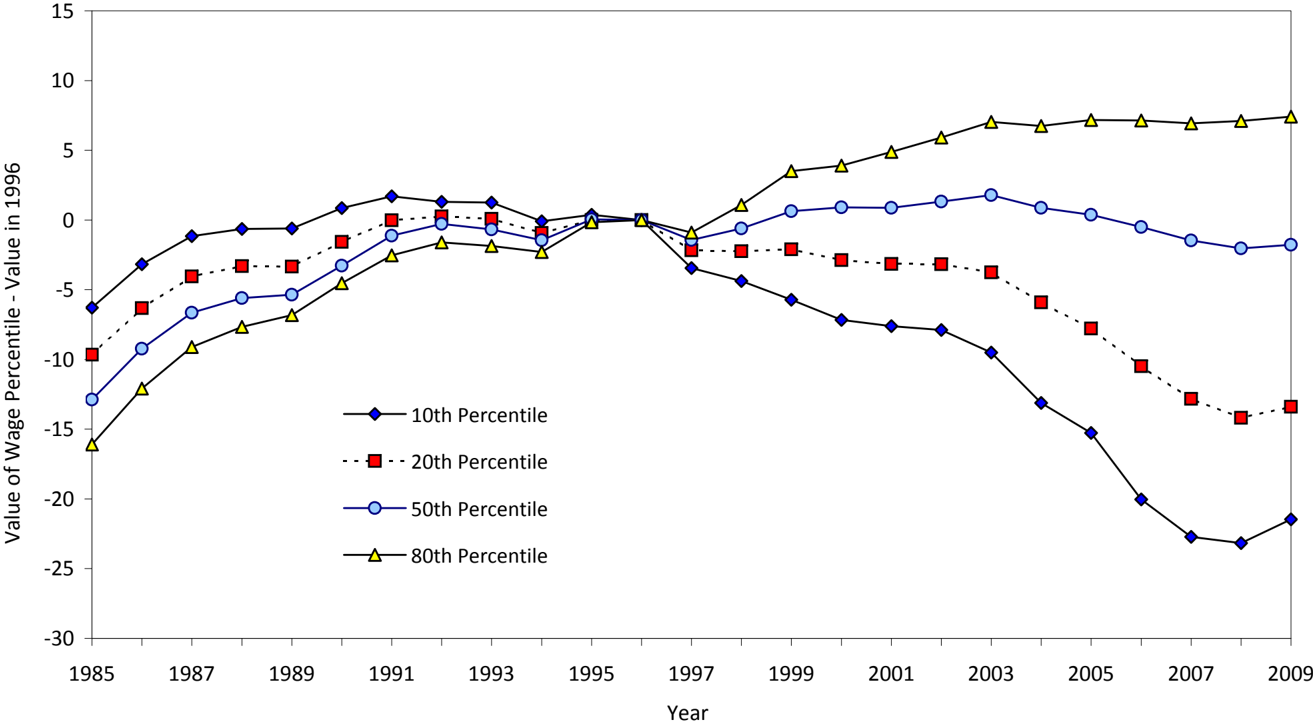
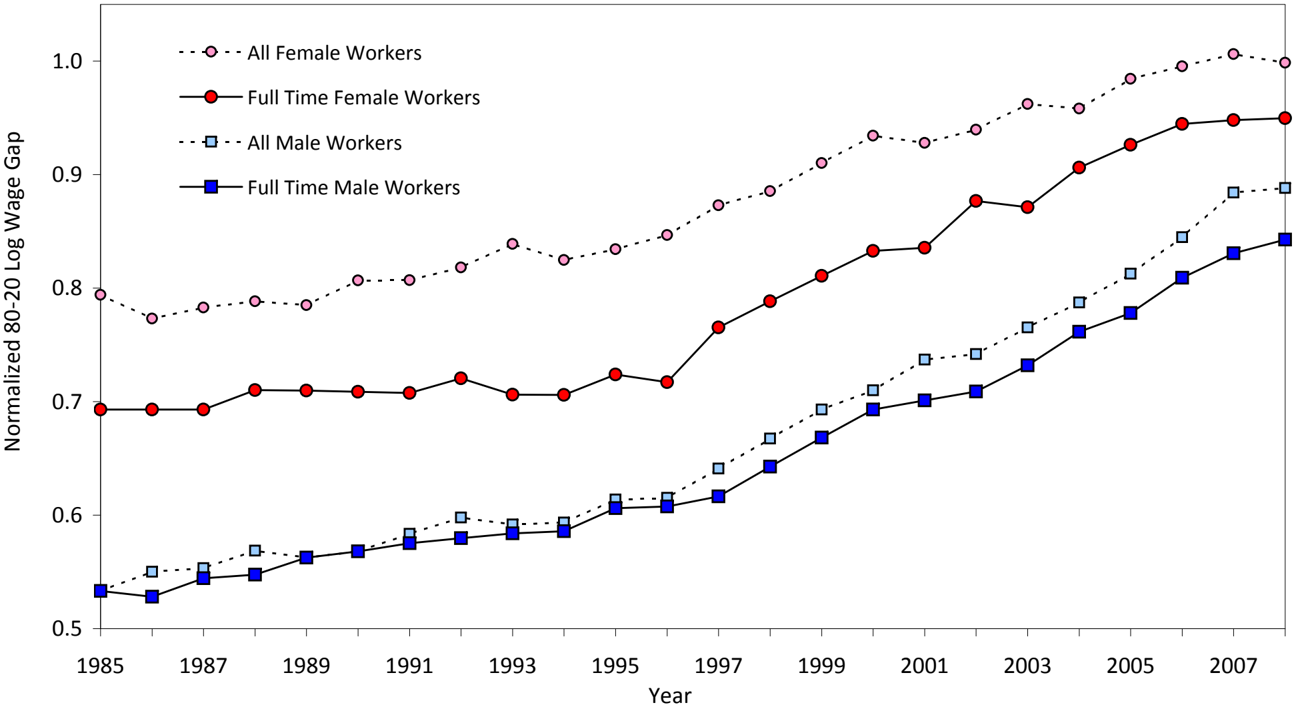
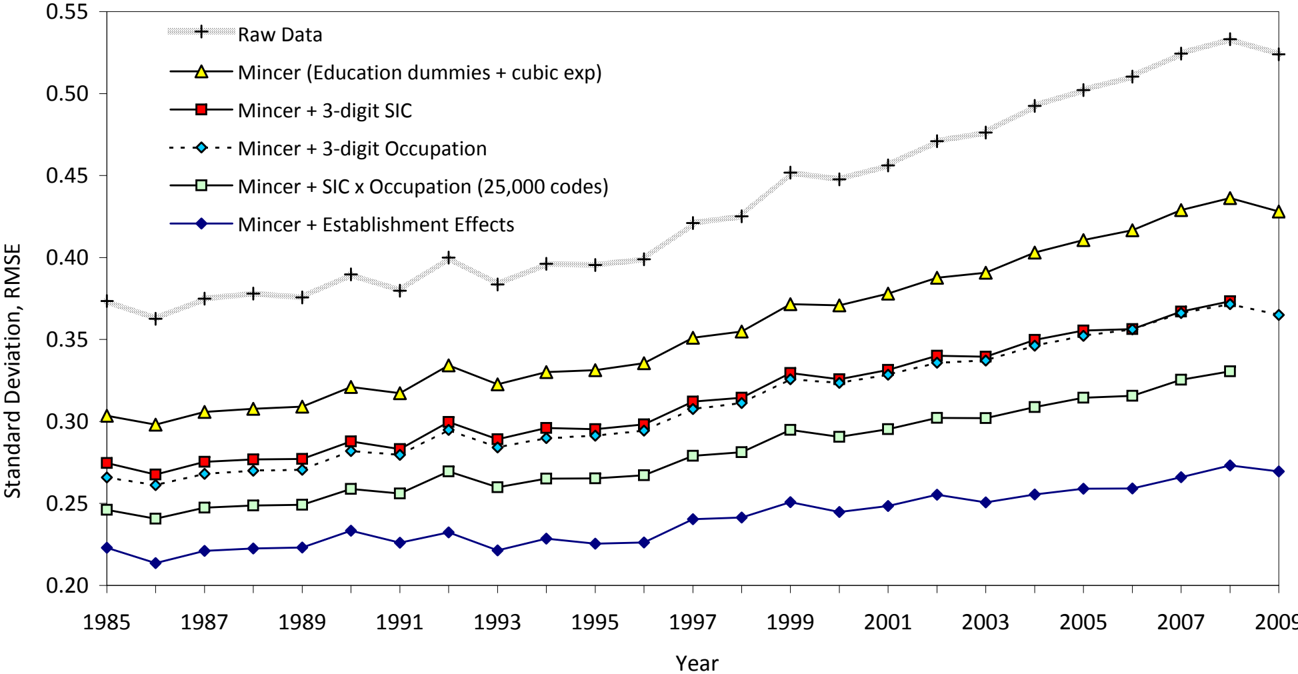
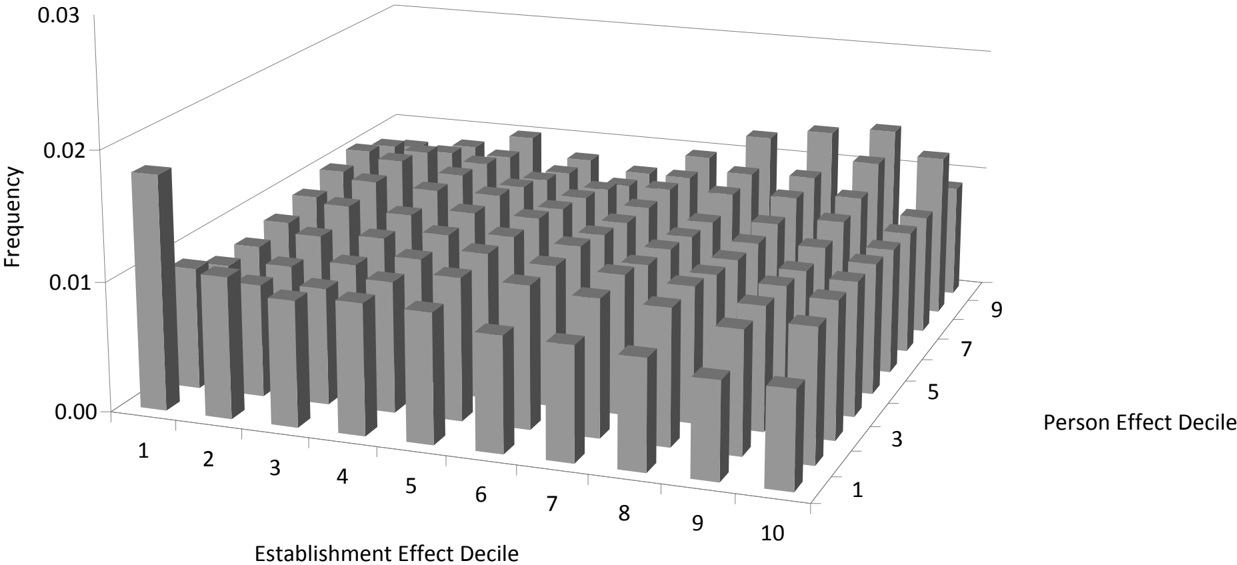
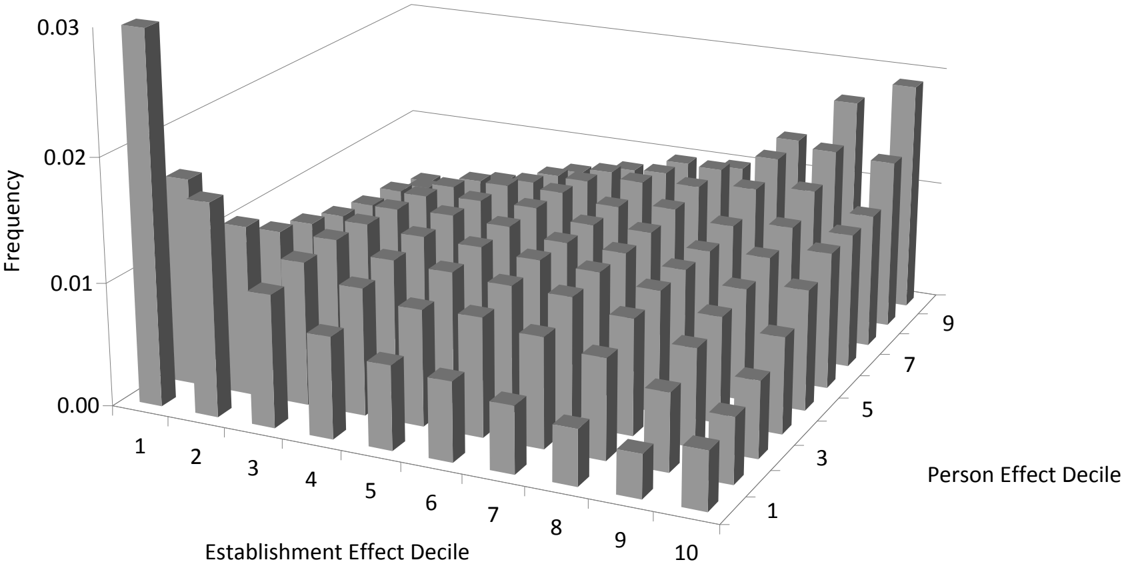
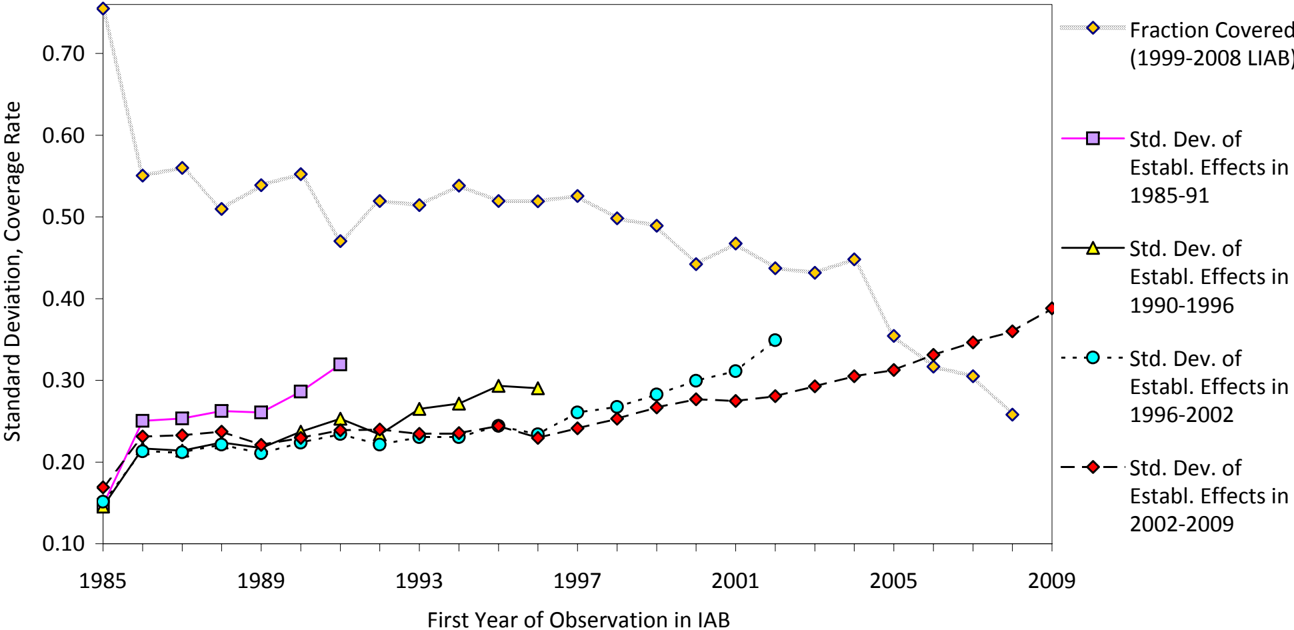
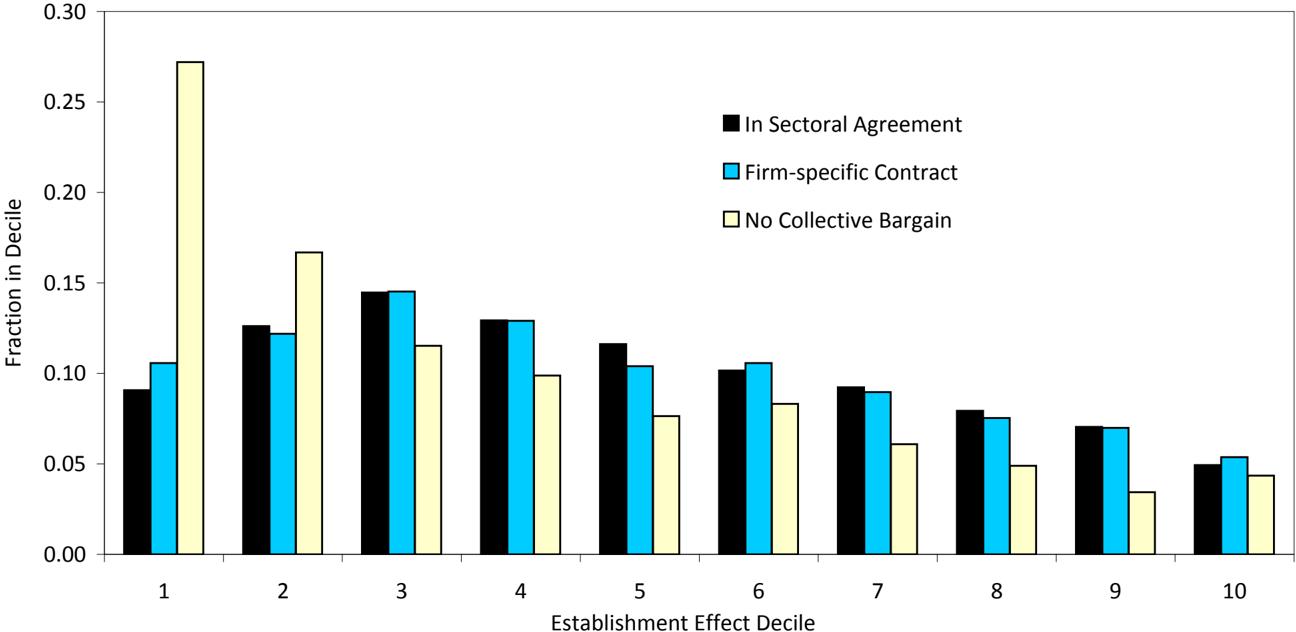
Verification
Claims the paper makes
0 Valid · 0 Not valid · 8 Not checked · 191 Own results and interpretations
A result the paper reports from its own data — it cites no other source for it, so there is none to check. The quote shows it is in the paper.
In the paper
“In particular, generalized non-separable models with xed e/ects for each job yield only a small improvement in explanatory power relative to the AKM speci cation, both within narrow time intervals and between intervals.”
plain- Asserted: passes — The authors put it forward as true.
- Checkable: passes — It can be checked against evidence.
- Load-bearing: passes — The paper’s conclusions depend on it.
- Based: passes — The paper gives a reason why it holds.
A result the paper reports from its own data — it cites no other source for it, so there is none to check. The quote shows it is in the paper.
In the paper
“Classifying establishments by entry year, we nd a trend toward increasing heterogeneity among establishments that entered the labor market after the mid-1990s, coupled with relatively small changes in the variability of the premiums paid by continuing establishments.”
plain- Asserted: passes — The authors put it forward as true.
- Checkable: passes — It can be checked against evidence.
- Load-bearing: passes — The paper’s conclusions depend on it.
- Based: passes — The paper gives a reason why it holds.
A result the paper reports from its own data — it cites no other source for it, so there is none to check. The quote shows it is in the paper.
In the paper
“We nd that two-thirds of the increase in the pay gap between higher and lower-educated workers is attributable to a widening in the average workplace pay premiums received by di/erent education groups.”
plainstates a cause- Asserted: passes — The authors put it forward as true.
- Checkable: passes — It can be checked against evidence.
- Load-bearing: passes — The paper’s conclusions depend on it.
- Based: passes — The paper gives a reason why it holds.
A result the paper reports from its own data — it cites no other source for it, so there is none to check. The quote shows it is in the paper.
In the paper
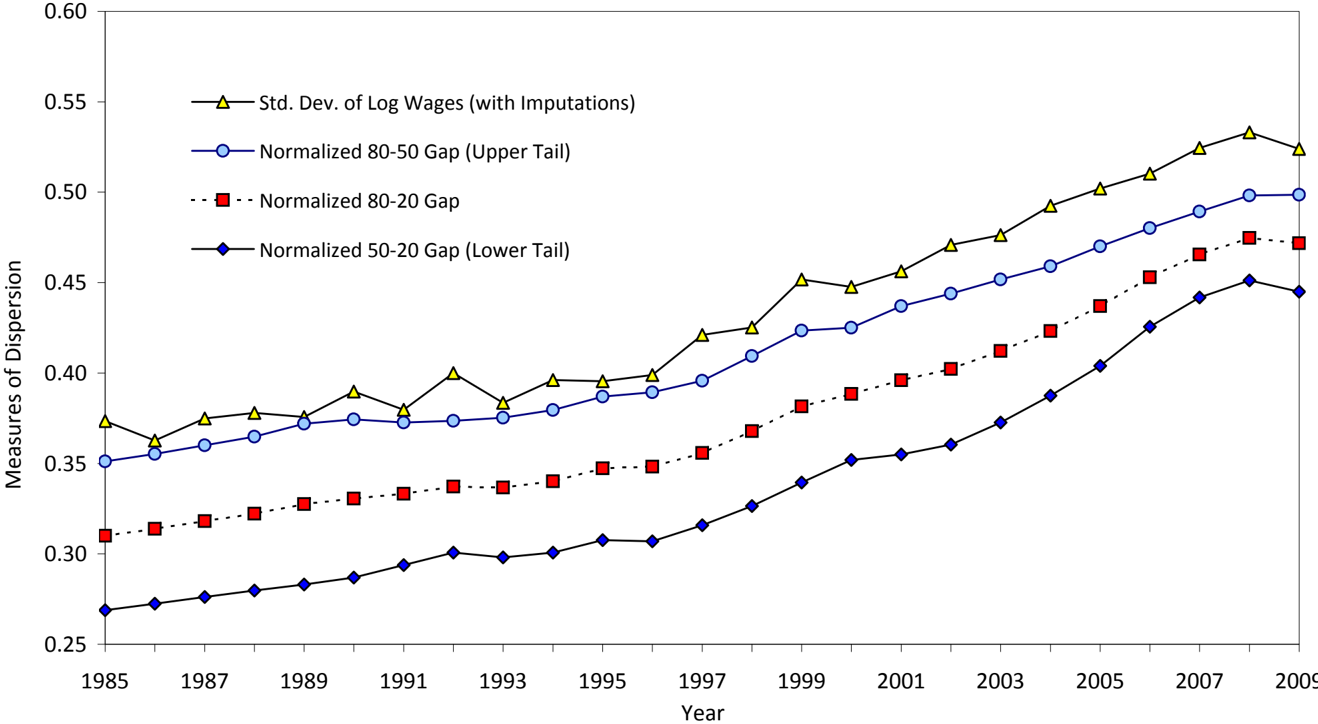
“In particular, the standard deviation rose by 15 log points from 1985 to 2009, the (normalized) 80-20 gap rose by 16 log points, the 80-50 gap rose by 15 log points, and the 50-20 gap rose by 18 log points.”
plain- Asserted: passes — The authors put it forward as true.
- Checkable: passes — It can be checked against evidence.
- Load-bearing: unclear — It is unclear whether the paper’s conclusions depend on it.
- Based: passes — The paper gives a reason why it holds.
118 more claims
Create a free account to see all 199 claims and to verify the 4 references still open.
- It may state two separate claims as one. 61
- Probably not a substantial claim. 17
- The quote only partly states this claim. 3
Claims other papers make about this one
Each is checked against this paper’s own text: does it say what the citing paper says it does?
The check wasn’t confident either way, so it gives no verdict — never disputed.
In the citing paper
“We estimate below that 75% is labor income.16”
From “Capitalists in the Twenty-First Century” (2019) · cites this paper as [16]
Experimental — accuracy not yet measured
Citations
Cites
A heteroskedasticity-consistent covariance matrix estimator and a direct test for heteroskedasticity
White, H. (1980) · Econometrica · doi:10.2307/1912934 · Cited by 25,861
The Skill Content of Recent Technological Change: An Empirical Exploration
Autor, D. H., Levy, F., & Murnane, R. J. (2003) · The Quarterly Journal of Economics · doi:10.1162/003355303322552801 · Cited by 6,205
On the Pooling of Time Series and Cross Section Data
Mundlak, Y. (1978) · Econometrica · doi:10.2307/1913646 · Cited by 5,412
Changes in Relative Wages, 1963-1987: Supply and Demand Factors
Katz, L. F., & Murphy, K. M. (1992) · The Quarterly Journal of Economics · doi:10.2307/2118323 · Cited by 4,793
Equilibrium Unemployment as a Worker Discipline Device
Shapiro, C., & Stiglitz, J. E. (1986) · Efficiency Wage Models of the Labor Market · doi:10.1017/cbo9780511559594.004 · Cited by 4,652
Misallocation and Manufacturing TFP in China and India*
Hsieh, C.-T., & Klenow, P. J. (2009) · Quarterly Journal of Economics · doi:10.1162/qjec.2009.124.4.1403 · Cited by 4,175
Job Creation and Job Destruction in the Theory of Unemployment
Mortensen, D. T., & Pissarides, C. A. (1994) · The Review of Economic Studies · doi:10.2307/2297896 · Cited by 3,840
Hybrid Corn: An Exploration in the Economics of Technological Change
Griliches, Z. (1957) · Econometrica · doi:10.2307/1905380 · Cited by 3,330
Labor Contracts as Partial Gift Exchange
Akerlof, G. A. (1982) · The Quarterly Journal of Economics · doi:10.2307/1885099 · Cited by 3,210
Plants and Productivity in International Trade
Bernard, A. B., Eaton, J., Jensen, J. B., & Kortum, S. (2003) · American Economic Review · doi:10.1257/000282803769206296 · Cited by 2,980
Research works printed but not linked: 1
- 70. Rees, Albert and George Schultz. 1970. Workers in an Urban Labor Market. Chicago: University of Chicago Press.
Cited by
Items 101–200 of 1,904
Polarization and Rising Wage Inequality: Comparing the U.S. and Germany
Antonczyk, D., DeLeire, T., & Fitzenberger, B. (2018) · Econometrics · doi:10.3390/econometrics6020020 · Cited by 132
From Sick Man of Europe to Economic Superstar: Germany’s Resurgent Economy
Dustmann, C., Fitzenberger, B., Schönberg, U., & Spitz‐Oener, A. (2014) · Gospodarka Narodowa · doi:10.33119/gn/100903 · Cited by 127
Wage Inequality in Germany after the Minimum Wage Introduction
Bossler, M., & Schänk, T. (2022) · Journal of Labor Economics · doi:10.1086/720391 · Cited by 132
For whom the bell tolls: The firm-level effects of automation on wage and gender inequality
Domini, G., Grazzi, M., Moschella, D., & Treibich, T. (2022) · Research Policy · doi:10.1016/j.respol.2022.104533 · Cited by 127
Card, D., Cardoso, A. R., & Kline, P. (2015) · National Bureau of Economic Research · doi:10.3386/w21403 · Cited by 125
Self-citationChanges in Workplace Heterogeneity and How They Widen the Gender Wage Gap
Bruns, B. (2019) · American Economic Journal Applied Economics · doi:10.1257/app.20160664 · Cited by 121
Adjusting to Globalization in Germany
Dauth, W., Findeisen, S., & Suedekum, J. (2019) · Journal of Labor Economics · doi:10.1086/707356 · Cited by 116
Productivity Spillovers in Team Production: Evidence from Professional Basketball
Arcidiacono, P., Kinsler, J., & Price, J. (2016) · Journal of Labor Economics · doi:10.1086/687529 · Cited by 116
Firm Heterogeneity in Consumption Baskets: Evidence from Home and Store Scanner Data
Faber, B. M., & Fally, T. (2018) · The Review of Economic Studies · doi:10.1093/restud/rdab061 · Cited by 114
Estimating Hospital Quality with Quasi-Experimental DataPreprint
Hull, P. (2018) · SSRN Electronic Journal · doi:10.2139/ssrn.3118358 · Cited by 113
The Spread of Gig Economy: Trends and Effects
Banik, N., & Padalkar, M. (2021) · Foresight-Russia · doi:10.17323/2500-2597.2021.1.19.29 · Cited by 113
Job Displacement, Family Dynamics, and Spousal Labor Supply
Halla, M., Schmieder, J., & Weber, A. M. (2020) · American Economic Journal Applied Economics · doi:10.1257/app.20180671 · Cited by 113
The Unequal Consequences of Job Loss across Countries
Bertheau, A., Acabbi, E. M., Barceló, C., Gulyas, A., Lombardi, S., & Saggio, R. (2023) · American Economic Review Insights · doi:10.1257/aeri.20220006 · Cited by 115
How Substitutable Are Workers? Evidence from Worker Deaths
Jäger, S., & Heining, J. (2022) · National Bureau of Economic Research · doi:10.3386/w30629 · Cited by 112
Self-citationIs Germany the North Star of Labor Market Policy?
Rinne, U., & Zimmermann, K. F. (2013) · IMF Economic Review · doi:10.1057/imfer.2013.21 · Cited by 110
Bilal, A. (2021) · The Quarterly Journal of Economics · doi:10.1093/qje/qjad010 · Cited by 109
Job Quality, Health and Productivity: An evidence-based framework for analysis
Saint-Martin, A., Inanc, H., & Prinz, C. (2018) · OECD social employment and migration working papers · doi:10.1787/a8c84d91-en · Cited by 109
Wage Flexibility under Sectoral Bargaining
Card, D., & Cardoso, A. R. (2022) · Journal of the European Economic Association · doi:10.1093/jeea/jvac020 · Cited by 107
Self-citationWhat Firms Do: Gender Inequality in Linked Employer-Employee Data
Casarico, A., & Lattanzio, S. (2022) · Journal of Labor Economics · doi:10.1086/723177 · Cited by 107
The human side of productivity: Uncovering the role of skills and diversity for firm productivity
Criscuolo, C., Gál, P., Leidecker, T., & Nicoletti, G. (2021) · OECD productivity working papers · doi:10.1787/5f391ba9-en · Cited by 108
Wage Adjustment and Productivity Shocks
Carlsson, M., Messina, J., & Skans, O. N. (2015) · The Economic Journal · doi:10.1111/ecoj.12214 · Cited by 107
Career Consequences of Firm Heterogeneity for Young Workers: First Job and Firm Size
Arellano-Bover, J. (2020) · Journal of Labor Economics · doi:10.1086/723500 · Cited by 104
Employment Hysteresis from the Great Recession
Yagan, D. (2017) · National Bureau of Economic Research · doi:10.3386/w23844 · Cited by 104
Exports and Wage Premiums: Evidence from Mexican Employer-Employee Data
Frías, J., Kaplan, D. S., Verhoogen, E., & Alfaro‐Serrano, D. (2024) · The Review of Economics and Statistics · doi:10.1162/rest_a_01178 · Cited by 103
The Origins of Firm Heterogeneity: A Production Network Approach
Bernard, A. B., Dhyne, E., Magerman, G., Manova, K. B., & Moxnes, A. (2019) · National Bureau of Economic Research · doi:10.3386/w25441 · Cited by 106
The Human Side of Structural Transformation
Porzio, T., Rossi, F., & Santangelo, G. (2021) · American Economic Review · doi:10.1257/aer.20201157 · Cited by 105
Declining Migration within the U.S.: The Role of the Labor Market
Molloy, R. S., Smith, C. L., & Wozniak, A. K. (2014) · National Bureau of Economic Research · doi:10.3386/w20065 · Cited by 103
Understanding Declining Fluidity in the U.S. Labor Market
Molloy, R. S., Smith, C. L., Trezzi, R., & Wozniak, A. K. (2016) · Finance and Economics Discussion Series · doi:10.17016/feds.2016.015 · Cited by 99
Performance and Progress: Essays on Capitalism, Business, and Society
Rangan, S. (2015) · Oxford University Press eBooks · doi:10.1093/acprof:oso/9780198744283.001.0001 · Cited by 100
Executive Compensation, Fat Cats and Best Athletes
Kim, J. W., Kogut, B., & Yang, J. (2012) · American Sociological Review · doi:10.1177/0003122415572463 · Cited by 100
Within-job gender pay inequality in 15 countries
Penner, A. M., Petersen, T., Hermansen, A. S., Rainey, A., Boza, I., Elvira, M. M., Godechot, O., Hällsten, M., Henriksen, L. F., Hou, F., et al. (2022) · Nature Human Behaviour · doi:10.1038/s41562-022-01470-z · Cited by 99
Management as a Technology?Preprint
Bloom, N., & Reenen, J. M. V. (2016) · SSRN Electronic Journal · doi:10.2139/ssrn.2788794 · Cited by 99
Selection in initial and return migration: Evidence from moves across Spanish cities
la Roca, J. D. (2017) · Journal of Urban Economics · doi:10.1016/j.jue.2017.04.004 · Cited by 102
Do firm effects drift? Evidence from Washington administrative data
Lachowska, M., Mas, A., Saggio, R., & Woodbury, S. A. (2022) · Journal of Econometrics · doi:10.1016/j.jeconom.2021.12.014 · Cited by 99
Paying Outsourced Labor: Direct Evidence from Linked Temp Agency-Worker-Client Data
Drenik, A., Jäger, S., Plotkin, P., & Schoefer, B. (2023) · The Review of Economics and Statistics · doi:10.1162/rest_a_01037 · Cited by 99
The Selection of High-Skilled Emigrants
Parey, M., Ruhose, J., Waldinger, F., & Netz, N. (2017) · The Review of Economics and Statistics · doi:10.1162/rest_a_00687 · Cited by 97
Abowd, J. M., McKinney, K. L., & Zhao, N. (2017) · Journal of Labor Economics · doi:10.1086/694104 · Cited by 94
The Costs of Job Displacement over the Business Cycle and Its Sources: Evidence from Germany
Schmieder, J. F., von Wachter, T., & Heining, J. (2022) · National Bureau of Economic Research · doi:10.3386/w30162 · Cited by 95
Self-citationFirm Wage Premia, Industrial Relations, and Rent Sharing in Germany
Hirsch, B., & Mueller, S. (2018) · Industrial and Labor Relations Review · doi:10.2139/ssrn.3117313 · Cited by 95
A Method for Studying Differences in Segregation Across Time and Space
Elbers, B. (2021) · Sociological Methods & Research · doi:10.1177/0049124121986204 · Cited by 92
Engbom, N., Moser, C., & Sauermann, J. (2022) · Journal of Econometrics · doi:10.1016/j.jeconom.2022.01.012 · Cited by 93
How Much Should we Trust Estimates of Firm Effects and Worker Sorting?
Bonhomme, S., Holzheu, K., Lamadon, T., Manresa, E., Mogstad, M., & Setzler, B. (2020) · National Bureau of Economic Research · doi:10.3386/w27368 · Cited by 92
The dynamics of gender earnings differentials: Evidence from establishment data
Barth, E., Kerr, S. P., & Claudia Olivetti, Z. (2021) · European Economic Review · doi:10.1016/j.euroecorev.2021.103713 · Cited by 91
The American Political Economy: Politics, Markets, and Power
(2021) · Cambridge University Press eBooks · doi:10.1017/9781009029841 · Cited by 92
Fixed‐Effect Regressions on Network Data
Jochmans, K., & Weidner, M. (2019) · Econometrica · doi:10.3982/ecta14605 · Cited by 91
Investment responses to trade liberalization: Evidence from U.S. industries and establishments
Pierce, J. R., & Schott, P. K. (2018) · Journal of International Economics · doi:10.1016/j.jinteco.2018.09.005 · Cited by 93
Firms and Skills: The Evolution of Worker Sorting
Håkanson, C., Lindqvist, E., & Vlachos, J. (2020) · The Journal of Human Resources · doi:10.3368/jhr.56.2.0517-8801r2 · Cited by 90
Firm Organization with Multiple Establishments
Gumpert, A., Steimer, H., & Antoni, M. (2019) · The Quarterly Journal of Economics · doi:10.1093/qje/qjab049 · Cited by 91
Multi-Task Agents and Incentives: The Case of Teaching and Research for University Professors
Philippis, M. D. (2020) · The Economic Journal · doi:10.1093/ej/ueaa119 · Cited by 89
Collective Bargaining and the Evolution of Wage Inequality in Italy
Devicienti, F., Fanfani, B., & Maida, A. (2018) · British Journal of Industrial Relations · doi:10.1111/bjir.12444 · Cited by 88
The Estimation of Compensating Wage Differentials: Lessons From the Deadliest Catch
Lavetti, K. (2018) · Journal of Business and Economic Statistics · doi:10.1080/07350015.2018.1470000 · Cited by 86
Cantoni, E., & Pons, V. (2020) · American Economic Review · doi:10.1257/aer.20201660 · Cited by 87
Burdett, K., Carrillo‐Tudela, C., & Coles, M. (2020) · The Review of Economic Studies · doi:10.1093/restud/rdaa014 · Cited by 87
The Labor Market Gender Gap in Denmark: Sorting Out the Past 30 Years
Gallen, Y., Lesner, R. V., & Vejlin, R. (2017) · Labour Economics · doi:10.1016/j.labeco.2018.11.003 · Cited by 85
Economía del comportamiento: pasado, presente y futuro
Thaler, R. H. (2018) · Revista de Economía Institucional · doi:10.18601/01245996.v20n38.02 · Cited by 92
Employer policies and the immigrant–native earnings gap
Dostie, B., Li, J., Card, D., & Parent, D. (2021) · Journal of Econometrics · doi:10.1016/j.jeconom.2021.07.012 · Cited by 87
Self-citationGlobal trends in income inequality and income dynamics: New insights from GRID
Guvenen, F., Pistaferri, L., & Violante, G. L. (2022) · Quantitative Economics · doi:10.3982/qe2260 · Cited by 84
Strategic or Confused Firms? Evidence from “Missing” Transactions in Uganda
Almunia, M., Hjort, J., Knebelmann, J., & Tian, L. (2024) · The Review of Economics and Statistics · doi:10.1162/rest_a_01180 · Cited by 84
Working from Home, Wages, and Regional Inequality in the Light of COVID-19
Irlacher, M., & Koch, M. (2020) · Jahrbücher für Nationalökonomie und Statistik · doi:10.1515/jbnst-2020-0030 · Cited by 84
Consolidated Advantage: New Organizational Dynamics of Wage Inequality
Wilmers, N., & Aeppli, C. (2021) · American Sociological Review · doi:10.1177/00031224211049205 · Cited by 84
Skewed Idiosyncratic Income Risk over the Business Cycle: Sources and Insurance
Busch, C., Domeij, D., Guvenen, F., & Madera, R. (2022) · American Economic Journal Macroeconomics · doi:10.1257/mac.20190019 · Cited by 82
Leveraging Lotteries for School Value-Added: Testing and Estimation
Angrist, J., Hull, P., Pathak, P., & Walters, C. (2015) · National Bureau of Economic Research · doi:10.3386/w21748 · Cited by 73
High Wage Workers Work for High Wage Firms
Borovičková, K., & Shimer, R. J. (2017) · National Bureau of Economic Research · doi:10.3386/w24074 · Cited by 82
Show Me the Amenity: Are Higher-Paying Firms Better All Around?Preprint
Sockin, J. (2022) · SSRN Electronic Journal · doi:10.2139/ssrn.4167445 · Cited by 83
Bahar, D., Hauptmann, A., Özgüzel, C., & Rapoport, H. (2024) · The Review of Economics and Statistics · doi:10.1162/rest_a_01165 · Cited by 82
The Sources of Wage Variation: A Three-Way High-Dimensional Fixed Effects Regression Model
Torres, S., Portugal, P., Addison, J. T., & Guimarães, P. (2013) · Labour Economics · doi:10.2139/ssrn.2238309 · Cited by 83
Twenty Years of Wage Inequality in Latin America
Messina, J., & Silva, J. (2019) · The World Bank Economic Review · doi:10.1093/wber/lhz029 · Cited by 84
Adda, J., & Dustmann, C. (2022) · Journal of Political Economy · doi:10.1086/721657 · Cited by 81
Globalization and imperfect labor market sorting
Davidson, C., Heyman, F., Matusz, S. J., Sjöholm, F., & Zhu, S. C. (2014) · Journal of International Economics · doi:10.1016/j.jinteco.2014.08.001 · Cited by 80
Job Loss and Immigrant Labour Market Performance
Bratsberg, B., Raaum, O., & Røed, K. (2017) · Economica · doi:10.1111/ecca.12244 · Cited by 82
Is Murder Bad for Business? Evidence from Colombia
Rozo, S. (2018) · The Review of Economics and Statistics · doi:10.1162/rest_a_00735 · Cited by 81
Are Inventors or Firms the Engines of Innovation?
Bhaskarabhatla, A., Cabral, L., Hegde, D., & Peeters, T. L. P. R. (2020) · Management Science · doi:10.1287/mnsc.2020.3646 · Cited by 78
Adjusting to Globalization - Evidence from Worker-Establishment Matches in GermanyPreprint
Dauth, W., Findeisen, S., & Suedekum, J. (2016) · RePEc: Research Papers in Economics · Cited by 86
Cyclical Job Ladders by Firm Size and Firm Wage
Haltiwanger, J., Hyatt, H. R., Kahn, L., & McEntarfer, E. (2017) · National Bureau of Economic Research · doi:10.3386/w23485 · Cited by 79
The Role of Firms in Gender Earnings Inequality: Evidence from the United States
Sorkin, I. (2017) · American Economic Review · doi:10.1257/aer.p20171015 · Cited by 77
Skill Requirements across Firms and Labor Markets: Evidence from Job Postings for Professionals
Deming, D. J., & Kahn, L. (2017) · National Bureau of Economic Research · doi:10.3386/w23328 · Cited by 79
Avent‐Holt, D., Henriksen, L. F., Hägglund, A. E., Jung, J., Kodama, N., Melzer, S. M., Mun, E., Rainey, A., & Tomaskovic‐Devey, D. (2019) · Research in Social Stratification and Mobility · doi:10.1016/j.rssm.2019.100456 · Cited by 78
The Welfare State and Antipoverty Policy in Rich Countries
Marx, I., Nolan, B. W., & Olivera, J. (2014) · Handbook of income distribution · doi:10.1016/b978-0-444-59429-7.00024-8 · Cited by 79
Technological and Organizational Change and the Careers of Workers
Battisti, M., Dustmann, C., & Schönberg, U. (2023) · Journal of the European Economic Association · doi:10.1093/jeea/jvad014 · Cited by 75
Skill Mismatch and the Costs of Job Displacement
Neffke, F. M. H., Nedelkoska, L., & Wiederhold, S. (2022) · Research Policy · doi:10.1016/j.respol.2023.104933 · Cited by 76
Labor market reforms: An evaluation of the Hartz policies in Germany
Bradley, J., & Kügler, A. (2019) · European Economic Review · doi:10.1016/j.euroecorev.2018.12.008 · Cited by 76
Firm Heterogeneity in Consumption Baskets: Evidence from Home and Store Scanner Data
Faber, B. M., & Fally, T. (2017) · National Bureau of Economic Research · doi:10.3386/w23101 · Cited by 74
Addison, J. T. (2016) · IZA Journal of Labor Policy · doi:10.1186/s40173-016-0075-8 · Cited by 73
VanHeuvelen, T. (2018) · Social Forces · doi:10.1093/sf/soy045 · Cited by 76
The Gender Application Gap: Do Men and Women Apply for the Same Jobs?
Fluchtmann, J., Glenny, A. M., Harmon, N., & Maibom, J. (2024) · American Economic Journal Economic Policy · doi:10.1257/pol.20210607 · Cited by 73
Trade Shocks, Firm Hierarchies, and Wage Inequality
Friedrich, B. (2022) · The Review of Economics and Statistics · doi:10.1162/rest_a_00998 · Cited by 76
The Impact of Technological Innovation on the Future of WorkPreprint
Goos, M., Arntz, M., Zierahn, U., Gregory, T., Carretero, S., Vazquez, I., & Jonkers, K. (2019) · RePEc: Research Papers in Economics · Cited by 75
Worker Beliefs About Outside Options
Jäger, S., Roth, C., Roussille, N., & Schoefer, B. (2021) · SSRN Electronic Journal · doi:10.2139/ssrn.4009408 · Cited by 74
Drivers of Effort: Evidence from Employee Absenteeism
Bennedsen, M., Tsoutsoura, M., & Wolfenzon, D. (2017) · Journal of Financial Economics · doi:10.1016/j.jfineco.2018.12.001 · Cited by 73
Integrity of firms’ emissions reporting in China’s early carbon markets
Zhang, D., Zhang, Q., Qi, S., Huang, J., Karplus, V. J., & Zhang, X. (2019) · Nature Climate Change · doi:10.1038/s41558-018-0394-4 · Cited by 72
Sources of Displaced Workers’ Long-Term Earnings Losses
Lachowska, M., Mas, A., & Woodbury, S. A. (2018) · National Bureau of Economic Research · doi:10.3386/w24217 · Cited by 73
Supervisors and Performance Management Systems
Frederiksen, A., Kahn, L., & Lange, F. (2019) · Journal of Political Economy · doi:10.1086/705715 · Cited by 71
Bureaucrat Allocation in the Public Sector: Evidence from the World Bank
Limodio, N. (2021) · The Economic Journal · doi:10.1093/ej/ueab008 · Cited by 71
Garin, A., & Silvério, F. (2023) · The Review of Economic Studies · doi:10.1093/restud/rdad069 · Cited by 70
Long-Term Contextual Effects in Education: Schools and Neighborhoods
Laliberté, J.-W. (2021) · American Economic Journal: Economic Policy · doi:10.1257/pol.20190257 · Cited by 69
Occupation Growth, Skill Prices, and Wage Inequality
Böhm, M. J., von Gaudecker, H., & Schran, F. (2019) · Journal of Labor Economics · doi:10.1086/722084 · Cited by 69
Worker Beliefs About Outside Options
Jäger, S., Roth, C., Roussille, N., & Schoefer, B. (2021) · National Bureau of Economic Research · doi:10.3386/w29623 · Cited by 69
The Unequal Consequences of Job Loss across Countries
Bertheau, A., Acabbi, E. M., Barceló, C., Gulyas, A., Lombardi, S., & Saggio, R. (2022) · National Bureau of Economic Research · doi:10.3386/w29727 · Cited by 69
The Urban Wage Premium in Imperfect Labor Markets
Hirsch, B., Jahn, E. J., Manning, A., & Oberfichtner, M. (2020) · The Journal of Human Resources · doi:10.3368/jhr.monopsony.0119-9960r1 · Cited by 68
Industry Wage Differentials: A Firm-Based Approach
Card, D., Rothstein, J., & Yi, M. (2024) · Journal of Labor Economics · doi:10.1086/728803 · Cited by 68
Self-citation
Metadata
- Authors
- Card, D., Heining, J., & Kline, P.
- Affiliations
- University of California, Berkeley (US)
- Corresponding author
- Kline, Patrick
- ORCID
- Card, David
- Venue
- The Quarterly Journal of Economics
- Publisher
- Oxford University Press (OUP)
- Published
- 2013-05-02
- Volume
- 128
- Issue
- 3
- Pages
- 967-1015
- ISSN
- 0033-5533 (ISSN-L)
- 1531-4650
- OpenAlex
- W2141295263
- Cited by
- 1,904
- References
- 146
- Citations by year
- 2026: 153 · 2025: 204 · 2024: 228 · 2023: 156 · 2022: 185 · 2021: 178 · 2020: 143 · 2019: 125 · 2018: 156 · 2017: 113 · 2016: 105 · 2015: 71 · 2014: 58 · 2013: 22
- FWCI
- 118.40
- Type
- journal article
- Language
- en
- Open access
- closed
- Locations
- The Quarterly Journal of Economics (publishedVersion)
- RePEc: Research Papers in Economics (submittedVersion)
- Econstor (Econstor) (submittedVersion)
- Funders
- Washington Center for Equitable Growth
- Topics
- Social Sciences › Economics, Econometrics and Finance › Economics and Econometrics › Labor market dynamics and wage inequality
- Social Sciences › Economics, Econometrics and Finance › Economics and Econometrics › Historical Economic and Social Studies
- Social Sciences › Sociology and Political Science › Income, Poverty, and Inequality
- Keywords
- wage inequality, job matching, fixed effects model, education and wages
About these checks
Registry, retraction, Cites and statistics results are computed, not judged, with one exception: a printed reference that no index lists is read once by a model before it counts as a citation error. Claims are extracted by a model and kept only when their quote appears verbatim in the text; each cited source is then checked, with a model’s help, for whether it says what the claim relies on. Those verdicts can be wrong — read the claim’s quote and the cited source before relying on one.
A language model drew the claims from the paper on 2026-11-17, under version 3 of the claim definition (model deepseek-v4.1-flash, prompt extract-v3).
A second model labelled each claim on 2026-11-17 (model jev-1.13-20260917, definition revision gold-guideline-v0.2).
Statistics and arithmetic are recomputed, not judged.
Confidence bands are shown only for fields calibrated on our annotated test set. None is calibrated yet, so no band is shown.
What counts as a claim ›How we measure confidence ›How we check this ›
Are you an author, or do you see a problem with this page? Request a review
Data sources
Bibliographic data: Semantic Scholar, OpenAlex, Crossref.
Contains information from the Semantic Scholar Academic Graph Datasets, made available under the ODC Attribution License (ODC-BY 1.0).
Semantic Scholar’s data is described in: Kinney, R., et al. (2023). The Semantic Scholar Open Data Platform. arXiv:2301.10140.
