

Workplace Heterogeneity and the Rise of West German Wage Inequality*
The DOI matches its Crossref record; 144 of the 147 references it cites were found in a registry or an index, and 1 are not checked yet; none of the 8 sources its claims cite is checked for support yet.
Abstract
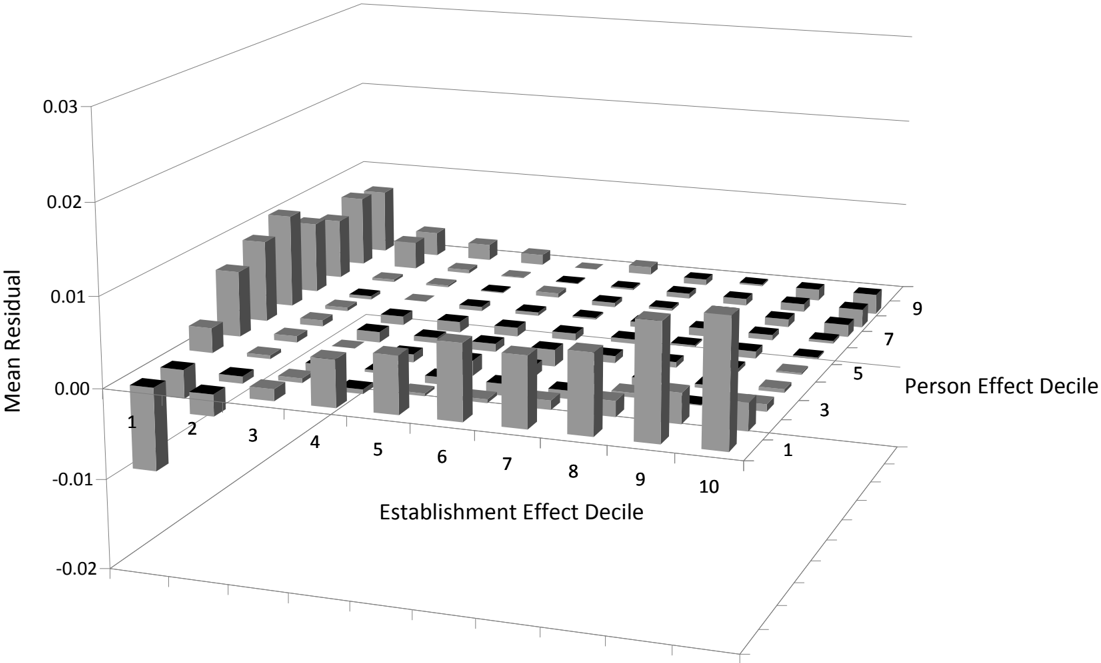
We study the role of establishment-specific wage premiums in generating recent increases in West German wage inequality. Models with additive fixed effects for workers and establishments are fit into four subintervals spanning the period from 1985 to 2009. We show that these models provide a good approximation to the wage structure and can explain nearly all of the dramatic rise in West German wage inequality. Our estimates suggest that the increasing dispersion of West German wages has arisen from a combination of rising heterogeneity between workers, rising dispersion in the wage premiums at different establishments, and increasing assortativeness in the assignment of workers to plants. In contrast, the idiosyncratic job-match component of wage variation is small and stable over time. Decomposing changes in mean wages between different education groups, occupations, and industries, we find that increasing plant-level heterogeneity and rising assortativeness in the assignment of workers to establishments explain a large share of the rise in inequality along all three dimensions.
Checked 2026-11-19 · 1 reference not checked yet
Overview
CoChat Summary
TL;DR
Using West German administrative data from 1985–2009, the paper shows that models with additive person and establishment fixed effects explain nearly all of the rise in wage inequality. The increase is driven by rising worker-effect variance, rising establishment-premium variance, and increased assortative matching of high-wage workers to high-wage plants.
Key findings
- In the AKM variance decomposition, total log-wage variance rose from 0.137 in interval 1 (1985–1991) to 0.249 in interval 4 (2002–2009). The variance of person effects rose from 0.084 to 0.127 and contributed 39% of the total rise; establishment-effect variance rose from 0.025 to 0.053 and contributed 25%; the covariance term rose from 0.003 to 0.041 and contributed 34%.
- Assortative matching increased: the correlation between person and establishment effects rose from 0.034 in interval 1 to 0.249 in interval 4. Counterfactuals imply that holding sorting constant would have produced 69% of the actual variance rise, while holding establishment-effect variance constant would have produced 64%.
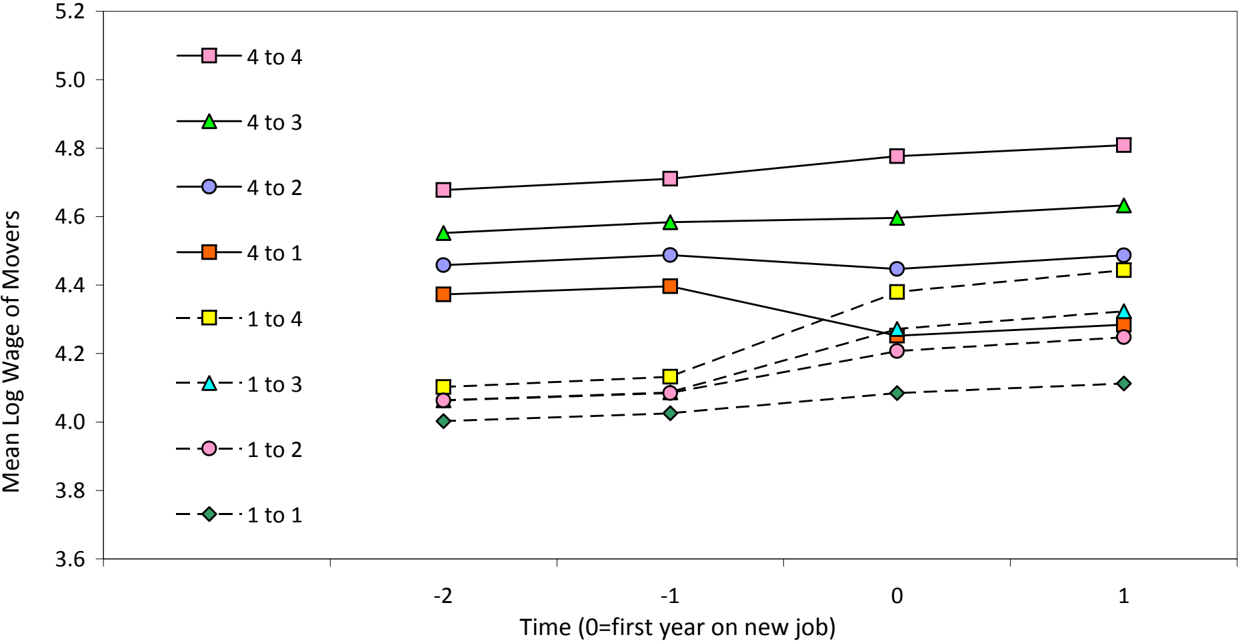
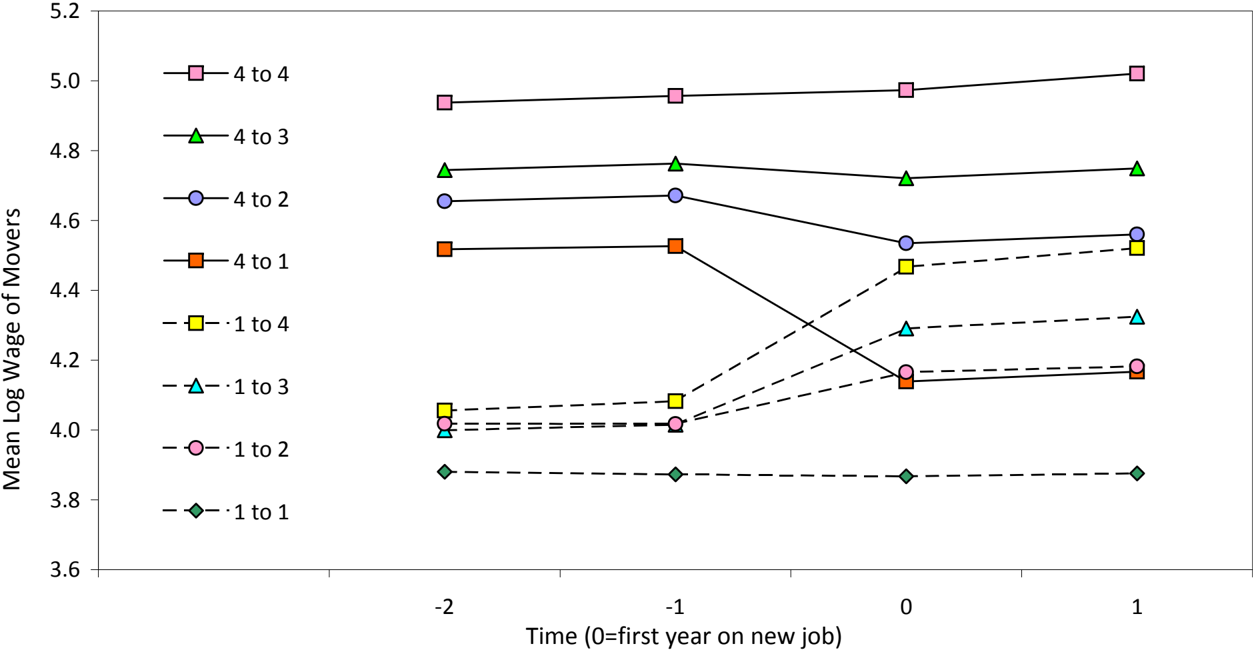
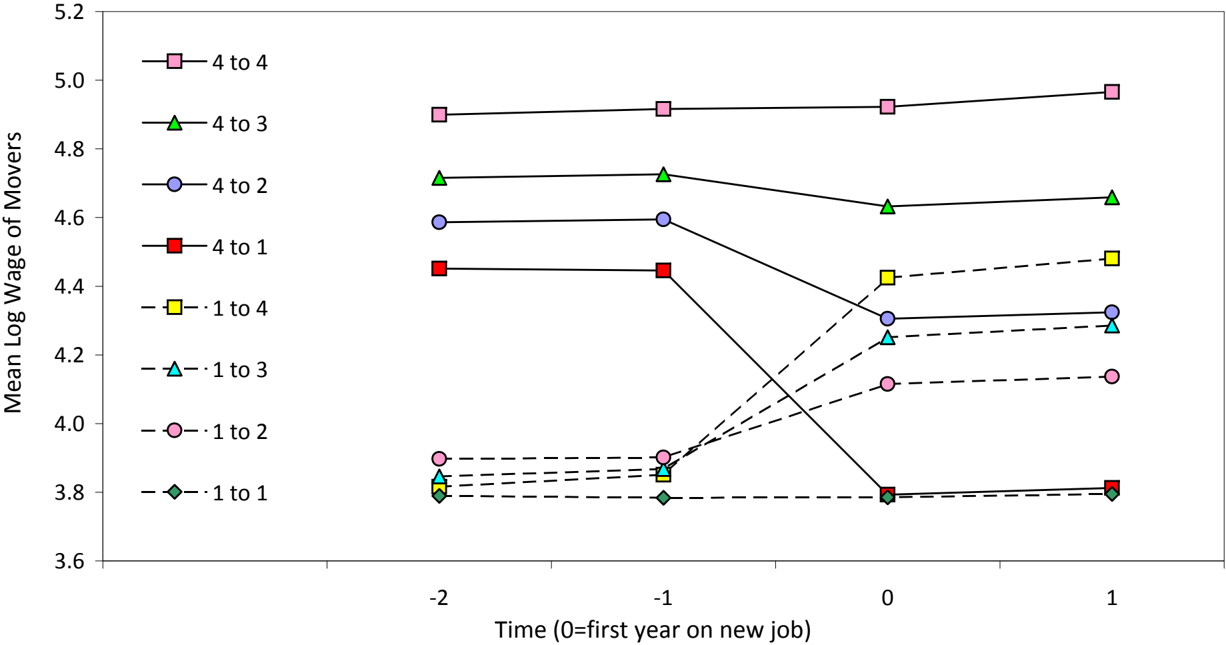
- Job-mobility event studies show growing establishment premia: a trend-adjusted move from quartile 1 to quartile 4 co-worker-wage establishments was associated with a 23 log-point gain in 1985–1991 versus 47 log points in 2002–2009; the reverse move yielded losses of 22 versus 43 log points.
- Between-group decompositions attribute 70% of the relative rise in university-educated men’s wages and 80% of the relative fall for workers with no/missing qualifications to establishment effects. For occupations, 42% of the rise in between-occupation variance is from person–establishment covariance, 28% from establishment variance, and about 30% from person variance; for industries, 44% is person variance, 19% establishment variance, and 42% sorting.
Methods
- Data: German Social Security records from the IEB, focusing on full-time West German men age 20–60 from 1985–2009, with parallel analyses for full-time women. The main sample has 85–90 million person-year observations per interval and about 17 million individual workers.
- Model: AKM-style log daily wage equation with additive person fixed effects, establishment fixed effects, time-varying covariates, and an error component; estimated by OLS on the largest connected set of establishments linked by worker mobility. Censored earnings are imputed using Tobit models.
- Analyses: variance decompositions and counterfactuals across four overlapping intervals (1985–1991, 1990–1996, 1996–2002, 2002–2009); event studies of job changers; decompositions of between-group wage gaps by education, occupation, and industry; and establishment cohort/collective-bargaining analyses.
Limitations
- The paper states that earnings are censored at the Social Security maximum (10–12% of male observations and 1–3% of female observations per year), so it uses Tobit imputation and checks robustness using apprentice-trained men, who have lower censoring rates.
- The paper states that establishment identifiers are administrative: ownership changes can create new establishment IDs, and only about half of EID births/deaths are estimated to be true plant openings/closings. It also states that sampling errors bias estimated variances upward and the covariance downward, and it does not construct bias-corrected estimates, assuming biases are similar across intervals.
- The paper states that collective bargaining cannot be assigned a causal role because firms choose coverage, and that female estimates may have more negatively biased covariance terms due to fewer observed matches per plant/worker. Evident from the text: the main analysis is restricted to full-time workers in West Germany, excluding civil servants, self-employed, and many part-time/mini-job workers, which limits generalizability.
Model-written summary. Check it against the paper before relying on it.
Integrity signals
Registry
Cites
Statistics
Figures


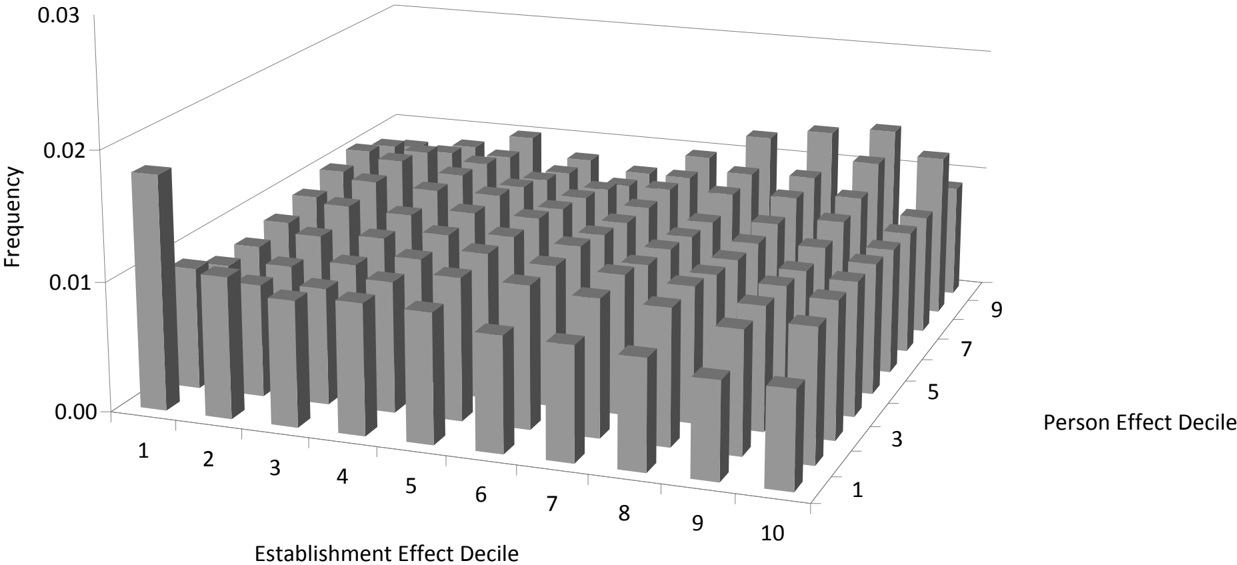
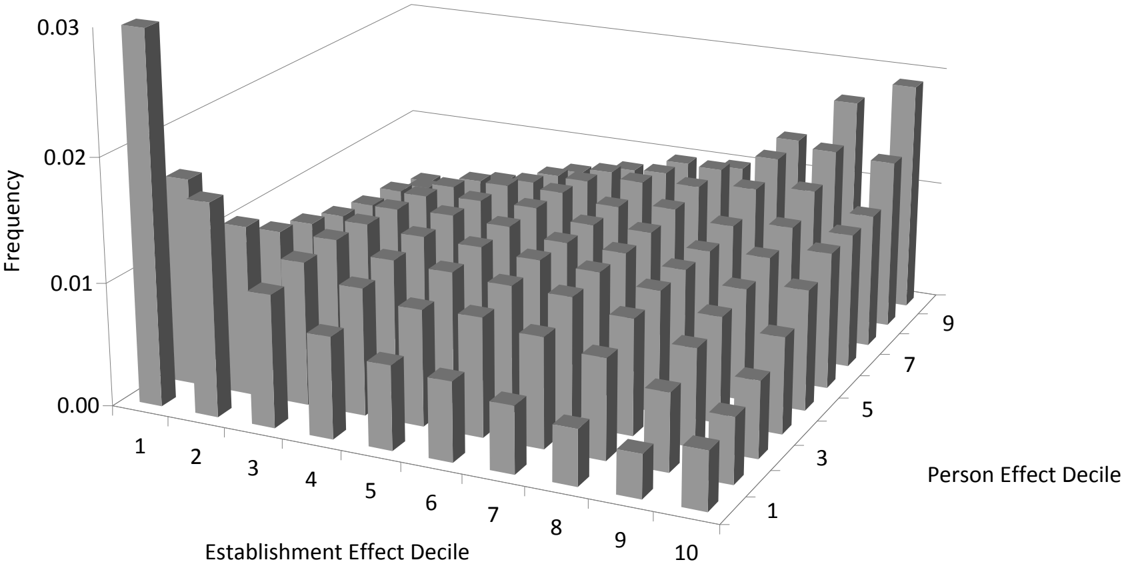
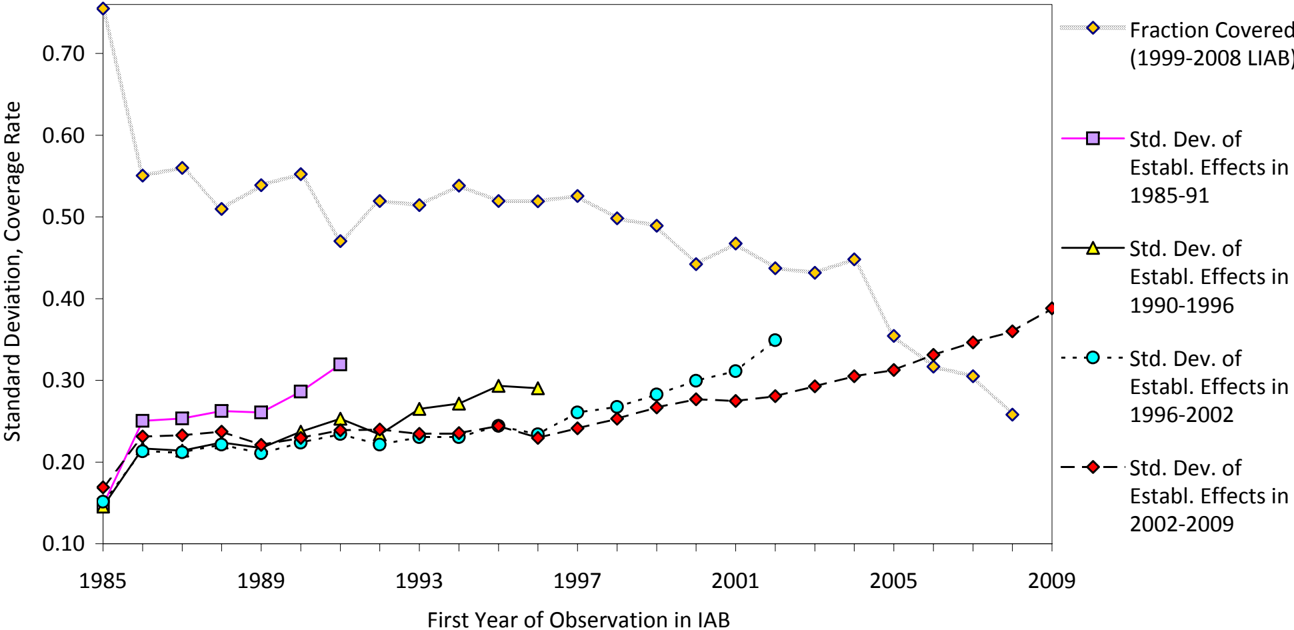
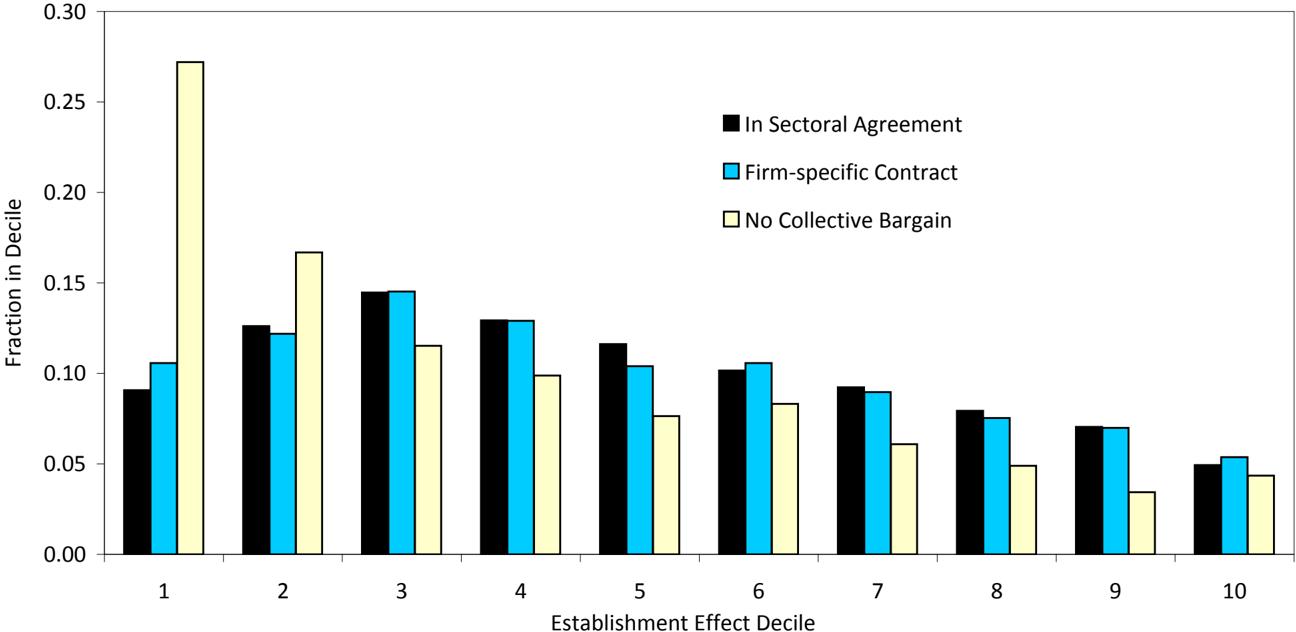
Verification
Claims the paper makes
0 Valid · 0 Not valid · 8 Not checked · 191 Own results and interpretations
A result the paper reports from its own data — it cites no other source for it, so there is none to check. The quote shows it is in the paper.
In the paper
“In particular, generalized non-separable models with xed e/ects for each job yield only a small improvement in explanatory power relative to the AKM speci cation, both within narrow time intervals and between intervals.”
plain- Asserted: passes — The authors put it forward as true.
- Checkable: passes — It can be checked against evidence.
- Load-bearing: passes — The paper’s conclusions depend on it.
- Based: passes — The paper gives a reason why it holds.
A result the paper reports from its own data — it cites no other source for it, so there is none to check. The quote shows it is in the paper.
In the paper
“Classifying establishments by entry year, we nd a trend toward increasing heterogeneity among establishments that entered the labor market after the mid-1990s, coupled with relatively small changes in the variability of the premiums paid by continuing establishments.”
plain- Asserted: passes — The authors put it forward as true.
- Checkable: passes — It can be checked against evidence.
- Load-bearing: passes — The paper’s conclusions depend on it.
- Based: passes — The paper gives a reason why it holds.
A result the paper reports from its own data — it cites no other source for it, so there is none to check. The quote shows it is in the paper.
In the paper
“We nd that two-thirds of the increase in the pay gap between higher and lower-educated workers is attributable to a widening in the average workplace pay premiums received by di/erent education groups.”
plainstates a cause- Asserted: passes — The authors put it forward as true.
- Checkable: passes — It can be checked against evidence.
- Load-bearing: passes — The paper’s conclusions depend on it.
- Based: passes — The paper gives a reason why it holds.
A result the paper reports from its own data — it cites no other source for it, so there is none to check. The quote shows it is in the paper.
In the paper
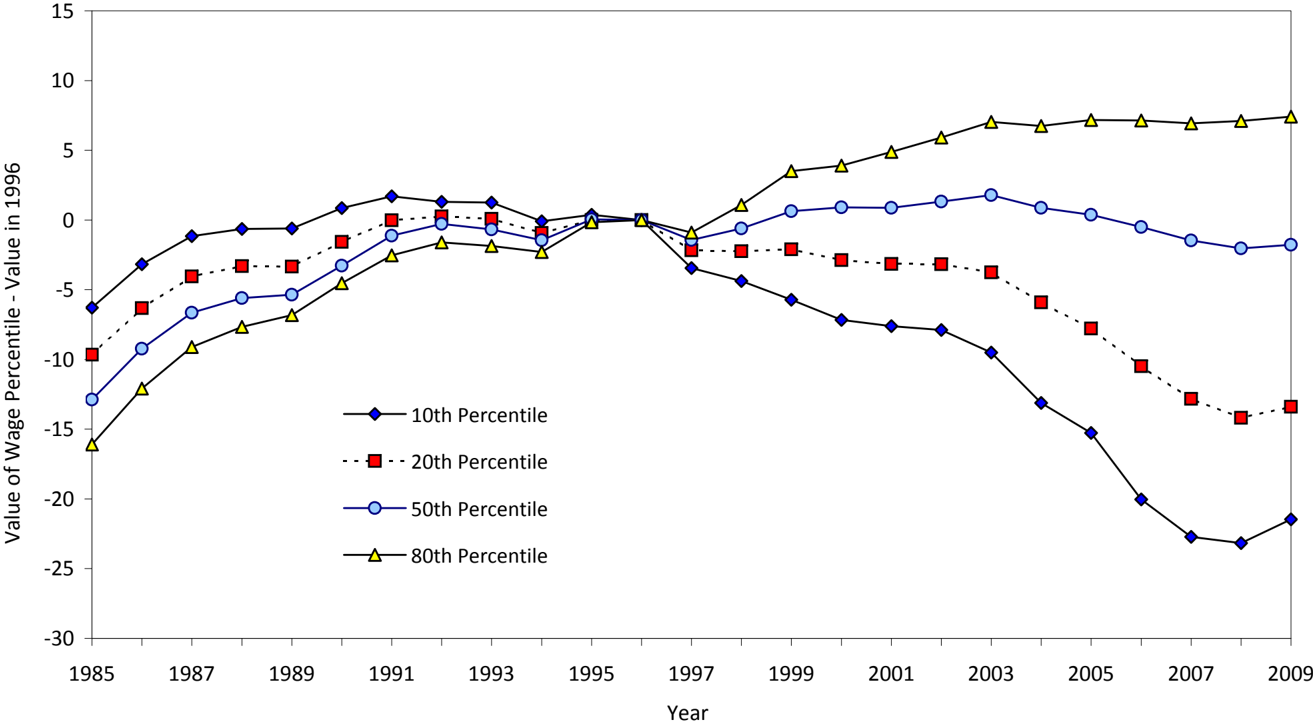
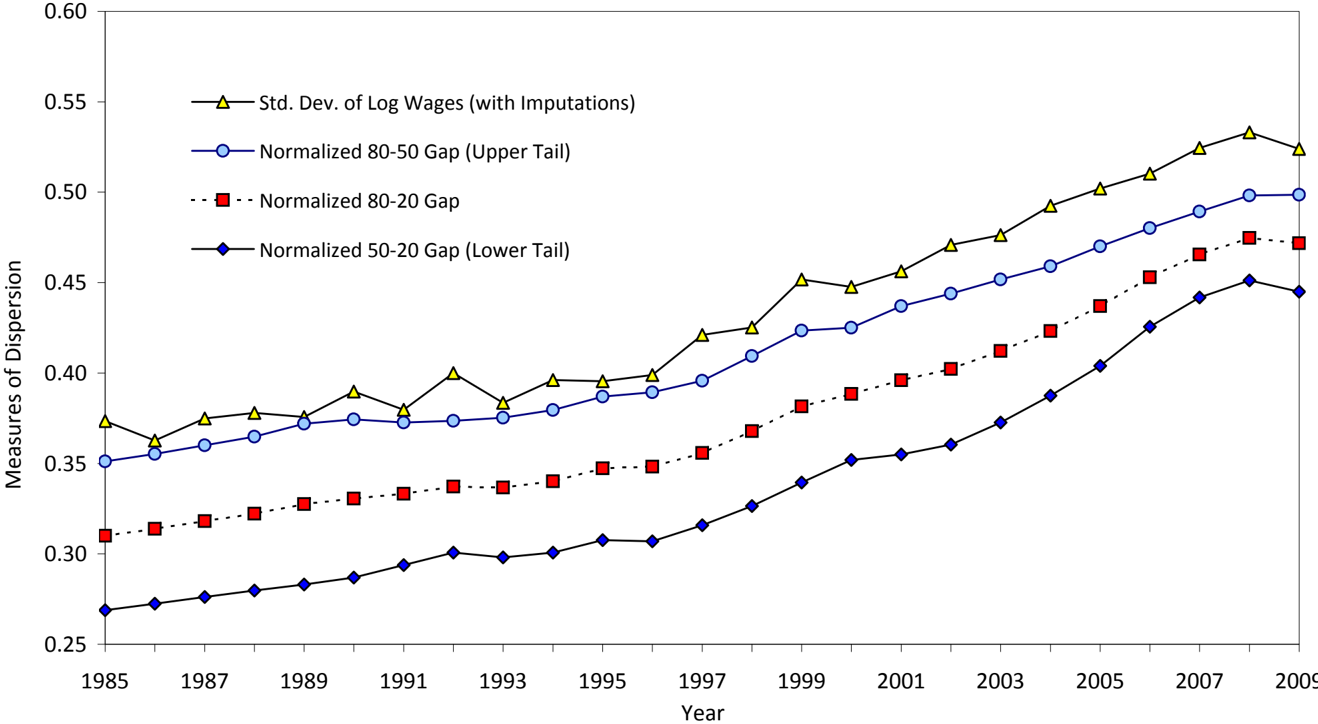
“In particular, the standard deviation rose by 15 log points from 1985 to 2009, the (normalized) 80-20 gap rose by 16 log points, the 80-50 gap rose by 15 log points, and the 50-20 gap rose by 18 log points.”
plain- Asserted: passes — The authors put it forward as true.
- Checkable: passes — It can be checked against evidence.
- Load-bearing: unclear — It is unclear whether the paper’s conclusions depend on it.
- Based: passes — The paper gives a reason why it holds.
118 more claims
Create a free account to see all 199 claims and to verify the 4 references still open.
- It may state two separate claims as one. 61
- Probably not a substantial claim. 17
- The quote only partly states this claim. 3
Claims other papers make about this one
Each is checked against this paper’s own text: does it say what the citing paper says it does?
The check wasn’t confident either way, so it gives no verdict — never disputed.
In the citing paper
“We estimate below that 75% is labor income.16”
From “Capitalists in the Twenty-First Century” (2019) · cites this paper as [16]
Experimental — accuracy not yet measured
Citations
Cites
A heteroskedasticity-consistent covariance matrix estimator and a direct test for heteroskedasticity
White, H. (1980) · Econometrica · doi:10.2307/1912934 · Cited by 25,861
The Skill Content of Recent Technological Change: An Empirical Exploration
Autor, D. H., Levy, F., & Murnane, R. J. (2003) · The Quarterly Journal of Economics · doi:10.1162/003355303322552801 · Cited by 6,205
On the Pooling of Time Series and Cross Section Data
Mundlak, Y. (1978) · Econometrica · doi:10.2307/1913646 · Cited by 5,412
Changes in Relative Wages, 1963-1987: Supply and Demand Factors
Katz, L. F., & Murphy, K. M. (1992) · The Quarterly Journal of Economics · doi:10.2307/2118323 · Cited by 4,793
Equilibrium Unemployment as a Worker Discipline Device
Shapiro, C., & Stiglitz, J. E. (1986) · Efficiency Wage Models of the Labor Market · doi:10.1017/cbo9780511559594.004 · Cited by 4,652
Misallocation and Manufacturing TFP in China and India*
Hsieh, C.-T., & Klenow, P. J. (2009) · Quarterly Journal of Economics · doi:10.1162/qjec.2009.124.4.1403 · Cited by 4,175
Job Creation and Job Destruction in the Theory of Unemployment
Mortensen, D. T., & Pissarides, C. A. (1994) · The Review of Economic Studies · doi:10.2307/2297896 · Cited by 3,840
Hybrid Corn: An Exploration in the Economics of Technological Change
Griliches, Z. (1957) · Econometrica · doi:10.2307/1905380 · Cited by 3,330
Labor Contracts as Partial Gift Exchange
Akerlof, G. A. (1982) · The Quarterly Journal of Economics · doi:10.2307/1885099 · Cited by 3,210
Plants and Productivity in International Trade
Bernard, A. B., Eaton, J., Jensen, J. B., & Kortum, S. (2003) · American Economic Review · doi:10.1257/000282803769206296 · Cited by 2,980
Research works printed but not linked: 1
- 70. Rees, Albert and George Schultz. 1970. Workers in an Urban Labor Market. Chicago: University of Chicago Press.
Cited by
Items 301–400 of 1,904
Team Players: How Social Skills Improve Group Performance
Weidmann, B., & Deming, D. J. (2020) · National Bureau of Economic Research · doi:10.3386/w27071 · Cited by 43
Earnings Inequality and the Minimum Wage: Evidence from Brazil
Engbom, N., & Moser, C. (2021) · National Bureau of Economic Research · doi:10.3386/w28831 · Cited by 45
Political Bias in the Media. Evidence from the Universe of French Broadcasts, 2002-2020Preprint
Cagé, J., Hengel, M., Hervé, N., & Urvoy, C. (2022) · SSRN Electronic Journal · doi:10.2139/ssrn.4036211 · Cited by 43
Collective Bargaining, Unions, and the Wage Structure: An International Perspective
Jäger, S., Naidu, S., & Schoefer, B. (2024) · National Bureau of Economic Research · doi:10.3386/w33267 · Cited by 44
Place-based policies – How to do them and why
Suedekum, J. (2024) · Global challenges & regional science. · doi:10.1016/j.gcrs.2024.100003 · Cited by 42
International Trade and Income Inequality*
Furusawa, T., Konishi, H., & Duong, T. L. A. (2019) · Scandinavian Journal of Economics · doi:10.1111/sjoe.12360 · Cited by 42
Is Education Consumption or Investment? Implications for School Competition
MacLeod, W. B., & Urquiola, M. (2019) · Annual Review of Economics · doi:10.1146/annurev-economics-080218-030402 · Cited by 43
The Gender Gap in Earnings Losses after Job Displacement
Illing, H., Schmieder, J. F., & Trenkle, S. (2021) · National Bureau of Economic Research · doi:10.3386/w29251 · Cited by 43
Lohnungleichheit – Gibt es eine Trendwende?
Möller, J. (2016) · Wirtschaftsdienst · doi:10.1007/s10273-016-1949-5 · Cited by 41
Per capita income and the demand for skills
Caron, J., Fally, T., & Markusen, J. R. (2020) · Journal of International Economics · doi:10.1016/j.jinteco.2020.103306 · Cited by 42
The 2011 break in the part-time indicator and the evolution of wage inequality in Germany
Fitzenberger, B., & Seidlitz, A. (2020) · Journal for Labour Market Research · doi:10.1186/s12651-019-0265-0 · Cited by 42
Firm Dynamics and Residual Inequality in Open Economies
Felbermayr, G. J., Impullitti, G., & Prat, J. (2018) · Journal of the European Economic Association · doi:10.1093/jeea/jvx049 · Cited by 43
Wage cyclicality: Evidence from Spain using social security data
la Roca, J. D. (2014) · SERIEs · doi:10.1007/s13209-014-0111-0 · Cited by 41
How Responsive are Wages to Demand within the Firm? Evidence from Idiosyncratic Export Demand ShocksPreprint
Garin, A., & Silvério, F. (2018) · RePEc: Research Papers in Economics · Cited by 41
Is Parental Leave Costly for Firms and Coworkers?
Brenøe, A., Canaan, S., Harmon, N., & Royer, H. (2020) · National Bureau of Economic Research · doi:10.3386/w26622 · Cited by 41
Flabbi, L., Macis, M., Moro, A., & Schivardi, F. (2016) · National Bureau of Economic Research · doi:10.3386/w22877 · Cited by 43
The effects of equal pay laws on firm pay premiums: Evidence from Chile
Cruz, G., & Rau, T. (2022) · Labour Economics · doi:10.1016/j.labeco.2022.102135 · Cited by 40
Decline In Wage Inequality In Brazil : A Survey
FIRPO, S. P., & Portella, A. L. (2019) · World Bank, Washington, DC eBooks · doi:10.1596/1813-9450-9096 · Cited by 41
Bargaining and the Gender Wage Gap: A Direct AssessmentPreprint
Card, D., Cardoso, A. R., & Kline, P. (2013) · SSRN Electronic Journal · doi:10.2139/ssrn.2325850 · Cited by 43
Self-citationThe Gender Pay Gap: Micro Sources and Macro Consequences
Morchio, I., & Moser, C. (2024) · National Bureau of Economic Research · doi:10.3386/w32408 · Cited by 41
Engbom, N., & Moser, C. (2017) · American Economic Review · doi:10.1257/aer.p20171013 · Cited by 39
Fachkräftemangel in der Gesamtperspektive
Bonin, H. (2019) · Springer eBooks · doi:10.1007/978-3-662-58935-9_4 · Cited by 39
Labor Market Polarization, Job Tasks, and Monopsony Power
Bachmann, R., Demir, G., & Frings, H. (2021) · The Journal of Human Resources · doi:10.3368/jhr.monopsony.0219-10011r1 · Cited by 40
Motivating gig workers – evidence from a field experiment
Butschek, S., Amor, R. G., Kampkötter, P., & Sliwka, D. (2021) · Labour Economics · doi:10.1016/j.labeco.2021.102105 · Cited by 41
Worker Beliefs About Outside OptionsPreprint
Jäger, S., Roth, C., Roussille, N., & Schoefer, B. (2022) · SSRN Electronic Journal · doi:10.2139/ssrn.3998796 · Cited by 39
Valuing Labor Market Power: the Role of Productivity AdvantagesPreprint
Seegmiller, B. (2023) · SSRN Electronic Journal · doi:10.2139/ssrn.4412667 · Cited by 39
Kline, P. (2024) · Handbook of labour economics · doi:10.1016/bs.heslab.2024.11.005 · Cited by 38
Self-citationHigh wage workers and high wage peers
Battisti, M. (2017) · Labour Economics · doi:10.1016/j.labeco.2017.02.002 · Cited by 39
Adoption and learning across hospitals: The case of a revenue-generating practice
Sacarny, A. (2018) · Journal of Health Economics · doi:10.1016/j.jhealeco.2018.06.005 · Cited by 38
Firms and wage inequality in Central and Eastern Europe
Magda, I., Gromadzki, J., & Moriconi, S. (2020) · Journal of Comparative Economics · doi:10.1016/j.jce.2020.08.002 · Cited by 38
Cross-border acquisitions and employment policies
Liang, H., Renneboog, L. D. R., & Vansteenkiste, C. (2020) · Journal of Corporate Finance · doi:10.1016/j.jcorpfin.2020.101575 · Cited by 38
Income inequality in the knowledge economy
Antonelli, C., & Tubiana, M. (2020) · Structural Change and Economic Dynamics · doi:10.1016/j.strueco.2020.07.003 · Cited by 38
Gender differences in the skill content of jobs
Pető, R., & Reizer, B. (2021) · Journal of Population Economics · doi:10.1007/s00148-021-00825-6 · Cited by 39
Selecting Top Bureaucrats: Admission Exams and Performance in Brazil
Dahis, R., Schiavon, L., & Scot, T. (2020) · The Review of Economics and Statistics · doi:10.1162/rest_a_01311 · Cited by 38
Does ICT Usage Erode Routine Occupations at the Firm Level?
Böckerman, P., Laaksonen, S., & Vainiomäki, J. (2018) · Labour · doi:10.1111/labr.12137 · Cited by 39
Dauth, W., Findeisen, S., Moretti, E., & Suedekum, J. (2018) · National Bureau of Economic Research · doi:10.3386/w25227 · Cited by 38
Heterogeneous Passthrough from TFP to Wages
Chan, M., Salgado, S. A., & Xu, M. (2020) · Journal of Labor Economics · doi:10.2139/ssrn.3538503 · Cited by 38
Mas, A., & Pallais, A. (2020) · National Bureau of Economic Research · doi:10.3386/w26605 · Cited by 39
Do Recessions Accelerate Routine-Biased Technological Change? Evidence from Vacancy Postings
Hershbein, B. J., & Kahn, L. (2016) · Upjohn Research (W.E. Upjohn Institute for Employment Research) · doi:10.17848/wp16-254 · Cited by 41
Card, D., Rothstein, J., & Yi, M. (2023) · National Bureau of Economic Research · doi:10.3386/w31587 · Cited by 38
Self-citationEarnings inequality and workers’ skills in Italy
Franzini, M., & Raitano, M. (2019) · Structural Change and Economic Dynamics · doi:10.1016/j.strueco.2019.09.004 · Cited by 38
Public Economics and Inequality: Uncovering Our Social Nature
Saez, E. (2021) · AEA Papers and Proceedings · doi:10.1257/pandp.20211098 · Cited by 38
AKM Effects for German Labour Market Data from 1985 to 2021
Lochner, B., Wolter, S., & Seth, S. (2023) · Jahrbücher für Nationalökonomie und Statistik · doi:10.1515/jbnst-2023-0018 · Cited by 37
Wage mobility in East and West Germany
Riphahn, R. T., & Schnitzlein, D. D. (2016) · Labour Economics · doi:10.1016/j.labeco.2016.01.003 · Cited by 38
Declining Migration Within the US: The Role of the Labor Market
Molloy, R. S., Smith, C. L., & Wozniak, A. K. (2013) · Finance and Economics Discussion Series · doi:10.17016/feds.2013.27 · Cited by 37
Augmenting the Human Capital Earnings Equation with Measures of Where People Work
Barth, E., Davis, J. C., & Freeman, R. B. (2017) · Journal of Labor Economics · doi:10.1086/694187 · Cited by 37
Economy 4.0 – Digitalisation and Its Effect on Wage Inequality
Mönnig, A., Maier, T., & Zika, G. (2019) · Jahrbücher für Nationalökonomie und Statistik · doi:10.1515/jbnst-2017-0151 · Cited by 37
Credit Supply, Firms, and Earnings InequalityPreprint
Moser, C., Saidi, F., Wirth, B., & Wolter, S. (2020) · SSRN Electronic Journal · doi:10.2139/ssrn.3597181 · Cited by 37
Do Recessions Accelerate Routine-Biased Technological Change? Evidence from Vacancy Postings
Hershbein, B. J., & Kahn, L. (2016) · National Bureau of Economic Research · doi:10.3386/w22762 · Cited by 38
Falck, O., Heimisch, A., & Wiederhold, S. (2016) · OECD education working papers · doi:10.1787/5jlzfl2p5rzq-en · Cited by 38
Firms and Unemployment Insurance Take-up
Lachowska, M., Sorkin, I., & Woodbury, S. A. (2022) · National Bureau of Economic Research · doi:10.3386/w30266 · Cited by 37
The Anatomy of Sorting—Evidence From Danish Data
Lentz, R., Piyapromdee, S., & Robin, J. (2023) · Econometrica · doi:10.3982/ecta16425 · Cited by 38
Xie, E., Xu, M., & Yu, M. (2024) · Journal of Development Economics · doi:10.1016/j.jdeveco.2024.103353 · Cited by 36
Econometric analysis of bipartite networks
Bonhomme, S. (2020) · Elsevier eBooks · doi:10.1016/b978-0-12-811771-2.00011-0 · Cited by 37
The effect of pension reforms on old-age income inequality
Etgeton, S. (2018) · Labour Economics · doi:10.1016/j.labeco.2018.05.006 · Cited by 38
The Arrival of Fast Internet and Employment in Africa
Hjort, J., & Poulsen, J. (2017) · National Bureau of Economic Research · doi:10.3386/w23582 · Cited by 36
Immigrant–native pay gap driven by lack of access to high-paying jobs
Hermansen, A. S., Penner, A. M., Boza, I., Elvira, M. M., Godechot, O., Hällsten, M., Henriksen, L. F., Hou, F., Lippényi, Z., Petersen, T., et al. (2025) · Nature · doi:10.1038/s41586-025-09259-6 · Cited by 35
Collective bargaining, unions, and the wage structure: an international perspective
Jäger, S., Naidu, S., & Schoefer, B. (2025) · Handbook of labour economics · doi:10.1016/bs.heslab.2025.07.006 · Cited by 36
Firm Pay Policies and the Gender Earnings Gap: The Mediating Role of Marital and Family Status
Li, J., Dostie, B., & Simard‐Duplain, G. (2022) · Industrial and Labor Relations Review · doi:10.1177/00197939221093562 · Cited by 35
Identifying Sorting in Practice
Bartolucci, C., Devicienti, F., & Monzón, I. (2018) · American Economic Journal Applied Economics · doi:10.1257/app.20170068 · Cited by 35
Unequal Use of Social Insurance Benefits: The Role of EmployersPreprint
Bana, S., Bedard, K., Rossin‐Slater, M., & Stearns, J. (2018) · SSRN Electronic Journal · doi:10.1016/j.jeconom.2022.02.008 · Cited by 35
The Heterogeneous Earnings Impact of Job Loss Across Workers, Establishments, and MarketsPreprint
Athey, S. C., Simon, L. K., Skans, O. N., Vikström, J., & Yakymovych, Y. (2023) · arXiv (Cornell University) · doi:10.48550/arxiv.2307.06684 · Cited by 36
Schwartz, H. M. (2021) · Cambridge University Press eBooks · doi:10.1017/9781009029841.009 · Cited by 34
COVID-19 and the labour market: What are the working conditions in critical jobs?
Dütsch, M. (2022) · Journal for Labour Market Research · doi:10.1186/s12651-022-00315-6 · Cited by 34
Lachowska, M., Mas, A., Saggio, R., & Woodbury, S. A. (2023) · Econometrica · doi:10.3982/ecta21849 · Cited by 34
Dissecting Between‐Plant and Within‐Plant Wage Dispersion: Evidence from Germany
Baumgarten, D., Felbermayr, G. J., & Lehwald, S. (2020) · Industrial Relations A Journal of Economy and Society · doi:10.1111/irel.12249 · Cited by 36
Influence and Information in Team Decisions: Evidence from Medical Residency
Chan, D. C. (2021) · American Economic Journal Economic Policy · doi:10.1257/pol.20180501 · Cited by 34
The Human Side of Structural Transformation
Porzio, T., Rossi, F., & Santangelo, G. (2021) · National Bureau of Economic Research · doi:10.3386/w29390 · Cited by 38
Workforce Composition, Productivity and Pay: The Role of Firms in Wage InequalityPreprint
Criscuolo, C., Hijzen, A., Schwellnus, C., Chen, W., Fabling, R. B., Fialho, P., Grabska, K., Kambayashi, R., Leidecker, T., Skans, O. N., et al. (2020) · SSRN Electronic Journal · doi:10.2139/ssrn.3596678 · Cited by 35
The Impact of Privatization of State-Owned Enterprises on Workers
Arnold, D. S. (2022) · American Economic Journal Applied Economics · doi:10.1257/app.20190428 · Cited by 33
Dissecting Idiosyncratic Earnings Risk
Halvorsen, E., Holter, H. A., Ozkan, S., & Storesletten, K. (2023) · Journal of the European Economic Association · doi:10.1093/jeea/jvad047 · Cited by 33
Bruckmeier, K., Peichl, A., Popp, M., Wiemers, J., & Wollmershäuser, T. (2021) · The Journal of Economic Inequality · doi:10.1007/s10888-021-09489-4 · Cited by 33
The Morale Effects of Pay Inequality
Breza, E., Kaur, S., & Shamdasani, Y. (2016) · National Bureau of Economic Research · doi:10.3386/w22491 · Cited by 33
The Firm's Role in Displaced Workers' Earnings Losses
Moore, B., & Scott-Clayton, J. (2019) · National Bureau of Economic Research · doi:10.3386/w26525 · Cited by 33
Kwok, J. (2022) · SSRN Electronic Journal · doi:10.2139/ssrn.4030445 · Cited by 33
Micro versus Macro Labor Supply Elasticities: The Role of Dynamic Returns to Effort
Kleven, H., Kreiner, C., Larsen, K., & Søgaard, J. (2025) · American Economic Review · doi:10.1257/aer.20240554 · Cited by 13
Internal Labor Markets: A Worker Flow Approach
Huitfeldt, I., Kostøl, A., Nimczik, J. S., & Weber, A. M. (2021) · Journal of Econometrics · doi:10.1016/j.jeconom.2021.12.016 · Cited by 33
Keeping Up with “The Joneses”: Reference-Dependent Choice with Social Comparisons
Langtry, A. (2023) · American Economic Journal Microeconomics · doi:10.1257/mic.20220088 · Cited by 32
Employers and Unemployment Insurance Take-Up
Lachowska, M., Sorkin, I., & Woodbury, S. A. (2025) · American Economic Review · doi:10.1257/aer.20230195 · Cited by 32
Correlation bias correction in two‐way fixed‐effects linear regression
Gaure, S. (2014) · Stat · doi:10.1002/sta4.68 · Cited by 33
Does exporting improve matching? Evidence from French employer-employee data
Bombardini, M., Orefice, G., & Tito, M. D. (2018) · Journal of International Economics · doi:10.1016/j.jinteco.2018.11.001 · Cited by 32
Industry Mix, Local Labor Markets, and the Incidence of Trade Shocks
Yi, M., Mueller, S., & Stegmaier, J. (2023) · Journal of Labor Economics · doi:10.1086/724569 · Cited by 32
Supervisors and Performance Management Systems
Frederiksen, A., Kahn, L., & Lange, F. (2017) · National Bureau of Economic Research · doi:10.3386/w23351 · Cited by 32
Employer Policies and the Immigrant-Native Earnings GapPreprint
Dostie, B., Li, J., Card, D., & Parent, D. (2020) · SSRN Electronic Journal · doi:10.2139/ssrn.3592173 · Cited by 35
Self-citationMinkus, L., & Busch-Heizmann, A. (2018) · Social Politics International Studies in Gender State & Society · doi:10.1093/sp/jxy032 · Cited by 31
Employment and Wages over the Business Cycle in Worker‐Owned Firms: Evidence from Spain*
Garcia‐Louzao, J. (2020) · British Journal of Industrial Relations · doi:10.1111/bjir.12559 · Cited by 31
Raising the Bar: Minimum Wages and Employers’ Hiring Standards
Butschek, S. (2022) · American Economic Journal Economic Policy · doi:10.1257/pol.20190534 · Cited by 31
High-Pressure, High-Paying Jobs?
Nagler, M., Rincke, J., & Winkler, E. (2022) · The Review of Economics and Statistics · doi:10.1162/rest_a_01362 · Cited by 31
Sauer, C., Valet, P., & Liebig, S. (2016) · KZfSS Kölner Zeitschrift für Soziologie und Sozialpsychologie · doi:10.1007/s11577-016-0385-2 · Cited by 31
Job-to-job transitions, sorting, and wage growth
Jinkins, D. C., & Morin, A. (2018) · Labour Economics · doi:10.1016/j.labeco.2018.10.008 · Cited by 32
The Speed of Earnings Responses to Taxation and the Role of Firm Labor Demand
Gudgeon, M., & Trenkle, S. (2022) · Journal of Labor Economics · doi:10.1086/723831 · Cited by 31
Herrero, D., & Rial, A. (2022) · Economic Systems Research · doi:10.1080/09535314.2022.2026894 · Cited by 32
Heterogeneity of Skill Needs and Job Complexity: Evidence from the OECD PIAAC SurveyPreprint
Pouliakas, K., & Russo, G. (2015) · SSRN Electronic Journal · doi:10.2139/ssrn.2672178 · Cited by 30
Management Practices and Productivity in GermanyPreprint
Broszeit, S., Fritsch, U., Görg, H., & Laible, M. (2016) · SSRN Electronic Journal · doi:10.2139/ssrn.2872627 · Cited by 32
Peer Effects in the WorkplacePreprint
Cornelißen, T., Dustmann, C., & Schönberg, U. (2013) · SSRN Electronic Journal · doi:10.2139/ssrn.2330320 · Cited by 31
Bilal, A. (2021) · National Bureau of Economic Research · doi:10.3386/w29269 · Cited by 32
Trade and Domestic Distortions: the Case of Informality
Dix-Carneiro, R., Goldberg, P. K., Meghir, C., & Ulyssea, G. (2021) · National Bureau of Economic Research · doi:10.3386/w28391 · Cited by 31
Immigration, Monopsony and the Distribution of Firm PayPreprint
Amior, M., & Stuhler, J. L. (2024) · SSRN Electronic Journal · doi:10.2139/ssrn.4682476 · Cited by 34
The value of specific skills under shock: High risks and high returns
Eggenberger, C., Janssen, S., & Backes-Gellner, U. (2022) · Labour Economics · doi:10.1016/j.labeco.2022.102187 · Cited by 20
Gender Pay Gap Patterns in Domestic and Foreign-Owned Firms
Magda, I., & Sałach, K. (2019) · Empirical Economics · doi:10.2139/ssrn.3415798 · Cited by 30
Metadata
- Authors
- Card, D., Heining, J., & Kline, P.
- Affiliations
- University of California, Berkeley (US)
- Corresponding author
- Kline, Patrick
- ORCID
- Card, David
- Venue
- The Quarterly Journal of Economics
- Publisher
- Oxford University Press (OUP)
- Published
- 2013-05-02
- Volume
- 128
- Issue
- 3
- Pages
- 967-1015
- ISSN
- 0033-5533 (ISSN-L)
- 1531-4650
- OpenAlex
- W2141295263
- Cited by
- 1,904
- References
- 146
- Citations by year
- 2026: 153 · 2025: 204 · 2024: 228 · 2023: 156 · 2022: 185 · 2021: 178 · 2020: 143 · 2019: 125 · 2018: 156 · 2017: 113 · 2016: 105 · 2015: 71 · 2014: 58 · 2013: 22
- FWCI
- 118.40
- Type
- journal article
- Language
- en
- Open access
- closed
- Locations
- The Quarterly Journal of Economics (publishedVersion)
- RePEc: Research Papers in Economics (submittedVersion)
- Econstor (Econstor) (submittedVersion)
- Funders
- Washington Center for Equitable Growth
- Topics
- Social Sciences › Economics, Econometrics and Finance › Economics and Econometrics › Labor market dynamics and wage inequality
- Social Sciences › Economics, Econometrics and Finance › Economics and Econometrics › Historical Economic and Social Studies
- Social Sciences › Sociology and Political Science › Income, Poverty, and Inequality
- Keywords
- wage inequality, job matching, fixed effects model, education and wages
About these checks
Registry, retraction, Cites and statistics results are computed, not judged, with one exception: a printed reference that no index lists is read once by a model before it counts as a citation error. Claims are extracted by a model and kept only when their quote appears verbatim in the text; each cited source is then checked, with a model’s help, for whether it says what the claim relies on. Those verdicts can be wrong — read the claim’s quote and the cited source before relying on one.
A language model drew the claims from the paper on 2026-11-17, under version 3 of the claim definition (model deepseek-v4.1-flash, prompt extract-v3).
A second model labelled each claim on 2026-11-17 (model jev-1.13-20260917, definition revision gold-guideline-v0.2).
Statistics and arithmetic are recomputed, not judged.
Confidence bands are shown only for fields calibrated on our annotated test set. None is calibrated yet, so no band is shown.
What counts as a claim ›How we measure confidence ›How we check this ›
Are you an author, or do you see a problem with this page? Request a review
Data sources
Bibliographic data: Semantic Scholar, OpenAlex, Crossref.
Contains information from the Semantic Scholar Academic Graph Datasets, made available under the ODC Attribution License (ODC-BY 1.0).
Semantic Scholar’s data is described in: Kinney, R., et al. (2023). The Semantic Scholar Open Data Platform. arXiv:2301.10140.
