

Workplace Heterogeneity and the Rise of West German Wage Inequality*
The DOI matches its Crossref record; 144 of the 147 references it cites were found in a registry or an index, and 1 are not checked yet; none of the 8 sources its claims cite is checked for support yet.
Abstract
We study the role of establishment-specific wage premiums in generating recent increases in West German wage inequality. Models with additive fixed effects for workers and establishments are fit into four subintervals spanning the period from 1985 to 2009. We show that these models provide a good approximation to the wage structure and can explain nearly all of the dramatic rise in West German wage inequality. Our estimates suggest that the increasing dispersion of West German wages has arisen from a combination of rising heterogeneity between workers, rising dispersion in the wage premiums at different establishments, and increasing assortativeness in the assignment of workers to plants. In contrast, the idiosyncratic job-match component of wage variation is small and stable over time. Decomposing changes in mean wages between different education groups, occupations, and industries, we find that increasing plant-level heterogeneity and rising assortativeness in the assignment of workers to establishments explain a large share of the rise in inequality along all three dimensions.
Checked 2026-11-19 · 1 reference not checked yet
Overview
CoChat Summary
TL;DR
Using West German administrative data from 1985–2009, the paper shows that models with additive person and establishment fixed effects explain nearly all of the rise in wage inequality. The increase is driven by rising worker-effect variance, rising establishment-premium variance, and increased assortative matching of high-wage workers to high-wage plants.
Key findings
- In the AKM variance decomposition, total log-wage variance rose from 0.137 in interval 1 (1985–1991) to 0.249 in interval 4 (2002–2009). The variance of person effects rose from 0.084 to 0.127 and contributed 39% of the total rise; establishment-effect variance rose from 0.025 to 0.053 and contributed 25%; the covariance term rose from 0.003 to 0.041 and contributed 34%.
- Assortative matching increased: the correlation between person and establishment effects rose from 0.034 in interval 1 to 0.249 in interval 4. Counterfactuals imply that holding sorting constant would have produced 69% of the actual variance rise, while holding establishment-effect variance constant would have produced 64%.
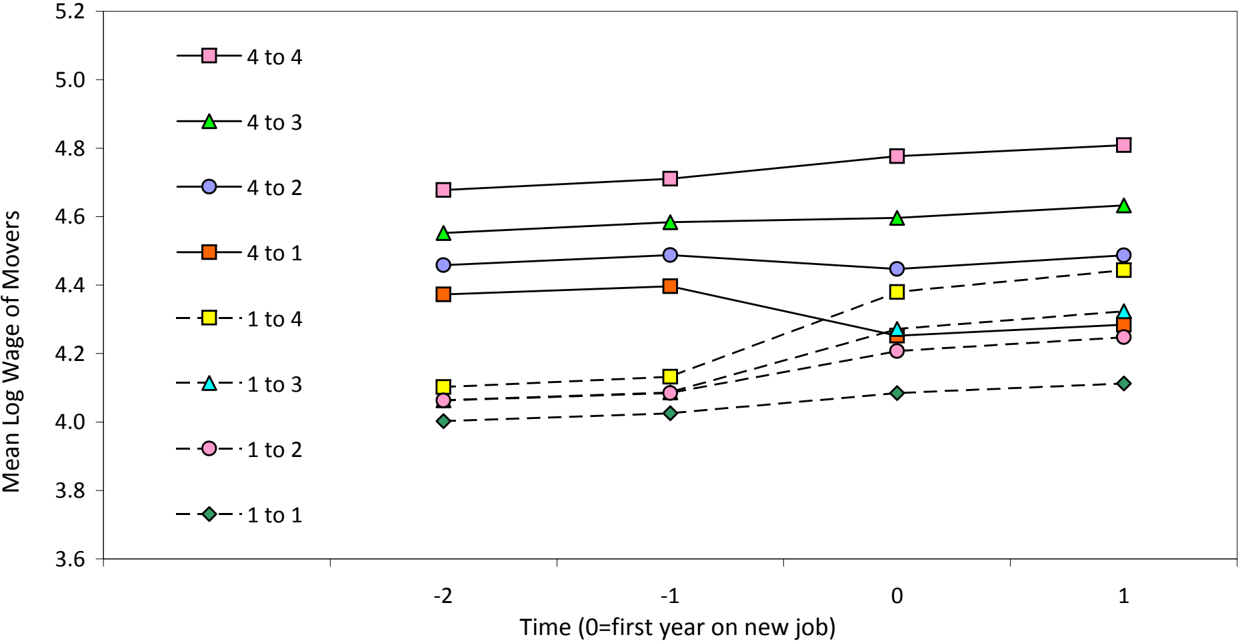
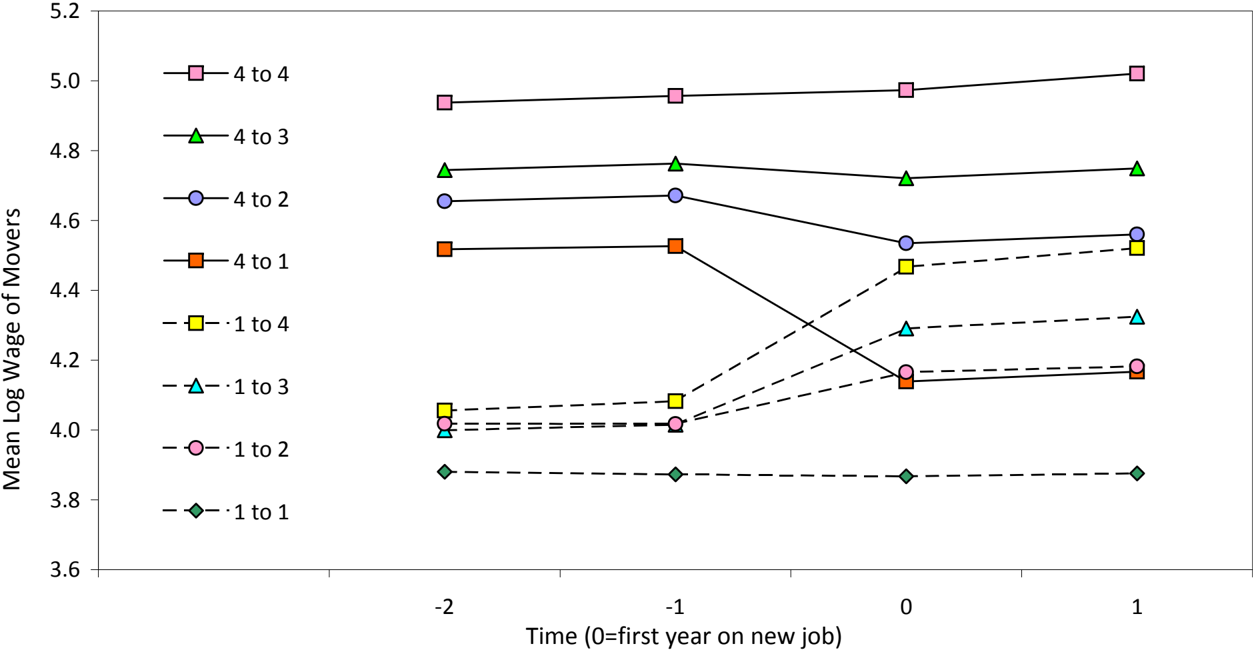
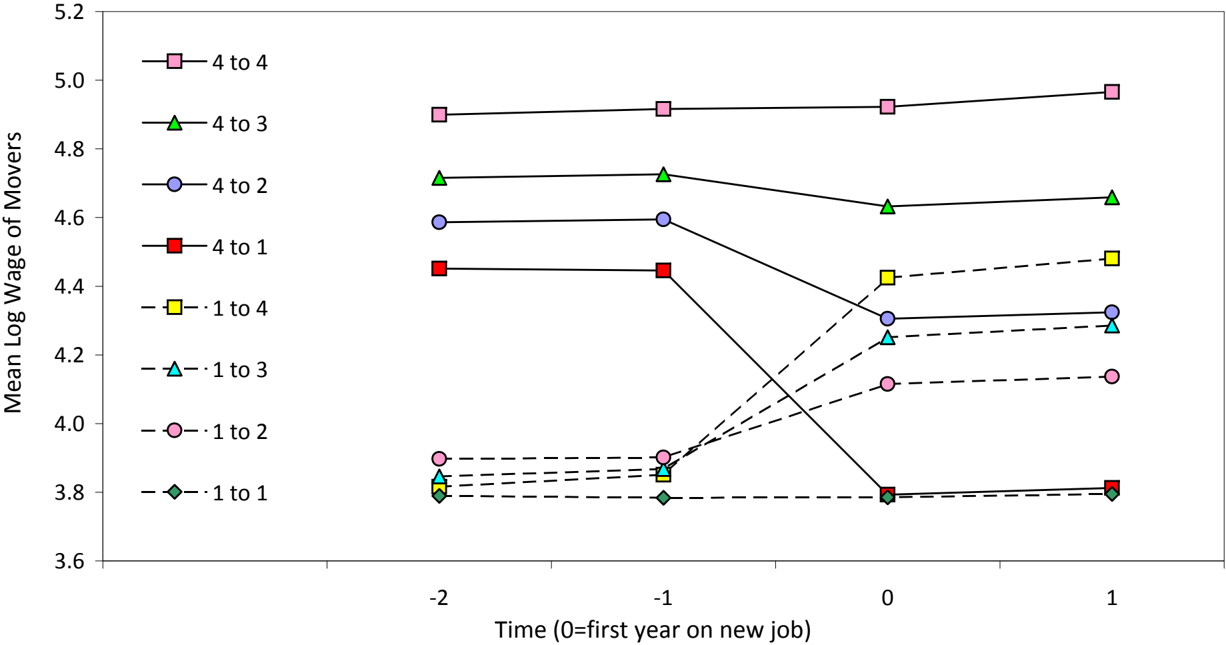
- Job-mobility event studies show growing establishment premia: a trend-adjusted move from quartile 1 to quartile 4 co-worker-wage establishments was associated with a 23 log-point gain in 1985–1991 versus 47 log points in 2002–2009; the reverse move yielded losses of 22 versus 43 log points.
- Between-group decompositions attribute 70% of the relative rise in university-educated men’s wages and 80% of the relative fall for workers with no/missing qualifications to establishment effects. For occupations, 42% of the rise in between-occupation variance is from person–establishment covariance, 28% from establishment variance, and about 30% from person variance; for industries, 44% is person variance, 19% establishment variance, and 42% sorting.
Methods
- Data: German Social Security records from the IEB, focusing on full-time West German men age 20–60 from 1985–2009, with parallel analyses for full-time women. The main sample has 85–90 million person-year observations per interval and about 17 million individual workers.
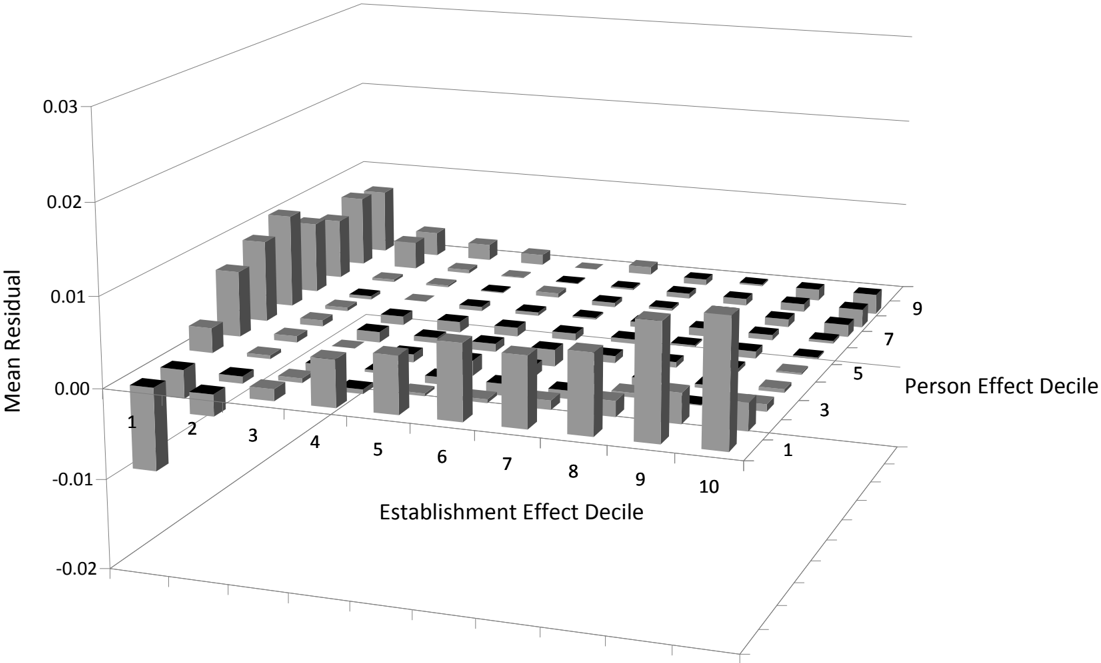
- Model: AKM-style log daily wage equation with additive person fixed effects, establishment fixed effects, time-varying covariates, and an error component; estimated by OLS on the largest connected set of establishments linked by worker mobility. Censored earnings are imputed using Tobit models.
- Analyses: variance decompositions and counterfactuals across four overlapping intervals (1985–1991, 1990–1996, 1996–2002, 2002–2009); event studies of job changers; decompositions of between-group wage gaps by education, occupation, and industry; and establishment cohort/collective-bargaining analyses.
Limitations
- The paper states that earnings are censored at the Social Security maximum (10–12% of male observations and 1–3% of female observations per year), so it uses Tobit imputation and checks robustness using apprentice-trained men, who have lower censoring rates.
- The paper states that establishment identifiers are administrative: ownership changes can create new establishment IDs, and only about half of EID births/deaths are estimated to be true plant openings/closings. It also states that sampling errors bias estimated variances upward and the covariance downward, and it does not construct bias-corrected estimates, assuming biases are similar across intervals.
- The paper states that collective bargaining cannot be assigned a causal role because firms choose coverage, and that female estimates may have more negatively biased covariance terms due to fewer observed matches per plant/worker. Evident from the text: the main analysis is restricted to full-time workers in West Germany, excluding civil servants, self-employed, and many part-time/mini-job workers, which limits generalizability.
Model-written summary. Check it against the paper before relying on it.
Integrity signals
Registry
Cites
Statistics
Figures


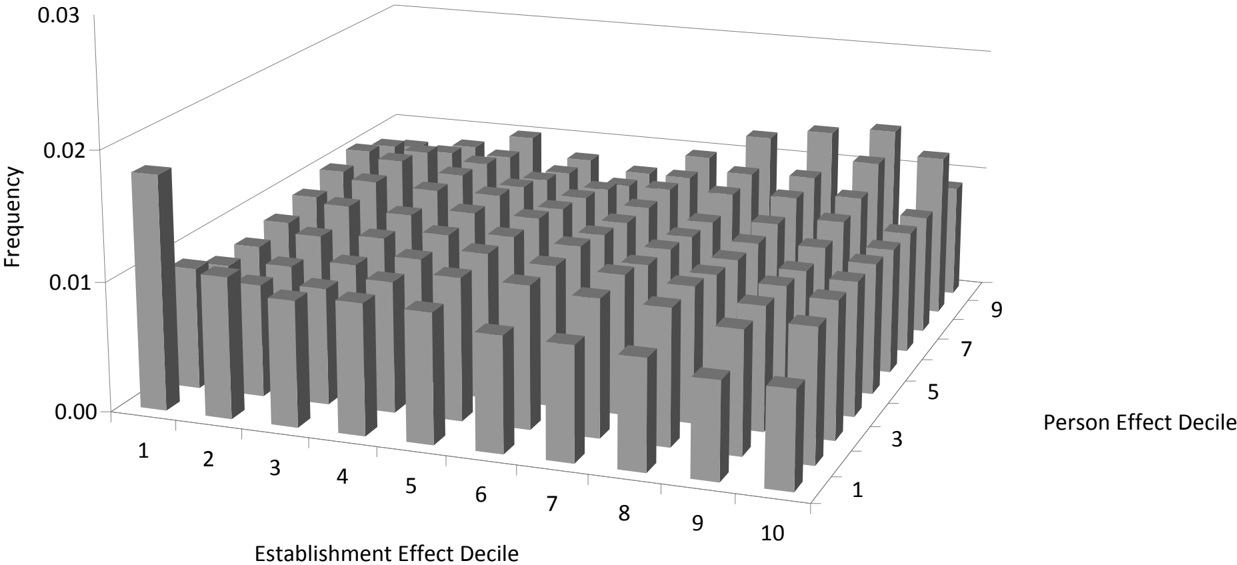
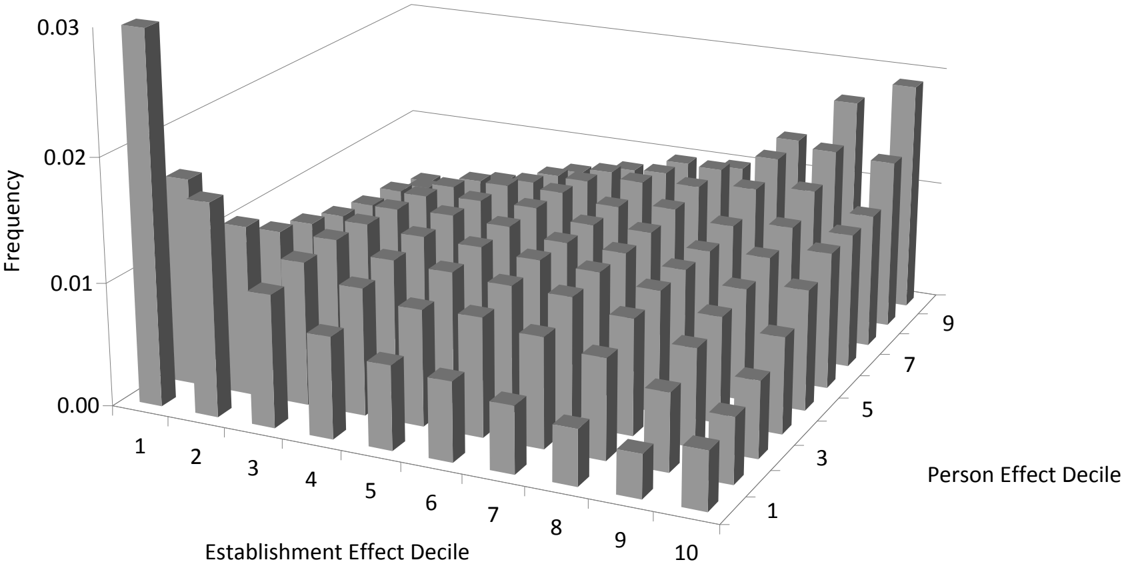
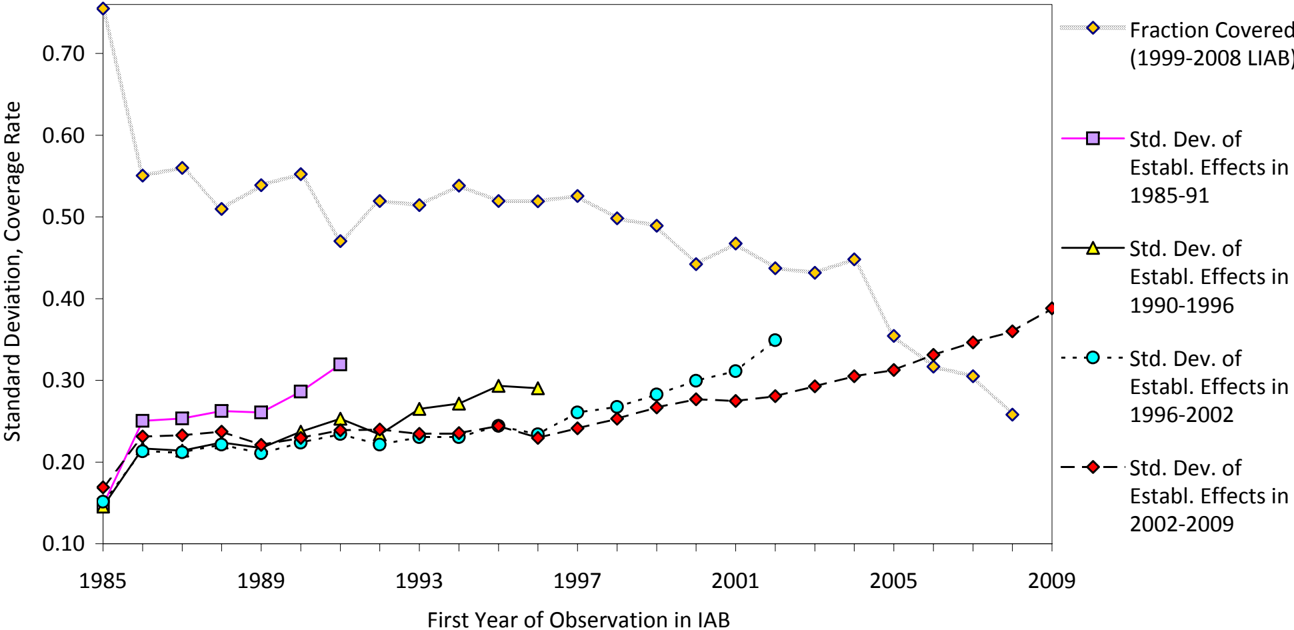
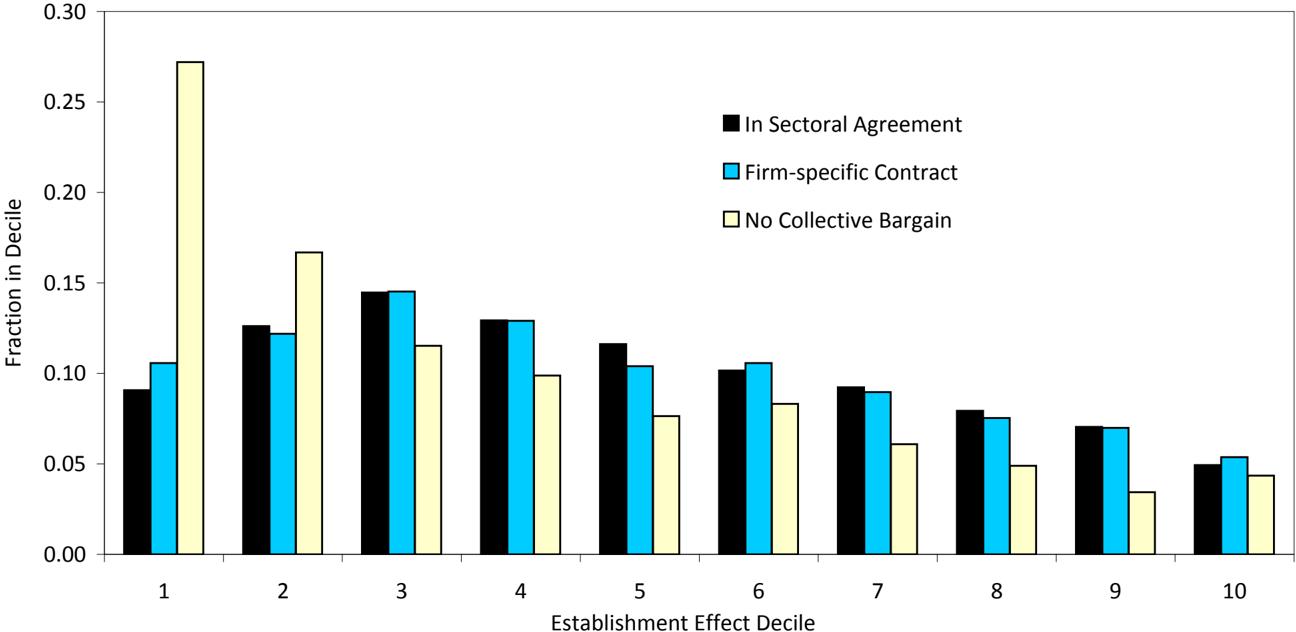
Verification
Claims the paper makes
0 Valid · 0 Not valid · 8 Not checked · 191 Own results and interpretations
A result the paper reports from its own data — it cites no other source for it, so there is none to check. The quote shows it is in the paper.
In the paper
“In particular, generalized non-separable models with xed e/ects for each job yield only a small improvement in explanatory power relative to the AKM speci cation, both within narrow time intervals and between intervals.”
plain- Asserted: passes — The authors put it forward as true.
- Checkable: passes — It can be checked against evidence.
- Load-bearing: passes — The paper’s conclusions depend on it.
- Based: passes — The paper gives a reason why it holds.
A result the paper reports from its own data — it cites no other source for it, so there is none to check. The quote shows it is in the paper.
In the paper
“Classifying establishments by entry year, we nd a trend toward increasing heterogeneity among establishments that entered the labor market after the mid-1990s, coupled with relatively small changes in the variability of the premiums paid by continuing establishments.”
plain- Asserted: passes — The authors put it forward as true.
- Checkable: passes — It can be checked against evidence.
- Load-bearing: passes — The paper’s conclusions depend on it.
- Based: passes — The paper gives a reason why it holds.
A result the paper reports from its own data — it cites no other source for it, so there is none to check. The quote shows it is in the paper.
In the paper
“We nd that two-thirds of the increase in the pay gap between higher and lower-educated workers is attributable to a widening in the average workplace pay premiums received by di/erent education groups.”
plainstates a cause- Asserted: passes — The authors put it forward as true.
- Checkable: passes — It can be checked against evidence.
- Load-bearing: passes — The paper’s conclusions depend on it.
- Based: passes — The paper gives a reason why it holds.
A result the paper reports from its own data — it cites no other source for it, so there is none to check. The quote shows it is in the paper.
In the paper
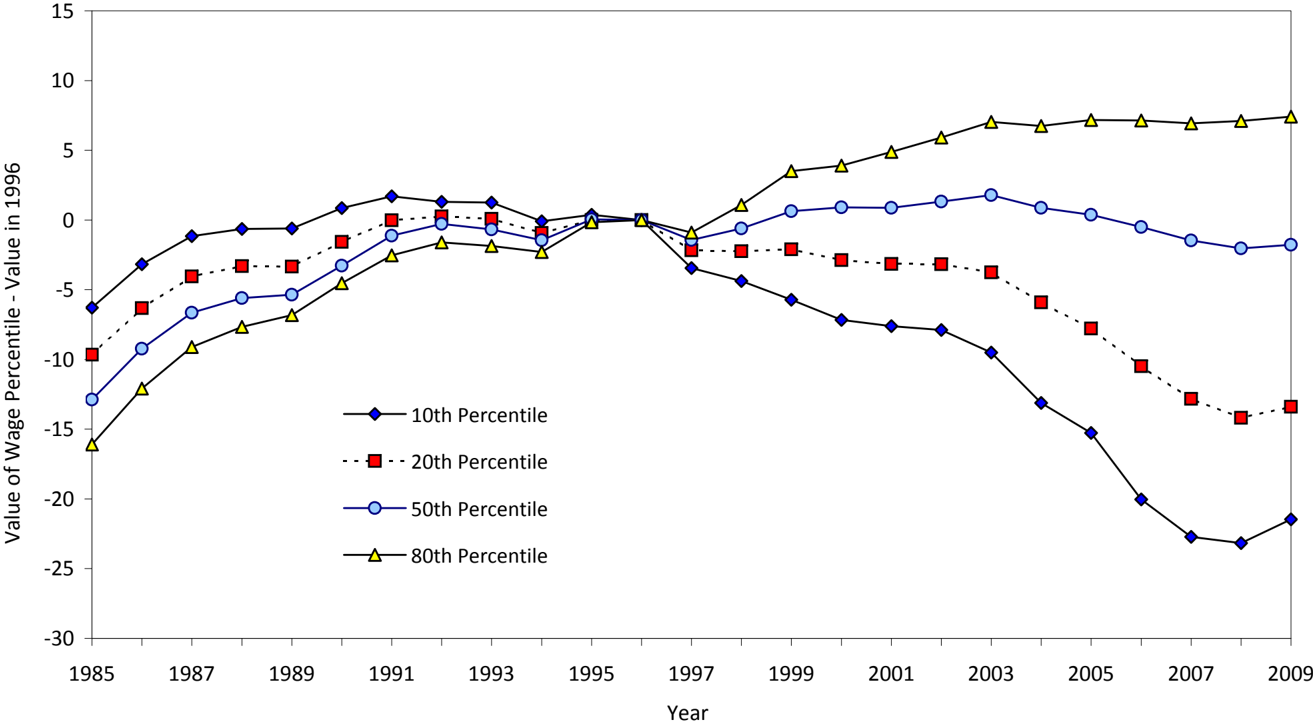
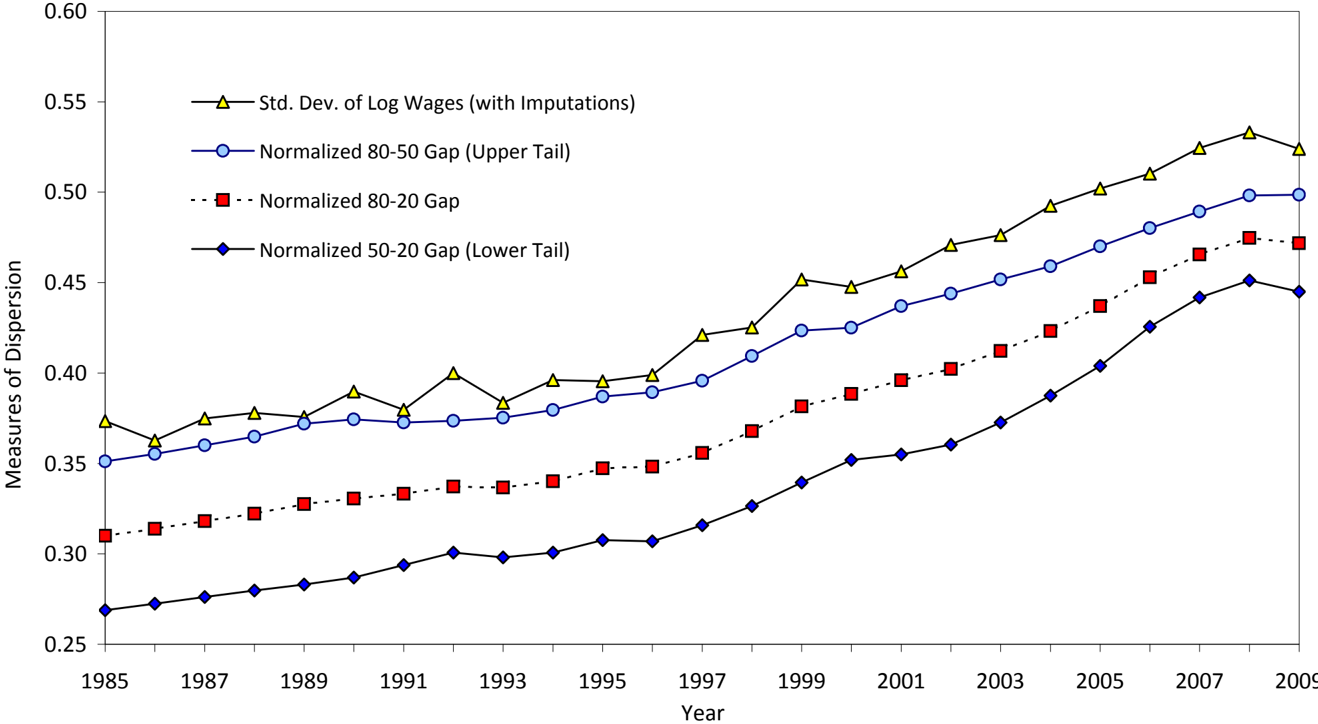
“In particular, the standard deviation rose by 15 log points from 1985 to 2009, the (normalized) 80-20 gap rose by 16 log points, the 80-50 gap rose by 15 log points, and the 50-20 gap rose by 18 log points.”
plain- Asserted: passes — The authors put it forward as true.
- Checkable: passes — It can be checked against evidence.
- Load-bearing: unclear — It is unclear whether the paper’s conclusions depend on it.
- Based: passes — The paper gives a reason why it holds.
118 more claims
Create a free account to see all 199 claims and to verify the 4 references still open.
- It may state two separate claims as one. 61
- Probably not a substantial claim. 17
- The quote only partly states this claim. 3
Claims other papers make about this one
Each is checked against this paper’s own text: does it say what the citing paper says it does?
The check wasn’t confident either way, so it gives no verdict — never disputed.
In the citing paper
“We estimate below that 75% is labor income.16”
From “Capitalists in the Twenty-First Century” (2019) · cites this paper as [16]
Experimental — accuracy not yet measured
Citations
Cites
A heteroskedasticity-consistent covariance matrix estimator and a direct test for heteroskedasticity
White, H. (1980) · Econometrica · doi:10.2307/1912934 · Cited by 25,861
The Skill Content of Recent Technological Change: An Empirical Exploration
Autor, D. H., Levy, F., & Murnane, R. J. (2003) · The Quarterly Journal of Economics · doi:10.1162/003355303322552801 · Cited by 6,205
On the Pooling of Time Series and Cross Section Data
Mundlak, Y. (1978) · Econometrica · doi:10.2307/1913646 · Cited by 5,412
Changes in Relative Wages, 1963-1987: Supply and Demand Factors
Katz, L. F., & Murphy, K. M. (1992) · The Quarterly Journal of Economics · doi:10.2307/2118323 · Cited by 4,793
Equilibrium Unemployment as a Worker Discipline Device
Shapiro, C., & Stiglitz, J. E. (1986) · Efficiency Wage Models of the Labor Market · doi:10.1017/cbo9780511559594.004 · Cited by 4,652
Misallocation and Manufacturing TFP in China and India*
Hsieh, C.-T., & Klenow, P. J. (2009) · Quarterly Journal of Economics · doi:10.1162/qjec.2009.124.4.1403 · Cited by 4,175
Job Creation and Job Destruction in the Theory of Unemployment
Mortensen, D. T., & Pissarides, C. A. (1994) · The Review of Economic Studies · doi:10.2307/2297896 · Cited by 3,840
Hybrid Corn: An Exploration in the Economics of Technological Change
Griliches, Z. (1957) · Econometrica · doi:10.2307/1905380 · Cited by 3,330
Labor Contracts as Partial Gift Exchange
Akerlof, G. A. (1982) · The Quarterly Journal of Economics · doi:10.2307/1885099 · Cited by 3,210
Plants and Productivity in International Trade
Bernard, A. B., Eaton, J., Jensen, J. B., & Kortum, S. (2003) · American Economic Review · doi:10.1257/000282803769206296 · Cited by 2,980
Research works printed but not linked: 1
- 70. Rees, Albert and George Schultz. 1970. Workers in an Urban Labor Market. Chicago: University of Chicago Press.
Cited by
Items 701–800 of 1,904
Trade Diversion and Labor Market OutcomesPreprint
Chen, N., Novy, D., & Solórzano, D. (2025) · SSRN Electronic Journal · doi:10.2139/ssrn.5323778 · Cited by 12
How are Wages Determined? A Quasi-Experimental Test of Wage Determination Theories *
Carvalho, M., da Fonseca, J. G., & Santarrosa, R. (2023) · Papyrus : Institutional Repository (Université de Montréal) · doi:10.13140/rg.2.2.36348.10885 · Cited by 12
Sorting in the U.S. Corporate Executive Labor MarketPreprint
Matveyev, E. (2014) · SSRN Electronic Journal · doi:10.2139/ssrn.2482732 · Cited by 12
Rising concentration and wage inequality
Cortés, G. M., & Tschopp, J. (2024) · Scandinavian Journal of Economics · doi:10.1111/sjoe.12547 · Cited by 12
Size of training firms – the role of firms, luck, and ability in young workers’ careers
Müller, S., & Neubaeumer, R. (2018) · International Journal of Manpower · doi:10.1108/ijm-07-2016-0155 · Cited by 11
Bossler, M., & Popp, M. (2026) · Industrial and Labor Relations Review · doi:10.1177/00197939261435961 · Cited by 11
The dynamics of wage dispersion between firms: the role of firm entry and exit
Schröpf, B. (2023) · Journal for Labour Market Research · doi:10.1186/s12651-022-00326-3 · Cited by 11
Nogueira, M. C., & Madaleno, M. (2023) · Economies · doi:10.3390/economies11040115 · Cited by 11
The Slow Diffusion of Earnings Inequality
Sorkin, I., & Wallskog, M. (2023) · Journal of Labor Economics · doi:10.1086/726635 · Cited by 11
Organizational Capital, Skills and Productivity
Cammeraat, E., Samek, L., & Squicciarini, M. (2024) · Review of Income and Wealth · doi:10.1111/roiw.12663 · Cited by 12
Managers’ Productivity and Recruitment in the Public Sector
Muñoz, P., & Prem, M. (2024) · American Economic Journal Economic Policy · doi:10.1257/pol.20220732 · Cited by 13
What Do Managers Do? An Economist's Perspective
Benson, A. M., & Shaw, K. L. (2025) · Annual Review of Economics · doi:10.1146/annurev-economics-082222-073303 · Cited by 12
Performance pay, trade and inequality
Pupato, G. (2017) · Journal of Economic Theory · doi:10.1016/j.jet.2017.10.001 · Cited by 11
No Line Left Behind: Assortative Matching Inside the Firm
Adhvaryu, A. R., Bassi, V., Nyshadham, A., & Tamayo, J. (2019) · The Review of Economics and Statistics · doi:10.1162/rest_a_01516 · Cited by 11
GVC and wage dispersion. Firm-level evidence from employee?employer database
Nikulin, D., Wolszczak‐Derlacz, J., & Parteka, A. (2021) · Equilibrium Quarterly Journal of Economics and Economic Policy · doi:10.24136/eq.2021.013 · Cited by 11
Kölling, A. (2017) · Review of Economics · doi:10.1515/roe-2016-0011 · Cited by 11
Job loss at home: children's school performance during the great recession in Spain
Ruiz-Valenzuela, J. (2015) · London School of Economics and Political Science Theses Online (London School of Economics and Political Science) · Cited by 11
Quality in early years settings and children’s school achievementPreprint
Blanden, J., Hansen, K., & McNally, S. (2017) · RePEc: Research Papers in Economics · Cited by 11
Increasing Wage Inequality in Germany: What Role Does Global Trade Play?
Felbermayr, G. J., Baumgarten, D., & Lehwald, S. (2014) · Archive of European Integration (AEI) (University of Pittsburgh) · Cited by 11
Gabriele, R. (2019) · Regional Studies · doi:10.1080/00343404.2019.1581445 · Cited by 11
Skill Demand and Wages. Evidence from Linked Vacancy DataPreprint
Ziegler, L. (2021) · SSRN Electronic Journal · doi:10.2139/ssrn.3879359 · Cited by 11
Firm Sorting, College Major, and the Gender Earnings GapPreprint
Neilson, C., Huneeus, F., Miller, C., & Zimmerman, S. (2021) · RePEc: Research Papers in Economics · Cited by 11
Coworker ComplementarityPreprint
Neffke, F. M. H. (2017) · SSRN Electronic Journal · doi:10.2139/ssrn.2929339 · Cited by 11
Skill Depreciation during Unemployment: Evidence from Panel Data
Cohen, J., Johnston, A., & Lindner, A. (2023) · National Bureau of Economic Research · doi:10.3386/w31120 · Cited by 11
Big Data and Bigger Firms: A Labor Market ChannelPreprint
Gupta, A. K., Nishesh, N., & Simintzi, E. (2024) · SSRN Electronic Journal · doi:10.2139/ssrn.4994837 · Cited by 11
Making the Invisible Hand Visible: Managers and the Allocation of Workers to JobsPreprint
Minni, V. (2025) · SSRN Electronic Journal · doi:10.2139/ssrn.5289177 · Cited by 11
Bureaucrats and the Korean export miraclePreprint
Barteska, P. (2024) · RePEc: Research Papers in Economics · doi:10.21953/lse.00004651 · Cited by 11
Bossler, M., & Popp, M. (2023) · Econstor (Econstor) · doi:10.48720/iab.dp.2302 · Cited by 11
The Heterogeneous Earnings Impact of Job Loss Across Workers, Establishments, and MarketsPreprint
Athey, S. C., Simon, L. K., Skans, O. N., Vikström, J., & Yakymovych, Y. (2024) · RePEc: Research Papers in Economics · Cited by 11
Difference‐in‐Difference Causal Forests With an Application to Payroll Tax Incidence in Norway
Gavrilova, E., Langørgen, A., & Zoutman, F. T. (2025) · Journal of Applied Econometrics · doi:10.1002/jae.70001 · Cited by 10
Brunow, S., & Jost, R. (2023) · Review of Regional Research · doi:10.1007/s10037-023-00194-5 · Cited by 10
Entering the mainstream economy? Workplace segregation and immigrant assimilation
Lillehagen, M. E., & Hermansen, A. S. (2024) · Social Forces · doi:10.1093/sf/soae162 · Cited by 10
Making the Invisible Hand Visible: Managers and the Allocation of Workers to Jobs
Minni, V. (2026) · The Quarterly Journal of Economics · doi:10.1093/qje/qjag017 · Cited by 10
Regional wage and productivity in Italy: a spatio-temporal analysis
Martini, B., & Giannini, M. (2020) · Spatial Economic Analysis · doi:10.1080/17421772.2020.1769169 · Cited by 10
Dawid, H., Harting, P., & Neugart, M. (2020) · Dynamic modeling and econometrics in economics and finance · doi:10.1007/978-3-030-52970-3_9 · Cited by 10
Productivity dispersion, wage dispersion and superstar firms
Bormans, Y., & Theodorakopoulos, A. (2023) · Economica · doi:10.1111/ecca.12490 · Cited by 10
Zohrehvand, A., Doshi, A. R., & Vanneste, B. S. (2023) · Long Range Planning · doi:10.1016/j.lrp.2023.102392 · Cited by 10
The Peer Effect on Future Wages in the Workplace
Hong, L., & Lattanzio, S. (2022) · Journal of Applied Econometrics · doi:10.1002/jae.3127 · Cited by 11
Characteristics Contributing to Low- and Minimum-Wage Labour in Germany
Dütsch, M., & Himmelreicher, R. K. (2019) · Jahrbücher für Nationalökonomie und Statistik · doi:10.1515/jbnst-2018-0076 · Cited by 10
A Sequential Decomposition of the Drop in Collective Bargaining Coverage
Fitzenberger, B., & Sommerfeld, K. (2015) · Jahrbücher für Nationalökonomie und Statistik · doi:10.1515/jbnst-2015-1002 · Cited by 10
Wage Formation: Towards Isolating Search and Bargaining Effects from the Marginal Product
Tschopp, J. (2015) · The Economic Journal · doi:10.1111/ecoj.12344 · Cited by 10
Job Mobility and Sorting: Theory and Evidence
Stijepic, D. (2019) · Jahrbücher für Nationalökonomie und Statistik · doi:10.1515/jbnst-2018-0047 · Cited by 10
The Dynamics of Earnings in Germany: Evidence from Social Security RecordsPreprint
BBnke, T., Giesecke, M. N., & LLthen, H. (2015) · SSRN Electronic Journal · doi:10.2139/ssrn.2706591 · Cited by 10
Sorting and Wage InequalityPreprint
Kantenga, K., & Law, T. H. (2014) · RePEc: Research Papers in Economics · Cited by 10
Technology, Skill and the Wage Structure
Stokey, N. L. (2016) · National Bureau of Economic Research · doi:10.3386/w22176 · Cited by 10
THE DEVELOPMENT OF WAGE DISPERSION AND WAGE RIGIDITY IN FINLAND
Vainiomäki, J. (2017) · Finnish economic papers · doi:10.13140/rg.2.2.28915.84009 · Cited by 10
Job polarization, task prices and the distribution of task returnsPreprint
Cavaglia, C., & Etheridge, B. (2017) · RePEc: Research Papers in Economics · Cited by 11
Abowd, J. M., McKinney, K. L., & Zhao, N. (2017) · National Bureau of Economic Research · doi:10.3386/w23224 · Cited by 10
Returns to ICT SkillsPreprint
Falck, O., Heimisch, A., & Wiederhold, S. (2016) · SSRN Electronic Journal · doi:10.2139/ssrn.2743094 · Cited by 10
Economy Wide Spillovers From Booms: Long Distance Commuting and the Spread of Wage EffectsPreprint
Green, D. G., Morissette, R., & Sand, B. (2017) · RePEc: Research Papers in Economics · Cited by 10
Small Employers, Large Employers and the Skill PremiumPreprint
Stijepic, D. (2015) · SSRN Electronic Journal · doi:10.2139/ssrn.2635535 · Cited by 10
Lergetporer, P., Ruhose, J., & Simon, L. (2018) · SSRN Electronic Journal · doi:10.2139/ssrn.3261716 · Cited by 11
College Openings and Local Economic DevelopmentPreprint
Berlingieri, F., Gathmann, C., & Quinckhardt, M. (2022) · SSRN Electronic Journal · doi:10.2139/ssrn.4168907 · Cited by 10
Cyclical Earnings, Career and Employment TransitionsPreprint
Carrillo‐Tudela, C., Visschers, L., & Wiczer, D. G. (2022) · SSRN Electronic Journal · doi:10.2139/ssrn.4246397 · Cited by 10
Worker Mobility in Production Networks
Cardoza, M., Grigoli, F., Pierri, N., & Ruane, C. (2024) · The Review of Economic Studies · doi:10.1093/restud/rdae114 · Cited by 9
Evaluating Probabilistic Population Forecasts
Keilman, N. (2020) · Economie et Statistique / Economics and Statistics · doi:10.24187/ecostat.2020.520d.2033 · Cited by 9
Social networks and job referrals in recruitment
Lalanne, M. (2025) · Labour Economics · doi:10.1016/j.labeco.2025.102761 · Cited by 9
The evolution of wage inequality within local U.S. labor markets
Eisenbarth, A., & Chen, Z. F. (2022) · Journal for Labour Market Research · doi:10.1186/s12651-022-00307-6 · Cited by 10
Firms' margins of adjustment to wage growth: the case of Italian collective bargaining
Devicienti, F., & Fanfani, B. (2024) · Economica · doi:10.1111/ecca.12558 · Cited by 9
Lappi, E. (2023) · Industrial and Corporate Change · doi:10.1093/icc/dtad032 · Cited by 9
Public child care and mothers’ career trajectories
Huber, K., & Rolvering, G. (2026) · Labour Economics · doi:10.1016/j.labeco.2026.102943 · Cited by 9
Functional Differencing in Networks
Bonhomme, S., & Dano, K. (2024) · Revue économique · doi:10.3917/reco.751.0147 · Cited by 9
Labour market trends and income inequality in Germany, 1983–2020
Blömer, M., Herold, E., Lay, M., Peichl, A., Rathje, A.-C., Schüle, P., & Steuernagel, A. (2024) · Fiscal Studies · doi:10.1111/1475-5890.12389 · Cited by 9
Filling the Gap: The Consequences of Collaborator Loss in Corporate R&D
Poege, F., Gaessler, F., Hoisl, K., Harhoff, D., & Dorner, M. (2022) · Management Science · doi:10.1287/mnsc.2022.03045 · Cited by 10
Equilibrium effects of tax exemptions for low pay
Haywood, L., & Neumann, M. (2021) · Labour Economics · doi:10.1016/j.labeco.2021.101976 · Cited by 10
Koerner, K., Moritz, M., & Schäffler, J. (2021) · World Economy · doi:10.1111/twec.13223 · Cited by 9
Jost, O. (2021) · International Journal of Manpower · doi:10.1108/ijm-02-2021-0065 · Cited by 9
Place and immigrant labour market integration: A sequence analysis approach
Klæsson, J., & Wixe, S. (2023) · European Urban and Regional Studies · doi:10.1177/09697764231166358 · Cited by 9
Baumann, F., & Brändle, T. (2017) · British Journal of Industrial Relations · doi:10.1111/bjir.12239 · Cited by 9
Security and labour market flexibility: an alternative view from Denmark
Refslund, B., Rasmussen, S., & Sørensen, O. H. (2017) · VBN Forskningsportal (Aalborg Universitet) · Cited by 9
What are the main drivers of Brazilian income distribution changes in the new millennium?
Nerí, M. C. (2018) · Working Paper Series · doi:10.35188/unu-wider/2018/628-9 · Cited by 9
The City Re-centered? Local Inequality Mitigation in the 21st Century
Ogorzalek, T. K. (2021) · Cambridge University Press eBooks · doi:10.1017/9781009029841.007 · Cited by 9
German FDI in the Czech Republic: Employment effects in the home countryPreprint
Schäffler, J., & Moritz, M. (2018) · RePEc: Research Papers in Economics · Cited by 9
The Effect of Employment Protection on Firms' Worker SelectionPreprint
Butschek, S., & Sauermann, J. (2019) · SSRN Electronic Journal · doi:10.2139/ssrn.3390295 · Cited by 9
Trade Competition, Technology and Labour ReallocationPreprint
Baziki, S. B., Ginja, R., & Borota, T. (2016) · SSRN Electronic Journal · doi:10.2139/ssrn.2810425 · Cited by 9
Firm Performance and the Volatility of Worker Earnings
Juhn, C., McCue, K., Monti, H., & Pierce, B. (2017) · National Bureau of Economic Research · doi:10.3386/w23102 · Cited by 9
Wage Flexibility Under Sectoral Bargaining
Card, D., & Cardoso, A. R. (2021) · National Bureau of Economic Research · doi:10.3386/w28695 · Cited by 9
Self-citationMisallocation and InequalityPreprint
Guner, N., & Ruggieri, A. (2022) · SSRN Electronic Journal · doi:10.2139/ssrn.4114734 · Cited by 9
Industries, Mega Firms, and Increasing InequalityPreprint
Haltiwanger, J., Hyatt, H. R., & Spletzer, J. R. (2022) · SSRN Electronic Journal · doi:10.2139/ssrn.4114770 · Cited by 9
Women in Management and the Gender Pay GapPreprint
Sondergeld, V., & Wrohlich, K. (2023) · SSRN Electronic Journal · doi:10.2139/ssrn.4517086 · Cited by 9
The Accuracy of Job Seekers' Wage ExpectationsPreprint
Caliendo, M., Mahlstedt, R., Schmeißer, A., & Wagner, S. (2023) · arXiv (Cornell University) · doi:10.48550/arxiv.2309.14044 · Cited by 9
The changing geography of jobs
Xu, X. (2023) · doi:10.1920/re.ifs.2023.0286 · Cited by 9
Do Commuting Subsidies Drive Workers to Better Firms?Preprint
Agrawal, D. R., Janeba, E., & Jahn, E. J. (2024) · SSRN Electronic Journal · doi:10.2139/ssrn.4729591 · Cited by 9
Estimating Heterogeneous Effects: Applications to Labor EconomicsPreprint
Bonhomme, S., & Denis, A. (2024) · SSRN Electronic Journal · doi:10.2139/ssrn.4763136 · Cited by 9
The Pay and Non-Pay Content of Job Ads
Audoly, R., Bhuller, M., & Reiremo, T. A. (2024) · Staff reports · doi:10.59576/sr.1124 · Cited by 9
Bidding for Talent: A Test of Conduct in a High-Wage Labor Market
Roussille, N., & Scuderi, B. (2025) · National Bureau of Economic Research · doi:10.3386/w33848 · Cited by 9
Walwei, U. (2015) · RePEc: Research Papers in Economics · Cited by 9
Peede, L., & Stops, M. (2024) · Econstor (Econstor) · doi:10.48720/iab.dp.2415 · Cited by 9
Inequality at work:Occupations, organizations, and the wage distribution
Janietz, C. (2024) · UvA-DARE (University of Amsterdam) · Cited by 9
Agag, G., Zaabi, A. A., & Eid, R. (2026) · Tourism Management · doi:10.1016/j.tourman.2026.105470 · Cited by 8
Malleability of Alcohol Consumption: Evidence from Migrants
Hinnosaar, M., & Liu, E. M. (2022) · Journal of Health Economics · doi:10.1016/j.jhealeco.2022.102648 · Cited by 8
Unions and Collective Bargaining: The Influence on Wages, Employment, and Firm Survival
Brändle, T. (2025) · Springer eBooks · doi:10.1007/978-3-319-57365-6_203-1 · Cited by 8
Skill Depreciation during Unemployment: Evidence from Panel Data†
Cohen, J., Johnston, A. C., & Lindner, A. (2025) · American Economic Journal Applied Economics · doi:10.1257/app.20230195 · Cited by 8
Child Penalty Estimation and Mothers' Age at First Birth
Melentyeva, V., & Riedel, L. (2023) · Kölner Universitäts PublikationsServer (Universität zu Köln) · Cited by 8
Job Transitions and Employee Earnings after Acquisitions: Linking Corporate and Worker Outcomes
Arnold, D. C., Milligan, K. S., Moon, T. S., & Tavakoli, A. (2026) · The Review of Economics and Statistics · doi:10.1162/rest.a.1787 · Cited by 8
Do internal labour markets protect the unskilled from low payment? Evidence from Germany
Lengfeld, H., & Ohlert, C. (2015) · International Journal of Manpower · doi:10.1108/ijm-01-2014-0033 · Cited by 8
Wage gap and dispersion in a partially unionized structure in Turkey
Yılmaz, E., & San, S. (2016) · Empirical Economics · doi:10.1007/s00181-016-1087-3 · Cited by 9
Adriaans, J., Valet, P., & Liebig, S. (2019) · Quality & Quantity · doi:10.1007/s11135-019-00931-4 · Cited by 8
Groizard, J. L., Oliver, X., & Sard, M. (2021) · World Economy · doi:10.1111/twec.13221 · Cited by 8
Metadata
- Authors
- Card, D., Heining, J., & Kline, P.
- Affiliations
- University of California, Berkeley (US)
- Corresponding author
- Kline, Patrick
- ORCID
- Card, David
- Venue
- The Quarterly Journal of Economics
- Publisher
- Oxford University Press (OUP)
- Published
- 2013-05-02
- Volume
- 128
- Issue
- 3
- Pages
- 967-1015
- ISSN
- 0033-5533 (ISSN-L)
- 1531-4650
- OpenAlex
- W2141295263
- Cited by
- 1,904
- References
- 146
- Citations by year
- 2026: 153 · 2025: 204 · 2024: 228 · 2023: 156 · 2022: 185 · 2021: 178 · 2020: 143 · 2019: 125 · 2018: 156 · 2017: 113 · 2016: 105 · 2015: 71 · 2014: 58 · 2013: 22
- FWCI
- 118.40
- Type
- journal article
- Language
- en
- Open access
- closed
- Locations
- The Quarterly Journal of Economics (publishedVersion)
- RePEc: Research Papers in Economics (submittedVersion)
- Econstor (Econstor) (submittedVersion)
- Funders
- Washington Center for Equitable Growth
- Topics
- Social Sciences › Economics, Econometrics and Finance › Economics and Econometrics › Labor market dynamics and wage inequality
- Social Sciences › Economics, Econometrics and Finance › Economics and Econometrics › Historical Economic and Social Studies
- Social Sciences › Sociology and Political Science › Income, Poverty, and Inequality
- Keywords
- wage inequality, job matching, fixed effects model, education and wages
About these checks
Registry, retraction, Cites and statistics results are computed, not judged, with one exception: a printed reference that no index lists is read once by a model before it counts as a citation error. Claims are extracted by a model and kept only when their quote appears verbatim in the text; each cited source is then checked, with a model’s help, for whether it says what the claim relies on. Those verdicts can be wrong — read the claim’s quote and the cited source before relying on one.
A language model drew the claims from the paper on 2026-11-17, under version 3 of the claim definition (model deepseek-v4.1-flash, prompt extract-v3).
A second model labelled each claim on 2026-11-17 (model jev-1.13-20260917, definition revision gold-guideline-v0.2).
Statistics and arithmetic are recomputed, not judged.
Confidence bands are shown only for fields calibrated on our annotated test set. None is calibrated yet, so no band is shown.
What counts as a claim ›How we measure confidence ›How we check this ›
Are you an author, or do you see a problem with this page? Request a review
Data sources
Bibliographic data: Semantic Scholar, OpenAlex, Crossref.
Contains information from the Semantic Scholar Academic Graph Datasets, made available under the ODC Attribution License (ODC-BY 1.0).
Semantic Scholar’s data is described in: Kinney, R., et al. (2023). The Semantic Scholar Open Data Platform. arXiv:2301.10140.
