

Workplace Heterogeneity and the Rise of West German Wage Inequality*
The DOI matches its Crossref record; 144 of the 147 references it cites were found in a registry or an index, and 1 are not checked yet; none of the 8 sources its claims cite is checked for support yet.
Abstract
We study the role of establishment-specific wage premiums in generating recent increases in West German wage inequality. Models with additive fixed effects for workers and establishments are fit into four subintervals spanning the period from 1985 to 2009. We show that these models provide a good approximation to the wage structure and can explain nearly all of the dramatic rise in West German wage inequality. Our estimates suggest that the increasing dispersion of West German wages has arisen from a combination of rising heterogeneity between workers, rising dispersion in the wage premiums at different establishments, and increasing assortativeness in the assignment of workers to plants. In contrast, the idiosyncratic job-match component of wage variation is small and stable over time. Decomposing changes in mean wages between different education groups, occupations, and industries, we find that increasing plant-level heterogeneity and rising assortativeness in the assignment of workers to establishments explain a large share of the rise in inequality along all three dimensions.
Checked 2026-11-19 · 1 reference not checked yet
Overview
CoChat Summary
TL;DR
Using West German administrative data from 1985–2009, the paper shows that models with additive person and establishment fixed effects explain nearly all of the rise in wage inequality. The increase is driven by rising worker-effect variance, rising establishment-premium variance, and increased assortative matching of high-wage workers to high-wage plants.
Key findings
- In the AKM variance decomposition, total log-wage variance rose from 0.137 in interval 1 (1985–1991) to 0.249 in interval 4 (2002–2009). The variance of person effects rose from 0.084 to 0.127 and contributed 39% of the total rise; establishment-effect variance rose from 0.025 to 0.053 and contributed 25%; the covariance term rose from 0.003 to 0.041 and contributed 34%.
- Assortative matching increased: the correlation between person and establishment effects rose from 0.034 in interval 1 to 0.249 in interval 4. Counterfactuals imply that holding sorting constant would have produced 69% of the actual variance rise, while holding establishment-effect variance constant would have produced 64%.
- Job-mobility event studies show growing establishment premia: a trend-adjusted move from quartile 1 to quartile 4 co-worker-wage establishments was associated with a 23 log-point gain in 1985–1991 versus 47 log points in 2002–2009; the reverse move yielded losses of 22 versus 43 log points.
- Between-group decompositions attribute 70% of the relative rise in university-educated men’s wages and 80% of the relative fall for workers with no/missing qualifications to establishment effects. For occupations, 42% of the rise in between-occupation variance is from person–establishment covariance, 28% from establishment variance, and about 30% from person variance; for industries, 44% is person variance, 19% establishment variance, and 42% sorting.
Methods
- Data: German Social Security records from the IEB, focusing on full-time West German men age 20–60 from 1985–2009, with parallel analyses for full-time women. The main sample has 85–90 million person-year observations per interval and about 17 million individual workers.
- Model: AKM-style log daily wage equation with additive person fixed effects, establishment fixed effects, time-varying covariates, and an error component; estimated by OLS on the largest connected set of establishments linked by worker mobility. Censored earnings are imputed using Tobit models.
- Analyses: variance decompositions and counterfactuals across four overlapping intervals (1985–1991, 1990–1996, 1996–2002, 2002–2009); event studies of job changers; decompositions of between-group wage gaps by education, occupation, and industry; and establishment cohort/collective-bargaining analyses.
Limitations
- The paper states that earnings are censored at the Social Security maximum (10–12% of male observations and 1–3% of female observations per year), so it uses Tobit imputation and checks robustness using apprentice-trained men, who have lower censoring rates.
- The paper states that establishment identifiers are administrative: ownership changes can create new establishment IDs, and only about half of EID births/deaths are estimated to be true plant openings/closings. It also states that sampling errors bias estimated variances upward and the covariance downward, and it does not construct bias-corrected estimates, assuming biases are similar across intervals.
- The paper states that collective bargaining cannot be assigned a causal role because firms choose coverage, and that female estimates may have more negatively biased covariance terms due to fewer observed matches per plant/worker. Evident from the text: the main analysis is restricted to full-time workers in West Germany, excluding civil servants, self-employed, and many part-time/mini-job workers, which limits generalizability.
Model-written summary. Check it against the paper before relying on it.
Integrity signals
Registry
Cites
Statistics
Figures


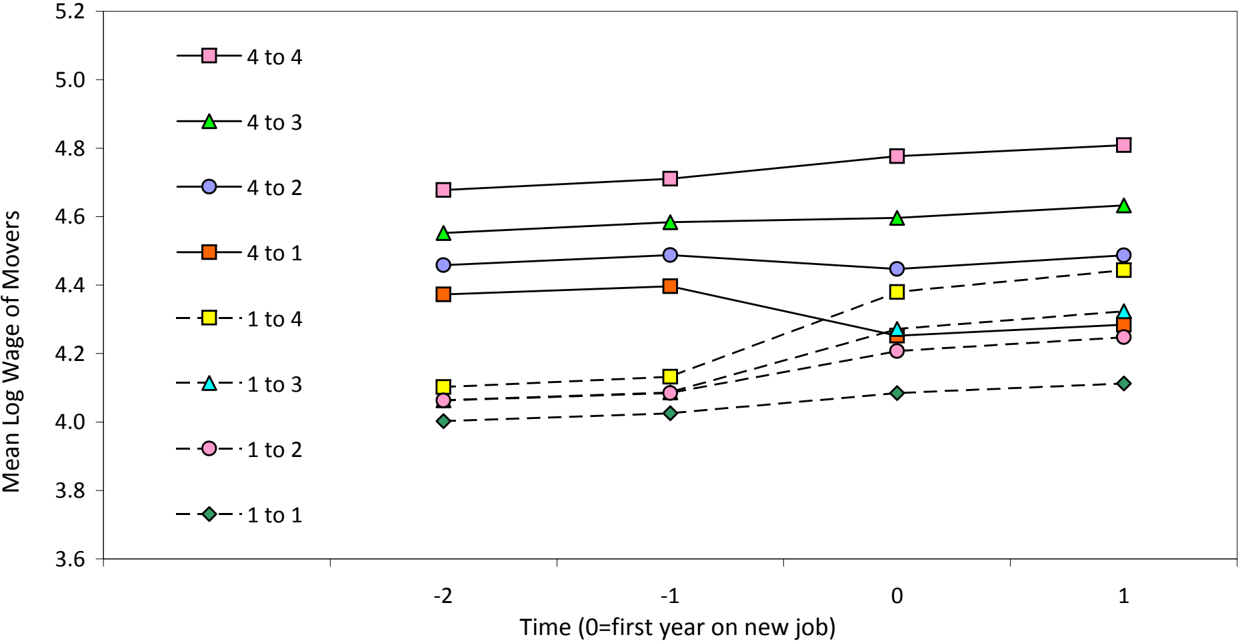
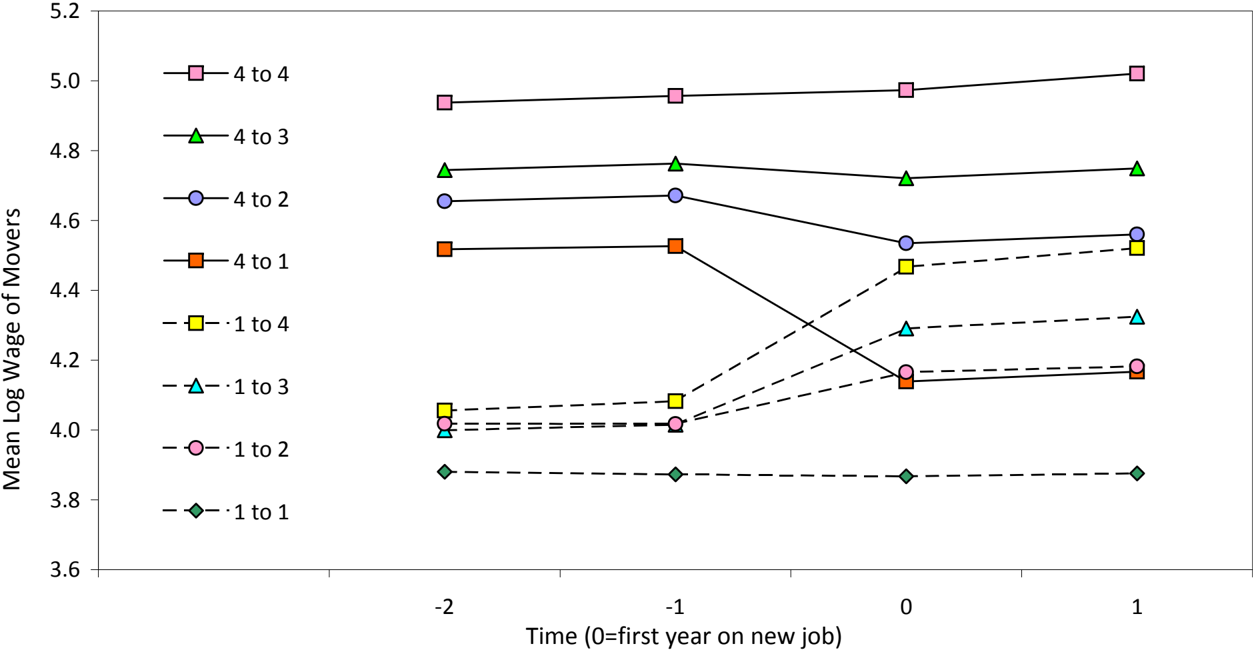
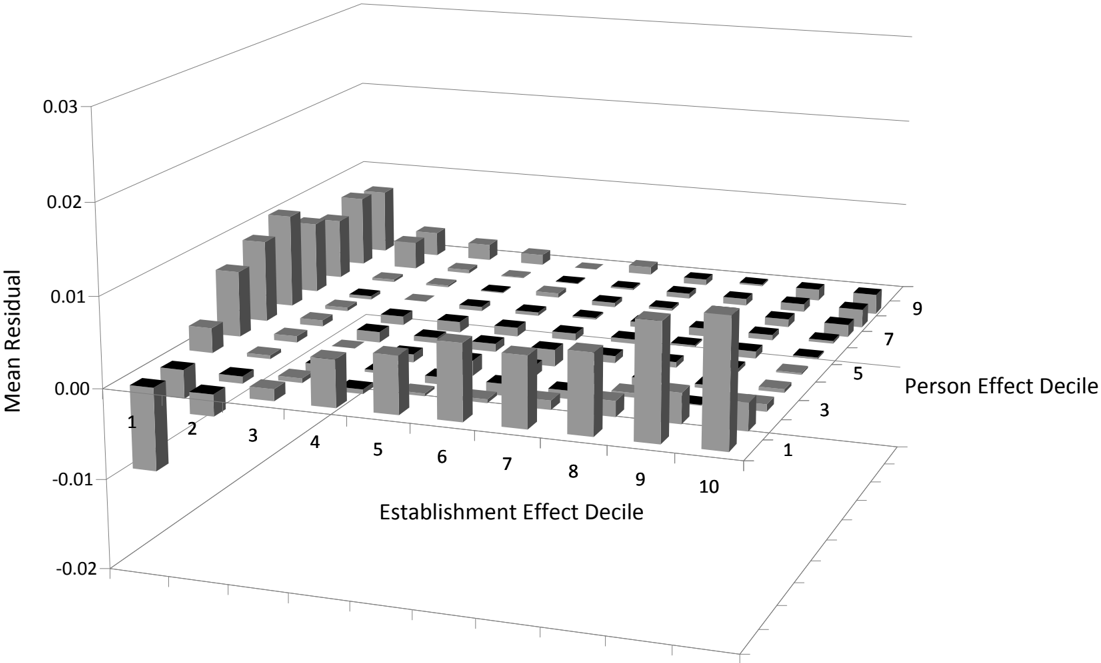
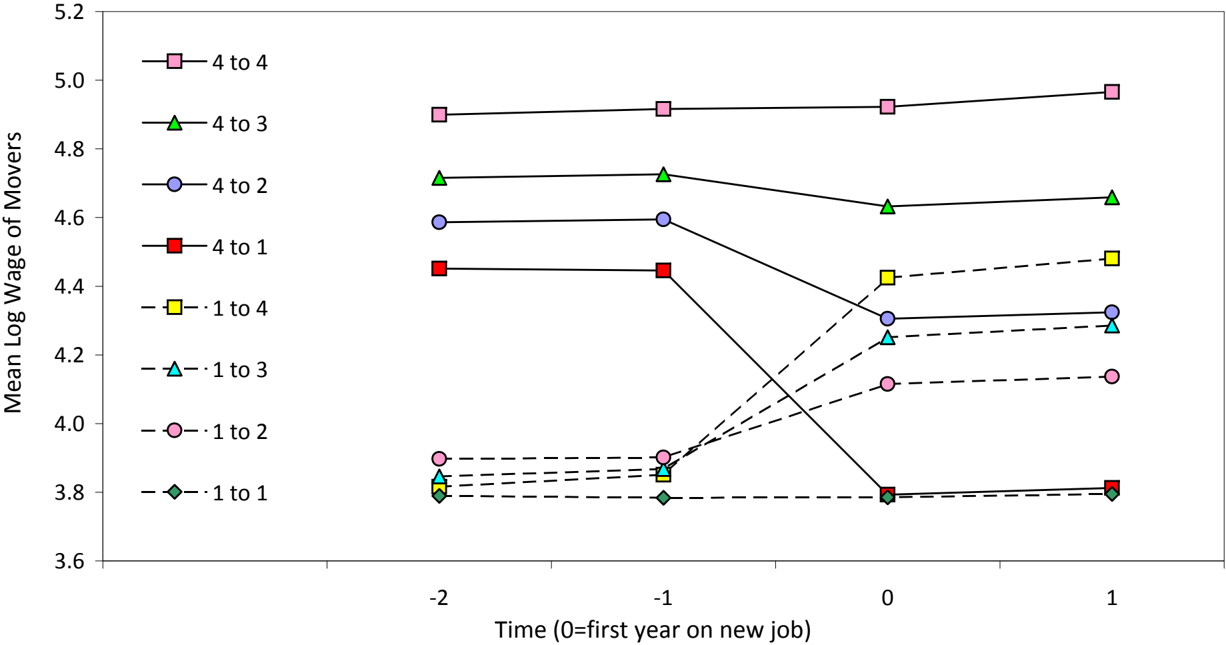
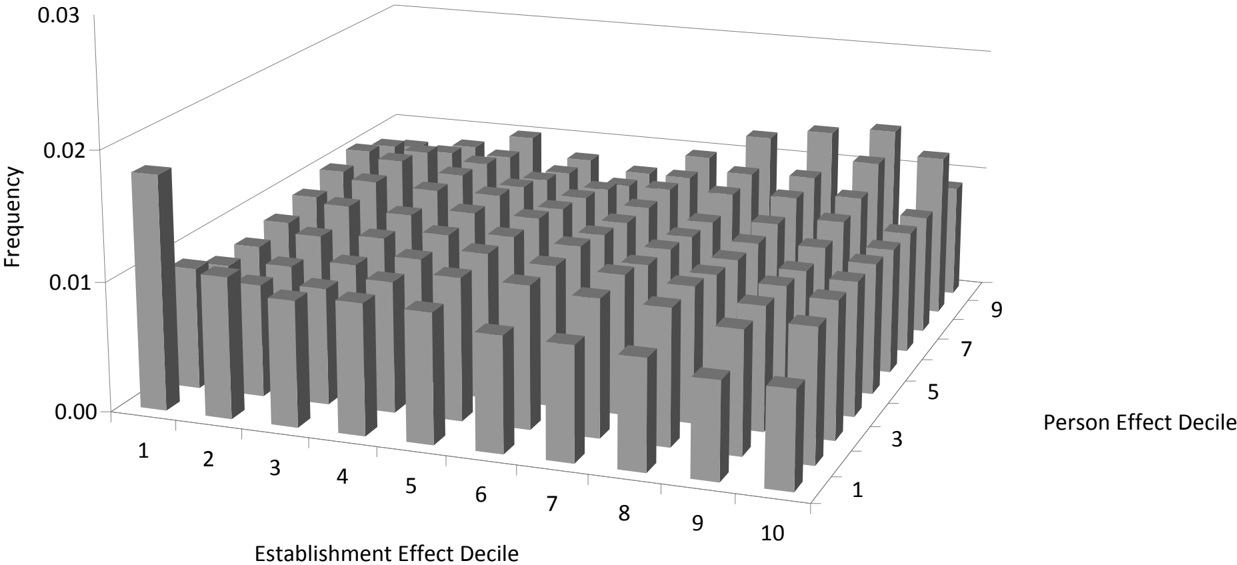
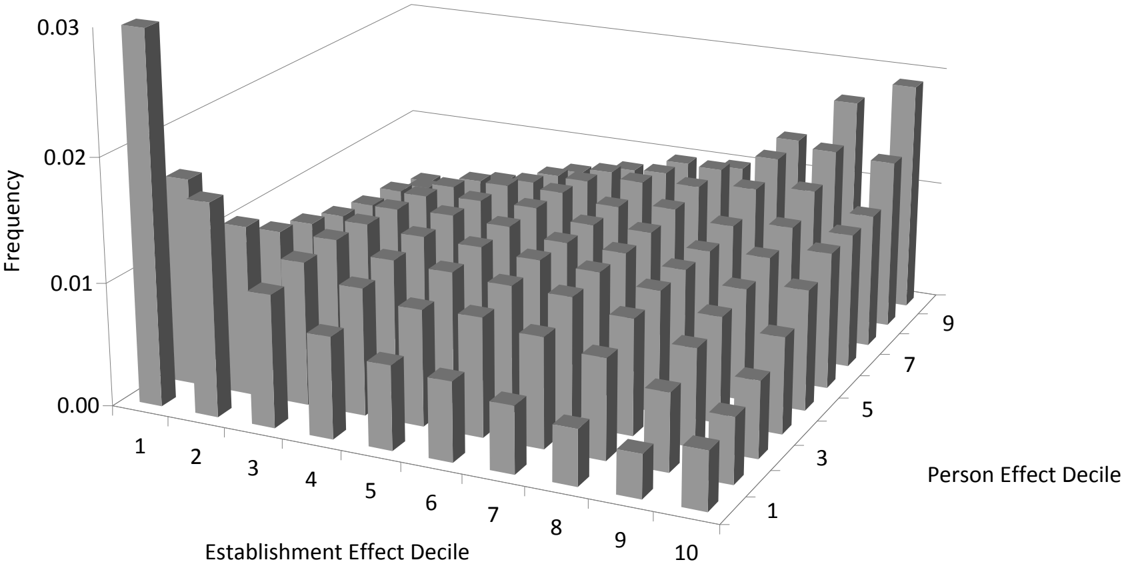
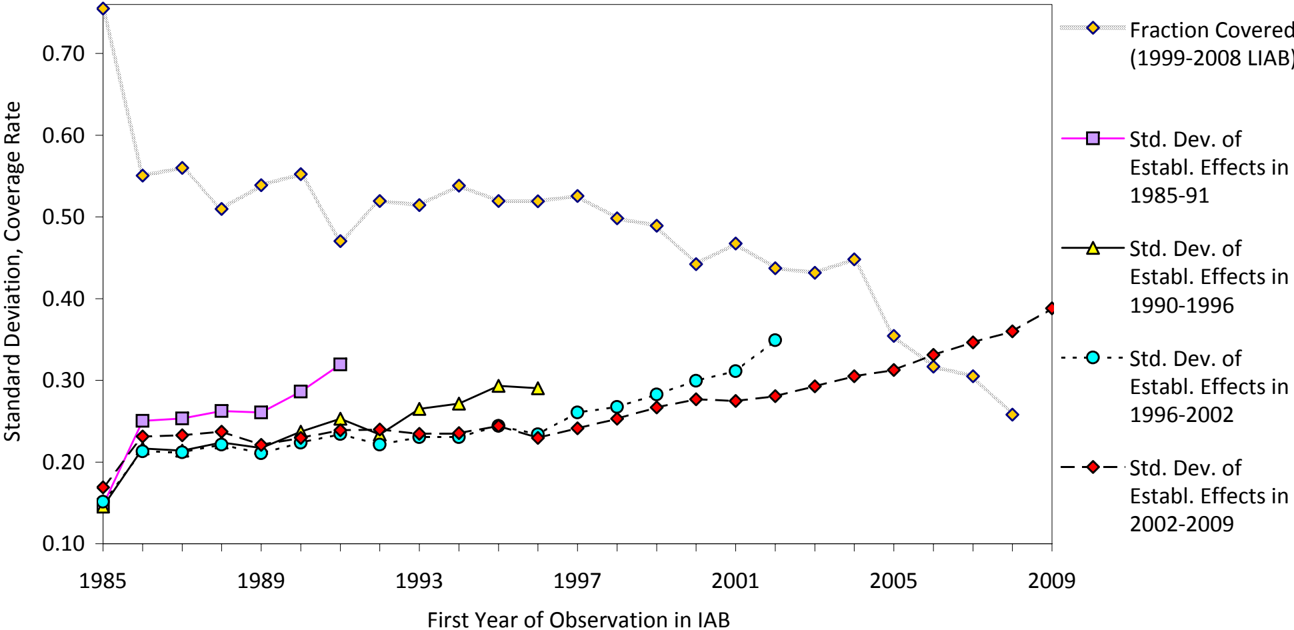
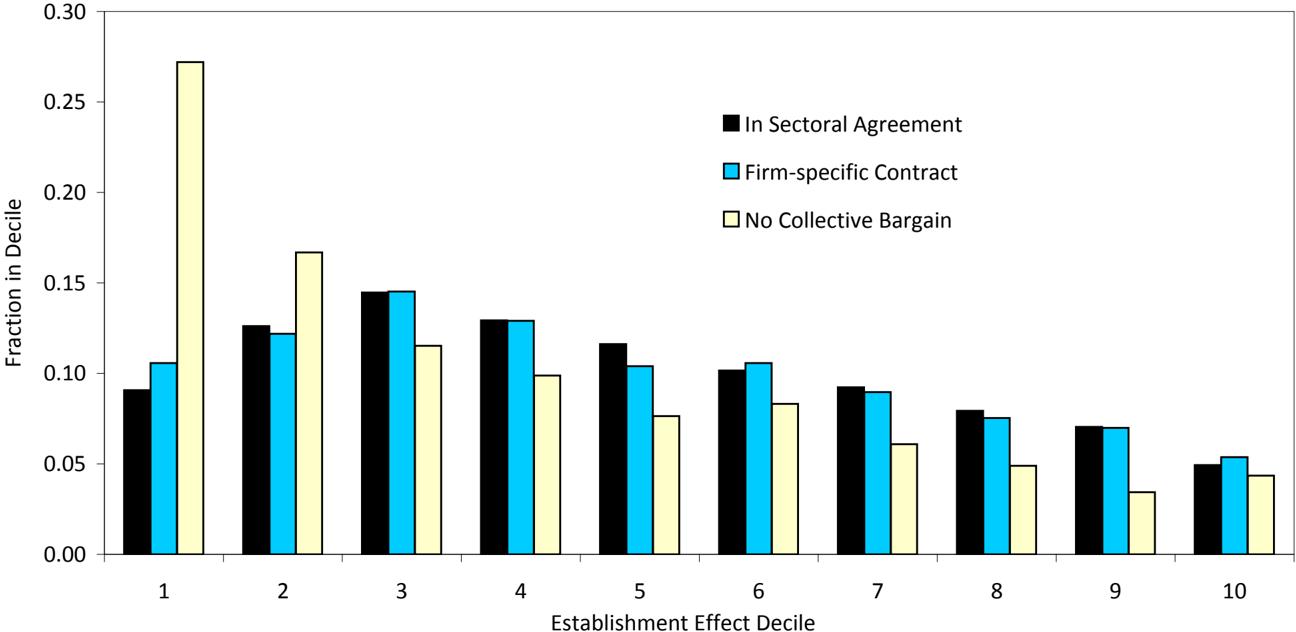
Verification
Claims the paper makes
0 Valid · 0 Not valid · 8 Not checked · 191 Own results and interpretations
A result the paper reports from its own data — it cites no other source for it, so there is none to check. The quote shows it is in the paper.
In the paper
“In particular, generalized non-separable models with xed e/ects for each job yield only a small improvement in explanatory power relative to the AKM speci cation, both within narrow time intervals and between intervals.”
plain- Asserted: passes — The authors put it forward as true.
- Checkable: passes — It can be checked against evidence.
- Load-bearing: passes — The paper’s conclusions depend on it.
- Based: passes — The paper gives a reason why it holds.
A result the paper reports from its own data — it cites no other source for it, so there is none to check. The quote shows it is in the paper.
In the paper
“Classifying establishments by entry year, we nd a trend toward increasing heterogeneity among establishments that entered the labor market after the mid-1990s, coupled with relatively small changes in the variability of the premiums paid by continuing establishments.”
plain- Asserted: passes — The authors put it forward as true.
- Checkable: passes — It can be checked against evidence.
- Load-bearing: passes — The paper’s conclusions depend on it.
- Based: passes — The paper gives a reason why it holds.
A result the paper reports from its own data — it cites no other source for it, so there is none to check. The quote shows it is in the paper.
In the paper
“We nd that two-thirds of the increase in the pay gap between higher and lower-educated workers is attributable to a widening in the average workplace pay premiums received by di/erent education groups.”
plainstates a cause- Asserted: passes — The authors put it forward as true.
- Checkable: passes — It can be checked against evidence.
- Load-bearing: passes — The paper’s conclusions depend on it.
- Based: passes — The paper gives a reason why it holds.
A result the paper reports from its own data — it cites no other source for it, so there is none to check. The quote shows it is in the paper.
In the paper
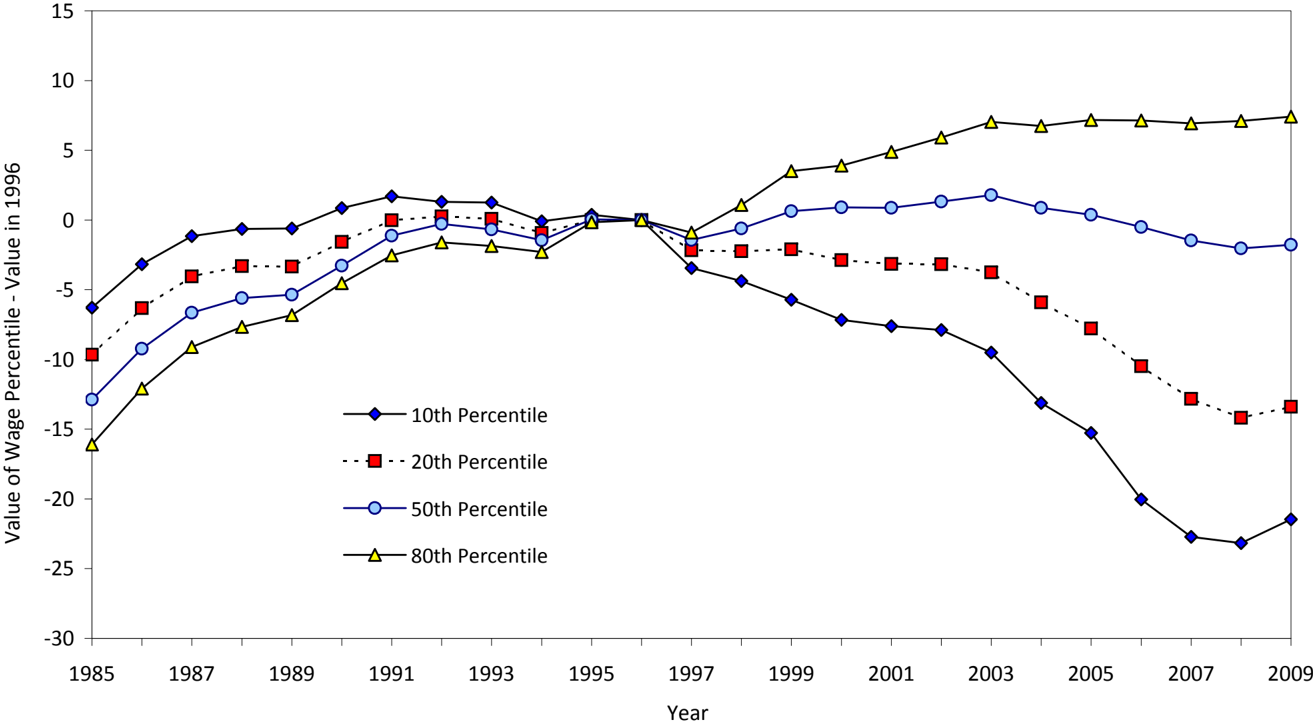
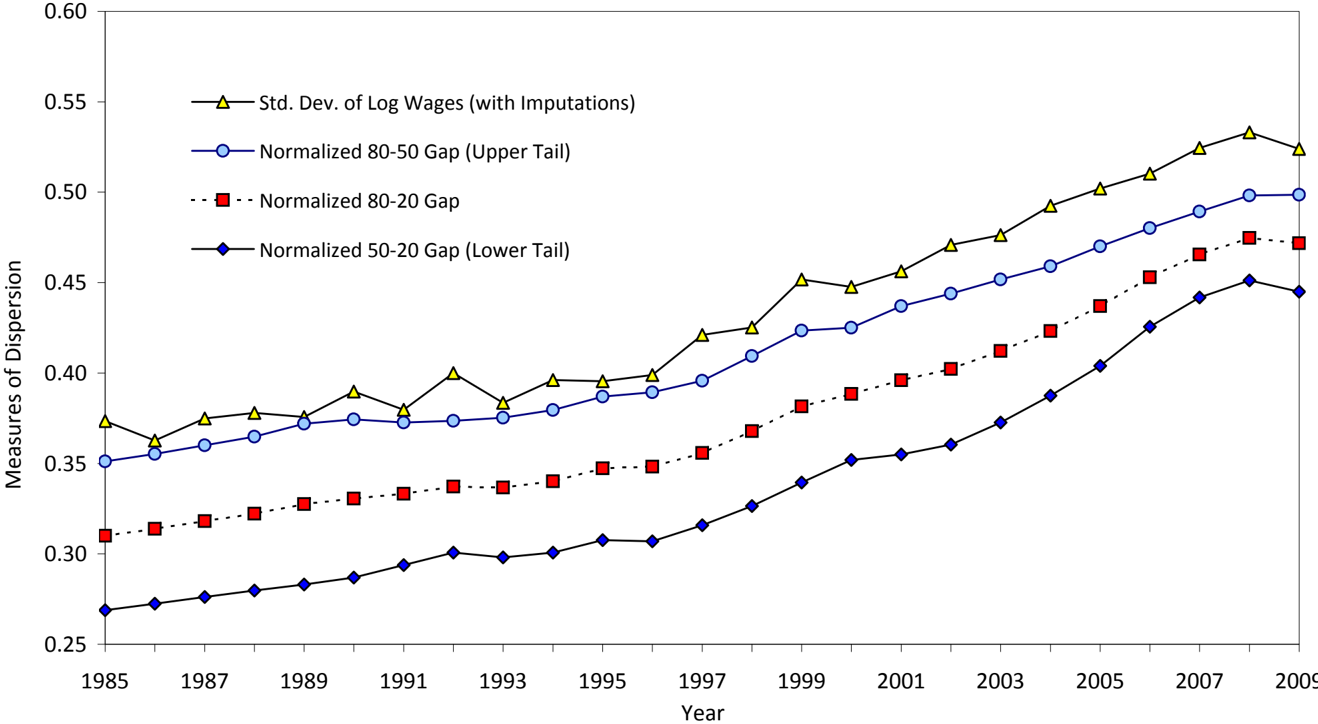
“In particular, the standard deviation rose by 15 log points from 1985 to 2009, the (normalized) 80-20 gap rose by 16 log points, the 80-50 gap rose by 15 log points, and the 50-20 gap rose by 18 log points.”
plain- Asserted: passes — The authors put it forward as true.
- Checkable: passes — It can be checked against evidence.
- Load-bearing: unclear — It is unclear whether the paper’s conclusions depend on it.
- Based: passes — The paper gives a reason why it holds.
118 more claims
Create a free account to see all 199 claims and to verify the 4 references still open.
- It may state two separate claims as one. 61
- Probably not a substantial claim. 17
- The quote only partly states this claim. 3
Claims other papers make about this one
Each is checked against this paper’s own text: does it say what the citing paper says it does?
The check wasn’t confident either way, so it gives no verdict — never disputed.
In the citing paper
“We estimate below that 75% is labor income.16”
From “Capitalists in the Twenty-First Century” (2019) · cites this paper as [16]
Experimental — accuracy not yet measured
Citations
Cites
A heteroskedasticity-consistent covariance matrix estimator and a direct test for heteroskedasticity
White, H. (1980) · Econometrica · doi:10.2307/1912934 · Cited by 25,861
The Skill Content of Recent Technological Change: An Empirical Exploration
Autor, D. H., Levy, F., & Murnane, R. J. (2003) · The Quarterly Journal of Economics · doi:10.1162/003355303322552801 · Cited by 6,205
On the Pooling of Time Series and Cross Section Data
Mundlak, Y. (1978) · Econometrica · doi:10.2307/1913646 · Cited by 5,412
Changes in Relative Wages, 1963-1987: Supply and Demand Factors
Katz, L. F., & Murphy, K. M. (1992) · The Quarterly Journal of Economics · doi:10.2307/2118323 · Cited by 4,793
Equilibrium Unemployment as a Worker Discipline Device
Shapiro, C., & Stiglitz, J. E. (1986) · Efficiency Wage Models of the Labor Market · doi:10.1017/cbo9780511559594.004 · Cited by 4,652
Misallocation and Manufacturing TFP in China and India*
Hsieh, C.-T., & Klenow, P. J. (2009) · Quarterly Journal of Economics · doi:10.1162/qjec.2009.124.4.1403 · Cited by 4,175
Job Creation and Job Destruction in the Theory of Unemployment
Mortensen, D. T., & Pissarides, C. A. (1994) · The Review of Economic Studies · doi:10.2307/2297896 · Cited by 3,840
Hybrid Corn: An Exploration in the Economics of Technological Change
Griliches, Z. (1957) · Econometrica · doi:10.2307/1905380 · Cited by 3,330
Labor Contracts as Partial Gift Exchange
Akerlof, G. A. (1982) · The Quarterly Journal of Economics · doi:10.2307/1885099 · Cited by 3,210
Plants and Productivity in International Trade
Bernard, A. B., Eaton, J., Jensen, J. B., & Kortum, S. (2003) · American Economic Review · doi:10.1257/000282803769206296 · Cited by 2,980
Research works printed but not linked: 1
- 70. Rees, Albert and George Schultz. 1970. Workers in an Urban Labor Market. Chicago: University of Chicago Press.
Cited by
Items 601–700 of 1,904
JAQ of all trades: Job mismatch, firm productivity and managerial quality
Coraggio, L., Pagano, M., Scognamiglio, A., & Tå̊g, J. (2024) · Journal of Financial Economics · doi:10.1016/j.jfineco.2024.103992 · Cited by 17
Trade and Domestic Distortions: The Case of Informality
Dix-Carneiro, R., Goldberg, P. K., Meghir, C., & Ulyssea, G. (2026) · Econometrica · doi:10.3982/ecta19378 · Cited by 15
A simple method to estimate large fixed effects models applied to wage determinants
Mittag, N. (2019) · Labour Economics · doi:10.1016/j.labeco.2019.101766 · Cited by 16
Bauer, A., & Boussard, J. (2020) · Economie et Statistique / Economics and Statistics · doi:10.24187/ecostat.2020.520d.2034 · Cited by 15
The wage effects of offshoring to the East and West: evidence from the German labor market
Koerner, K. (2022) · Review of World Economics · doi:10.1007/s10290-022-00471-4 · Cited by 15
The determinants of displaced workers’ wages: Sorting, matching, selection, and the Hartz reforms
Woodcock, S. D. (2022) · Journal of Econometrics · doi:10.1016/j.jeconom.2022.03.013 · Cited by 15
Occupational tasks and wage inequality in West Germany: A decomposition analysis
Koomen, M., & Backes‐Gellner, U. (2022) · Labour Economics · doi:10.1016/j.labeco.2022.102284 · Cited by 16
The labor market in Germany, 2000–2018
IZA, G., Rinne, U., Schneider, H., & IZA, G. (2019) · IZA World of Labor · doi:10.15185/izawol.379.v2 · Cited by 17
Skill Premiums and the Supply of Young Workers in Germany
Glitz, A., & Wissmann, D. (2021) · Labour Economics · doi:10.1016/j.labeco.2021.102034 · Cited by 16
Das Mindestlohngesetz — Hoffnungen und Befürchtungen
Möller, J., Brenke, K., Wagner, G. G., Schulten, T., Horn, G. A., Lesch, H., Mayer, A., Schmid, L. M. H., Arni, P. P., Eichhörst, W., et al. (2014) · Wirtschaftsdienst · doi:10.1007/s10273-014-1686-6 · Cited by 15
Racial Divisions and Criminal Justice: Evidence from Southern State Courts
Feigenberg, B., & Miller, C. (2018) · National Bureau of Economic Research · doi:10.3386/w24726 · Cited by 15
Does Schooling Cause Structural Transformation?Preprint
Porzio, T., & Santangelo, G. (2019) · RePEc: Research Papers in Economics · doi:10.17863/cam.38660 · Cited by 15
The Great Separation: Top Earner Segregation at Work in High-Income CountriesPreprint
Godechot, O., Apascaritei, P., Boza, I., Henriksen, L. F., Hermansen, A. S., Hou, F., Kodama, N., Křížková, A., Jung, J., Elvira, M. M., et al. (2020) · RePEc: Research Papers in Economics · Cited by 15
Mergers and Managers: Manager-Specific Wage Premiums and Rent Extraction in M&AsPreprint
He, A. X., & le Maire, D. (2019) · SSRN Electronic Journal · doi:10.2139/ssrn.3481262 · Cited by 15
The Role of Within-Occupation Task Changes in Wage DevelopmentPreprint
Bachmann, R., Demir, G., Green, C. P., & Uhlendorff, A. (2022) · SSRN Electronic Journal · doi:10.2139/ssrn.4254511 · Cited by 16
Non-Wage Job Values and Implications for InequalityPreprint
Lehmann, T. (2023) · SSRN Electronic Journal · doi:10.2139/ssrn.4373816 · Cited by 15
The Anatomy of Labor Cost Adjustment to Demand Shocks: Germany and Italy During the Great RecessionPreprint
D’Amuri, F., Lattanzio, S., & Smith, B. (2024) · SSRN Electronic Journal · doi:10.2139/ssrn.4848902 · Cited by 15
Two-Sided Sorting of Workers and Firms: Implications for Spatial Inequality and WelfarePreprint
Hong, G. (2024) · RePEc: Research Papers in Economics · doi:10.25740/vy773wr1460 · Cited by 15
Cai, X., Jiang, W., Song, H., & Xie, H. (2022) · Journal of Development Economics · doi:10.1016/j.jdeveco.2022.102840 · Cited by 15
New Evidence about Skill-Biased Technological Change and Gender Wage Inequality
Nogueira, M. C., & Madaleno, M. (2023) · Economies · doi:10.3390/economies11070193 · Cited by 15
Schnabel, C. (2025) · Journal for Labour Market Research · doi:10.1186/s12651-025-00393-2 · Cited by 14
Disability onset and labor market outcomes
Collischon, M., Hiesinger, K., & Pohlan, L. (2025) · Socio-Economic Review · doi:10.1093/ser/mwaf021 · Cited by 14
The Role of People versus Places in Individual Carbon Emissions
Lyubich, E. (2025) · American Economic Review · doi:10.1257/aer.20230346 · Cited by 14
Abraham, M., Damelang, A., & Haupt, A. (2018) · Springer eBooks · doi:10.1007/978-3-658-02256-3_7 · Cited by 16
The Role of Hours Changes for the Increase in German Earnings Inequality
Biewen, M., & Plötze, D. (2019) · Jahrbücher für Nationalökonomie und Statistik · doi:10.1515/jbnst-2018-0013 · Cited by 14
Trade, technology, and the labour market: impacts on wage inequality within countries
Wang, W., FINDLAY, C. C., & Thangavelu, S. M. (2021) · Asian-Pacific Economic Literature · doi:10.1111/apel.12313 · Cited by 15
Diversity of experience and labor productivity in creative industries
Kekezi, O. (2021) · Journal for Labour Market Research · doi:10.1186/s12651-021-00302-3 · Cited by 15
Do innovative firms pay higher wages? Micro-level evidence from Brazil
Cirera, X., & Martins-Neto, A. (2022) · Research Policy · doi:10.1016/j.respol.2022.104645 · Cited by 14
Solving Social Dilemmas: Ethics, Politics, and Prosperity
Congleton, R. D. (2022) · doi:10.1093/oso/9780197642788.001.0001 · Cited by 14
Stüber, H., Grabka, M. M., & Schnitzlein, D. D. (2023) · Journal for Labour Market Research · doi:10.1186/s12651-023-00336-9 · Cited by 14
Changes in the gender pay gap over time: the case of West Germany
Töpfer, M., Castagnetti, C., & Rosti, L. (2023) · Journal for Labour Market Research · doi:10.1186/s12651-023-00338-7 · Cited by 15
Collective bargaining and spillovers in local labor markets
Bassier, I. (2022) · London School of Economics and Political Science Research Online (London School of Economics and Political Science) · Cited by 14
Singleton, C. (2018) · Economics Letters · doi:10.1016/j.econlet.2018.11.005 · Cited by 14
Immigration and Worker-Firm Matching
Orefice, G., & Peri, G. (2020) · The Review of Economics and Statistics · doi:10.1162/rest_a_01476 · Cited by 14
Establishment heterogeneity, rent sharing and the rise of wage inequality in Germany
Ohlert, C. (2016) · International Journal of Manpower · doi:10.1108/ijm-01-2015-0005 · Cited by 15
Ochsenfeld, F. (2017) · Socio-Economic Review · doi:10.1093/ser/mwx026 · Cited by 15
Better Workers Move to Better Firms: A Simple Test to Identify SortingPreprint
Bartolucci, C., & Devicienti, F. (2012) · SSRN Electronic Journal · doi:10.2139/ssrn.2154322 · Cited by 14
The valuation of changes in commuting distances: An analysis using georeferenced dataPreprint
Dauth, W., & Haller, P. (2016) · RePEc: Research Papers in Economics · Cited by 14
The Costs of Corporate Tax Complexity
Zwick, E. (2018) · National Bureau of Economic Research · doi:10.3386/w24382 · Cited by 16
Technological change and the Swedish labor marketPreprint
Graetz, G. (2020) · RePEc: Research Papers in Economics · Cited by 14
Sorting Between and Within Industries: A Testable Model of Assortative Matching
Abowd, J. M., Kramarz, F., Pérez-Duarte, S., & Schmutte, I. M. (2014) · National Bureau of Economic Research · doi:10.3386/w20472 · Cited by 16
Job-to-job Flows and Wage Dynamics in France and ItalyPreprint
Berson, C., Philippis, M. D., & Viviano, E. (2020) · SSRN Electronic Journal · doi:10.2139/ssrn.3659962 · Cited by 14
Jašová, M., Mendicino, C., Panetti, E., Peydró, J., & Supera, D. (2021) · SSRN Electronic Journal · doi:10.2139/ssrn.3930286 · Cited by 14
The Unequal Consequences of Job Loss Across CountriesPreprint
Bertheau, A., Acabbi, E. M., Barceló, C., Gulyas, A., Lombardi, S., & Saggio, R. (2022) · SSRN Electronic Journal · doi:10.2139/ssrn.4161776 · Cited by 14
Can Tax Incentives Bring Brains Back? Returnees Tax Schemes and High-Skilled Migration in ItalyPreprint
Bassetto, J., & Ippedico, G. (2023) · SSRN Electronic Journal · doi:10.2139/ssrn.4359376 · Cited by 14
The Economic Burden of BurnoutPreprint
Nekoei, A., Sigurðsson, J., & Wehr, D. (2024) · SSRN Electronic Journal · doi:10.2139/ssrn.4827359 · Cited by 14
Budde, J., Dohmen, T., Jäger, S., & Trenkle, S. (2024) · National Bureau of Economic Research · doi:10.3386/w32740 · Cited by 14
Empirical Bayes Methods in Labor Economics
Walters, C. (2024) · National Bureau of Economic Research · doi:10.3386/w33091 · Cited by 15
Migration Restrictions and the Migrant-Native Wage Gap: The Roles of Wage Setting and SortingPreprint
Guo, N., Zhang, L., Zhang, R., & Zou, B. (2025) · SSRN Electronic Journal · doi:10.2139/ssrn.5092829 · Cited by 14
What Drives Risky Prescription Opioid Use? Evidence From Migration
Finkelstein, A. N., Gentzkow, M. A., & Li, D. (2025) · The Quarterly Journal of Economics · doi:10.1093/qje/qjaf037 · Cited by 14
Assortative labor matching, city size, and the education level of workers
Leknes, S., Rattsø, J., & Stokke, H. E. (2022) · Regional Science and Urban Economics · doi:10.1016/j.regsciurbeco.2022.103806 · Cited by 13
Banfi, S., Choi, S., & Villena-Roldán, B. (2019) · European Economic Review · doi:10.1016/j.euroecorev.2022.104128 · Cited by 13
Convex vacancy creation costs and on‐the‐job search in a global economy
Holzner, C., & Larch, M. (2021) · World Economy · doi:10.1111/twec.13136 · Cited by 13
Trends in Wage Inequality in the Netherlands
Schneck, C. (2021) · De Economist · doi:10.1007/s10645-021-09388-z · Cited by 13
Concentration and Commodification: The Political Economy of Postindustrialism in America and Beyond
Ansell, B. W., & Gingrich, J. R. (2021) · Cambridge University Press eBooks · doi:10.1017/9781009029841.014 · Cited by 13
Sorting Between and Within Industries: A Testable Model of Assortative Matching
Abowd, J. M., Kramarz, F., Pérez-Duarte, S., & Schmutte, I. M. (2018) · Annals of Economics and Statistics · doi:10.15609/annaeconstat2009.129.0001 · Cited by 13
Avent‐Holt, D. (2017) · Socio-Economic Review · doi:10.1093/ser/mwx048 · Cited by 13
Profit as Social Rent: Embeddedness and Stratification in Markets
Münnich, S. (2019) · Sociological Theory · doi:10.1177/0735275119850860 · Cited by 13
Inequality in Germany: Myths, Facts, and Policy ImplicationsPreprint
Battisti, M., Felbermayr, G. J., & Lehwald, S. (2016) · RePEc: Research Papers in Economics · Cited by 13
The Causal Impact of Social Connections on Firms' OutcomesPreprint
Skans, O. N., Eliason, M., Hensvik, L., & Kramarz, F. (2017) · RePEc: Research Papers in Economics · Cited by 13
Wandel der Beschäftigung: Polarisierungstendenzen auf dem deutschen ArbeitsmarktPreprint
Eichhörst, W., Arni, P. P., Buhlmann, F., Isphording, I. E., & Tobsch, V. (2015) · RePEc: Research Papers in Economics · Cited by 14
Technological Change, Firm Heterogeneity and Wage InequalityPreprint
Cortés, G. M., Lerche, A., Schönberg, U., & Tschopp, J. (2023) · SSRN Electronic Journal · doi:10.2139/ssrn.4419826 · Cited by 14
How Much Should We Trust Estimates of Firm Effects and Worker Sorting?Preprint
Bonhomme, S., Holzheu, K., Lamadon, T., Manresa, E., Mogstad, M., & Setzler, B. (2020) · SSRN Electronic Journal · doi:10.2139/ssrn.3625745 · Cited by 13
Racial Gaps in the Labor Market: The Role of Nonwhite EntrepreneurshipPreprint
Rocha, R. H., & Dias, M. V. B. (2021) · SSRN Electronic Journal · doi:10.2139/ssrn.3935982 · Cited by 13
Willingness to Pay for Workplace SafetyPreprint
Anelli, M., & Koenig, F. (2021) · SSRN Electronic Journal · doi:10.2139/ssrn.3982032 · Cited by 13
Global Trends in Income Inequality and Income Dynamics: New Insights from GRID
Guvenen, F., Pistaferri, L., & Violante, G. L. (2022) · National Bureau of Economic Research · doi:10.3386/w30524 · Cited by 13
Firm heterogeneity and the impact of payroll taxes
Branyiczki, R., Bíró, A., Lindner, A., Márk, L., & Prinz, D. (2026) · doi:10.1920/wp.ifs.2022.4922 · Cited by 13
The Pay and Non-Pay Content of Job AdsPreprint
Audoly, R., Bhuller, M., & Reiremo, T. A. (2024) · SSRN Electronic Journal · doi:10.2139/ssrn.4972187 · Cited by 13
Understanding the Gender Gap Further: The Case of Turn-of-the-Century Swedish Compositors
Burnette, J., & Stanfors, M. (2020) · The Journal of Economic History · doi:10.1017/s002205071900086x · Cited by 12
The Global Forum on Productivity at 10: Past and Future Perspectives on Reviving Productivity Growth
OECD (2025) · OECD eBooks · doi:10.1787/ca7295d9-en · Cited by 12
Doctor Decision-Making and Patient Outcomes
Currie, J., MacLeod, W. B., & Musen, K. (2026) · Journal of Economic Literature · doi:10.1257/jel.20251762 · Cited by 13
Ehrl, P. (2016) · Oxford Economic Papers · doi:10.1093/oep/gpw025 · Cited by 12
Berlingieri, G., Blanchenay, P., & Criscuolo, C. (2024) · Research Policy · doi:10.1016/j.respol.2024.104955 · Cited by 12
Persistence of commuting habits: context effects in Germany
Jost, R. (2023) · The Annals of Regional Science · doi:10.1007/s00168-023-01223-4 · Cited by 12
Racial Inequality, Market Inequality, and the American Political Economy
Thurston, C. N. (2021) · Cambridge University Press eBooks · doi:10.1017/9781009029841.005 · Cited by 12
Labor by design: contributions of David Card, Joshua Angrist, and Guido Imbens*
Hull, P., Kolesár, M., & Walters, C. (2022) · Scandinavian Journal of Economics · doi:10.1111/sjoe.12505 · Cited by 12
The evolution of educational wage differentials for women and men in Germany, from 1996 to 2019
Ordemann, J., & Pfeiffer, F. (2022) · Journal for Labour Market Research · doi:10.1186/s12651-022-00323-6 · Cited by 12
What Lies Behind the Returns to Schooling: The Role of Labor Market Sorting and Worker Heterogeneity
Portugal, P., Reis, H., Guimarães, P., & Cardoso, A. R. (2024) · The Review of Economics and Statistics · doi:10.1162/rest_a_01482 · Cited by 12
Unemployment effects of the German minimum wage in an equilibrium job search model
Blömer, M., Gürtzgen, N., Pohlan, L., Stichnoth, H., & van den Berg, G. J. (2024) · Labour Economics · doi:10.1016/j.labeco.2024.102626 · Cited by 12
Heterogeneity in School Value Added and the Private Premium
Andrabi, T., Bau, N., Das, J., & Khwaja, A. I. (2024) · American Economic Review · doi:10.1257/aer.20221422 · Cited by 12
Atypical employment over the life cycle
Bachmann, R., Felder, R., & Tamm, M. (2020) · Evidence-based HRM a Global Forum for Empirical Scholarship · doi:10.1108/ebhrm-08-2019-0073 · Cited by 12
Gorodnichenko, Y., Revoltella, D., Švejnar, J., & Weiss, C. (2018) · American Economic Journal Macroeconomics · doi:10.1257/mac.20210220 · Cited by 12
Changing selection into full-time work and its effect on wage inequality in Germany
Fitzenberger, B., & de Lazzer, J. (2021) · Empirical Economics · doi:10.1007/s00181-021-02098-0 · Cited by 12
Aizawa, N., Mommaerts, C., & Rennane, S. (2022) · AEA Papers and Proceedings · doi:10.1257/pandp.20221124 · Cited by 12
Salaires et salariés en Île-de-France
Combes, P., Duranton, G., & Gobillon, L. (2014) · Revue économique · doi:10.3917/reco.pr2.0039 · Cited by 12
Local Labor Markets and the Evolution of Inequality
Black, D. A., Kolesnikova, N. A., & Taylor, L. J. (2014) · Annual Review of Economics · doi:10.1146/annurev-economics-080213-040816 · Cited by 12
Physicians, sick leave certificates, and patients' subsequent employment outcomes
Ahammer, A. (2018) · Health Economics · doi:10.1002/hec.3646 · Cited by 12
Chasing after “good jobs.” Do they exist and does it matter if they do?
Green, D. A. (2015) · Canadian Journal of Economics/Revue canadienne d économique · doi:10.1111/caje.12188 · Cited by 12
Marriage Dynamics, Earnings Dynamics, and Lifetime Family Income
Altonji, J. G., Páez, D. G., Hynsjö, D., & Vidangos, I. (2021) · National Bureau of Economic Research · doi:10.3386/w28400 · Cited by 12
Mergers, Employee Hold-Up and the Scope of the Firm: An Intrafirm Bargaining Approach to MergersPreprint
Stole, L., & Zwiebel, J. (2014) · SSRN Electronic Journal · doi:10.2139/ssrn.2396077 · Cited by 12
Does Exporting Improve Matching? Evidence from French Employer-Employee Data
Bombardini, M., Orefice, G., & Tito, M. D. (2015) · National Bureau of Economic Research · doi:10.3386/w21225 · Cited by 13
Leave-out estimation of variance componentsPreprint
Kline, P., Saggio, R., & Sølvsten, M. (2018) · RePEc: Research Papers in Economics · doi:10.48550/arxiv.1806.01494 · Cited by 18
Self-citationManagement, skills and productivity
Cammeraat, E., Samek, L., & Squicciarini, M. (2021) · OECD science, technology and industry policy papers · doi:10.1787/007f399e-en · Cited by 12
Which Ladder to Climb? Decomposing Life Cycle Wage DynamicsPreprint
Bayer, C., & Kuhn, M. (2019) · SSRN Electronic Journal · doi:10.2139/ssrn.3275410 · Cited by 12
Minimum Wages in Concentrated Labor MarketsPreprint
Popp, M. (2021) · RePEc: Research Papers in Economics · doi:10.48550/arxiv.2111.13692 · Cited by 13
The Long-Term Effects of Teachers' Gender StereotypesPreprint
Martinez, J. (2022) · RePEc: Research Papers in Economics · doi:10.48550/arxiv.2212.08220 · Cited by 13
Firm Heterogeneity and the Impact of Payroll Taxes
Bíró, A., Branyiczki, R., Lindner, A., Márk, L., & Prinz, D. (2022) · World Bank, Washington, DC eBooks · doi:10.1596/1813-9450-10265 · Cited by 12
Estimating Counterfactual Matrix Means with Short Panel DataPreprint
Lei, L., & Ross, B. (2023) · RePEc: Research Papers in Economics · doi:10.48550/arxiv.2312.07520 · Cited by 12
De-routinization in the Fourth Industrial Revolution – Firm-Level EvidencePreprint
Arntz, M., Genz, S., Gregory, T., Lehmer, F., & Zierahn, U. (2024) · SSRN Electronic Journal · doi:10.2139/ssrn.4726223 · Cited by 12
Why Workers Stay: Pay, Beliefs, and Attachment
Caldwell, S., Haegele, I., & Heining, J. (2025) · National Bureau of Economic Research · doi:10.3386/w33445 · Cited by 12
Self-citation
Metadata
- Authors
- Card, D., Heining, J., & Kline, P.
- Affiliations
- University of California, Berkeley (US)
- Corresponding author
- Kline, Patrick
- ORCID
- Card, David
- Venue
- The Quarterly Journal of Economics
- Publisher
- Oxford University Press (OUP)
- Published
- 2013-05-02
- Volume
- 128
- Issue
- 3
- Pages
- 967-1015
- ISSN
- 0033-5533 (ISSN-L)
- 1531-4650
- OpenAlex
- W2141295263
- Cited by
- 1,904
- References
- 146
- Citations by year
- 2026: 153 · 2025: 204 · 2024: 228 · 2023: 156 · 2022: 185 · 2021: 178 · 2020: 143 · 2019: 125 · 2018: 156 · 2017: 113 · 2016: 105 · 2015: 71 · 2014: 58 · 2013: 22
- FWCI
- 118.40
- Type
- journal article
- Language
- en
- Open access
- closed
- Locations
- The Quarterly Journal of Economics (publishedVersion)
- RePEc: Research Papers in Economics (submittedVersion)
- Econstor (Econstor) (submittedVersion)
- Funders
- Washington Center for Equitable Growth
- Topics
- Social Sciences › Economics, Econometrics and Finance › Economics and Econometrics › Labor market dynamics and wage inequality
- Social Sciences › Economics, Econometrics and Finance › Economics and Econometrics › Historical Economic and Social Studies
- Social Sciences › Sociology and Political Science › Income, Poverty, and Inequality
- Keywords
- wage inequality, job matching, fixed effects model, education and wages
About these checks
Registry, retraction, Cites and statistics results are computed, not judged, with one exception: a printed reference that no index lists is read once by a model before it counts as a citation error. Claims are extracted by a model and kept only when their quote appears verbatim in the text; each cited source is then checked, with a model’s help, for whether it says what the claim relies on. Those verdicts can be wrong — read the claim’s quote and the cited source before relying on one.
A language model drew the claims from the paper on 2026-11-17, under version 3 of the claim definition (model deepseek-v4.1-flash, prompt extract-v3).
A second model labelled each claim on 2026-11-17 (model jev-1.13-20260917, definition revision gold-guideline-v0.2).
Statistics and arithmetic are recomputed, not judged.
Confidence bands are shown only for fields calibrated on our annotated test set. None is calibrated yet, so no band is shown.
What counts as a claim ›How we measure confidence ›How we check this ›
Are you an author, or do you see a problem with this page? Request a review
Data sources
Bibliographic data: Semantic Scholar, OpenAlex, Crossref.
Contains information from the Semantic Scholar Academic Graph Datasets, made available under the ODC Attribution License (ODC-BY 1.0).
Semantic Scholar’s data is described in: Kinney, R., et al. (2023). The Semantic Scholar Open Data Platform. arXiv:2301.10140.
