

Workplace Heterogeneity and the Rise of West German Wage Inequality*
The DOI matches its Crossref record; 144 of the 147 references it cites were found in a registry or an index, and 1 are not checked yet; none of the 8 sources its claims cite is checked for support yet.
Abstract
We study the role of establishment-specific wage premiums in generating recent increases in West German wage inequality. Models with additive fixed effects for workers and establishments are fit into four subintervals spanning the period from 1985 to 2009. We show that these models provide a good approximation to the wage structure and can explain nearly all of the dramatic rise in West German wage inequality. Our estimates suggest that the increasing dispersion of West German wages has arisen from a combination of rising heterogeneity between workers, rising dispersion in the wage premiums at different establishments, and increasing assortativeness in the assignment of workers to plants. In contrast, the idiosyncratic job-match component of wage variation is small and stable over time. Decomposing changes in mean wages between different education groups, occupations, and industries, we find that increasing plant-level heterogeneity and rising assortativeness in the assignment of workers to establishments explain a large share of the rise in inequality along all three dimensions.
Checked 2026-11-19 · 1 reference not checked yet
Overview
CoChat Summary
TL;DR
Using West German administrative data from 1985–2009, the paper shows that models with additive person and establishment fixed effects explain nearly all of the rise in wage inequality. The increase is driven by rising worker-effect variance, rising establishment-premium variance, and increased assortative matching of high-wage workers to high-wage plants.
Key findings
- In the AKM variance decomposition, total log-wage variance rose from 0.137 in interval 1 (1985–1991) to 0.249 in interval 4 (2002–2009). The variance of person effects rose from 0.084 to 0.127 and contributed 39% of the total rise; establishment-effect variance rose from 0.025 to 0.053 and contributed 25%; the covariance term rose from 0.003 to 0.041 and contributed 34%.
- Assortative matching increased: the correlation between person and establishment effects rose from 0.034 in interval 1 to 0.249 in interval 4. Counterfactuals imply that holding sorting constant would have produced 69% of the actual variance rise, while holding establishment-effect variance constant would have produced 64%.
- Job-mobility event studies show growing establishment premia: a trend-adjusted move from quartile 1 to quartile 4 co-worker-wage establishments was associated with a 23 log-point gain in 1985–1991 versus 47 log points in 2002–2009; the reverse move yielded losses of 22 versus 43 log points.
- Between-group decompositions attribute 70% of the relative rise in university-educated men’s wages and 80% of the relative fall for workers with no/missing qualifications to establishment effects. For occupations, 42% of the rise in between-occupation variance is from person–establishment covariance, 28% from establishment variance, and about 30% from person variance; for industries, 44% is person variance, 19% establishment variance, and 42% sorting.
Methods
- Data: German Social Security records from the IEB, focusing on full-time West German men age 20–60 from 1985–2009, with parallel analyses for full-time women. The main sample has 85–90 million person-year observations per interval and about 17 million individual workers.
- Model: AKM-style log daily wage equation with additive person fixed effects, establishment fixed effects, time-varying covariates, and an error component; estimated by OLS on the largest connected set of establishments linked by worker mobility. Censored earnings are imputed using Tobit models.
- Analyses: variance decompositions and counterfactuals across four overlapping intervals (1985–1991, 1990–1996, 1996–2002, 2002–2009); event studies of job changers; decompositions of between-group wage gaps by education, occupation, and industry; and establishment cohort/collective-bargaining analyses.
Limitations
- The paper states that earnings are censored at the Social Security maximum (10–12% of male observations and 1–3% of female observations per year), so it uses Tobit imputation and checks robustness using apprentice-trained men, who have lower censoring rates.
- The paper states that establishment identifiers are administrative: ownership changes can create new establishment IDs, and only about half of EID births/deaths are estimated to be true plant openings/closings. It also states that sampling errors bias estimated variances upward and the covariance downward, and it does not construct bias-corrected estimates, assuming biases are similar across intervals.
- The paper states that collective bargaining cannot be assigned a causal role because firms choose coverage, and that female estimates may have more negatively biased covariance terms due to fewer observed matches per plant/worker. Evident from the text: the main analysis is restricted to full-time workers in West Germany, excluding civil servants, self-employed, and many part-time/mini-job workers, which limits generalizability.
Model-written summary. Check it against the paper before relying on it.
Integrity signals
Registry
Cites
Statistics
Figures


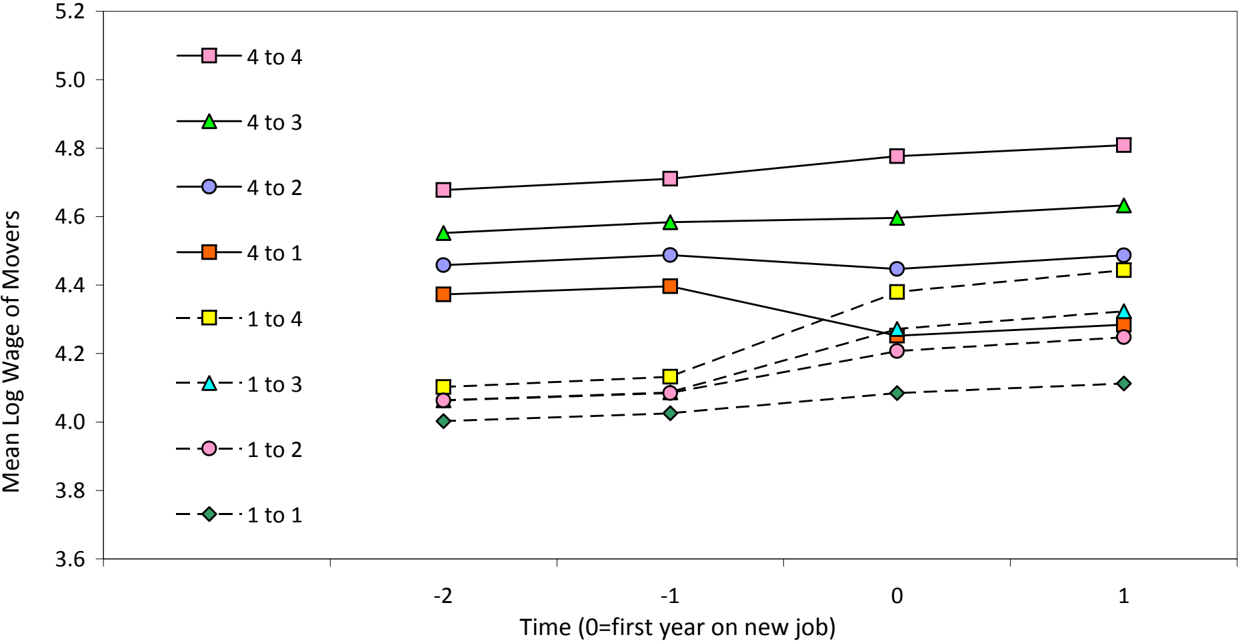
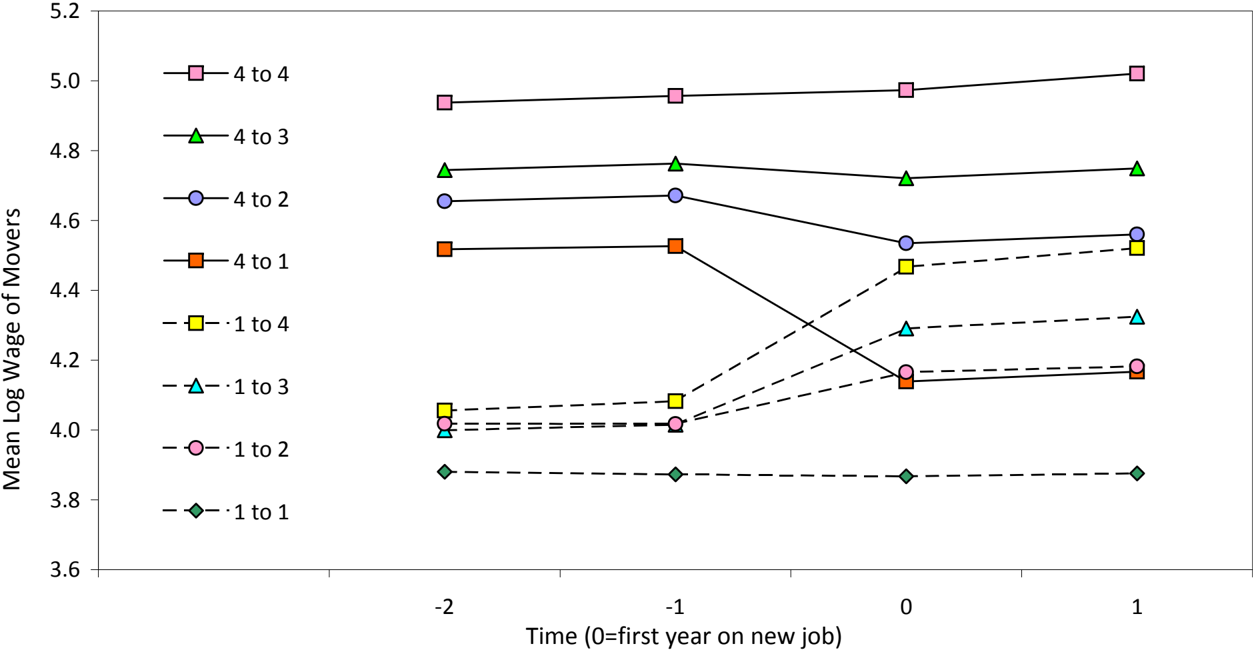
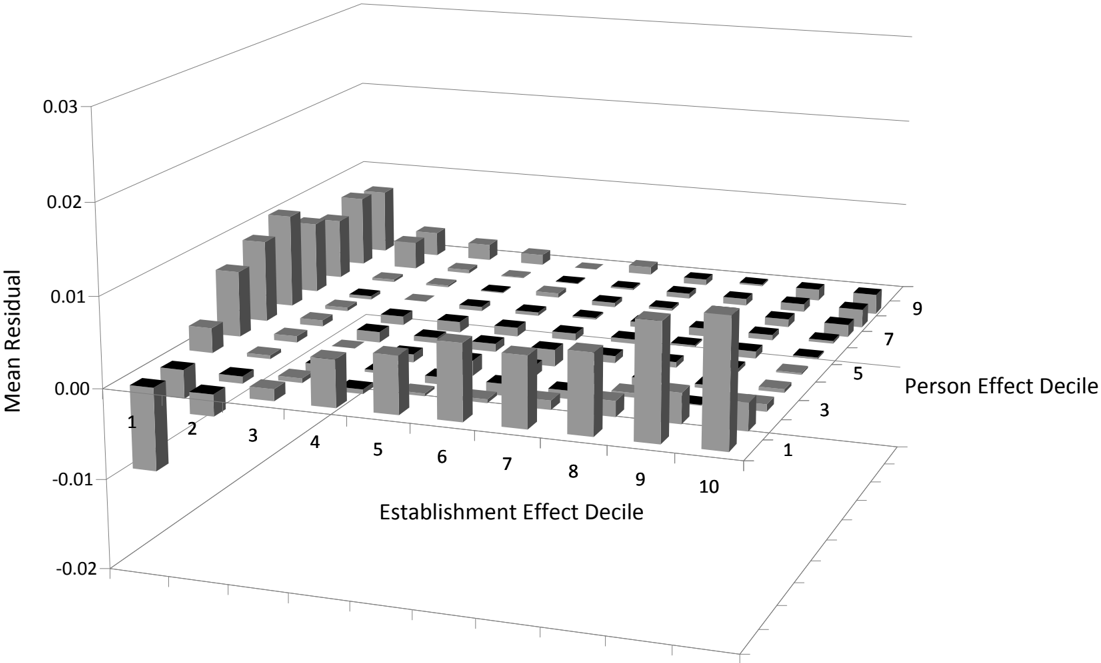
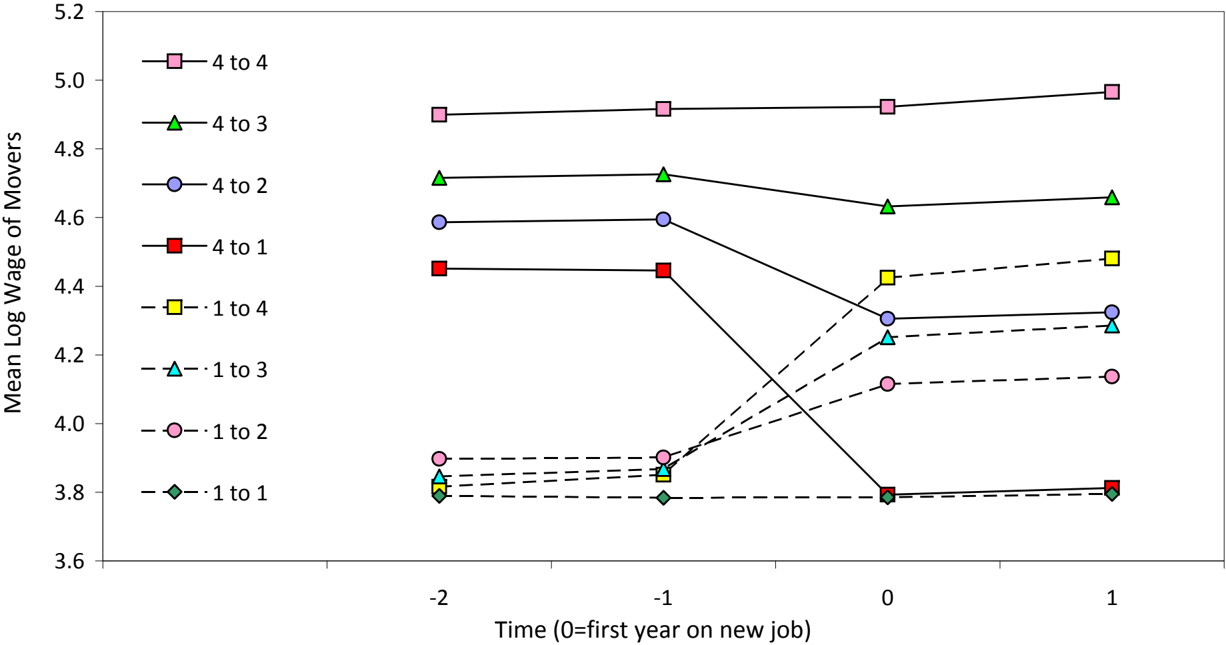
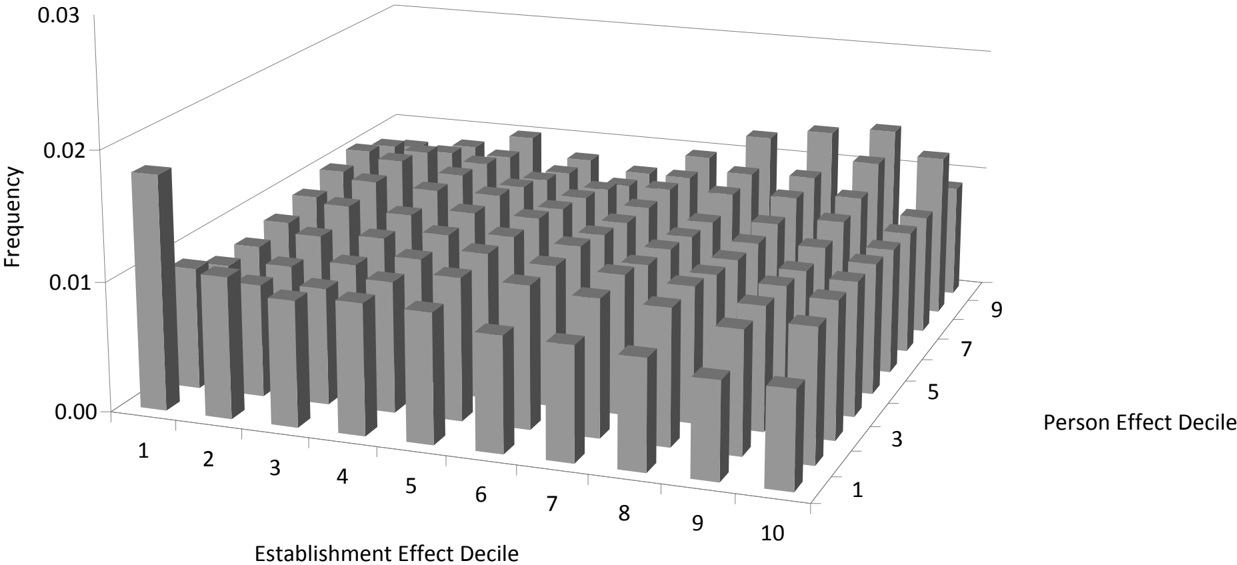
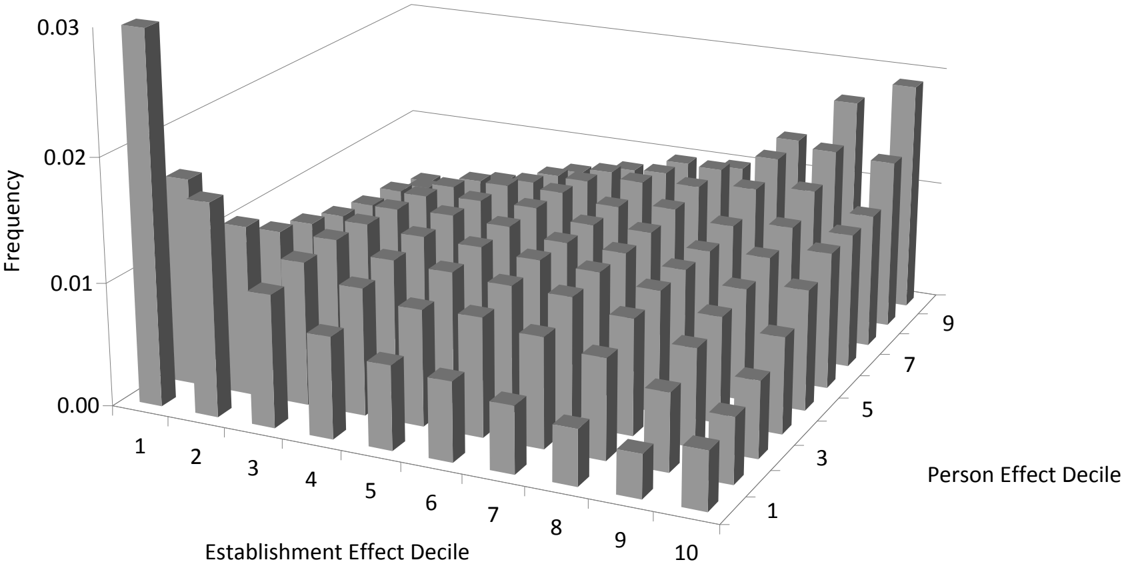
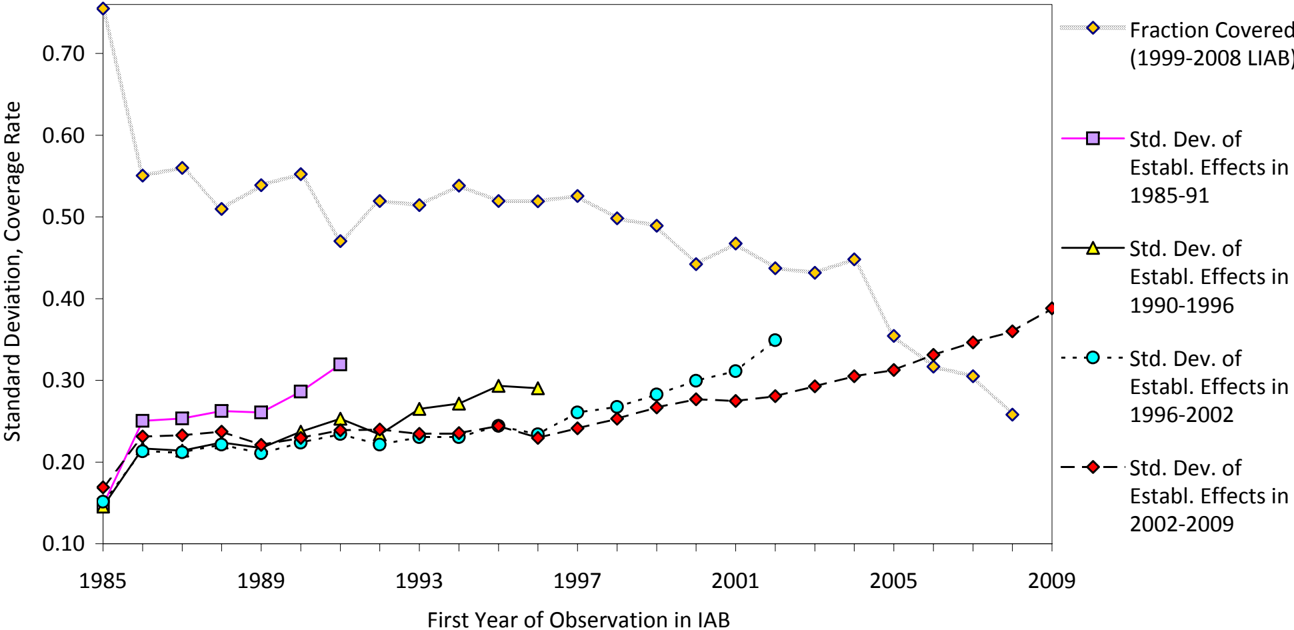
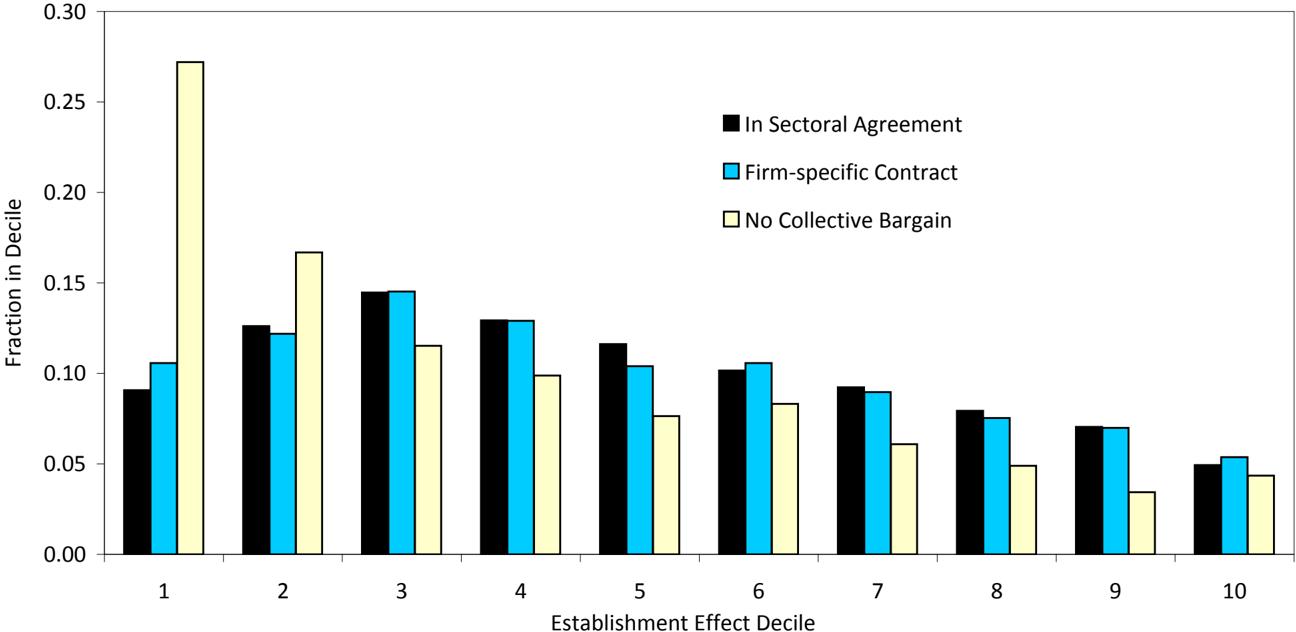
Verification
Claims the paper makes
0 Valid · 0 Not valid · 8 Not checked · 191 Own results and interpretations
A result the paper reports from its own data — it cites no other source for it, so there is none to check. The quote shows it is in the paper.
In the paper
“In particular, generalized non-separable models with xed e/ects for each job yield only a small improvement in explanatory power relative to the AKM speci cation, both within narrow time intervals and between intervals.”
plain- Asserted: passes — The authors put it forward as true.
- Checkable: passes — It can be checked against evidence.
- Load-bearing: passes — The paper’s conclusions depend on it.
- Based: passes — The paper gives a reason why it holds.
A result the paper reports from its own data — it cites no other source for it, so there is none to check. The quote shows it is in the paper.
In the paper
“Classifying establishments by entry year, we nd a trend toward increasing heterogeneity among establishments that entered the labor market after the mid-1990s, coupled with relatively small changes in the variability of the premiums paid by continuing establishments.”
plain- Asserted: passes — The authors put it forward as true.
- Checkable: passes — It can be checked against evidence.
- Load-bearing: passes — The paper’s conclusions depend on it.
- Based: passes — The paper gives a reason why it holds.
A result the paper reports from its own data — it cites no other source for it, so there is none to check. The quote shows it is in the paper.
In the paper
“We nd that two-thirds of the increase in the pay gap between higher and lower-educated workers is attributable to a widening in the average workplace pay premiums received by di/erent education groups.”
plainstates a cause- Asserted: passes — The authors put it forward as true.
- Checkable: passes — It can be checked against evidence.
- Load-bearing: passes — The paper’s conclusions depend on it.
- Based: passes — The paper gives a reason why it holds.
A result the paper reports from its own data — it cites no other source for it, so there is none to check. The quote shows it is in the paper.
In the paper
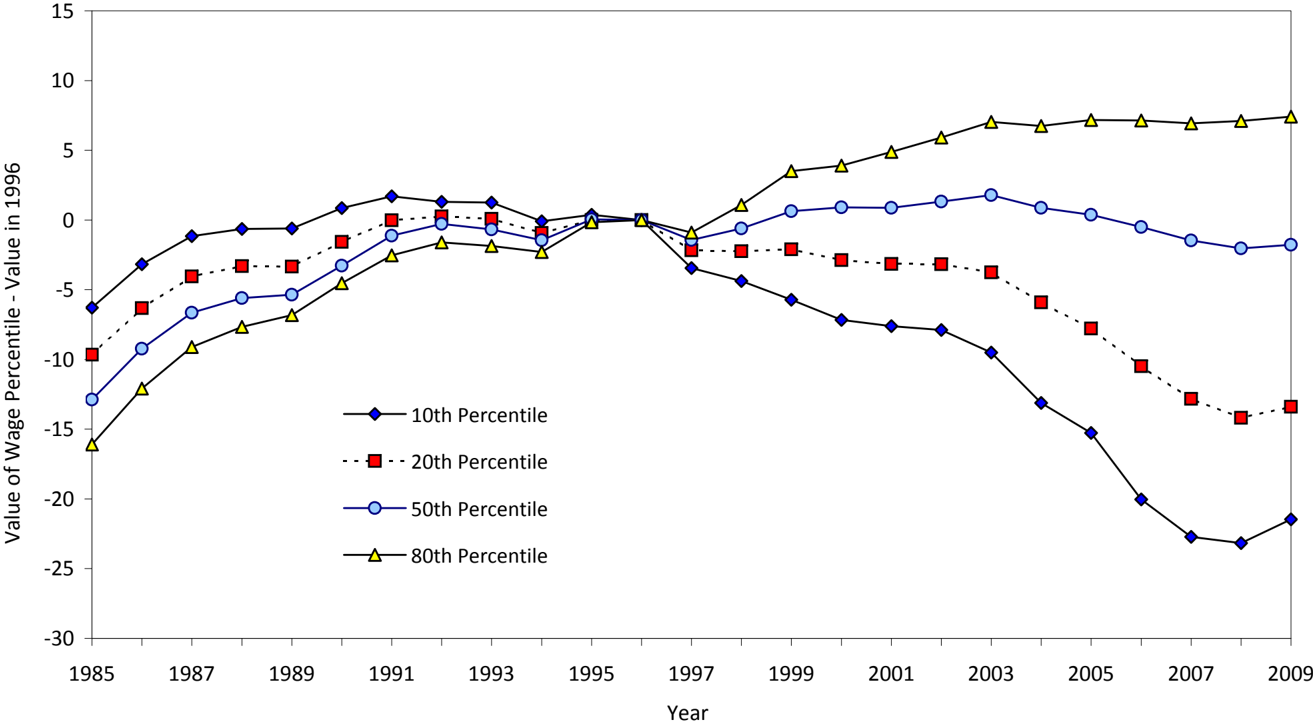
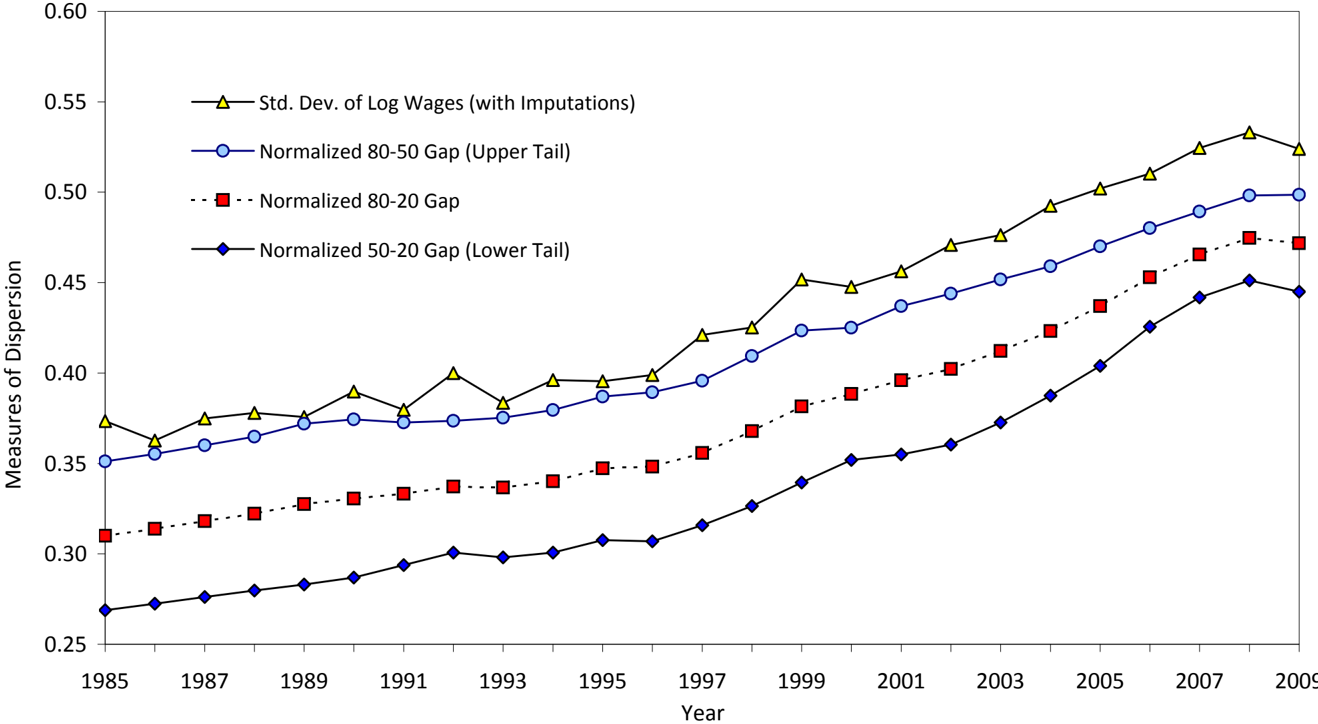
“In particular, the standard deviation rose by 15 log points from 1985 to 2009, the (normalized) 80-20 gap rose by 16 log points, the 80-50 gap rose by 15 log points, and the 50-20 gap rose by 18 log points.”
plain- Asserted: passes — The authors put it forward as true.
- Checkable: passes — It can be checked against evidence.
- Load-bearing: unclear — It is unclear whether the paper’s conclusions depend on it.
- Based: passes — The paper gives a reason why it holds.
118 more claims
Create a free account to see all 199 claims and to verify the 4 references still open.
- It may state two separate claims as one. 61
- Probably not a substantial claim. 17
- The quote only partly states this claim. 3
Claims other papers make about this one
Each is checked against this paper’s own text: does it say what the citing paper says it does?
The check wasn’t confident either way, so it gives no verdict — never disputed.
In the citing paper
“We estimate below that 75% is labor income.16”
From “Capitalists in the Twenty-First Century” (2019) · cites this paper as [16]
Experimental — accuracy not yet measured
Citations
Cites
A heteroskedasticity-consistent covariance matrix estimator and a direct test for heteroskedasticity
White, H. (1980) · Econometrica · doi:10.2307/1912934 · Cited by 25,861
The Skill Content of Recent Technological Change: An Empirical Exploration
Autor, D. H., Levy, F., & Murnane, R. J. (2003) · The Quarterly Journal of Economics · doi:10.1162/003355303322552801 · Cited by 6,205
On the Pooling of Time Series and Cross Section Data
Mundlak, Y. (1978) · Econometrica · doi:10.2307/1913646 · Cited by 5,412
Changes in Relative Wages, 1963-1987: Supply and Demand Factors
Katz, L. F., & Murphy, K. M. (1992) · The Quarterly Journal of Economics · doi:10.2307/2118323 · Cited by 4,793
Equilibrium Unemployment as a Worker Discipline Device
Shapiro, C., & Stiglitz, J. E. (1986) · Efficiency Wage Models of the Labor Market · doi:10.1017/cbo9780511559594.004 · Cited by 4,652
Misallocation and Manufacturing TFP in China and India*
Hsieh, C.-T., & Klenow, P. J. (2009) · Quarterly Journal of Economics · doi:10.1162/qjec.2009.124.4.1403 · Cited by 4,175
Job Creation and Job Destruction in the Theory of Unemployment
Mortensen, D. T., & Pissarides, C. A. (1994) · The Review of Economic Studies · doi:10.2307/2297896 · Cited by 3,840
Hybrid Corn: An Exploration in the Economics of Technological Change
Griliches, Z. (1957) · Econometrica · doi:10.2307/1905380 · Cited by 3,330
Labor Contracts as Partial Gift Exchange
Akerlof, G. A. (1982) · The Quarterly Journal of Economics · doi:10.2307/1885099 · Cited by 3,210
Plants and Productivity in International Trade
Bernard, A. B., Eaton, J., Jensen, J. B., & Kortum, S. (2003) · American Economic Review · doi:10.1257/000282803769206296 · Cited by 2,980
Research works printed but not linked: 1
- 70. Rees, Albert and George Schultz. 1970. Workers in an Urban Labor Market. Chicago: University of Chicago Press.
Cited by
The Growing Importance of Social Skills in the Labor Market*
Deming, D. J. (2017) · The Quarterly Journal of Economics · doi:10.1093/qje/qjx022 · Cited by 1,727
Firms and Labor Market Inequality: Evidence and Some Theory
Card, D., Cardoso, A. R., Heining, J., & Kline, P. (2018) · Journal of Labor Economics · doi:10.1086/694153 · Cited by 919
Self-citationBehavioral Economics: Past, Present, and Future
Thaler, R. H. (2016) · American Economic Review · doi:10.1257/aer.106.7.1577 · Cited by 799
The Arrival of Fast Internet and Employment in Africa
Hjort, J., & Poulsen, J. (2019) · American Economic Review · doi:10.1257/aer.20161385 · Cited by 777
Card, D., Cardoso, A. R., & Kline, P. (2016) · The Quarterly Journal of Economics · doi:10.1093/qje/qjv038 · Cited by 714
Self-citationLearning by Working in Big Cities
Roca, J. D. L., & Puga, D. (2017) · The Review of Economic Studies · doi:10.1093/restud/rdw031 · Cited by 707
Song, J., Price, D. J., Guvenen, F., Bloom, N., & von Wachter, T. (2019) · The Quarterly Journal of Economics · doi:10.1093/qje/qjy025 · Cited by 674
Returns to skills around the world: Evidence from PIAAC
Hanushek, E. A., Schwerdt, G., Wiederhold, S., & Woessmann, L. (2015) · European Economic Review · doi:10.1016/j.euroecorev.2014.10.006 · Cited by 653
From Sick Man of Europe to Economic Superstar: Germany's Resurgent Economy
Dustmann, C., Fitzenberger, B., Schönberg, U., & Spitz-Oener, A. (2014) · Journal of Economic Perspectives · doi:10.1257/jep.28.1.167 · Cited by 595
Do Recessions Accelerate Routine-Biased Technological Change? Evidence from Vacancy Postings
Hershbein, B., & Kahn, L. B. (2018) · American Economic Review · doi:10.1257/aer.20161570 · Cited by 573
The Adjustment of Labor Markets to Robots
Dauth, W., Findeisen, S., Suedekum, J., & Woessner, N. (2021) · Journal of the European Economic Association · doi:10.1093/jeea/jvab012 · Cited by 546
German Robots - The Impact of Industrial Robots on WorkersPreprint
Dauth, W., Findeisen, S., Südekum, J., & Woessner, N. (2017) · RePEc: Research Papers in Economics · Cited by 542
Skill Requirements across Firms and Labor Markets: Evidence from Job Postings for Professionals
Deming, D., & Kahn, L. B. (2018) · Journal of Labor Economics · doi:10.1086/694106 · Cited by 508
Ranking Firms Using Revealed Preference*
Sorkin, I. (2018) · The Quarterly Journal of Economics · doi:10.1093/qje/qjy001 · Cited by 503
Sources of Geographic Variation in Health Care: Evidence From Patient Migration*
Finkelstein, A., Gentzkow, M., & Williams, H. (2016) · The Quarterly Journal of Economics · doi:10.1093/qje/qjw023 · Cited by 500
“As further support for additive separability, we follow Card et al. (2013) and show that the increase in R2 when we fully saturate the model with patient-place fixed effects is relatively small.”
Subnational leaders and economic growth: evidence from Chinese cities
Yao, Y., & Zhang, M. (2015) · Journal of Economic Growth · doi:10.1007/s10887-015-9116-1 · Cited by 462
Trade and Inequality: From Theory to Estimation
Helpman, E., Itskhoki, O., Muendler, M.-A., & Redding, S. J. (2017) · The Review of Economic Studies · doi:10.1093/restud/rdw025 · Cited by 443
Do Higher Corporate Taxes Reduce Wages? Micro Evidence from Germany
Fuest, C., Peichl, A., & Siegloch, S. (2018) · American Economic Review · doi:10.1257/aer.20130570 · Cited by 385
Who Profits from Patents? Rent-Sharing at Innovative Firms*
Kline, P., Petkova, N., Williams, H., & Zidar, O. (2019) · The Quarterly Journal of Economics · doi:10.1093/qje/qjz011 · Cited by 384
Self-citationThe Morale Effects of Pay Inequality*
Breza, E., Kaur, S., & Shamdasani, Y. (2018) · The Quarterly Journal of Economics · doi:10.1093/qje/qjx041 · Cited by 370
Barth, E., Bryson, A., Davis, J. C., & Freeman, R. (2016) · Journal of Labor Economics · doi:10.1086/684045 · Cited by 361
An Introductory Guide to Event Study Models
Miller, D. L. (2023) · Journal of Economic Perspectives · doi:10.1257/jep.37.2.203 · Cited by 360
“The Rise of Domestic Outsourcing and the Evolution of the German Wage Structure”
Goldschmidt, D., & Schmieder, J. F. (2017) · The Quarterly Journal of Economics · doi:10.1093/qje/qjx008 · Cited by 340
Unions and Inequality over the Twentieth Century: New Evidence from Survey Data
Farber, H. S., Herbst, D., Kuziemko, I., & Naidu, S. (2021) · The Quarterly Journal of Economics · doi:10.1093/qje/qjab012 · Cited by 334
Reallocation Effects of the Minimum Wage
Dustmann, C., Lindner, A., Schönberg, U., Umkehrer, M., & vom Berge, P. (2021) · The Quarterly Journal of Economics · doi:10.1093/qje/qjab028 · Cited by 322
Unions and Inequality Over the Twentieth Century: New Evidence from Survey Data
Farber, H., Herbst, D., Kuziemko, I., & Naidu, S. (2018) · National Bureau of Economic Research · doi:10.3386/w24587 · Cited by 319
Bloom, N., Sadun, R., & Van Reenen, J. (2016) · National Bureau of Economic Research · doi:10.3386/w22327 · Cited by 306
Monopsony in Labor Markets: A Review
Manning, A. (2021) · ILR Review · doi:10.1177/0019793920922499 · Cited by 296
Management Practices, Workforce Selection, and Productivity
Bender, S., Bloom, N., Card, D., Van Reenen, J., & Wolter, S. (2018) · Journal of Labor Economics · doi:10.1086/694107 · Cited by 291
Self-citationA Distributional Framework for Matched Employer Employee Data
Bonhomme, S., Lamadon, T., & Manresa, E. (2019) · Econometrica · doi:10.3982/ecta15722 · Cited by 282
Payroll Taxes, Firm Behavior, and Rent Sharing: Evidence from a Young Workers' Tax Cut in Sweden
Saez, E., Schoefer, B., & Seim, D. (2019) · American Economic Review · doi:10.1257/aer.20171937 · Cited by 280
Employment Hysteresis from the Great Recession
Yagan, D. (2019) · Journal of Political Economy · doi:10.1086/701809 · Cited by 277
Cornelissen, T., Dustmann, C., & Schönberg, U. (2017) · American Economic Review · doi:10.1257/aer.20141300 · Cited by 265
“Capitalists in the Twenty-First Century”
Smith, M., Yagan, D., Zidar, O., & Zwick, E. (2019) · The Quarterly Journal of Economics · doi:10.1093/qje/qjz020 · Cited by 263
Asset Manager Capitalism as a Corporate Governance Regime
Braun, B. (2021) · Cambridge University Press eBooks · doi:10.1017/9781009029841.010 · Cited by 255
Flabbi, L., Macis, M., Moro, A., & Schivardi, F. (2019) · The Economic Journal · doi:10.1093/ej/uez012 · Cited by 254
The Costs of Job Displacement Over the Business Cycle and its Sources: Evidence from Germany
Schmieder, J. F., von Wachter, T., & Heining, J. (2022) · American Economic Review · doi:10.1257/aer.20200252 · Cited by 244
Self-citationCoverage and representativeness of Orbis data
Bajgar, M., Berlingieri, G., Calligaris, S., Criscuolo, C., & Timmis, J. (2020) · OECD science, technology and industry working papers · doi:10.1787/c7bdaa03-en · Cited by 239
Berlingieri, G., Blanchenay, P., & Criscuolo, C. (2017) · OECD science, technology and industry policy papers · doi:10.1787/953f3853-en · Cited by 237
Firms and the Decline in Earnings Inequality in Brazil
Alvarez, J. A., Benguria, F., Engbom, N., & Moser, C. (2018) · American Economic Journal Macroeconomics · doi:10.1257/mac.20150355 · Cited by 229
Digital Innovation and the Distribution of Income
Guellec, D., & Paunov, C. (2017) · National Bureau of Economic Research · doi:10.3386/w23987 · Cited by 227
JEEA-FBBVA LECTURE 2013: THE NEW EMPIRICAL ECONOMICS OF MANAGEMENT: The New Empirics of Management
Bloom, N., Lemos, R., Sadun, R., Scur, D., & Van Reenen, J. (2014) · Journal of the European Economic Association · doi:10.1111/jeea.12094 · Cited by 225
Leveraging Lotteries for School Value-Added: Testing and Estimation*
Angrist, J. D., Hull, P. D., Pathak, P. A., & Walters, C. R. (2017) · The Quarterly Journal of Economics · doi:10.1093/qje/qjx001 · Cited by 157
Mueller, H. M., Ouimet, P. P., & Simintzi, E. (2017) · The Review of Financial Studies · doi:10.1093/rfs/hhx032 · Cited by 217
Song, J. G., Price, D. J., Guvenen, F., Bloom, N., & von Wachter, T. (2015) · National Bureau of Economic Research · doi:10.3386/w21199 · Cited by 212
Card, D. (2022) · American Economic Review · doi:10.1257/aer.112.4.1075 · Cited by 210
Self-citationBesley, T., Burgess, R., Khan, A., & Xu, G. (2022) · Annual Review of Economics · doi:10.1146/annurev-economics-080521-011950 · Cited by 205
Inequality and Aggregate Demand
Auclert, A., & Rognlie, M. (2018) · National Bureau of Economic Research · doi:10.3386/w24280 · Cited by 203
Cyclical Job Ladders by Firm Size and Firm Wage
Haltiwanger, J., Hyatt, H. R., Kahn, L., & McEntarfer, E. (2018) · American Economic Journal Macroeconomics · doi:10.1257/mac.20150245 · Cited by 200
The Growing Importance of Social Skills in the Labor Market
Deming, D. (2015) · National Bureau of Economic Research · doi:10.3386/w21473 · Cited by 197
Place-Based Policies and Spatial Disparities across European Cities
Ehrlich, M. V., & Overman, H. G. (2020) · The Journal of Economic Perspectives · doi:10.1257/jep.34.3.128 · Cited by 195
Estimation of a Roy/Search/Compensating Differential Model of the Labor Market
Taber, C. R., & Vejlin, R. (2016) · Econometrica · doi:10.2139/ssrn.2790012 · Cited by 195
Sources of Displaced Workers’ Long-Term Earnings Losses
Lachowska, M., Mas, A., & Woodbury, S. A. (2020) · American Economic Review · doi:10.1257/aer.20180652 · Cited by 194
The Origins of Firm Heterogeneity: A Production Network Approach
Bernard, A. B., Dhyne, E., Magerman, G., Manova, K. B., & Moxnes, A. (2018) · Journal of Political Economy · doi:10.1086/719759 · Cited by 193
Adam Cobb, J. (2016) · Academy of Management Review · doi:10.5465/amr.2013.0451 · Cited by 191
Jäger, S., Schoefer, B., & Heining, J. (2019) · The Quarterly Journal of Economics · doi:10.2139/ssrn.3495776 · Cited by 193
Self-citationWage Inequality and Firm Growth
Mueller, H. M., Ouimet, P., & Simintzi, E. (2014) · American Economic Review · doi:10.1257/aer.p20171014 · Cited by 190
Leave‐Out Estimation of Variance Components
Kline, P., Saggio, R., & Sølvsten, M. (2020) · Econometrica · doi:10.3982/ecta16410 · Cited by 186
Self-citationIncreasing differences between firms: market power and the macro-economyPreprint
Reenen, J. M. V. (2018) · RePEc: Research Papers in Economics · Cited by 186
How Much Should We Trust Estimates of Firm Effects and Worker Sorting?
Bonhomme, S., Holzheu, K., Lamadon, T., Manresa, E., Mogstad, M., & Setzler, B. (2022) · Journal of Labor Economics · doi:10.1086/720009 · Cited by 185
Searching for Job Security and the Consequences of Job Loss
Jarosch, G. (2021) · National Bureau of Economic Research · doi:10.3386/w28481 · Cited by 184
Place-Based Drivers of Mortality: Evidence from Migration
Finkelstein, A., Gentzkow, M., & Williams, H. (2021) · American Economic Review · doi:10.1257/aer.20190825 · Cited by 183
Searching for Job Security and the Consequences of Job Loss
Jarosch, G. (2021) · Econometrica · doi:10.3982/ecta14008 · Cited by 185
Managers and Productivity in the Public Sector
Fenizia, A. (2022) · Econometrica · doi:10.3982/ecta19244 · Cited by 182
The New Empirical Economics of Management
Bloom, N., Lemos, R., Sadun, R., Scur, D., & Van Reenen, J. (2014) · National Bureau of Economic Research · doi:10.3386/w20102 · Cited by 179
Worker Beliefs About Outside Options
Jäger, S., Roth, C., Roussille, N., & Schoefer, B. (2024) · The Quarterly Journal of Economics · doi:10.1093/qje/qjae001 · Cited by 177
Adjusting to Robots: Worker-Level EvidencePreprint
Dauth, W., Findeisen, S., Suedekum, J., & Woessner, N. (2018) · doi:10.21034/iwp.13 · Cited by 176
Klein, N., Kneib, T., Lang, S., & Silbersdorff, A. (2015) · The Annals of Applied Statistics · doi:10.1214/15-aoas823 · Cited by 175
Spillover Effects of Mass Layoffs
Gathmann, C., Helm, I., & Schönberg, U. (2018) · Journal of the European Economic Association · doi:10.1093/jeea/jvy045 · Cited by 174
Earnings Inequality and the Minimum Wage: Evidence from Brazil
Engbom, N., & Moser, C. (2022) · American Economic Review · doi:10.1257/aer.20181506 · Cited by 170
Falck, O., Heimisch, A., & Wiederhold, S. (2016) · Research Policy · doi:10.1016/j.respol.2020.104064 · Cited by 184
Job Referral Networks and the Determination of Earnings in Local Labor Markets
Schmutte, I. M. (2015) · Journal of Labor Economics · doi:10.1086/677389 · Cited by 167
Mas, A., & Pallais, A. (2020) · Annual Review of Economics · doi:10.1146/annurev-economics-022020-032512 · Cited by 164
Lifetime Earnings Inequality in Germany
Bönke, T., Corneo, G. G., & Lüthen, H. (2014) · Journal of Labor Economics · doi:10.1086/677559 · Cited by 161
THE IMPACT OF CHANGING YOUTH EMPLOYMENT PATTERNS ON FUTURE WAGESPreprint
Umkehrer, M. (2014) · RePEc: Research Papers in Economics · Cited by 161
Dauth, W., Findeisen, S., Moretti, E., & Suedekum, J. (2022) · Journal of the European Economic Association · doi:10.1093/jeea/jvac004 · Cited by 159
Identifying Equilibrium Models of Labor Market Sorting
Hagedorn, M., Law, T. H., & Manovskii, I. (2012) · Econometrica · doi:10.3982/ecta11301 · Cited by 154
THE DRIVERS OF INCOME INEQUALITY IN RICH COUNTRIES
Nolan, B. W., Richiardi, M. G., & Valenzuela, L. (2019) · Journal of Economic Surveys · doi:10.1111/joes.12328 · Cited by 153
The Cycle of Earnings Inequality: Evidence from Spanish Social Security Data
Bonhomme, S., & Hospido, L. (2016) · The Economic Journal · doi:10.1111/ecoj.12368 · Cited by 153
Team Players: How Social Skills Improve Team Performance
Weidmann, B., & Deming, D. J. (2021) · Econometrica · doi:10.3982/ecta18461 · Cited by 156
Individuals and Organizations as Sources of State Effectiveness
Best, M., Hjort, J., & Szakonyi, D. (2023) · American Economic Review · doi:10.1257/aer.20191598 · Cited by 147
Jäger, S., Noy, S., & Schoefer, B. (2021) · Industrial and Labor Relations Review · doi:10.1177/00197939211065727 · Cited by 148
Rising between-workplace inequalities in high-income countries
Tomaskovic‐Devey, D., Rainey, A., Avent‐Holt, D., Bandelj, N., Boza, I., Cort, D. A., Godechot, O., Hajdú, G., Hällsten, M., Henriksen, L. F., et al. (2020) · Proceedings of the National Academy of Sciences · doi:10.1073/pnas.1918249117 · Cited by 146
Firm Wage Differentials and Labor Market Sorting: Reconciling Theory and Evidence
de Melo, R. L. (2017) · Journal of Political Economy · doi:10.1086/695505 · Cited by 145
Why Do Sectoral Employment Programs Work? Lessons from WorkAdvance
Katz, L. F., Roth, J., Hendra, R., & Schaberg, K. (2020) · Journal of Labor Economics · doi:10.1086/717932 · Cited by 144
Preparing the sample of integrated labour market biographies (SIAB) for scientific analysis: a guide
Dauth, W., & Eppelsheimer, J. (2020) · Journal for Labour Market Research · doi:10.1186/s12651-020-00275-9 · Cited by 143
The Costs of Corporate Tax Complexity
Zwick, E. (2021) · American Economic Journal Economic Policy · doi:10.1257/pol.20180406 · Cited by 145
Understanding Declining Fluidity in the U.S. Labor Market
Molloy, R. S., Trezzi, R., Smith, C. L., & Wozniak, A. K. (2016) · Brookings Papers on Economic Activity · doi:10.1353/eca.2016.0015 · Cited by 141
Independent directors: Less informed but better selected than affiliated board members?
Cavaco, S., Crifo, P., Rebérioux, A., & Roudaut, G. (2017) · Journal of Corporate Finance · doi:10.1016/j.jcorpfin.2017.01.004 · Cited by 141
The Disappearing Large-Firm Wage Premium
Bloom, N., Guvenen, F., Smith, B. S., Song, J. G., & von Wachter, T. (2018) · AEA Papers and Proceedings · doi:10.1257/pandp.20181066 · Cited by 139
Individuals and Organizations as Sources of State Effectiveness
Best, M., Hjort, J., & Szakonyi, D. (2017) · National Bureau of Economic Research · doi:10.3386/w23350 · Cited by 141
Barth, E., Bryson, A., Davis, J. C., & Freeman, R. B. (2014) · National Bureau of Economic Research · doi:10.3386/w20447 · Cited by 136
Monopsony in Movers: The Elasticity of Labor Supply to Firm Wage Policies
Bassier, I., Dubé, A., & Naidu, S. (2021) · The Journal of Human Resources · doi:10.3368/jhr.monopsony.0319-10111r1 · Cited by 135
Exports and Wages: Rent Sharing, Workforce Composition, or Returns to Skills?
Macis, M., & Schivardi, F. (2016) · Journal of Labor Economics · doi:10.1086/686275 · Cited by 135
Gérard, F., Lagos, L., Severnini, E., & Card, D. (2021) · American Economic Review · doi:10.1257/aer.20181596 · Cited by 135
Self-citationRising Inequality As a Threat to the Liberal International Order
Flaherty, T., & Rogowski, R. L. (2021) · International Organization · doi:10.1017/s0020818321000163 · Cited by 132
How Substitutable Are Workers? Evidence from Worker Deaths
JJger, S. (2016) · SSRN Electronic Journal · doi:10.2139/ssrn.2925897 · Cited by 14
Understanding the Present and Future of Work in the Fissured Workplace Context
Weil, D. (2019) · RSF The Russell Sage Foundation Journal of the Social Sciences · doi:10.7758/rsf.2019.5.5.08 · Cited by 131
International Migration Outlook 2025
OECD (2025) · International migration outlook · doi:10.1787/ae26c893-en · Cited by 130
It ain’t where you’re from, it’s where you’re at: Hiring origins, firm heterogeneity, and wages
Addario, S. L. D., Kline, P., Saggio, R., & Sølvsten, M. (2022) · Journal of Econometrics · doi:10.1016/j.jeconom.2021.12.017 · Cited by 129
Self-citation
Metadata
- Authors
- Card, D., Heining, J., & Kline, P.
- Affiliations
- University of California, Berkeley (US)
- Corresponding author
- Kline, Patrick
- ORCID
- Card, David
- Venue
- The Quarterly Journal of Economics
- Publisher
- Oxford University Press (OUP)
- Published
- 2013-05-02
- Volume
- 128
- Issue
- 3
- Pages
- 967-1015
- ISSN
- 0033-5533 (ISSN-L)
- 1531-4650
- OpenAlex
- W2141295263
- Cited by
- 1,904
- References
- 146
- Citations by year
- 2026: 153 · 2025: 204 · 2024: 228 · 2023: 156 · 2022: 185 · 2021: 178 · 2020: 143 · 2019: 125 · 2018: 156 · 2017: 113 · 2016: 105 · 2015: 71 · 2014: 58 · 2013: 22
- FWCI
- 118.40
- Type
- journal article
- Language
- en
- Open access
- closed
- Locations
- The Quarterly Journal of Economics (publishedVersion)
- RePEc: Research Papers in Economics (submittedVersion)
- Econstor (Econstor) (submittedVersion)
- Funders
- Washington Center for Equitable Growth
- Topics
- Social Sciences › Economics, Econometrics and Finance › Economics and Econometrics › Labor market dynamics and wage inequality
- Social Sciences › Economics, Econometrics and Finance › Economics and Econometrics › Historical Economic and Social Studies
- Social Sciences › Sociology and Political Science › Income, Poverty, and Inequality
- Keywords
- wage inequality, job matching, fixed effects model, education and wages
About these checks
Registry, retraction, Cites and statistics results are computed, not judged, with one exception: a printed reference that no index lists is read once by a model before it counts as a citation error. Claims are extracted by a model and kept only when their quote appears verbatim in the text; each cited source is then checked, with a model’s help, for whether it says what the claim relies on. Those verdicts can be wrong — read the claim’s quote and the cited source before relying on one.
A language model drew the claims from the paper on 2026-11-17, under version 3 of the claim definition (model deepseek-v4.1-flash, prompt extract-v3).
A second model labelled each claim on 2026-11-17 (model jev-1.13-20260917, definition revision gold-guideline-v0.2).
Statistics and arithmetic are recomputed, not judged.
Confidence bands are shown only for fields calibrated on our annotated test set. None is calibrated yet, so no band is shown.
What counts as a claim ›How we measure confidence ›How we check this ›
Are you an author, or do you see a problem with this page? Request a review
Data sources
Bibliographic data: Semantic Scholar, OpenAlex, Crossref.
Contains information from the Semantic Scholar Academic Graph Datasets, made available under the ODC Attribution License (ODC-BY 1.0).
Semantic Scholar’s data is described in: Kinney, R., et al. (2023). The Semantic Scholar Open Data Platform. arXiv:2301.10140.
