

Workplace Heterogeneity and the Rise of West German Wage Inequality*
The DOI matches its Crossref record; 144 of the 147 references it cites were found in a registry or an index, and 1 are not checked yet; none of the 8 sources its claims cite is checked for support yet.
Abstract
We study the role of establishment-specific wage premiums in generating recent increases in West German wage inequality. Models with additive fixed effects for workers and establishments are fit into four subintervals spanning the period from 1985 to 2009. We show that these models provide a good approximation to the wage structure and can explain nearly all of the dramatic rise in West German wage inequality. Our estimates suggest that the increasing dispersion of West German wages has arisen from a combination of rising heterogeneity between workers, rising dispersion in the wage premiums at different establishments, and increasing assortativeness in the assignment of workers to plants. In contrast, the idiosyncratic job-match component of wage variation is small and stable over time. Decomposing changes in mean wages between different education groups, occupations, and industries, we find that increasing plant-level heterogeneity and rising assortativeness in the assignment of workers to establishments explain a large share of the rise in inequality along all three dimensions.
Checked 2026-11-19 · 1 reference not checked yet
Overview
CoChat Summary
TL;DR
Using West German administrative data from 1985–2009, the paper shows that models with additive person and establishment fixed effects explain nearly all of the rise in wage inequality. The increase is driven by rising worker-effect variance, rising establishment-premium variance, and increased assortative matching of high-wage workers to high-wage plants.
Key findings
- In the AKM variance decomposition, total log-wage variance rose from 0.137 in interval 1 (1985–1991) to 0.249 in interval 4 (2002–2009). The variance of person effects rose from 0.084 to 0.127 and contributed 39% of the total rise; establishment-effect variance rose from 0.025 to 0.053 and contributed 25%; the covariance term rose from 0.003 to 0.041 and contributed 34%.
- Assortative matching increased: the correlation between person and establishment effects rose from 0.034 in interval 1 to 0.249 in interval 4. Counterfactuals imply that holding sorting constant would have produced 69% of the actual variance rise, while holding establishment-effect variance constant would have produced 64%.
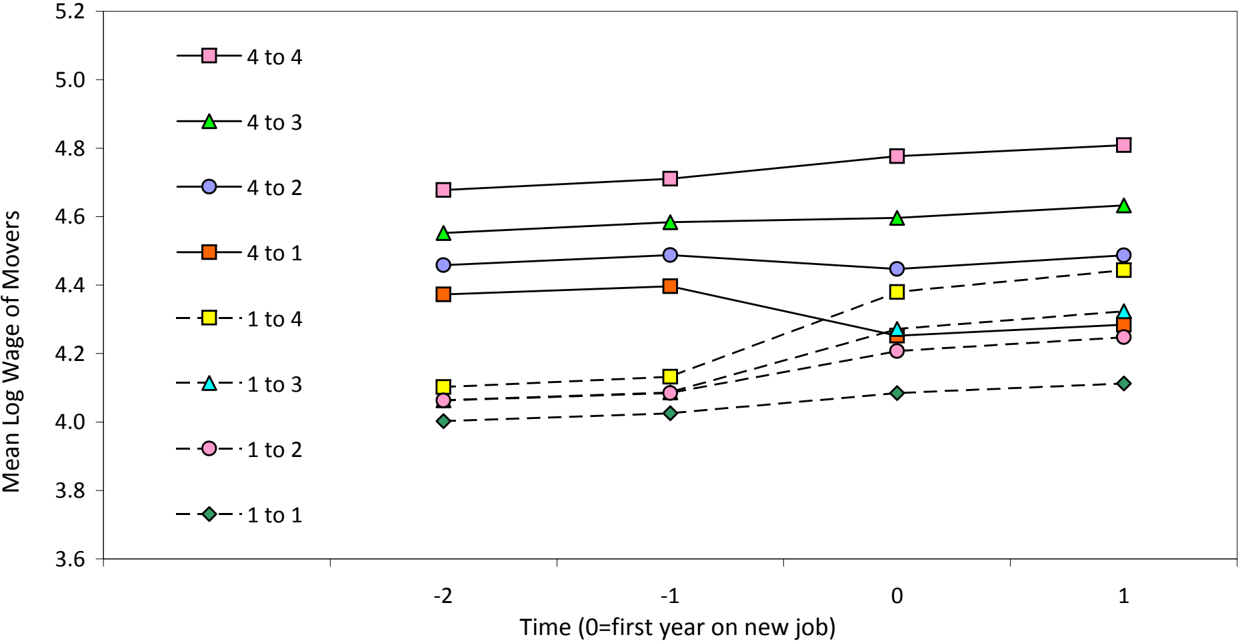
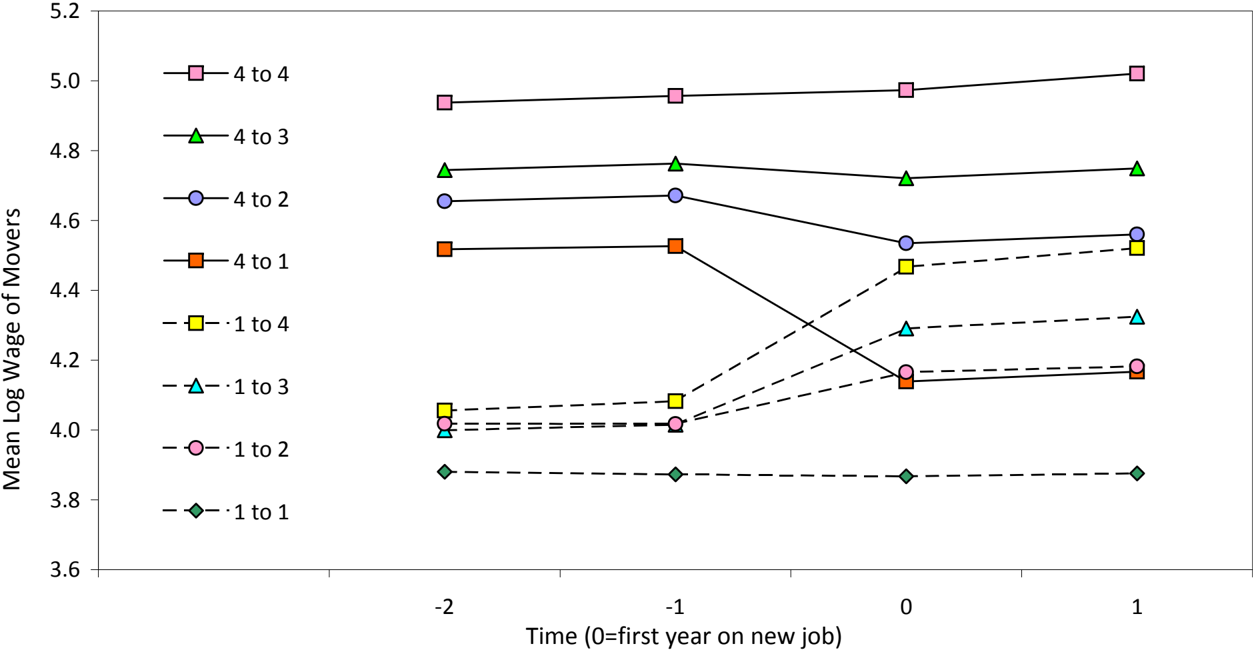
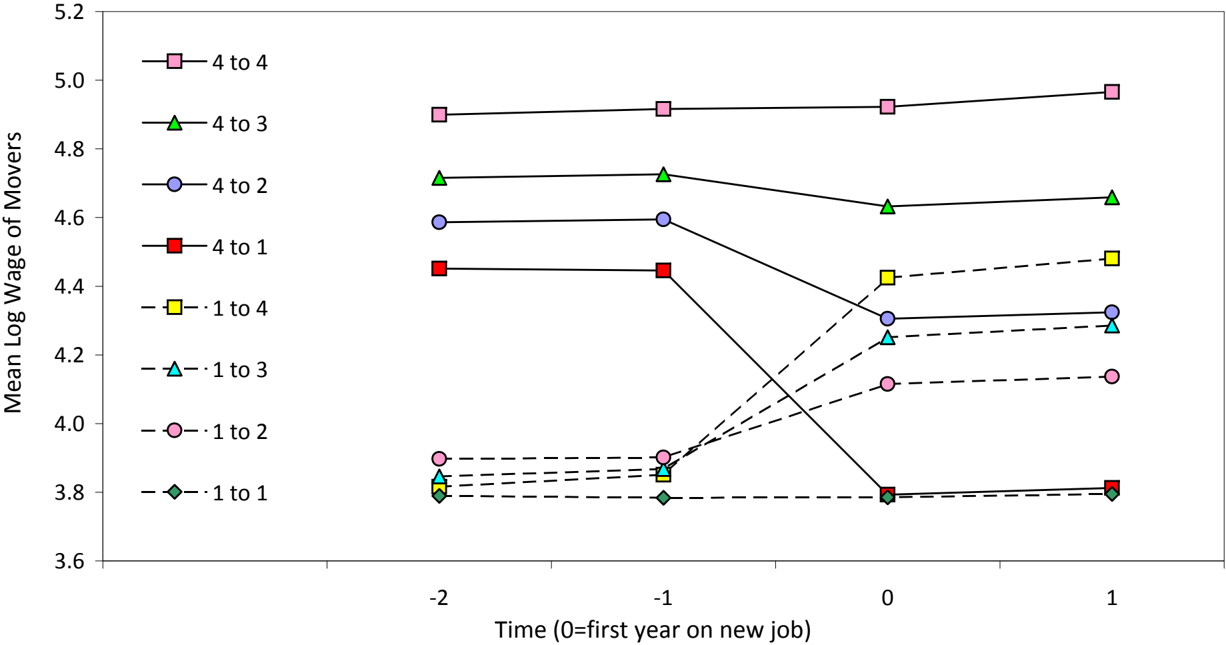
- Job-mobility event studies show growing establishment premia: a trend-adjusted move from quartile 1 to quartile 4 co-worker-wage establishments was associated with a 23 log-point gain in 1985–1991 versus 47 log points in 2002–2009; the reverse move yielded losses of 22 versus 43 log points.
- Between-group decompositions attribute 70% of the relative rise in university-educated men’s wages and 80% of the relative fall for workers with no/missing qualifications to establishment effects. For occupations, 42% of the rise in between-occupation variance is from person–establishment covariance, 28% from establishment variance, and about 30% from person variance; for industries, 44% is person variance, 19% establishment variance, and 42% sorting.
Methods
- Data: German Social Security records from the IEB, focusing on full-time West German men age 20–60 from 1985–2009, with parallel analyses for full-time women. The main sample has 85–90 million person-year observations per interval and about 17 million individual workers.
- Model: AKM-style log daily wage equation with additive person fixed effects, establishment fixed effects, time-varying covariates, and an error component; estimated by OLS on the largest connected set of establishments linked by worker mobility. Censored earnings are imputed using Tobit models.
- Analyses: variance decompositions and counterfactuals across four overlapping intervals (1985–1991, 1990–1996, 1996–2002, 2002–2009); event studies of job changers; decompositions of between-group wage gaps by education, occupation, and industry; and establishment cohort/collective-bargaining analyses.
Limitations
- The paper states that earnings are censored at the Social Security maximum (10–12% of male observations and 1–3% of female observations per year), so it uses Tobit imputation and checks robustness using apprentice-trained men, who have lower censoring rates.
- The paper states that establishment identifiers are administrative: ownership changes can create new establishment IDs, and only about half of EID births/deaths are estimated to be true plant openings/closings. It also states that sampling errors bias estimated variances upward and the covariance downward, and it does not construct bias-corrected estimates, assuming biases are similar across intervals.
- The paper states that collective bargaining cannot be assigned a causal role because firms choose coverage, and that female estimates may have more negatively biased covariance terms due to fewer observed matches per plant/worker. Evident from the text: the main analysis is restricted to full-time workers in West Germany, excluding civil servants, self-employed, and many part-time/mini-job workers, which limits generalizability.
Model-written summary. Check it against the paper before relying on it.
Integrity signals
Registry
Cites
Statistics
Figures


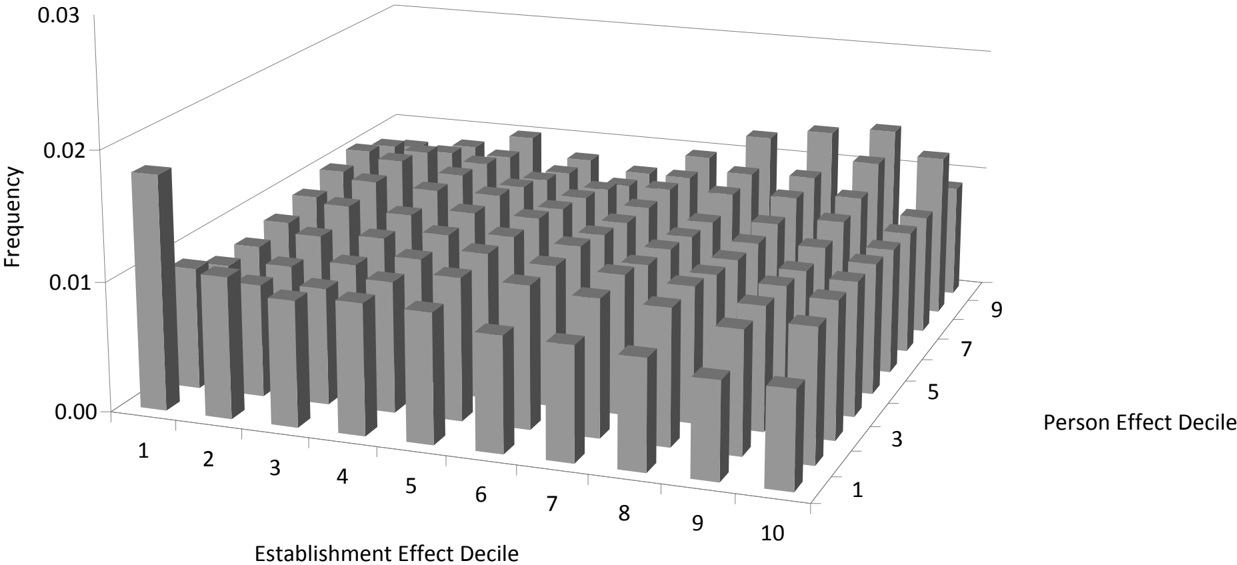
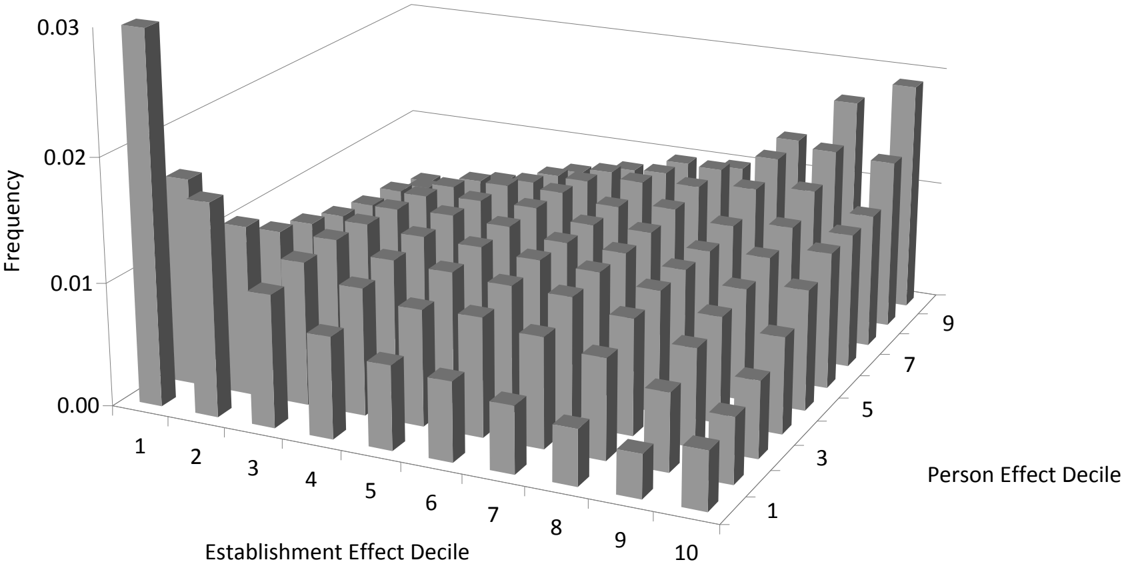
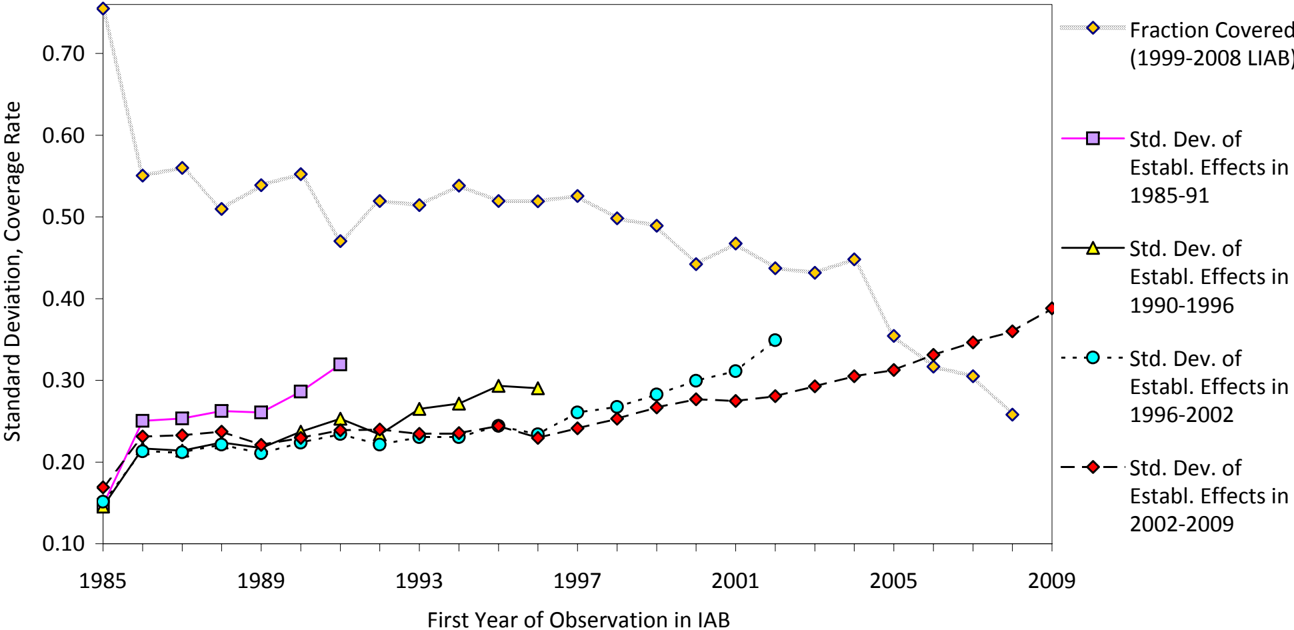
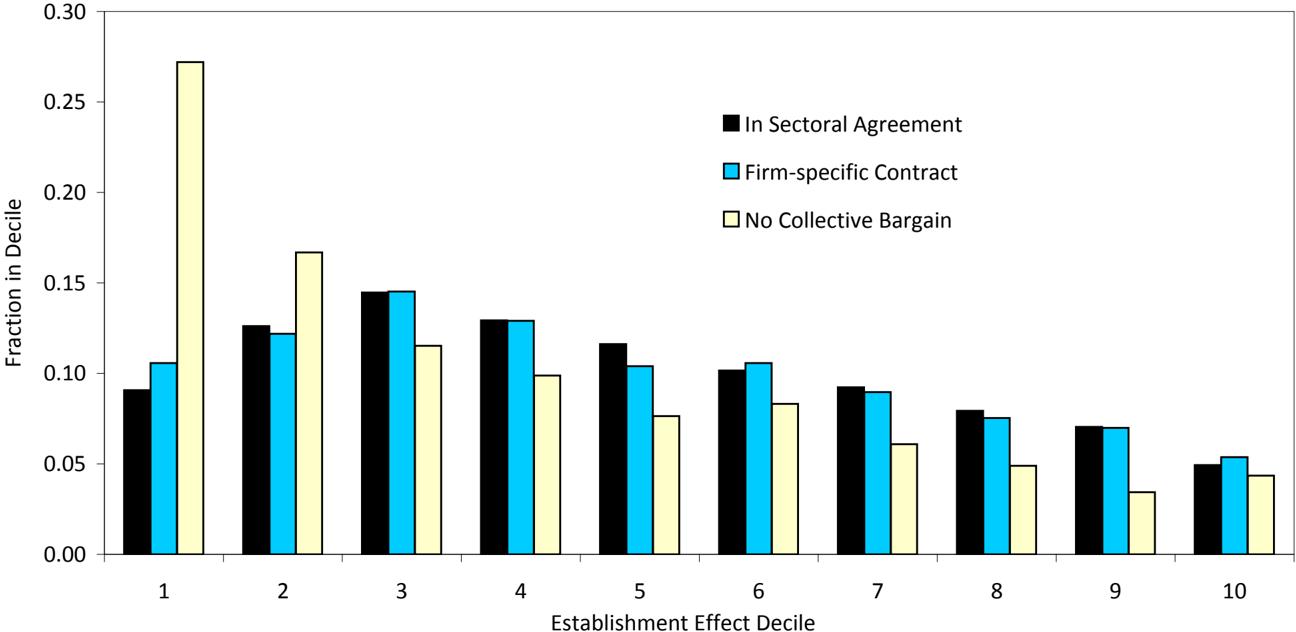
Verification
Claims the paper makes
0 Valid · 0 Not valid · 8 Not checked · 191 Own results and interpretations
A result the paper reports from its own data — it cites no other source for it, so there is none to check. The quote shows it is in the paper.
In the paper
“In particular, generalized non-separable models with xed e/ects for each job yield only a small improvement in explanatory power relative to the AKM speci cation, both within narrow time intervals and between intervals.”
plain- Asserted: passes — The authors put it forward as true.
- Checkable: passes — It can be checked against evidence.
- Load-bearing: passes — The paper’s conclusions depend on it.
- Based: passes — The paper gives a reason why it holds.
A result the paper reports from its own data — it cites no other source for it, so there is none to check. The quote shows it is in the paper.
In the paper
“Classifying establishments by entry year, we nd a trend toward increasing heterogeneity among establishments that entered the labor market after the mid-1990s, coupled with relatively small changes in the variability of the premiums paid by continuing establishments.”
plain- Asserted: passes — The authors put it forward as true.
- Checkable: passes — It can be checked against evidence.
- Load-bearing: passes — The paper’s conclusions depend on it.
- Based: passes — The paper gives a reason why it holds.
A result the paper reports from its own data — it cites no other source for it, so there is none to check. The quote shows it is in the paper.
In the paper
“We nd that two-thirds of the increase in the pay gap between higher and lower-educated workers is attributable to a widening in the average workplace pay premiums received by di/erent education groups.”
plainstates a cause- Asserted: passes — The authors put it forward as true.
- Checkable: passes — It can be checked against evidence.
- Load-bearing: passes — The paper’s conclusions depend on it.
- Based: passes — The paper gives a reason why it holds.
A result the paper reports from its own data — it cites no other source for it, so there is none to check. The quote shows it is in the paper.
In the paper
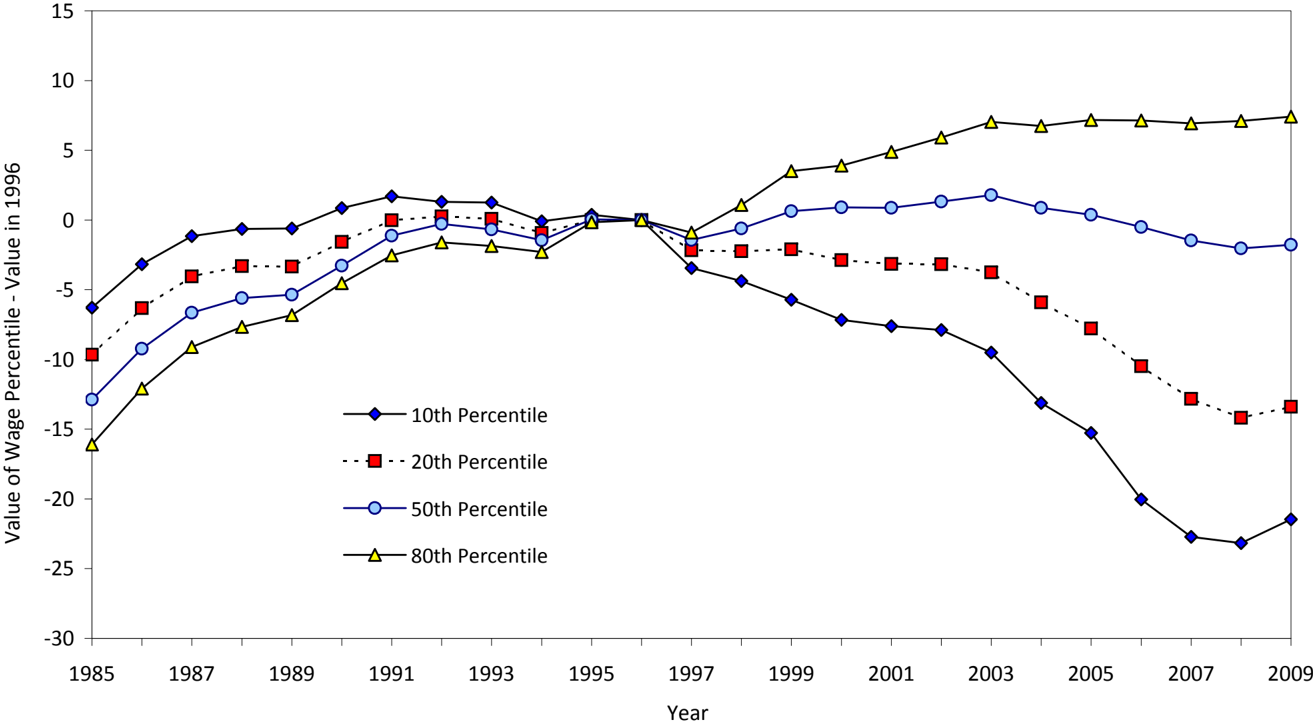
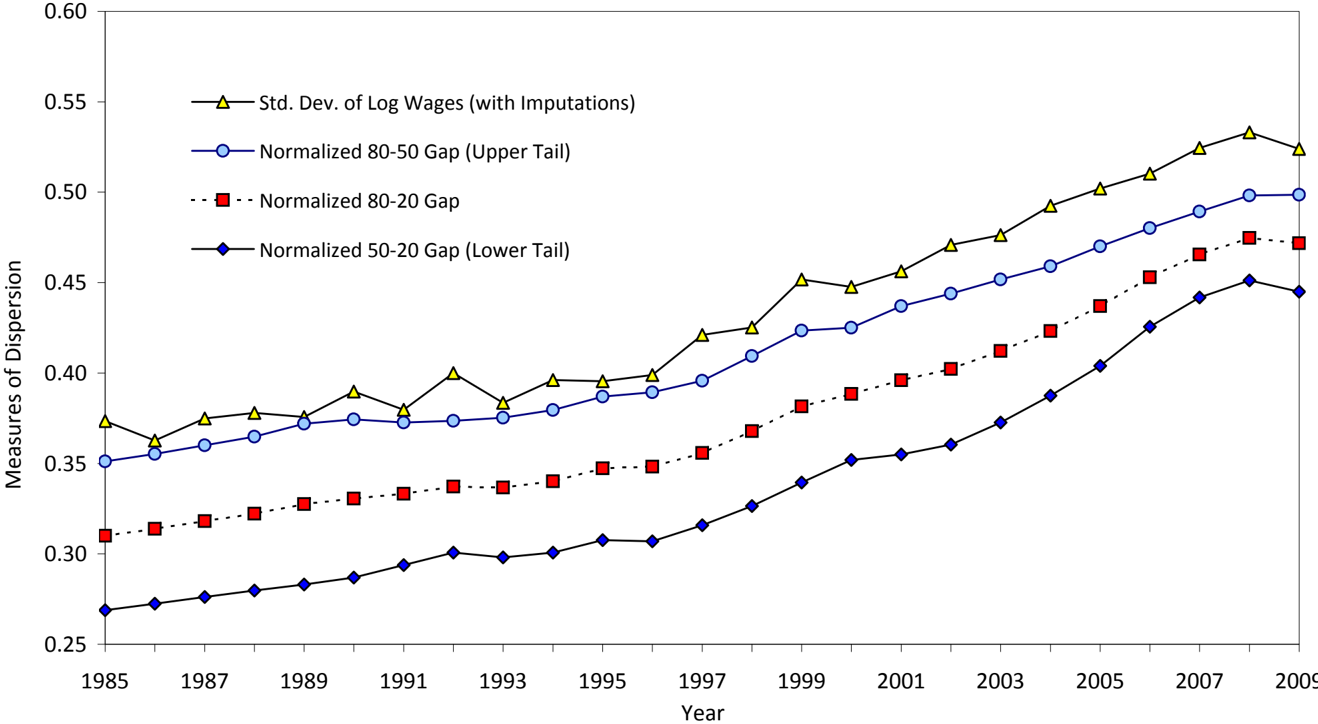
“In particular, the standard deviation rose by 15 log points from 1985 to 2009, the (normalized) 80-20 gap rose by 16 log points, the 80-50 gap rose by 15 log points, and the 50-20 gap rose by 18 log points.”
plain- Asserted: passes — The authors put it forward as true.
- Checkable: passes — It can be checked against evidence.
- Load-bearing: unclear — It is unclear whether the paper’s conclusions depend on it.
- Based: passes — The paper gives a reason why it holds.
118 more claims
Create a free account to see all 199 claims and to verify the 4 references still open.
- It may state two separate claims as one. 61
- Probably not a substantial claim. 17
- The quote only partly states this claim. 3
Claims other papers make about this one
Each is checked against this paper’s own text: does it say what the citing paper says it does?
The check wasn’t confident either way, so it gives no verdict — never disputed.
In the citing paper
“We estimate below that 75% is labor income.16”
From “Capitalists in the Twenty-First Century” (2019) · cites this paper as [16]
Experimental — accuracy not yet measured
Citations
Cites
A heteroskedasticity-consistent covariance matrix estimator and a direct test for heteroskedasticity
White, H. (1980) · Econometrica · doi:10.2307/1912934 · Cited by 25,861
The Skill Content of Recent Technological Change: An Empirical Exploration
Autor, D. H., Levy, F., & Murnane, R. J. (2003) · The Quarterly Journal of Economics · doi:10.1162/003355303322552801 · Cited by 6,205
On the Pooling of Time Series and Cross Section Data
Mundlak, Y. (1978) · Econometrica · doi:10.2307/1913646 · Cited by 5,412
Changes in Relative Wages, 1963-1987: Supply and Demand Factors
Katz, L. F., & Murphy, K. M. (1992) · The Quarterly Journal of Economics · doi:10.2307/2118323 · Cited by 4,793
Equilibrium Unemployment as a Worker Discipline Device
Shapiro, C., & Stiglitz, J. E. (1986) · Efficiency Wage Models of the Labor Market · doi:10.1017/cbo9780511559594.004 · Cited by 4,652
Misallocation and Manufacturing TFP in China and India*
Hsieh, C.-T., & Klenow, P. J. (2009) · Quarterly Journal of Economics · doi:10.1162/qjec.2009.124.4.1403 · Cited by 4,175
Job Creation and Job Destruction in the Theory of Unemployment
Mortensen, D. T., & Pissarides, C. A. (1994) · The Review of Economic Studies · doi:10.2307/2297896 · Cited by 3,840
Hybrid Corn: An Exploration in the Economics of Technological Change
Griliches, Z. (1957) · Econometrica · doi:10.2307/1905380 · Cited by 3,330
Labor Contracts as Partial Gift Exchange
Akerlof, G. A. (1982) · The Quarterly Journal of Economics · doi:10.2307/1885099 · Cited by 3,210
Plants and Productivity in International Trade
Bernard, A. B., Eaton, J., Jensen, J. B., & Kortum, S. (2003) · American Economic Review · doi:10.1257/000282803769206296 · Cited by 2,980
Research works printed but not linked: 1
- 70. Rees, Albert and George Schultz. 1970. Workers in an Urban Labor Market. Chicago: University of Chicago Press.
Cited by
Items 901–1,000 of 1,904
The Effect of the Hartz Labor Market Reforms on Post-Unemployment Wages, Sorting, and MatchingPreprint
Woodcock, S. D. (2020) · SSRN Electronic Journal · doi:10.2139/ssrn.3614248 · Cited by 6
Within-Job Wage Inequality: Performance Pay and Job RelatednessPreprint
Tang, R., Tang, Y., & Wang, P. (2020) · SSRN Electronic Journal · doi:10.2139/ssrn.3632616 · Cited by 7
Do Innovative Firms Pay Higher Wages?: Micro-Level Evidence from Brazil
Martins-Neto, A., & Cirera, X. (2020) · World Bank, Washington, DC eBooks · doi:10.1596/1813-9450-9442 · Cited by 6
Job mobility, reallocation and wage growth: A tale of two countries
Hijzen, A., Zwysen, W., & Lillehagen, M. E. (2021) · OECD social employment and migration working papers · doi:10.1787/807becdf-en · Cited by 6
The Cost of Migrating to a Culturally Different LocationPreprint
Falck, O., Lameli, A., & Ruhose, J. (2014) · SSRN Electronic Journal · doi:10.2139/ssrn.2507751 · Cited by 6
Cross-Border Acquisitions and Employee-EngagementPreprint
Liang, H., Renneboog, L. D. R., & Vansteenkiste, C. (2017) · SSRN Electronic Journal · doi:10.2139/ssrn.3040579 · Cited by 6
Which Ladder to Climb? Wages of Workers by Job, Plant, and EducationPreprint
Bayer, C., & Kuhn, M. (2018) · SSRN Electronic Journal · doi:10.2139/ssrn.3253485 · Cited by 6
Public Economics and Inequality: Uncovering Our Social Nature
Saez, E. (2021) · National Bureau of Economic Research · doi:10.3386/w28387 · Cited by 6
Bassier, I. (2021) · WIDER Working Paper Series · doi:10.35188/unu-wider/2021/072-6 · Cited by 6
Outsourcing, Inequality and Aggregate OutputPreprint
Bilal, A., & Lhuillier, H. (2021) · SSRN Electronic Journal · doi:10.2139/ssrn.3940034 · Cited by 7
Managers' Productivity and Recruitment in the Public SectorPreprint
Muñoz, P., & Prem, M. (2021) · SocArXiv (OSF Preprints) · doi:10.31235/osf.io/7zn2b · Cited by 6
Owner Culture and Pay Inequality within FirmsPreprint
Bena, J., Lu, G., & Wang, I. (2021) · SSRN Electronic Journal · doi:10.2139/ssrn.3966530 · Cited by 6
College Openings and Local Economic DevelopmentPreprint
Berlingieri, F., Gathmann, C., & Quinckhardt, M. (2022) · SSRN Electronic Journal · doi:10.2139/ssrn.4135927 · Cited by 6
Shareholder Power and the Decline of LaborPreprint
Falato, A., Kim, H., & von Wachter, T. (2022) · SSRN Electronic Journal · doi:10.2139/ssrn.4113449 · Cited by 6
Cygan‐Rehm, K. (2022) · SSRN Electronic Journal · doi:10.2139/ssrn.4196288 · Cited by 6
Bobonis, G. J., Bonikowska, A., Oreopoulos, P., Riddell, W. C., & Ryan, S. (2022) · SSRN Electronic Journal · doi:10.2139/ssrn.4216214 · Cited by 6
Jobs in the Smog: Firm Location and Workers’ Exposure to Pollution in African Cities
Bassi, V., Kahn, M. E., Lozano‐Gracia, N., Porzio, T., & Sorin, J. (2022) · National Bureau of Economic Research · doi:10.3386/w30536 · Cited by 6
Differences in On-the-Job Learning Across FirmsPreprint
Arellano-Bover, J., & Saltiel, F. (2024) · SSRN Electronic Journal · doi:10.2139/ssrn.4783711 · Cited by 6
Quantifying the Role of Firms in Intergenerational Mobility
Dobbin, C., & Zohar, T. (2026) · CESifo · doi:10.65864/58gcvwndg9 · Cited by 6
Bossler, M., Liang, Y., & Schänk, T. (2024) · arXiv (Cornell University) · doi:10.48550/arxiv.2403.17206 · Cited by 6
Coworker Sorting, Learning, and InequalityPreprint
Hong, L. (2024) · SSRN Electronic Journal · doi:10.2139/ssrn.4759478 · Cited by 6
Horowitz-Manski-Lee Bounds with Multilayered Sample Selection
Kroft, K., Mourifié, I., & Vayalinkal, A. (2024) · National Bureau of Economic Research · doi:10.3386/w32952 · Cited by 6
Gender Gaps in the Urban Wage PremiumPreprint
Elass, K., García-Peñalosa, C., & Schlüter, C. (2024) · SSRN Electronic Journal · doi:10.2139/ssrn.4991922 · Cited by 6
The Parenthood Gap: Firms and Earnings Inequality after Kids
Jack, R. S., Tannenbaum, D. I., & Timpe, B. (2025) · Upjohn Research (W.E. Upjohn Institute for Employment Research) · doi:10.17848/wp25-412 · Cited by 6
Job Sorting and the Labor Market Effects of a Criminal Record
Hjalmarsson, R., Lindquist, M. J., Lepage, L., & Miller, C. (2025) · National Bureau of Economic Research · doi:10.3386/w33865 · Cited by 6
Dauth, W., Findeisen, S., Moretti, E., & Suedekum, J. (2019) · Econstor (Econstor) · Cited by 6
Robot adoption, worker-firm sorting and wage inequality: evidence from administrative panel dataPreprint
Faia, E., Ottaviano, G. I. P., & Spinella, S. (2023) · RePEc: Research Papers in Economics · Cited by 6
Personnel is policy (implementation) bureaucrats and the Korean export miraclePreprint
Barteska, P., & Lee, J. E. (2025) · RePEc: Research Papers in Economics · Cited by 6
Wedges: A Microeconomic Perspective on Misallocation
Bergquist, L., Lashkari, D., & Verhoogen, E. (2026) · National Bureau of Economic Research · doi:10.3386/w34756 · Cited by 6
Forecasting the average monthly accrued wages of employees by econometric modeling
Kabashova, E. V., & Кузнецова, А. Р. (2018) · RUSSIAN ELECTRONIC SCIENTIFIC JOURNAL · doi:10.31563/2308-9644-2018-27-1-26-46 · Cited by 5
Firm Heterogeneity in Skill Returns
Böhm, M. J., Esmkhani, K., & Gallipoli, G. (2023) · Journal of Labor Economics · doi:10.1086/729103 · Cited by 5
Declining Wage Inequality in Developing Countries: The Case of Brazil
FIRPO, S. P., & Portella, A. L. (2025) · Journal of Economic Literature · doi:10.1257/jel.20241697 · Cited by 5
Educational Networks, Social Closure, and Cleavage Stabilization
Attewell, D., & Zollinger, D. (2025) · British Journal of Political Science · doi:10.1017/s000712342510080x · Cited by 5
Wedges: a microeconomic perspective on misallocation
Bergquist, L., Lashkari, D., & Verhoogen, E. (2026) · Handbook of development economics · doi:10.1016/bs.hesde.2026.10.001 · Cited by 5
Skill Demand and Wages: Evidence From Linked Vacancy Data
Ziegler, L. (2024) · Research in labor economics · doi:10.1108/s0147-91212024000052b025 · Cited by 5
Off to a slow start: which workplace policies can limit gender pay gaps across firm tenure?
Kronberg, A., & Gerlach, A. (2023) · Socio-Economic Review · doi:10.1093/ser/mwad055 · Cited by 5
Schlüter, C., & Trede, M. M. (2024) · The Journal of Economic Inequality · doi:10.1007/s10888-023-09616-3 · Cited by 5
Measurement error in longitudinal earnings data: evidence from Germany
Schmillen, A. D., Umkehrer, M., & von Wachter, T. (2024) · Journal for Labour Market Research · doi:10.1186/s12651-024-00366-x · Cited by 5
Motivation for Politicians: Extracting Rents and Staying in Power
Vuković, V. (2024) · Oxford University Press eBooks · doi:10.1093/oso/9780197774229.003.0007 · Cited by 5
Earnings Inequality in Germany and Its Implications
Corneo, G. G. (2015) · Economic and Political Studies · doi:10.1080/20954816.2015.11673831 · Cited by 5
Institution, Major, and Firm-Specific Premia: Evidence from Administrative Data
Ost, B., Pan, W., & Weber, D. (2019) · Canadian Journal of Economics/Revue canadienne d économique · doi:10.1111/caje.70050 · Cited by 5
Ungleichheit der Haushaltsnettoeinkommen — Trends, Treiber, Politikmaßnahmen
Grabka, M. M. (2021) · Wirtschaftsdienst · doi:10.1007/s10273-021-2957-7 · Cited by 5
Kelly, N. J., & Morgan, J. (2021) · Cambridge University Press eBooks · doi:10.1017/9781009029841.002 · Cited by 5
Workplace heterogeneity and wage inequality in Denmark
Morin, A. (2022) · Journal of Applied Econometrics · doi:10.1002/jae.2941 · Cited by 5
Using Supervised Learning to Estimate Inequality in the Size and Persistence of Income Shocks
Bruns-Smith, D., Feller, A., & Nakamura, E. (2023) · ACM Conference on Fairness, Accountability, and Transparency (FAccT) · doi:10.1145/3593013.3594113 · Cited by 5
Flexible specification testing in quantile regression models
Kutzker, T., Klein, N., & Wied, D. (2023) · Scandinavian Journal of Statistics · doi:10.1111/sjos.12671 · Cited by 5
Soener, M., Godechot, O., & Safi, M. (2023) · Sociological Forum · doi:10.1111/socf.12969 · Cited by 5
Firm-specific pay premia and the returns to higher education: Evidence from community colleges
Pan, W. (2025) · Labour Economics · doi:10.1016/j.labeco.2025.102685 · Cited by 5
Inequality and market power in Latin America and the Caribbean
Eslava, M., García-Marín, Á., & Messina, J. (2025) · Oxford Open Economics · doi:10.1093/ooec/odae037 · Cited by 5
Equilibrium Transport with Time-Inconsistent Costs
Bayraktar, E., & Han, B. (2025) · Mathematics of Operations Research · doi:10.1287/moor.2023.0323 · Cited by 5
Comments on “Wage determination and imperfect competition”
Fitzenberger, B. (2014) · Labour Economics · doi:10.1016/j.labeco.2014.07.012 · Cited by 5
Technological Diffusion Across Hospitals: The Case of a Revenue-Generating Practice
Sacarny, A. (2014) · 6th Biennial Conference of the American Society of Health Economists · Cited by 5
Wage inequality as a source of endogenous macroeconomic fluctuations
da Silveira, J. J., & Lima, G. T. (2020) · Structural Change and Economic Dynamics · doi:10.1016/j.strueco.2020.07.009 · Cited by 5
Jost, O. (2022) · Empirica · doi:10.1007/s10663-022-09540-1 · Cited by 5
Dütsch, M., Altun, O., Grundmann, L., & Himmelreicher, R. K. (2023) · Jahrbücher für Nationalökonomie und Statistik · doi:10.1515/jbnst-2022-0070 · Cited by 5
Mathiasi, F. B., & Pimentel, T. D. (2019) · Teoria Jurídica Contemporânea · doi:10.21875/tjc.v4i1.24697 · Cited by 5
Building a productive workforce: the role of structured management practices
Cornwell, C. M., Schmutte, I. M., & Scur, D. (2019) · London School of Economics and Political Science Research Online (London School of Economics and Political Science) · Cited by 5
Collective Action, Law, and the Fragmented Development of the American Labor Movement
Hertel‐Fernandez, A. (2021) · Cambridge University Press eBooks · doi:10.1017/9781009029841.004 · Cited by 5
Does Exporting Improve Matching? Evidence from French Employer-Employee Data
Tito, M. D., Bombardini, M., & Orefice, G. (2015) · Finance and Economics Discussion Series · doi:10.17016/feds.2015.113 · Cited by 5
Market concentration and the relative demand for college‐educated labour
Åkerman, A. (2023) · Economica · doi:10.1111/ecca.12504 · Cited by 5
Technology Diffusion, Worker Mobility and the Returns to SkillPreprint
Stijepic, D. (2015) · SSRN Electronic Journal · doi:10.2139/ssrn.2635538 · Cited by 5
Gazaniol, A., & Laffineur, C. (2015) · RePEc: Research Papers in Economics · Cited by 5
Status Inequality, Moral Disengagement and ViolencePreprint
Falk, A. (2017) · SSRN Electronic Journal · doi:10.2139/ssrn.3034149 · Cited by 6
Corporate Employee-Engagement and Merger OutcomesPreprint
Liang, H., Renneboog, L. D. R., & Vansteenkiste, C. (2017) · SSRN Electronic Journal · doi:10.2139/ssrn.2926479 · Cited by 5
Felbermayr, G. J., Lehwald, S., Schoof, U., & Ronge, M. (2013) · Archive of European Integration (AEI) (University of Pittsburgh) · Cited by 5
The Drivers of Inequality in Rich Countries
Nolan, B. W., Richiardi, M. G., & Valenzuela, L. (2018) · Munich Personal RePEc Archive (Ludwig Maximilian University of Munich) · Cited by 5
The Long-Term Consequences of the Tech Bubble on Skilled Workers' EarningsPreprint
Hombert, J., & Matray, A. (2018) · SSRN Electronic Journal · doi:10.2139/ssrn.3187093 · Cited by 5
The Selection of High-Skilled MigrantsPreprint
Parey, M., Ruhose, J., Waldinger, F., & Netz, N. (2015) · SSRN Electronic Journal · doi:10.2139/ssrn.2655113 · Cited by 6
Bernard, A. B., Dhyne, E., Magerman, G., Manova, K. B., & Moxnes, A. (2019) · Archive of European Integration (AEI) (University of Pittsburgh) · Cited by 5
Organised Labour, Labour Market Imperfections, and Employer Wage PremiaPreprint
Dobbelaere, S., Hirsch, B., Mueller, S., & Neuschäffer, G. (2020) · SSRN Electronic Journal · doi:10.2139/ssrn.3744404 · Cited by 5
Augmenting the Human Capital Earnings Equation with Measures of Where People Work
Barth, E., Davis, J. C., & Freeman, R. B. (2016) · National Bureau of Economic Research · doi:10.3386/w22512 · Cited by 5
The Effect of Income on Mortality: New Evidence for the Absence of a Causal LinkPreprint
Ahammer, A., Horvath, T. A., & Winter‐Ebmer, R. (2015) · SSRN Electronic Journal · doi:10.2139/ssrn.2655125 · Cited by 5
Sources of Displaced Workers' Long-Term Earnings LossesPreprint
Lachowska, M., Mas, A., & Woodbury, S. (2017) · SSRN Electronic Journal · doi:10.2139/ssrn.3122340 · Cited by 5
Wage Inequality in Germany after the Minimum Wage IntroductionPreprint
Bossler, M., & Schänk, T. (2020) · RePEc: Research Papers in Economics · Cited by 5
More female manager hires through more female managers? Evidence from GermanyPreprint
Schänk, T., Bossler, M., & Mosthaf, A. (2016) · RePEc: Research Papers in Economics · Cited by 5
Losing control? Unions' Representativeness, "Pirate" Collective Agreements and WagesPreprint
Lucifora, C., & Vigani, D. (2020) · RePEc: Research Papers in Economics · Cited by 5
The Internal Labor Markets of Business GroupsPreprint
Huneeus, C., Huneeus, F., Larraín, B., Larraín, M., & Prem, M. (2021) · SocArXiv (OSF Preprints) · doi:10.31235/osf.io/zjkvf · Cited by 5
Pollution in Ugandan Cities: Do Managers Avoid it or Adapt in Place?
Bassi, V., Kahn, M. E., Lozano‐Gracia, N., Porzio, T., & Sorin, J. (2021) · World Bank, Washington, DC eBooks · doi:10.1596/1813-9450-9743 · Cited by 5
Owner Culture and Pay Inequality within FirmsPreprint
Wang, I., Bena, J., & Lu, G. (2022) · SSRN Electronic Journal · doi:10.2139/ssrn.4071250 · Cited by 5
Minimum Wages and the Rise in Solo Self-EmploymentPreprint
Ganserer, A., Gregory, T., & Zierahn, U. (2022) · SSRN Electronic Journal · doi:10.2139/ssrn.4114868 · Cited by 6
Firms and Unemployment Insurance Take-Up
Lachowska, M., Sorkin, I., & Woodbury, S. A. (2022) · Upjohn Research (W.E. Upjohn Institute for Employment Research) · doi:10.17848/wp22-369 · Cited by 5
Labor Market Matching, Wages, and AmenitiesPreprint
Lamadon, T., Lise, J., Meghir, C., & Robin, J. (2024) · SSRN Electronic Journal · doi:10.2139/ssrn.4895416 · Cited by 5
An Engine of (Pay) Growth? Productivity and Wages in the UK Auto Industry
Keiller, A. N., Obermeier, T., Teichgraeber, A., & Reenen, J. M. V. (2024) · National Bureau of Economic Research · doi:10.3386/w32695 · Cited by 5
Non-Compete Agreements, Tacit Knowledge and Market ImperfectionsPreprint
Bartelsman, E. J., Dobbelaere, S., & Mattioli, A. Z. (2024) · SSRN Electronic Journal · doi:10.2139/ssrn.4944892 · Cited by 6
The 'Clean Energy Transition' and the Cost of Job Displacement in Energy-intensive Industries
Barreto, C., Fluchtmann, J., Hijzen, A., Lombardi, S., VATT, Bennett, P., Bertheau, A., NHH, Chan, W. M. F., Canada, S., et al. (2024) · doi:10.47688/rdp2024-09 · Cited by 5
Careers and Wages in Family Firms: Evidence from Matched Employer-Employee DataPreprint
Porto, E. D., Pagano, M., Pezone, V., Saggio, R., & Schivardi, F. (2024) · SSRN Electronic Journal · doi:10.2139/ssrn.5048576 · Cited by 5
Location Effects or Sorting? Evidence from Firm Relocation
Carry, P., Kleinman, B., & Nimier-David, E. (2025) · National Bureau of Economic Research · doi:10.3386/w33779 · Cited by 5
Optimal Estimation of Two-Way Effects under Limited MobilityPreprint
Cheng, X., Ho, S. C., & Schorfheide, F. (2025) · SSRN Electronic Journal · doi:10.2139/ssrn.5350344 · Cited by 5
Shifts in the Composition of College Workers: Implications for US Inequality and Labor DemandPreprint
Chandar, B. (2025) · SSRN Electronic Journal · doi:10.2139/ssrn.5384528 · Cited by 5
Sorting within and across establishments: The immigrant-native wage differential in GermanyPreprint
Bossler, M. (2014) · RePEc: Research Papers in Economics · Cited by 5
High-wage workers and high-productivity firms - a regional view on matching in GermanyPreprint
Ehrl, P. (2014) · RePEc: Research Papers in Economics · Cited by 5
The influence of headteachers on their schools
Zuccollo, J., Dias, J. C., Jiménez, E., & Braakmann, N. (2023) · Digital Education Resource Archive (University College London) · Cited by 5
The Labor Market Return to Permanent Residency
Kroft, K., Norwich, I., Notowidigdo, M. J., & Tino, S. P. (2026) · National Bureau of Economic Research · doi:10.3386/w34630 · Cited by 7
Zimmermann, F., Wolbring, T., & Fong, E. (2025) · Socio-Economic Review · doi:10.1093/ser/mwaf046 · Cited by 4
Do firms or workers drive the foreign acquisition wage premium?
Rösch, M., Gerritse, M., Karreman, B., Oort, F. G. V., & Loog, B. (2022) · European Economic Review · doi:10.1016/j.euroecorev.2025.105105 · Cited by 4
Perspectives des migrations internationales 2025
OCDE (2025) · Perspectives des migrations internationales · doi:10.1787/695789d1-fr · Cited by 4
Within-Firm Pay Inequality and Productivity
Wallskog, M., Bloom, N., Ohlmacher, S., & Tello-Trillo, C. (2026) · The Economic Journal · doi:10.1093/ej/ueag020 · Cited by 4
Decomposing the Exporter Wage Gap: Selection or Differential Returns?
Bødker, J. E., Maibom, J., & Vejlin, R. (2018) · Labour Economics · doi:10.1016/j.labeco.2024.102633 · Cited by 4
Do Brokerages Benefit From All-Star Females?
Jannati, S. (2018) · Journal of Empirical Finance · doi:10.1016/j.jempfin.2024.101493 · Cited by 5
Doing business far from home: Multinational firms and labor market outcomes in Saudi Arabia
González, A. L., & Kong, X. (2025) · European Economic Review · doi:10.1016/j.euroecorev.2024.104944 · Cited by 5
Metadata
- Authors
- Card, D., Heining, J., & Kline, P.
- Affiliations
- University of California, Berkeley (US)
- Corresponding author
- Kline, Patrick
- ORCID
- Card, David
- Venue
- The Quarterly Journal of Economics
- Publisher
- Oxford University Press (OUP)
- Published
- 2013-05-02
- Volume
- 128
- Issue
- 3
- Pages
- 967-1015
- ISSN
- 0033-5533 (ISSN-L)
- 1531-4650
- OpenAlex
- W2141295263
- Cited by
- 1,904
- References
- 146
- Citations by year
- 2026: 153 · 2025: 204 · 2024: 228 · 2023: 156 · 2022: 185 · 2021: 178 · 2020: 143 · 2019: 125 · 2018: 156 · 2017: 113 · 2016: 105 · 2015: 71 · 2014: 58 · 2013: 22
- FWCI
- 118.40
- Type
- journal article
- Language
- en
- Open access
- closed
- Locations
- The Quarterly Journal of Economics (publishedVersion)
- RePEc: Research Papers in Economics (submittedVersion)
- Econstor (Econstor) (submittedVersion)
- Funders
- Washington Center for Equitable Growth
- Topics
- Social Sciences › Economics, Econometrics and Finance › Economics and Econometrics › Labor market dynamics and wage inequality
- Social Sciences › Economics, Econometrics and Finance › Economics and Econometrics › Historical Economic and Social Studies
- Social Sciences › Sociology and Political Science › Income, Poverty, and Inequality
- Keywords
- wage inequality, job matching, fixed effects model, education and wages
About these checks
Registry, retraction, Cites and statistics results are computed, not judged, with one exception: a printed reference that no index lists is read once by a model before it counts as a citation error. Claims are extracted by a model and kept only when their quote appears verbatim in the text; each cited source is then checked, with a model’s help, for whether it says what the claim relies on. Those verdicts can be wrong — read the claim’s quote and the cited source before relying on one.
A language model drew the claims from the paper on 2026-11-17, under version 3 of the claim definition (model deepseek-v4.1-flash, prompt extract-v3).
A second model labelled each claim on 2026-11-17 (model jev-1.13-20260917, definition revision gold-guideline-v0.2).
Statistics and arithmetic are recomputed, not judged.
Confidence bands are shown only for fields calibrated on our annotated test set. None is calibrated yet, so no band is shown.
What counts as a claim ›How we measure confidence ›How we check this ›
Are you an author, or do you see a problem with this page? Request a review
Data sources
Bibliographic data: Semantic Scholar, OpenAlex, Crossref.
Contains information from the Semantic Scholar Academic Graph Datasets, made available under the ODC Attribution License (ODC-BY 1.0).
Semantic Scholar’s data is described in: Kinney, R., et al. (2023). The Semantic Scholar Open Data Platform. arXiv:2301.10140.
