

What the brain ‘Likes’: neural correlates of providing feedback on social media
Open accessThe DOI matches its Crossref record; 45 of the 46 references it cites were found in a registry or an index, and 1 are not checked yet.
Abstract
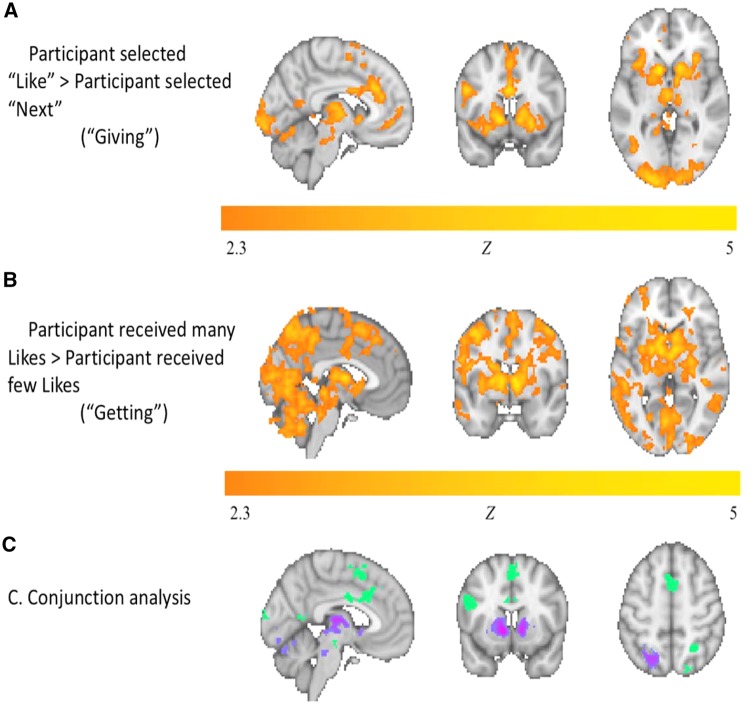
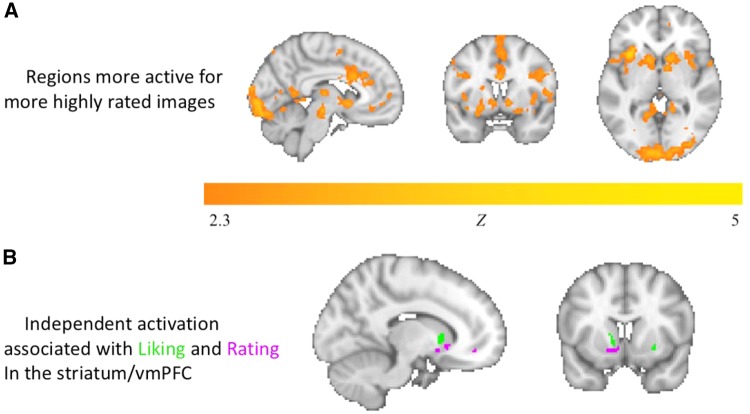
Evidence increasingly suggests that neural structures that respond to primary and secondary rewards are also implicated in the processing of social rewards. The 'Like'-a popular feature on social media-shares features with both monetary and social rewards as a means of feedback that shapes reinforcement learning. Despite the ubiquity of the Like, little is known about the neural correlates of providing this feedback to others. In this study, we mapped the neural correlates of providing Likes to others on social media. Fifty-eight adolescents and young adults completed a task in the MRI scanner designed to mimic the social photo-sharing app Instagram. We examined neural responses when participants provided positive feedback to others. The experience of providing Likes to others on social media related to activation in brain circuity implicated in reward, including the striatum and ventral tegmental area, regions also implicated in the experience of receiving Likes from others. Providing Likes was also associated with activation in brain regions involved in salience processing and executive function. We discuss the implications of these findings for our understanding of the neural processing of social rewards, as well as the neural processes underlying social media use.
Overview
The claims and statistics of this paper haven’t been checked yet.
Free: it reads the open-access text and checks the first 5 claims that cite a source we can check. Create a free account to check every claim.
Integrity signals
Registry
Cites
Statistics
Figures
Verification
Claims the paper makes
The claims and statistics of this paper haven’t been checked yet.
Free: it reads the open-access text and checks the first 5 claims that cite a source we can check. Create a free account to check every claim.
Claims other papers make about this one
Each is checked against this paper’s own text: does it say what the citing paper says it does?
The cited source says what the claim attributes to it.
In the citing paper
“In humans, brain imaging studies have consistently shown that likes8,9, and other social rewards, are processed by neural and computational mechanisms closely overlapping with those processing non-social rewards10–14.”
From A computational reward learning account of social media engagement (2021) · cites this paper as [9]
Self-check
Percentages, sums and reported differences re-computed from the paper’s own numbers.
The self-check needs the paper’s full text.
Citations
Cites
The need to belong: Desire for interpersonal attachments as a fundamental human motivation.
Baumeister, R. F., & Leary, M. R. (1995) · Psychological Bulletin · doi:10.1037//0033-2909.117.3.497 · Cited by 23,245
Jenkinson, M., Beckmann, C. F., Behrens, T. E. J., Woolrich, M. W., & Smith, S. M. (2012) · NeuroImage · doi:10.1016/j.neuroimage.2011.09.015 · Cited by 11,314
AFNI: Software for analysis and visualization of functional magnetic resonance neuroimages
Cox, R. W. (1996) · Computers and Biomedical Research · doi:10.1006/cbmr.1996.0014 · Cited by 10,913 · cited 3×
“The rating task was introduced after data had been collected on several participants; rating data were available for 41 out of 58 participants. fMRI data analysis fMRI data were preprocessed and analyzed using AFNI (Cox, 1996) and the FMRIB Software Library (FSL) (Jenkinson et al., 2012); full details are available in…”
MethodInfluentialDissociable intrinsic connectivity networks for salience processing and executive control
Seeley, W. W., Menon, V., Schatzberg, A. F., Keller, J., Glover, G. H., Kenna, H., Reiss, A. L., & Greicius, M. D. (2007) · The Journal of Neuroscience · doi:10.1523/jneurosci.5587-06.2007 · Cited by 7,426 · cited 1×
“regions, which often co-activate during cognitively demanding tasks, has been dubbed the ‘task activation ensemble’ (Seeley et al., 2007).”
BackgroundSaliency, switching, attention and control: a network model of insula function
Menon, V., & Uddin, L. Q. (2010) · Brain Structure and Function · doi:10.1007/s00429-010-0262-0 · Cited by 5,592
Cluster failure: why fMRI inferences for spatial extent have inflated false-positive rates
Eklund, A., Nichols, T. E., & Knutsson, H. (2016) · Proceedings of the National Academy of Sciences · doi:10.1073/pnas.1602413113 · Cited by 3,487 · cited 2×
“Given the recent concern about the validity of parametric cluster thresholding (Eklund et al., 2016), we also performed a confirmatory analysis of our main contrasts of interest using FSL’s permutation-based testing tool RANDOMISE to obtain nonparametric statistics with 10 000 random permutations and threshold-free cl…”
MethodAnticipation of Increasing Monetary Reward Selectively Recruits Nucleus Accumbens
Knutson, B., Adams, C. M., Fong, G. W., & Hommer, D. (2001) · The Journal of Neuroscience · doi:10.1523/jneurosci.21-16-j0002.2001 · Cited by 2,244 · cited 1×
“Much of the early literature on reward processing investigated brain responses to monetary reward as feedback on task performance (e.g. Delgado et al., 2000; Knutson et al., 2001; Galvan et al., 2005).”
BackgroundValid conjunction inference with the minimum statistic
Nichols, T., Brett, M., Andersson, J., Wager, T., & Poline, J.-B. (2005) · NeuroImage · doi:10.1016/j.neuroimage.2004.12.005 · Cited by 1,880 · cited 1×
“conjunction analysis using the tool easythresh_conj (Nichols et al., 2005), with a cluster correction of P < 0.”
MethodThe Proceedings of the National Academy of Sciences
Wilson, E. B. (1919) · Science · doi:10.1126/science.49.1254.46.b · Cited by 1,833
The Social Brain: Neural Basis of Social Knowledge
Adolphs, R. (2009) · Annual Review of Psychology · doi:10.1146/annurev.psych.60.110707.163514 · Cited by 1,827
Research works printed but not linked: 1
- Hu Y., Manikonda L., Kambhampati S. (2014). What we instagram: a first analysis of instagram photo content and user types. Proceedings of the 8th International Conference on Weblogs and Social Media.
Cited by
Items 101–200 of 282
Elhai, J. D., Yang, H., & Montag, C. (2022) · Debates em Psiquiatria · doi:10.25118/2763-9037.2022.v12.457 · Cited by 7
Gugushvili, N. (2023) · Research Publications (Maastricht University) · doi:10.26481/dis.20230320ng · Cited by 7
Why Do We “Like” on WeChat Moments: The Effects of Personality Traits and Content Characteristics
Zheng, C., Song, X., Li, J., Chen, Y., Dong, T., & Yang, S. (2022) · Frontiers in Psychology · doi:10.3389/fpsyg.2022.772547 · Cited by 7
Hensums, M., van den Bos, W., Overbeek, G. J., & Larsen, H. (2023) · Journal of Adolescence · doi:10.1002/jad.12207 · Cited by 7
Understanding the neurocognitive mechanisms of cognitive security
Crum, J. E., II, Allred, A. R., Bostrom, S. R., Doherty, E. J., McLain, M., Richardson, E. E., Spencer, C. A., Niemeyer, R. E., Anderson, A. P., Tossell, C. C., et al. (2025) · Neuroscience & Biobehavioral Reviews · doi:10.1016/j.neubiorev.2025.106448 · Cited by 6
Das, S., Ahmed, T., Kapadia, A. C., & Patil, S. (2021) · Proceedings of the ACM on Human-Computer Interaction · doi:10.1145/3449120 · Cited by 6
Pearce, A. (2020) · International Conference on Education Technology and Computer · doi:10.1145/3436756.3437040 · Cited by 6
Change on the Brain? The Neuroscience of Organizational Transformation
McCreedy, R. T. W. (2024) · International Journal of Applied Research in Management and Economics · doi:10.33422/ijarme.v7i3.1402 · Cited by 6
da Costa, Y. P., Martins, F., Fonseca, F. D. S., Albuquerque, M. R., Batista, G. R., & Fortes, L. D. S. (2024) · International Journal of Sport and Exercise Psychology · doi:10.1080/1612197x.2024.2325585 · Cited by 6
Wang, Z., Jin, H., & Li, S. (2025) · Frontiers in Psychology · doi:10.3389/fpsyg.2025.1664890 · Cited by 5
Anderson, I. A. (2024) · PsyArXiv (OSF Preprints) · doi:10.31234/osf.io/824nb · Cited by 5
Do Social Media Likes Affect Food Consumption?
Mamalikou, M., Gkatzionis, K., & Παναγιώτου, Μ. (2024) · Businesses · doi:10.3390/businesses4040037 · Cited by 5
Testing dopaminergic markers of problematic social media use using neuromelanin-sensitive MRI
Shannon, H., Montgomery, M., Cassidy, C., Lemieux, M., Yee, J., Brunier, L.-S., Hellemans, K., & Guimond, S. (2026) · Psychiatry Research Neuroimaging · doi:10.1016/j.pscychresns.2026.112144 · Cited by 5
Latent neural architecture organising shared aesthetic evaluations of visual artworks
Liang, X., Zhuang, K., Wang, Y., Su, Y., Feng, J., Zhou, F., Becker, B., & Vatansever, D. (2026) · Nature Communications · doi:10.1038/s41467-026-73153-6 · Cited by 5
Greenfield, P. M. (2020) · Human Behavior and Emerging Technologies · doi:10.1002/hbe2.222 · Cited by 5
Self-citationRipple Effect of a Pandemic: Analysis of the Psychological Stress Landscape during COVID19Preprint
Agarwal, A. K. (2020) · PsyArXiv (OSF Preprints) · doi:10.31234/osf.io/nat49 · Cited by 5
da Silva, A. V. (2025) · CUB Ph.D. Dissertations (Corvinus University of Budapest) · doi:10.14267/phd.2025004 · Cited by 5
Digital technologies and adolescents’ body image
Aubrey, J. S., Yan, K., & Gahler, H. (2022) · Elsevier eBooks · doi:10.1016/b978-0-12-818872-9.00156-4 · Cited by 4
Quantifying the drivers behind collective attention in information ecosystems
Calleja-Solanas, V., Pigani, E., Palazzi, M. J., Solé‐Ribalta, A., Suweis, S. S., Borge‐Holthoefer, J., & Meloni, S. (2021) · Journal of Physics Complexity · doi:10.1088/2632-072x/ac35b6 · Cited by 4
Problematische Mediennutzung in der Adoleszenz – Dark Patterns und mediale Bindungsfaktoren
Wiedemann, H., Büsch, K., Thomasius, R., & Paschke, K. (2025) · Kinder- und Jugendmedizin · doi:10.1055/a-2471-2043 · Cited by 4
Sitnik‐Warchulska, K., Izydorczyk, B., & Wajda, Z. (2022) · Routledge eBooks · doi:10.4324/9781003221043 · Cited by 4
Zhai, G., Feng, Y., Ling, X., Su, J., Liu, Y., Li, Y., Jiang, Y., & Wu, X. (2025) · Neuropsychologia · doi:10.1016/j.neuropsychologia.2025.109291 · Cited by 4
Wuestenenk, N., van Tubergen, F., Stark, T., & Ellemers, N. (2024) · Communication Research · doi:10.1177/00936502241259919 · Cited by 4
Wong, K. L., Chiu, M. M., Chan, K. K., Chong, E. K., Bhowmik, M. K., & Krzywosz‐Rynkiewicz, B. (2025) · Information Development · doi:10.1177/02666669251359962 · Cited by 4
Influencer-Centered Accounts of Manipulation
Werner, M. H. (2024) · Ethical Theory and Moral Practice · doi:10.1007/s10677-024-10458-9 · Cited by 4
Pattern Mining Approaches Used in Social Media Data
Chaki, J., Dey, N., Panigrahi, B. K., Shi, F., Fong, S. J., & Sherratt, R. S. (2020) · International Journal of Uncertainty Fuzziness and Knowledge-Based Systems · doi:10.1142/s021848852040019x · Cited by 4
Scholte, H. S., van der Leij, A. R., & Lamme, V. A. F. (2022) · Management for professionals · doi:10.1007/978-3-658-35185-4_4 · Cited by 4
The impact of social media on students’ lives : case: LAB University of Applied Sciences
Nguyen, M. H. (2021) · Theseus (Ammattikorkeakoulujen) · Cited by 4
The Relationship Between Body Shaming And Anxiety In Adolescents At Alhusna High School In 2024
Riyanto, D. A., & Musfirowati, F. (2025) · Journal Research of Social Science Economics and Management · doi:10.59141/jrssem.v5i2.1095 · Cited by 4
de Freitas-Junior, C. G., Nakamura, F. Y., da Costa, Y. P., Batista, G. R., & Fortes, L. D. S. (2025) · European Journal of Sport Science · doi:10.1002/ejsc.12258 · Cited by 4
Effects of social comparison, self-esteem and affect on problematic instagram use: a mediation model
Veleda, G. W., Ezequiel, G. R., Seoane, G. R., Ferreira, C. M., & Souza, L. D. D. M. (2024) · Current Psychology · doi:10.1007/s12144-024-06866-w · Cited by 3
Verhaltenssüchte: theoretische Modelle
Brand, M. (2021) · Psychotherapeut · doi:10.1007/s00278-020-00486-y · Cited by 3
Social Media and the Social Brain
Andrews, M. E., Pei, R., Lauharatanahirun, N., Paul, A. M., & Falk, E. B. (2023) · Oxford University Press eBooks · doi:10.1093/oso/9780197520536.003.0006 · Cited by 3
Zhuang, Y., Zhu, Q., Duan, Y., & Kim, N. (2025) · IEEE Transactions on Engineering Management · doi:10.1109/tem.2025.3593392 · Cited by 3
Your pain, my gain: Schadenfreude as a driving mechanism of online “liking” behavior
Lunt, D. C., Lunt, L. D., Wood, A. D., & Highley, Z. C. (2026) · Acta Psychologica · doi:10.1016/j.actpsy.2026.107413 · Cited by 3
Mechanism of Rehabilitation through Physical Exercise for Adolescents Addicted to Social Media
Li, L. (2023) · Academic Journal of Humanities & Social Sciences · doi:10.25236/ajhss.2023.061011 · Cited by 3
Neilsen, R. (2021) · UNSWorks (University of New South Wales, Sydney, Australia) · doi:10.26190/unsworks/2402 · Cited by 3
Yetişkinlerde sosyal medya kullanımının depresyon ve sosyal kaygı düzeyleri ile ilişkisi
Özkapı, M. (2021) · Istanbul Kent University Institutional Repository · Cited by 3
Silencing the spectacle: A call for critical disengagement from social media in MOS academia
Vianna, F. R. P. M., Alcadipani, R., & Fontenelle, I. A. (2026) · Management Learning · doi:10.1177/13505076251390724 · Cited by 2
Association between the Taq1A polymorphism and problematic media use in preadolescent children
Emond, J. A., Renier, T. J., Yeum, D., Carlson, D. D., Ballarino, G. A., & Gilbert‐Diamond, D. (2025) · Frontiers in Psychology · doi:10.3389/fpsyg.2024.1395957 · Cited by 2
Navigating Complexity in Reflexive Cybernetics: Forces, feedback, and felt valences
Rutherford, G. (2026) · Integrative Psychological and Behavioral Science · doi:10.1007/s12124-026-09989-w · Cited by 2
Peters, U., & Quintana, I. O. (2024) · Synthese · doi:10.1007/s11229-024-04639-3 · Cited by 2
Chan, S. L., & Yusuf, F. (2025) · International Journal of Education Psychology and Counseling · doi:10.35631/ijepc.1061038 · Cited by 2
The Pragmatic Effects of Figurative Language in Social Media
Benammar, S. (2024) · theses.fr (ABES) · doi:10.70675/3212891bz71b3z4db2z8ffczb927c573d5a2 · Cited by 2
Díaz-Moreno, A., Bonilla, I., & Lusar, A. C. (2026) · Psychology Society & Education · doi:10.21071/pse.v18i1.18478 · Cited by 2
Research Report: A Link between Sertraline Treatment and Susceptibility to (Mis)information
Piksa, M., Noworyta, K., Piasecki, J., Gundersen, A. B., Kunst, J. R., Morzy, M., & Ryguła, R. (2024) · ACS Chemical Neuroscience · doi:10.1021/acschemneuro.3c00825 · Cited by 2
The Infamous “Like” Feature: A Neuro Perspective
Issa, H., & Jabbouri, R. (2022) · International Journal of Technology and Human Interaction · doi:10.4018/ijthi.299073 · Cited by 2
Psychology of Social Media and the Brain Behind It
Fiolić, L., & Knežević, M. (2025) · Collegium Antropologicum · doi:10.5671/ca.48.1.9 · Cited by 2
BEHAVIORAL EVIDENCE OF EVERYDAY SADISM IN A NOVEL SAMPLE OF CHILEAN STUDENTS.
Córdova, P., Delgado, J., & Fernández, A. M. (2018) · Human Ethology · doi:10.22330/heb/334/049-060 · Cited by 2
Il diritto di contestazione delle decisioni automatizzate nel GDPR
Sarra, C. (2019) · e_Buah · Cited by 2
Musical Policing in Today’s Brazil: A Study of Jingles in the Bolsonaro Movement
Bøhler, K. K. (2024) · Palgrave's critical policing studies · doi:10.1007/978-3-031-68326-8_8 · Cited by 2
Krzywosz-Rynkiewicz, B. (2025) · doi:10.24131/9788368313772 · Cited by 2
Fullerton, H., Dawood, A., Kalavrezos, N., & Sinha, D. (2021) · BDJ · doi:10.1038/s41415-021-3320-5 · Cited by 2
La construcción y la gestión de la identidad en las redes sociales: la creación del “yo” digital
Parra López, M., & Egea, M. A. (2018) · Zaguan (Universidad de Zaragoza) · Cited by 2
Ho, T. T. Q., Nguyễn, H. T., & Dau, M. L. (2025) · Psychology Health & Medicine · doi:10.1080/13548506.2025.2571985 · Cited by 1
Sándor, A. V. (2023) · Eötvös Loránd Tudományegyetem · doi:10.15476/elte.2023.118 · Cited by 1
Social feedback mechanisms & misinformation: A neuroscience-based argument for algorithm regulation
Cohen, M. S., & Decety, J. (2026) · Behavioral Science & Policy · doi:10.1177/23794607251403323 · Cited by 1
Shannon, H. (2022) · Carleton University's Institutional Repository (MacOdrum Library, Carleton University) · doi:10.22215/etd/2022-15233 · Cited by 1
Thumb up or Head down? The Impact of Upvote on Social Media Self-efficacy
Shu, Z. (2024) · Lecture Notes in Education Psychology and Public Media · doi:10.54254/2753-7048/37/20240529 · Cited by 1
Wei, W., Su, R., Chen, L., Meng, M., & Zheng, R. (2025) · Frontiers in Psychology · doi:10.3389/fpsyg.2025.1575832 · Cited by 1
Cornell, S., Piatkowski, T. M., Brander, R. W., & Peden, A. E. (2025) · Health Promotion Journal of Australia · doi:10.1002/hpja.70133 · Cited by 1
Procrastination as a Mediator Between Facebook Addiction and Mental Health
Dau, M. L., Ho, T. T. Q., Nguyen, B. T. N., & Pham, T. T. H. (2025) · Journal of Rational-Emotive & Cognitive-Behavior Therapy · doi:10.1007/s10942-025-00600-6 · Cited by 1
Neurobiological and psychosocial correlates of problematic social media use: an addiction framework
Shannon, H., Montgomery, M., Bush, K., Griffiths, M. D., Stead, J., Lemieux, M., Guimond, S., & Hellemans, K. G. C. (2026) · Addiction Research & Theory · doi:10.1080/16066359.2026.2650300 · Cited by 1
Worlds apart: using technology to alleviate grief-related loneliness in young people
Weinstock, L., Jeayes, A., Kurze, H., & Albuquerque, S. (2025) · Mental Health and Digital Technologies · doi:10.1108/mhdt-01-2025-0011 · Cited by 1
Screen Time Is Associated with Altered Neural Maturation in a Massive Adolescent Cohort
Atalay, A. S., Newman, B. T., & Druzgal, T. J. (2026) · Children · doi:10.3390/children13070969 · Cited by 1
A sense of commitment to activity on Facebook: Evidence from a web-based paradigm
Brozzo, C., & Michael, J. (2023) · PLoS ONE · doi:10.1371/journal.pone.0271798 · Cited by 1
Ripple Effect of a Pandemic: Analysis of the Psychological Stress Landscape during COVID19Preprint
Agarwal, A. K. (2021) · PsyArXiv (OSF Preprints) · doi:10.31234/osf.io/dm5x2 · Cited by 1
The Neuroscience of Philanthropic Behavior
Tudor, M. C., Sooter, N. M., & Ugazio, G. (2025) · Routledge eBooks · doi:10.4324/9781003546986-8 · Cited by 1
Pakarinen, S. (2018) · Tampere University Institutional Repository (Tampere University) · Cited by 1
Paige, K. J., Angstadt, M., Martz, M. E., Hyde, L. W., Heitzeg, M. M., Sripada, C., & Kardan, O. (2026) · Biological Psychiatry Cognitive Neuroscience and Neuroimaging · doi:10.1016/j.bpsc.2026.03.012 · Cited by 1
Wadsley, M. G. (2023) · Durham e-Theses (Durham University) · Cited by 1
de Souza, Á. F. S., de Arruda, T. T. A., & Monteiro, E. R. (2025) · Research Society and Development · doi:10.33448/rsd-v14i12.50377 · Cited by 1
Narcissism and Attachment Anxiety Predicting the Impact of Hiding Instagram “Likes” In Canada
Visca, M. T. (2020) · Scholarship@Western (Western University) · Cited by 1
Ying, F., Zha, R., Li, J., & Lv, X. (2025) · Preprints.org · doi:10.20944/preprints202502.0706.v1 · Cited by 1
Adolescent Mental Health in the Context of Social Media – Focus on Social Anxiety and Depression
Hanifah, H. R., Wiweko, A., Wiguna, I. M. D., Wardana, S. P., & Prawira, I. N. D. Y. (2026) · Indonesian Journal of Health and Medical Education · doi:10.67434/ijhme.v1i1.1845 · Cited by 1
Kolas, J. (2024) · Warwick Research Archive Portal (University of Warwick) · Cited by 1
A., F. M. (n.d.) · Institutional Research Information System University of Turin (University of Turin) · Cited by 1
Jin, T., Tan, K. H., & Mao, S. (2025) · Journal of Cultural Analysis and Social Change · doi:10.64753/jcasc.v10i2.1880 · Cited by 1
Ripple Effect of a Pandemic: Analysis of the Psychological Stress Landscape during COVID19Preprint
Agarwal, A. K. (2021) · PsyArXiv (OSF Preprints) · doi:10.31234/osf.io/dm5x2_v1 · Cited by 1
Molla, M. E. L. (2023) · Dipòsit Digital de la Universitat de Barcelona (Universitat de Barcelona) · Cited by 1
Like me, or else: Nature, nurture and neural mechanisms of social emotion regulation in childhood
Achterberg, M. (2020) · Leiden Repository (Leiden University) · Cited by 1
KANSOY, B. (2023) · The journal of academic social science studies/The journal of academic social science · doi:10.29228/jasss.73647 · Cited by 1
Mut‘a as Practised by Danish Shi‘i Women
Jørgensen, T. B. (2023) · Journal of Muslims in Europe · doi:10.1163/22117954-bja10078 · Cited by 1
Palencia Cuadrado, D. (2023) · UVaDOC UVaDOC University of Valladolid Documentary Repository (University of Valladolid) · Cited by 1
Ethicality of modern shopping applications : how gamification is used to manipulate customers
Tarvainen, M. (2024) · LUTPub (LUT University) · Cited by 1
Computational analysis of speech clarity predicts audience engagement in TED talks
Segal, R., Lary, M., Schmälzle, R., & Ben-Zion, Y. (2026) · Computers in Human Behavior Reports · doi:10.1016/j.chbr.2026.101191
Curation As Competition, Curation As VicePreprint
Bambauer, J. R. Y., & Adams, G. (2025) · SSRN Electronic Journal · doi:10.2139/ssrn.5148059
Doğan, E. A., & Doğan, O. (2026) · Journal of Human Behavior in the Social Environment · doi:10.1080/10911359.2026.2696012
Saleh, M., Macdonald, S. A., & Sturm, C. (2025) · Lecture notes in computer science · doi:10.1007/978-3-032-05002-1_11
Zhang, M., Zhang, X., Xu, T., Zhou, J., & Shen, M. (2025) · Behavioral Sciences · doi:10.3390/bs15081086
Walsh, N. D. (2020) · PsyArXiv (OSF Preprints) · doi:10.31234/osf.io/e4qt9
ATTACHMENT STYLES AND SOCIAL MEDIA
Kirilov, K. N., Ivanova, E. I., & Paraskevova, V. T. (2020) · Balkan Scientific Review · doi:10.34671/sch.bsr.2020.0401.0016
Wegmann, E., & Steins‐Loeber, S. (2026) · Journal of Behavioral Addictions · doi:10.1556/2006.2025.00417
Petro, N. M., Webert, L. K., McDonald, K. M., Son, J. J., Ward, T. W., Rice, D. L., Ende, G. C., Coutant, A. T., Steiner, E. L., Livermore, C. L., et al. (2026) · Developmental Cognitive Neuroscience · doi:10.1016/j.dcn.2026.101735
Qaissi, Z. (2021) · The Cardinal Edge · doi:10.18297/tce/vol1/iss1/19
(2021) · Emerald Group Publishing Limited eBooks · doi:10.1108/978-1-83909-135-320211004
Going Green online: how higher education institutions use Instagram to communicate sustainability
Shields, A. B., Peruta, A., & Shackell, M. B. (2026) · Journal of Marketing for HIGHER EDUCATION · doi:10.1080/08841241.2026.2711634
The Role of Emotions in Believing MisinformationPreprint
Konijn, E. A., de Jonge, J., Burgers, C. F., & Bálint, K. (2026) · SSRN Electronic Journal · doi:10.2139/ssrn.7299925
Zhou, S., He, Q., Zhao, Y., & Zhang, Z. (2026) · Frontiers in Psychology · doi:10.3389/fpsyg.2026.1593532
Cope, O., & Binder, J. F. (2026) · Springer eBooks · doi:10.1007/978-3-031-52643-5_292-1
Metadata
- Authors
- Sherman, L. E., Hernandez, L. M., Greenfield, P. M., & Dapretto, M.
- Venue
- Social Cognitive and Affective Neuroscience
- Publisher
- Oxford University Press (OUP)
- Published
- 2018-07-04
- Volume
- 13
- Issue
- 7
- Pages
- 699-707
- ISSN
- 1749-5016 (ISSN-L)
- 1749-5024
- PMC
- PMC6121147
- OpenAlex
- W2886427183
- Cited by
- 205
- References
- 44
- FWCI
- 8.30
- Type
- journal article
- Language
- en
- Open access
- gold
- Funders
- National Center for Research Resources (C06-RR012169, C06-RR015431)
- Office of the Director (S10-OD011939)
- National Institutes of Health (F31-DA038578-01A1)
- National Institute on Drug Abuse
- Brain Mapping Medical Research Organization
- Brain Mapping Support Foundation
- Pierson-Lovelace Foundation
- The Ahmanson Foundation
- Capital Group Companies Charitable Foundation
- William M. and Linda R. Dietel Philanthropic Fund
- Northstar Fund
About these checks
Registry, retraction, Cites and statistics results are computed, not judged, with one exception: a printed reference that no index lists is read once by a model before it counts as a citation error. Claims are extracted by a model and kept only when their quote appears verbatim in the text; each cited source is then checked, with a model’s help, for whether it says what the claim relies on. Those verdicts can be wrong — read the claim’s quote and the cited source before relying on one.
Statistics and arithmetic are recomputed, not judged.
Confidence bands are shown only for fields calibrated on our annotated test set. None is calibrated yet, so no band is shown.
What counts as a claim ›How we measure confidence ›How we check this ›
Are you an author, or do you see a problem with this page? Request a review
Data sources
Bibliographic data: Semantic Scholar, OpenAlex, Crossref.
Contains information from the Semantic Scholar Academic Graph Datasets, made available under the ODC Attribution License (ODC-BY 1.0).
Semantic Scholar’s data is described in: Kinney, R., et al. (2023). The Semantic Scholar Open Data Platform. arXiv:2301.10140.
