

What the brain ‘Likes’: neural correlates of providing feedback on social media
Open accessThe DOI matches its Crossref record; 45 of the 46 references it cites were found in a registry or an index, and 1 are not checked yet.
Abstract
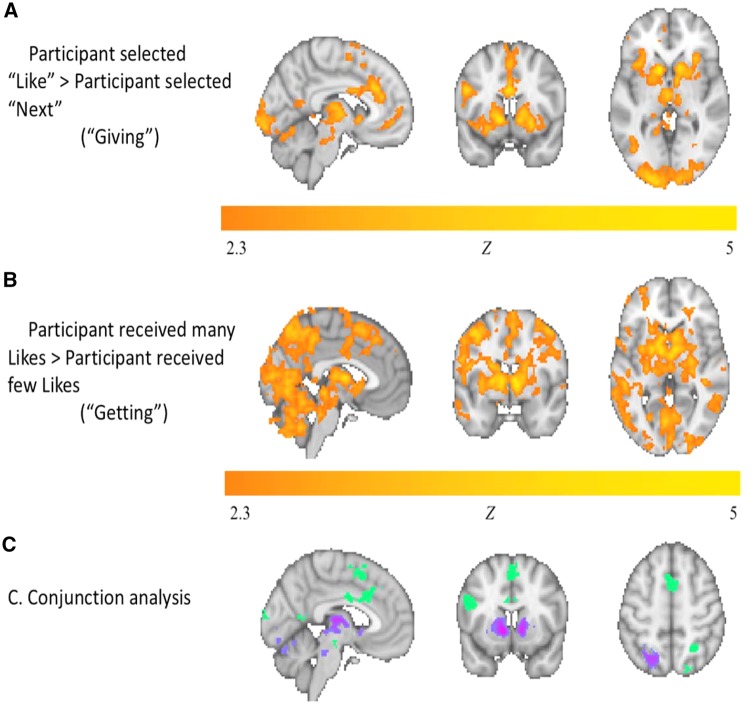
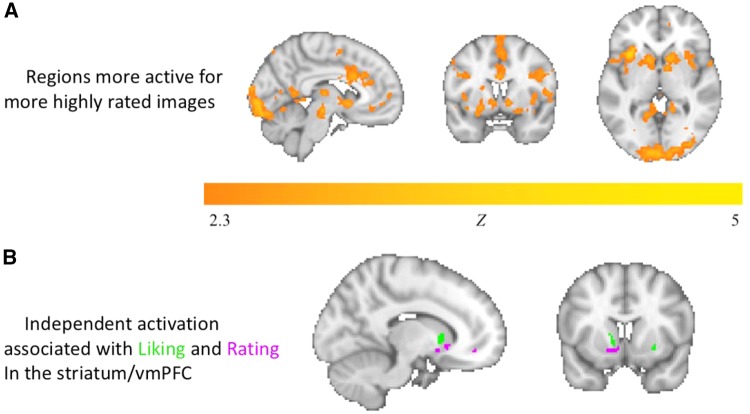
Evidence increasingly suggests that neural structures that respond to primary and secondary rewards are also implicated in the processing of social rewards. The 'Like'-a popular feature on social media-shares features with both monetary and social rewards as a means of feedback that shapes reinforcement learning. Despite the ubiquity of the Like, little is known about the neural correlates of providing this feedback to others. In this study, we mapped the neural correlates of providing Likes to others on social media. Fifty-eight adolescents and young adults completed a task in the MRI scanner designed to mimic the social photo-sharing app Instagram. We examined neural responses when participants provided positive feedback to others. The experience of providing Likes to others on social media related to activation in brain circuity implicated in reward, including the striatum and ventral tegmental area, regions also implicated in the experience of receiving Likes from others. Providing Likes was also associated with activation in brain regions involved in salience processing and executive function. We discuss the implications of these findings for our understanding of the neural processing of social rewards, as well as the neural processes underlying social media use.
Overview
The claims and statistics of this paper haven’t been checked yet.
Free: it reads the open-access text and checks the first 5 claims that cite a source we can check. Create a free account to check every claim.
Integrity signals
Registry
Cites
Statistics
Figures
Verification
Claims the paper makes
The claims and statistics of this paper haven’t been checked yet.
Free: it reads the open-access text and checks the first 5 claims that cite a source we can check. Create a free account to check every claim.
Claims other papers make about this one
Each is checked against this paper’s own text: does it say what the citing paper says it does?
The cited source says what the claim attributes to it.
In the citing paper
“In humans, brain imaging studies have consistently shown that likes8,9, and other social rewards, are processed by neural and computational mechanisms closely overlapping with those processing non-social rewards10–14.”
From A computational reward learning account of social media engagement (2021) · cites this paper as [9]
Self-check
Percentages, sums and reported differences re-computed from the paper’s own numbers.
The self-check needs the paper’s full text.
Citations
Cites
The need to belong: Desire for interpersonal attachments as a fundamental human motivation.
Baumeister, R. F., & Leary, M. R. (1995) · Psychological Bulletin · doi:10.1037//0033-2909.117.3.497 · Cited by 23,245
Jenkinson, M., Beckmann, C. F., Behrens, T. E. J., Woolrich, M. W., & Smith, S. M. (2012) · NeuroImage · doi:10.1016/j.neuroimage.2011.09.015 · Cited by 11,314
AFNI: Software for analysis and visualization of functional magnetic resonance neuroimages
Cox, R. W. (1996) · Computers and Biomedical Research · doi:10.1006/cbmr.1996.0014 · Cited by 10,913 · cited 3×
“The rating task was introduced after data had been collected on several participants; rating data were available for 41 out of 58 participants. fMRI data analysis fMRI data were preprocessed and analyzed using AFNI (Cox, 1996) and the FMRIB Software Library (FSL) (Jenkinson et al., 2012); full details are available in…”
MethodInfluentialDissociable intrinsic connectivity networks for salience processing and executive control
Seeley, W. W., Menon, V., Schatzberg, A. F., Keller, J., Glover, G. H., Kenna, H., Reiss, A. L., & Greicius, M. D. (2007) · The Journal of Neuroscience · doi:10.1523/jneurosci.5587-06.2007 · Cited by 7,426 · cited 1×
“regions, which often co-activate during cognitively demanding tasks, has been dubbed the ‘task activation ensemble’ (Seeley et al., 2007).”
BackgroundSaliency, switching, attention and control: a network model of insula function
Menon, V., & Uddin, L. Q. (2010) · Brain Structure and Function · doi:10.1007/s00429-010-0262-0 · Cited by 5,592
Cluster failure: why fMRI inferences for spatial extent have inflated false-positive rates
Eklund, A., Nichols, T. E., & Knutsson, H. (2016) · Proceedings of the National Academy of Sciences · doi:10.1073/pnas.1602413113 · Cited by 3,487 · cited 2×
“Given the recent concern about the validity of parametric cluster thresholding (Eklund et al., 2016), we also performed a confirmatory analysis of our main contrasts of interest using FSL’s permutation-based testing tool RANDOMISE to obtain nonparametric statistics with 10 000 random permutations and threshold-free cl…”
MethodAnticipation of Increasing Monetary Reward Selectively Recruits Nucleus Accumbens
Knutson, B., Adams, C. M., Fong, G. W., & Hommer, D. (2001) · The Journal of Neuroscience · doi:10.1523/jneurosci.21-16-j0002.2001 · Cited by 2,244 · cited 1×
“Much of the early literature on reward processing investigated brain responses to monetary reward as feedback on task performance (e.g. Delgado et al., 2000; Knutson et al., 2001; Galvan et al., 2005).”
BackgroundValid conjunction inference with the minimum statistic
Nichols, T., Brett, M., Andersson, J., Wager, T., & Poline, J.-B. (2005) · NeuroImage · doi:10.1016/j.neuroimage.2004.12.005 · Cited by 1,880 · cited 1×
“conjunction analysis using the tool easythresh_conj (Nichols et al., 2005), with a cluster correction of P < 0.”
MethodThe Proceedings of the National Academy of Sciences
Wilson, E. B. (1919) · Science · doi:10.1126/science.49.1254.46.b · Cited by 1,833
The Social Brain: Neural Basis of Social Knowledge
Adolphs, R. (2009) · Annual Review of Psychology · doi:10.1146/annurev.psych.60.110707.163514 · Cited by 1,827
Research works printed but not linked: 1
- Hu Y., Manikonda L., Kambhampati S. (2014). What we instagram: a first analysis of instagram photo content and user types. Proceedings of the 8th International Conference on Weblogs and Social Media.
Cited by
Items 201–282 of 282
Mortágua, M., Ferreira, V., & Louçã, F. (2025) · Industrial and Corporate Change · doi:10.1093/icc/dtaf068
Atmung und Stille: Regulation des Nervensystems für bewusste Kommunikation
Herdin, T. (2026) · Innovativ und kompakt - gesellschaftliche Herausforderungen der Gegenwart · doi:10.1007/978-3-658-51341-2_9
Fitzduff, M. (2021) · Oxford University Press eBooks · doi:10.1093/oso/9780197512654.003.0007
Fitzduff, M. (2021) · Oxford University Press eBooks · doi:10.1093/oso/9780197512654.003.0009
Fitzduff, M. (2021) · Oxford University Press eBooks · doi:10.1093/oso/9780197512654.003.0010
Fitzduff, M. (2021) · Oxford University Press eBooks · doi:10.1093/oso/9780197512654.003.0003
Fitzduff, M. (2021) · Oxford University Press eBooks · doi:10.1093/oso/9780197512654.003.0005
Fitzduff, M. (2021) · Oxford University Press eBooks · doi:10.1093/oso/9780197512654.003.0001
Fitzduff, M. (2021) · Oxford University Press eBooks · doi:10.1093/oso/9780197512654.003.0002
Peacebuilding More Successfully?
Fitzduff, M. (2021) · Oxford University Press eBooks · doi:10.1093/oso/9780197512654.003.0011
Fitzduff, M. (2021) · Oxford University Press eBooks · doi:10.1093/oso/9780197512654.003.0006
Fitzduff, M. (2021) · Oxford University Press eBooks · doi:10.1093/oso/9780197512654.003.0004
Fitzduff, M. (2021) · Oxford University Press eBooks · doi:10.1093/oso/9780197512654.003.0008
Fitzduff, M. (2021) · Oxford University Press eBooks · doi:10.1093/oso/9780197512654.002.0003
Fitzduff, M. (2021) · Oxford University Press eBooks · doi:10.1093/oso/9780197512654.002.0006
Fitzduff, M. (2021) · Oxford University Press eBooks · doi:10.1093/oso/9780197512654.002.0004
Implicitly tuned: The neural effects of social feedback on adolescent learning
Bosseler, A. N., Peterson, E. R., Stavropoulos, K. K. M., Mizrahi, J. C., Larson, E., Corrigan, N. M., Taulu, S., Meltzoff, A. N., & Kuhl, P. K. (2026) · Developmental Cognitive Neuroscience · doi:10.1016/j.dcn.2026.101809
Eroğlu, D. T. (2026) · Pamukkale University Journal of Social Sciences Institute · doi:10.30794/pausbed.1756548
Cejudo, J., Rodríguez-Donaire, A., Luna, P., Stavraki, M., Díaz, D., & Bajo, M. (2025) · Psychological Reports · doi:10.1177/00332941251363888
Wu, Q., & O’Doherty, J. P. (2025) · OSF Preprints (OSF Preprints) · doi:10.31219/osf.io/ncz4j_v2
Wu, Q., & O’Doherty, J. P. (2026) · Springer eBooks · doi:10.1007/978-3-032-02925-6_6
Xuan, P., Wang, L., & Li, D. (2026) · Frontiers in Psychology · doi:10.3389/fpsyg.2026.1911494
Brain activity reveals how wildlife imagery evokes engagement on social media
Srirangarajan, T., Sawe, N. A., Thys, T., Wu, X., & Knutson, B. D. (2026) · PNAS Nexus · doi:10.1093/pnasnexus/pgag012
Social Media Engagement: Likes, Reactions, and Comments
Orchard, L. (2026) · Springer eBooks · doi:10.1007/978-3-031-52643-5_209-1
Young People Are Willing to Intervene Against Rape Myths Online: A Simulated Social Media Experiment
Nicolla, S., McKenzie, A. H., Lazard, A. J., DiFranzo, D. J., Aghajari, Z., Mao, C., & Dasgupta, N. (2025) · Journal of Adolescent Health · doi:10.1016/j.jadohealth.2025.01.006
KILIÇ, S., & Ediş, L. B. (2026) · Advances in computational intelligence and robotics book series · doi:10.4018/979-8-3373-7734-6.ch012
Клиточенко, Г. В., Lukash, A. I., & Малюжинская, Н. В. (2026) · Современные проблемы науки и образования · doi:10.17513/spno.34559
Özüçetin, B. (2026) · Journal of Consultation Liaison Psychiatry · doi:10.71350/jclp.27
Votinov, M. (2026) · Elsevier eBooks · doi:10.1016/b978-0-443-34080-2.00004-4
Xiao, X., Zhang, X., Liu, Y., Liu, X., Han, Y., & Zhou, Y. (2026) · Food Quality and Preference · doi:10.1016/j.foodqual.2026.105889
Neural and psychological predictors of digital status‐seeking in adolescence
Jack, D. B., Trekels, J., Capella, J., Maza, M. T., Lindquist, K. A., Prinstein, M. J., & Telzer, E. H. (2026) · Journal of Research on Adolescence · doi:10.1111/jora.70240
Spend it or Earn it? A Comparative Assessment of Market and Social Signals in Social Commerce
Mookherjee, S., Nazari, S., & Bose, I. (2026) · Information Systems Frontiers · doi:10.1007/s10796-026-10767-7
Evans, C., & Prinstein, M. (2026) · CU Scholar (University of Colorado Boulder)
Bielak, A. (2026) · Annales Universitatis Mariae Curie-Skłodowska sectio J – Paedagogia-Psychologia · doi:10.17951/j.2026.39.1.199-220
Wu, Y., Gan, X., Jiao, G., Hurlemann, R., Scheele, D., Zhou, X., Zhang, R., Zhou, F., Jiang, H., Fu, K., et al. (2026) · bioRxiv (Cold Spring Harbor Laboratory) · doi:10.64898/2026.08.10.744060
Olivera, M. (2025) · El Servicio de Difusión de la Creación Intelectual (National University of La Plata) · doi:10.35537/10915/182691
Youth visions of the future: between stability and structural transformation
Lattanzi, T., Monchietto, A., Mattiello, S., & Lombardo, G. (2026) · Institutional Research Information System University of Turin (University of Turin) · doi:10.7346/sipes-01-2026-12
Pupi, V. (2023) · AMS Dottorato Institutional Doctoral Theses Repository (University of Bologna) · doi:10.48676/unibo/amsdottorato/10851
Sentiment Analysis and its Application in Managerial Decision Making
Švaňa, M. (2024) · DSpace VŠB-TUO (VŠB-TUO)
Psychosocial stress brain reactivity and effects of mindfulness in young adolescents
Knight-Celen, Z. (2024) · Archive ouverte UNIGE (University of Geneva) · doi:10.13097/archive-ouverte/unige:182548
Health psychology in the age of social media: pointers for future research
Gültzow, T., Yılmaz, N. G., Benvenuti, M., Birtel, M. D., Dolinšek, Š., Green, J., Gugushvili, N., Mo, J., Oldeman, M. G., Qin, K., et al. (2026) · European Health Psychologist · doi:10.62696/sdrf4145
"Likes" y aprobación social: un análisis multidimensional de la búsqueda de reconomiento digital
Ferreiro, M. L. P., Bargiela, I. M., & Carril, P. C. M. (2026) · Hispana
Chiao, J. Y., Mano, Y., & Sadato, N. (2022) · Oxford University Press eBooks · doi:10.1093/oxfordhb/9780190057695.013.23
In the name of status:Adolescent harmful social behavior as strategic self-regulation
Hensums, M. (2024) · UvA-DARE (University of Amsterdam)
Díaz-Moreno, A. (2026) · Tesis Doctorals en Xarxa (Consorci de Serveis Universitaris de Catalunya)
Den digitala dansen : En studie om sociala mediers design och effekter på unga vuxna
Hammarberg, C., & Höglund, E. (2024) · Hogskolan Ihalmstad (Halmstad University)
Fardell, A.-M. (2026) · Charles Sturt University Research Output (CRO)
Independent and Interacting Effects of Co-Presence and Social Media 'Likes' on Online Disinhibition
Doheny, M. M. (2026) · STARS (University of Central Florida)
Powell Galaviz, J. A. (2024) · El Repositorio Academico Digital de la UANL (Universidad Autónoma de Nuevo León)
A youth-engaged approach to explore adolescent social influence processes within digital contexts
Maza, M. T. (2025) · Carolina Digital Repository (University of North Carolina at Chapel Hill) · doi:10.17615/2bsb-ca44
NEURAL AND PSYCHOLOGICAL PREDICTORS OF DIGITAL STATUS SEEKING IN ADOLESCENCE
Jack, D. B. (2025) · Carolina Digital Repository (University of North Carolina at Chapel Hill) · doi:10.17615/mb0m-sr31
Autopercepción de la imagen corporal en adolescentes usuarias de Instagram de Lima Metropolitana
Bernal, E. C. Q. (2025) · Universidad Peruana de Ciencias Aplicadas (UPC) · doi:10.19083/tesis/686580
DuBoff, D. (2019) · ScholarsArchive at Johnson & Wales University (Johnson & Wales University)
Brogle, N., Dai, A., Edara, A., Kudriavtsev, K., Linares, A., Nguyen, M., Shui, H., Zhao, M., & Cervera, M. (2024) · eScholarship (California Digital Library)
Marciano, L., Camerini, A.-L., & Morese, R. (2021) · doi:10.3389/fpsyg.2021.671817.s001
Sosyal Medya Bağımlılığının Nörobiyolojik Temelleri
Adıgüzel, S. (2021) · Akademisyen Kitabevi eBooks · doi:10.37609/akya.12.c3745
The relationship between Social media & Emotional regulation : A quantitive survey study
Nilsson Litrico, M., & Eriksson, N. (2023) · DiVA (Luleå University of Technology)
Coburn, C. (2026) · Digital Commons (Liberty University)
Öztürk, S. B. (2023) · Hitit University Institutional Repository
Increased Behavioural Sensitivity to ‘Likes’ During COVID-19 Social DistancingPreprint
Davidson, B. C., Turner, G., Palminteri, S., Tomova, L., Eichstaedt, J. C., Salecha, A., Subrahmanya, S., Gunschera, L. J., & Orben, A. C. (2025) · PsyArXiv (OSF Preprints) · doi:10.31234/osf.io/65tdz_v1
Findley, A. M. (2026) · CUNY Academic Works (City University of New York)
김효정 (2023) · Seoul National University Open Repository (Seoul National University)
Power to the People: Agents' Role in and Responsibility for Domination
McHugh, H. (2024) · UCL Discovery (University College London)
Freitas, C. A. D. O. (2023) · LA Referencia (Red Federada de Repositorios Institucionales de Publicaciones Científicas)
Hvers konar auglýsingaefni hrífur notendur á Facebook og Instagram?
Garðarsdóttir, K. L., & Lárusdóttir, L. B. (2020) · Skemman
Conflict-Generated Content: Cognitive Surplus and the Life Cycle of Online Conflict Reporting
Simkin, D. (2023) · Research Online (University of Wollongong)
Couto, G. F., Resende, M. E., Pereira, L. M. D. O., & de Oliveira, E. (2024) · Contribuciones a las Ciencias Sociales · doi:10.55905/revconv.17n.12-378
The Influence of Social Media on Adolescent Cognitive Memory: A Review
Hao, Y. (2025) · Lecture Notes in Education Psychology and Public Media · doi:10.54254/2753-7048/2025.ld29668
Sharma, R. (2026) · International Journal of Innovative Science and Research Technology (IJISRT) · doi:10.38124/ijisrt/26feb1213
Costello, N., Almassian, M., Sutton, R., Jones, M., Diamond, S., Ojumu, O., Raffoul, A., Salvia, M., Kavanaugh, J. R., & Austin, S. B. (2024) · Digital Access to Scholarship at Harvard (DASH) (Harvard University)
Sadin, M. A. F., Harindutta, N. G., Zahro, F. A., & Nurbaini, Y. (2026) · Jurnal Kesehatan Tambusai · doi:10.31004/jkt.v7i3.63196
Chikore, T., & Nyabadza, F. (2026) · Scientific Reports · doi:10.1038/s41598-026-50538-7
Abarca, J. P., Carreón, M. T., & García, A. C. (2026) · Prisma Journal · doi:10.63803/prisma.v2n4.43
DIPP: Information Diffusion for Privacy in Multi-agent Systems
Mwanjesa, A. (2021) · Utrecht University Repository (Utrecht University)
Social Media's Impact on Mental Health in Children & Adolescents
Tahhan, G. (2019) · ScholarWorks -A service of University of Vermont Libraries (University of Vermont)
Vícios em curtidas: uma tendência em medicina
Stauffer, A., Barros, A. L., Angelim, A., Mitleg, B., Altoé, D., Costa, E., Lacerda, E., VASCONCELLOS, G. L. N. D., Canali, J. O., Zafra, J. M., et al. (2023) · Brazilian Journal of Health Review · doi:10.34119/bjhrv6n1-130
Švaňa, M., Zapletal, F., & Hudec, M. (2025) · Fuzzy management methods · doi:10.1007/978-3-032-00129-0_5
Ali-zade, A. (2025) · Social Sciences · doi:10.59849/2710-0820.2025.2.213
Digital Dopamine and Human Connections: Neural Responses to Online and Offline Social Feedback
Swar, S. (2026) · International journal of high school research · doi:10.36838/ijhsr89.154
Zulfa, I. N. (2025) · Maliki Interdisciplinary Journal
Vahed, S., Goanta, C., Ortolani, P., & Sanfey, A. G. (2024) · doi:10.1371/journal.pone.0300960.r005
Metadata
- Authors
- Sherman, L. E., Hernandez, L. M., Greenfield, P. M., & Dapretto, M.
- Venue
- Social Cognitive and Affective Neuroscience
- Publisher
- Oxford University Press (OUP)
- Published
- 2018-07-04
- Volume
- 13
- Issue
- 7
- Pages
- 699-707
- ISSN
- 1749-5016 (ISSN-L)
- 1749-5024
- PMC
- PMC6121147
- OpenAlex
- W2886427183
- Cited by
- 205
- References
- 44
- FWCI
- 8.30
- Type
- journal article
- Language
- en
- Open access
- gold
- Funders
- National Center for Research Resources (C06-RR012169, C06-RR015431)
- Office of the Director (S10-OD011939)
- National Institutes of Health (F31-DA038578-01A1)
- National Institute on Drug Abuse
- Brain Mapping Medical Research Organization
- Brain Mapping Support Foundation
- Pierson-Lovelace Foundation
- The Ahmanson Foundation
- Capital Group Companies Charitable Foundation
- William M. and Linda R. Dietel Philanthropic Fund
- Northstar Fund
About these checks
Registry, retraction, Cites and statistics results are computed, not judged, with one exception: a printed reference that no index lists is read once by a model before it counts as a citation error. Claims are extracted by a model and kept only when their quote appears verbatim in the text; each cited source is then checked, with a model’s help, for whether it says what the claim relies on. Those verdicts can be wrong — read the claim’s quote and the cited source before relying on one.
Statistics and arithmetic are recomputed, not judged.
Confidence bands are shown only for fields calibrated on our annotated test set. None is calibrated yet, so no band is shown.
What counts as a claim ›How we measure confidence ›How we check this ›
Are you an author, or do you see a problem with this page? Request a review
Data sources
Bibliographic data: Semantic Scholar, OpenAlex, Crossref.
Contains information from the Semantic Scholar Academic Graph Datasets, made available under the ODC Attribution License (ODC-BY 1.0).
Semantic Scholar’s data is described in: Kinney, R., et al. (2023). The Semantic Scholar Open Data Platform. arXiv:2301.10140.
