

What the brain ‘Likes’: neural correlates of providing feedback on social media
Open accessThe DOI matches its Crossref record; 45 of the 46 references it cites were found in a registry or an index, and 1 are not checked yet.
Abstract
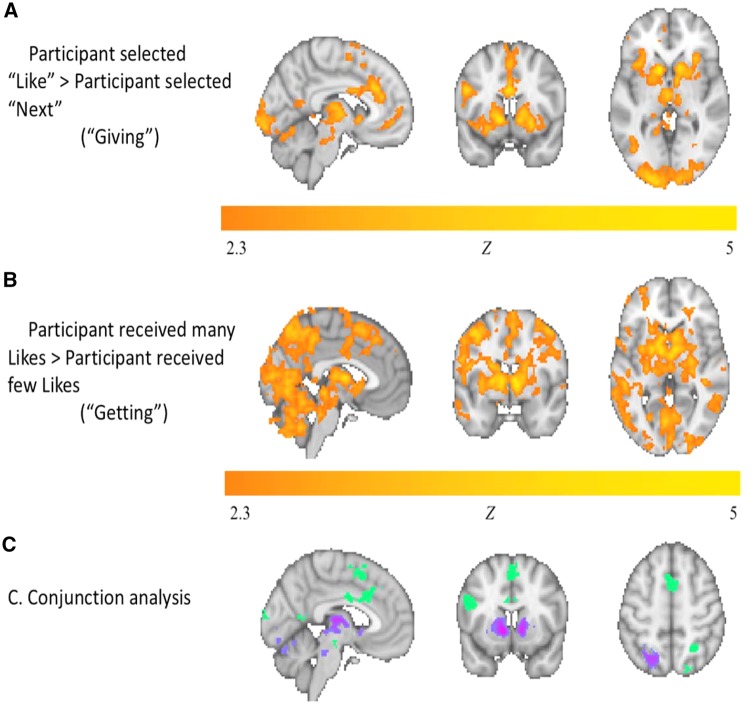
Evidence increasingly suggests that neural structures that respond to primary and secondary rewards are also implicated in the processing of social rewards. The 'Like'-a popular feature on social media-shares features with both monetary and social rewards as a means of feedback that shapes reinforcement learning. Despite the ubiquity of the Like, little is known about the neural correlates of providing this feedback to others. In this study, we mapped the neural correlates of providing Likes to others on social media. Fifty-eight adolescents and young adults completed a task in the MRI scanner designed to mimic the social photo-sharing app Instagram. We examined neural responses when participants provided positive feedback to others. The experience of providing Likes to others on social media related to activation in brain circuity implicated in reward, including the striatum and ventral tegmental area, regions also implicated in the experience of receiving Likes from others. Providing Likes was also associated with activation in brain regions involved in salience processing and executive function. We discuss the implications of these findings for our understanding of the neural processing of social rewards, as well as the neural processes underlying social media use.
Overview
The claims and statistics of this paper haven’t been checked yet.
Free: it reads the open-access text and checks the first 5 claims that cite a source we can check. Create a free account to check every claim.
Integrity signals
Registry
Cites
Statistics
Figures
Verification
Claims the paper makes
The claims and statistics of this paper haven’t been checked yet.
Free: it reads the open-access text and checks the first 5 claims that cite a source we can check. Create a free account to check every claim.
Claims other papers make about this one
Each is checked against this paper’s own text: does it say what the citing paper says it does?
The cited source says what the claim attributes to it.
In the citing paper
“In humans, brain imaging studies have consistently shown that likes8,9, and other social rewards, are processed by neural and computational mechanisms closely overlapping with those processing non-social rewards10–14.”
From A computational reward learning account of social media engagement (2021) · cites this paper as [9]
Self-check
Percentages, sums and reported differences re-computed from the paper’s own numbers.
The self-check needs the paper’s full text.
Citations
Cites
The need to belong: Desire for interpersonal attachments as a fundamental human motivation.
Baumeister, R. F., & Leary, M. R. (1995) · Psychological Bulletin · doi:10.1037//0033-2909.117.3.497 · Cited by 23,245
Jenkinson, M., Beckmann, C. F., Behrens, T. E. J., Woolrich, M. W., & Smith, S. M. (2012) · NeuroImage · doi:10.1016/j.neuroimage.2011.09.015 · Cited by 11,314
AFNI: Software for analysis and visualization of functional magnetic resonance neuroimages
Cox, R. W. (1996) · Computers and Biomedical Research · doi:10.1006/cbmr.1996.0014 · Cited by 10,913 · cited 3×
“The rating task was introduced after data had been collected on several participants; rating data were available for 41 out of 58 participants. fMRI data analysis fMRI data were preprocessed and analyzed using AFNI (Cox, 1996) and the FMRIB Software Library (FSL) (Jenkinson et al., 2012); full details are available in…”
MethodInfluentialDissociable intrinsic connectivity networks for salience processing and executive control
Seeley, W. W., Menon, V., Schatzberg, A. F., Keller, J., Glover, G. H., Kenna, H., Reiss, A. L., & Greicius, M. D. (2007) · The Journal of Neuroscience · doi:10.1523/jneurosci.5587-06.2007 · Cited by 7,426 · cited 1×
“regions, which often co-activate during cognitively demanding tasks, has been dubbed the ‘task activation ensemble’ (Seeley et al., 2007).”
BackgroundSaliency, switching, attention and control: a network model of insula function
Menon, V., & Uddin, L. Q. (2010) · Brain Structure and Function · doi:10.1007/s00429-010-0262-0 · Cited by 5,592
Cluster failure: why fMRI inferences for spatial extent have inflated false-positive rates
Eklund, A., Nichols, T. E., & Knutsson, H. (2016) · Proceedings of the National Academy of Sciences · doi:10.1073/pnas.1602413113 · Cited by 3,487 · cited 2×
“Given the recent concern about the validity of parametric cluster thresholding (Eklund et al., 2016), we also performed a confirmatory analysis of our main contrasts of interest using FSL’s permutation-based testing tool RANDOMISE to obtain nonparametric statistics with 10 000 random permutations and threshold-free cl…”
MethodAnticipation of Increasing Monetary Reward Selectively Recruits Nucleus Accumbens
Knutson, B., Adams, C. M., Fong, G. W., & Hommer, D. (2001) · The Journal of Neuroscience · doi:10.1523/jneurosci.21-16-j0002.2001 · Cited by 2,244 · cited 1×
“Much of the early literature on reward processing investigated brain responses to monetary reward as feedback on task performance (e.g. Delgado et al., 2000; Knutson et al., 2001; Galvan et al., 2005).”
BackgroundValid conjunction inference with the minimum statistic
Nichols, T., Brett, M., Andersson, J., Wager, T., & Poline, J.-B. (2005) · NeuroImage · doi:10.1016/j.neuroimage.2004.12.005 · Cited by 1,880 · cited 1×
“conjunction analysis using the tool easythresh_conj (Nichols et al., 2005), with a cluster correction of P < 0.”
MethodThe Proceedings of the National Academy of Sciences
Wilson, E. B. (1919) · Science · doi:10.1126/science.49.1254.46.b · Cited by 1,833
The Social Brain: Neural Basis of Social Knowledge
Adolphs, R. (2009) · Annual Review of Psychology · doi:10.1146/annurev.psych.60.110707.163514 · Cited by 1,827
The Proceedings of the National Academy of Sciences
Wilson, E. B. (1919) · Science · doi:10.1126/science.49.1254.46-b · Cited by 1,776
The Role of the Dorsal Striatum in Reward and Decision-Making: Figure 1.
Balleine, B. W., Delgado, M. R., & Hikosaka, O. (2007) · The Journal of Neuroscience · doi:10.1523/jneurosci.1554-07.2007 · Cited by 1,390
Neural Correlates of Behavioral Preference for Culturally Familiar Drinks
McClure, S. M., Li, J., Tomlin, D., Cypert, K. S., Montague, L. M., & Montague, P. R. (2004) · Neuron · doi:10.1016/j.neuron.2004.09.019 · Cited by 1,353 · cited 1×
“related to activation in this circuitry (e.g. Erk et al., 2002; McClure et al., 2004; Knutson et al., 2007).”
BackgroundOnline and offline social networks: Use of social networking sites by emerging adults
Subrahmanyam, K., Reich, S. M., Waechter, N., & Espinoza, G. (2008) · Journal of Applied Developmental Psychology · doi:10.1016/j.appdev.2008.07.003 · Cited by 1,284
Neural Predictors of Purchases
Knutson, B., Rick, S., Wimmer, G. E., Prelec, D., & Loewenstein, G. (2007) · Neuron · doi:10.1016/j.neuron.2006.11.010 · Cited by 1,171 · cited 1×
“related to activation in this circuitry (e.g. Erk et al., 2002; McClure et al., 2004; Knutson et al., 2007).”
BackgroundTracking the Hemodynamic Responses to Reward and Punishment in the Striatum
Delgado, M. R., Nystrom, L. E., Fissell, C., Noll, D. C., & Fiez, J. A. (2000) · Journal of Neurophysiology · doi:10.1152/jn.2000.84.6.3072 · Cited by 1,116
Neural Responses to Taxation and Voluntary Giving Reveal Motives for Charitable Donations
Harbaugh, W. T., Mayr, U., & Burghart, D. R. (2007) · Science · doi:10.1126/science.1140738 · Cited by 1,046
Processing of Social and Monetary Rewards in the Human Striatum
Izuma, K., Saito, D. N., & Sadato, N. (2008) · Neuron · doi:10.1016/j.neuron.2008.03.020 · Cited by 855
The social brain hypothesis and its implications for social evolution
Dunbar, R. I. M. (2009) · Annals of Human Biology · doi:10.1080/03014460902960289 · Cited by 795 · cited 1×
“Researchers and anthropologists have hypothesized that the evolutionary history of the primate brain, and especially the human brain, is directly tied to the increasing importance of social interaction and group membership (e.g. Adolphs, 2009; Dunbar, 2009).”
BackgroundSherman, L. E., Payton, A. A., Hernandez, L. M., Greenfield, P. M., & Dapretto, M. (2016) · Psychological Science · doi:10.1177/0956797616645673 · Cited by 627 · cited 3×
“Receiving many Likes on one’s own Instagram photo leads to activation of this network, including the NAcc and vmPFC (Sherman et al., 2016), and the experience of sharing information with others elicits response in the NAcc and VTA (Tamir and Mitchell, 2012).”
BackgroundSelf-citationDisclosing information about the self is intrinsically rewarding
Tamir, D. I., & Mitchell, J. P. (2012) · Proceedings of the National Academy of Sciences · doi:10.1073/pnas.1202129109 · Cited by 563 · cited 7×
“The brain’s reward circuitry, which includes the dorsal and ventral striatum [including the nucleus accumbens (NAcc)], ventromedial prefrontal cortex (vmPFC), and ventral tegmental area (VTA), has been implicated in several aspects of processing socially relevant information in online environments.”
BackgroundInfluentialReward value of attractiveness and gaze
Kampe, K. K. W., Frith, C. D., Dolan, R. J., & Frith, U. (2001) · Nature · doi:10.1038/35098149 · Cited by 475 · cited 1×
“…images is related to greater recruitment of the VS (Lacey et al., 2011), and the experience of viewing attractive faces has been related to several brain regions implicated in this study, including the anterior cingulate, amygdala and vmPFC (e.g. Kampe et al., 2001; Winston et al., 2007).”
MethodFaces engage us: photos with faces attract more likes and comments on Instagram
Bakhshi, S., Shamma, D. A., & Gilbert, E. (2014) · Proceedings of the SIGCHI Conference on Human Factors in Computing Systems · doi:10.1145/2556288.2557403 · Cited by 399 · cited 1×
“(this finding is at odds with earlier work suggesting young people more frequently like Instagram photos depicting people; Bakshi et al., 2014; the difference may result from the presence of strangers’ photos in our study).”
ResultBrain systems for assessing facial attractiveness
Winston, J. S., O’Doherty, J., Kilner, J. M., Perrett, D. I., & Dolan, R. J. (2007) · Neuropsychologia · doi:10.1016/j.neuropsychologia.2006.05.009 · Cited by 367
Cultural objects modulate reward circuitry
Erk, S., Spitzer, M., Wunderlich, A. P., Galley, L., & Walter, H. (2002) · NeuroReport · doi:10.1097/00001756-200212200-00024 · Cited by 359
One click, many meanings: interpreting paralinguistic digital affordances in social media
Hayes, R. A., Carr, C. T., & Wohn, D. Y. (2016) · Journal of Broadcasting & Electronic Media · doi:10.1080/08838151.2015.1127248 · Cited by 346 · cited 2×
“On the other hand, some social media users report that Likes function as a form of social support (Hayes et al., 2016), and work by Inagaki and Eisenberger (2012) and Inagaki et al.”
BackgroundThe Emerging Neuroscience of Social Media
Meshi, D., Tamir, D. I., & Heekeren, H. R. (2015) · Trends in Cognitive Sciences · doi:10.1016/j.tics.2015.09.004 · Cited by 322
The social brain and reward: Social information processing in the human striatum
Bhanji, J. P., & Delgado, M. R. (2014) · WIREs Cognitive Science · doi:10.1002/wcs.1266 · Cited by 256 · cited 2×
“Although we refer to this system as a ‘reward circuit’, it is important to know that this circuitry is involved not only in the subjective experience of pleasure but also in recognizing, evaluating, predicting and responding to rewards (Bhanji and Delgado, 2014).”
BackgroundDo you like me? Neural correlates of social evaluation and developmental trajectories
Gunther Moor, B., van Leijenhorst, L., Rombouts, S. A. R. B., Crone, E. A., & Van der Molen, M. W. (2010) · Social Neuroscience · doi:10.1080/17470910903526155 · Cited by 231
Art for reward's sake: Visual art recruits the ventral striatum
Lacey, S., Hagtvedt, H., Patrick, V. M., Anderson, A., Stilla, R., Deshpande, G., Hu, X., Sato, J. R., Reddy, S., & Sathian, K. (2011) · NeuroImage · doi:10.1016/j.neuroimage.2010.11.027 · Cited by 227 · cited 1×
“related to greater recruitment of the VS (Lacey et al., 2011), and the experience of viewing attractive faces has been related to several brain regions implicated in this study, including the anterior cingulate, amygdala and vmPFC (e.”
BackgroundThe role of ventral frontostriatal circuitry in reward-based learning in humans.
Galvan, A., Hare, T. A., Davidson, M., Spicer, J., Glover, G., & Casey, B. J. (2005) · The Journal of Neuroscience · doi:10.1523/jneurosci.2431-05.2005 · Cited by 207 · cited 1×
“Much of the early literature on reward processing investigated brain responses to monetary reward as feedback on task performance (e.g. Delgado et al., 2000; Knutson et al., 2001; Galvan et al., 2005).”
BackgroundCommon and distinct neural correlates of personal and vicarious reward: A quantitative meta-analysis
Morelli, S. A., Sacchet, M. D., & Zaki, J. (2015) · NeuroImage · doi:10.1016/j.neuroimage.2014.12.056 · Cited by 203 · cited 2×
“Given that vicarious rewards were not reliably associated with striatal activation (Morelli et al., 2015), but that striatal activation was associated with other relevant social activities, such as sharing information with others (Tamir and Mitchell, 2012), we hypothesized that the striatum would potentially be involv…”
BackgroundPositively Biased Processing of Self-Relevant Social Feedback
Korn, C. W., Prehn, K., Park, S. Q., Walter, H., & Heekeren, H. R. (2012) · The Journal of Neuroscience · doi:10.1523/jneurosci.3016-12.2012 · Cited by 200 · cited 1×
“This finding has been replicated many times since (e.g. Davey et al., 2010; Jones et al., 2012; Korn et al., 2012).”
ResultPeer Influence via Instagram: Effects on Brain and Behavior in Adolescence and Young Adulthood
Sherman, L. E., Greenfield, P. M., Hernandez, L. M., & Dapretto, M. (2018) · Child Development · doi:10.1111/cdev.12838 · Cited by 196
Self-citationBehavioral and Neural Properties of Social Reinforcement Learning
Jones, R. M., Somerville, L. H., Li, J., Ruberry, E. J., Libby, V., Glover, G., Voss, H. U., Ballon, D. J., & Casey, B. J. (2011) · The Journal of Neuroscience · doi:10.1523/jneurosci.2972-11.2011 · Cited by 191
Gaining while giving: An fMRI study of the rewards of family assistance among White and Latino youth
Telzer, E. H., Masten, C. L., Berkman, E. T., Lieberman, M. D., & Fuligni, A. J. (2010) · Social Neuroscience · doi:10.1080/17470911003687913 · Cited by 189 · cited 1×
“Here, our finding that giving positive social feedback is associated with response in these regions is parsimonious with a large body of previous work suggesting that the striatum and vmPFC are activated when one makes monetary contributions to others (e.g. Harbaugh et al., 2007; Telzer et al., 2010), and provides soc…”
Silk, J. S., Stroud, L. R., Siegle, G. J., Dahl, R. E., Lee, K. H., & Nelson, E. E. (2012) · Social Cognitive and Affective Neuroscience · doi:10.1093/scan/nsr044 · Cited by 187
Social Network Modulation of Reward-Related Signals
Fareri, D. S., Niznikiewicz, M. A., Lee, V. K., & Delgado, M. R. (2012) · Journal of Neuroscience · doi:10.1523/jneurosci.0610-12.2012 · Cited by 175
Being liked activates primary reward and midline self‐related brain regions
Davey, C. G., Allen, N. B., Harrison, B. J., Dwyer, D. B., & Yücel, M. (2010) · Human Brain Mapping · doi:10.1002/hbm.20895 · Cited by 155
Giving support to others reduces sympathetic nervous system‐related responses to stress
Inagaki, T. K., & Eisenberger, N. I. (2015) · Psychophysiology · doi:10.1111/psyp.12578 · Cited by 149
Neural correlates of giving support to a loved one
Inagaki, T. K., & Eisenberger, N. I. (2012) · Psychosomatic Medicine · doi:10.1097/psy.0b013e3182359335 · Cited by 141
Achterberg, M., van Duijvenvoorde, A. C. K., Bakermans-Kranenburg, M. J., & Crone, E. A. (2016) · Social Cognitive and Affective Neuroscience · doi:10.1093/scan/nsv154 · Cited by 125
Social rewards and social networks in the human brain
Fareri, D. S., & Delgado, M. R. (2014) · The Neuroscientist · doi:10.1177/1073858414521869 · Cited by 124 · cited 1×
“Many have discussed the evolutionary importance of seeking and receiving feedback from others (e.g. Baumeister and Leary, 1995; van Winden et al., 2008; Fareri and Delgado, 2014), but it would also be adaptive for the act of providing positive feedback to be rewarding, insofar as this feedback can contribute to the fo…”
BackgroundOn the Nature, Modeling, and Neural Bases of Social Ties
van Winden, F. A. A. M., Stallen, M., & Ridderinkhof, K. R. (2008) · RePub (Erasmus University Rotterdam) · Cited by 27
On the nature, modeling, and neural bases of social ties
van Winden, F. A. A. M., Stallen, M., & Ridderinkhof, K. R. (2008) · Advances in health economics and health services research · doi:10.1016/s0731-2199(08)20006-3 · Cited by 25
What Types of Photographs Do Teenagers “Like”?
Greenfield, P. M., Evers, N. F. G., & Dembo, J. (2017) · International Journal of Cyber Behavior Psychology and Learning · doi:10.4018/ijcbpl.2017070101 · Cited by 7 · cited 1×
“While many social media users interact with strangers, interactions with known individuals are much more common (e.g. Subrahmanyam et al., 2008), and teens tend to less frequently Like photos of strangers (Greenfield et al., 2017).”
BackgroundSelf-citation
Research works printed but not linked: 1
- Hu Y., Manikonda L., Kambhampati S. (2014). What we instagram: a first analysis of instagram photo content and user types. Proceedings of the 8th International Conference on Weblogs and Social Media.
Cited by
Citizens Versus the Internet: Confronting Digital Challenges With Cognitive Tools
Kozyreva, A., Lewandowsky, S., & Hertwig, R. (2020) · Psychological Science in the Public Interest · doi:10.1177/1529100620946707 · Cited by 479
“, 2016), especially in regions associated with reward processing and prosocial behavior (Sherman et al., 2018).”
BackgroundElhai, J. D., Yang, H., & Montag, C. (2021) · Brazilian Journal of Psychiatry · doi:10.1590/1516-4446-2020-0870 · Cited by 362
Fineberg, N. A., Menchón, J. M., Hall, N., Dell'Osso, B., Brand, M., Potenza, M. N., Chamberlain, S. R., Cirnigliaro, G., Lochner, C., Billieux, J., et al. (2022) · Comprehensive Psychiatry · doi:10.1016/j.comppsych.2022.152346 · Cited by 241
A taxonomy of technology design features that promote potentially addictive online behaviours
Flayelle, M., Brevers, D., King, D. L., Maurage, P., Perales, J. C., & Billieux, J. (2023) · Nature Reviews Psychology · doi:10.1038/s44159-023-00153-4 · Cited by 195
A computational reward learning account of social media engagement
Lindström, B., Bellander, M., Schultner, D. T., Chang, A., Tobler, P. N., & Amodio, D. M. (2021) · Nature Communications · doi:10.1038/s41467-020-19607-x · Cited by 185
Metadata
- Authors
- Sherman, L. E., Hernandez, L. M., Greenfield, P. M., & Dapretto, M.
- Venue
- Social Cognitive and Affective Neuroscience
- Publisher
- Oxford University Press (OUP)
- Published
- 2018-07-04
- Volume
- 13
- Issue
- 7
- Pages
- 699-707
- ISSN
- 1749-5016 (ISSN-L)
- 1749-5024
- PMC
- PMC6121147
- OpenAlex
- W2886427183
- Cited by
- 205
- References
- 44
- FWCI
- 8.30
- Type
- journal article
- Language
- en
- Open access
- gold
- Funders
- National Center for Research Resources (C06-RR012169, C06-RR015431)
- Office of the Director (S10-OD011939)
- National Institutes of Health (F31-DA038578-01A1)
- National Institute on Drug Abuse
- Brain Mapping Medical Research Organization
- Brain Mapping Support Foundation
- Pierson-Lovelace Foundation
- The Ahmanson Foundation
- Capital Group Companies Charitable Foundation
- William M. and Linda R. Dietel Philanthropic Fund
- Northstar Fund
About these checks
Registry, retraction, Cites and statistics results are computed, not judged, with one exception: a printed reference that no index lists is read once by a model before it counts as a citation error. Claims are extracted by a model and kept only when their quote appears verbatim in the text; each cited source is then checked, with a model’s help, for whether it says what the claim relies on. Those verdicts can be wrong — read the claim’s quote and the cited source before relying on one.
Statistics and arithmetic are recomputed, not judged.
Confidence bands are shown only for fields calibrated on our annotated test set. None is calibrated yet, so no band is shown.
What counts as a claim ›How we measure confidence ›How we check this ›
Are you an author, or do you see a problem with this page? Request a review
Data sources
Bibliographic data: Semantic Scholar, OpenAlex, Crossref.
Contains information from the Semantic Scholar Academic Graph Datasets, made available under the ODC Attribution License (ODC-BY 1.0).
Semantic Scholar’s data is described in: Kinney, R., et al. (2023). The Semantic Scholar Open Data Platform. arXiv:2301.10140.
