

Regenerative Peripheral Nerve Interfaces for the Treatment of Postamputation Neuroma Pain: A Pilot Study
Open accessThe DOI matches its Crossref record; 47 of the 47 references it cites were found in a registry or an index.
Abstract
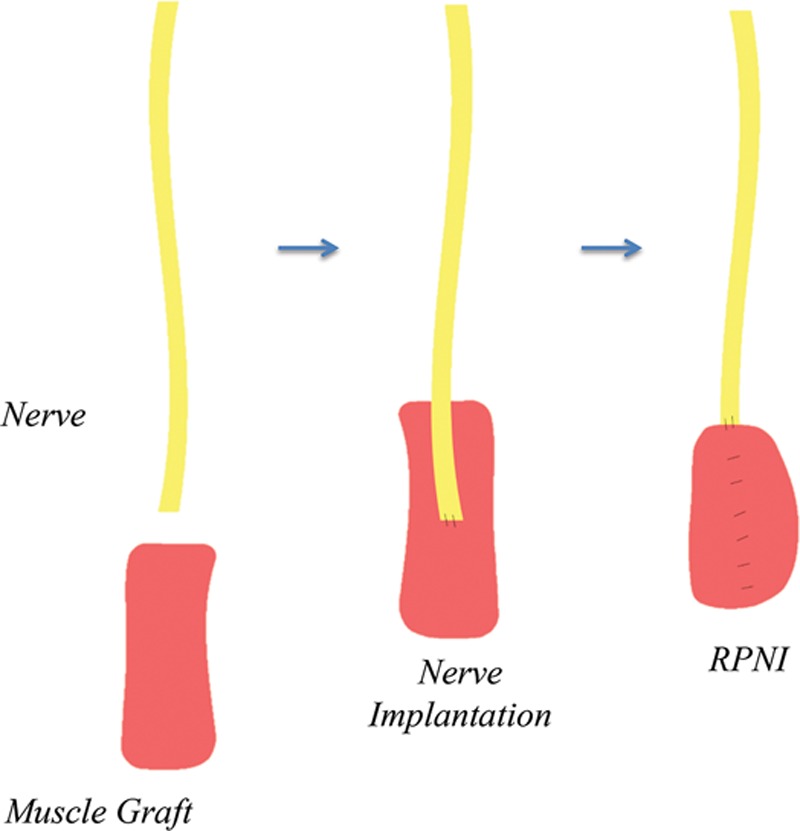
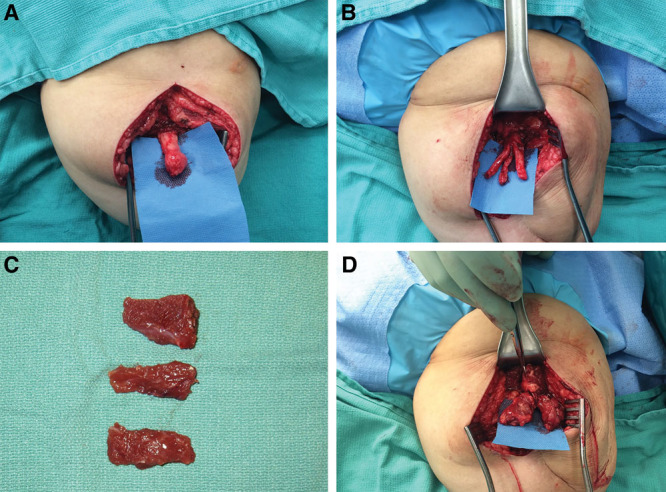
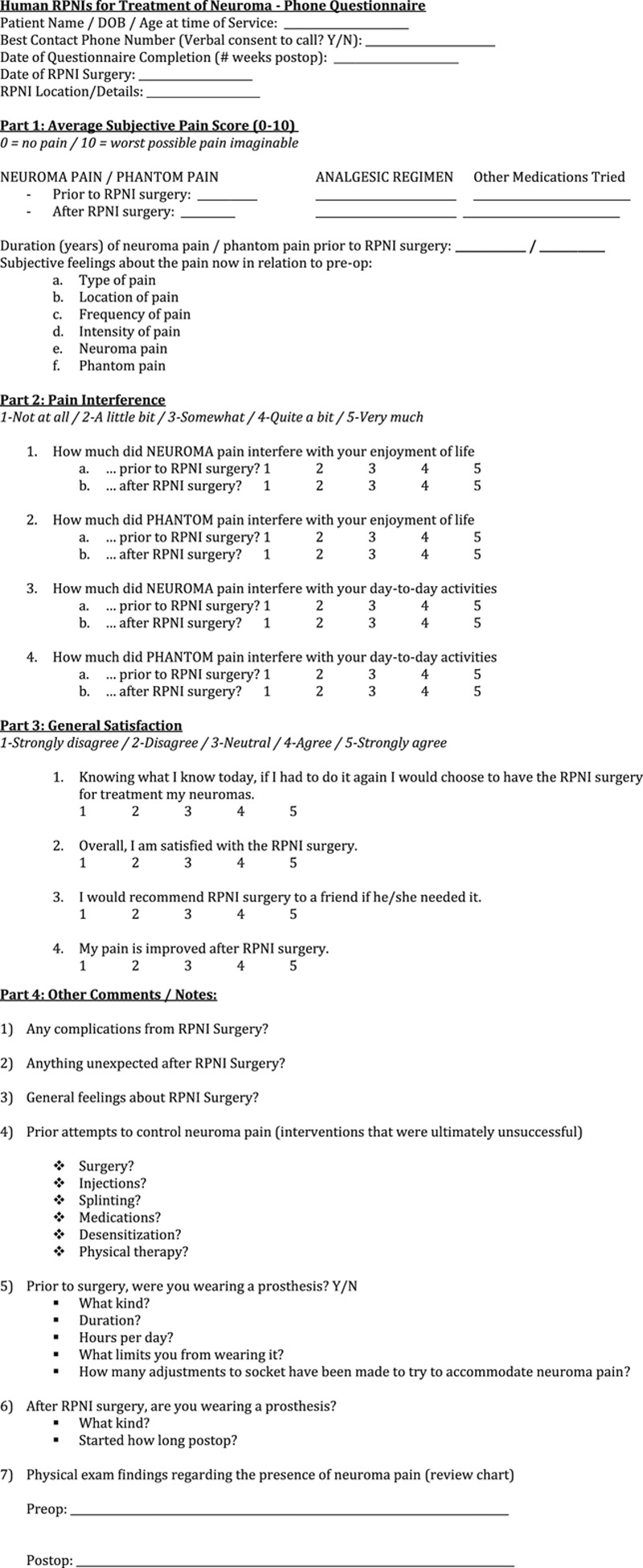
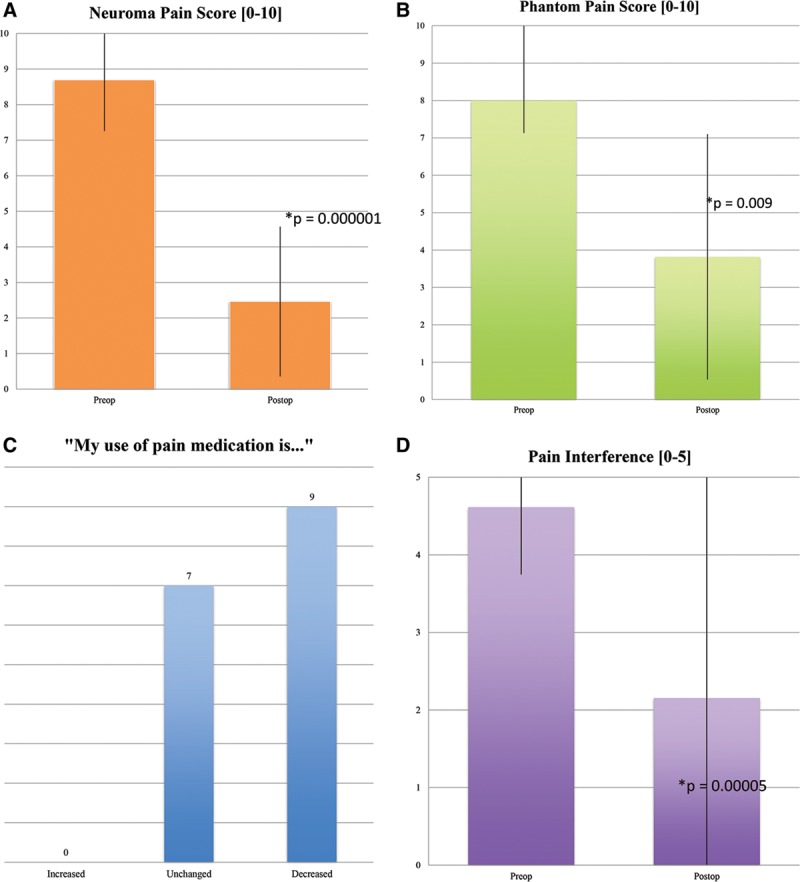
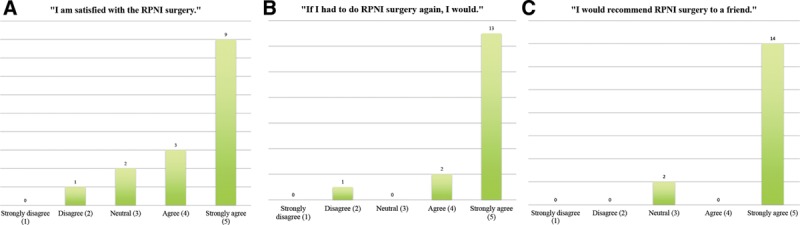
Background: Originally designed for prosthetic control, regenerative peripheral nerve interfaces (RPNIs) prevent neuroma formation by providing free muscle grafts as physiological targets for peripheral nerve ingrowth. We report the first series of patients undergoing RPNI implantation for treatment of symptomatic postamputation neuromas. Methods: A retrospective case series of all amputees undergoing RPNI implantation for treatment of symptomatic neuromas between November 2013 and June 2015 is presented. Data were obtained via chart review and phone interviews using questions derived from the Patient Reported Outcomes Measurement Information System instruments. Statistical analyses were performed using dependent sample t tests with a significance threshold of P < 0.01. Results: Forty-six RPNIs were implanted into 16 amputees for neuroma relief (3 upper extremities and 14 lower extremities). Mean age was 53.5 years (6 females and 10 males). All patients participated in postoperative phone interviews at 7.5 ± 3.4 (range: 3–15) months. Patients reported a 71% reduction in neuroma pain and a 53% reduction in phantom pain. Most patients felt satisfied or highly satisfied with RPNI surgery (75%), reporting decreased (56%) or stable (44%) levels of analgesic use. Most patients would strongly recommend RPNI surgery to a friend (88%) and would do it again if given the option (94%). Complications included delayed wound healing (n = 4) and neuroma pain at a different site (n = 2). Conclusions: RPNI implantation carries a reasonable complication profile while offering a simple, effective treatment for symptomatic neuromas. Most patients report a significant reduction in neuroma and phantom pain with a high level of satisfaction. The physiological basis for preventing neuroma recurrence is an intriguing benefit to this approach.
Overview
The claims and statistics of this paper haven’t been checked yet.
Free: it reads the open-access text and checks the first 5 claims that cite a source we can check. Create a free account to check every claim.
Integrity signals
Registry
Cites
Statistics
Figures
Verification
Claims the paper makes
The claims and statistics of this paper haven’t been checked yet.
Free: it reads the open-access text and checks the first 5 claims that cite a source we can check. Create a free account to check every claim.
Claims other papers make about this one
Each is checked against this paper’s own text: does it say what the citing paper says it does?
The source backs part of the claim, not all of it — or backs it for a different population, condition or comparison.
In the citing paper
“In addition, RPNIs have been shown to prevent and treat neuroma pain and phantom pain after amputation (18–20).”
From A regenerative peripheral nerve interface allows real-time control of an artificial hand in upper limb amputees (2020) · cites this paper as [20]
Experimental — accuracy not yet measuredThe source backs part of the claim, not all of it — or backs it for a different population, condition or comparison.
In the citing paper
“RPNIs have shown to be an effective technique to reduce symptomatic neuroma pain and also prevent neuroma formation (18–20).”
From A regenerative peripheral nerve interface allows real-time control of an artificial hand in upper limb amputees (2020) · cites this paper as [20]
Experimental — accuracy not yet measuredThe cited source says what the claim attributes to it.
In the citing paper
“RPNIs have also shown promising results in the treatment of neuroma pain [37].”
From Interfaces with the peripheral nervous system for the control of a neuroprosthetic limb: a review (2020) · cites this paper as [37]
The check wasn’t confident either way, so it gives no verdict — never disputed.
In the citing paper
“After the implantation procedure, fibrous tissue grows around the electrode as part of a foreign body reaction and this is profitable since it stabilizes the electrode. Following this stabilization process, signals from the nerves are both accurate and reproducible [37, 45].”
From Interfaces with the peripheral nervous system for the control of a neuroprosthetic limb: a review (2020) · cites this paper as [37]
Experimental — accuracy not yet measured
Self-check
Percentages, sums and reported differences re-computed from the paper’s own numbers.
The self-check needs the paper’s full text.
Citations
Cites
Cella, D., Riley, W., Stone, A., Rothrock, N., Reeve, B., Yount, S., Amtmann, D., Bode, R., Buysse, D., Choi, S., et al. (2010) · Journal of Clinical Epidemiology · doi:10.1016/j.jclinepi.2010.04.011 · Cited by 5,128
Estimating the Prevalence of Limb Loss in the United States: 2005 to 2050
Ziegler-Graham, K., MacKenzie, E. J., Ephraim, P. L., Travison, T. G., & Brookmeyer, R. (2008) · Archives of Physical Medicine and Rehabilitation · doi:10.1016/j.apmr.2007.11.005 · Cited by 2,816
The role and interpretation of pilot studies in clinical research
Leon, A. C., Davis, L. L., & Kraemer, H. C. (2011) · Journal of Psychiatric Research · doi:10.1016/j.jpsychires.2010.10.008 · Cited by 1,917
The regeneration of skeletal muscle fibers following injury: a review
CARLSON, B. M., & FAULKNER, J. A. (1983) · Medicine & Science in Sports & Exercise · doi:10.1249/00005768-198315030-00003 · Cited by 419
Targeted Muscle Reinnervation: A Novel Approach to Postamputation Neuroma Pain
Souza, J. M., Cheesborough, J. E., Ko, J. H., Cho, M. S., Kuiken, T. A., & Dumanian, G. A. (2014) · Clinical Orthopaedics & Related Research · doi:10.1007/s11999-014-3528-7 · Cited by 407
Postamputation pain: epidemiology, mechanisms, and treatment
Cohen, S., & Hsu (2013) · Journal of Pain Research · doi:10.2147/jpr.s32299 · Cited by 372
Treatment of the Painful Neuroma by Neuroma Resection and Muscle Implantation
Dellon, A. L., & Mackinnon, S. E. (1986) · Plastic and Reconstructive Surgery · doi:10.1097/00006534-198603000-00016 · Cited by 354
Ambulatory and inpatient procedures in the United States, 1996.
Owings, M. F., & Kozak, L. J. (1998) · PubMed · Cited by 314
McFarland, L. V., Winkler, S. L. H., Heinemann, A. W., Jones, M., & Esquenazi, A. (2010) · The Journal of Rehabilitation Research and Development · doi:10.1682/jrrd.2009.03.0027 · Cited by 227
AUTOGENOUS FREE GRAFTS OF SKELETAL MUSCLE: A Preliminary Experimental and Clinical Study
THOMPSON, N. (1971) · Plastic and Reconstructive Surgery · doi:10.1097/00006534-197107000-00004 · Cited by 190
Kung, T. A., Langhals, N. B., Martin, D. C., Johnson, P. J., Cederna, P. S., & Urbanchek, M. G. (2014) · Plastic & Reconstructive Surgery · doi:10.1097/prs.0000000000000168 · Cited by 181
Self-citationDoes Targeted Nerve Implantation Reduce Neuroma Pain in Amputees?
Pet, M. A., Ko, J. H., Friedly, J. L., Mourad, P. D., & Smith, D. G. (2014) · Clinical Orthopaedics and Related Research · doi:10.1007/s11999-014-3602-1 · Cited by 157
Health-Related Profiles of People With Lower Limb Loss
Amtmann, D., Morgan, S. J., Kim, J., & Hafner, B. J. (2015) · Archives of Physical Medicine and Rehabilitation · doi:10.1016/j.apmr.2015.03.024 · Cited by 150
Surgical management of neuroma pain: A prospective follow-up study
Stokvis, A., van der Avoort, D.-J. J. C., van Neck, J. W., Hovius, S. E. R., & Coert, H. J. (2010) · Pain · doi:10.1016/j.pain.2010.09.032 · Cited by 127
Ducic, I., Mesbahi, A. N., Attinger, C. E., & Graw, K. (2008) · Plastic and Reconstructive Surgery · doi:10.1097/01.prs.0000299281.57480.77 · Cited by 126
Key changes in denervated muscles and their impact on regeneration and reinnervation
Wang, H., Wu, P., Chawla, A., Spinner, R., Yu, C., Yaszemski, M. J., & Windebank, A. (2014) · Neural Regeneration Research · doi:10.4103/1673-5374.143424 · Cited by 105
The surgical treatment of painful traumatic neuromas
Burchiel, K. J., Johans, T. J., & Ochoa, J. (1993) · Journal of Neurosurgery · doi:10.3171/jns.1993.78.5.0714 · Cited by 105
Providing a sense of touch to prosthetic hands
Nghiem, B. T., Sando, I. C., Gillespie, R. B., McLaughlin, B. L., Gerling, G. J., Langhals, N. B., Urbanchek, M. G., & Cederna, P. S. (2015) · Plastic and Reconstructive Surgery · doi:10.1097/prs.0000000000001289 · Cited by 104
Self-citationThe prevention and treatment of amputation neuromata by silicone capping
Swanson, A. B., Nr, B., & Lumsden, R. M. (1977) · The Journal Of Hand Surgery · doi:10.1016/s0363-5023(77)80013-0 · Cited by 93
Kortlever, J. T. P., Janssen, S. J., van Berckel, M. M. G., Ring, D., & Vranceanu, A. M. (2015) · Clinical Orthopaedics & Related Research · doi:10.1007/s11999-015-4419-2 · Cited by 92
Postamputation pain: studies on mechanisms.
Nikolajsen, L. (2012) · PubMed · Cited by 82
Cheesborough, J. E., Souza, J. M., Dumanian, G. A., & Bueno, R. A. (2014) · HAND · doi:10.1007/s11552-014-9602-5 · Cited by 74
Innovations in Prosthetic Interfaces for the Upper Extremity
Kung, T. A., Bueno, R. A., Alkhalefah, G. K., Langhals, N. B., Urbanchek, M. G., & Cederna, P. S. (2013) · Plastic and Reconstructive Surgery · doi:10.1097/prs.0b013e3182a97e5f · Cited by 71
Self-citationŞehirlioğlu, A., Öztürk, Ç., Yazıcıoğlu, K., Tuğcu, İ., Yılmaz, B., & Göktepe, A. S. (2007) · International Orthopaedics · doi:10.1007/s00264-007-0466-y · Cited by 70
Mechanisms of Nerve Capping Technique in Prevention of Painful Neuroma Formation
Yan, H., Zhang, F., Kolkin, J., Wang, C., Xia, Z. R., & Fan, C. (2014) · PLoS ONE · doi:10.1371/journal.pone.0093973 · Cited by 54
Surgical Management of Painful Peripheral Nerves
Elliot, D. (2014) · Clinics in Plastic Surgery · doi:10.1016/j.cps.2014.03.004 · Cited by 54
Histochemical and Neurophysiological Studies of Autotransplanted Cat Muscle
Hakelius, L., Nyström, B., & Stålberg, E. (1975) · Scandinavian Journal of Plastic and Reconstructive Surgery · doi:10.3109/02844317509022851 · Cited by 50
Surgical Treatment of Chronic Phantom Limb Sensation and Limb Pain after Lower Limb Amputation
Prantl, L., Schreml, S., Heine, N., Eisenmann‐Klein, M., & Angele, P. (2006) · Plastic & Reconstructive Surgery · doi:10.1097/01.prs.0000233048.15879.0e · Cited by 47
In vivo characterization of regenerative peripheral nerve interface function
Ursu, D. C., Urbanchek, M. G., Nedic, A., Cederna, P. S., & Gillespie, R. B. (2016) · Journal of Neural Engineering · doi:10.1088/1741-2560/13/2/026012 · Cited by 46
Self-citationReinnervation of motor endplate-containing and motor endplate-less muscle grafts
Bader, D. M. (1980) · Developmental Biology · doi:10.1016/0012-1606(80)90477-7 · Cited by 45
Carlson, B. M., & GUTMANN, E. (1976) · Experimental Neurology · doi:10.1016/0014-4886(76)90007-8 · Cited by 34
Electrically stimulated signals from a long-term Regenerative Peripheral Nerve Interface
Langhals, N. B., Woo, S. L., Moon, J. D., Larson, J. V., Leach, M. K., Cederna, P. S., & Urbanchek, M. G. (2014) · 2014 36th Annual International Conference of the IEEE Engineering in Medicine and Biology Society · doi:10.1109/embc.2014.6944004 · Cited by 30
Self-citationRevisiting Nonvascularized Partial Muscle Grafts
Woo, S. L., Urbanchek, M. G., Cederna, P. S., & Langhals, N. B. (2014) · Plastic & Reconstructive Surgery · doi:10.1097/prs.0000000000000317 · Cited by 30
Self-citationLong-Term Stability of Regenerative Peripheral Nerve Interfaces (RPNI)
Urbanchek, M. G., Wei, B., Baghmanli, Z., Sugg, K., & Cederna, P. S. (2011) · Plastic and Reconstructive Surgery · doi:10.1097/01.prs.0000406317.25436.00 · Cited by 30
Self-citationNeuroma in Bilateral Upper Limb Amputation
Soroush, M., Modirian, E., Soroush, M. R., & Masoumi, M. (2008) · Orthopedics · doi:10.3928/01477447-20081201-26 · Cited by 29
Nerve capping in the treatment of troublesome terminal neuromata
Robbins, T. (1986) · British Journal of Plastic Surgery · doi:10.1016/0007-1226(86)90089-5 · Cited by 28
Mong, F. S. F. (1977) · Journal of Morphology · doi:10.1002/jmor.1051510309 · Cited by 24
Larson, J. V., Urbanchek, M. G., Moon, J. D., Hunter, D. A., Newton, P., Johnson, P. J., Wood, M. D., Kung, T. A., Cederna, P. S., & Langhals, N. B. (2014) · Plastic & Reconstructive Surgery · doi:10.1097/01.prs.0000445040.57505.da · Cited by 13
Self-citationIs less more? A preliminary investigation of the number of response categories in self-reported pain
Cook (2010) · Patient Related Outcome Measures · doi:10.2147/prom.s7584 · Cited by 11
A comparison between the free grafting of sliced and intact muscles in the rat
GUTMANN, E., & Carlson, B. M. (1975) · Cellular and Molecular Life Sciences · doi:10.1007/bf01938500 · Cited by 8
Partial Skeletal Muscle Grafts for Prosthetic Control
Woo, S. L., Urbanchek, M. G., Zheng, X., Leach, M. K., Moon, J. D., Cederna, P. S., & Langhals, N. B. (2014) · Plastic & Reconstructive Surgery · doi:10.1097/01.prs.0000455396.91552.19 · Cited by 8
Self-citationTime course of the regeneration of the endplate zone after autologous muscle transplantation
Killer, H. E., & Müntener, M. (1986) · Cellular and Molecular Life Sciences · doi:10.1007/bf01942513 · Cited by 7
Frost, C. M., Ursu, D. C., Nedic, A., Hassett, C. A., Moon, J. D., Gillespie, R. B., Langhals, N. B., Cederna, P. S., & Urbanchek, M. G. (2014) · Plastic & Reconstructive Surgery · doi:10.1097/01.prs.0000445051.00569.56 · Cited by 4
Self-citationAugmented Signal Transduction from Regenerative Peripheral Nerve Interfaces
Kung, T. A., Cederna, P., Langhals, N. B., Martin, D. C., & Urbanchek, M. G. (2013) · Plastic & Reconstructive Surgery · doi:10.1097/01.prs.0000435961.43094.89 · Cited by 3
Self-citationWoo, S. L., Urbanchek, M. G., Cederna, P. S., & Langhals, N. B. (2014) · Plastic & Reconstructive Surgery · doi:10.1097/01.prs.0000444998.95623.5a · Cited by 1
Self-citationFrost, C. M., Ursu, D. C., Nedic, A., Hassett, C. A., Moon, J. D., Woo, S. L., Gillespie, R. B., Cederna, P. S., Langhals, N. B., & Urbanchek, M. G. (2014) · Plastic & Reconstructive Surgery · doi:10.1097/01.prs.0000445832.37342.6f · Cited by 1
Self-citationSurgical Model for Analysis of Signal Transfer Through Biologic and Synthetic Materials
Larson, J. V., Kung, T. A., Cederna, P. S., Urbanchek, M. G., & Langhals, N. B. (2014) · Annals of Plastic Surgery · doi:10.1097/sap.0000000000000278 · Cited by 1
Self-citation
Research works printed but not linked: 2
- Nedic A Moon JD Kung TA Von Frey monofilament testing successfully discriminates between sensory function of mixed nerve and sensory nerve regenerative peripheral nerve interfaces. 2013 6th International IEEE/EMBS Conference on Neural Engineering (NER) 255 258
- Woo SL Urbanchek M Cederna PS Revisiting nonvascularized partial muscle grafts: a novel use for prosthetic control. Plast Reconstr Surg 2014 134 344e 346e 25068369 · DOI
Cited by
Vu, P. P., Vaskov, A. K., Irwin, Z. T., Henning, P. T., Lueders, D. R., Laidlaw, A. T., Davis, A. J., Nu, C. S., Gates, D. H., Gillespie, R. B., et al. (2020) · Science Translational Medicine · doi:10.1126/scitranslmed.aay2857 · Cited by 291
Self-citationSurgical Algorithm for Neuroma Management: A Changing Treatment Paradigm
Eberlin, K. R., & Ducic, I. (2018) · Plastic and Reconstructive Surgery - Global Open · doi:10.1097/gox.0000000000001952 · Cited by 207
Prophylactic Regenerative Peripheral Nerve Interfaces to Prevent Postamputation Pain
Kubiak, C. A., Kemp, S. W. P., Cederna, P. S., & Kung, T. A. (2019) · Plastic & Reconstructive Surgery · doi:10.1097/prs.0000000000005922 · Cited by 175
Self-citationMioton, L. M., Dumanian, G. A., Shah, N. M., Qiu, C. S., Ertl, W. J. J., Potter, B. K., Souza, J. M., Valerio, I. L., Ko, J. H., & Jordan, S. W. (2020) · Clinical Orthopaedics and Related Research · doi:10.1097/corr.0000000000001323 · Cited by 133
“Chronic residual limb and phantom limb pain, until recently, have been difficult to manage, and there have been numerous ineffective or inconsistent treatment strategies [3, 8, 14, 19, 20, 28, 29].”
BackgroundNeuromorphic hardware for somatosensory neuroprostheses
Donati, E., & Valle, G. D. (2024) · Nature Communications · doi:10.1038/s41467-024-44723-3 · Cited by 133
“Moreover, RPNIs have been shown to prevent and treat neuroma pain and phantom pain after amputation 209 .”
Background
Metadata
- Authors
- Woo, S. L., Kung, T. A., Brown, D. L., Leonard, J. A., Kelly, B. M., & Cederna, P. S.
- Affiliations
- Michigan Medicine (US)
- Corresponding author
- Woo, Shoshana L.
- Kung, Theodore A.
- Brown, David L.
- Cederna, Paul S.
- Venue
- Plastic and Reconstructive Surgery - Global Open
- Published
- 2016-12
- Volume
- 4
- Issue
- 12
- Pages
- e1038
- ISSN
- 2169-7574 (ISSN-L)
- PMC
- PMC5222635
- OpenAlex
- W2973865545
- Semantic Scholar
- 801356af4a65f43d22752a2efc4c9b9bb13fe557
- Cited by
- 230
- References
- 47
- Citations by year
- 2026: 17 · 2025: 22 · 2024: 47 · 2023: 34 · 2022: 32 · 2021: 30 · 2020: 28 · 2019: 6 · 2018: 10 · 2017: 2
- FWCI
- 8.79
- Type
- journal article
- Language
- en
- Open access
- gold
- doi.org
- Licence
- Locations
- Plastic & Reconstructive Surgery Global Open (publishedVersion, cc-by-nc-nd)
- PubMed Central (publishedVersion, cc-by-nc-nd)
- PubMed (publishedVersion)
- Topics
- Health Sciences › Medicine › Anesthesiology and Pain Medicine › Pain Management and Treatment
- Life Sciences › Neuroscience › Cellular and Molecular Neuroscience › Neuroscience and Neural Engineering
- Health Sciences › Medicine › Surgery › Nerve Injury and Rehabilitation
- Keywords
- regenerative peripheral nerve interface, neuroma pain, phantom pain, amputation, free muscle graft, patient satisfaction, analgesic use, surgical complications, delayed wound healing
About these checks
Registry, retraction, Cites and statistics results are computed, not judged, with one exception: a printed reference that no index lists is read once by a model before it counts as a citation error. Claims are extracted by a model and kept only when their quote appears verbatim in the text; each cited source is then checked, with a model’s help, for whether it says what the claim relies on. Those verdicts can be wrong — read the claim’s quote and the cited source before relying on one.
Statistics and arithmetic are recomputed, not judged.
Confidence bands are shown only for fields calibrated on our annotated test set. None is calibrated yet, so no band is shown.
What counts as a claim ›How we measure confidence ›How we check this ›
Are you an author, or do you see a problem with this page? Request a review
Data sources
Bibliographic data: Semantic Scholar, OpenAlex, Crossref.
Contains information from the Semantic Scholar Academic Graph Datasets, made available under the ODC Attribution License (ODC-BY 1.0).
Semantic Scholar’s data is described in: Kinney, R., et al. (2023). The Semantic Scholar Open Data Platform. arXiv:2301.10140.
