

The DOI matches its Crossref record; 63 of the 63 references it cites were found in a registry or an index.
Are We Witnessing a Paradigm Shift?: A Systematic Review of Social Media in Residency
Open accessAbstract
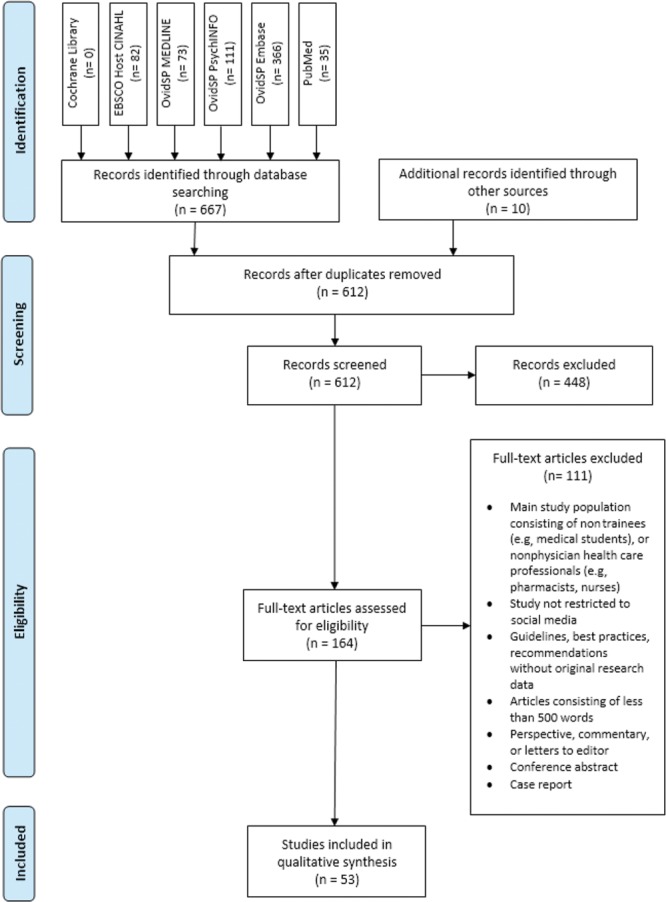
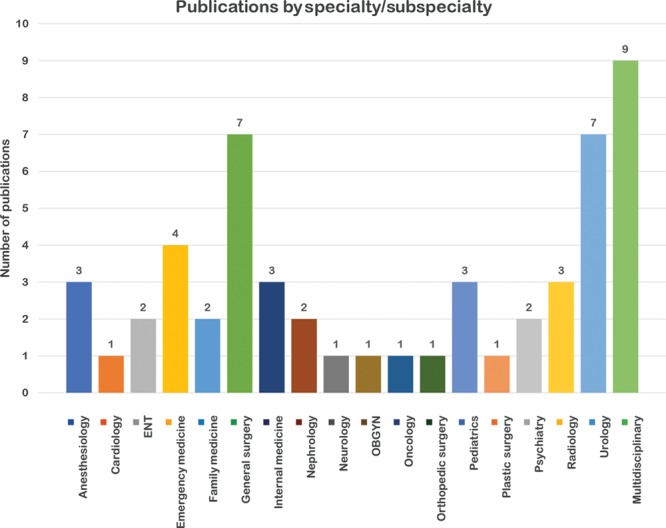
Background: As social media’s applications continue to evolve, the pitfalls and dangers associated with misuse have been accentuated in the literature. Consequently, academic institutions across the nation have implemented social media policies. This study is aimed to evaluate the state of social media literature examining postgraduate trainees (residents/fellows). Methods: A systematic search was performed identifying peer-reviewed publications presenting original research. Studies published through December 8, 2018, focusing on social media use among postgraduate trainees were considered for inclusion. Results: Fifty-three studies were categorized into 4 domains: (1) resident recruitment, (2) graduate medical education, (3) professional development, and (4) academic scholarship. Thirty-four (64.15%) investigated social media’s impact on professional development, of which 16 (47.05%) highlighted the detrimental potential on trainee professionalism. The remaining 18 (52.94%) focused on promoting social media training during residency, and/or enhancing social media competency to benefit professional development. Fourteen (26.42%) rationalized social media use in augmenting graduate medical education. Ten (18.87%) assessed social media’s influence on resident recruitment, of which 7 (70%) depicted use as a screening instrument for program directors on resident applicants. Two (3.77%) of the studies introduced social media as a platform for academic scholarship with indicators as altmetrics. Conclusions: The well-established disadvantages of social media use by the postgraduate trainee continue to persist in the literature. However, there is recognition of social media as a valuable resource in influencing resident recruitment, graduate medical education, professional development, and academic scholarship, representing a paradigm shift—from cautiously avoidant to thoughtful capitalization on its immense potential.
Overview
The claims and statistics of this paper haven’t been checked yet.
Run the check — free, no account needed. It reads the open-access text and checks the sources it cites.
Integrity signals
Registry
Cites
Statistics
Figures
Verification
Claims the paper makes
The claims and statistics of this paper haven’t been checked yet.
Run the check — free, no account needed. It reads the open-access text and checks the sources it cites.
Claims other papers make about this one
Each is checked against this paper’s own text: does it say what the citing paper says it does?
The cited source says what the claim attributes to it.
In the citing paper
“Economides et al’s [184] review depicts evolving perceptions and a paradigm shift, where a growing body of literature is now focusing on promoting responsible SM use, examining how SM training can enhance professional growth and academic scholarship.”
From Dangers and Benefits of Social Media on E-Professionalism of Health Care Professionals: Scoping Review (2021) · cites this paper as [184]
The cited source says what the claim attributes to it.
In the citing paper
“Similar conclusions were made in a systematic review of SM in residency [184].”
From Dangers and Benefits of Social Media on E-Professionalism of Health Care Professionals: Scoping Review (2021) · cites this paper as [184]
Self-check
Percentages, sums and reported differences re-computed from the paper’s own numbers.
The self-check needs the paper’s full text.
Citations
Cites
Tong, A., Sainsbury, P., & Craig, J. (2007) · International Journal for Quality in Health Care · doi:10.1093/intqhc/mzm042 · Cited by 42,509
Social media in marketing: A review and analysis of the existing literature
Alalwan, A. A., Rana, N. P., Dwivedi, Y. K., & Algharabat, R. (2017) · Telematics and Informatics · doi:10.1016/j.tele.2017.05.008 · Cited by 1,126
Cook, D. A., & Reed, D. A. (2015) · Academic Medicine · doi:10.1097/acm.0000000000000786 · Cited by 781
Social Media: A Review and Tutorial of Applications in Medicine and Health Care
Grajales III, F. J., Sheps, S., Ho, K., Novak-Lauscher, H., & Eysenbach, G. (2014) · Journal of Medical Internet Research · doi:10.2196/jmir.2912 · Cited by 737
The Intersection of Online Social Networking with Medical Professionalism
Thompson, L. A., Dawson, K., Ferdig, R., Black, E. W., Boyer, J., Coutts, J., & Black, N. P. (2008) · Journal of General Internal Medicine · doi:10.1007/s11606-008-0538-8 · Cited by 425
A general critical appraisal tool: An evaluation of construct validity
Crowe, M. J., & Sheppard, L. A. (2011) · International Journal of Nursing Studies · doi:10.1016/j.ijnurstu.2011.06.004 · Cited by 210
Greysen, S. R., Chretien, K. C., Kind, T., Young, A., & Gross, C. P. (2012) · JAMA · doi:10.1001/jama.2012.330 · Cited by 158
Branford, O. A., Kamali, P., Rohrich, R. J., et al. (2016) · Plastic & Reconstructive Surgery · doi:10.1097/prs.0000000000002814 · Cited by 154
Shore, R., Halsey, J., Shah, K., Crigger, B.-J., & Douglas, S. P. (2011) · The Journal of Clinical Ethics · doi:10.1086/jce201122208 · Cited by 149
Use of social media in urology: data from the A merican U rological A ssociation ( AUA )
Loeb, S., Bayne, C. E., Frey, C., Davies, B., Averch, T. D., Woo, H. H., Stork, B., Cooperberg, M. R., & Eggener, S. E. (2013) · British Journal of Urology · doi:10.1111/bju.12586 · Cited by 143
Facebook activity of residents and fellows and its impact on the doctor–patient relationship
Moubarak, G., Guiot, A., Benhamou, Y., Benhamou, A., & Hariri, S. (2011) · Journal of Medical Ethics · doi:10.1136/jme.2010.036293 · Cited by 138
Protected health information on social networking sites: ethical and legal considerations
Thompson, L. A., Black, E., Duff, W. P., Paradise Black, N., Saliba, H., & Dawson, K. (2011) · Journal of Medical Internet Research · doi:10.2196/jmir.1590 · Cited by 114
Tweeting the Meeting: An In-Depth Analysis of Twitter Activity at Kidney Week 2011
Desai, T., Shariff, A. I., Shariff, A., Кац, М. Д., Fang, X., Christiano, C., & Ferris, M. (2012) · PLoS ONE · doi:10.1371/journal.pone.0040253 · Cited by 111
The use of social media to supplement resident medical education – the SMART-ME initiative
Galiatsatos, P., Carreiro, F. P., Hayashi, J., Zakaria, S., & Christmas, C. (2016) · Medical Education Online · doi:10.3402/meo.v21.29332 · Cited by 98
Chandawarkar, A. A., Gould, D. J., & Stevens, W. G. (2018) · Aesthetic Surgery Journal · doi:10.1093/asj/sjy055 · Cited by 93
eLearning among Canadian anesthesia residents: a survey of podcast use and content needs
Matava, C. T., Rosen, D., Siu, E. C. K., & Bould, M. D. (2013) · BMC Medical Education · doi:10.1186/1472-6920-13-59 · Cited by 89
Social media in professional medicine: new resident perceptions and practices
Lefebvre, C., Mesner, J., Stopyra, J., O'Neill, J., Husain, I., Geer, C., Gerancher, K., Atkinson, H., Harper, E., Huang, W., et al. (2016) · Journal of Medical Internet Research · doi:10.2196/jmir.5612 · Cited by 88
Langenfeld, S. J., Cook, G., Sudbeck, C., Luers, T., & Schenarts, P. J. (2014) · Journal of Surgical Education · doi:10.1016/j.jsurg.2014.05.013 · Cited by 87
Adilman, R., Rajmohan, Y., Brooks, E., Urgoiti, G. R., Chung, C., Hammad, N., Trinkaus, M., Naseem, M., Simmons, C., Adilman, R., et al. (2016) · Journal of Oncology Practice · doi:10.1200/jop.2015.006429 · Cited by 82
Radiologists’ Usage of Social Media: Results of the RANSOM Survey
Ranschaert, E. R., van Ooijen, P. M. A., McGinty, G. B., & Parizel, P. M. (2016) · Journal of Imaging Informatics in Medicine · doi:10.1007/s10278-016-9865-1 · Cited by 82
Langenfeld, S. J., Vargo, D. J., & Schenarts, P. J. (2016) · Journal of Surgical Education · doi:10.1016/j.jsurg.2016.07.010 · Cited by 82
The decision to access patient information from a social media site: what would you do?
Jent, J. F., Eaton, C. K., Merrick, M. T., Englebert, N. E., Dandes, S. K., Chapman, A. V., & Hershorin, E. R. (2011) · Journal of Adolescent Health · doi:10.1016/j.jadohealth.2011.02.004 · Cited by 79
Social Media Return on Investment: How Much is it Worth to My Practice?
Gould, D. J., & Mobin, S. S. N. (2017) · Aesthetic Surgery Journal · doi:10.1093/asj/sjx152 · Cited by 77
Guidelines for maintaining a professional compass in the era of social networking
Landman, M. P., Shelton, J., Kauffmann, R. M., & Dattilo, J. B. (2010) · Journal of surgical education · doi:10.1016/j.jsurg.2010.07.006 · Cited by 72
Radiology Resident Recruitment
Deloney, L. A., Perrot, L. J., Lensing, S., & Jambhekar, K. R. (2014) · Academic Radiology · doi:10.1016/j.acra.2014.03.009 · Cited by 71
Social media and medical education: Exploring the potential of Twitter as a learning tool
Jalali, A., Sherbino, J., Frank, J. R., & Sutherland, S. (2015) · International Review of Psychiatry · doi:10.3109/09540261.2015.1015502 · Cited by 69
Rivas, J. G., Socarrás, M. E. R., Patruno, G., Uvin, P., Esperto, F., Dinis, P. J., Morgan Rouprêt, A., & Borgmann, H. (2018) · European Urology Focus · doi:10.1016/j.euf.2016.11.010 · Cited by 64
A cross-sectional study of the presence of United Kingdom (UK) plastic surgeons on social media
Mabvuure, N. T., Rodrigues, J. N., Klimach, S. G., & Nduka, C. C. (2014) · Journal of Plastic Reconstructive & Aesthetic Surgery · doi:10.1016/j.bjps.2013.12.015 · Cited by 59
Professional Use of Social Media Among Surgeons: Results of a Multi-Institutional Study
Wagner, J. P., Cochran, A. L., Jones, C., Gusani, N. J., Varghese, T. K., & Attai, D. J. (2018) · Journal of Surgical Education · doi:10.1016/j.jsurg.2017.09.008 · Cited by 56
(2015) · PubMed · Cited by 55
Unprofessional content on Facebook accounts of US urology residency graduates
Koo, K., Ficko, Z., & Gormley, E. A. (2017) · British Journal of Urology · doi:10.1111/bju.13846 · Cited by 53
Education Research: Evaluating the use of podcasting for residents during EEG instruction
Bensalem‐Owen, M., Chau, D. F., Sardam, S. C., et al. (2011) · Neurology · doi:10.1212/wnl.0b013e31822b0017 · Cited by 52
Go, P. H., Klaassen, Z. W. A., & Chamberlain, R. S. (2012) · Journal of surgical education · doi:10.1016/j.jsurg.2011.11.008 · Cited by 48
The role of social networking web sites in influencing residency decisions.
Schweitzer, J., Hannan, A., & Coren, J. S. (2012) · PubMed · Cited by 46
Addressing Therapeutic Boundaries in Social Networking
Ginory, A., Sabatier, L. M. M., & Eth, S. (2012) · Psychiatry · doi:10.1521/psyc.2012.75.1.40 · Cited by 46
Revisiting Social Network Utilization by Physicians-in-Training
Black, E. W., Thompson, L. A., Duff, W. P., Dawson, K., Saliba, H., & Black, N. M. P. (2010) · Journal of Graduate Medical Education · doi:10.4300/jgme-d-10-00011.1 · Cited by 43
Social Networking Profiles and Professionalism Issues in Residency Applicants
Ponce, B. A., Determann, J. R., Boohaker, H., Sheppard, E. D., McGwin, G., & Theiss, S. M. (2013) · Journal of surgical education · doi:10.1016/j.jsurg.2013.02.005 · Cited by 41
Social Media Utilization at an Academic Radiology Practice
Koontz, N. A., Kamer, A. P., Dodson, S. C., Capps, A. E., Tomblinson, C. M., Brown, B. P., Frank, M. S., & Heitkamp, D. E. (2017) · Academic Radiology · doi:10.1016/j.acra.2017.08.012 · Cited by 40
Residency selection: do the perceptions of US programme directors and applicants match?
Go, P. H., Klaassen, Z. W. A., & Chamberlain, R. S. (2012) · Medical Education · doi:10.1111/j.1365-2923.2012.04257.x · Cited by 37
Maintaining a Twitter Feed to Advance an Internal Medicine Residency Program’s Educational Mission
Bergl, P. A., Narang, A., & Arora, V. M. (2015) · JMIR Medical Education · doi:10.2196/mededu.4434 · Cited by 34
Innovative teaching tools in nephrology
Calderon, K., Vij, R. S., Mattana, J., & Jhaveri, K. D. (2011) · Kidney International · doi:10.1038/ki.2011.13 · Cited by 34
Teaching and Assessment of Ethics and Professionalism: A Survey of Pediatric Program Directors
Cook, A. F., Sobotka, S. A., & Ross, L. F. (2013) · Academic Pediatrics · doi:10.1016/j.acap.2013.07.009 · Cited by 31
Koo, K., Bowman, M. S., Ficko, Z., & Gormley, E. A. (2018) · BJU International · doi:10.1111/bju.14363 · Cited by 29
How we made professionalism relevant to twenty-first century residents
Khandelwal, A., Nugus, P., Elkoushy, M. A., Cruess, R. L., Cruess, S. R., Smilovitch, M., & Andonian, S. (2015) · Medical Teacher · doi:10.3109/0142159x.2014.990878 · Cited by 28
To Bot or Not? Challenging the Top Social Media Influencers in #PlasticSurgery
Fan, K. L., Economides, J. M., & Song, D. H. (2018) · Plastic & Reconstructive Surgery · doi:10.1097/prs.0000000000005103 · Cited by 28
Self-citationSocial networking and professionalism in otolaryngology residency applicants
Golden, J. B., Sweeny, L., Bush, B., & Carroll, W. R. (2012) · The Laryngoscope · doi:10.1002/lary.23388 · Cited by 26
Educational content and the use of social media at US departments of surgery
Nikolian, V. C., Barrett, M., Valbuena, V. S. M., et al. (2017) · Surgery · doi:10.1016/j.surg.2017.10.039 · Cited by 25
Morning Report Blog: A Web-Based Tool to Enhance Case-Based Learning
Bogoch, I. I., Frost, D., Bridge, S., Lee, T. C., Gold, W. L., Panisko, D. M., & Cavalcanti, R. B. (2012) · Teaching and Learning in Medicine · doi:10.1080/10401334.2012.692273 · Cited by 23
Ben-Yakov, M., Kayssi, A., Bernardo, J. D., Hicks, C. M., & Devon, K. (2015) · Western Journal of Emergency Medicine · doi:10.5811/westjem.2015.1.24258 · Cited by 22
Barker, A. L., Wehbe-Janek, H., Bhandari, N. S., Bittenbinder, T. M., Jo, C., & McAllister, R. K. (2012) · Journal of Clinical Anesthesia · doi:10.1016/j.jclinane.2012.06.002 · Cited by 21
A Descriptive Analysis of the Use of Twitter by Emergency Medicine Residency Programs
Diller, D., & Yarris, L. M. (2017) · Journal of Graduate Medical Education · doi:10.4300/jgme-d-16-00716.1 · Cited by 20
Medical student views on the use of Facebook profile screening by residency admissions committees
George, D. R., Green, M. J., Navarro, A. M., Stazyk, K. K., & Clark, M. A. (2014) · Postgraduate Medical Journal · doi:10.1136/postgradmedj-2013-132336 · Cited by 18
Electrocardiogram training for residents: A curriculum based on Facebook and Twitter
Liu, S. S., Zakaria, S., Vaidya, D. M., & Srivastava, M. C. (2017) · Journal of Electrocardiology · doi:10.1016/j.jelectrocard.2017.04.010 · Cited by 18
Dawkins, R., King, W. D., Boateng, B., Nichols, M., & Desselle, B. C. (2017) · JMIR Medical Education · doi:10.2196/mededu.5993 · Cited by 17
Irfan, K. S., Farhana, I., Eiad, A. F., Nassr, A. M., Al Mohammed, A. Q., Maya, N., Ali, A. H., MA, A. A., Gominda, P., & Cees van der, V. (2018) · African Health Sciences · doi:10.4314/ahs.v18i3.41 · Cited by 17
Dulmage, B., Akintilo, L. O., Welty, L. J., Davis, M. M., Colavincenzo, M. L., & Xu, S. (2018) · The American Journal of Medicine · doi:10.1016/j.amjmed.2018.05.019 · Cited by 16
Salem, J., Borgmann, H., Baunacke, M., Böehm, K., Hanske, J., MacNeily, A. E., Meyer, C. P., Nestler, T., Schmid, M., & Huber, J. C. (2017) · Canadian Urological Association Journal · doi:10.5489/cuaj.4267 · Cited by 14
Colvin, J. S., French, J. C., SIPERSTEIN, A. E., Capizzani, T. R., & Krishnamurthy, V. D. (2017) · Journal of surgical education · doi:10.1016/j.jsurg.2017.09.035 · Cited by 14
Jain, K., Fuoco, M., Fervaha, G., & Leveridge, M. (2018) · Canadian Urological Association Journal · doi:10.5489/cuaj.5042 · Cited by 14
Social media in otolaryngology-head and neck surgery.
Oyewumi, M., Lee, J., & Vescan, A. D. (2017) · PubMed · Cited by 13
A novel use of Twitter to provide feedback and evaluations
Desai, B. K. (2014) · The Clinical Teacher · doi:10.1111/tct.12086 · Cited by 12
Twitter Use among Academic Urology Programs
Farber, N. J., Koprowski, C. J., Modi, P. K., Wang, W., Dubin, J. M., Kwon, Y. S., & Elsamra, S. E. (2016) · Urology Practice · doi:10.1016/j.urpr.2016.07.009 · Cited by 8
Showing your public face: does screening social media assess residency applicants’ professionalism?
Sullivan, M. E., Frishman, G. N., & Vrees, R. (2017) · American Journal of Obstetrics and Gynecology · doi:10.1016/j.ajog.2017.07.035 · Cited by 7
Cited by
Sorted by citations
Vukušić Rukavina, T., Viskić, J., Machala Poplašen, L., Relić, D., Marelić, M., Jokic, D., & Sedak, K. (2021) · Journal of Medical Internet Research · doi:10.2196/25770 · Cited by 199
“Economides et al’s [184] review depicts evolving perceptions and a paradigm shift, where a growing body of literature is now focusing on promoting responsible SM use, examining how SM training can enhance professional growth and academic scholarship.”
Perception of social media behaviour among medical students, residents and medical specialists
Pronk, S. A., Gorter, S. L., Van Luijk, S. J., Barnhoorn, P. C., Binkhorst, B., & Van Mook, W. N. K. A. V. M. (2021) · Perspectives on Medical Education · doi:10.1007/s40037-021-00660-1 · Cited by 31
Metadata
- Authors
- Economides, J. M., Choi, Y. K., Fan, K. L., Kanuri, A. P., & Song, D. H.
- Affiliations
- Georgetown University Medical Center (US)
- University of Utah (US)
- Corresponding author
- Economides, James M.
- Fan, Kenneth L.
- Kanuri, Arjun P.
- Song, David H.
- Venue
- Plastic and Reconstructive Surgery - Global Open
- Published
- 2019-08
- Volume
- 7
- Issue
- 8
- Pages
- e2288
- ISSN
- 2169-7574 (ISSN-L)
- PMC
- PMC6756642
- OpenAlex
- W2969853444
- Cited by
- 63
- References
- 63
- Citations by year
- 2026: 5 · 2025: 8 · 2024: 6 · 2023: 11 · 2022: 9 · 2021: 12 · 2020: 12
- FWCI
- 1.75
- Type
- journal article
- Language
- en
- Open access
- gold
- doi.org
- Licence
- Locations
- Plastic & Reconstructive Surgery Global Open (publishedVersion, cc-by-nc-nd)
- PubMed Central (publishedVersion, cc-by-nc-nd)
- PubMed (publishedVersion)
- Topics
- Social Sciences › Health › Social Media in Health Education
- Social Sciences › Education › Innovations in Medical Education
- Social Sciences › Sociology and Political Science › Impact of Technology on Adolescents
- Keywords
- social media, medical residents, graduate medical education, professional development, residency recruitment, social media policy, professionalism, social media training, altmetrics, academic scholarship
About these checks
Registry, retraction, Cites and statistics results are computed, not judged, with one exception: a printed reference that no index lists is read once by a model before it counts as a citation error. Claims are extracted by a model and kept only when their quote appears verbatim in the text; each cited source is then checked, with a model’s help, for whether it says what the claim relies on. Those verdicts can be wrong — read the claim’s quote and the cited source before relying on one.
Statistics and arithmetic are recomputed, not judged.
Confidence bands are shown only for fields calibrated on our annotated test set. None is calibrated yet, so no band is shown.
What counts as a claim ›How we measure confidence ›How we check this ›
Are you an author, or do you see a problem with this page? Request a review
