

Perioperative Analgesia and Postoperative Nausea and Vomiting Management in Otoplasty: A Systematic Review
Open accessThe DOI matches its Crossref record; 20 of the 20 references it cites were found in a registry or an index; 10 of the 58 sources its claims cite were checked for support.
Abstract
Background: Effective perioperative analgesia and control of postoperative nausea and vomiting (PONV) are key determinants of recovery after otoplasty for prominent ear deformity, yet comparative evidence for current techniques is limited. Methods: A PROSPERO-registered systematic review (CRD42024586119) was performed in September 2024 following Preferred Reporting Items for Systematic Reviews and Meta-Analyses guidelines. PubMed, Google Scholar, Web of Science, and the Cochrane Library were searched (1989–2020) for English-language randomized or prospective studies reporting pain outcomes after otoplasty. Nine studies (6 randomized controlled trials and 3 cohort studies; 370 patients) met eligibility criteria. Two reviewers extracted pain scores, opioid use, PONV, and complications; risk of bias was assessed using RoB 2 and methodological index for non-randomized studies. Results: Regional nerve block provided superior analgesia versus local infiltration anesthesia with a mean pain score at 6 hours of 0.25 versus 2.34 ( P < 0.001) and opioid requirements of 14% versus 24%. Propofol anesthesia and transdermal hyoscine patches reduced PONV to 16% versus 48% with placebo. Reported adverse events were infrequent (<5%) and transient (eg, Horner syndrome, mild bradycardia, hoarseness). Overall methodological quality was moderate, and heterogeneity precluded meta-analysis. Conclusions: Regional nerve block is the most effective strategy for perioperative pain control in otoplasty, halving opioid use and improving early pain scores. Adjunctive propofol and hyoscine further reduce PONV, with no serious or lasting complications. Standardized multimodal protocols and high-quality trials—especially in pediatric and awake procedures—are required to strengthen evidence and broaden applicability.
Overview
CoChat Summary
TL;DR
This PROSPERO-registered systematic review of 9 studies (6 RCTs, 3 prospective observational studies; 370 patients) found regional nerve block (RNB) gave better early analgesia and less opioid use than local infiltration anesthesia (LIA) in otoplasty. Adjunctive propofol or transdermal hyoscine reduced postoperative nausea and vomiting (PONV), with adverse events reported as infrequent and transient.
Key findings
- RNB was superior to LIA for early pain control: mean 6-hour pain score 0.25 versus 2.34 (P < 0.001), delayed pain onset 10.5 versus 3.5 hours, and opioid requirements 14% versus 24%.
- PONV was reduced by targeted prophylaxis: transdermal hyoscine 0.5 mg lowered vomiting from 48% to 16% versus placebo (P < 0.05), and propofol maintenance produced 1 nausea and 3 vomiting episodes versus 8 and 10 with thiopentone/isoflurane; mean time to eye-opening was 6.3 versus 11.7 minutes.
- Adverse events were uncommon and transient: the abstract reports <5% overall, with examples including Horner syndrome, mild bradycardia, and hoarseness; hyoscine effects occurred in <10% of children and mostly resolved within 2 hours, with no permanent complications reported.
- Methodological quality was moderate: 4 of 6 RCTs were low risk and 2 had some concerns; observational studies scored 18–20/24 on MINORS. Heterogeneity precluded meta-analysis.
Methods
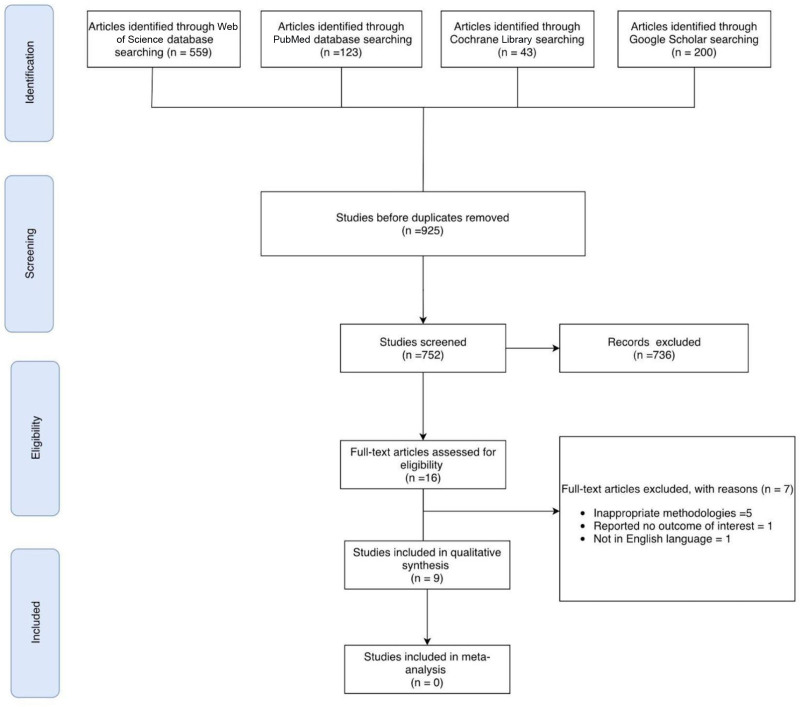
- PROSPERO-registered systematic review (CRD42024586119) following PRISMA; PubMed, Google Scholar, Web of Science, and Cochrane Library were searched, with English-language randomized or prospective studies reporting pain outcomes after otoplasty eligible.
- Nine studies (6 RCTs, 3 prospective observational; 370 patients; mean age roughly 16 years; 41% men) met criteria; two reviewers extracted pain scores, opioid use, PONV, and complications.
- Risk of bias was assessed with Cochrane RoB 2 for RCTs and MINORS for nonrandomized studies; heterogeneity prevented meta-analysis, so findings were synthesized narratively.
Limitations
- The paper states marked clinical and methodological heterogeneity—local anesthetic concentrations, adjunct dosing/timing, pain scales (VAS versus NRS), and PONV definitions—precluded meta-analysis; direct head-to-head comparisons were scarce, small, or single-center; all 9 trials used general anesthesia, limiting extrapolation to awake or office-based otoplasty; sample sizes were modest (median 32) and follow-up rarely exceeded 24 hours; reporting was inconsistent; English-language restriction raised possible publication bias; and the single lidocaine-versus-bupivacaine trial was vulnerable to “duration bias.”
- The paper also states the favorable hyoscine safety signal derives from just 1 pediatric RCT.
- Evident from the text: the methods say eligibility was limited to 2014–2024, but the included studies were published 1989–2020; inter-rater reliability for full-text inclusion was very low (Fleiss κ = 0.03; pairwise Cohen κ mean 0.21); and the Kepekçi and Kepekçi trial is described as enrolling 35 patients in the discussion while Table 1 lists N = 32.
Model-written summary. Check it against the paper before relying on it.
Integrity signals
Registry
Cites
Statistics
Figures
Verification
Claims the paper makes
8 Valid · 2 Not valid · 30 Not checked · 27 Own results and interpretations
The cited sources support only part of this claim — read each source’s verdict below.
In the paper
“Adjunctive therapies such as acupuncture and mindfulness-based interventions, though supported in broader surgical contexts, have been minimally explored in otoplasty, despite evidence suggesting they may reduce perioperative pain and opioid reliance.10”
§ Perioperative Analgesia and Postoperative Nausea and Vomiting Management in Otoplasty: A Systematic Review > INTRODUCTION
What the sources say
- Partly supportedcites [10] Garland EL Brintz CE Hanley AW. Mind-body therapies for opioid-treated pain: a systematic review and meta-analysis. JAMA Intern Med. 2020; 180: 91– 105. 31682676 PMC6830441 sourceExperimental — accuracy not yet measured
The Mindfulness or Meditation Studies section reports associations with reduced pain and some opioid-related outcomes, supporting the sentence’s broader rationale for mindfulness-based interventions. The Inclusion and Exclusion Criteria explicitly exclude acupuncture, and the paper provides no evidence about how extensively either therapy has been explored in otoplasty. No page numbers are available in our copy. (LLM, conf=0.86)
plain- Asserted: passes — The authors put it forward as true.
- Checkable: passes — It can be checked against evidence.
- Load-bearing: unclear — It is unclear whether the paper’s conclusions depend on it.
- Based: passes — The paper gives a reason why it holds.
- Partly supported
The cited sources support only part of this claim — read each source’s verdict below.
In the paper
“Where duration was reported, a single RNB injection provided 8 hours or more of analgesia1,7; subsequent oral or parenteral drugs were administered only as needed.1,7,19”
§ Perioperative Analgesia and Postoperative Nausea and Vomiting Management in Otoplasty: A Systematic Review > RESULTS
What the sources say
- Not checked — no full text of the sourcecites [1] Kepekçi AB Kepekçi AH. Anesthetic and analgesic efficiency of regional nerve blockade in otoplasty. J Craniofac Surg. 2020; 31: 1951– 1954. 32371690 source
- Partly supportedcites [7] Cregg N Conway F Casey W. Analgesia after otoplasty: regional nerve blockade vs local anaesthetic infiltration of the ear. Can J Anaesth. 1996; 43: 141– 147. 8825539 sourceExperimental — accuracy not yet measured
The Results report a mean analgesia duration of 10.5 hours for the regional nerve block group, but individual durations ranged from 1.3 to 24 hours; the paper does not say every block provided at least 8 hours. The Discussion explicitly says two injections are required to block all three nerves, contrary to the claim of a single injection. (LLM, conf=0.90)
- Not checked — no full text of the sourcecites [19] Woodward WM Barker I John RE. Propofol infusion vs thiopentone/isoflurane anaesthesia for prominent ear correction in children. Paediatr Anaesth. 1997; 7: 379– 383. 9308061 source
plainstates a cause- Asserted: passes — The authors put it forward as true.
- Checkable: passes — It can be checked against evidence.
- Load-bearing: passes — The paper’s conclusions depend on it.
- Based: passes — The paper gives a reason why it holds.
The cited sources support only part of this claim — read each source’s verdict below.
In the paper
“Cregg et al7 likewise reported fewer opioid requirements with RNB (14% versus 24%) despite comparable pain scores, although the difference was not powered for statistical testing.”
§ Perioperative Analgesia and Postoperative Nausea and Vomiting Management in Otoplasty: A Systematic Review > DISCUSSION
What the sources say
- Partly supportedcites [7] Cregg N Conway F Casey W. Analgesia after otoplasty: regional nerve blockade vs local anaesthetic infiltration of the ear. Can J Anaesth. 1996; 43: 141– 147. 8825539 sourceExperimental — accuracy not yet measured
The Abstract reports opioid use of 14% with regional nerve block versus 24% with local infiltration (P:NS), and the Results report comparable pain scores. The paper does not say the opioid-use difference was unpowered for statistical testing; its Statistical analysis section says analgesic requirements were tested, and the Abstract reports a nonsignificant result. (LLM, conf=0.86)
plainstates a cause- Asserted: passes — The authors put it forward as true.
- Checkable: passes — It can be checked against evidence.
- Load-bearing: passes — The paper’s conclusions depend on it.
- Based: passes — The paper gives a reason why it holds.
- Partly supported
The cited sources support only part of this claim — read each source’s verdict below.
In the paper
“Cregg et al7 likewise reported fewer opioid requirements with RNB (14% versus 24%) despite comparable pain scores, although the difference was not powered for statistical testing.”
§ Perioperative Analgesia and Postoperative Nausea and Vomiting Management in Otoplasty: A Systematic Review > DISCUSSION
What the sources say
- Partly supportedcites [7] Cregg N Conway F Casey W. Analgesia after otoplasty: regional nerve blockade vs local anaesthetic infiltration of the ear. Can J Anaesth. 1996; 43: 141– 147. 8825539 sourceExperimental — accuracy not yet measured
The Results report opioid use of 14% with regional nerve block versus 24% with infiltration, and the Discussion reports no difference in pain scores. But the Statistical analysis section says opioid use was tested, and the paper reports the difference as not statistically significant (P:NS). Its statement that numbers were too small for statistical analysis concerns the association between opioid use and postoperative nausea and vomiting, not the between-group opioid comparison. (LLM, conf=0.89)
plain- Asserted: passes — The authors put it forward as true.
- Checkable: passes — It can be checked against evidence.
- Load-bearing: unclear — It is unclear whether the paper’s conclusions depend on it.
- Based: passes — The paper gives a reason why it holds.
- Partly supported
In the paper
“Honkavaara et al18 reported that a 0.5-mg transdermal hyoscine patch reduced vomiting from 48% to 16% versus placebo, but produced short-lived blurred vision, dizziness, and bradycardia in less than 10% of children, almost all resolving within 2 hours, except for 1 case.”
§ Perioperative Analgesia and Postoperative Nausea and Vomiting Management in Otoplasty: A Systematic Review > RESULTS
What the sources say
- Not checked — no full text of the sourcecites [18] Honkavaara P Saarnivaara L Klemola UM. Effect of transdermal hyoscine on nausea and vomiting after surgical correction of prominent ears under general anaesthesia. Br J Anaesth. 1995; 74: 647– 650. 7640117 source
plainstates a cause- Asserted: passes — The authors put it forward as true.
- Checkable: passes — It can be checked against evidence.
- Load-bearing: passes — The paper’s conclusions depend on it.
- Based: passes — The paper gives a reason why it holds.
25 more claims
Create a free account to see all 67 claims and every source verdict.
- It may state two separate claims as one. 33
- Probably not a substantial claim. 8
Self-check
Percentages, sums and reported differences re-computed from the paper’s own numbers.
Each contradiction between two passages listed here was confirmed by an independent check.
Rated major: it would touch a result — a value a result rests on, reported and recomputed p-values on opposite sides of the significance level, two passages that conflict with no sign which is right, or a cited work retracted before this paper was published.
In the paper
§ Perioperative Analgesia and Postoperative Nausea and Vomiting Management in Otoplasty: A Systematic Review > METHODS AND MATERIALS
“We limited the eligibility to the studies published between 2014 and 2024”
§ Perioperative Analgesia and Postoperative Nausea and Vomiting Management in Otoplasty: A Systematic Review > RESULTS
“Sixteen full-text articles were assessed for eligibility, and 9 studies published between 1989 and 2020 satisfied all criteria (Fig. 1).”
Rated minor: it would not touch a result — a value no result rests on, a p-value that stays on the same side of the significance level, or a conflict that is clerical, resolved elsewhere in the paper, or outside its own findings.
In the paper
§ Perioperative Analgesia and Postoperative Nausea and Vomiting Management in Otoplasty: A Systematic Review > METHODS AND MATERIALS > Eligibility Criteria
“Single-arm observational series that reported 1 or more outcomes were also eligible”
§ Perioperative Analgesia and Postoperative Nausea and Vomiting Management in Otoplasty: A Systematic Review > METHODS AND MATERIALS > Eligibility Criteria
“studies lacking a comparator arm.”
Rated minor: it would not touch a result — a value no result rests on, a p-value that stays on the same side of the significance level, or a conflict that is clerical, resolved elsewhere in the paper, or outside its own findings.
In the paper
§ Perioperative Analgesia and Postoperative Nausea and Vomiting Management in Otoplasty: A Systematic Review > DISCUSSION > Limitations
“All 9 trials were conducted under general anesthesia; therefore, results may not extrapolate to awake or office-based otoplasty”
§ Perioperative Analgesia and Postoperative Nausea and Vomiting Management in Otoplasty: A Systematic Review > RESULTS
“| 8 | Santos, 201321 | Prospective cohort | 38 | 14–48 y | Local anesthesia with sedation | Local anesthesia without sedation |”
Rated minor: it would not touch a result — a value no result rests on, a p-value that stays on the same side of the significance level, or a conflict that is clerical, resolved elsewhere in the paper, or outside its own findings.
In the paper
§ Perioperative Analgesia and Postoperative Nausea and Vomiting Management in Otoplasty: A Systematic Review > RESULTS
“| 6 | Woodward et al, 199719 | Single-blind RCT | 30”
§ Perioperative Analgesia and Postoperative Nausea and Vomiting Management in Otoplasty: A Systematic Review > RESULTS
“| Design | Prospective comparative | Prospective comparative | Prospective single-blind, RCT-like | | Study ID | Kakagia et al20 | Santos21 | Woodward et al19 |”
Rated minor: it would not touch a result — a value no result rests on, a p-value that stays on the same side of the significance level, or a conflict that is clerical, resolved elsewhere in the paper, or outside its own findings.
In the paper
§ Perioperative Analgesia and Postoperative Nausea and Vomiting Management in Otoplasty: A Systematic Review > DISCUSSION
“the trial enrolled only 35 patients.”
§ Perioperative Analgesia and Postoperative Nausea and Vomiting Management in Otoplasty: A Systematic Review > RESULTS
“| 9 | Kepekçi and Kepekçi1 | RCT | 32 |”
2 more findings
Create a free account to see every finding of this check.
Citations
Cites
Preferred reporting items for systematic reviews and meta-analyses: The PRISMA statement
Moher, D., Liberati, A., Tetzlaff, J., Altman, D. G., & the PRISMA Group* (2009) · Annals of Internal Medicine · doi:10.7326/0003-4819-151-4-200908180-00135 · Cited by 37,554
The Cochrane Collaboration's tool for assessing risk of bias in randomised trials
Higgins, J. P. T., Altman, D. G., Gotzsche, P. C., Juni, P., Moher, D., Oxman, A. D., Savovic, J., Schulz, K. F., Weeks, L., Sterne, J. A. C., et al. (2011) · BMJ · doi:10.1136/bmj.d5928 · Cited by 33,817
Rayyan-a web and mobile app for systematic reviews.
Ouzzani, M., Hammady, H., Fedorowicz, Z., & Elmagarmid, A. (2016) · Systematic Reviews · doi:10.1186/s13643-016-0384-4 · Cited by 26,092
Slim, K., Nini, E., Forestier, D., Kwiatkowski, F., Panis, Y., & Chipponi, J. (2003) · ANZ Journal of Surgery · doi:10.1046/j.1445-2197.2003.02748.x · Cited by 7,603
Apfel, C. C., Läärä, E., Koivuranta, M., Greim, C.-A., & Roewer, N. (1999) · Anesthesiology · doi:10.1097/00000542-199909000-00022 · Cited by 2,121 · cited 2×
“19,26”
Postoperative Nausea and Vomiting: Its Etiology, Treatment, and Prevention
Watcha, M. F., & White, P. F. (1992) · Anesthesiology · doi:10.1097/00000542-199207000-00023 · Cited by 1,728 · cited 1×
“26,27 Targeted prophylaxis—chiefly trans-dermal hyoscine or total intravenous anesthesia with pro-pofol—substantially mitigated this risk.”
Mind-Body Therapies for Opioid-Treated Pain: A Systematic Review and Meta-analysis
Garland, E. L., Brintz, C. E., Hanley, A. W., Roseen, E. J., Atchley, R. M., Gaylord, S. A., Faurot, K. R., Yaffe, J., Fiander, M., & Keefe, F. J. (2020) · JAMA Internal Medicine · doi:10.1001/jamainternmed.2019.4917 · Cited by 190 · cited 2×
“10”
Postoperative emesis following otoplasty in children.
Paxton, D., Taylor, R. H., Gallagher, T. M., & Crean, P. M. (1995) · Anaesthesia · doi:10.1111/j.1365-2044.1995.tb05957.x · Cited by 51 · cited 1×
“7,15,17 Risk-of-bias assessment indicated that 4 of the 6 RCTs were at low risk, and 2 had some concerns, chiefly related to performance bias (Table 2).”
Analgesia after otoplasty: regional nerve blockade vs local anaesthetic infiltration of the ear.
Cregg, N., Conway, F., & Casey, W. (1996) · Canadian Journal of Anaesthesia · doi:10.1007/bf03011255 · Cited by 46 · cited 5×
“1,7,19 This extended coverage reflects bupivacaine’s slower dissociation from axonal Na ⁺ channels, whereas lidocaine, the agent most often used for LIA, typically wears off after 2–4 hours.”
InfluentialOtoplasty and Auricular Reconstruction
Siegert, R., & Magritz, R. (2019) · Facial Plastic Surgery · doi:10.1055/s-0039-1693745 · Cited by 37
Research works printed but not linked: 4
- Merrill DG Kuruvilla AG Arora VM. Multimodal pain management strategies in otolaryngology: a systematic review. Otolaryngol Head Neck Surg. 2021; 165: 649– 660.
- Urits I Orhurhu V Orhurhu MS. Pain management in pediatric surgery: an updated review. Curr Pain Headache Rep. 2020; 24: 16.32198571
- Cousins MJ Bridenbaugh PO, eds. Neural Blockade in Clinical Anesthesia and Management of Pain. Lippincott Williams & Wilkins; 1998.
- Europe PMC. Anesthetic and analgesic efficient of regional nerve blockade in otoplasty. Europe PMC. Available at https://europepmc.org/article/med/32371690. 2016. Accessed January 11, 2025. 32371690
Metadata
- Authors
- Alnufaei, A. H., AlSubaie, F. K., Aljabri, R. A., Aloqayli, S. Z., Alanshmi, S., Alotaibi, S. M., Ajeeb, Z. B., AlGhamdi, L. Y., Kattan, M. E., Alahmadi, B. H., & Alhujayri, A. K.
- Affiliations
- King Saud bin Abdulaziz University for Health Sciences (SA)
- King Abdulaziz University (SA)
- Prince Sattam Bin Abdulaziz University (SA)
- University of Jeddah (SA)
- Umm al-Qura University (SA)
- Imam Mohammad ibn Saud Islamic University (SA)
- King Abdullah International Medical Research Center (SA)
- Corresponding author
- Alnufaei, Abdulaziz Hamad
- Ajeeb, Zyinaab Bassam
- Venue
- Plastic and Reconstructive Surgery - Global Open
- Published
- 2026-02
- Volume
- 14
- Issue
- 2
- Pages
- e7347
- ISSN
- 2169-7574 (ISSN-L)
- PMC
- PMC12908817
- OpenAlex
- W7128792588
- Cited by
- 0
- References
- 19
- FWCI
- 0.00
- Type
- journal article
- Language
- en
- Open access
- gold
- doi.org
- Licence
- Locations
- Plastic & Reconstructive Surgery Global Open (publishedVersion, cc-by-nc-nd)
- PubMed (publishedVersion)
- PubMed Central (publishedVersion, cc-by-nc-nd)
- DOAJ (DOAJ: Directory of Open Access Journals) (submittedVersion)
- Topics
- Health Sciences › Medicine › Anesthesiology and Pain Medicine › Anesthesia and Pain Management
- Health Sciences › Medicine › Surgery › Nausea and vomiting management
- Health Sciences › Medicine › Surgery › Reconstructive Facial Surgery Techniques
- Keywords
- otoplasty, perioperative analgesia, postoperative nausea and vomiting, nerve block, propofol anesthesia, opioid use, postoperative pain, Horner's syndrome, multimodal analgesia
About these checks
Registry, retraction, Cites and statistics results are computed, not judged, with one exception: a printed reference that no index lists is read once by a model before it counts as a citation error. Claims are extracted by a model and kept only when their quote appears verbatim in the text; each cited source is then checked, with a model’s help, for whether it says what the claim relies on. Those verdicts can be wrong — read the claim’s quote and the cited source before relying on one.
The claim verdicts this report counts are experimental: their accuracy is not yet measured.
A language model drew the claims from the paper on 2026-10-10, under version 3 of the claim definition (model deepseek-v4.1-flash, prompt extract-v3).
A second model labelled each claim on 2026-10-10 (model jev-1.13-20260917, definition revision gold-guideline-v0.2).
Cited sources are checked with a language model’s help (gpt-6-sol).
Statistics and arithmetic are recomputed, not judged.
Confidence bands are shown only for fields calibrated on our annotated test set. None is calibrated yet, so no band is shown.
What counts as a claim ›How we measure confidence ›How we check this ›
Are you an author, or do you see a problem with this page? Request a review
How to cite
Cite CoChat for the checks on this page, and the paper for its own findings.
- This page
- CoChat. (2026). Citation check: Perioperative Analgesia and Postoperative Nausea and Vomiting Management in Otoplasty: A Systematic Review. https://app.cochat.ai/papers/10.1097/gox.0000000000007347
- The paper
- Alnufaei, A. H., AlSubaie, F. K., Aljabri, R. A., Aloqayli, S. Z., Alanshmi, S., Alotaibi, S. M., Ajeeb, Z. B., AlGhamdi, L. Y., Kattan, M. E., Alahmadi, B. H., & Alhujayri, A. K. (2026). Perioperative Analgesia and Postoperative Nausea and Vomiting Management in Otoplasty: A Systematic Review. Plastic and Reconstructive Surgery - Global Open. https://doi.org/10.1097/gox.0000000000007347
Data sources
Bibliographic data: Semantic Scholar, OpenAlex, Crossref.
Contains information from the Semantic Scholar Academic Graph Datasets, made available under the ODC Attribution License (ODC-BY 1.0).
Semantic Scholar’s data is described in: Kinney, R., et al. (2023). The Semantic Scholar Open Data Platform. arXiv:2301.10140.
