

The DOI matches its Crossref record; 29 of the 29 references it cites were found in a registry or an index; 31 of the 67 sources its claims cite were checked for support.
Ashwagandha-induced liver injury—A case series from India and literature review
Open accessAbstract
Background: Ashwagandha herb is commonly used in Ayurveda and a “fad” dietary supplement for a host of indications based on low levels of evidence. Recently, ashwagandha was implicated in multiple reports of herb-induced liver injury (HILI), mainly from the United States. We present the first, and currently largest, series of ashwagandha-HILI from multiple centers in India. Methods: We retrospectively analyzed the respective institutional electronic medical records for ashwagandha-HILI. Patients consuming ashwagandha as part of multiherbal formulations or along with other known hepatotoxic supplements or medicines were excluded. All patients underwent a detailed diagnostic workup to exclude competing causes reasonably. Where possible, the implicated herbal formulation was retrieved and subjected to chemical analysis. Results: Out of 23 patients with liver injury from ashwagandha (January 2019 to December 2022), we report 8 patients with single-ingredient formulation-related HILI. Study cohort was male predominant, and cholestatic hepatitis was the commonest presentation. Five patients had underlying chronic liver disease; 3 presented with acute-on-chronic liver failure, and all 3 died on follow-up. In others, the liver injury was prolonged, nonetheless self-limiting. Liver biopsy revealed cholestatic features predominantly with hepatocellular necrosis and lymphocyte/eosinophil predominant portal-based inflammation. One patient progressed to chronic HILI. Chemical analysis revealed only natural phytochemicals without adulteration or contamination. Conclusions: Ashwagandha-HILI presents with cholestatic hepatitis and can lead to the syndrome of acute-on-chronic liver failure with high mortality in those with pre-existing liver disease. Educating the public on avoiding the use of potentially toxic and unrecommended herbal supplements can help mitigate the avoidable liver disease burden in the community.
Overview
AI snapshot
Written from the paper’s full text.
TL;DR
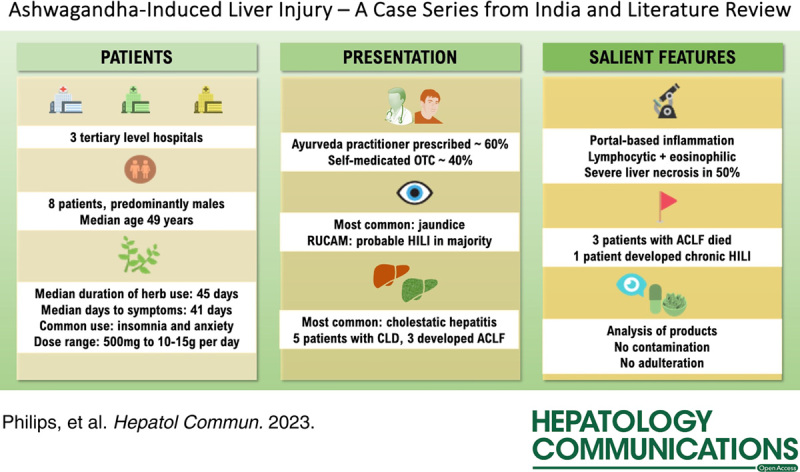
In a retrospective multicenter Indian case series, 8 patients with liver injury attributed to single-ingredient ashwagandha formulations most commonly presented with cholestatic hepatitis; those with pre-existing chronic liver disease who developed acute-on-chronic liver failure all died. Chemical analysis of retrieved products found natural phytochemicals without hepatotoxic adulterants or contaminants.
Key findings
- Among 8 included patients (6 male, 2 female; median age 49 years), liver injury type by R-ratio was cholestatic in 4, hepatocellular in 3, and mixed in 1; jaundice occurred in 7/8 (87.5%) and pruritus in 5/8 (62.5%).
- Five patients had underlying chronic liver disease; 3 presented with acute-on-chronic liver failure (ACLF), and all 3 died (overall mortality 37.5%, with deaths at 30, 242, and 288 days). HILI was severe in 6/8 (75%).
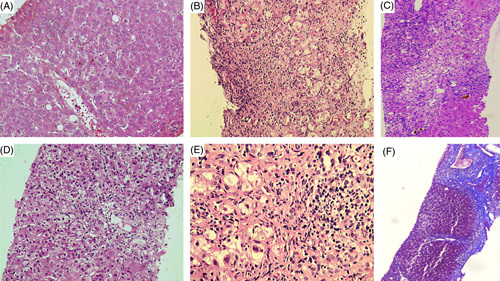
- RUCAM classified 6 cases as probable and 2 as possible. Liver biopsy in 6 patients showed predominantly cholestatic features, lymphocytic/eosinophilic portal-based inflammation, and hepatocellular necrosis in 50%; one patient progressed to chronic HILI.
- Chemical/toxicology analysis of 5 retrieved formulations found no hepatotoxic contaminants, adulterants, or synthetic agents; identified compounds included glycosides, lactones, terpenes, saponins, and alkaloids, with one product containing trace lead (0.21 mg/kg), cadmium (0.038 mg/kg), and arsenic (0.089 mg/kg).
Methods
- Retrospective review of institutional electronic medical records from 3 tertiary centers in India, January 2019 to December 2022; from 23 patients with liver injury from ashwagandha-containing supplements, 8 using ashwagandha-only formulations were included.
- Exclusions included multiherbal ashwagandha products, concomitant potentially toxic herbal supplements or prescription drugs, active alcohol use, and other competing causes of acute liver injury.
- Evaluation included laboratory tests, viral serologies, autoimmune biomarkers, cross-sectional imaging, R-ratio classification, RUCAM causality assessment, liver biopsy where consented, and chemical/toxicology analysis of retrieved formulations.
Limitations
- Stated: retrospective design and reliance on patient recall for duration/dates of herb consumption may introduce recall bias; data needed for Revised Electronic Causality Assessment Method could not be gathered; RUCAM may underestimate causality for herbal supplements; not all implicated products were retrieved for chemical analysis; HLA testing was not performed due to lack of resources; PCR for HCV and HEV was not performed, though viral hepatitis was considered unlikely.
- Stated: the authors note the lack of an organized national DILI network and centralized expert-driven data assessment system.
- Evident from the text: this is a small case series (8 patients) without a control group, and findings may not be generalizable beyond the participating Indian tertiary centers.
Model-written summary. Check it against the paper before relying on it.
Integrity signals
Registry
Cites
Statistics
Figures
Verification
Claims the paper makes
99 Own result · 16 Own interpretation · 15 Own method · 11 Partly supported · 11 Sources not found · 5 No basis given · 2 Supported · 2 Couldn’t confirm · 2 Not checked yet · 1 Supported so far · 1 No full text of the sources · accuracy not yet measured
The cited sources that could be checked couldn’t confirm or dispute this claim.
In the paper
“Recently, ashwagandha was implicated in multiple reports of herb-induced liver injury (HILI), mainly from the United States.”
- Also stated in: § INTRODUCTION · plain
“Multiple reports have been published on ashwagandha-related liver injury, mostly from centers in the United States, along with large numbers of self-reported adverse events, such as severe itching, based on analysis of commercial websites.14”
§ Ashwagandha-induced liver injury—A case series from India and literature review > Abstract > Background:
What the sources say
- Could not verifycites [14] Hayashi PH. Overview of causality assessment in drug-induced liver injury. Clin Liver Dis (Hoboken). 2017; 9: 29– 33. 30992953 PMC6467140 sourceExperimental — accuracy not yet measured
The Expert Consensus Opinion section describes the US Drug-Induced Liver Injury Network and its case registry, but does not identify ashwagandha or discuss reports involving it. Searches for ashwagandha-related liver injury and US reports found no passage supporting the claimed number or location of reports. (LLM, conf=0.76)
plaincorrelational- Asserted: passes — The authors put it forward as true.
- Checkable: passes — It can be checked against evidence.
- Load-bearing: unclear — It is unclear whether the paper’s conclusions depend on it.
- Based: passes — The paper gives a reason why it holds.
- Also stated in: § INTRODUCTION · plain
The cited sources support only part of this claim — read each source’s verdict below.
In the paper
“Nonetheless, conclusive evidence from rigorous, methodologically sound, well-designed, validated, and replicated trials does not exist for the aforementioned indications.11–13”
§ Ashwagandha-induced liver injury—A case series from India and literature review > INTRODUCTION
What the sources say
- Not checked — no full text of the sourcecites [11] D’Cruz M Andrade C. Potential clinical applications of Ashwagandha (Withania somnifera) in medicine and neuropsychiatry. Expert Rev Clin Pharmacol. 2022; 15: 1067– 80. 36062480 source
- Partly supportedcites [12] Bonilla DA Moreno Y Gho C Petro JL Odriozola-Martínez A Kreider RB. Effects of ashwagandha (Withania somnifera) on physical performance: Systematic review and Bayesian meta-analysis. J Funct Morphol Kinesiol. 2021; 6: 20. 33670194 PMC8006238 sourceExperimental — accuracy not yet measured
The Discussion (4.1) says the small number of studies means pooled effects should be interpreted cautiously and further research is needed to confirm ashwagandha’s effects on physical performance. The Conclusions (5) nevertheless report benefits over placebo. The paper does not establish that conclusive evidence is lacking for all the other indications implied by “aforementioned indications,” or that rigorous, validated trials do not exist. (LLM, conf=0.83)
- Not checked — no full text of the sourcecites [13] Akhgarjand C Asoudeh F Bagheri A Kalantar Z Vahabi Z Shab-Bidar S. Does ashwagandha supplementation have a beneficial effect on the management of anxiety and stress? A systematic review and meta-analysis of randomized controlled trials. Phytother Res. 2022; 36: 4115– 24. 36017529 source
boosted- Asserted: passes — The authors put it forward as true.
- Checkable: passes — It can be checked against evidence.
- Load-bearing: unclear — It is unclear whether the paper’s conclusions depend on it.
- Based: passes — The paper gives a reason why it holds.
Every source the paper cites for this claim was checked and supports it.
In the paper
“The previous largest published series of ashwagandha-related liver injuries were from Iceland and the United States. DILI Network concerning 5 patients.17”
§ Ashwagandha-induced liver injury—A case series from India and literature review > DISCUSSION
What the sources say
- Supportedcites [17] Björnsson HK Björnsson ES Avula B Khan IA Jonasson JG Ghabril M. Ashwagandha-induced liver injury: A case series from Iceland and the US Drug-Induced Liver Injury Network. Liver Int. 2020; 40: 825– 9. 31991029 PMC8041491 source
The Methods report five cases of liver injury attributed to ashwagandha-containing supplements: three from Iceland and two from the US Drug-Induced Liver Injury Network. The Background & Aims state that only one case had previously been published, supporting the description of this as the largest published series at the time. (LLM, conf=0.92)
plainn = 5- Asserted: passes — The authors put it forward as true.
- Checkable: passes — It can be checked against evidence.
- Load-bearing: passes — The paper’s conclusions depend on it.
- Based: passes — The paper gives a reason why it holds.
- Supported
The cited sources support only part of this claim — read each source’s verdict below.
In the paper
“and are very commonly described in patients with DILI”
§ Ashwagandha-induced liver injury—A case series from India and literature review > DISCUSSION
What the sources say
- Not checked — no full text of the sourcecites [7] Philips CA Paramaguru R Joy AK Antony KL Augustine P. Clinical outcomes, histopathological patterns, and chemical analysis of Ayurveda and herbal medicine associated with severe liver injury—a single-center experience from southern India. Indian J Gastroenterol. 2018; 37: 9– 17. 29476406 source
- Partly supportedcites [9] Philips CA Theruvath AH Raveendran R Ahamed R Rajesh S Abduljaleel JK. Clinical outcomes associated with complementary and alternative medicine-related “immunity-boosting” practices in patients with cirrhosis during the COVID-19 pandemic—an observational study. Medicine (Baltimore). 2023; 102: e33365. 36961176 PMC10035553 sourceExperimental — accuracy not yet measured
The Results (section 3.2; page not available) report low-titer antinuclear antibodies in two of 19 patients with immunity-booster-related liver injury. This supports the possibility of mild autoimmune-marker elevations, but not the claim that they are very common among patients with DILI generally. (LLM, conf=0.87)
- Partly supportedcites [17] Björnsson HK Björnsson ES Avula B Khan IA Jonasson JG Ghabril M. Ashwagandha-induced liver injury: A case series from Iceland and the US Drug-Induced Liver Injury Network. Liver Int. 2020; 40: 825– 9. 31991029 PMC8041491 sourceExperimental — accuracy not yet measured
The Results (page not available) report elevated ANA and SMA titers of 1:40 in one of five patients with ashwagandha-associated DILI. This supports the occurrence of low-titer autoimmune markers in a DILI patient, but the case series does not establish that such elevations are very common among patients with DILI generally. (LLM, conf=0.84)
- Could not verifycites [31] Navarro V Avula B Khan I Verma M Seeff L Serrano J. The contents of herbal and dietary supplements implicated in liver injury in the United States are frequently mislabeled. Hepatol Commun. 2019; 3: 792– 4. 31168513 PMC6545864 sourceExperimental — accuracy not yet measured
The Materials and Methods and Results discuss DILI cases and supplement-label testing, but do not report autoimmune-marker levels or how commonly they occur. Searches for autoimmune markers, autoantibodies, ANA, and related serology found no passage addressing the claim. (LLM, conf=0.76)
boostedcorrelational- Asserted: passes — The authors put it forward as true.
- Checkable: passes — It can be checked against evidence.
- Load-bearing: passes — The paper’s conclusions depend on it.
- Based: passes — The paper gives a reason why it holds.
The cited sources support only part of this claim — read each source’s verdict below.
In the paper
“and drug-triggered autoimmune hepatitis is not uncommon, especially in the context of HILI.7,9,17,31”
§ Ashwagandha-induced liver injury—A case series from India and literature review > DISCUSSION
What the sources say
- Not checked — no full text of the sourcecites [7] Philips CA Paramaguru R Joy AK Antony KL Augustine P. Clinical outcomes, histopathological patterns, and chemical analysis of Ayurveda and herbal medicine associated with severe liver injury—a single-center experience from southern India. Indian J Gastroenterol. 2018; 37: 9– 17. 29476406 source
- Partly supportedcites [9] Philips CA Theruvath AH Raveendran R Ahamed R Rajesh S Abduljaleel JK. Clinical outcomes associated with complementary and alternative medicine-related “immunity-boosting” practices in patients with cirrhosis during the COVID-19 pandemic—an observational study. Medicine (Baltimore). 2023; 102: e33365. 36961176 PMC10035553 sourceExperimental — accuracy not yet measured
The Discussion (page unavailable) reports that giloy-associated liver injury can have autoimmune features and mentions a turmeric-associated autoimmune hepatitis case. But it gives no basis for calling drug-triggered autoimmune hepatitis “not uncommon,” especially in herbal-induced liver injury (HILI). In this study’s cohort, the Results (section 3.2; page unavailable) state that neither of the two patients with positive autoimmune markers met the diagnostic criteria for autoimmune hepatitis. (LLM, conf=0.84)
- Could not verifycites [17] Björnsson HK Björnsson ES Avula B Khan IA Jonasson JG Ghabril M. Ashwagandha-induced liver injury: A case series from Iceland and the US Drug-Induced Liver Injury Network. Liver Int. 2020; 40: 825– 9. 31991029 PMC8041491 sourceExperimental — accuracy not yet measured
The Background & Aims and Conclusions discuss how often herbal and dietary supplements cause liver injury, but not how often they trigger autoimmune hepatitis. The Results report elevated autoimmune-marker titers in one of five patients; they do not diagnose autoimmune hepatitis. A search for autoimmune hepatitis and autoimmune markers found no passage supporting the claimed frequency. (LLM, conf=0.76)
- Could not verifycites [31] Navarro V Avula B Khan I Verma M Seeff L Serrano J. The contents of herbal and dietary supplements implicated in liver injury in the United States are frequently mislabeled. Hepatol Commun. 2019; 3: 792– 4. 31168513 PMC6545864 sourceExperimental — accuracy not yet measured
The Materials and Methods and Discussion (pages unavailable) address liver injury associated with herbal and dietary supplements and the accuracy of supplement labels, but do not address autoimmune hepatitis or how commonly it is drug-triggered in HILI. Searches for “autoimmune hepatitis” and “drug-triggered autoimmune hepatitis in herbal-induced liver injury” found no passage supporting that point. (LLM, conf=0.74)
plaincorrelational- Asserted: passes — The authors put it forward as true.
- Checkable: passes — It can be checked against evidence.
- Load-bearing: unclear — It is unclear whether the paper’s conclusions depend on it.
- Based: passes — The paper gives a reason why it holds.
The cited sources support only part of this claim — read each source’s verdict below.
In the paper
“Since the first report, a total of 14 cases (excluding the current series) of ashwagandha-induced liver injury are available.17–26”
§ Ashwagandha-induced liver injury—A case series from India and literature review > DISCUSSION
What the sources say
- Partly supportedcites [17] Björnsson HK Björnsson ES Avula B Khan IA Jonasson JG Ghabril M. Ashwagandha-induced liver injury: A case series from Iceland and the US Drug-Induced Liver Injury Network. Liver Int. 2020; 40: 825– 9. 31991029 PMC8041491 sourceExperimental — accuracy not yet measured
The Results report five cases of ashwagandha-associated liver injury, so this paper supports part of the cited case count. Its Background & Aims says only one case had been published before this series; it does not establish the citing paper’s total of 14 cases excluding its current series. (LLM, conf=0.82)
- Not checked yetcites [18] Inagaki K Mori N Honda Y Takaki S Tsuji K Chayama K. A case of drug-induced liver injury with prolonged severe intrahepatic cholestasis induced by ashwagandha. Kanzo. 2017; 58: 448– 54.
- Not checked — no full text of the sourcecites [19] Weber S Gerbes AL. Ashwagandha-induced liver injury: Self-reports on commercial websites as useful adjunct tools for causality assessment. Am J Gastroenterol. 2021; 116: 2151– 2152. 34187981 source
- Not checked — no full text of the sourcecites [20] Ireland PJ Hardy T Burt AD Donnelly MC. Drug-induced hepatocellular injury due to herbal supplement ashwagandha. J R Coll Physicians Edinb. 2021; 51: 363– 5. 34882134 source
- Not checked yetcites [21] Rattu M Maddock E Espinosa J Lucerna A Bhatnagar N An herbal liver effect: Ashwagandha-induced hepatotoxicity. Accessed June 17, 2023. https://rdw.rowan.edu/cgi/viewcontent.cgi?article=1194&context=stratford_research_day
- Partly supportedcites [22] Patel AD Pinsker BL Wall A Arbogast M King LY Sherzoy S. Itching to find a diagnosis. Clin Liver Dis (Hoboken). 2022; 20: 77– 80. 36187371 PMC9512456 sourceExperimental — accuracy not yet measured
The case description and Discussion report a patient with liver injury after ashwagandha use, so this paper supports the existence of a reported case. The Discussion refers to increasing reports but does not establish that 14 cases were available or identify the first report. (LLM, conf=0.84)
- Not checked yetcites [23] Ali Sajjadh MJ Suresh Mithil G Sanchez-Cruz J Anand C. S2976 cry me a liver: Ashwagandha-induced liver toxicity. Am J Gastroenterol. 2022; 117(10S): e1931.
- Partly supportedcites [24] Tóth M Benedek AE Longerich T Seitz HK. Ashwagandha-induced acute liver injury: A case report. Clin Case Rep. 2023; 11: e7078. 36937644 PMC10014511 sourceExperimental — accuracy not yet measured
The Introduction (page unavailable) says that a few cases of ashwagandha-associated liver injury had been reported, and the Abstract describes another case. Neither passage gives a total of 14 cases or establishes that count excluding the citing paper's current series; a search for “14” found no such count. (LLM, conf=0.85)
- Partly supportedcites [25] Lubarska M Hałasiński P Hryhorowicz S Mahadea DS Łykowska-Szuber L Eder P. Liver dangers of herbal products: a case report of ashwagandha-induced liver injury. Int J Environ Res Public Health. 2023; 20: 3921. 36900932 PMC10002162 sourceExperimental — accuracy not yet measured
The Discussion (page unavailable) describes previously published ashwagandha-induced liver injury cases, including a five-patient series and individual case reports. It does not state that there were 14 cases, or establish a total excluding the citing paper’s current series. (LLM, conf=0.82)
- Not checked — no full text of the sourcecites [26] Suryawanshi G Abdallah M Thomson M Desai N Chauhan A Lim N. Ashwagandha-associated acute liver failure requiring liver transplantation. Am J Ther. 2023; 30: e80– 3. 36321995 source
plainn = 14- Asserted: passes — The authors put it forward as true.
- Checkable: passes — It can be checked against evidence.
- Load-bearing: unclear — It is unclear whether the paper’s conclusions depend on it.
- Based: passes — The paper gives a reason why it holds.
- Partly supported
The sources with a verdict support this claim; the rest weren’t checked yet, have no full text we could read, or their verdicts aren’t rated yet.
In the paper
“Mild elevations of autoimmune markers are not pathognomonic for autoimmune hepatitis”
§ Ashwagandha-induced liver injury—A case series from India and literature review > DISCUSSION
What the sources say
- Not checked — no full text of the sourcecites [7] Philips CA Paramaguru R Joy AK Antony KL Augustine P. Clinical outcomes, histopathological patterns, and chemical analysis of Ayurveda and herbal medicine associated with severe liver injury—a single-center experience from southern India. Indian J Gastroenterol. 2018; 37: 9– 17. 29476406 source
- Supportedcites [9] Philips CA Theruvath AH Raveendran R Ahamed R Rajesh S Abduljaleel JK. Clinical outcomes associated with complementary and alternative medicine-related “immunity-boosting” practices in patients with cirrhosis during the COVID-19 pandemic—an observational study. Medicine (Baltimore). 2023; 102: e33365. 36961176 PMC10035553 source
The Results (section 3.2, Clinical presentation) report that two patients had positive antinuclear antibody tests at titers of 1:40 and 1:100, but neither met the diagnostic criteria for autoimmune hepatitis. These cases support the point that such marker findings alone are not diagnostic. (LLM, conf=0.88)
- Supportedcites [17] Björnsson HK Björnsson ES Avula B Khan IA Jonasson JG Ghabril M. Ashwagandha-induced liver injury: A case series from Iceland and the US Drug-Induced Liver Injury Network. Liver Int. 2020; 40: 825– 9. 31991029 PMC8041491 source
The Results (page not provided) report a patient with mildly elevated ANA and SMA titers whose liver tests normalized after stopping the supplement. The paper treats the case as ashwagandha-associated liver injury, supporting the point that these marker elevations alone do not establish autoimmune hepatitis. (LLM, conf=0.86)
- Could not verifycites [31] Navarro V Avula B Khan I Verma M Seeff L Serrano J. The contents of herbal and dietary supplements implicated in liver injury in the United States are frequently mislabeled. Hepatol Commun. 2019; 3: 792– 4. 31168513 PMC6545864 sourceExperimental — accuracy not yet measured
The Materials and Methods and Discussion passages address supplement contents, mislabeling, and liver injury, not the diagnostic significance of autoimmune markers. Searches for autoimmune markers, autoantibodies, and autoimmune hepatitis found no passage in our copy addressing the claim; page numbers were not available. (LLM, conf=0.76)
plain- Asserted: passes — The authors put it forward as true.
- Checkable: passes — It can be checked against evidence.
- Load-bearing: passes — The paper’s conclusions depend on it.
- Based: passes — The paper gives a reason why it holds.
The cited sources support only part of this claim — read each source’s verdict below.
In the paper
“Reports of ashwagandha-induced liver injury have been notable in medical literature since 2017.”
§ Ashwagandha-induced liver injury—A case series from India and literature review > DISCUSSION
What the sources say
- Supportedcites [17] Björnsson HK Björnsson ES Avula B Khan IA Jonasson JG Ghabril M. Ashwagandha-induced liver injury: A case series from Iceland and the US Drug-Induced Liver Injury Network. Liver Int. 2020; 40: 825– 9. 31991029 PMC8041491 source
The References list an ashwagandha-induced liver injury case report published in 2017, and the Conclusions discuss that report alongside this paper’s five additional cases. This supports the claim that reports have appeared in the medical literature since 2017, though the paper notes that only one case had been published before its case series. (LLM, conf=0.86)
- Not checked yetcites [18] Inagaki K Mori N Honda Y Takaki S Tsuji K Chayama K. A case of drug-induced liver injury with prolonged severe intrahepatic cholestasis induced by ashwagandha. Kanzo. 2017; 58: 448– 54.
- Not checked — no full text of the sourcecites [19] Weber S Gerbes AL. Ashwagandha-induced liver injury: Self-reports on commercial websites as useful adjunct tools for causality assessment. Am J Gastroenterol. 2021; 116: 2151– 2152. 34187981 source
- Not checked — no full text of the sourcecites [20] Ireland PJ Hardy T Burt AD Donnelly MC. Drug-induced hepatocellular injury due to herbal supplement ashwagandha. J R Coll Physicians Edinb. 2021; 51: 363– 5. 34882134 source
- Not checked yetcites [21] Rattu M Maddock E Espinosa J Lucerna A Bhatnagar N An herbal liver effect: Ashwagandha-induced hepatotoxicity. Accessed June 17, 2023. https://rdw.rowan.edu/cgi/viewcontent.cgi?article=1194&context=stratford_research_day
- Partly supportedcites [22] Patel AD Pinsker BL Wall A Arbogast M King LY Sherzoy S. Itching to find a diagnosis. Clin Liver Dis (Hoboken). 2022; 20: 77– 80. 36187371 PMC9512456 sourceExperimental — accuracy not yet measured
The Discussion (page not provided) says an increasing number of ashwagandha-related liver injury cases have recently been reported, supporting the claim that such reports appear in the medical literature. It does not identify 2017 as the starting point; the cited ashwagandha-specific reports listed in the References are dated 2020 and 2021. (LLM, conf=0.87)
- Not checked yetcites [23] Ali Sajjadh MJ Suresh Mithil G Sanchez-Cruz J Anand C. S2976 cry me a liver: Ashwagandha-induced liver toxicity. Am J Gastroenterol. 2022; 117(10S): e1931.
- Supportedcites [24] Tóth M Benedek AE Longerich T Seitz HK. Ashwagandha-induced acute liver injury: A case report. Clin Case Rep. 2023; 11: e7078. 36937644 PMC10014511 source
The Introduction says that a few cases of ashwagandha-associated liver injury had been reported. Its References list a 2017 case report followed by reports from 2020 and 2022, supporting the claim that such reports appear in the medical literature from 2017 onward. No page numbers are provided in our copy. (LLM, conf=0.87)
- Partly supportedcites [25] Lubarska M Hałasiński P Hryhorowicz S Mahadea DS Łykowska-Szuber L Eder P. Liver dangers of herbal products: a case report of ashwagandha-induced liver injury. Int J Environ Res Public Health. 2023; 20: 3921. 36900932 PMC10002162 sourceExperimental — accuracy not yet measured
The Abstract (page not provided) says that ashwagandha-associated liver injury has been reported in recent years, and the Discussion describes published cases. However, our copy does not establish that reports date back to 2017: the earlier case discussed has no publication year given in the paper’s reference entry. (LLM, conf=0.82)
- Not checked — no full text of the sourcecites [26] Suryawanshi G Abdallah M Thomson M Desai N Chauhan A Lim N. Ashwagandha-associated acute liver failure requiring liver transplantation. Am J Ther. 2023; 30: e80– 3. 36321995 source
plainn = 14- Asserted: passes — The authors put it forward as true.
- Checkable: passes — It can be checked against evidence.
- Load-bearing: unclear — It is unclear whether the paper’s conclusions depend on it.
- Based: passes — The paper gives a reason why it holds.
- Supported
A result the paper reports from its own data — it cites no other source for it, so there is none to check. The quote shows it is in the paper.
In the paper
“the median time to symptom onset was 41 (interquartile range 59.5, minimum 14 to maximum 540) days.”
§ Ashwagandha-induced liver injury—A case series from India and literature review > PATIENTS > General features and clinical details
plain- Asserted: passes — The authors put it forward as true.
- Checkable: passes — It can be checked against evidence.
- Load-bearing: unclear — It is unclear whether the paper’s conclusions depend on it.
- Based: passes — The paper gives a reason why it holds.
- Rests on an assumption: The doses and durations of ashwagandha intake reported by patients are accurate.
A result the paper reports from its own data — it cites no other source for it, so there is none to check. The quote shows it is in the paper.
In the paper
“Five patients had underlying chronic liver disease; 3 presented with acute-on-chronic liver failure, and all 3 died on follow-up.”
§ Ashwagandha-induced liver injury—A case series from India and literature review > Abstract > Results:
plainn = 3- Asserted: passes — The authors put it forward as true.
- Checkable: passes — It can be checked against evidence.
- Load-bearing: passes — The paper’s conclusions depend on it.
- Based: passes — The paper gives a reason why it holds.
- Probably not a substantial claim. 56
- It may state two separate claims as one. 31
The cited sources that could be checked couldn’t confirm or dispute this claim.
In the paper
“Multiple reports have been published on ashwagandha-related liver injury, mostly from centers in the United States, along with large numbers of self-reported adverse events, such as severe itching, based on analysis of commercial websites.14”
§ Ashwagandha-induced liver injury—A case series from India and literature review > INTRODUCTION
What the sources say
- Could not verifycites [14] Hayashi PH. Overview of causality assessment in drug-induced liver injury. Clin Liver Dis (Hoboken). 2017; 9: 29– 33. 30992953 PMC6467140 sourceExperimental — accuracy not yet measured
The Abstract discusses drug- and supplement-induced liver injury generally, while the Expert Consensus Opinion section describes how DILIN assesses cases (page numbers unavailable). Neither those passages nor searches for ashwagandha, severe itching, and commercial-website adverse-event reports address the attributed claim. (LLM, conf=0.76)
plain- Asserted: passes — The authors put it forward as true.
- Checkable: passes — It can be checked against evidence.
- Load-bearing: fails — The paper’s conclusions may not depend on it.
- Based: passes — The paper gives a reason why it holds.
Probably not a substantial claim. The paper’s conclusions may not depend on it.
- Could not verify
The cited sources support only part of this claim — read each source’s verdict below.
In the paper
“Ayurvedic herbal supplements have been implicated in serious liver injury, acute decompensation of cirrhosis, and acute-on-chronic liver failure.7–9”
§ Ashwagandha-induced liver injury—A case series from India and literature review > INTRODUCTION
What the sources say
- Not checked — no full text of the sourcecites [7] Philips CA Paramaguru R Joy AK Antony KL Augustine P. Clinical outcomes, histopathological patterns, and chemical analysis of Ayurveda and herbal medicine associated with severe liver injury—a single-center experience from southern India. Indian J Gastroenterol. 2018; 37: 9– 17. 29476406 source
- Supportedcites [8] Philips CA Paramaguru R Augustine P Rajesh S Ahamed R George T. A single-center experience on outcomes of complementary and alternative medicine use among patients with cirrhosis. Hepatol Commun. 2019; 3: 1001– 12. 31304453 PMC6601323 source
The Abstract reports severe drug-induced liver injury linked to Ayurvedic herbal drugs and identifies unlabeled polyherbal Ayurvedic formulations as the most common CAM used by patients with possible CAM-related acute-on-chronic liver failure. Results > Patient Screening and Inclusion reports decompensation associated with CAM use, including possible ACLF. The paper cautions that its retrospective design cannot establish that the exposure precipitated ACLF; the claim’s word “implicated” preserves that uncertainty. No page numbers are available in our copy. (LLM, conf=0.91)
- Partly supportedcites [9] Philips CA Theruvath AH Raveendran R Ahamed R Rajesh S Abduljaleel JK. Clinical outcomes associated with complementary and alternative medicine-related “immunity-boosting” practices in patients with cirrhosis during the COVID-19 pandemic—an observational study. Medicine (Baltimore). 2023; 102: e33365. 36961176 PMC10035553 sourceExperimental — accuracy not yet measured
The Discussion (page unavailable) links Ayurvedic herbal supplements to severe liver injury and reports decompensation associated with Ayurvedic formulations in patients with chronic liver disease. It also reports acute-on-chronic liver failure associated with drugs, predominantly complementary and alternative medicines, but does not specifically identify Ayurvedic supplements as the cause of those cases. (LLM, conf=0.83)
plaincorrelational- Asserted: passes — The authors put it forward as true.
- Checkable: passes — It can be checked against evidence.
- Load-bearing: passes — The paper’s conclusions depend on it.
- Based: passes — The paper gives a reason why it holds.
It may state two separate claims as one.
The cited sources support only part of this claim — read each source’s verdict below.
In the paper
“Herbal drugs and dietary supplements are a major growing concern for liver injury, liver failure, and death or liver transplantation globally.3–6”
§ Ashwagandha-induced liver injury—A case series from India and literature review > INTRODUCTION
What the sources say
- Supportedcites [3] Medina-Caliz I Garcia-Cortes M Gonzalez-Jimenez A Cabello MR Robles-Diaz M Sanabria-Cabrera J. Spanish DILI Registry. Herbal and dietary supplement-induced liver injuries in the Spanish DILI Registry. Clin Gastroenterol Hepatol. 2018; 16: 1495– 502. 29307848 source
The Introduction (page unavailable) describes worldwide use of herbal and dietary supplements and says they can cause liver injury up to acute liver failure. The Discussion calls supplement-induced liver injury a growing concern worldwide, and the Results report cases ending in death or liver transplantation. (LLM, conf=0.86)
- Not checked — no full text of the sourcecites [4] Bessone F García-Cortés M Medina-Caliz I Hernandez N Parana R Mendizabal M. Herbal and dietary supplements-induced liver injury in Latin America: Experience from the LATINDILI Network. Clin Gastroenterol Hepatol. 2022; 20: e548– 63. 33434654 source
- Partly supportedcites [5] Shen T Liu Y Shang J Xie Q Li J Yan M. Incidence and etiology of drug-induced liver injury in Mainland China. Gastroenterology. 2019; 156: 2230– 41.e11. 30742832 sourceExperimental — accuracy not yet measured
The discussion (accepted manuscript; page unavailable) identifies herbal drugs and dietary supplements as major causes of drug-induced liver injury in mainland China, links them to acute liver failure in Western studies, and says their use has increased worldwide. The results report deaths and liver transplants among Chinese drug-induced liver injury cases, and the supplementary death table includes herbal-medicine cases. The copy does not establish that herbal products are a major cause of death or liver transplantation globally. (LLM, conf=0.83)
- Partly supportedcites [6] Kesar V Channen L Masood U Grewal P Ahmad J Roth NC. Transplantation for acute liver injury in Asians is more likely due to herbal and dietary supplements. Liver Transpl. 2022; 28: 188– 99. 34370392 PMC8792150 sourceExperimental — accuracy not yet measured
The Background reports HDS-related liver injury in Asian and European countries and an association with death or liver transplantation in a US cohort. The Results and Discussion report increasing severe HDS-related liver injury and transplantation in the United States. These passages support a growing concern, but the paper does not establish that the trend or these outcomes are increasing globally. (LLM, conf=0.88)
plaincorrelational- Asserted: passes — The authors put it forward as true.
- Checkable: passes — It can be checked against evidence.
- Load-bearing: fails — The paper’s conclusions may not depend on it.
- Based: passes — The paper gives a reason why it holds.
Probably not a substantial claim. The paper’s conclusions may not depend on it.
- Supported
The cited sources support only part of this claim — read each source’s verdict below.
In the paper
“Thereafter, the causality assessment was performed to diagnose highly probable (score >8), probable (6-8), possible (3-5), and unlikely(1-2 or less) DILI using the 7-point Roussel Uclaf Causality Assessment Method (RUCAM).14”
§ Ashwagandha-induced liver injury—A case series from India and literature review > METHODS
What the sources say
- Partly supportedcites [14] Hayashi PH. Overview of causality assessment in drug-induced liver injury. Clin Liver Dis (Hoboken). 2017; 9: 29– 33. 30992953 PMC6467140 sourceExperimental — accuracy not yet measured
Table 1 (SUMMARY; page unavailable) presents RUCAM with seven assessment criteria, and Table 2 gives the stated thresholds for highly probable, probable, and possible DILI. The citing sentence's unlikely category does not match Table 2, which lists unlikely as 1 to 3 and separately lists scores below 1 as excluded. (LLM, conf=0.88)
plain- Asserted: passes — The authors put it forward as true.
- Checkable: passes — It can be checked against evidence.
- Load-bearing: passes — The paper’s conclusions depend on it.
- Based: passes — The paper gives a reason why it holds.
Probably not a substantial claim.
- Partly supported
The cited sources support only part of this claim — read each source’s verdict below.
In the paper
“Withania somnifera, popularly known as ashwagandha (also Indian Ginseng, Winter Cherry), is a commonly used and marketed herb as part of Ayurvedic herbals and dietary supplements for relieving stress and anxiety, improving sleep, increasing muscle mass and strength, improving sexual function in both males and females, increasing memory and as “immune-booster.”10”
§ Ashwagandha-induced liver injury—A case series from India and literature review > INTRODUCTION
What the sources say
- Partly supportedcites [10] Paul S Chakraborty S Anand U Dey S Nandy S Ghorai M. Withania somnifera (L.) Dunal (ashwagandha): A comprehensive review on ethnopharmacology, pharmacotherapeutics, biomedicinal and toxicological aspects. Biomed Pharmacother. 2021; 143: 112175. 34649336 sourceExperimental — accuracy not yet measured
The Introduction describes ashwagandha’s extensive use in Ayurvedic herbal medicine, and Table 2 lists commercial formulations for stress, anxiety, sleep, memory, sexual wellness, muscle growth, and promoting immunity. The table supports most of the marketed-use claim, but the passages found do not specifically establish marketing for increased muscle strength or improved sexual function in both males and females. (LLM, conf=0.84)
plain- Asserted: passes — The authors put it forward as true.
- Checkable: passes — It can be checked against evidence.
- Load-bearing: fails — The paper’s conclusions may not depend on it.
- Based: passes — The paper gives a reason why it holds.
Probably not a substantial claim. The paper’s conclusions may not depend on it. It may state two separate claims as one.
- Partly supported
The cited sources support only part of this claim — read each source’s verdict below.
In the paper
“The underlying mechanism for liver damage due to ashwagandha could be the presence of herb-specific compounds called withanolides that cause irreversible adduction to hepatocellular DNA.30”
§ Ashwagandha-induced liver injury—A case series from India and literature review > DISCUSSION
What the sources say
- Partly supportedcites [30] Siddiqui S Ahmed N Goswami M Chakrabarty A Chowdhury G. DNA damage by Withanone as a potential cause of liver toxicity observed for herbal products of Withania somnifera (Ashwagandha). Curr Res Toxicol. 2021; 2: 72– 81. 34345852 PMC8320610 sourceExperimental — accuracy not yet measured
The Conclusions report that withanone, one ashwagandha withanolide, forms non-labile DNA adducts and propose this as a possible explanation for reported liver damage. The Experimental section describes adduct tests using isolated calf thymus DNA, not hepatocellular DNA. The paper therefore supports a potential mechanism, but not the claim that withanolides as a class cause irreversible adduction in liver cells. Page numbers are unavailable in our copy. (LLM, conf=0.88)
hedgedconditional- Asserted: passes — The authors put it forward as true.
- Checkable: passes — It can be checked against evidence.
- Load-bearing: fails — The paper’s conclusions may not depend on it.
- Based: passes — The paper gives a reason why it holds.
Probably not a substantial claim. The paper’s conclusions may not depend on it.
- Partly supported
The cited sources support only part of this claim — read each source’s verdict below.
In the paper
“In some cohorts, DILI in patients with underlying liver disease has been associated with mortality rates as high as 16%, compared to ~5% in patients without pre-existing liver disease.8,27,28”
§ Ashwagandha-induced liver injury—A case series from India and literature review > DISCUSSION
What the sources say
- Partly supportedcites [8] Philips CA Paramaguru R Augustine P Rajesh S Ahamed R George T. A single-center experience on outcomes of complementary and alternative medicine use among patients with cirrhosis. Hepatol Commun. 2019; 3: 1001– 12. 31304453 PMC6601323 sourceExperimental — accuracy not yet measured
The Results (Outcomes and Significant Predictors; page unavailable) report mortality among patients with cirrhosis and possible CAM-related DILI, supporting the general point that DILI can be associated with death in patients with underlying liver disease. The paper reports 53% mortality in that cohort, however, and does not provide the claimed 16% versus approximately 5% comparison with patients without pre-existing liver disease. (LLM, conf=0.84)
- Not checked — no full text of the sourcecites [27] Devarbhavi H Choudhury AK Sharma MK Maiwall R Al Mahtab M Rahman S. APASL ACLF working party. Drug-induced acute-onchronic liver failure in Asian patients. Am J Gastroenterol. 2019; 114: 929– 37. 31021832 source
- Not checked yetcites [28] Chalasani NP Maddur H Russo MW Wong RJ Reddy KR. Practice Parameters Committee of the American College of Gastroenterology. ACG Clinical Guideline: Diagnosis and Management of Idiosyncratic Drug-Induced Liver Injury. Am J Gastroenterol. 2021; 116: 878– 98. 33929376
hedgedcorrelational- Asserted: passes — The authors put it forward as true.
- Checkable: passes — It can be checked against evidence.
- Load-bearing: fails — The paper’s conclusions may not depend on it.
- Based: passes — The paper gives a reason why it holds.
Probably not a substantial claim. The paper’s conclusions may not depend on it. It may state two separate claims as one.
- Partly supported
Every source the paper cites for this claim was checked and supports it.
In the paper
“Many cases of DILI due to herbal supplements are caused by formulations containing multi-ingredient mixtures, and it can be difficult to prove the exact compound that is responsible for liver injury.29”
§ Ashwagandha-induced liver injury—A case series from India and literature review > DISCUSSION
What the sources say
- Supportedcites [29] Björnsson ES Navarro VJ Chalasani N. Liver injury following Tinospora cordifolia consumption: Drug-induced AIH, or de novo AIH? J Clin Exp Hepatol. 2022; 12: 6– 9. 35068778 PMC8766689 source
The discussion of HDS-induced liver injury says that most botanical products contain many ingredients, any one or combination of which may be responsible. It also says chemical analysis has a very limited role in identifying the culprit ingredient in clinical practice (passage 2; page not provided). (LLM, conf=0.91)
plaindirect- Asserted: passes — The authors put it forward as true.
- Checkable: passes — It can be checked against evidence.
- Load-bearing: fails — The paper’s conclusions may not depend on it.
- Based: passes — The paper gives a reason why it holds.
Probably not a substantial claim. The paper’s conclusions may not depend on it. It may state two separate claims as one.
- Supported
A result the paper reports from its own data — it cites no other source for it, so there is none to check. The quote shows it is in the paper.
In the paper
“Three patients had diabetes or hypertension”
§ Ashwagandha-induced liver injury—A case series from India and literature review > PATIENTS > General features and clinical details
plainn = 3- Asserted: passes — The authors put it forward as true.
- Checkable: passes — It can be checked against evidence.
- Load-bearing: fails — The paper’s conclusions may not depend on it.
- Based: passes — The paper gives a reason why it holds.
Probably not a substantial claim. The paper’s conclusions may not depend on it.
A result the paper reports from its own data — it cites no other source for it, so there is none to check. The quote shows it is in the paper.
In the paper
“Among the latter 2, one was diagnosed with HILI on the background of NASH on liver biopsy”
§ Ashwagandha-induced liver injury—A case series from India and literature review > PATIENTS > General features and clinical details
plainSingle case- Asserted: passes — The authors put it forward as true.
- Checkable: passes — It can be checked against evidence.
- Load-bearing: fails — The paper’s conclusions may not depend on it.
- Based: passes — The paper gives a reason why it holds.
Probably not a substantial claim. The paper’s conclusions may not depend on it.
A result the paper reports from its own data — it cites no other source for it, so there is none to check. The quote shows it is in the paper.
In the paper
“while 2 patients were diagnosed to have underlying chronic liver disease during the evaluation of herb-induced liver injury (HILI).”
§ Ashwagandha-induced liver injury—A case series from India and literature review > PATIENTS > General features and clinical details
plainn = 2- Asserted: passes — The authors put it forward as true.
- Checkable: passes — It can be checked against evidence.
- Load-bearing: fails — The paper’s conclusions may not depend on it.
- Based: passes — The paper gives a reason why it holds.
Probably not a substantial claim. The paper’s conclusions may not depend on it.
A result the paper reports from its own data — it cites no other source for it, so there is none to check. The quote shows it is in the paper.
In the paper
“The median age was 49 (range 44, minimum 31 to maximum 75) years.”
§ Ashwagandha-induced liver injury—A case series from India and literature review > PATIENTS > General features and clinical details
plainn = 8- Asserted: passes — The authors put it forward as true.
- Checkable: passes — It can be checked against evidence.
- Load-bearing: fails — The paper’s conclusions may not depend on it.
- Based: passes — The paper gives a reason why it holds.
Probably not a substantial claim. The paper’s conclusions may not depend on it.
A result the paper reports from its own data — it cites no other source for it, so there is none to check. The quote shows it is in the paper.
In the paper
“Of the 8 patients included in the study, 6 were males and 2 were females.”
§ Ashwagandha-induced liver injury—A case series from India and literature review > PATIENTS > General features and clinical details
plainn = 8- Asserted: passes — The authors put it forward as true.
- Checkable: passes — It can be checked against evidence.
- Load-bearing: fails — The paper’s conclusions may not depend on it.
- Based: passes — The paper gives a reason why it holds.
Probably not a substantial claim. The paper’s conclusions may not depend on it.
A result the paper reports from its own data — it cites no other source for it, so there is none to check. The quote shows it is in the paper.
In the paper
“One patient had a history of non-Hodgkin lymphoma in remission for 4 years.”
§ Ashwagandha-induced liver injury—A case series from India and literature review > PATIENTS > General features and clinical details
plainSingle case- Asserted: passes — The authors put it forward as true.
- Checkable: passes — It can be checked against evidence.
- Load-bearing: fails — The paper’s conclusions may not depend on it.
- Based: passes — The paper gives a reason why it holds.
Probably not a substantial claim. The paper’s conclusions may not depend on it.
A result the paper reports from its own data — it cites no other source for it, so there is none to check. The quote shows it is in the paper.
In the paper
“followed by pruritus (N=5/8, 62.5%).”
§ Ashwagandha-induced liver injury—A case series from India and literature review > PATIENTS > General features and clinical details
plainn = 8- Asserted: passes — The authors put it forward as true.
- Checkable: passes — It can be checked against evidence.
- Load-bearing: fails — The paper’s conclusions may not depend on it.
- Based: passes — The paper gives a reason why it holds.
Probably not a substantial claim. The paper’s conclusions may not depend on it.
A result the paper reports from its own data — it cites no other source for it, so there is none to check. The quote shows it is in the paper.
In the paper
“The indications for ashwagandha use were insomnia and antistress in 2, postpregnancy detox in 1, appetite stimulant in 1, anticancer prevention (who was already in long-term remission from non-Hodgkin lymphoma) in 1, fever reduction in 1, and as a “wellness and energy booster” in 2 patients.”
§ Ashwagandha-induced liver injury—A case series from India and literature review > PATIENTS > General features and clinical details
plainn = 2- Asserted: passes — The authors put it forward as true.
- Checkable: passes — It can be checked against evidence.
- Load-bearing: fails — The paper’s conclusions may not depend on it.
- Based: passes — The paper gives a reason why it holds.
Probably not a substantial claim. The paper’s conclusions may not depend on it. It may state two separate claims as one.
A result the paper reports from its own data — it cites no other source for it, so there is none to check. The quote shows it is in the paper.
In the paper
“The other 15 patients were excluded because they had consumed concomitant potentially toxic herbal formulations or were on ashwagandha-based multiherbal preparations, or had other competing causes for liver injury”
§ Ashwagandha-induced liver injury—A case series from India and literature review > PATIENTS > General features and clinical details
plainn = 15- Asserted: passes — The authors put it forward as true.
- Checkable: passes — It can be checked against evidence.
- Load-bearing: passes — The paper’s conclusions depend on it.
- Based: passes — The paper gives a reason why it holds.
It may state two separate claims as one.
A result the paper reports from its own data — it cites no other source for it, so there is none to check. The quote shows it is in the paper.
In the paper
“and had been on medications for the same for decades without any significant prescription drug modifications pertinent to current events.”
§ Ashwagandha-induced liver injury—A case series from India and literature review > PATIENTS > General features and clinical details
plainn = 3- Asserted: passes — The authors put it forward as true.
- Checkable: passes — It can be checked against evidence.
- Load-bearing: fails — The paper’s conclusions may not depend on it.
- Based: passes — The paper gives a reason why it holds.
Probably not a substantial claim. The paper’s conclusions may not depend on it.
A result the paper reports from its own data — it cites no other source for it, so there is none to check. The quote shows it is in the paper.
In the paper
“A registered and certified Ayurveda practitioner prescribed the ashwagandha supplement to 5 patients, while 3 reported self-use of over-the-counter supplements.”
§ Ashwagandha-induced liver injury—A case series from India and literature review > PATIENTS > General features and clinical details
plainn = 5- Asserted: passes — The authors put it forward as true.
- Checkable: passes — It can be checked against evidence.
- Load-bearing: fails — The paper’s conclusions may not depend on it.
- Based: passes — The paper gives a reason why it holds.
Probably not a substantial claim. The paper’s conclusions may not depend on it. It may state two separate claims as one.
A result the paper reports from its own data — it cites no other source for it, so there is none to check. The quote shows it is in the paper.
In the paper
“Chemical analysis revealed only natural phytochemicals without adulteration or contamination.”
§ Ashwagandha-induced liver injury—A case series from India and literature review > Abstract > Results:
plain- Asserted: passes — The authors put it forward as true.
- Checkable: passes — It can be checked against evidence.
- Load-bearing: passes — The paper’s conclusions depend on it.
- Based: passes — The paper gives a reason why it holds.
It may state two separate claims as one.
A result the paper reports from its own data — it cites no other source for it, so there is none to check. The quote shows it is in the paper.
In the paper
“Three patients were known to have pre-existing chronic liver disease”
§ Ashwagandha-induced liver injury—A case series from India and literature review > PATIENTS > General features and clinical details
plainn = 3- Asserted: passes — The authors put it forward as true.
- Checkable: passes — It can be checked against evidence.
- Load-bearing: fails — The paper’s conclusions may not depend on it.
- Based: passes — The paper gives a reason why it holds.
Probably not a substantial claim. The paper’s conclusions may not depend on it.
A result the paper reports from its own data — it cites no other source for it, so there is none to check. The quote shows it is in the paper.
In the paper
“while the other patient had imaging features of cirrhosis and portal hypertension during the evaluation of HILI.”
§ Ashwagandha-induced liver injury—A case series from India and literature review > PATIENTS > General features and clinical details
plainSingle case- Asserted: passes — The authors put it forward as true.
- Checkable: passes — It can be checked against evidence.
- Load-bearing: fails — The paper’s conclusions may not depend on it.
- Based: passes — The paper gives a reason why it holds.
Probably not a substantial claim. The paper’s conclusions may not depend on it.
A result the paper reports from its own data — it cites no other source for it, so there is none to check. The quote shows it is in the paper.
In the paper
“Study cohort was male predominant, and cholestatic hepatitis was the commonest presentation.”
§ Ashwagandha-induced liver injury—A case series from India and literature review > Abstract > Results:
plainn = 23- Asserted: passes — The authors put it forward as true.
- Checkable: passes — It can be checked against evidence.
- Load-bearing: fails — The paper’s conclusions may not depend on it.
- Based: passes — The paper gives a reason why it holds.
Probably not a substantial claim. The paper’s conclusions may not depend on it.
The paper states this without a source or data behind it here, so there is nothing to check it against. The quote shows it is in the paper.
In the paper
“None of the patients had a history of concomitant hepatotoxic prescription or alternative medicine use, alcohol misuse, or i.v. drug use.”
§ Ashwagandha-induced liver injury—A case series from India and literature review > DISCUSSION
plain- Asserted: passes — The authors put it forward as true.
- Checkable: passes — It can be checked against evidence.
- Load-bearing: passes — The paper’s conclusions depend on it.
- Based: passes — The paper gives a reason why it holds.
It may state two separate claims as one.
A result the paper reports from its own data — it cites no other source for it, so there is none to check. The quote shows it is in the paper.
In the paper
“platelet count 168.5×10³/μL”
§ Ashwagandha-induced liver injury—A case series from India and literature review > PATIENTS > Investigations and outcomes
plainn = 8- Asserted: passes — The authors put it forward as true.
- Checkable: passes — It can be checked against evidence.
- Load-bearing: fails — The paper’s conclusions may not depend on it.
- Based: passes — The paper gives a reason why it holds.
Probably not a substantial claim. The paper’s conclusions may not depend on it.
A result the paper reports from its own data — it cites no other source for it, so there is none to check. The quote shows it is in the paper.
In the paper
“The portal area was the commonest site of inflammation”
§ Ashwagandha-induced liver injury—A case series from India and literature review > PATIENTS > Investigations and outcomes
plain- Asserted: passes — The authors put it forward as true.
- Checkable: passes — It can be checked against evidence.
- Load-bearing: fails — The paper’s conclusions may not depend on it.
- Based: passes — The paper gives a reason why it holds.
Probably not a substantial claim. The paper’s conclusions may not depend on it.
A result the paper reports from its own data — it cites no other source for it, so there is none to check. The quote shows it is in the paper.
In the paper
“In our patients, the herbal supplement was a single ingredient (ashwagandha) without any other known hepatotoxic ingredients or concomitant liver toxic medication use (as such, were excluded)”
§ Ashwagandha-induced liver injury—A case series from India and literature review > DISCUSSION
plain- Asserted: passes — The authors put it forward as true.
- Checkable: passes — It can be checked against evidence.
- Load-bearing: passes — The paper’s conclusions depend on it.
- Based: passes — The paper gives a reason why it holds.
It may state two separate claims as one.
A result the paper reports from its own data — it cites no other source for it, so there is none to check. The quote shows it is in the paper.
In the paper
“The predominant pattern of liver injury was cholestatic, with jaundice as the notable clinical presentation.”
§ Ashwagandha-induced liver injury—A case series from India and literature review > DISCUSSION
plain- Asserted: passes — The authors put it forward as true.
- Checkable: passes — It can be checked against evidence.
- Load-bearing: unclear — It is unclear whether the paper’s conclusions depend on it.
- Based: passes — The paper gives a reason why it holds.
It may state two separate claims as one.
A result the paper reports from its own data — it cites no other source for it, so there is none to check. The quote shows it is in the paper.
In the paper
“Liver injury: cholestatic type in 4 patients, hepatocellular in 3, and mixed in 1”
§ Ashwagandha-induced liver injury—A case series from India and literature review > DISCUSSION
plainn = 4- Asserted: passes — The authors put it forward as true.
- Checkable: passes — It can be checked against evidence.
- Load-bearing: unclear — It is unclear whether the paper’s conclusions depend on it.
- Based: passes — The paper gives a reason why it holds.
It may state two separate claims as one.
A result the paper reports from its own data — it cites no other source for it, so there is none to check. The quote shows it is in the paper.
In the paper
“The second hepatitis episode was well controlled by initiating low-dose immunosuppression (corticosteroids and mycophenolate), with the patient doing well on follow-up.”
§ Ashwagandha-induced liver injury—A case series from India and literature review > DISCUSSION
plaindirectSingle case- Asserted: passes — The authors put it forward as true.
- Checkable: passes — It can be checked against evidence.
- Load-bearing: passes — The paper’s conclusions depend on it.
- Based: passes — The paper gives a reason why it holds.
It may state two separate claims as one.
A result the paper reports from its own data — it cites no other source for it, so there is none to check. The quote shows it is in the paper.
In the paper
“Anxiety, stress, general wellness, appetite enhancer, insomnia”
§ Ashwagandha-induced liver injury—A case series from India and literature review > DISCUSSION
plain- Asserted: passes — The authors put it forward as true.
- Checkable: passes — It can be checked against evidence.
- Load-bearing: unclear — It is unclear whether the paper’s conclusions depend on it.
- Based: passes — The paper gives a reason why it holds.
It may state two separate claims as one.
A result the paper reports from its own data — it cites no other source for it, so there is none to check. The quote shows it is in the paper.
In the paper
“| Steroid use for treatment | No | No | Yes, 40 mg/d for 15 d | Yes, 40 mg/d for 30 d | No | No | Yes, 40 mg/d for 30 d | No |”
§ Ashwagandha-induced liver injury—A case series from India and literature review > PATIENTS > General features and clinical details
plainn = 8- Asserted: passes — The authors put it forward as true.
- Checkable: passes — It can be checked against evidence.
- Load-bearing: fails — The paper’s conclusions may not depend on it.
- Based: passes — The paper gives a reason why it holds.
Probably not a substantial claim. The paper’s conclusions may not depend on it.
A result the paper reports from its own data — it cites no other source for it, so there is none to check. The quote shows it is in the paper.
In the paper
“Dose: as recommended on the label or as advised by practitioners, patients reported no overdoses, but dosages could not be recorded”
§ Ashwagandha-induced liver injury—A case series from India and literature review > DISCUSSION
plain- Asserted: passes — The authors put it forward as true.
- Checkable: passes — It can be checked against evidence.
- Load-bearing: fails — The paper’s conclusions may not depend on it.
- Based: passes — The paper gives a reason why it holds.
Probably not a substantial claim. The paper’s conclusions may not depend on it. It may state two separate claims as one.
A result the paper reports from its own data — it cites no other source for it, so there is none to check. The quote shows it is in the paper.
In the paper
“spotty in 1, bridging in 1, and confluent in 2”
§ Ashwagandha-induced liver injury—A case series from India and literature review > PATIENTS > Investigations and outcomes
plain- Asserted: passes — The authors put it forward as true.
- Checkable: passes — It can be checked against evidence.
- Load-bearing: unclear — It is unclear whether the paper’s conclusions depend on it.
- Based: passes — The paper gives a reason why it holds.
It may state two separate claims as one.
A result the paper reports from its own data — it cites no other source for it, so there is none to check. The quote shows it is in the paper.
In the paper
“Two patients were positive for antinuclear antibodies”
§ Ashwagandha-induced liver injury—A case series from India and literature review > PATIENTS > Investigations and outcomes
plainn = 2- Asserted: passes — The authors put it forward as true.
- Checkable: passes — It can be checked against evidence.
- Load-bearing: fails — The paper’s conclusions may not depend on it.
- Based: passes — The paper gives a reason why it holds.
Probably not a substantial claim. The paper’s conclusions may not depend on it.
A result the paper reports from its own data — it cites no other source for it, so there is none to check. The quote shows it is in the paper.
In the paper
“The commonest indication for ashwagandha use in our cohort was for “stress and wellness.””
§ Ashwagandha-induced liver injury—A case series from India and literature review > DISCUSSION
plain- Asserted: passes — The authors put it forward as true.
- Checkable: passes — It can be checked against evidence.
- Load-bearing: fails — The paper’s conclusions may not depend on it.
- Based: passes — The paper gives a reason why it holds.
Probably not a substantial claim. The paper’s conclusions may not depend on it.
The paper states this without a source or data behind it here, so there is nothing to check it against. The quote shows it is in the paper.
In the paper
“Our study included patients with pre-existing liver disease, a novel aspect lacking in the current published literature on ashwagandha-induced liver injury.”
§ Ashwagandha-induced liver injury—A case series from India and literature review > DISCUSSION
plain- Asserted: passes — The authors put it forward as true.
- Checkable: passes — It can be checked against evidence.
- Load-bearing: passes — The paper’s conclusions depend on it.
- Based: unclear — It is unclear why the paper says it holds.
It may state two separate claims as one.
A result the paper reports from its own data — it cites no other source for it, so there is none to check. The quote shows it is in the paper.
In the paper
“median international normalized ratio 1.85”
§ Ashwagandha-induced liver injury—A case series from India and literature review > PATIENTS > Investigations and outcomes
plainn = 8- Asserted: passes — The authors put it forward as true.
- Checkable: passes — It can be checked against evidence.
- Load-bearing: fails — The paper’s conclusions may not depend on it.
- Based: passes — The paper gives a reason why it holds.
Probably not a substantial claim. The paper’s conclusions may not depend on it.
A result the paper reports from its own data — it cites no other source for it, so there is none to check. The quote shows it is in the paper.
In the paper
“aspartate aminotransferase 171 U/L”
§ Ashwagandha-induced liver injury—A case series from India and literature review > PATIENTS > Investigations and outcomes
plainn = 8- Asserted: passes — The authors put it forward as true.
- Checkable: passes — It can be checked against evidence.
- Load-bearing: fails — The paper’s conclusions may not depend on it.
- Based: passes — The paper gives a reason why it holds.
Probably not a substantial claim. The paper’s conclusions may not depend on it.
A result the paper reports from its own data — it cites no other source for it, so there is none to check. The quote shows it is in the paper.
In the paper
“The type of liver injury according to the R-ratio was cholestatic in 4, hepatocellular in 3, and mixed in 1.”
§ Ashwagandha-induced liver injury—A case series from India and literature review > PATIENTS > Investigations and outcomes
plainn = 8- Asserted: passes — The authors put it forward as true.
- Checkable: passes — It can be checked against evidence.
- Load-bearing: unclear — It is unclear whether the paper’s conclusions depend on it.
- Based: passes — The paper gives a reason why it holds.
It may state two separate claims as one.
A result the paper reports from its own data — it cites no other source for it, so there is none to check. The quote shows it is in the paper.
In the paper
“alanine aminotransferase 173 U/L”
§ Ashwagandha-induced liver injury—A case series from India and literature review > PATIENTS > Investigations and outcomes
plainn = 8- Asserted: passes — The authors put it forward as true.
- Checkable: passes — It can be checked against evidence.
- Load-bearing: fails — The paper’s conclusions may not depend on it.
- Based: passes — The paper gives a reason why it holds.
Probably not a substantial claim. The paper’s conclusions may not depend on it.
A result the paper reports from its own data — it cites no other source for it, so there is none to check. The quote shows it is in the paper.
In the paper
“Necrotic areas (notable at baseline biopsy) were absent, cholestasis had resolved, and focal areas showed hepatocyte rosettes”
§ Ashwagandha-induced liver injury—A case series from India and literature review > PATIENTS > Investigations and outcomes
plainSingle case- Asserted: passes — The authors put it forward as true.
- Checkable: passes — It can be checked against evidence.
- Load-bearing: passes — The paper’s conclusions depend on it.
- Based: passes — The paper gives a reason why it holds.
It may state two separate claims as one.
A result the paper reports from its own data — it cites no other source for it, so there is none to check. The quote shows it is in the paper.
In the paper
“mean serum albumin 3.51±0.93 mg/dL”
§ Ashwagandha-induced liver injury—A case series from India and literature review > PATIENTS > Investigations and outcomes
plainn = 8- Asserted: passes — The authors put it forward as true.
- Checkable: passes — It can be checked against evidence.
- Load-bearing: fails — The paper’s conclusions may not depend on it.
- Based: passes — The paper gives a reason why it holds.
Probably not a substantial claim. The paper’s conclusions may not depend on it.
A result the paper reports from its own data — it cites no other source for it, so there is none to check. The quote shows it is in the paper.
In the paper
“In 1 patient (patient 3), a second (percutaneous) liver biopsy (details not shown in Table 2) was performed 5 months after the initial HILI presentation in view of the recurrence of hepatitis (without jaundice) after prior complete resolution.”
§ Ashwagandha-induced liver injury—A case series from India and literature review > PATIENTS > Investigations and outcomes
plainSingle case- Asserted: passes — The authors put it forward as true.
- Checkable: passes — It can be checked against evidence.
- Load-bearing: fails — The paper’s conclusions may not depend on it.
- Based: passes — The paper gives a reason why it holds.
Probably not a substantial claim. The paper’s conclusions may not depend on it.
A result the paper reports from its own data — it cites no other source for it, so there is none to check. The quote shows it is in the paper.
In the paper
“Three patients died (mortality 37.5%; at 30, 242, and 288 d).”
§ Ashwagandha-induced liver injury—A case series from India and literature review > PATIENTS > Investigations and outcomes
plainn = 3- Asserted: passes — The authors put it forward as true.
- Checkable: passes — It can be checked against evidence.
- Load-bearing: passes — The paper’s conclusions depend on it.
- Based: passes — The paper gives a reason why it holds.
It may state two separate claims as one.
A result the paper reports from its own data — it cites no other source for it, so there is none to check. The quote shows it is in the paper.
In the paper
“Treatment: supportive care and ursodeoxycholic acid in those with cholestasis, immunosuppression in 1 patient with recurrence of hepatitis and chronic herb-induced liver injury on serial biopsy”
§ Ashwagandha-induced liver injury—A case series from India and literature review > DISCUSSION
plainSingle case- Asserted: passes — The authors put it forward as true.
- Checkable: passes — It can be checked against evidence.
- Load-bearing: unclear — It is unclear whether the paper’s conclusions depend on it.
- Based: passes — The paper gives a reason why it holds.
It may state two separate claims as one.
A result the paper reports from its own data — it cites no other source for it, so there is none to check. The quote shows it is in the paper.
In the paper
“The portal tract revealed predominantly lymphocytic and clustered macrophage-mediated inflammation, mild to moderate interface hepatitis with neutrophils and eosinophils, and minimal plasma cells.”
§ Ashwagandha-induced liver injury—A case series from India and literature review > PATIENTS > Investigations and outcomes
plainSingle case- Asserted: passes — The authors put it forward as true.
- Checkable: passes — It can be checked against evidence.
- Load-bearing: passes — The paper’s conclusions depend on it.
- Based: passes — The paper gives a reason why it holds.
It may state two separate claims as one.
A result the paper reports from its own data — it cites no other source for it, so there is none to check. The quote shows it is in the paper.
In the paper
“median hemoglobin 12.1 g/dL”
§ Ashwagandha-induced liver injury—A case series from India and literature review > PATIENTS > Investigations and outcomes
plainn = 8- Asserted: passes — The authors put it forward as true.
- Checkable: passes — It can be checked against evidence.
- Load-bearing: fails — The paper’s conclusions may not depend on it.
- Based: passes — The paper gives a reason why it holds.
Probably not a substantial claim. The paper’s conclusions may not depend on it.
A result the paper reports from its own data — it cites no other source for it, so there is none to check. The quote shows it is in the paper.
In the paper
“Even though the histology did not favor classical autoimmune hepatitis, the antinuclear antibody was positive with an elevated serum IgG.”
§ Ashwagandha-induced liver injury—A case series from India and literature review > PATIENTS > Investigations and outcomes
plainSingle case- Asserted: passes — The authors put it forward as true.
- Checkable: passes — It can be checked against evidence.
- Load-bearing: unclear — It is unclear whether the paper’s conclusions depend on it.
- Based: passes — The paper gives a reason why it holds.
It may state two separate claims as one.
A result the paper reports from its own data — it cites no other source for it, so there is none to check. The quote shows it is in the paper.
In the paper
“Patients: a total of 8, 6 males and 2 females”
§ Ashwagandha-induced liver injury—A case series from India and literature review > DISCUSSION
plainn = 8- Asserted: passes — The authors put it forward as true.
- Checkable: passes — It can be checked against evidence.
- Load-bearing: fails — The paper’s conclusions may not depend on it.
- Based: passes — The paper gives a reason why it holds.
Probably not a substantial claim. The paper’s conclusions may not depend on it.
A result the paper reports from its own data — it cites no other source for it, so there is none to check. The quote shows it is in the paper.
In the paper
“The mean total IgG level was 16.03±2.97 (normal 6–16) g/L.”
§ Ashwagandha-induced liver injury—A case series from India and literature review > PATIENTS > Investigations and outcomes
plainn = 8- Asserted: passes — The authors put it forward as true.
- Checkable: passes — It can be checked against evidence.
- Load-bearing: fails — The paper’s conclusions may not depend on it.
- Based: passes — The paper gives a reason why it holds.
Probably not a substantial claim. The paper’s conclusions may not depend on it.
A result the paper reports from its own data — it cites no other source for it, so there is none to check. The quote shows it is in the paper.
In the paper
“total white cell count 8.7×10⁹/L”
§ Ashwagandha-induced liver injury—A case series from India and literature review > PATIENTS > Investigations and outcomes
plainn = 8- Asserted: passes — The authors put it forward as true.
- Checkable: passes — It can be checked against evidence.
- Load-bearing: fails — The paper’s conclusions may not depend on it.
- Based: passes — The paper gives a reason why it holds.
Probably not a substantial claim. The paper’s conclusions may not depend on it.
A result the paper reports from its own data — it cites no other source for it, so there is none to check. The quote shows it is in the paper.
In the paper
“The RUCAM score revealed probable ashwagandha-induced liver injury in 6 and possible liver injury in 2 patients.”
§ Ashwagandha-induced liver injury—A case series from India and literature review > PATIENTS > Investigations and outcomes
plaindirectn = 8- Asserted: passes — The authors put it forward as true.
- Checkable: passes — It can be checked against evidence.
- Load-bearing: passes — The paper’s conclusions depend on it.
- Based: passes — The paper gives a reason why it holds.
It may state two separate claims as one.
A conclusion the paper draws from its own results — it cites no other source for it, so there is none to check. The quote shows it is in the paper.
In the paper
“Hence the adverse events related to the use of such products are usually identified on postmarketing surveillance from responsible public health regulatory bodies, specific adverse-events recognition action groups or reported by physicians and patients themselves.”
§ Ashwagandha-induced liver injury—A case series from India and literature review > INTRODUCTION
plain- Asserted: passes — The authors put it forward as true.
- Checkable: passes — It can be checked against evidence.
- Load-bearing: fails — The paper’s conclusions may not depend on it.
- Based: passes — The paper gives a reason why it holds.
Probably not a substantial claim. The paper’s conclusions may not depend on it.
In the paper
“The study was performed conforming to the Helsinki Declaration of 1975, as revised in 2000 and 2008, concerning human rights”
§ Ashwagandha-induced liver injury—A case series from India and literature review > METHODS
What the sources say
- Not matchedcites Helsinki Declaration of 1975
Couldn’t be matched to a paper in Crossref, so it can’t be checked.
plain- Asserted: passes — The authors put it forward as true.
- Checkable: passes — It can be checked against evidence.
- Load-bearing: fails — The paper’s conclusions may not depend on it.
- Based: passes — The paper gives a reason why it holds.
Probably not a substantial claim. The paper’s conclusions may not depend on it.
- Not matched
What the paper did — it cites no source for this, so there is none to check. The quote shows it is in the paper.
In the paper
“the study design and retrospective collection of patient data were approved by the respective institutional ethics and review boards.”
§ Ashwagandha-induced liver injury—A case series from India and literature review > METHODS
plain- Asserted: passes — The authors put it forward as true.
- Checkable: passes — It can be checked against evidence.
- Load-bearing: fails — The paper’s conclusions may not depend on it.
- Based: passes — The paper gives a reason why it holds.
Probably not a substantial claim. The paper’s conclusions may not depend on it.
What the paper did — it cites no source for this, so there is none to check. The quote shows it is in the paper.
In the paper
“Percutaneous or transjugular liver biopsy was performed in all patients after informed consent.”
§ Ashwagandha-induced liver injury—A case series from India and literature review > METHODS
plain- Asserted: passes — The authors put it forward as true.
- Checkable: passes — It can be checked against evidence.
- Load-bearing: fails — The paper’s conclusions may not depend on it.
- Based: passes — The paper gives a reason why it holds.
Probably not a substantial claim. The paper’s conclusions may not depend on it.
A conclusion the paper draws from its own results — it cites no other source for it, so there is none to check. The quote shows it is in the paper.
In the paper
“We present the first, and currently largest, series of ashwagandha-HILI from multiple centers in India.”
- Also stated in: § INTRODUCTION · plain
“We present 8 cases of severe liver injury due to the ashwagandha herb from 3 tertiary centers in India.”
§ Ashwagandha-induced liver injury—A case series from India and literature review > Abstract > Background:
plainn = 8- Asserted: passes — The authors put it forward as true.
- Checkable: passes — It can be checked against evidence.
- Load-bearing: passes — The paper’s conclusions depend on it.
- Based: passes — The paper gives a reason why it holds.
It may state two separate claims as one.
- Rests on an assumption: There are no reports of ashwagandha-related liver toxicity published from the Asian continent.
- Also stated in: § INTRODUCTION · plain
What the paper did — it cites no source for this, so there is none to check. The quote shows it is in the paper.
In the paper
“Owing to the retrospective pooled analysis but not the individualistic scrutiny of existing clinical data, the respective institutional review boards waived the requirement to obtain informed patient consent.”
§ Ashwagandha-induced liver injury—A case series from India and literature review > METHODS
plaindirect- Asserted: passes — The authors put it forward as true.
- Checkable: passes — It can be checked against evidence.
- Load-bearing: fails — The paper’s conclusions may not depend on it.
- Based: passes — The paper gives a reason why it holds.
Probably not a substantial claim. The paper’s conclusions may not depend on it.
None of the sources cited for this claim could be matched to a paper in Crossref, so there is nothing to check it against.
In the paper
“The methodology, chemical standards, reagents, and vials were acquired per standards set by the US Environmental Protection Agency (USEPA), method 5021A, 8015, 8021, and 8260.”
§ Ashwagandha-induced liver injury—A case series from India and literature review > METHODS
What the sources say
- Not matchedcites USEPA
Couldn’t be matched to a paper in Crossref, so it can’t be checked.
- Not matchedcites method 5021A, 8015, 8021, and 8260
Couldn’t be matched to a paper in Crossref, so it can’t be checked.
plain- Asserted: passes — The authors put it forward as true.
- Checkable: passes — It can be checked against evidence.
- Load-bearing: fails — The paper’s conclusions may not depend on it.
- Based: passes — The paper gives a reason why it holds.
Probably not a substantial claim. The paper’s conclusions may not depend on it.
- Not matched
What the paper did — it cites no source for this, so there is none to check. The quote shows it is in the paper.
In the paper
“All patients underwent a detailed diagnostic workup to exclude other well-known causes for liver injury.”
§ Ashwagandha-induced liver injury—A case series from India and literature review > METHODS
plainn = 8- Asserted: passes — The authors put it forward as true.
- Checkable: passes — It can be checked against evidence.
- Load-bearing: passes — The paper’s conclusions depend on it.
- Based: passes — The paper gives a reason why it holds.
Probably not a substantial claim.
What the paper did — it cites no source for this, so there is none to check. The quote shows it is in the paper.
In the paper
“Where possible, the implicated herbal formulation was retrieved and subjected to chemical analysis.”
- Also stated in: § METHODS · hedged
“Where possible, the implicated ashwagandha formulations were retrieved for further chemical and toxicology analysis.”
§ Ashwagandha-induced liver injury—A case series from India and literature review > Abstract > Methods:
hedged- Asserted: passes — The authors put it forward as true.
- Checkable: passes — It can be checked against evidence.
- Load-bearing: fails — The paper’s conclusions may not depend on it.
- Based: passes — The paper gives a reason why it holds.
Probably not a substantial claim. The paper’s conclusions may not depend on it.
- Also stated in: § METHODS · hedged
What the paper did — it cites no source for this, so there is none to check. The quote shows it is in the paper.
In the paper
“Biomarkers for autoimmune liver disease and diagnostic cross-sectional imaging were performed in all patients.”
§ Ashwagandha-induced liver injury—A case series from India and literature review > METHODS
plainn = 8- Asserted: passes — The authors put it forward as true.
- Checkable: passes — It can be checked against evidence.
- Load-bearing: passes — The paper’s conclusions depend on it.
- Based: passes — The paper gives a reason why it holds.
Probably not a substantial claim. It may state two separate claims as one.
What the paper did — it cites no source for this, so there is none to check. The quote shows it is in the paper.
In the paper
“We also excluded patients with active alcohol use and those with other competing causes of acute liver injury.”
§ Ashwagandha-induced liver injury—A case series from India and literature review > METHODS
plain- Asserted: passes — The authors put it forward as true.
- Checkable: passes — It can be checked against evidence.
- Load-bearing: passes — The paper’s conclusions depend on it.
- Based: passes — The paper gives a reason why it holds.
Probably not a substantial claim.
What the paper did — it cites no source for this, so there is none to check. The quote shows it is in the paper.
In the paper
“Patients consuming ashwagandha as part of multiherbal formulations or along with other known hepatotoxic supplements or medicines were excluded.”
- Also stated in: § METHODS · plain
“Those consuming ashwagandha as part of multiherbal products or ashwagandha along with other potentially toxic herbal supplements or prescription drugs were excluded from this analysis.”
§ Ashwagandha-induced liver injury—A case series from India and literature review > Abstract > Methods:
plain- Asserted: passes — The authors put it forward as true.
- Checkable: passes — It can be checked against evidence.
- Load-bearing: passes — The paper’s conclusions depend on it.
- Based: passes — The paper gives a reason why it holds.
Probably not a substantial claim.
- Also stated in: § METHODS · plain
In the paper
“The first report was from Japan, followed by multiple reports from United States, Germany, and Poland.”
§ Ashwagandha-induced liver injury—A case series from India and literature review > DISCUSSION
What the sources say
- Not matchedcites Table 3
Couldn’t be matched to a paper in Crossref, so it can’t be checked.
plainn = 14- Asserted: passes — The authors put it forward as true.
- Checkable: passes — It can be checked against evidence.
- Load-bearing: fails — The paper’s conclusions may not depend on it.
- Based: passes — The paper gives a reason why it holds.
Probably not a substantial claim. The paper’s conclusions may not depend on it. It may state two separate claims as one.
- Not matched
What the paper did — it cites no source for this, so there is none to check. The quote shows it is in the paper.
In the paper
“In our study, we could not perform such testing due to a lack of resources.”
§ Ashwagandha-induced liver injury—A case series from India and literature review > DISCUSSION
plain- Asserted: passes — The authors put it forward as true.
- Checkable: passes — It can be checked against evidence.
- Load-bearing: fails — The paper’s conclusions may not depend on it.
- Based: passes — The paper gives a reason why it holds.
Probably not a substantial claim. The paper’s conclusions may not depend on it.
A conclusion the paper draws from its own results — it cites no other source for it, so there is none to check. The quote shows it is in the paper.
In the paper
“Our findings could only be the “tip of the iceberg” and demonstrate that the nationwide burden of liver injury due to ashwagandha could be more.”
§ Ashwagandha-induced liver injury—A case series from India and literature review > DISCUSSION
hedged- Asserted: passes — The authors put it forward as true.
- Checkable: unclear — It is unclear whether it could be checked against evidence.
- Load-bearing: unclear — It is unclear whether the paper’s conclusions depend on it.
- Based: passes — The paper gives a reason why it holds.
It may state two separate claims as one.
- Rests on an assumption: There has been an increase in reports of DILI due to ashwagandha use.
The paper states this without a source or data behind it here, so there is nothing to check it against. The quote shows it is in the paper.
In the paper
“Even though RUCAM is the standardized, validated tool to measure causality in DILI, it tends to underestimate the causality associated with herbal supplements because it was designed to assess the causality of a single product, whereas herbal products typically contain multiple herbal and nonherbal ingredients.”
§ Ashwagandha-induced liver injury—A case series from India and literature review > DISCUSSION
plaindirect- Asserted: passes — The authors put it forward as true.
- Checkable: passes — It can be checked against evidence.
- Load-bearing: fails — The paper’s conclusions may not depend on it.
- Based: passes — The paper gives a reason why it holds.
Probably not a substantial claim. The paper’s conclusions may not depend on it. It may state two separate claims as one.
A conclusion the paper draws from its own results — it cites no other source for it, so there is none to check. The quote shows it is in the paper.
In the paper
“making our conclusions on ashwagandha causing severe liver injury and death among our patients pertinent and concerning.”
§ Ashwagandha-induced liver injury—A case series from India and literature review > DISCUSSION
plaindirect- Asserted: passes — The authors put it forward as true.
- Checkable: fails — It may be too vague to check against evidence.
- Load-bearing: passes — The paper’s conclusions depend on it.
- Based: passes — The paper gives a reason why it holds.
Probably not a substantial claim. It may be too vague to check against evidence. It may state two separate claims as one.
- Rests on an assumption: Most herbal supplements implicated in liver injury are frequently mislabeled or have accurate ingredients not evidently disclosed.
- Rests on an assumption: There has been an increase in reports of DILI due to ashwagandha use.
What the paper did — it cites no source for this, so there is none to check. The quote shows it is in the paper.
In the paper
“In our series, all patients underwent a thorough, exhaustive, and pragmatically detailed diagnostic evaluation to rule out other competing causes for acute liver injury.”
§ Ashwagandha-induced liver injury—A case series from India and literature review > DISCUSSION
plain- Asserted: passes — The authors put it forward as true.
- Checkable: passes — It can be checked against evidence.
- Load-bearing: passes — The paper’s conclusions depend on it.
- Based: passes — The paper gives a reason why it holds.
Probably not a substantial claim.
What the paper did — it cites no source for this, so there is none to check. The quote shows it is in the paper.
In the paper
“We lack an organized, core DILI network in our country, there is a deficit of DILI coordinating centers, and paucity of centralized expert-driven electronic/online data assessment system for a rigorous and validating consensus which operates under DILIN in the United States.”
§ Ashwagandha-induced liver injury—A case series from India and literature review > DISCUSSION
plain- Asserted: passes — The authors put it forward as true.
- Checkable: passes — It can be checked against evidence.
- Load-bearing: passes — The paper’s conclusions depend on it.
- Based: fails — The paper may give no reason why it holds.
Probably not a substantial claim. The paper may give no reason why it holds. It may state two separate claims as one.
What the paper did — it cites no source for this, so there is none to check. The quote shows it is in the paper.
In the paper
“We could not retrieve all implicated products for exhaustive chemical analysis.”
§ Ashwagandha-induced liver injury—A case series from India and literature review > DISCUSSION
plain- Asserted: passes — The authors put it forward as true.
- Checkable: passes — It can be checked against evidence.
- Load-bearing: fails — The paper’s conclusions may not depend on it.
- Based: passes — The paper gives a reason why it holds.
Probably not a substantial claim. The paper’s conclusions may not depend on it.
What the paper did — it cites no source for this, so there is none to check. The quote shows it is in the paper.
In the paper
“Even though we did not perform the PCR test for HCV and HEV infection”
§ Ashwagandha-induced liver injury—A case series from India and literature review > DISCUSSION
plain- Asserted: passes — The authors put it forward as true.
- Checkable: passes — It can be checked against evidence.
- Load-bearing: passes — The paper’s conclusions depend on it.
- Based: passes — The paper gives a reason why it holds.
Probably not a substantial claim.
What the paper did — it cites no source for this, so there is none to check. The quote shows it is in the paper.
In the paper
“However, due to the retrospective nature of our study, we could not gather specific data inputs (such as exact dates of transaminase peak) required for Revised Electronic Causality Assessment Method completion.”
§ Ashwagandha-induced liver injury—A case series from India and literature review > DISCUSSION
plaindirect- Asserted: passes — The authors put it forward as true.
- Checkable: passes — It can be checked against evidence.
- Load-bearing: passes — The paper’s conclusions depend on it.
- Based: passes — The paper gives a reason why it holds.
Probably not a substantial claim.
A conclusion the paper draws from its own results — it cites no other source for it, so there is none to check. The quote shows it is in the paper.
In the paper
“However, the highest level of clinical evidence from available studies does not clarify these findings (Supplemental Table S1, http://links.lww.com/HC9/A531), and hence the recommendation to use ashwagandha as a preventive or therapeutic modality does not exist in the current literature.”
§ Ashwagandha-induced liver injury—A case series from India and literature review > DISCUSSION
plain- Asserted: passes — The authors put it forward as true.
- Checkable: passes — It can be checked against evidence.
- Load-bearing: fails — The paper’s conclusions may not depend on it.
- Based: passes — The paper gives a reason why it holds.
Probably not a substantial claim. The paper’s conclusions may not depend on it.
The paper relies on this without support.
There are no reports of ashwagandha-related liver toxicity published from the Asian continent.
“There are no reports of ashwagandha-related liver toxicity published from the Asian continent.”
The paper relies on this without support.
Herbal and dietary supplements are not considered drugs/medications, responsibility for their safety lies with manufacturers, and good manufacturing practices approval from health regulatory bodies is required before marketing.
“The HDS is not considered drugs/medications, and the responsibility for the safety of such products lies with the respective manufacturers, while good manufacturing practices approval from concerned health regulatory bodies is required before marketing.”
The paper relies on this without support.
The doses and durations of ashwagandha intake reported by patients are accurate.
“The dose of ashwagandha ranged from 10 to 15 g/d to 500 mg per day based on the type of formulation or as labeled on the product.”
The paper relies on this without support.
The retrospective clinical data collected from patients are complete and accurate.
“the study design and retrospective collection of patient data were approved by the respective institutional ethics and review boards.”
The paper relies on this without support.
The chemical analysis of the retrieved ashwagandha formulations reflects the composition of the formulations actually consumed by the patients.
“A detailed representation of various ashwagandha formulations retrieved from the patients and the specific formulations that were subjected to chemical analysis and toxicology are shown in Figure 1.”
The paper relies on this without support.
The exclusion of other competing causes was sufficient to attribute the liver injury to ashwagandha.
“The other 15 patients were excluded because they had consumed concomitant potentially toxic herbal formulations or were on ashwagandha-based multiherbal preparations, or had other competing causes for liver injury”
The paper relies on this without support.
Most herbal supplements implicated in liver injury are frequently mislabeled or have accurate ingredients not evidently disclosed.
“Most herbal supplements implicated in liver injury are frequently mislabeled or accurate ingredients not evidently disclosed.”
The paper relies on this without support.
Ashwagandha is generally considered safe to consume.
“Although ashwagandha is generally considered safe to consume”
The paper relies on this without support.
There has been an increase in reports of DILI due to ashwagandha use.
“there has been an increase in reports of DILI due to its use”
The paper relies on this without support.
The increase in reports of DILI due to ashwagandha use is driven by unscientific and nonevidence-based promotion among general people through print, visual, and social media.
“driven by unscientific and nonevidence-based promotion among general people through print, visual, and social media.”
The paper relies on this without support.
RUCAM is the standardized, validated tool to measure causality in DILI.
“RUCAM is the standardized, validated tool to measure causality in DILI”
The paper relies on this without support.
Published studies on single-ingredient herbal supplements have used RUCAM to approximate causality, while others have only depended on an exhaustive diagnosis of exclusion without using any causality tools.
“published studies on single-ingredient herbal supplements have used RUCAM to approximate the causality, while others have only depended on an exhaustive diagnosis of exclusion without using any causality tools.”
The paper relies on this without support.
The newly developed Revised Electronic Causality Assessment Method and the gold standard DILIN consensus are better tools for causality assessment.
“We understand that the newly developed Revised Electronic Causality Assessment Method and the gold standard DILIN consensus are better tools for causality assessment.”
The paper relies on this without support.
Multiple prior studies have demonstrated a drug or herb-specific HLA association with DILI.
“Multiple prior studies have demonstrated a drug or herb-specific HLA association with DILI.”
The paper relies on this without support.
Ashwagandha use as a dietary supplement for unproven indications has been rising in western countries, especially for mental health disorders and as a workout supplement among gym-goers.
“but lately, its use as a dietary supplement for unproven indications has been on the rise in western countries, especially for mental health disorders and as a workout supplement among gym-goers.”
Self-check
Percentages, sums and reported differences re-computed from the paper’s own numbers.
Each contradiction between two passages listed here was confirmed by an independent check.
Rated minor: it would not touch a result — a value no result rests on, a p-value that stays on the same side of the significance level, or a conflict that is clerical, resolved elsewhere in the paper, or outside its own findings.
In the paper
§ Ashwagandha-induced liver injury—A case series from India and literature review > METHODS
“Percutaneous or transjugular liver biopsy was performed in all patients after informed consent.”
§ Ashwagandha-induced liver injury—A case series from India and literature review > PATIENTS > Investigations and outcomes
“A liver biopsy was performed in 6 patients (percutaneous in 4 and transjugular in 2).”
Rated minor: it would not touch a result — a value no result rests on, a p-value that stays on the same side of the significance level, or a conflict that is clerical, resolved elsewhere in the paper, or outside its own findings.
In the paper
§ Ashwagandha-induced liver injury—A case series from India and literature review > PATIENTS > General features and clinical details
“The dose of ashwagandha ranged from 10 to 15 g/d to 500 mg per day based on the type of formulation or as labeled on the product.”
§ Ashwagandha-induced liver injury—A case series from India and literature review > PATIENTS > General features and clinical details
“Dose | Approximately 20 g/d | 10–15 g/d | 10–15 g/d | 500 mg daily | ~100 mL daily | Manufacturer instruction | Manufacturer instruction | Manufacturer instruction |”
Rated minor: it would not touch a result — a value no result rests on, a p-value that stays on the same side of the significance level, or a conflict that is clerical, resolved elsewhere in the paper, or outside its own findings.
In the paper
§ Ashwagandha-induced liver injury—A case series from India and literature review > PATIENTS > Investigations and outcomes
“median hemoglobin 12.1 g/dL”
§ Ashwagandha-induced liver injury—A case series from India and literature review > PATIENTS > Investigations and outcomes
“Hemoglobin (g/L) | 12.1 | 13.4 | 12.6 | 11.8 | 12 | 11.9 | 11 | 14.2 |”
Rated minor: it would not touch a result — a value no result rests on, a p-value that stays on the same side of the significance level, or a conflict that is clerical, resolved elsewhere in the paper, or outside its own findings.
In the paper
§ Ashwagandha-induced liver injury—A case series from India and literature review > PATIENTS > General features and clinical details
“Three patients were known to have pre-existing chronic liver disease, while 2 patients were diagnosed to have underlying chronic liver disease during the evaluation of herb-induced liver injury (HILI).”
§ Ashwagandha-induced liver injury—A case series from India and literature review > PATIENTS > General features and clinical details
“Chronic liver disease | Yes | No | Yes | No | No | Yes | Yes | Diagnosed during event |”
Rated minor: it would not touch a result — a value no result rests on, a p-value that stays on the same side of the significance level, or a conflict that is clerical, resolved elsewhere in the paper, or outside its own findings.
In the paper
§ Ashwagandha-induced liver injury—A case series from India and literature review > DISCUSSION
“Initially, in all patients except those with severe ACLF, withdrawal of offending herb and supportive care without immunosuppression resolved jaundice and hepatitis.”
§ Ashwagandha-induced liver injury—A case series from India and literature review > PATIENTS > General features and clinical details
“Steroid use for treatment | No | No | Yes, 40 mg/d for 15 d | Yes, 40 mg/d for 30 d | No | No | Yes, 40 mg/d for 30 d | No |”
Rated minor: it would not touch a result — a value no result rests on, a p-value that stays on the same side of the significance level, or a conflict that is clerical, resolved elsewhere in the paper, or outside its own findings.
In the paper
§ Ashwagandha-induced liver injury—A case series from India and literature review > PATIENTS > Investigations and outcomes
“Two patients were positive for antinuclear antibodies and none for anti-smooth muscle or anti-liver-kidney-microsomal antibodies.”
§ Ashwagandha-induced liver injury—A case series from India and literature review > PATIENTS > Investigations and outcomes
“Antinuclear antibody | Negative | Negative | Positive | Negative | Negative | Positive | Negative | Positive |”
Citations
Cites
Case definition and phenotype standardization in drug-induced liver injury
Aithal, G. P., Watkins, P. B., Andrade, R. J., Larrey, D., Molokhia, M., Takikawa, H., Hunt, C. M., Wilke, R. A., Avigan, M., Kaplowitz, N., et al. (2011) · Clinical Pharmacology & Therapeutics · doi:10.1038/clpt.2011.58 · Cited by 944
Incidence and Etiology of Drug-Induced Liver Injury in Mainland China
Shen, T., Liu, Y., Shang, J., Xie, Q., Li, J., Yan, M., Xu, J., Niu, J., Liu, J., Watkins, P. B., et al. (2019) · Gastroenterology · doi:10.1053/j.gastro.2019.02.002 · Cited by 615
ACG Clinical Guideline: Diagnosis and Management of Idiosyncratic Drug-Induced Liver Injury
Chalasani, N. P., Maddur, H., Russo, M. W., Wong, R. J., Reddy, K. R., & on behalf of the Practice Parameters Committee of the American College of Gastroenterology (2021) · American Journal of Gastroenterology · doi:10.14309/ajg.0000000000001259 · Cited by 430
Paul, S., Chakraborty, S., Anand, U., Dey, S., Nandy, S., Ghorai, M., Saha, S. C., Patil, M. T., Kandimalla, R., Proćków, J., et al. (2021) · Biomedicine & Pharmacotherapy · doi:10.1016/j.biopha.2021.112175 · Cited by 306 · cited 1×
“”[10] Nonetheless, conclusive evidence from rigorous, methodologically sound, well-designed, validated, and replicated trials does not exist for the aforementioned indications.”
BackgroundBrown, A. C. (2017) · Food and Chemical Toxicology · doi:10.1016/j.fct.2016.11.001 · Cited by 184
Björnsson, H. K., Björnsson, E. S., Avula, B., Khan, I. A., Jonasson, J. G., Ghabril, M., Hayashi, P. H., & Navarro, V. (2020) · Liver International · doi:10.1111/liv.14393 · Cited by 125 · cited 2×
“Patients consuming ashwagandha as part of multiherbal preparations, like those included in the paper by Björnsson et al[17], were systematically excluded to remove the confounding effect of complex herbal preparations causing liver injury.”
BackgroundHerbal and Dietary Supplement-Induced Liver Injuries in the Spanish DILI Registry
Medina-Caliz, I., Garcia-Cortes, M., Gonzalez-Jimenez, A., Cabello, M. R., Robles-Diaz, M., Sanabria-Cabrera, J., Sanjuan-Jimenez, R., Ortega-Alonso, A., García-Muñoz, B., Moreno, I., et al. (2018) · Clinical Gastroenterology and Hepatology · doi:10.1016/j.cgh.2017.12.051 · Cited by 111
Bonilla, D. A., Moreno, Y., Gho, C., Petro, J. L., Odriozola-Martínez, A., & Kreider, R. B. (2021) · Journal of Functional Morphology and Kinesiology · doi:10.3390/jfmk6010020 · Cited by 106
Akhgarjand, C., Asoudeh, F., Bagheri, A., Kalantar, Z., Vahabi, Z., Shab‐bidar, S., Rezvani, H., & Djafarian, K. (2022) · Phytotherapy Research · doi:10.1002/ptr.7598 · Cited by 93
Drug-Induced Acute-on-Chronic Liver Failure in Asian Patients
Devarbhavi, H., Choudhury, A. K., Sharma, M. K., Maiwall, R., Al Mahtab, M., Rahman, S., Chawla, Y. K., Dhiman, R. K., Duseja, A., Taneja, S., et al. (2019) · American Journal of Gastroenterology · doi:10.14309/ajg.0000000000000201 · Cited by 85
Cited by
Sorted by citations
Acute-on-chronic liver failure (ACLF): the ‘Kyoto Consensus’—steps from Asia
Choudhury, A. K., Kulkarni, A. V., Arora, V., Soin, A. S., Dökmeci, A. K., Chowdhury, A., Koshy, A., Duseja, A. K., Kumar, A., Mishra, A. K., et al. (2025) · Hepatology International · doi:10.1007/s12072-024-10773-4 · Cited by 98
Self-citationCan Ashwagandha Benefit the Endocrine System?—A Review
Wiciński, M., Fajkiel-Madajczyk, A., Kurant, Z., Kurant, D., Gryczka, K., Falkowski, M., Wiśniewska, M., Słupski, M., Ohla, J., & Zabrzyński, J. (2023) · International Journal of Molecular Sciences · doi:10.3390/ijms242216513 · Cited by 66
Wiciński, M., Fajkiel-Madajczyk, A., Kurant, Z., Liss, S., Szyperski, P., Szambelan, M., Gromadzki, B., Rupniak, I., Słupski, M., & Sadowska-Krawczenko, I. (2024) · Nutrients · doi:10.3390/nu16152481 · Cited by 44
Challenges in herbal‐induced liver injury identification and prevention
Halegoua-DeMarzio, D. L., & Navarro, V. J. (2024) · Liver International · doi:10.1111/liv.16071 · Cited by 36
Estimated Exposure to 6 Potentially Hepatotoxic Botanicals in US Adults
Likhitsup, A., Chen, V. L., & Fontana, R. J. (2024) · JAMA Network Open · doi:10.1001/jamanetworkopen.2024.25822 · Cited by 32
Drug-induced cholestatic liver diseases
Bjornsson, E. S., & Devarbhavi, H. C. (2024) · Hepatology · doi:10.1097/hep.0000000000001052 · Cited by 29
Philips, C. A., & Theruvath, A. H. (2024) · Medicine · doi:10.1097/md.0000000000037903 · Cited by 27
Self-citationComplementary and alternative medicines and liver disease
Philips, C. A., Theruvath, A. H., Ravindran, R., & Augustine, P. (2024) · Hepatology Communications · doi:10.1097/hc9.0000000000000417 · Cited by 24
Self-citationQuantifying Withanolides in Plasma: Pharmacokinetic Studies and Analytical Methods
Speers, A. B., Lozano-Ortiz, A., & Soumyanath, A. (2024) · Nutrients · doi:10.3390/nu16223836 · Cited by 14
Acute and sub-chronic oral GLP toxicity of Withania somnifera root extract in Sprague Dawley rats
Wangikar, P. B., Chaudhari, P., Sharma, E., Godse, C., Vora, A., & Nair, S. (2024) · Drug Metabolism and Personalized Therapy · doi:10.1515/dmdi-2024-0056 · Cited by 13
Ashwagandha: Is It Safe? Part 2: A Preclinical Evidence Review
Williamson, E. M., & Brendler, T. (2025) · Phytotherapy Research · doi:10.1002/ptr.70090 · Cited by 10
Koturbash, I., Yeager, R. P., Mitchell, C. A., Ferguson, S., Navarro, V. J., Paine, M. F., & Roe, A. L. (2024) · Regulatory Toxicology and Pharmacology · doi:10.1016/j.yrtph.2024.105708 · Cited by 10
A patient-centered approach to dietary supplements for patients with chronic liver disease
Lai, J. C., Ring, M. R., Dhruva, A., & Yeh, G. Y. (2024) · Hepatology Communications · doi:10.1097/hc9.0000000000000552 · Cited by 9
McDonald, K. L., Raichura, Z., Pondugula, S. R., Marney, L. C., Yang, L., Choi, J., Salamat, J. M., Brandes, M. S., Neff, C. J., Adams, K., et al. (2025) · Journal of Dietary Supplements · doi:10.1080/19390211.2025.2514458 · Cited by 8
Philips, C. A., Theruvath, A. H., Ravindran, R., & Chopra, P. (2024) · Medicine · doi:10.1097/md.0000000000037724 · Cited by 8
Self-citationCoope, O. C., Otaegui, E., Suárez, M., Levington, A., Sangrà, M. A., Lloyd, B., Spurr, T. J., & Roman-Viñas, B. (2026) · Nutrients · doi:10.3390/nu18020230 · Cited by 6
Chauhan, R., Kondaveeti, S. B., Babu, N., Pathak, V. M., Kaur, D., Tuli, H. S., Ranjan, A., Joshi, N. C., Dufossé, L., & Chauhan, A. P. S. (2026) · Phytomedicine Plus · doi:10.1016/j.phyplu.2026.100974 · Cited by 6
Namysł, M., Matczak, S., Dachowska, S., Haraj, J., Majcherek, E., Sobkowiak, M., Bieniek, M., & Woźniak, K. (2026) · Cureus · doi:10.7759/cureus.101431 · Cited by 5
Changing Perspectives: Unveiling the Risks of Ashwagandha-Induced Hepatotoxicity
Casiano-Manzano, S., Torres-Larrubia, M., Masa-Caballero, A., Jiménez-Colmenarez, Z., Martín-Noguerol, E., Fernández‐Bermejo, M., & Solís‐Muñoz, P. (2023) · Revista Española de Enfermedades Digestivas · doi:10.17235/reed.2023.10080/2023 · Cited by 5
Adaptogenic Botanicals with Emphasis on Rhodiola rosea and Withania somnifera
Machín, R. P., Florido, M., Chirino, R., & López-Ríos, L. (2023) · European Journal of Medicinal Plants · doi:10.9734/ejmp/2023/v34i111168 · Cited by 6
Patel, S. R., Tareen, K., Patel, C. B., & Rosinski, A. B. (2024) · Current Psychiatry Reports · doi:10.1007/s11920-024-01517-0 · Cited by 4
Unveiling the hidden risk: Herbal and dietary supplement consumption in liver disease patients
Canga, E., Pocurull, A., Rodríguez-Reyes, M., Collazos, C., Martín, L., Mariñó, Z., Lens, S., & Forns, X. (2025) · Gastroenterología y Hepatología (English Edition) · doi:10.1016/j.gastrohep.2025.502520 · Cited by 3
Ronen, Y., Ebert, C., Tamim-Yecheskel, B.-C., Zev, S., Kantor, O., & Arbel, H. B.-H. (2025) · Frontiers in Nutrition · doi:10.3389/fnut.2025.1658265 · Cited by 3
Gaba, A., & Bennett, R. (2024) · JMIR Formative Research · doi:10.2196/63281 · Cited by 3
India’s struggle to integrate traditional medicine into modern healthcare
Krishna, G. (2024) · BMJ · doi:10.1136/bmj.q268 · Cited by 3
Dumitru-Martoiu, M.-M., Petrescu, S., & Panea, C. (2025) · Reports — Medical Cases Images and Videos · doi:10.3390/reports8020038 · Cited by 2
Chlorophytum Comosum in Hepatoprotection: A Novel Approach to Managing Toxic Liver Damage
Magomedova, N. Y., Magomedova, P. M., Pashaeva, P. M., Magomedova, A. G., Amagaeva, I. A., Mukhidinova, P. R., Shakhbanov, M. R., & Abdulpatakhov, R. A. (2025) · Journal Of Biochemical Technology · doi:10.51847/jrmpvia6dk · Cited by 2
Li, L., Zhang, X., Hao, J., Tian, X., Zhu, Y., Yang, Y., Qiu, B., & Wen, J. (2025) · Phytotherapy Research · doi:10.1002/ptr.70157 · Cited by 2
Winther, K. (2026) · Nutrients · doi:10.3390/nu18050871 · Cited by 2
Philips, C. A., Oommen, T. T., Theruvath, A. H., Sreemohan, A., Baby, A. G., Ahamed, R., Tharakan, A. K., & Augustine, P. (2026) · Frontiers in Gastroenterology · doi:10.3389/fgstr.2026.1784785 · Cited by 2
Self-citationThe dark side of herbal medicine - risks of Ashwagandha (Withania Somnifera) consumption
Burda, K., Czarnecka, K., Łopacińska, O., Stańczyk, K., Korn, A., Wójcik, E., Korczak, A., Jędrzejczyk, J., Szewczyk, O., & Olek, E. (2024) · Journal of Education Health and Sport · doi:10.12775/jehs.2024.70.51094 · Cited by 1
Priyadarshini, P., Verma, S., Verma, M., & Verma, S. K. (2026) · Clinical Epidemiology and Global Health · doi:10.1016/j.cegh.2026.102304 · Cited by 1
(2025) · Biointerface Research in Applied Chemistry · doi:10.33263/briac155.075 · Cited by 1
An update on drug‐induced liver injury—What's new?
Bjornsson, E. S., & Andrade, R. J. (2026) · Journal of Internal Medicine · doi:10.1111/joim.70111 · Cited by 1
Brzozowska, A., & Grabowski, J. (2026) · Scientific Reports · doi:10.1038/s41598-026-61359-z · Cited by 1
Ashwagandha-induced liver injury: a systematic review of case reports
Felemban, R. A., Aljefri, L., Shaheen, Y. A., Sindi, G., Albadri, M., Bukhari, J. I., Younus, Y., Dahlawi, G., & Abudawood, K. A. (2026) · The Egyptian Journal of Internal Medicine · doi:10.1186/s43162-026-00683-2 · Cited by 1
(2023) · Reactions Weekly · doi:10.1007/s40278-023-50767-y
Acute toxic hepatitis caused by ashwagandha consumption
Marinchuk, A. T., Khar’kov, A. S., Kolomatskaya, O. E., & Kashina, M. A. (2024) · South Russian Journal of Therapeutic Practice · doi:10.21886/2712-8156-2024-5-1-86-89
Miroshnikov, A. B., Rybakova, P. D., & Antonov, A. G. (2024) · Medical alphabet · doi:10.33667/2078-5631-2024-16-83-87
Liver Cleansers and Detoxes—Separating Market Hype From Medical Reality
Philips, C. A. (2025) · The American Journal of Gastroenterology · doi:10.14309/ajg.0000000000003491
Self-citationWithdrawal Symptoms and Acute Psychosis Following Discontinuation of AshwagandhaPreprint
Mageswari, P., Langham, T., Chakraborty, N., & Chakravorty, I. (2025) · doi:10.14293/s2199-1006.1.sor-.pp4sdac.v1
Ayurvedic herbs in oncological care: traditional wisdom meets translational science
Patel, B. P., & Upadhyaya, A. (2025) · Elsevier eBooks · doi:10.1016/b978-0-443-40511-2.00013-9
Zhang, S. L., Du, X. A., & Wang, H. L. (2025) · Pracatical anatomic pathology · doi:10.1007/978-3-031-97506-6_12
Singha, S., & KUMAR, A. (2026) · International Journal of Pharmacy and Pharmaceutical Sciences · doi:10.22159/ijpps.2026v18i2.57048
Everett, J., Minehan, M., Praet, S., & McKune, A. J. (2026) · Nutrition and Health · doi:10.1177/02601060261431124
Madireddy, R. K., Dodda, S., Chinta, G., & Alluri, K. V. (2026) · BioMed Research International · doi:10.1155/bmri/6355273
Malakar, S., Kothalkar, S., Mishra, P., & Ghoshal, U. C. (2026) · Journal of Clinical and Experimental Hepatology · doi:10.1016/j.jceh.2026.103549
Kawaf, R. R., Alkherat, A. M., Shareef, Y., Jandali, L. K., Salamalek, R., Shakartalla, S. B., Soliman, S. S., Mohamed, N. A., & Soliman, S. S. M. (2026) · Journal of Natural Medicines · doi:10.1007/s11418-026-02026-5
McIntyre, D., Nguyen, P., 김유진, Meyer, B., & Salloum, M. E. (2026) · Cureus · doi:10.7759/cureus.109764 · Cited by 1
Pandey, S., Pant, P., Corbioli, G., Bonazzi, E., Cisneros‐Yupanqui, M., Salmaso, P., & Dall’Acqua, S. (2026) · Foods · doi:10.3390/foods15122192
Bisaccia, M., Lucchetta, L., Bifarini, B., Bonanno, E., Ripani, U., Siragusano, M., Bronzini, F., & Rinonapoli, G. (2026) · International Journal of Medical Science and Clinical Research Studies · doi:10.47191/ijmscrs/v6-i7-24
Domián, B. M., Ashraf, A. R., Fittler, A., Pusztai, V., Horváth, Á. S., Sokoray-Varga, J., Fábián, E., Nagy, Á. S., Jónás, B., Kalocsa, L., et al. (2026) · Applied Food Research · doi:10.1016/j.afres.2026.102444
Ashwagandha‐Induced Herb‐Induced Liver Injury Assessed With the Updated 2016 RUCAM
Perez, S., Zumaqué-Valverde, E., Saavedra-Chacón, M. F., & Arteta, A. A. (2026) · Case Reports in Hepatology · doi:10.1155/crhe/8417352
Analysis of androgen modulation by natural products
Sharma, K., Yakubu, J., & Pandey, A. V. (2026) · Pharmacological Research · doi:10.1016/j.phrs.2026.108377
Woźniak, T., Filipiak, Z. M., Sokołowska, A., Masłowski, M., Wabiszczewicz, Ł., Golińska, M., Wasilewska, N., Nowak, A., Kita, N., & Dudziak, P. M. (2026) · Pharmacotherapy in Psychiatry and Neurology · doi:10.17219/fpn/219223
Reclaiming wholeness: Ayurveda, colonization, and the healing of medicine
Patel, S. (2026) · Elsevier eBooks · doi:10.1016/b978-0-443-44998-7.00017-x
EFFECTS OF ASHWAGANDHA SUPPLEMENTATION ON PHYSICAL PERFORMANCE AND RECOVERY: A NARRATIVE REVIEW
Łysynkiewicz, K., Wątek, Z., Krawczyk, P., Grzyb, I., Haba, S., Szewczyk, J., Bołoz, M., Dapkiewicz, E., Gąsowski, D., & Smolińska, A. (2026) · International Journal of Innovative Technologies in Social Science · doi:10.31435/ijitss.3(51).2026.6177
Raza, S. N., & Yasmin, N. (2026) · doi:10.70593/978-81-69589-72-7
(2026) · International Journal of Drug Delivery Technology · doi:10.25258/ijddt.16.75s.7
Multidisciplinary Research: New Horizons, Emerging Trends and Contemporary Perspectives
Ragini, R. D., Priya, M., Dr. Soniya, K., & Sanitha, K. K. (2026) · doi:10.65647/msp/149/2026
Metadata
- Authors
- Philips, C. A., Valsan, A., Theruvath, A. H., Ravindran, R., Oommen, T. T., Rajesh, S., Bishnu, S., Augustine, P., & India, O. B. O. T. L. R. C.
- Affiliations
- Amrita Institute of Medical Sciences and Research Centre (IN)
- Rajagiri Hospital (IN)
- Department of Gastroenterology and Hepatology, Astha Medical Centre, Koshbagan, Burdwan, West Bengal, India
- Corresponding author
- Philips, Cyriac A.
- ORCID
- Venue
- Hepatology Communications
- Published
- 2023-09-27
- Volume
- 7
- Issue
- 10
- ISSN
- 2471-254X (ISSN-L)
- PMC
- PMC10531359
- OpenAlex
- W4387078308
- Semantic Scholar
- cef3afd91ea4ef34dcceaf16d153cc2a64cd3e5d
- Cited by
- 62
- References
- 29
- Citations by year
- 2026: 26 · 2025: 14 · 2024: 17 · 2023: 4
- FWCI
- 14.58
- Type
- journal article
- Language
- en
- Open access
- gold
- doi.org
- Licence
- Locations
- Hepatology Communications (publishedVersion, cc-by-nc-nd)
- PubMed Central (publishedVersion, cc-by-nc-nd)
- PubMed (publishedVersion)
- Topics
- Life Sciences › Pharmacology, Toxicology and Pharmaceutics › Pharmacology › Drug-Induced Hepatotoxicity and Protection
- Health Sciences › Medicine › Complementary and alternative medicine › Complementary and Alternative Medicine Studies
- Life Sciences › Pharmacology, Toxicology and Pharmaceutics › Toxicology › Plant Toxicity and Pharmacological Properties
- Keywords
- Withania somnifera, herb-induced liver injury, hepatotoxicity, cholestatic hepatitis, acute-on-chronic liver failure, herbal supplements, Ayurveda, chronic liver disease, liver necrosis
- MeSH terms
- Hepatitis, Humans, India, Male, Plant Extracts, Retrospective Studies, Chemical and Drug Induced Liver Injury, Chemical and Drug Induced Liver Injury, Chronic, Acute-On-Chronic Liver Failure
About these checks
Registry, retraction, Cites and statistics results are computed, not judged, with one exception: a printed reference that no index lists is read once by a model before it counts as a citation error. Claims are extracted by a model and kept only when their quote appears verbatim in the text; each cited source is then checked, with a model’s help, for whether it says what the claim relies on. Those verdicts can be wrong — read the claim’s quote and the cited source before relying on one.
A language model drew the claims from the paper on 2026-11-05, under version 3 of the claim definition (model deepseek-v4.1-flash, prompt extract-v3).
A second model labelled each claim on 2026-11-05 (model jev-1.13-20260917, definition revision gold-guideline-v0.2).
Cited sources are checked with a language model’s help (gpt-6-sol).
Statistics and arithmetic are recomputed, not judged.
Confidence bands are shown only for fields calibrated on our annotated test set. None is calibrated yet, so no band is shown.
What counts as a claim ›How we measure confidence ›How we check this ›
Are you an author, or do you see a problem with this page? Request a review
