

The DOI matches its Crossref record; 42 of the 42 references it cites were found in a registry or an index.
When shared pain is not half the pain: enhanced central nervous system processing and verbal reports of pain in the presence of a solicitous spouse
Open accessAbstract
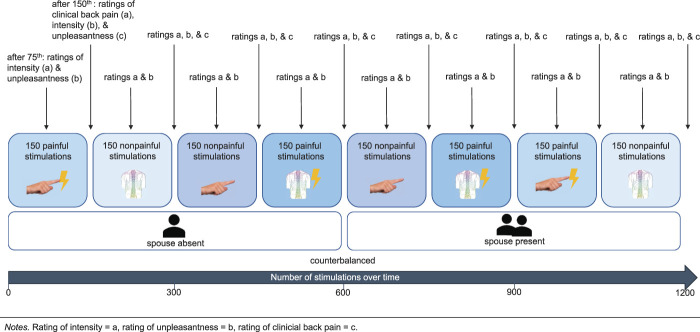
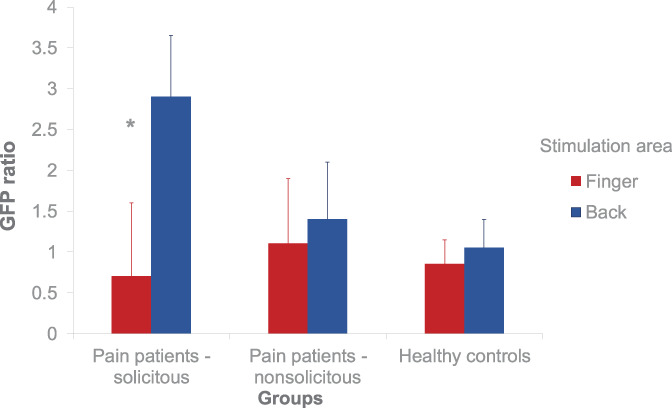
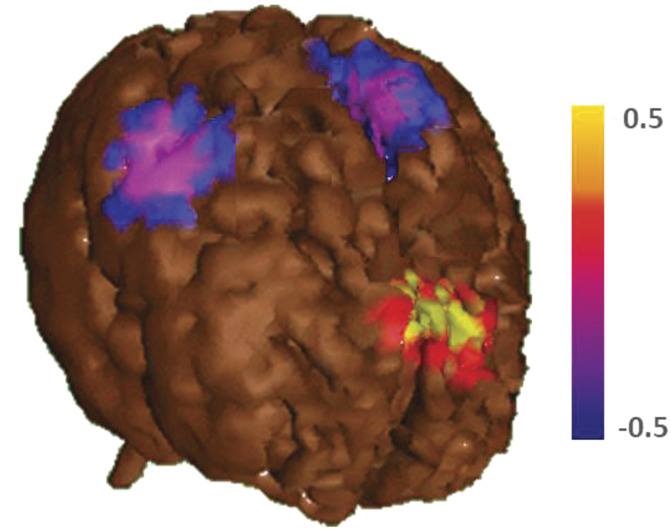
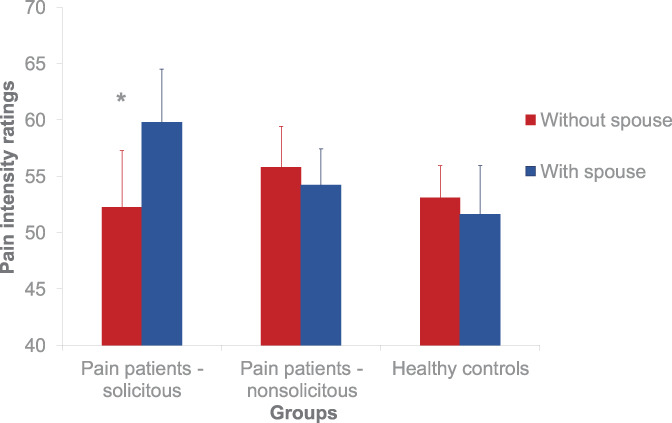
The experience of pain and pain behaviors is not only determined by physiological but also psychosocial factors. In this context, the learning history of the individual and specifically operant reinforcement related to spouse responses might play an important role. We investigated the effect of a solicitous and habitually pain-reinforcing spouse for the processing of pain in patients with chronic pain. Using multichannel electroencephalography, pain behaviors, and self-reports of pain, we examined 20 patients with chronic back pain (10 with solicitous and 10 with nonsolicitous spouses) and 10 matched healthy controls. The participants received a series of painful and nonpainful electrical stimuli applied to the site of pain (back) and a control area (finger) in the presence vs absence of the spouse. The global field power of the electroencephalogram with a focus in the frontal region was enhanced in patients with chronic back pain who had a solicitous spouse compared to those with a nonsolicitous spouse and the healthy controls. This was specific for the painful stimulation at the back and occurred only in the presence but not the absence of the spouse. Pain ratings of intensity and unpleasantness were also higher in the patients with solicitous spouses when the spouse was present during painful stimulation. These data suggest that significant other responses indicative of operant reinforcement may have a direct effect on the cerebral processing of pain and related pain perception.
Overview
The claims and statistics of this paper haven’t been checked yet.
Run the check — free, no account needed. It reads the open-access text and checks the sources it cites.
Integrity signals
Registry
Cites
Statistics
Figures
Verification
Claims the paper makes
The claims and statistics of this paper haven’t been checked yet.
Run the check — free, no account needed. It reads the open-access text and checks the sources it cites.
Claims other papers make about this one
Each is checked against this paper’s own text: does it say what the citing paper says it does?
The cited source says what the claim attributes to it.
In the citing paper
“and that therapy outcomes can be improved if therapy is addressed to both partners [35, 36].”
From Endometriosis: patient–doctor communication and psychological counselling (2023) · cites this paper as [35]
Self-check
Percentages, sums and reported differences re-computed from the paper’s own numbers.
The self-check needs the paper’s full text.
Citations
Cites
Empathy for Pain Involves the Affective but not Sensory Components of Pain
Singer, T., Seymour, B., O'Doherty, J., Kaube, H., Dolan, R. J., & Frith, C. D. (2004) · Science · doi:10.1126/science.1093535 · Cited by 3,929 · cited 2×
“These data are, however, in accordance with findings by Singer et al.40 showing that empathy toward the pain experience of another person is also mediated by the anterior cingulate.”
ResultPain Affect Encoded in Human Anterior Cingulate But Not Somatosensory Cortex
Rainville, P., Duncan, G. H., Price, D. D., Carrier, B., & Bushnell, M. C. (1997) · Science · doi:10.1126/science.277.5328.968 · Cited by 2,629 · cited 2×
“In relation to brain activity, the location of the differential effects in the frontocentral region suggests that this activity may originate from the anterior cingulate and might thus be more related to affective than sensory-discriminative pain processing.(38) A detailed source analysis was not possible with this ty…”
BackgroundResultThe West Haven-Yale Multidimensional Pain Inventory (WHYMPI)
Kerns, R. D., Turk, D. C., & Rudy, T. E. (1985) · Pain · doi:10.1016/0304-3959(85)90004-1 · Cited by 2,128
Towards a theory of chronic pain
Apkarian, A. V., Baliki, M. N., & Geha, P. Y. (2009) · Progress in Neurobiology · doi:10.1016/j.pneurobio.2008.09.018 · Cited by 876
Hashmi, J. A., Baliki, M. N., Huang, L., Baria, A. T., Torbey, S., Hermann, K. M., Schnitzer, T. J., & Apkarian, A. V. (2013) · Brain · doi:10.1093/brain/awt211 · Cited by 762
Nociception, pain, negative moods, and behavior selection
Baliki, M. N., & Apkarian, A. V. (2015) · Neuron · doi:10.1016/j.neuron.2015.06.005 · Cited by 731
Extensive reorganization of primary somatosensory cortex in chronic back pain patients
Flor, H., Braun, C., Elbert, T. R., & Birbaumer, N. (1997) · Neuroscience Letters · doi:10.1016/s0304-3940(97)13441-3 · Cited by 715
Self-citationCortical Representation of the Sensory Dimension of Pain
Hofbauer, R. K., Rainville, P., Duncan, G. H., & Bushnell, M. C. (2001) · Journal of Neurophysiology · doi:10.1152/jn.2001.86.1.402 · Cited by 611 · cited 1×
“These data also are in accordance with studies that sought to separate emotional and sensory components of pain and found differential activity in either the anterior cingulate (unpleasantness focus) or the somatosensory cortex (sensory focus).(23,38)Notably, they support the hypothesis of a shift in functional brain…”
ResultTurner, J. A., Jensen, M. P., & Romano, J. M. (2000) · Pain · doi:10.1016/s0304-3959(99)00259-6 · Cited by 487
Attachment figures activate a safety signal-related neural region and reduce pain experience
Eisenberger, N. I., Master, S. L., Inagaki, T. K., Taylor, S. E., Shirinyan, D., Lieberman, M. D., & Naliboff, B. D. (2011) · Proceedings of the National Academy of Sciences · doi:10.1073/pnas.1108239108 · Cited by 471
Brain-to-brain coupling during handholding is associated with pain reduction
Goldstein, P., Weissman-Fogel, I., Dumas, G., & Shamay-Tsoory, S. G. (2018) · Proceedings of the National Academy of Sciences · doi:10.1073/pnas.1703643115 · Cited by 311
Assessment of pain-related cognitions in chronic pain patients
Flor, H., Behle, D. J., & Birbaumer, N. (1993) · Behaviour Research and Therapy · doi:10.1016/0005-7967(93)90044-u · Cited by 302
Self-citationThe role of spouse reinforcement, perceived pain, and activity levels of chronic pain patients
Flor, H., Kerns, R. D., & Turk, D. C. (1987) · Journal of Psychosomatic Research · doi:10.1016/0022-3999(87)90082-1 · Cited by 281
Self-citationLeonard, M. T., Cano, A., & Johansen, A. B. (2006) · The Journal of Pain · doi:10.1016/j.jpain.2006.01.442 · Cited by 259
Zur Anwendbarkeit des West Haven-Yale Multidimensional Pain Inventory im deutschen Sprachraum
Flor, H., Rudy, T. E., Birbaumer, N., Streit, B., & Schugens, M. M. (1990) · Der Schmerz · doi:10.1007/bf02527839 · Cited by 249
Self-citationThe intracutaneous stimulus: a new pain model for algesimetric studies.
Bromm, B., & Meier, W. (1984) · PubMed · Cited by 220
The role of operant conditioning in chronic pain: an experimental investigation
Flor, H., Knost, B., & Birbaumer, N. (2002) · Pain · doi:10.1016/s0304-3959(01)00385-2 · Cited by 193
Self-citationFear in the context of pain: Lessons learned from 100 years of fear conditioning research
Meulders, A. (2020) · Behaviour Research and Therapy · doi:10.1016/j.brat.2020.103635 · Cited by 191
Thieme, K., Flor, H., & Turk, D. C. (2006) · Arthritis Research & Therapy · doi:10.1186/ar2010 · Cited by 167 · cited 1×
“Basedon this, therapy aims to sensitively analyze the couple’s interaction behavior, develop alternatives and train the partner to distract the patient from the pain, to reinforce painincompatible behavior, and elaborate scenarios that improve relationship quality.(43) This study has several limitations.”
BackgroundSelf-citationHyperscanning neuroimaging technique to reveal the “two-in-one” system in social interactions
Koike, T., Tanabe, H. C., & Sadato, N. (2014) · Neuroscience Research · doi:10.1016/j.neures.2014.11.006 · Cited by 152
Flor, H., Turk, D. C., & Rudy, T. E. (1989) · Pain · doi:10.1016/0304-3959(89)90071-7 · Cited by 138
Self-citationConstruct Validity of the Short Forms of the Dyadic Adjustment Scale
Hunsley, J. D., Pinsent, C., Lefèbvre, M., James-Tanner, S., & Vito, D. (1995) · Family Relations · doi:10.2307/585520 · Cited by 129
Stroud, M. W., Thorn, B. E., Jensen, M. P., & Boothby, J. L. (2000) · Pain · doi:10.1016/s0304-3959(99)00226-2 · Cited by 118
Chronic Pain: An Integrated Biobehavioral Approach
Flor, H., & Turk, D. C. (2011) · Cited by 106
Self-citationThe pain behavior check list (PBCL): Factor structure and psychometric properties
Kerns, R. D., Haythornthwaite, J. A., Rosenberg, R. L., Southwick, S. M., Giller, E. L., & Jacob, M. C. (1991) · Journal of Behavioral Medicine · doi:10.1007/bf00846177 · Cited by 103
Flor, H., Breitenstein, C., Birbaumer, N., & Fürst, M. (1995) · Behavior Therapy · doi:10.1016/s0005-7894(05)80105-4 · Cited by 93
Self-citationObservational assessment of chronic pain patient-spouse behavioral interactions
Romano, J. M., Turner, J. A., Friedman, L. S., Bulcroft, R., Jensen, M. P., & Hops, H. (1991) · Behavior Therapy · doi:10.1016/s0005-7894(05)80345-4 · Cited by 76
Oxytocin enhances the pain‐relieving effects of social support in romantic couples
Kreuder, A., Wassermann, L., Wollseifer, M., Ditzen, B., Eckstein, M., Stoffel‐Wagner, B., Hennig, J., Hurlemann, R., & Scheele, D. (2019) · Human Brain Mapping · doi:10.1002/hbm.24368 · Cited by 62 · cited 1×
“A supportive spouse and affectionate touch can reduce pain intensity and brain responses to painful stimuli.(21,30,37) However, the influence of the spouse seems to differ depending on acute and chronic states of pain.”
BackgroundSelf-citationBurns, J. W., Peterson, K. M., Smith, D. A., Keefe, F. J., Porter, L. S., Schuster, E., & Kinner, E. M. (2013) · Pain · doi:10.1016/j.pain.2013.07.053 · Cited by 58
Miltner, W. H. R., Larbig, W., & Braun, C. (1988) · Pain · doi:10.1016/0304-3959(88)90228-x · Cited by 46
Steady-state analysis of somatosensory evoked potentials
Noss, R. S., Boles, C. D., & Yingling, C. D. (1996) · Electroencephalography and Clinical Neurophysiology/Evoked Potentials Section · doi:10.1016/0168-5597(96)96011-6 · Cited by 39
Spousal criticism and hostility in response to pain: what is the alternative?
Caño, A., & Tankha, H. (2017) · Pain · doi:10.1097/j.pain.0000000000001045 · Cited by 37
Treating Relationship Distress and Psychopathology in Couples: A Cognitive-Behavioural Approach
Baucom, D. H., Fischer, M. S., Corrie, S., Worrell, M., & Boeding, S. E. (2019) · Cited by 26
Oxytocin and positive couple interaction affect the perception of wound pain in everyday life
Pfeifer, A.-C., Schröder‐Pfeifer, P., Schneider, E., Schick, M., Heinrichs, M., Bodenmann, G., Ehlert, U., Herpertz, S. C., Läuchli, S., Eckstein, M., et al. (2020) · Molecular Pain · doi:10.1177/1744806920918692 · Cited by 25
Self-citationGrinevich, V., & Charlet, A. (2017) · Pain · doi:10.1097/j.pain.0000000000001006 · Cited by 24
How Significant is the Significant Other in Patient Coping in Chronic Pain?
Newton-John, T. R. O. (2013) · Pain Management · doi:10.2217/pmt.13.52 · Cited by 23
Dowman, R., & Rosenfeld, J. P. (1985) · Brain Research · doi:10.1016/0006-8993(85)91573-2 · Cited by 15
“Now I have hope”: Rebuilding relationships affected by chronic pain.
Tankha, H., Caño, A., & Dillaway, H. E. (2020) · Families Systems & Health · doi:10.1037/fsh0000472 · Cited by 15
Knost, B., Flor, H., & Birbaumer, N. (1999) · Zeitschrift für Klinische Psychologie und Psychotherapie · doi:10.1026//0084-5345.28.4.242 · Cited by 11
Self-citationBurns, J. W., Gerhart, J. I., Post, K. M., Smith, D. A., Porter, L. S., Buvanendran, A., Fras, A. M., & Keefe, F. J. (2018) · Journal of Pain · doi:10.1016/j.jpain.2018.05.007 · Cited by 10
Nah, S., Martire, L. M., & Zhaoyang, R. (2020) · Journal of Aging and Health · doi:10.1177/0898264320919631 · Cited by 9
Wirick, D. M., & Teufel‐Prida, L. A. (2018) · The Family Journal · doi:10.1177/1066480718756845 · Cited by 4
Cited by
Sorted by citations
Löffler, M., Levine, S. M., Usai, K., Desch, S., Mišić, M., Nees, F., & Flor, H. (2022) · Cell Reports Medicine · doi:10.1016/j.xcrm.2022.100677 · Cited by 45
Self-citationThe impact of the social context on the development of secondary hyperalgesia: an experimental study
Jaltare, K. P., Vanderijst, L., Karos, K., & Torta, D. M. E. (2023) · Pain · doi:10.1097/j.pain.0000000000002971 · Cited by 16
Naka, A., Kotz, C., Gutmann, E., Pramhas, S., Schukro, R. P., Ristl, R., Schuhfried, O., Crevenna, R., & Sator, S. (2023) · Medicina · doi:10.3390/medicina59050823 · Cited by 13
Differential effects of everyday-life social support on chronic pain
Weiss, M. H., Jachnik, A., Lampe, E. C., Gründahl, M., Harnik, M. A., Sommer, C., Rittner, H. L., & Hein, G. (2024) · BMC Neurology · doi:10.1186/s12883-024-03792-z · Cited by 11
Endometriosis: patient–doctor communication and psychological counselling
Wischmann, T., & Ditzen, B. (2023) · Archives of Gynecology and Obstetrics · doi:10.1007/s00404-023-07292-2 · Cited by 11
Self-citation
Metadata
- Authors
- Nees, F., Ditzen, B., & Flor, H.
- Affiliations
- Heidelberg University (DE)
- University Hospital Heidelberg (DE)
- Corresponding author
- Flor, Herta
- Venue
- Pain
- Published
- 2021-12-15
- Volume
- 163
- Issue
- 9
- Pages
- e1006-e1012
- ISSN
- 0304-3959 (ISSN-L)
- 1872-6623
- PMC
- PMC9393802
- OpenAlex
- W4200598987
- Cited by
- 18
- References
- 41
- Citations by year
- 2026: 2 · 2025: 4 · 2024: 5 · 2023: 6 · 2022: 1
- FWCI
- 1.89
- Type
- journal article
- Language
- en
- Open access
- hybrid
- doi.org
- Licence
- Locations
- Pain (publishedVersion, cc-by-nc-nd)
- PubMed Central (publishedVersion, cc-by-nc-nd)
- PubMed (publishedVersion)
- Topics
- Health Sciences › Medicine › Physiology (medical) › Pain Mechanisms and Treatments
- Health Sciences › Health Professions › Physical Therapy, Sports Therapy and Rehabilitation › Musculoskeletal pain and rehabilitation
- Life Sciences › Neuroscience › Cognitive Neuroscience › Pain Management and Placebo Effect
- Keywords
- chronic back pain, shared pain, operant reinforcement, pain processing, pain perception, psychosocial factors in pain, pain behavior
- MeSH terms
- Back Pain, Central Nervous System, Humans, Pain Measurement, Spouses, Chronic Pain
About these checks
Registry, retraction, Cites and statistics results are computed, not judged, with one exception: a printed reference that no index lists is read once by a model before it counts as a citation error. Claims are extracted by a model and kept only when their quote appears verbatim in the text; each cited source is then checked, with a model’s help, for whether it says what the claim relies on. Those verdicts can be wrong — read the claim’s quote and the cited source before relying on one.
Statistics and arithmetic are recomputed, not judged.
Confidence bands are shown only for fields calibrated on our annotated test set. None is calibrated yet, so no band is shown.
What counts as a claim ›How we measure confidence ›How we check this ›
Are you an author, or do you see a problem with this page? Request a review
