

ChatGPT and other artificial intelligence applications speed up scientific writing
Open accessThe DOI matches its Crossref record; 15 of the 15 references it cites were found in a registry or an index.
Abstract
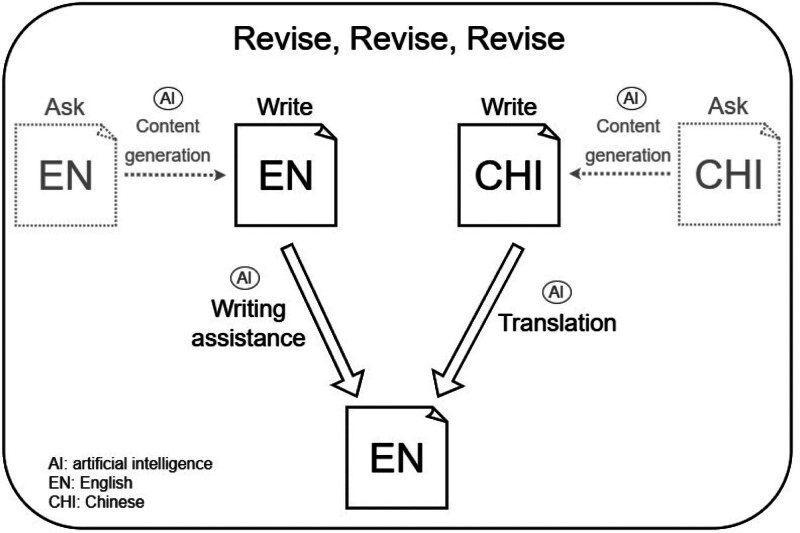
The launch of ChatGPT (Chat Generative Pre-trained Transformer, OpenAI Limited Partnership, San Francisco, USA) on November 30, 2022, has sparked a wave of enthusiasm.1,2 People from all walks of life are eager to experiment with this novel application and discussions are lively, especially in the education sector.3–5 In contrast, discussion of this topic in medical journals has lagged behind,6–9 and much of the discussion has focused on ghostwriting by ChatGPT, involving academic ethics, originality, and authorship.10–12 In fact, the use of artificial intelligence (AI) technology in texts has become increasingly mature in recent years,13 dramatically changing the way scientific writing works (Table 1). Table 1 - Examples of artificial intelligence applications in scientific writing Tool Web address (accessed on February 5, 2023) Writing assistance DeepL Write https://www.deepl.com/write Ludwig https://ludwig.guru/ Grammarly https://app.grammarly.com/ QuillBot https://quillbot.com/ Trinka https://www.trinka.ai/ Microsoft Editor https://www.microsoft.com/zh-tw/microsoft-365/microsoft -editor Translation DeepL Translator https://www.deepl.com/translator Google Translate https://translate.google.com/ Bing Translator https://www.bing.com/translator Reverso Translation https://www.reverso.net/text-translation Youdao Translate https://fanyi.youdao.com/ Baidu Translate https://fanyi.baidu.com/ Content generation ChatGPT https://chat.openai.com/ Copy.ai https://www.copy.ai/ Texta https://www.texta.ai/ ChatSonic https://writesonic.com/chat Writier https://writier.io/ Writerly https://writerly.ai/ English has been the dominant scientific language (lingua franca) for decades.14 It is undeniable that the vast majority of scientists who do not speak English as their mother tongue still have difficulty or are much less proficient in writing in English. Machine translation, especially natural language processing using neural networks and deep learning, can almost help overcome language barriers. The following demonstrates three AI-powered approaches to writing in English for native Chinese speakers (Fig. 1).Fig. 1: Use of artificial intelligence applications in scientific writing.The tools available now for writing assistance, particularly in English, go well beyond simple grammar, punctuation, and spelling checks. They can provide immediate synonym searches to suggest word choices, as well as paraphrasing to alter the tone and style of the text. Take as an example DeepL Write (DeepL GmbH, Cologne, Germany), the public beta version of which has been launched on January 17, 2023. The moment the user types a word, the software automatically suggests various synonyms or related terms. Once the user has written a few words, the software offers a number of additional word choices that can be used to complete the sentence. For an entire sentence, dozens of different ways to write that sentence will be available. AI provides contextualized examples for reference through the sentence search engine and natural language processing. In translation, AI has dramatically improved the accuracy of machine translation in recent years, with DeepL Translator (DeepL GmbH) being probably the leader.15 DeepL Translator uses an algorithm called a convolutional neural network in deep learning. In August 2017, DeepL Translator launched the free online translation service. By the end of 2022, it has supported 29 languages, with Chinese in March 2020. A variety of comparable products are available on the internet. Users can paste the Chinese text into various translation tools, compare the results, and choose the right one. More importantly, try to rewrite the original Chinese text repeatedly so that the translation software can understand it and then provide appropriate results. The use of AI to write scientific papers is clearly unethical, and its accuracy is currently in doubt. Generally speaking, writing is only a small part of the overall research. The core of the research should be the idea together with its results. In addition, science is based on previous research and citation is very important. Currently, AI content generation tools are not yet able to automatically provide correct citing sources. There is no denying that for many people, writing is not easy. ChatGPT and other AI-powered content generation tools can write various versions of text in a few seconds, perhaps inspiring the authors to overcome the writer’s block. Regarding the role of AI in scientific writing, we should bravely embrace the new world with an open mind. Physicians do not need to understand the physics of computed tomography and magnetic resonance imaging in detail, but only how to interpret the images. Researchers do not need to understand the mathematical principles underlying statistical models; instead, they must understand how to apply statistical formulae. Similarly, scientists do not need to be embarrassed about not knowing AI algorithms; rather, they shou
Overview
The claims and statistics of this paper haven’t been checked yet.
Free: it reads the open-access text and checks the first 5 claims that cite a source we can check. Create a free account to check every claim.
Integrity signals
Registry
Cites
Statistics
Figures
Verification
Claims the paper makes
The claims and statistics of this paper haven’t been checked yet.
Free: it reads the open-access text and checks the first 5 claims that cite a source we can check. Create a free account to check every claim.
Claims other papers make about this one
Each is checked against this paper’s own text: does it say what the citing paper says it does?
The source backs part of the claim, not all of it — or backs it for a different population, condition or comparison.
In the citing paper
“Fifth, the risk of research fraud (e.g., ghostwriting, falsified or fake research) involving ChatGPT should be considered seriously [23,37,38,66,72,79]”
From ChatGPT Utility in Healthcare Education, Research, and Practice: Systematic Review on the Promising Perspectives and Valid Concerns (2023) · cites this paper as [23]
Experimental — accuracy not yet measuredThe source backs part of the claim, not all of it — or backs it for a different population, condition or comparison.
In the citing paper
“Additionally, learners can expedite their writing development as AI tools help them identify and rectify grammatical and lexical errors, while also suggesting alternative sentence structures to enhance the overall writing quality and structure (Zhao, 2022; Chen, 2023; Salvagno et al., 2023).”
From Enhancing academic writing skills and motivation: assessing the efficacy of ChatGPT in AI-assisted language learning for EFL students (2023) · cites this paper as Chen, 2023
Experimental — accuracy not yet measuredThe source backs part of the claim, not all of it — or backs it for a different population, condition or comparison.
In the citing paper
“In particular, differences between domestic and international students are likely to be significant, as international students often face unique challenges in the learning process and have reported viewing tools such as ChatGPT as valuable for overcoming language barriers and accessing personalised academic support (Chen 2023).”
From Widely used but barely trusted: understanding student perceptions on the use of generative AI in higher education (2025) · cites this paper as Chen 2023
Experimental — accuracy not yet measuredThe source backs part of the claim, not all of it — or backs it for a different population, condition or comparison.
In the citing paper
“Moreover, the utility of ChatGPT extends to involve an improvement in language and a better ability to express and communicate research ideas and results, ultimately speeding up the publication process with the faster availability of research results [23,25,29,40,48,63,66].”
From ChatGPT Utility in Healthcare Education, Research, and Practice: Systematic Review on the Promising Perspectives and Valid Concerns (2023) · cites this paper as [23]
Experimental — accuracy not yet measuredThe source backs part of the claim, not all of it — or backs it for a different population, condition or comparison.
In the citing paper
“Second, several records mentioned the current problems regarding citation inaccuracies, insufficient references, and ChatGPT referencing to non-existent sources [23,26].”
From ChatGPT Utility in Healthcare Education, Research, and Practice: Systematic Review on the Promising Perspectives and Valid Concerns (2023) · cites this paper as [23]
Experimental — accuracy not yet measured
3 more claims about this paper
Create a free account to see every claim other papers make about this one.
Self-check
Percentages, sums and reported differences re-computed from the paper’s own numbers.
The self-check needs the paper’s full text.
Citations
Cites
ChatGPT and other large language models are double-edged swords
Shen, Y., Heacock, L., Elias, J., Hentel, K. D., Reig, B., Shih, G., & Moy, L. (2023) · Radiology · doi:10.1148/radiol.230163 · Cited by 1,008
ChatGPT listed as author on research papers: many scientists disapprove
Stokel-Walker, C. (2023) · Nature · doi:10.1038/d41586-023-00107-z · Cited by 868
Abstracts written by ChatGPT fool scientists
Else, H. (2023) · Nature · doi:10.1038/d41586-023-00056-7 · Cited by 611
A Conversation on Artificial Intelligence, Chatbots, and Plagiarism in Higher Education
King, M. R., & chatGPT (2023) · Cellular and Molecular Bioengineering · doi:10.1007/s12195-022-00754-8 · Cited by 602
Open artificial intelligence platforms in nursing education: Tools for academic progress or abuse?
O’Connor, S., & ChatGPT (2023) · Nurse Education in Practice · doi:10.1016/j.nepr.2022.103537 · Cited by 585
AI bot ChatGPT writes smart essays — should professors worry?
Stokel-Walker, C. (2022) · Nature · doi:10.1038/d41586-022-04397-7 · Cited by 543
Flanagin, A., Bibbins-Domingo, K., Berkwits, M., & Christiansen, S. L. (2023) · JAMA · doi:10.1001/jama.2023.1344 · Cited by 420
ChatGPT: Evolution or revolution?
Gordijn, B., & Have, H. T. (2023) · Medicine, Health Care and Philosophy · doi:10.1007/s11019-023-10136-0 · Cited by 317
The Future of AI in Medicine: A Perspective from a Chatbot
King, M. R. (2023) · Annals of Biomedical Engineering · doi:10.1007/s10439-022-03121-w · Cited by 299
Baethge, C. (2008) · Deutsches Ärzteblatt international · doi:10.3238/arztebl.2008.0037 · Cited by 108
Cited by
Items 201–244 of 244
EPIDEMIOLOGY OF AEROMONAS HYDROPHILA STOOL ISOLATES IN A PEDIATRIC POPULATION
Leggiadro, R. J., & Szabo, K. (1986) · The Pediatric Infectious Disease Journal · doi:10.1097/00006454-198607000-00033
Нормы времени на противоэпизоотические мероприятия в Республике Чад
Араб, М. М. (2012) · Ученые записки Казанской государственной академии ветеринарной медицины им. Н.Э. Баумана
Marín-Castañeda, L. A., Chejfec‐Ciociano, J. M., Verhoeven, V., Baumgärtner, C., Fijačko, N., Štiglic, G., Gosak, L., Arnaout, M. M., Manohar, N., Prasad, S. S., et al. (2023) · doi:10.2196/preprints.49419
Jose, E. M. K., & Kushwaha, B. P. (2023) · SSRN Electronic Journal · doi:10.2139/ssrn.4520537
Ehrett, C., Hegde, S., André, K., Liu, D., & Wilson, T. (2023) · doi:10.2196/preprints.51433
Enhancing English Students’ Writing Skills with Technology Tools: A Qualitative Study
Dewi, R. S., Hidayat, D. N., & Zulfa, S. (2023) · International Conference on Cyber and IT Service Management (CITSM) · doi:10.1109/citsm60085.2023.10455378
“Students can develop their ideas through writing, which requires genuine and precise content and form [30].”
BackgroundThe Role of ChatGPT in Exploring Science and Its Applications: A Case Study at the “Citizen” Program
Nepal, T. K. (2024) · Asian Journal of Research in Computer Science · doi:10.9734/ajrcos/2024/v17i5446 · Cited by 1
Alhamadani, A., Althubiti, K., Sarkar, S., He, J., Alkulaib, L., Behal, S., Khan, M. H., & Lu, C. (2023) · IEEE/ACM International Conference on Advances in Social Networks Analysis and Mining (ASONAM) · doi:10.1145/3625007.3632331 · Cited by 3
PLUGIN CHATGPT: MITRA DALAM PENELITIAN
Rozady, M. P. N., & Koten, Y. P. K. (2024) · JATI (Jurnal Mahasiswa Teknik Informatika) · doi:10.36040/jati.v8i1.9298 · Cited by 1
“…permasalahan terkini mengenai ketidakakuratan kutipan, referensi yang tidak mencukupi, dan tidak ada sumber dari referensi yang diberikan ChatGpt [ 23 ,24 ]. b. ChatGPT akan memberikan jawaban yang berbeda-beda sesuai inputan teks, respon yang berbeda-beda mungkin dihasilkan berdasarkan…”
BackgroundIs Artificial Intelligence against/for Better Ethical Scientific Research?
Yaşar, H., & Karagücük, V. (2024) · Gaziantep Islam Science and Technology University · doi:10.46871/eams.1455756 · Cited by 1
Liu, C., & Wang, P. (2024) · Journal of the Chinese Medical Association · doi:10.1097/jcma.0000000000001130
Qin, G. (2024) · International Conference on Data Science and Information System (ICDSIS) · doi:10.1109/icdsis61070.2024.10594480
“Chen T J took ChatGPT, a representative of artificial intelligence technology, as an example and believed that this product can perform translation work well by using neural network and deep learning for natural language processing [10].”
BackgroundAddressing emerging issues in entomology: 2023 student debates
Pickens, V., Maille, J. M., Pitt, W. J., Ellis, J. T., Salgado, S., Tims, K. M., Edwards, C.-C., Peavy, M., Williamson, Z., Musgrove, T. R. T., et al. (2024) · Journal of Insect Science · doi:10.1093/jisesa/ieae080
“Some LLM tools can translate text, aiding EFL researchers seeking to improve their publications in an English-dominated scientific community (Guo et al. 2022, Chen 2023, Ciaccio 2023, Zhao 2023).”
BackgroundA Comparative Study of Large Language Models in Explaining Intrinsically Disordered ProteinsPreprint
Gonzalez, D. T., Djulbegovic, M. B., Kim, C. K., Antonietti, M., Gameiro, G. R., & Uversky, V. N. (2024) · Qeios · doi:10.32388/5d952o
Design of ChatGPT Translation NER Model Fusing Dice Loss and Global Attention
Sun, H., & Du, Q. (2024) · International Conference on Frontiers of Artificial Intelligence and Machine Learning (FAIML) · doi:10.1145/3653644.3658513
“…ChatGPT Chinese translation as the research object, and the Chinese named entity recognition task is investigated, using BIOES annotation method to label the dataset labels, and preprocessing operations on the dataset to ensure that only one entity exists in the sentence is correctly labeled [6-7].”
Comparative Analysis of AI-Generated Research Content: Evaluating ChatGPT and Google GeminiPreprint
Akhoon, I. U. H., Khan, M. Y., & Bhat, T. A. (2024) · Research Square · doi:10.21203/rs.3.rs-5265799/v1 · Cited by 4
A Comparative Analysis of ChatGPT and AI-Powered Research Tools for Scientific Writing and Research
Hamad, Z. T., Laouar, M. R., & Yaccoub, M. H. D. (2024) · Lecture notes in networks and systems · doi:10.1007/978-3-031-71429-0_19 · Cited by 2
Intelligent Translation Platform Based on Neural Network Algorithms
Xin, Y. (2025) · Lecture notes on data engineering and communications technologies · doi:10.1007/978-981-96-0211-7_47
Yaseen, K. N., & Dweikat, K. (2025) · Advances in computational intelligence and robotics book series · doi:10.4018/979-8-3693-9811-1.ch012
An Exploratory Study of the ChatGPT Use of Vietnamese Graduate Students in a Research Writing Course
Ho, P. V. P., & Nguyen, N. H. (2025) · Advances in computational intelligence and robotics book series · doi:10.4018/979-8-3693-7260-9.ch010 · Cited by 1
YÜCEOL, N., Urfa, A. M., & Akın, M. (2025) · Journal of Cultural Cognitive Science · doi:10.1007/s41809-025-00180-y
“In particular, AI-powered tools like ChatGPT help researchers manage challenges such as writer’s block and extend beyond basic spelling and grammar correction by offering support that improves overall writing fluency and productivity (Chen, 2023).”
Shishakly, R., Abukhait, R., & Khattak, M. N. (2025) · Lecture notes in networks and systems · doi:10.1007/978-3-032-00450-5_53 · Cited by 1
Artificial Intelligence in Healthcare: Roles, Challenges, and Disadvantages
Aknouch, A., Soussi, H., El-ouardi, Y., Belcadi, H., Aitouhanni, I., Dahbi, A., & Rachmoune, K. (2025) · IGI Global eBooks · doi:10.4018/979-8-3373-1992-6.ch008
AI-driven fuzzy requirement engineering for cybersecurity: integrating linguistic decision models
Ahmad, S., Arif, M., Ansari, M. A., & Nazim, M. (2025) · Iran Journal of Computer Science · doi:10.1007/s42044-025-00324-x · Cited by 2
A critique of qualitative accounting research in China
Dellaportas, S., Xue, Q., Li, J., Zhang, J., How, S.-M., Lu, X., Jiang, J., Zhang, Y., & Huang, K. (2025) · Meditari Accountancy Research · doi:10.1108/medar-05-2025-3048 · Cited by 1
Decision-making for technology-led transformation in research practices
Ulusoy, Ö. (2025) · AI & Society · doi:10.1007/s00146-025-02567-5
“These systems can generate summaries, suggest hypotheses, provide research ideas, and assist in drafting grant proposals and purpose statements (Chen 2023; Meyer et al. 2023).”
The Effect of Employing ChatGPT to Enhance the Searchability among Female Researchers
Owda, M. F. A., & Zaqout, Y. (2025) · Creative Education · doi:10.4236/ce.2025.169080
Unraveling the Ai2 Asta Scholarly Research Assistant Citation System
Orduña-Malea, E., & Lopezosa, C. (2025) · Revista Panamericana de Comunicación · doi:10.21555/rpc.v7i2.3675
“LLMs are being used in tasks such as writing support (Chen, 2023), literature synthesis (Zheng et al., 2023; Scherbakov, 2025; Silva and Wickra-maarachchi, 2025), data analysis (Nejjar et al., 2025), assistance in designing research techniques such as interviews or surveys (Jansen et al., 2023),…”
Shahbazi, Z., Mohammadkarimi, E., Yousefiazar, S., & Othman, K. (2025) · Journal of Digital Educational Technology · doi:10.30935/jdet/17480 · Cited by 1
“AI texts have some malignant disadvantages of which originality is the absolute weakness (Chen, 2023).”
InfluentialDinh, T. H., Nguyễn, H. N., Phạm, T. T. H., & Vũ, T. Y. (2025) · Tạp chí Khoa học Thương mại · doi:10.54404/jts.2025.208v.03
Inteligencia artificial y futuro editorial en el ámbito científico: una revisión narrativa
Vargas-Pancorbo, L., Andunce, P. M., & Reyes, E. L. C. (2026) · Espergesia · doi:10.18050/rev.espergesia.v12i1.4306
Utilizing Artificial Intelligence to create narrative literature reviews
del Giglio, A., & da Costa, M. U. P. (2026) · Einstein (São Paulo) · doi:10.31744/einstein_journal/2026rw1165 · Cited by 1
Alkahtany, S. M., Almalky, H. A., Albahouth, H. S., Almutairi, E. S., Alatyan, M. H., Almohaimede, A. A., Al-Maflehi, N. S., & Al‐Madi, E. M. (2026) · European Journal Of Dental Education · doi:10.1111/eje.70140
Ethical Use of ChatGPT and Critic-AI in Academic Writing and ResearchPreprint
Yaprak, Z. (2026) · SSRN Electronic Journal · doi:10.2139/ssrn.6539730
Investigating EFL Students’ Perception of AI- Powered Learning Assistance
Febianti, K., Yakob, R., & Pratama, Y. (2025) · Loquēla (Journal of Linguistics Literature and Education) · doi:10.61276/loqula.v3i2.85
“In the last few years, Artificial Intelligence (AI) has grown in prominence by offering diverse technological tools to facilitate academic writing, including QuillBot, DeepL, Google Translate, and ChatGPT (Chen, 2023) In the domain of learning languages, Xu et al. (2019) emphasize that AI can support specific language…”
Taç, C., Mesquita, A., Batista, J., & Soyer, B. B. (2026) · Springer proceedings in business and economics · doi:10.1007/978-3-032-09683-8_1
Hawanti, S., & Nugroho, G. I. (2026) · IJORER International Journal of Recent Educational Research · doi:10.46245/ijorer.v7i3.1423
“…the rise of technology-assisted learning has led students to increasingly rely on digital tools such as Quillbot, DeepL Translator, and ChatGPT to assist with paraphrasing, translation, and content generation, helping them refine their writing more efficiently (Perkins, 2023; Chen, 2023).”
Divya, T. J., & Alamelu, C. (2026) · Frontiers in Artificial Intelligence · doi:10.3389/frai.2026.1838463 · Cited by 1
“According to Chen (2023), the public beta version of DeepL Write (DeepL GmbH, Cologne, Germany), launched on January 17, 2023, suggests synonyms, completes partial phrases, and offers multiple full-sentence rewrites, all powered by contextualised examples via Natural Language Processing (NLP).”
CEVHER, T. Y., & Kayman, F. (2026) · Çukurova Üniversitesi Sosyal Bilimler Enstitüsü Dergisi · doi:10.35379/cusosbil.1696137
Sosyal Bilgiler Eğitiminde Yapay Zekâ Araçlarının Kullanımı
Ağalday, M. M., & YILDIZ, K. (2026) · Abant İzzet Baysal Üniversitesi Eğitim Fakültesi Dergisi · doi:10.17240/aibuefd.2026..-1682631
The effect of artificial intelligence on students’ writing performance: a meta-analysis
Wu, J., Chen, Q., Jiang, H., & Bai, X. (2026) · Reading and Writing · doi:10.1007/s11145-026-10884-4 · Cited by 2
Contemporary AI attitude scale research: a systematic mapping review and bibliometric analysis
Olpak, Y. Z. (2026) · Frontiers in Psychology · doi:10.3389/fpsyg.2026.1956889
“To maintain consistency throughout the screening and analysis process, and given the predominant role of English in international scientific communication (Chen, 2023), only articles published in English were considered.”
InfluentialMaryam, Z., Sanif, S. B., Rehman, A. U. R., Nawal, A., & Shoaib, M. (2026) · International Journal of Information and Learning Technology · doi:10.1108/ijilt-10-2024-0224
Metadata
- Authors
- Chen, T.-J.
- Affiliations
- National Chung Hsing University (TW)
- Corresponding author
- Chen, Tzeng-Ji
- ORCID
- Chen, Tzeng-Ji
- Venue
- Journal of the Chinese Medical Association
- Published
- 2023-02-14
- Volume
- 86
- Issue
- 4
- Pages
- 351-353
- ISSN
- 1726-4901 (ISSN-L)
- PMC
- PMC12755446
- OpenAlex
- W4320895630
- Semantic Scholar
- a799caac53cdab687d3748dea4b7106fe654a7e6
- Cited by
- 240
- References
- 15
- Citations by year
- 2026: 17 · 2025: 52 · 2024: 88 · 2023: 80
- Type
- journal article
- Language
- en
- Open access
- hybrid
- doi.org
- Licence
- Locations
- Journal of the Chinese Medical Association (publishedVersion, cc-by-nc-nd)
- PubMed Central (publishedVersion, cc-by-nc-nd)
- PubMed (publishedVersion)
- Topics
- Social Sciences › Library and Information Sciences › Academic Writing and Publishing
- Health Sciences › Medicine › Health Informatics › Artificial Intelligence in Healthcare and Education
- Social Sciences › Library and Information Sciences › Academic Publishing and Open Access
- Keywords
- ChatGPT, artificial intelligence in scientific writing, scientific writing, machine translation, writing assistance tools, paraphrase, ghostwriting, academic ethics, authorship, English as a lingua franca, AI-generated text, deep learning, natural language processing
- MeSH terms
- Artificial Intelligence, Writing, Mobile Applications
About these checks
Registry, retraction, Cites and statistics results are computed, not judged, with one exception: a printed reference that no index lists is read once by a model before it counts as a citation error. Claims are extracted by a model and kept only when their quote appears verbatim in the text; each cited source is then checked, with a model’s help, for whether it says what the claim relies on. Those verdicts can be wrong — read the claim’s quote and the cited source before relying on one.
Statistics and arithmetic are recomputed, not judged.
Confidence bands are shown only for fields calibrated on our annotated test set. None is calibrated yet, so no band is shown.
What counts as a claim ›How we measure confidence ›How we check this ›
Are you an author, or do you see a problem with this page? Request a review
Data sources
Bibliographic data: Semantic Scholar, OpenAlex, Crossref.
Contains information from the Semantic Scholar Academic Graph Datasets, made available under the ODC Attribution License (ODC-BY 1.0).
Semantic Scholar’s data is described in: Kinney, R., et al. (2023). The Semantic Scholar Open Data Platform. arXiv:2301.10140.
