

Gastrointestinal function and nutritional interventions in septic shock
Open accessThe DOI matches its Crossref record; 89 of the 93 references it cites were found in a registry or an index; 21 of the 65 sources its claims cite were checked for support.
Abstract
PURPOSE OF REVIEW: Gastrointestinal (GI) dysfunction significantly impacts patient outcomes in septic shock, complicating clinical management due to its central role in systemic inflammation, barrier integrity, and nutrient assimilation. This review summarizes the evolving understanding of GI dysfunction during septic shock and provides an updated framework for clinical management. RECENT FINDINGS: New insights from recent studies focus on individualized nutritional strategies over standardized calorie-driven targets, highlighting risks associated with aggressive enteral nutrition, such as exacerbation of gut ischemia and bowel distension, and microbial dysbiosis. Maintaining splanchnic perfusion, monitoring GI dysfunction with standardized tools, and advancing nutritional support progressively based on patient-specific gastrointestinal tolerance are current strategies. Novel adjunctive therapies targeting gut permeability and microbiome restoration have been proposed, yet robust clinical data remain limited. SUMMARY: Clinical management should prioritize hemodynamic stabilization and organ support rather than immediately targeting any nutritional goals. Monitoring GI function systematically and tailoring nutritional interventions may prevent complications and support recovery. Future research should validate monitoring tools, refine individual patient assessment, and evaluate novel therapeutic interventions to improve patient-centered outcomes in septic shock.
Overview
CoChat Summary
TL;DR
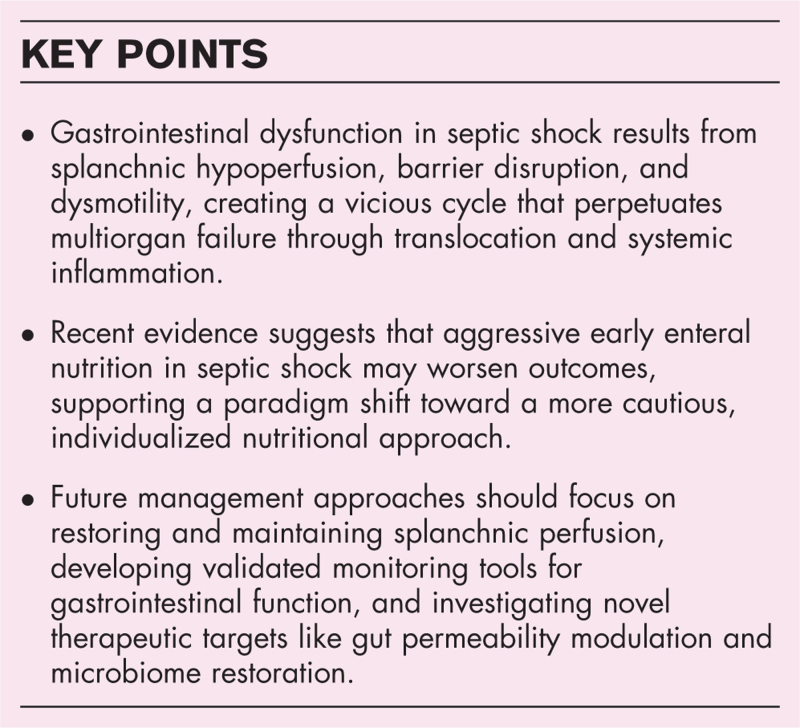
This review summarizes how gastrointestinal dysfunction in septic shock is driven by splanchnic hypoperfusion, barrier disruption, and dysmotility, with bidirectional worsening of multiorgan dysfunction. It argues that management should prioritize hemodynamic stabilization and gut perfusion before individualized, progressive nutritional support rather than aggressive calorie targets.
Key findings
- GI dysfunction in septic shock is common and bidirectionally linked with MODS: hypoperfusion and ischemia-reperfusion loosen tight junctions, permit endotoxin/LPS translocation, and amplify systemic inflammation.
- In a small ICU study, patients with septic shock (n = 30) had higher and increasing AGI grades during the first 10 days versus sepsis without shock (n = 28); a recent systematic review associated sepsis and vasoactive drugs with more enteral feeding intolerance (EFI).
- Nutrition trials included 22–49% sepsis patients (EPaNIC, PRECISe, EFFORT Protein, PERMIT, TARGET); septic shock nutrition trials including vasopressor-treated patients had around 60% septic shock and roughly 85% on antibiotics at baseline. Nutrirea-2 reported more vomiting, diarrhea, mesenteric ischemia, and Ogilvie’s syndrome with full EN vs full PN; Nutrirea-3 found more of these symptoms except Ogilvie’s with high- vs low-dose nutrition.
- ESPEN recommends starting EN in hemodynamically stable septic ICU patients, including those on vasopressors/inotropes, once perfusion targets are reached, with low-dose EN advanced by GI tolerance; MAP of at least 65 mmHg is suggested. Protein targets differ: up to 1.3 g/kg/day in European guidelines vs 1.2–2.0 g/kg/day in American guidelines.
Methods
- Narrative review of current evidence on GI function, monitoring, management, and nutritional interventions in septic shock; no primary data collection.
- Synthesizes experimental models, a small clinical study, a systematic review, randomized nutrition trials, guidelines, and a consensus process; no systematic search or meta-analysis is described.
- Main analysis is qualitative, proposing a structured clinical pathway (Fig. 2) that prioritizes hemodynamic stabilization and gut perfusion before gradually initiating nutrition under GI monitoring.
Limitations
- Stated: no larger studies assessing GI dysfunction specifically in septic shock; lack of definitions and monitoring tools, no gold standard for GI function, and EFI is not uniformly defined and often refers only to upper GI/gastroparesis.
- Stated: robust clinical data for novel therapies targeting gut permeability and microbiome restoration remain limited; evidence for pre-, pro-, synbiotics, fecal transplantation, and selective digestive decontamination in critically ill/septic shock patients is limited or controversial.
- Evident: as a narrative review, it does not describe a systematic search or formal quality appraisal, and many supporting findings come from animal models, small studies, or mixed critically ill populations rather than septic shock-specific trials.
Model-written summary. Check it against the paper before relying on it.
Integrity signals
Registry
Cites
Statistics
Figures


Verification
Claims the paper makes
15 Valid · 0 Not valid · 35 Not checked · 9 Own results and interpretations
Every source the paper cites for this claim was checked and supports it.
In the paper
“Thus, GI dysfunction has a bidirectional relationship with other organ dysfunctions/failures, creating a cycle in which worsening gut function promotes further systemic deterioration (Fig. 1) [22].”
§ Gastrointestinal function and nutritional interventions in septic shock > INTERACTIONS BETWEEN GASTROINTESTINAL AND ORGANS DURING SEPTIC SHOCK
What the sources say
- Supportedcites [22] Meng M Klingensmith NJ Coopersmith CM. New insights into the gut as the driver of critical illness and organ failure. Curr Opin Crit Care 2017; 23: 143– 148. 28092310 PMC5373099 source
The “Cross-talk between gut and other distant organs” section (page not provided) describes bilateral gut–lung effects and a gut–kidney cycle: gut barrier dysfunction triggers inflammation that worsens acute kidney injury. The Conclusions also state that gut dysregulation can drive and propagate distant organ dysfunction. (LLM, conf=0.93)
states a cause- Asserted: passes — The authors put it forward as true.
- Checkable: passes — It can be checked against evidence.
- Load-bearing: passes — The paper’s conclusions depend on it.
- Based: passes — The paper gives a reason why it holds.
- Supported
The cited sources support only part of this claim — read each source’s verdict below.
In the paper
“Gut barrier dysfunction during septic shock can lead to impaired cardiac function via endotoxemia [25].”
§ Gastrointestinal function and nutritional interventions in septic shock > INTERACTIONS BETWEEN GASTROINTESTINAL AND ORGANS DURING SEPTIC SHOCK
What the sources say
- Partly supportedcites [25] Nguyen M Gautier T Masson D. Endotoxemia in acute heart failure and cardiogenic shock: evidence, mechanisms and therapeutic options. J Clin Med 2023; 12: 2579. 37048662 PMC10094881 sourceExperimental — accuracy not yet measured
The Introduction describes gut barrier failure leading to endotoxemia, which can reduce cardiac performance. But it frames this pathway around acute heart failure and cardiogenic shock, not septic shock; the discussion of gut barrier function in Section 2.2 likewise concerns acute heart failure. The septic-shock passages address endotoxin treatments rather than establishing the claimed pathway in that setting. (LLM, conf=0.88)
plainstates a cause- Asserted: passes — The authors put it forward as true.
- Checkable: passes — It can be checked against evidence.
- Load-bearing: passes — The paper’s conclusions depend on it.
- Based: passes — The paper gives a reason why it holds.
- Partly supported
The cited sources support only part of this claim — read each source’s verdict below.
In the paper
“Gut-derived inflammatory mediators and endotoxins that enter the bloodstream may exacerbate renal injury [31,32].”
§ Gastrointestinal function and nutritional interventions in septic shock > INTERACTIONS BETWEEN GASTROINTESTINAL AND ORGANS DURING SEPTIC SHOCK
What the sources say
- Supportedcites [31] Xu Y Kong X Zhu Y. Contribution of gut microbiota toward renal function in sepsis. Front Microbiol 2022; 13: 985283. 36147845 PMC9486003 source
The “Gut microbiota has deleterious effects on the kidneys” section says gut microbiota alterations release inflammatory mediators that enter circulation and affect renal function. It also reports that gut-derived endotoxin amplifies intrarenal inflammation and that increased endotoxin release aggravates acute kidney injury. (LLM, conf=0.92)
- Partly supportedcites [32] Zhang J Ankawi G Sun J. Gut-kidney crosstalk in septic acute kidney injury. Crit Care 2018; 22: 117. 29724256 PMC5934860 sourceExperimental — accuracy not yet measured
The Background (page unavailable) says gut-derived bacteria and toxins may enter systemic circulation, amplify inflammation, and potentiate acute kidney injury. The paper also mentions intestinal endotoxin production, but does not specifically say that gut-derived inflammatory mediators enter the bloodstream; it describes systemic inflammation arising after gut-barrier disruption. (LLM, conf=0.78)
hedgedstates a possible cause- Asserted: passes — The authors put it forward as true.
- Checkable: passes — It can be checked against evidence.
- Load-bearing: unclear — It is unclear whether the paper’s conclusions depend on it.
- Based: passes — The paper gives a reason why it holds.
- Supported
The sources with a verdict support this claim; the rest weren’t checked yet, have no full text we could read, or their verdicts aren’t rated yet.
In the paper
“The inflammatory cascade stemming from GI-released bacteria and endotoxins can exacerbate pulmonary dysfunction, leading to acute respiratory distress syndrome (ARDS) [27], worsening pulmonary outcomes [28].”
§ Gastrointestinal function and nutritional interventions in septic shock > INTERACTIONS BETWEEN GASTROINTESTINAL AND ORGANS DURING SEPTIC SHOCK
What the sources say
- Supportedcites [27] Zhou X Liao Y. Gut-lung crosstalk in sepsis-induced acute lung injury. Front Microbiol 2021; 12: 779620. 35003009 PMC8733643 source
The Introduction says that sepsis-related gut barrier damage allows bacteria and endotoxins to cross the intestinal barrier, triggering inflammatory factors that promote lung injury. It also says this gut–lung interaction may potentiate ALI/ARDS. The claim’s qualified wording is consistent with those passages; no page numbers are provided in our copy. (LLM, conf=0.89)
- Not checked yetcites [28] Nath S Kitsios GD Bos LDJ. Gut-lung crosstalk during critical illness. Curr Opin Crit Care 2023; 29: 130– 137. 36762684 source
Checked before — its earlier verdict is held back until a new check runs.
plainstates a cause- Asserted: passes — The authors put it forward as true.
- Checkable: passes — It can be checked against evidence.
- Load-bearing: passes — The paper’s conclusions depend on it.
- Based: passes — The paper gives a reason why it holds.
- Supported
Every source the paper cites for this claim was checked and supports it.
In the paper
“Bacterial translocation results in the release of pathogen-associated molecular patterns (PAMPs) and damage-associated molecular patterns (DAMPs) into the liver, contributing to sepsis-induced liver injury [39].”
§ Gastrointestinal function and nutritional interventions in septic shock > INTERACTIONS BETWEEN GASTROINTESTINAL AND ORGANS DURING SEPTIC SHOCK
What the sources say
- Supportedcites [39] Zhang X Liu H Hashimoto K. The gut-liver axis in sepsis: interaction mechanisms and therapeutic potential. Crit Care 2022; 26: 213. 35831877 PMC9277879 source
The Conclusions state that sepsis-related gut barrier damage is accompanied by translocation of abundant PAMPs and DAMPs to the liver. The section “Effects of gut dysfunction on the liver” says these gut-derived molecules may trigger inflammation and hepatic dysfunction, supporting their contribution to sepsis-induced liver injury. (LLM, conf=0.91)
plainstates a cause- Asserted: passes — The authors put it forward as true.
- Checkable: passes — It can be checked against evidence.
- Load-bearing: unclear — It is unclear whether the paper’s conclusions depend on it.
- Based: passes — The paper gives a reason why it holds.
- Supported
23 more claims · 3 with their cited sources checked
Create a free account to see all 59 claims and to verify the 3 references still open.
- It may state two separate claims as one. 28
- Probably not a substantial claim. 5
- Borderline: one of the tests for a substantial claim is unclear. 2
Citations
Cites
Schuetz, P., Fehr, R., Baechli, V., Geiser, M., Deiss, M., Gomes, F., Kutz, A., Tribolet, P., Bregenzer, T., Braun, N., et al. (2019) · The Lancet · doi:10.1016/s0140-6736(18)32776-4 · Cited by 910
Bauer, M., Gerlach, H., Vogelmann, T., Preissing, F., Stiefel, J., & Adam, D. (2020) · Critical Care · doi:10.1186/s13054-020-02950-2 · Cited by 867
ESPEN practical and partially revised guideline: Clinical nutrition in the intensive care unit
Singer, P., Blaser, A. R., Berger, M. M., Calder, P. C., Casaer, M., Hiesmayr, M., Mayer, K., Montejo-Gonzalez, J. C., Pichard, C., Preiser, J.-C., et al. (2023) · Clinical Nutrition · doi:10.1016/j.clnu.2023.07.011 · Cited by 793
Self-citationCompher, C., Bingham, A. L., McCall, M., Patel, J., Rice, T. W., Braunschweig, C., & McKeever, L. (2022) · Journal of Parenteral and Enteral Nutrition · doi:10.1002/jpen.2267 · Cited by 747
Reignier, J., Boisramé-Helms, J., Brisard, L., Lascarrou, J.-B., Ait Hssain, A., Anguel, N., Argaud, L., Asehnoune, K., Asfar, P., Bellec, F., et al. (2018) · The Lancet · doi:10.1016/s0140-6736(17)32146-3 · Cited by 595
2023 Update on Sepsis and Septic Shock in Adult Patients: Management in the Emergency Department
Guarino, M., Perna, B., Cesaro, A. E., Maritati, M., Spampinato, M. D., Contini, C., & De Giorgio, R. (2023) · Journal of Clinical Medicine · doi:10.3390/jcm12093188 · Cited by 294
Reignier, J., Plantefeve, G., Mira, J.-P., Argaud, L., Asfar, P., Aissaoui, N., Badie, J., Botoc, N.-V., Brisard, L., Bui, H.-N., et al. (2023) · The Lancet Respiratory Medicine · doi:10.1016/s2213-2600(23)00092-9 · Cited by 270
Merker, M., Felder, M., Gueissaz, L., Bolliger, R., Tribolet, P., Kägi-Braun, N., Gomes, F., Hoess, C., Pavlicek, V., Bilz, S., et al. (2020) · JAMA Network Open · doi:10.1001/jamanetworkopen.2020.0663 · Cited by 262
Gut-liver crosstalk in sepsis-induced liver injury
Sun, J., Zhang, J., Wang, X., Ji, F., Ronco, C., Tian, J., & Yin, Y. (2020) · Critical Care · doi:10.1186/s13054-020-03327-1 · Cited by 246
Tumour Necrosis Factor Alpha in Intestinal Homeostasis and Gut Related Diseases
Ruder, B., Atreya, R., & Becker, C. (2019) · International Journal of Molecular Sciences · doi:10.3390/ijms20081887 · Cited by 228 · cited 1×
“1) [11], but may have deleterious effects on the GI tract by inducing enterocyte apoptosis [12,13].”
Cited by
Gut microbiota and sepsis: mechanisms, clinical correlations, and therapeutic prospects
Yu, J., & Liu, X. (2026) · Frontiers in Medicine · doi:10.3389/fmed.2026.1793041 · Cited by 4
Li, Z., & Zhang, G. Q. (2026) · European journal of medical research · doi:10.1186/s40001-026-04401-0 · Cited by 2
Acute gastrointestinal injury in children on ECMO: an analysis of risk factors
Hou, L., Li, J., Yan, B., & Wang, W. (2026) · Frontiers in Medicine · doi:10.3389/fmed.2026.1786101 · Cited by 1
Ferroptosis in vascular injury of critically ill patients: implications of gut microbiota regulation
Hou, H., Gao, J., Wang, M., Sun, M., Zhang, T., Tian, L., Yang, Z., Chen, M., Lian, G., & Fang, W. (2026) · Frontiers in Cellular and Infection Microbiology · doi:10.3389/fcimb.2026.1781905 · Cited by 1
Metadata
- Authors
- Bachmann, K. F., Cotoia, A., & Reintam Blaser, A.
- Affiliations
- University Hospital of Basel (CH)
- Ospedali Riuniti di Foggia (IT)
- Intensive Care Unit, Department of Acute Medicine, University Hospital Basel, Basel, Switzerland
- Corresponding author
- Bachmann, Kaspar F.
- Venue
- Current Opinion in Critical Care
- Published
- 2025-07-09
- Volume
- 31
- Issue
- 5
- Pages
- 599-607
- ISSN
- 1070-5295 (ISSN-L)
- 1531-7072
- PMC
- PMC12419005
- OpenAlex
- W4412156186
- Cited by
- 13
- References
- 93
- Citations by year
- 2026: 13
- FWCI
- 1.72
- Type
- journal article
- Language
- en
- Open access
- hybrid
- doi.org
- Locations
- Current Opinion in Critical Care (publishedVersion, cc-by)
- PubMed (publishedVersion)
- PubMed Central (publishedVersion, cc-by)
- Topics
- Health Sciences › Nursing › Nutrition and Dietetics › Clinical Nutrition and Gastroenterology
- Health Sciences › Medicine › Critical Care and Intensive Care Medicine › Sepsis Diagnosis and Treatment
- Health Sciences › Medicine › Surgery › Abdominal Surgery and Complications
- Keywords
- septic shock, gastrointestinal dysfunction, enteral nutrition, nutritional support, gut ischemia, bowel distension, dysbiosis, intestinal permeability, splanchnic perfusion, intestinal barrier integrity
- MeSH terms
- Critical Care, Enteral Nutrition, Gastrointestinal Diseases, Humans, Shock, Septic, Nutritional Support, Gastrointestinal Tract
About these checks
Registry, retraction, Cites and statistics results are computed, not judged, with one exception: a printed reference that no index lists is read once by a model before it counts as a citation error. Claims are extracted by a model and kept only when their quote appears verbatim in the text; each cited source is then checked, with a model’s help, for whether it says what the claim relies on. Those verdicts can be wrong — read the claim’s quote and the cited source before relying on one.
The claim verdicts this report counts are experimental: their accuracy is not yet measured.
A language model drew the claims from the paper on 2026-10-10, under version 3 of the claim definition (model deepseek-v4.1-flash, prompt extract-v3).
A second model labelled each claim on 2026-10-10 (model jev-1.13-20260917, definition revision gold-guideline-v0.2).
Cited sources are checked with a language model’s help (gpt-6-sol).
Statistics and arithmetic are recomputed, not judged.
Confidence bands are shown only for fields calibrated on our annotated test set. None is calibrated yet, so no band is shown.
What counts as a claim ›How we measure confidence ›How we check this ›
Are you an author, or do you see a problem with this page? Request a review
How to cite
Cite CoChat for the checks on this page, and the paper for its own findings.
- This page
- CoChat. (2026). Citation check: Gastrointestinal function and nutritional interventions in septic shock. https://app.cochat.ai/papers/10.1097/mcc.0000000000001302
- The paper
- Bachmann, K. F., Cotoia, A., & Reintam Blaser, A. (2025). Gastrointestinal function and nutritional interventions in septic shock. Current Opinion in Critical Care. https://doi.org/10.1097/mcc.0000000000001302
Data sources
Bibliographic data: Semantic Scholar, OpenAlex, Crossref.
Contains information from the Semantic Scholar Academic Graph Datasets, made available under the ODC Attribution License (ODC-BY 1.0).
Semantic Scholar’s data is described in: Kinney, R., et al. (2023). The Semantic Scholar Open Data Platform. arXiv:2301.10140.
