

With advancement in health technology comes great responsibility—ethical and safety considerations for using digital health technology: a narrative review
Open accessThe DOI matches its Crossref record; 55 of the 56 references it cites were found in a registry or an index.
Abstract
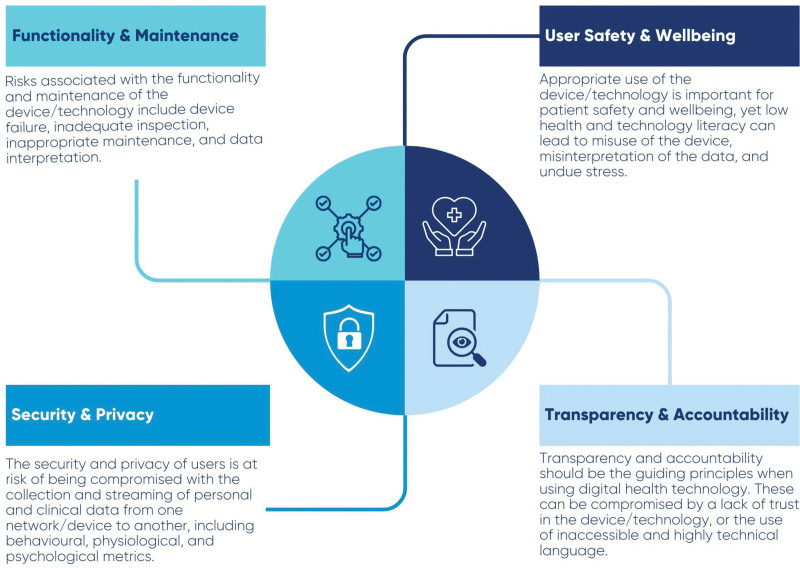
The accelerated adoption of digital health technologies in the last decades has raised important ethical and safety concerns. Despite the potency and usefulness of digital health technologies, addressing safety, and ethical considerations needs to take greater prominence. This review paper focuses on ethical and safety facets, including health technology-related risks, users’ safety and well-being risks, security and privacy concerns, and risks to transparency and diminished accountability associated with the utilization of digital health technologies. In order to maximize the potential of health technology benefits, awareness of safety risks, and ethical concerns should be increased, and the use of appropriate strategies and measures should be considered.
Overview
The claims and statistics of this paper haven’t been checked yet.
Free: it reads the open-access text and checks the first 5 claims that cite a source we can check. Create a free account to check every claim.
Integrity signals
Registry
Cites
Statistics
Figures
Verification
Claims the paper makes
The claims and statistics of this paper haven’t been checked yet.
Free: it reads the open-access text and checks the first 5 claims that cite a source we can check. Create a free account to check every claim.
Self-check
Percentages, sums and reported differences re-computed from the paper’s own numbers.
The self-check needs the paper’s full text.
Citations
Cites
Privacy and human behavior in the age of information
Acquisti, A., Brandimarte, L., & Loewenstein, G. (2015) · Science · doi:10.1126/science.aaa1465 · Cited by 1,879 · cited 1×
“[41] The leakage of these sensitive data generated by health technology is a major concern.”
BackgroundUnique in the Crowd: The privacy bounds of human mobility
de Montjoye, Y.-A., Hidalgo, C. A., Verleysen, M., & Blondel, V. D. (2013) · Scientific Reports · doi:10.1038/srep01376 · Cited by 1,645
Demirci, K., Akgönül, M., & Akpinar, A. (2015) · Journal of Behavioral Addictions · doi:10.1556/2006.4.2015.010 · Cited by 1,529 · cited 1×
“[30,31] Potentially, these psychological disorders can be similar with the use of many health technologies.”
BackgroundThe Rise of Consumer Health Wearables: Promises and Barriers
Piwek, L., Ellis, D. A., Andrews, S., & Joinson, A. (2016) · PLOS Medicine · doi:10.1371/journal.pmed.1001953 · Cited by 1,235
Kontos, E., Blake, K. D., Chou, W.-Y. S., & Prestin, A. (2014) · Journal of Medical Internet Research · doi:10.2196/jmir.3117 · Cited by 917
Personal Sensing: Understanding Mental Health Using Ubiquitous Sensors and Machine Learning
Mohr, D. C., Zhang, M., & Schueller, S. M. (2017) · Annual Review of Clinical Psychology · doi:10.1146/annurev-clinpsy-032816-044949 · Cited by 802 · cited 2×
“[51] 6 The immense numbers of digital health technology innovations used for health and wellness have tremendous potential to improve many aspects of health and health provision.”
BackgroundTorous, J., Kiang, M. V., Lorme, J., & Onnela, J.-P. (2016) · JMIR Mental Health · doi:10.2196/mental.5165 · Cited by 758 · cited 1×
“[36,37] Concerns are raised about privacy and confidentiality breaches, regarding the collection and storage of highly detailed data such as individuals’ health, communication, media consumption, and spatial location.”
BackgroundCell-phone addiction: a review
De-Sola Gutiérrez, J., Rodríguez de Fonseca, F., & Rubio, G. (2016) · Frontiers in Psychiatry · doi:10.3389/fpsyt.2016.00175 · Cited by 722
The invisible addiction: Cell-phone activities and addiction among male and female college students
Roberts, J., Yaya, L., & Manolis, C. (2014) · Journal of Behavioral Addictions · doi:10.1556/jba.3.2014.015 · Cited by 711 · cited 1×
“[29] For example, smartphone applications and internet abuse are associated with a range of psychological disorders, including sleep disturbance, anxiety, stress, and depression.”
BackgroundFleming, T., Bavin, L., Lucassen, M., Stasiak, K., Hopkins, S., & Merry, S. (2018) · Journal of Medical Internet Research · doi:10.2196/jmir.9275 · Cited by 670 · cited 1×
“[45,46] In many cases, the usability of technology in clinical settings to support patient management is not yet fully understood and needs to be thoroughly examined.”
BackgroundPredicting personality from patterns of behavior collected with smartphones
Stachl, C., Au, Q., Schoedel, R., Gosling, S. D., Harari, G. M., Buschek, D., Völkel, S. T., Schuwerk, T., Oldemeier, M., Ullmann, T., et al. (2020) · Proceedings of the National Academy of Sciences · doi:10.1073/pnas.1920484117 · Cited by 348
The attentional cost of receiving a cell phone notification.
Stothart, C., Mitchum, A., & Yehnert, C. (2015) · Journal of Experimental Psychology: Human Perception and Performance · doi:10.1037/xhp0000100 · Cited by 346
Health promotion in the digital era: a critical commentary
Lupton, D. (2015) · Health Promotion International · doi:10.1093/heapro/dau091 · Cited by 346 · cited 4×
“[23] Some patients do not have internet access, desk-tops, laptops, smartphones, or tablets, and probably less likely to feel comfortable using these technologies.”
BackgroundInfluentialO’Kane, M. J., Bunting, B., Copeland, M., & Coates, V. E. (2008) · BMJ · doi:10.1136/bmj.39534.571644.be · Cited by 326
Huckvale, K., Torous, J., & Larsen, M. E. (2019) · JAMA Network Open · doi:10.1001/jamanetworkopen.2019.2542 · Cited by 312 · cited 1×
“[48] One of the challenges when employing health technology is that human-led data input is prone to errors.”
Background‘It's like having a physician in your pocket!’ A critical analysis of self-diagnosis smartphone apps
Lupton, D., & Jutel, A. (2015) · Social Science & Medicine · doi:10.1016/j.socscimed.2015.04.004 · Cited by 254
Martinez-Martin, N., & Kreitmair, K. (2018) · JMIR Mental Health · doi:10.2196/mental.9423 · Cited by 221 · cited 4×
“[8] There are also health risks due to data corruption or data loss due to power outages, power disruptions, improper shutdowns, hardware failure and dysfunction, or issues with programming.”
BackgroundInfluentialData mining for health: staking out the ethical territory of digital phenotyping
Martinez-Martin, N., Insel, T. R., Dagum, P., Greely, H. T., & Cho, M. K. (2018) · npj Digital Medicine · doi:10.1038/s41746-018-0075-8 · Cited by 218 · cited 10×
“[9] • Manufactures of health technologies should anticipate future security threats and develop security features to address threats.”
BackgroundInfluentialAzzopardi-Muscat, N., & Sørensen, K. (2019) · European Journal of Public Health · doi:10.1093/eurpub/ckz166 · Cited by 211
Koh, Y. S., Asharani, P. V., Devi, F., Roystonn, K., Wang, P., Vaingankar, J. A., Abdin, E., Sum, C. F., Lee, E. S., Müller‐Riemenschneider, F., et al. (2022) · BMC Public Health · doi:10.1186/s12889-022-13431-2 · Cited by 176
Digital tools in the informed consent process: a systematic review
Gesualdo, F., Daverio, M., Palazzani, L., Dimitriou, D., Díez‐Domingo, J., Fons‐Martínez, J., Jackson, S., Vignally, P., Rizzo, C., & Tozzi, A. E. (2021) · BMC Medical Ethics · doi:10.1186/s12910-021-00585-8 · Cited by 169
Seppälä, J., De Vita, I., Jämsä, T., Miettunen, J., Isohanni, M., Rubinstein, K., Feldman, Y., Grasa, E., Corripio, I., Berdun, J., et al. (2019) · JMIR Mental Health · doi:10.2196/mental.9819 · Cited by 148
Toward a procedure for integrating moral issues in health technology assessment
Hofmann, B. (2005) · International Journal of Technology Assessment in Health Care · doi:10.1017/s0266462305050415 · Cited by 142
Ethical perspectives on recommending digital technology for patients with mental illness
Bauer, M., Glenn, T., Monteith, S., Bauer, R., Whybrow, P. C., & Geddes, J. (2017) · International Journal of Bipolar Disorders · doi:10.1186/s40345-017-0073-9 · Cited by 130
The Sociotechnical Ethics of Digital Health: A Critique and Extension of Approaches From Bioethics
Shaw, J., & Donia, J. (2021) · Frontiers in Digital Health · doi:10.3389/fdgth.2021.725088 · Cited by 119
Digital Health Interventions to Enhance Prevention in Primary Care: Scoping Review
Willis, V. C., Thomas Craig, K. J., Jabbarpour, Y., Scheufele, E. L., Arriaga, Y. E., Ajinkya, M., Rhee, K. B., & Bazemore, A. (2022) · JMIR Medical Informatics · doi:10.2196/33518 · Cited by 118
Mapping the integration of social and ethical issues in health technology assessment
Lehoux, P., & Williams-Jones, B. (2007) · International Journal of Technology Assessment in Health Care · doi:10.1017/s0266462307051513 · Cited by 115
Improving the Security and Privacy of Implantable Medical Devices
Maisel, W. H., & Kohno, T. (2010) · New England Journal of Medicine · doi:10.1056/nejmp1000745 · Cited by 110
Vicious cycles: digital technologies and determinants of health in Australia
Baum, F., Newman, L., & Biedrzycki, K. (2014) · Health Promotion International · doi:10.1093/heapro/das062 · Cited by 108
Health and Wellness Technology Use by Historically Underserved Health Consumers: Systematic Review
Montague, E., & Perchonok, J. (2012) · Journal of Medical Internet Research · doi:10.2196/jmir.2095 · Cited by 100
Telemonitoring systems for respiratory patients: technological aspects
Angelucci, A., & Aliverti, A. (2020) · Pulmonology · doi:10.1016/j.pulmoe.2019.11.006 · Cited by 86
Vianello, A., Fusello, M., Gubian, L., Rinaldo, C., Dario, C., Concas, A., Saccavini, C., Battistella, L., Pellizzon, G., Zanardi, G., et al. (2016) · BMC Pulmonary Medicine · doi:10.1186/s12890-016-0321-2 · Cited by 84
Feldman, M. D., Petersen, A. J., Karliner, L., & Tice, J. A. (2007) · Journal of General Internal Medicine · doi:10.1007/s11606-007-0275-4 · Cited by 75
Leaving patients to their own devices? Smart technology, safety and therapeutic relationships
Ho, A., & Quick, O. (2018) · BMC Medical Ethics · doi:10.1186/s12910-018-0255-8 · Cited by 73
Fatigue after myocardial infarction – a two‐year follow‐up study
Alsén, P., & Brink, E. (2013) · Journal of Clinical Nursing · doi:10.1111/jocn.12114 · Cited by 60
Fuller, D., Shareck, M., & Stanley, K. G. (2017) · Social Science & Medicine · doi:10.1016/j.socscimed.2017.08.043 · Cited by 58
Friedman, V. J., Wright, C. J. C., Molenaar, A., McCaffrey, T., Brennan, L., & Lim, M. S. C. (2022) · Journal of Medical Internet Research · doi:10.2196/28063 · Cited by 57
A Successful Model for a Comprehensive Patient Flow Management Center at an Academic Health System
Lovett, P. B., Illg, M. L., & Sweeney, B. (2014) · American Journal of Medical Quality · doi:10.1177/1062860614564618 · Cited by 52
Smart phone apps: Smart patients, steer clear
Hogan, N. M., & Kerin, M. J. (2012) · Patient Education and Counseling · doi:10.1016/j.pec.2012.07.016 · Cited by 51
ETHICS IN HEALTH TECHNOLOGY ASSESSMENT: A SYSTEMATIC REVIEW
Bellemare, C. A., Dagenais, P., Kocsis-Bédard, S., Béland, J.-P., Bernier, L., Daniel, C.-É., Gagnon, H., Legault, G. A., Parent, M., & Patenaude, J. (2018) · International Journal of Technology Assessment in Health Care · doi:10.1017/s0266462318000508 · Cited by 51
Updating HIPAA for the electronic medical record era
Rosenbloom, S. T., Smith, J. R. L., Bowen, R., Burns, J., Riplinger, L., & Payne, T. H. (2019) · Journal of the American Medical Informatics Association · doi:10.1093/jamia/ocz090 · Cited by 51
Wegier, P., Koo, E., Ansari, S., Kobewka, D. M., O’Connor, E. S., Wu, P. E., Steinberg, L. R., Bell, C. M., Walton, T., van Walraven, C., et al. (2019) · BMJ Quality & Safety · doi:10.1136/bmjqs-2018-009285 · Cited by 41
Self-citationMulvenna, M. D., Bond, R., Delaney, J., Dawoodbhoy, F. M., Boger, J., Potts, C., & Turkington, R. (2021) · Philosophy & Technology · doi:10.1007/s13347-021-00445-8 · Cited by 41
Hansen, A. H., Bradway, M., Broz, J., Claudi, T., Henriksen, Ø., Wangberg, S. C., & Årsand, E. (2019) · Journal of Medical Internet Research · doi:10.2196/13615 · Cited by 38 · cited 1×
“28] Also, elderly patients with inadequate technology literacy, who feel uncom-fortable with technologies may be marginalized.”
BackgroundBhargava, R., Keating, B., Isenberg, S. R., Subramaniam, S., Wegier, P., & Chasen, M. R. (2021) · Current Oncology · doi:10.3390/curroncol28060363 · Cited by 38
Self-citationMichalski, A., Stopa, M., & Miśkowiak, B. (2016) · Medical Science Monitor · doi:10.12659/msm.894147 · Cited by 37
Consent and engagement, security, and authentic living using wearable and mobile health technology
Kreitmair, K., Cho, M. K., & Magnus, D. C. (2017) · Nature Biotechnology · doi:10.1038/nbt.3887 · Cited by 35
Davenport, P. B., CARTER, K. F., Echternach, J. M., & Tuck, C. R. (2018) · JONA The Journal of Nursing Administration · doi:10.1097/nna.0000000000000579 · Cited by 32
Kaplan, B. (2020) · Journal of Law and the Biosciences · doi:10.1093/jlb/lsaa062 · Cited by 30
Evaluating Digital Health Tools—Prospective, Experimental, and Real World
Auerbach, A. D. (2019) · JAMA Internal Medicine · doi:10.1001/jamainternmed.2018.7229 · Cited by 24
Wegier, P., Kurahashi, A. M., Saunders, S., Lokuge, B., Steinberg, L. R., Myers, J., Koo, E., van Walraven, C., & Downar, J. (2021) · BMJ Supportive & Palliative Care · doi:10.1136/bmjspcare-2020-002870 · Cited by 19
Self-citationSaunders, S., Downar, J., Subramaniam, S., Embuldeniya, G., van Walraven, C., & Wegier, P. (2021) · BMJ Quality & Safety · doi:10.1136/bmjqs-2020-012461 · Cited by 18
Self-citationDevelopment of a Culturally Relevant Consumer Health Information Website for Harlem, New York
Smith, M., Morita, H., Mateo, K. F., Nye, A., Hutchinson, C., & Cohall, A. T. (2014) · Health Promotion Practice · doi:10.1177/1524839914530401 · Cited by 15
Use of High-Reliability Principles in the Evolution of a Hospital Command Centre
Collins, B. (2021) · Healthcare Quarterly · doi:10.12927/hcq.2020.26393 · Cited by 13
Reducing Hospital Harm: Establishing a Command Centre to Foster Situational Awareness
Collins, B. E. (2022) · Healthcare Quarterly · doi:10.12927/hcq.2022.26885 · Cited by 9
Cited by
Wearable Devices in Healthcare Beyond the One-Size-Fits All Paradigm
Bignami, E. G., Fornaciari, A., Fedele, S., Madeo, M., Panizzi, M., Marconi, F., Cerdelli, E., & Bellini, V. (2025) · Sensors · doi:10.3390/s25206472 · Cited by 27
Marinelli, S., Paola, L. D., Stark, M. M., & Vergallo, G. M. (2025) · PubMed · doi:10.7417/ct.2025.5192 · Cited by 25
Zhang, R., & Wang, H. (2025) · Healthcare · doi:10.3390/healthcare13070740 · Cited by 22
Do we need AI guardians to protect us from health information overload?
Mahajan, A., & Gilbert, S. (2025) · npj Digital Medicine · doi:10.1038/s41746-025-02093-0 · Cited by 13
Jabin, M. S. R. (2026) · Frontiers in Digital Health · doi:10.3389/fdgth.2026.1785086 · Cited by 10
Metadata
- Authors
- Grosman-Rimon, L., & Wegier, P.
- Affiliations
- Levinsky-Wingate Academic College, Wingate Institute, Netanya, Israel
- University of Toronto (CA)
- Venue
- Medicine
- Published
- 2024-08-16
- Volume
- 103
- Issue
- 33
- Pages
- e39136
- ISSN
- 0025-7974 (ISSN-L)
- 1536-5964
- PMC
- PMC11332755
- OpenAlex
- W4401669910
- Cited by
- 46
- References
- 56
- Citations by year
- 2026: 34 · 2025: 11 · 2024: 1
- FWCI
- 1.05
- Type
- journal article
- Language
- en
- Open access
- gold
- doi.org
- Locations
- Medicine (publishedVersion, cc-by)
- PubMed Central (publishedVersion, cc-by)
- PubMed (publishedVersion)
- Topics
- Health Sciences › Medicine › Health Informatics › Artificial Intelligence in Healthcare and Education
- Physical Sciences › Computer Science › Artificial Intelligence › Ethics and Social Impacts of AI
- Health Sciences › Medicine › Public Health, Environmental and Occupational Health › Technology and Human Factors in Education and Health
- Keywords
- digital health technologies, ethics, safety, user safety, privacy, security (computing), transparency, accountability
- MeSH terms
- Digital Technology, Digital Health, Confidentiality, Humans, Computer Security, Telemedicine, Patient Safety
About these checks
Registry, retraction, Cites and statistics results are computed, not judged, with one exception: a printed reference that no index lists is read once by a model before it counts as a citation error. Claims are extracted by a model and kept only when their quote appears verbatim in the text; each cited source is then checked, with a model’s help, for whether it says what the claim relies on. Those verdicts can be wrong — read the claim’s quote and the cited source before relying on one.
Statistics and arithmetic are recomputed, not judged.
Confidence bands are shown only for fields calibrated on our annotated test set. None is calibrated yet, so no band is shown.
What counts as a claim ›How we measure confidence ›How we check this ›
Are you an author, or do you see a problem with this page? Request a review
Data sources
Bibliographic data: Semantic Scholar, OpenAlex, Crossref.
Contains information from the Semantic Scholar Academic Graph Datasets, made available under the ODC Attribution License (ODC-BY 1.0).
Semantic Scholar’s data is described in: Kinney, R., et al. (2023). The Semantic Scholar Open Data Platform. arXiv:2301.10140.
