

Are dietary fish oil supplements appropriate for dyslipidemia management? A review of the evidence
Open accessThe DOI matches its Crossref record; 60 of the 62 references it cites were found in a registry or an index.
Abstract
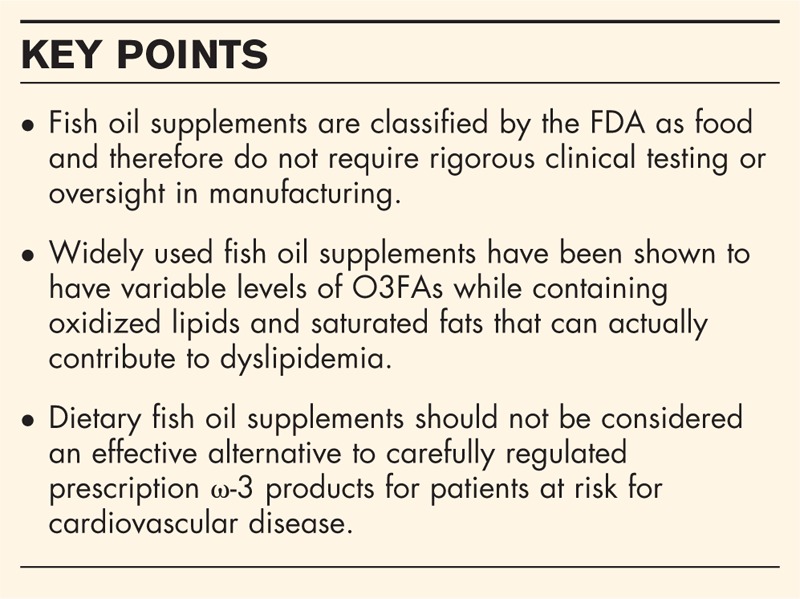
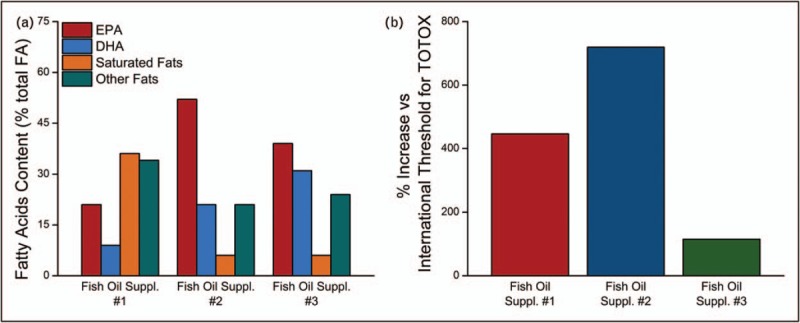
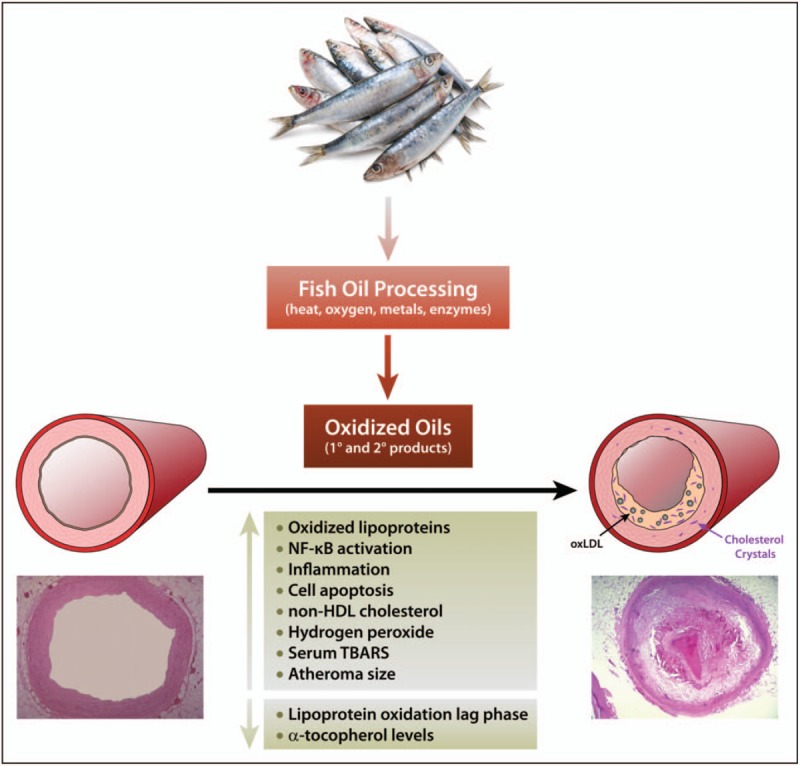
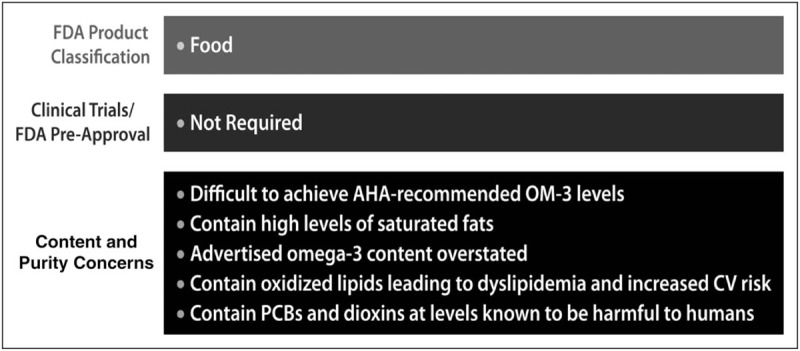
PURPOSE OF REVIEW: The purpose of this review is to assess whether dietary fish oil supplements can be appropriate for patients with elevated triglycerides and cardiovascular risk based on a comprehensive analysis of their composition, and level of regulatory oversight. RECENT FINDINGS: Approximately 19 million people in the United States take fish oil supplements, many for the purpose of treating or preventing heart disease. Unlike prescription products, fish oil supplements are classified as food by the Food and Drug Administration (FDA) and are not required to undergo manufacturing oversight or clinical testing. Analysis of widely used dietary fish oil supplements show that they may have lower amounts of ω-3 than advertised as well as significant levels of saturated fat and oxidized oils which actually may contribute to dyslipidemia. Clinical outcome trials have failed to show a consistent cardiovascular benefit with fish oil supplements and other low-dose mixed ω-3 fatty acids. SUMMARY: In light of limited regulatory oversight and evidence of quality concerns, dietary fish oil supplements are not an appropriate substitute for FDA approved prescription ω-3 fatty acids for their indicated use in treatment of elevated triglycerides or the prevention of cardiovascular events.
Overview
The claims and statistics of this paper haven’t been checked yet.
Free: it reads the open-access text and checks the first 5 claims that cite a source we can check. Create a free account to check every claim.
Integrity signals
Registry
Cites
Statistics
Figures
Verification
Claims the paper makes
The claims and statistics of this paper haven’t been checked yet.
Free: it reads the open-access text and checks the first 5 claims that cite a source we can check. Create a free account to check every claim.
Claims other papers make about this one
Each is checked against this paper’s own text: does it say what the citing paper says it does?
The cited source says what the claim attributes to it.
In the citing paper
“It is estimated that 19 million people take fish oil dietary supplements in the United States”
From Cardiovascular Impact of Nutritional Supplementation With Omega-3 Fatty Acids (2021) · cites this paper as [11]
In the citing paper
“Fish oil dietary supplements are the most commonly consumed nonvitamin, nonmineral natural products by adults.”
From Cardiovascular Impact of Nutritional Supplementation With Omega-3 Fatty Acids (2021) · cites this paper as [11]
Self-check
Percentages, sums and reported differences re-computed from the paper’s own numbers.
The self-check needs the paper’s full text.
Citations
Cites
Inflammation in atherosclerosis
Libby, P. (2002) · Nature · doi:10.1038/nature01323 · Cited by 8,315
Caspases: the executioners of apoptosis
COHEN, G. M. (1997) · Biochemical Journal · doi:10.1042/bj3260001 · Cited by 4,719
Inflammation in Atherosclerosis
Libby, P. (2012) · Arteriosclerosis, Thrombosis, and Vascular Biology · doi:10.1161/atvbaha.108.179705 · Cited by 3,736
Cardiovascular Risk Reduction with Icosapent Ethyl for Hypertriglyceridemia
Bhatt, D. L., Steg, P. G., Miller, M., Brinton, E. A., Jacobson, T. A., Ketchum, S. B., Doyle, R. T., Juliano, R. A., Jiao, L., Granowitz, C., et al. (2019) · New England Journal of Medicine · doi:10.1056/nejmoa1812792 · Cited by 3,317
Barnes, P. M., Bloom, B., & Nahin, R. L. (2008) · PsycEXTRA Dataset · doi:10.1037/e623942009-001 · Cited by 3,147
Role of oxidized low density lipoprotein in atherogenesis.
Witztum, J. L., & Steinberg, D. (1991) · Journal of Clinical Investigation · doi:10.1172/jci115499 · Cited by 2,675
Festa, A., D’Agostino, R., Howard, G., Mykkänen, L., Tracy, R. P., & Haffner, S. M. (2000) · Circulation · doi:10.1161/01.cir.102.1.42 · Cited by 2,358
Optimal Diets for Prevention of Coronary Heart Disease
Hu, F. B. (2002) · JAMA · doi:10.1001/jama.288.20.2569 · Cited by 1,503
Lipid oxidation and improving the oxidative stability
Shahidi, F., & Zhong, Y. (2010) · Chemical Society Reviews · doi:10.1039/b922183m · Cited by 1,151
Sayre, L. M., Zelasko, D. A., Harris, P. L. R., Perry, G., Salomon, R. G., & Smith, M. A. (1997) · Journal of Neurochemistry · doi:10.1046/j.1471-4159.1997.68052092.x · Cited by 1,007
Research works printed but not linked: 1
- Frankel EN Lipid oxidation. Bridgwater, UK: The Oily Press; 2005.
Cited by
Handelsman, Y., Jellinger, P. S., Guerin, C. K., Bloomgarden, Z. T., Brinton, E. A., Budoff, M. J., Davidson, M. H., Einhorn, D., Fazio, S., Fonseca, V. A., et al. (2020) · Endocrine Practice · doi:10.4158/cs-2020-0490 · Cited by 248
“Over-the-counter fish oil dietary supplements are not FDA-approved for lowering triglycerides and are not recommended for this purpose because they contain very low amounts of polyunsaturated omega3 fatty acids as well as trans fatty acids and saturated fat (111-113).”
Wierzejska, R. E. (2021) · International Journal of Environmental Research and Public Health · doi:10.3390/ijerph18178897 · Cited by 161
“Importantly, recent years have brought a growing number of reports about low-quality fish oil supplements [46], which according to various authors are nowhere near as good as preparations registered as medicines [47].”
BackgroundFatty Acids and Cardiovascular Risk. Evidence, Lack of Evidence, and Diligence
Visioli, F., & Poli, A. (2020) · Nutrients · doi:10.3390/nu12123782 · Cited by 113
“Another often overlooked and controversial [120] issue is that fish oil is, by its own nature and be it from diet [121] or supplements [122,123], prone to oxidation [124].”
BackgroundDo patients benefit from omega-3 fatty acids?
Sherratt, S. C. R., Mason, R. P., Libby, P., Steg, P. G., & Bhatt, D. L. (2023) · Cardiovascular Research · doi:10.1093/cvr/cvad188 · Cited by 80
“22 27 While inconsistent levels of O3FAs may compromise any intended benefit of these supplements, the presence of saturated fats, excess calories, and oxidized oils might actually cause harm, especially if consumed in large quantities and for long periods of time.”
BackgroundSelf-citationChapman, M. J., Zamorano, J. L., & Parhofer, K. G. (2022) · Pharmacology & Therapeutics · doi:10.1016/j.pharmthera.2022.108172 · Cited by 67
Cardiovascular Impact of Nutritional Supplementation With Omega-3 Fatty Acids
Weinberg, R. L., Brook, R. D., Rubenfire, M., & Eagle, K. A. (2021) · Journal of the American College of Cardiology · doi:10.1016/j.jacc.2020.11.060 · Cited by 63
Sherratt, S. C. R., Libby, P., Bhatt, D. L., & Mason, R. P. (2022) · Prostaglandins, Leukotrienes and Essential Fatty Acids · doi:10.1016/j.plefa.2022.102450 · Cited by 43
Self-citationMcClung, J. A., Levy, L., Garcia, V. G., Stec, D. E., Peterson, S. J., & Abraham, N. G. (2021) · Pharmacology & Therapeutics · doi:10.1016/j.pharmthera.2021.107975 · Cited by 49
Omega-3 fatty acids for cardiovascular event lowering
Kaur, G., Mason, R. P., Steg, P. G., & Bhatt, D. L. (2024) · European Journal of Preventive Cardiology · doi:10.1093/eurjpc/zwae003 · Cited by 47
Self-citationWang, Z., Wang, S., Feng, Y., Wan, W., Zhang, H., Bai, X., Cui, Q., & Song, X. (2021) · Journal of Agricultural and Food Chemistry · doi:10.1021/acs.jafc.1c03781 · Cited by 42
Shen, H. H., Peterson, S. J., Bellner, L., Choudhary, A., Levy, L., Gancz, L., Sasson, A., Trainer, J., Rezzani, R., Resnick, A., et al. (2020) · Antioxidants · doi:10.3390/antiox9060489 · Cited by 40
RetractedSafety and efficacy of therapies for chylomicronemia
Shamsudeen, I., & Hegele, R. A. (2022) · Expert Review of Clinical Pharmacology · doi:10.1080/17512433.2022.2094768 · Cited by 37
“of hepatic VLDL and inhibiting apo C-III [1,46].”
BackgroundLipid-Modifying Therapies and Stroke Prevention
Hackam, D. G., & Hegele, R. A. (2022) · Current Neurology and Neuroscience Reports · doi:10.1007/s11910-022-01197-4 · Cited by 37
A Revolution in Omega-3 Fatty Acid Research
Bhatt, D. L., Budoff, M. J., & Mason, R. P. (2020) · Journal of the American College of Cardiology · doi:10.1016/j.jacc.2020.09.005 · Cited by 38
Self-citationChen, Y., Sun, Y. G., Ding, Y., Ding, Y., Liu, S., Zhou, X., Wu, H., Xiao, J., & Lu, B. (2022) · Critical Reviews in Food Science and Nutrition · doi:10.1080/10408398.2022.2118658 · Cited by 31
“Results from a recent study showed that quality-controlled and highly purified EPA formulations (4 g/day) had noteworthy cardiovascular benefits (Sherratt, Lero, and Mason 2020).”
BackgroundVolanesorsen for treatment of familial chylomicronemia syndrome
Lazarte, J., & Hegele, R. A. (2021) · Expert Review of Cardiovascular Therapy · doi:10.1080/14779072.2021.1955348 · Cited by 26
“It is likely, however, that the IPE has additional non-lipid related beneficial mechanisms [6].”
BackgroundTrivedi, K., Le, V. T., & Nelson, J. R. (2020) · Postgraduate Medicine · doi:10.1080/00325481.2020.1783937 · Cited by 21
“A recent review concluded that dietary fish oil supplements should not be considered as an effective substitute for prescription omega-3 fatty acids [111].”
BackgroundDiffenderfer, M. R., Rajapakse, N., Pham, E., He, L., Dansinger, M. L., Nelson, J. R., & Schaefer, E. J. (2022) · Journal of clinical lipidology · doi:10.1016/j.jacl.2021.12.005 · Cited by 19
The Truth About Fish (Oil) in the Treatment of Dyslipidemia
Pitha, J. V., & Poledne, R. (2021) · Current Atherosclerosis Reports · doi:10.1007/s11883-021-00904-9 · Cited by 8
Morandini, H. A. E., Watson, P. A., Stewart, R. M., Wong, J. W. Y., Rao, P., & Zepf, F. D. (2022) · Clinical Nutrition ESPEN · doi:10.1016/j.clnesp.2022.10.004 · Cited by 8
Sales, A. L. C. C., Primo, M. G. S., Neto, R. S. M., Mendes, A. V. D. S., Furtado, M. M., Rocha, J. É. L., de Almeida, J. O. C. S., França, J. V. D. S., de Alencar, S. R. M., Brito, A. K. D. S., et al. (2024) · Pharmaceuticals · doi:10.3390/ph17010072 · Cited by 9
“EPA and DHA are susceptible to oxidation due to multiple double and conjugated bonds and some causes that contribute to this are thermal oxidation, auto-oxidation and photo-oxidation [16].”
BackgroundÇelik, M. Y., Canda, E. E., Yazıcı, H., Erdem, F., Yanbolu, A. Y., Altınok, Y. A., Parıltay, E., Akın, H., Uçar, S. K., & Çöker, M. (2024) · Nutrition Metabolism and Cardiovascular Diseases · doi:10.1016/j.numecd.2024.02.006 · Cited by 7
Sherratt, S. C. R., Libby, P., Dunbar, R. L., Bhatt, D. L., & Mason, R. P. (2025) · Cardiovascular Research · doi:10.1093/cvr/cvaf144 · Cited by 6
“39 The unsaturated fatty acids, being particularly susceptible to oxidative modification, then lose their biological actions and antioxidant activity.”
Self-citationMao, H., Lu, G., Zheng, L., Zhuang, M., Liang, L., Zhou, S., Li, J., Sun, X., Liu, Y., Ma, M., et al. (2025) · British Journal Of Nutrition · doi:10.1017/s0007114525103875 · Cited by 3
Singh, N., Dove, E., & Bhatt, D. L. (2023) · Elsevier eBooks · doi:10.1016/b978-0-323-88286-6.00019-4 · Cited by 4
Beneficial Effects of Capybara Oil Supplementation on Steatosis and Liver Apoptosis in Obese Mice
Alves, L. L., Pereira, P. G., Ciambarella, B. T., Campos, M. P., Rabelo, K., Nascimento, A. L. R., Cunha, R. L. D. C. D. S., de Andrade, C. B. V., de Moraes, A. C. N., Bernardi, A., et al. (2024) · Journal of Obesity · doi:10.1155/2024/7204607 · Cited by 2
“Currently, the best-known and most used PUFA supplementation is fsh oil [17].”
BackgroundAthanasiadis, V., Giannopoulou, M., Sarlami, G., Bozinou, E., Varagiannis, P., & Lalas, S. I. (2025) · Foods · doi:10.3390/foods14213653 · Cited by 2
Wang, A., Yuan, C., & Li-gen, W. (2025) · International Journal of Food Science & Technology · doi:10.1093/ijfood/vvaf001 · Cited by 2
Fish oil supplements in patients with chronic kidney disease
Ferro, C. J., Thomas, M. R., Khattak, S., Chanouzas, D., & Townend, J. (2026) · Clinical Kidney Journal · doi:10.1093/ckj/sfag168 · Cited by 1
Hatami, M., Yarahmadi, H. M., Fakhraei, J., & Ahmadi, A. (2022) · Tropical Animal Science Journal · doi:10.5398/tasj.2022.45.4.413 · Cited by 1
“High levels of unsaturated fatty acids in fish oil expose it to peroxidation (Sherratt et al., 2020), which results in oxidative stress.”
Elmas, Ö., Şahin, H. H. K., Güven, B., ALMisned, G., Zakaly, H. M. H., Tekin, H. O., & Ene, A. (2025) · Journal of Radiation Research and Applied Sciences · doi:10.1016/j.jrras.2025.101321 · Cited by 2
Ganda, O. P., Busch, R. S., Nelson, J. R., & Philip, S. (2023) · Contemporary diabetes · doi:10.1007/978-3-031-26681-2_25 · Cited by 1
Oily Fish Intake and Cardiovascular Diseases: A Mendelian Randomization StudyPreprint
Liu, X., Chen, A., Lou, Y., Zhang, C., & Yue, Z. (2024) · Research Square · doi:10.21203/rs.3.rs-4710125/v1
Current advances and controversies in the therapeutic use of fish oil: Theme revisited
Télessy, I. G., Buttar, H. S., & Wilson, D. W. (2025) · Elsevier eBooks · doi:10.1016/b978-0-443-33122-0.00015-5
Aggarwal, R., Bursill, C. A., Figtree, G. A., HOCKING, S. L., Mason, R. P., Michos, E. D., Miller, M. J., Nelson, A. J., Nicholls, S. J., Rye, K., et al. (2026) · Nature Reviews Cardiology · doi:10.1038/s41569-026-01358-9
Self-citation
Metadata
- Authors
- Sherratt, S. C. R., Lero, M., & Mason, R. P.
- Affiliations
- Elucida Research LLC, Beverly, MA, USA
- University of Massachusetts Chan Medical School (US)
- Brigham and Women's Hospital (US)
- Corresponding author
- Mason, R. Preston
- Venue
- Current Opinion in Lipidology
- Published
- 2020-04
- Volume
- 31
- Issue
- 2
- Pages
- 94-100
- ISSN
- 0957-9672 (ISSN-L)
- 1473-6535
- PMC
- PMC7069411
- OpenAlex
- W3005213123
- Semantic Scholar
- 5c25f4965ae8956bee7040cd5befc49d8190bc3e
- Cited by
- 33
- References
- 62
- Citations by year
- 2026: 1 · 2025: 5 · 2024: 5 · 2023: 3 · 2022: 8 · 2021: 6 · 2020: 5
- FWCI
- 0.67
- Type
- journal article
- Language
- en
- Open access
- hybrid
- doi.org
- Licence
- Locations
- Current Opinion in Lipidology (publishedVersion, cc-by-nc-nd)
- PubMed Central (publishedVersion, cc-by-nc-nd)
- PubMed (publishedVersion)
- The Journal of the American Medical Association (JAMA) Network (American Medical Association) (submittedVersion, cc-by-nc-nd)
- Topics
- Health Sciences › Nursing › Nutrition and Dietetics › Fatty Acid Research and Health
- Physical Sciences › Chemistry › Organic Chemistry › Edible Oils Quality and Analysis
- Health Sciences › Medicine › Cardiology and Cardiovascular Medicine › Lipoproteins and Cardiovascular Health
- Keywords
- fish oil supplements, dyslipidemia, triglyceride elevation, omega-3 fatty acids, cardiovascular risk, supplement quality, regulatory oversight, saturated fat, oxidized oil, cardiovascular benefits
- MeSH terms
- Animals, Cardiovascular Diseases, Fish Oils, Humans, United States, Fatty Acids, Omega-3, Dietary Supplements, Dyslipidemias
About these checks
Registry, retraction, Cites and statistics results are computed, not judged, with one exception: a printed reference that no index lists is read once by a model before it counts as a citation error. Claims are extracted by a model and kept only when their quote appears verbatim in the text; each cited source is then checked, with a model’s help, for whether it says what the claim relies on. Those verdicts can be wrong — read the claim’s quote and the cited source before relying on one.
Statistics and arithmetic are recomputed, not judged.
Confidence bands are shown only for fields calibrated on our annotated test set. None is calibrated yet, so no band is shown.
What counts as a claim ›How we measure confidence ›How we check this ›
Are you an author, or do you see a problem with this page? Request a review
Data sources
Bibliographic data: Semantic Scholar, OpenAlex, Crossref.
Contains information from the Semantic Scholar Academic Graph Datasets, made available under the ODC Attribution License (ODC-BY 1.0).
Semantic Scholar’s data is described in: Kinney, R., et al. (2023). The Semantic Scholar Open Data Platform. arXiv:2301.10140.
