

The impact of malnutrition on childhood infections
Open accessThe DOI matches its Crossref record; 47 of the 47 references it cites were found in a registry or an index.
Abstract
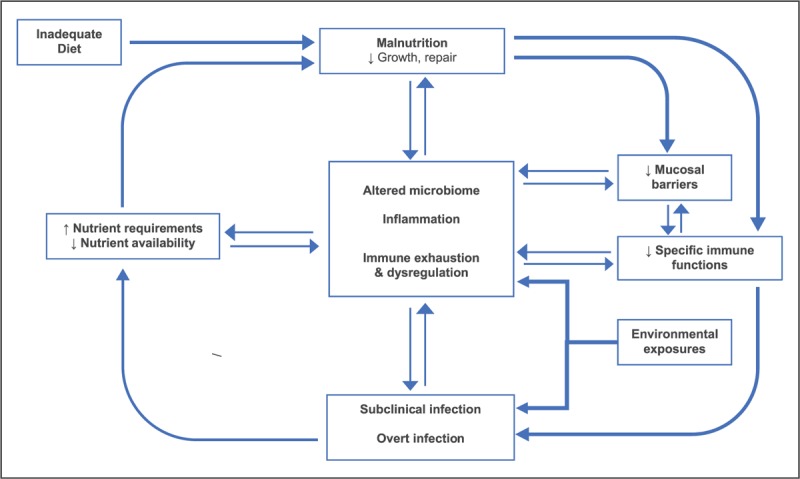
Purpose of review: Almost half of all childhood deaths worldwide occur in children with malnutrition, predominantly in sub-Saharan Africa and South Asia. This review summarizes the mechanisms by which malnutrition and serious infections interact with each other and with children's environments. Recent findings: It has become clear that whilst malnutrition results in increased incidence, severity and case fatality of common infections, risks continue beyond acute episodes resulting in significant postdischarge mortality. A well established concept of a ‘vicious-cycle’ between nutrition and infection has now evolving to encompass dysbiosis and pathogen colonization as precursors to infection; enteric dysfunction constituting malabsorption, dysregulation of nutrients and metabolism, inflammation and bacterial translocation. All of these interact with a child's diet and environment. Published trials aiming to break this cycle using antimicrobial prophylaxis or water, sanitation and hygiene interventions have not demonstrated public health benefit so far. Summary: As further trials are planned, key gaps in knowledge can be filled by applying new tools to re-examine old questions relating to immune competence during and after infection events and changes in nutritional status; and how to characterize overt and subclinical infection, intestinal permeability to bacteria and the role of antimicrobial resistance using specific biomarkers.
Overview
The claims and statistics of this paper haven’t been checked yet.
Free: it reads the open-access text and checks the first 5 claims that cite a source we can check. Create a free account to check every claim.
Integrity signals
Registry
Cites
Statistics
Figures
Verification
Claims the paper makes
The claims and statistics of this paper haven’t been checked yet.
Free: it reads the open-access text and checks the first 5 claims that cite a source we can check. Create a free account to check every claim.
Self-check
Percentages, sums and reported differences re-computed from the paper’s own numbers.
The self-check needs the paper’s full text.
Citations
Cites
Maternal and child undernutrition and overweight in low-income and middle-income countries
Black, R. E., Victora, C. G., Walker, S. P., Bhutta, Z. A., Christian, P., de Onis, M., Ezzati, M., Grantham-McGregor, S., Katz, J., Martorell, R., et al. (2013) · The Lancet · doi:10.1016/s0140-6736(13)60937-x · Cited by 8,475
Kotloff, K. L., Nataro, J. P., Blackwelder, W. C., Nasrin, D., Farag, T. H., Panchalingam, S., Wu, Y., Sow, S. O., Sur, D., Breiman, R. F., et al. (2013) · The Lancet · doi:10.1016/s0140-6736(13)60844-2 · Cited by 3,560 · cited 5×
“Worldwide, 5.6 million children die before their fifth birthday each year, with 80% of these deaths occurring in sub-Saharan Africa and Asia.”
BackgroundInfluentialGut Microbiomes of Malawian Twin Pairs Discordant for Kwashiorkor
Smith, M. I., Yatsunenko, T., Manary, M. J., Trehan, I., Mkakosya, R., Cheng, J., Kau, A. L., Rich, S. S., Concannon, P., Mychaleckyj, J. C., et al. (2013) · Science · doi:10.1126/science.1229000 · Cited by 1,173 · cited 1×
“receiving transplanted microbiota from malnourished children [33].”
Bacteremia among Children Admitted to a Rural Hospital in Kenya
Berkley, J. A., Lowe, B. S., Mwangi, I., Williams, T., Bauni, E., Mwarumba, S., Ngetsa, C., Slack, M. P. E., Njenga, S., Hart, C. A., et al. (2005) · New England Journal of Medicine · doi:10.1056/nejmoa040275 · Cited by 851 · cited 1×
“Some previous studies have suggested an increased likelihood of Gram negative bacteraemia in malnourished children [43].”
BackgroundSelf-citationImmune Dysfunction as a Cause and Consequence of Malnutrition
Bourke, C. D., Berkley, J. A., & Prendergast, A. J. (2016) · Trends in Immunology · doi:10.1016/j.it.2016.04.003 · Cited by 725 · cited 1×
“pathogen challenge, a range of abnormalities across multiple pathways in the innate and adaptive immune system have been described in these children [41,42].”
BackgroundSelf-citationMulti-country analysis of the effects of diarrhoea on childhood stunting
Checkley, W., Buckley, G., Gilman, R. H., Assis, A. M., Guerrant, R. L., Morris, S. S., Mølbak, K., Valentiner-Branth, P., Lanata, C. F., Black, R. E., et al. (2008) · International Journal of Epidemiology · doi:10.1093/ije/dyn099 · Cited by 653 · cited 1×
“At the same time, a meta-analysis assessing the impact of diarrhoea among several cohorts of children followed from birth until 24 months of age, demonstrated a 16% increase in stunting for every 5% increase in longitudinal incidence [16].”
BackgroundThe Immune System in Children with Malnutrition—A Systematic Review
Rytter, M. J. H., Kolte, L., Briend, A., Friis, H., & Christensen, V. B. (2014) · PLoS ONE · doi:10.1371/journal.pone.0105017 · Cited by 649 · cited 1×
“pathogen challenge, a range of abnormalities across multiple pathways in the innate and adaptive immune system have been described in these children [41,42].”
BackgroundBhutta, Z. A., Berkley, J. A., Bandsma, R. H. J., Kerac, M., Trehan, I., & Briend, A. (2017) · Nature Reviews Disease Primers · doi:10.1038/nrdp.2017.67 · Cited by 481
Self-citationAntibiotics as Part of the Management of Severe Acute Malnutrition
Trehan, I., Goldbach, H. S., LaGrone, L. N., Meuli, G. J., Wang, R. J., Maleta, K. M., & Manary, M. J. (2013) · New England Journal of Medicine · doi:10.1056/nejmoa1202851 · Cited by 351
Kosek, M., Haque, R., Lima, A., Babji, S., Shrestha, S., Qureshi, S., Amidou, S., Mduma, E., Lee, G., Yori, P. P., et al. (2013) · The American Society of Tropical Medicine and Hygiene · doi:10.4269/ajtmh.2012.12-0549 · Cited by 326
Historical Concepts of Interactions, Synergism and Antagonism between Nutrition and Infection
Scrimshaw, N. S. (2003) · The Journal of Nutrition · doi:10.1093/jn/133.1.316s · Cited by 315 · cited 1×
“A classic monograph by Scrimshaw in 1968, ‘Interactions of Nutrition and Infection,’ sets out a vicious cycle between nutrition and infection [25].”
BackgroundMyatt, M., Khara, T., & Collins, S. (2006) · Food and Nutrition Bulletin · doi:10.1177/15648265060273s302 · Cited by 273 · cited 4×
“Wasting (thinness) is defined by weight-for-height/length (WHZ) among children under 5 years old, and BMI for age among 5–19- year olds.”
BackgroundInfluentialGuerrant, R. L., Schorling, J. B., McAuliffe, J. F., & De Souza, M. A. (1992) · The American Journal of Tropical Medicine and Hygiene · doi:10.4269/ajtmh.1992.47.28 · Cited by 263 · cited 1×
“For example, children with malnutrition appear to be at substantially higher risk of diarrhoea, with both higher incidence and increased severity reported in malnourished children [15].”
BackgroundEnvironmental Enteropathy, Oral Vaccine Failure and Growth Faltering in Infants in Bangladesh
Naylor, C., Lu, M., Haque, R., Mondal, D., Buonomo, E., Nayak, U., Mychaleckyj, J. C., Kirkpatrick, B., Colgate, R., Carmolli, M., et al. (2015) · EBioMedicine · doi:10.1016/j.ebiom.2015.09.036 · Cited by 260 · cited 1×
“In many settings, markers associated with EED can be detected in as many as half of all children and these markers have been strongly associated with future linear growth failure [27,28].”
BackgroundMapping child growth failure in Africa between 2000 and 2015
Osgood-Zimmerman, A., Millear, A. I., Stubbs, R. W., Shields, C., Pickering, B. V., Earl, L., Graetz, N., Kinyoki, D. K., Ray, S. E., Bhatt, S., et al. (2018) · Nature · doi:10.1038/nature25760 · Cited by 245
Environmental enteric dysfunction pathways and child stunting: A systematic review
Harper, K. M., Mutasa, M., Prendergast, A. J., Humphrey, J., & Manges, A. R. (2018) · PLOS Neglected Tropical Diseases · doi:10.1371/journal.pntd.0006205 · Cited by 225 · cited 7×
“However, other studies have found mixed associations between frequent episodes of diarrhoea and long-term linear growth [17,18].”
BackgroundInfluentialGut microbiota and malnutrition
Million, M., Diallo, A., & Raoult, D. (2017) · Microbial Pathogenesis · doi:10.1016/j.micpath.2016.02.003 · Cited by 219 · cited 1×
“Preventive trials using candidate probiotic organisms and prebiotic foods are also in progress as microbiota are better characterized [9,32].”
BackgroundCauses of Impaired Oral Vaccine Efficacy in Developing Countries
Parker, E. P. K., Ramani, S., Lopman, B. A., Church, J. A., Iturriza-Gómara, M., Prendergast, A. J., & Grassly, N. C. (2018) · Future Microbiology · doi:10.2217/fmb-2017-0128 · Cited by 214 · cited 1×
“Early studies of vaccine responses among malnourished children suggesting reduced efficacy of oral vaccines (polio, rotavirus), but no differences in antibody titres following parenterally given vaccines [45,46].”
BackgroundLandscape Analysis of Interactions between Nutrition and Vaccine Responses in Children
Savy, M., Edmond, K. M., Fine, P., Hall, A., Hennig, B. J., Moore, S. E., Mulholland, K., Schaible, U. E., & Prentice, A. M. (2009) · Journal of Nutrition · doi:10.3945/jn.109.105312 · Cited by 166 · cited 1×
“Early studies of vaccine responses among malnourished children suggesting reduced efficacy of oral vaccines (polio, rotavirus), but no differences in antibody titres following parenterally given vaccines [45,46].”
BackgroundRichard, S. A., Black, R. E., Gilman, R. H., Guerrant, R. L., Kang, G., Lanata, C. F., Molbak, K., Rasmussen, Z. A., Sack, R. B., Valentiner-Branth, P., et al. (2013) · American Journal of Epidemiology · doi:10.1093/aje/kwt094 · Cited by 163 · cited 1×
“However, other studies have found mixed associations between frequent episodes of diarrhoea and long-term linear growth [17,18].”
BackgroundAttia, S., Versloot, C. J., Voskuijl, W., van Vliet, S. J., Di Giovanni, V., Zhang, L., Richardson, S., Bourdon, C., Netea, M. G., Berkley, J. A., et al. (2016) · The American Journal of Clinical Nutrition · doi:10.3945/ajcn.116.130518 · Cited by 157
Self-citationMramba, L. K., Ngari, M. M., Mwangome, M., Muchai, L., Bauni, E., Walker, A. S., Gibb, D. M., Fegan, G., & Berkley, J. A. (2017) · BMJ · doi:10.1136/bmj.j3423 · Cited by 148 · cited 2×
“Similarly, amongst schoolaged children and adolescents discharged from a rural hospital in Kenya (n¼1741) and amongst cohort of children over 5 years old with HIV infection in Uganda and Zimbabwe (n¼685), MUAC discriminated mortality risk at least as well as BMI-for-age [6].”
BackgroundSelf-citationTidjani Alou, M., Million, M., Traore, S. I., Mouelhi, D., Khelaifia, S., Bachar, D., Caputo, A., Delerce, J., Brah, S., Alhousseini, D., et al. (2017) · Frontiers in Microbiology · doi:10.3389/fmicb.2017.00899 · Cited by 146
Routine Amoxicillin for Uncomplicated Severe Acute Malnutrition in Children
Isanaka, S., Langendorf, C., Berthé, F., Gnegne, S., Li, N., Ousmane, N., Harouna, S., Hassane, H., Schaefer, M., Adehossi, E., et al. (2016) · New England Journal of Medicine · doi:10.1056/nejmoa1507024 · Cited by 141 · cited 1×
“1 year among severely malnourished children [12].”
Berkley, J. A., Ngari, M., Thitiri, J., Mwalekwa, L., Timbwa, M., Hamid, F., Ali, R., Shangala, J., Mturi, N., Jones, K. D. J., et al. (2016) · The Lancet Global Health · doi:10.1016/s2214-109x(16)30096-1 · Cited by 137
Self-citationO'Reilly, C. E., Jaron, P., Ochieng, B., Nyaguara, A., Tate, J. E., Parsons, M. B., Bopp, C. A., Williams, K. A., Vinjé, J., Blanton, E., et al. (2012) · PLoS Medicine · doi:10.1371/journal.pmed.1001256 · Cited by 123 · cited 1×
“In addition, as demonstrated in a study of 1146 children admitted to hospital with moderate-severe diarrhoea in Western Kenya (2005–2007), among children with severe acute malnutrition, risk of death following an episode of diarrhoea was four times higher than better nourished children [20].”
BackgroundBaggett, H. C., Watson, N. L., Knoll, M. D., Brooks, W. A., Feikin, D. R., Hammitt, L. L., Howie, S. R. C., Kotloff, K. L., Levine, O. S., Madhi, S. A., et al. (2017) · Clinical Infectious Diseases · doi:10.1093/cid/cix100 · Cited by 112
Fecal Markers of Environmental Enteropathy and Subsequent Growth in Bangladeshi Children
Arndt, M. B., Richardson, B. A., Ahmed, T., Mahfuz, M., Haque, R., John-Stewart, G. C., Denno, D. M., Petri, W. A., Kosek, M. N., & Walson, J. L. (2016) · American Journal of Tropical Medicine and Hygiene · doi:10.4269/ajtmh.16-0098 · Cited by 104 · cited 6×
“It is not yet clear if this is EED or a separate disease.”
BackgroundSelf-citationMetabolomic Changes in Serum of Children with Different Clinical Diagnoses of Malnutrition
Giovanni, V. D., Bourdon, C., Wang, D. X., Seshadri, S., Senga, E. L., Versloot, C. J., Voskuijl, W. P., Semba, R. D., Trehan, I., Moaddel, R., et al. (2016) · Journal of Nutrition · doi:10.3945/jn.116.239145 · Cited by 93
Hooli, S., Colbourn, T., Lufesi, N., Costello, A. M. D. L., Nambiar, B., Thammasitboon, S., Makwenda, C., Mwansambo, C., McCollum, E. D., & King, C. (2016) · PLoS ONE · doi:10.1371/journal.pone.0168126 · Cited by 86 · cited 1×
“Development of an inpatient paediatric pneumonia mortality risk score (RISC) in Malawi (n1⁄416 475) [22,23], identified severe malnutrition as having similar predictive value to hypoxaemia and coma [21].”
BackgroundPlatts-Mills, J. A., Taniuchi, M., Uddin, M. J., Sobuz, S. U., Mahfuz, M., Gaffar, S. M. A., Mondal, D., Hossain, M. I., Islam, M. M., Ahmed, A. M. S., et al. (2017) · American Journal of Clinical Nutrition · doi:10.3945/ajcn.116.138800 · Cited by 83
Mortality after Inpatient Treatment for Severe Pneumonia in Children: a Cohort Study
Ngari, M. M., Fegan, G., Mwangome, M., Ngama, M., Mturi, N., Scott, J. A. G., Bauni, E., Nokes, D. J., & Berkley, J. A. (2017) · Paediatric and Perinatal Epidemiology · doi:10.1111/ppe.12348 · Cited by 81
Self-citationBriend, A., Alvarez, J.-L., Avril, N., Bahwere, P., Bailey, J., Berkley, J. A., Binns, P., Blackwell, N., Dale, N. M., Deconinck, H., et al. (2016) · BMC Nutrition · doi:10.1186/s40795-016-0101-7 · Cited by 79 · cited 4×
“Wasting (thinness) is defined by weight-for-height/length (WHZ) among children under 5 years old, and BMI for age among 5–19- year olds.”
BackgroundSelf-citationCohen, C., von Mollendorf, C., de Gouveia, L., Lengana, S., Meiring, S. T., Quan, V., Nguweneza, A., Moore, D. P., Reubenson, G., Moshe, M., et al. (2017) · The Lancet Global Health · doi:10.1016/s2214-109x(17)30043-8 · Cited by 70
Diagnostic criteria for severe acute malnutrition among infants aged under 6 mo
Mwangome, M., Ngari, M., Fegan, G., Mturi, N., Shebe, M., Bauni, E., & Berkley, J. A. (2017) · The American Journal of Clinical Nutrition · doi:10.3945/ajcn.116.149815 · Cited by 70 · cited 5×
“Amongst infants (n1⁄42882) under 6 months old admitted to hospital in Kenya, MUAC was better at discriminating risk of subsequent inpatient death than WHZ [5].”
BackgroundSelf-citationImpact of Childhood Nutritional Status on Pathogen Prevalence and Severity of Acute Diarrhea
Tickell, K. D., Pavlinac, P. B., John-Stewart, G. C., Denno, D. M., Richardson, B. A., Naulikha, J. M., Kirera, R. K., Swierczewski, B., Singa, B. O., & Walson, J. L. (2017) · American Journal of Tropical Medicine and Hygiene · doi:10.4269/ajtmh.17-0139 · Cited by 70
Self-citationStarved Guts: Morphologic and Functional Intestinal Changes in Malnutrition
Attia, S. L., Feenstra, M. E., Swain, N., Cuesta, M., & Bandsma, R. (2017) · Journal of Pediatric Gastroenterology and Nutrition · doi:10.1097/mpg.0000000000001629 · Cited by 53 · cited 1×
“Similarly, malnutrition is associated with small intestinal histological abnormalities, including villous blunting, reduction in mucus-secreting goblet cells and inflammation [31].”
BackgroundLazzaroni, S., & Wagner, N. (2016) · Economics & Human Biology · doi:10.1016/j.ehb.2016.10.006 · Cited by 46 · cited 1×
“In addition to a diet low in energy or specific nutrients, a wide range of antenatal and postnatal environmental exposures, acute infection, chronic illness or psychosocial neglect may result in malnutrition [10].”
BackgroundLima, A. Â. M., Soares, A. M., Filho, J. Q. S., Havt, A., Lima, I. F. N., Lima, N. L., Abreu, C. B., Junior, F. S., Mota, R. M. S., Pan, W., et al. (2017) · Journal of Pediatric Gastroenterology and Nutrition · doi:10.1097/mpg.0000000000001717 · Cited by 40
Environmental Enteric Dysfunction: A Case Definition for Intervention Trials
Denno, D. M., Tarr, P. I., & Nataro, J. P. (2017) · American Journal of Tropical Medicine and Hygiene · doi:10.4269/ajtmh.17-0183 · Cited by 40 · cited 6×
“It is not yet clear if this is EED or a separate disease.”
BackgroundInfluentialGebre, T., Tadesse, M., Aragaw, D., Feye, D., Beyene, H. B., Seyoum, D., & Mekonnen, M. (2017) · Children · doi:10.3390/children4040027 · Cited by 32 · cited 1×
“In Ethiopia, nasopharyngeal carriage of Streptococcus pneumonia was assessed in 361 children at an outpatient clinic [37].”
BackgroundNutritional Enteric Failure: Neglected Tropical Diseases and Childhood Stunting
Tickell, K. D., & Walson, J. L. (2016) · PLoS neglected tropical diseases · doi:10.1371/journal.pntd.0004523 · Cited by 28 · cited 1×
“that the microbiome, both measured by diversity and taxa distribution, is a critical modulator of homeostasis within the gut, influencing absorption, immune function and hormonal regulation [34].”
BackgroundSelf-citationVerhagen, L. M., Gómez-Castellano, K., Snelders, E., Rivera-Olivero, I. A., Pocaterra, L. A., Melchers, W. J. G., de Waard, J. H., & Hermans, P. W. M. (2013) · Journal of Infection · doi:10.1016/j.jinf.2013.06.010 · Cited by 25 · cited 1×
“However, a significant association had been previously shown in another population in Venezuela, with a 33% reduction in colonization per unit HAZ, and clear association between colonization and acute respiratory infection [39].”
Viewpoint 1: 75 years of Kwashiorkor in Africa
Heikens, G., & MANARY, M. J. (2009) · Malawi Medical Journal · doi:10.4314/mmj.v21i3.45627 · Cited by 18 · cited 1×
“Why only some severely malnourished children develop kwashiorkor remains unknown [7].”
BackgroundVerhagen, L. M., Hermsen, M., Rivera-Olivero, I. A., Sisco, M. C., de Jonge, M. I., Hermans, P. W. M., & de Waard, J. H. (2017) · Tropical Medicine & International Health · doi:10.1111/tmi.12835 · Cited by 18 · cited 1×
“pneumoniae colonization was (nonsignificantly on multivariable analysis) more common among stunted children who were stunted [38].”
BackgroundHooli, S., Colbourn, T., Lufesi, N., Costello, A. M. D. L., Nambiar, B., Thammasitboon, S., Makwenda, C., Mwansambo, C., McCollum, E. D., & King, C. (2018) · PLoS ONE · doi:10.1371/journal.pone.0193557 · Cited by 9 · cited 1×
“Development of an inpatient paediatric pneumonia mortality risk score (RISC) in Malawi (n1⁄416 475) [22,23], identified severe malnutrition as having similar predictive value to hypoxaemia and coma [21].”
BackgroundObiero, C. W., Seale, A. C., Jones, K. D. J., Ngari, M. M., Bendon, C. L., Morpeth, S. C., Mohammed, S., Mturi, N., Fegan, G., & Berkley, J. A. (2017) · PLoS ONE · doi:10.1371/journal.pone.0182354 · Cited by 6 · cited 1×
“In Kenya, contrary to previous case series suggesting that coagulase-negative staphylococci (CONS, usually associated with invasive medical devices) may be important pathogens in severely malnourished children, there was no association between CONS being identified on blood culture and mortality or duration of hospita…”
ResultSelf-citation
Cited by
Alebel, A., Demant, D., Petrucka, P., & Sibbritt, D. (2021) · BMC Infectious Diseases · doi:10.1186/s12879-020-05706-z · Cited by 194
“On the contrary, malnutrition increases the risk of infections by causing immune deficiency, resulting in the persistence of malnutrition as the most common cause of immunodeficiency [16, 137].”
BackgroundFourteen pathways between urban transportation and health: A conceptual model and literature review
Glazener, A., Sanchez, K., Ramani, T., Zietsman, J., Nieuwenhuijsen, M. J., Mindell, J. S., Fox, M., & Khreis, H. (2021) · Journal of Transport & Health · doi:10.1016/j.jth.2021.101070 · Cited by 178
“Several studies have suggested that charging stations built in accordance with the International Commission on Non-Ionizing Radiation Protection standards should ensure human safety (Bi et al., 2016; Ding et al., 2014b; Watanabe and Ishida, 2016; Wen and Huang, 2017).”
BackgroundPrediction of survival odds in COVID-19 by zinc, age and selenoprotein P as composite biomarker
Heller, R. A., Sun, Q., Hackler, J., Seelig, J., Seibert, L., Cherkezov, A., Minich, W. B., Seemann, P., Diegmann, J., Pilz, M., et al. (2021) · Redox Biology · doi:10.1016/j.redox.2020.101764 · Cited by 178
“The situation is worse in many developing parts of the world with limited access to high-quality food and water, causing high rates of childhood deaths from common infections [3].”
Godman, B., Haque, M., McKimm, J., Abu Bakar, M., Sneddon, J., Wale, J., Campbell, S., Martin, A. P., Hoxha, I., Abilova, V., et al. (2020) · Current Medical Research and Opinion · doi:10.1080/03007995.2019.1700947 · Cited by 171
Evaluation and Management of Respiratory Illness in Children With Cerebral Palsy
Marpole, R. M., Blackmore, A. M., Gibson, N., Cooper, M. S., Langdon, K., & Wilson, A. C. (2020) · Frontiers in Pediatrics · doi:10.3389/fped.2020.00333 · Cited by 137
Metadata
- Authors
- Walson, J. L., & Berkley, J. A.
- Affiliations
- University of Washington (US)
- Kenya Medical Research Institute (KE)
- Corresponding author
- Berkley, James A.
- ORCID
- Berkley, James A.
- Venue
- Current Opinion in Infectious Diseases
- Published
- 2018-06
- Volume
- 31
- Issue
- 3
- Pages
- 231-236
- ISSN
- 0951-7375 (ISSN-L)
- 1473-6527
- PMC
- PMC6037284
- OpenAlex
- W2790487502
- Cited by
- 273
- References
- 47
- Citations by year
- 2026: 19 · 2025: 20 · 2024: 46 · 2023: 51 · 2022: 49 · 2021: 47 · 2020: 24 · 2019: 13 · 2018: 3
- FWCI
- 2.79
- Type
- journal article
- Language
- en
- Open access
- hybrid
- doi.org
- Locations
- Current Opinion in Infectious Diseases (publishedVersion, cc-by)
- Europe PMC (PubMed Central) (publishedVersion, cc-by)
- PubMed Central (publishedVersion, cc-by)
- PubMed (publishedVersion)
- Funders
- Wellcome Trust
- Medical Research Council (MR/M007367/1)
- Topics
- Health Sciences › Nursing › Nutrition and Dietetics › Child Nutrition and Water Access
- Health Sciences › Nursing › Nutrition and Dietetics › Clinical Nutrition and Gastroenterology
- Health Sciences › Nursing › Nutrition and Dietetics › Infant Nutrition and Health
- Keywords
- child malnutrition, pediatric infection, dysbiosis, pathogen colonization, malabsorption, bacterial translocation, intestinal permeability, inflammation, immunocompetence, antibiotic prophylaxis, water, sanitation and hygiene, post-discharge mortality, antimicrobial resistance, asymptomatic infection, biomarkers
- MeSH terms
- Asia, Enteritis, Humans, Intestinal Absorption, Incidence, Survival Analysis, Africa South of the Sahara, Bacterial Translocation, Malnutrition, Dysbiosis
About these checks
Registry, retraction, Cites and statistics results are computed, not judged, with one exception: a printed reference that no index lists is read once by a model before it counts as a citation error. Claims are extracted by a model and kept only when their quote appears verbatim in the text; each cited source is then checked, with a model’s help, for whether it says what the claim relies on. Those verdicts can be wrong — read the claim’s quote and the cited source before relying on one.
Statistics and arithmetic are recomputed, not judged.
Confidence bands are shown only for fields calibrated on our annotated test set. None is calibrated yet, so no band is shown.
What counts as a claim ›How we measure confidence ›How we check this ›
Are you an author, or do you see a problem with this page? Request a review
Data sources
Bibliographic data: Semantic Scholar, OpenAlex, Crossref.
Contains information from the Semantic Scholar Academic Graph Datasets, made available under the ODC Attribution License (ODC-BY 1.0).
Semantic Scholar’s data is described in: Kinney, R., et al. (2023). The Semantic Scholar Open Data Platform. arXiv:2301.10140.
