

Incidence, prevalence and mortality of anorexia nervosa and bulimia nervosa
Open accessThe DOI matches its Crossref record; 58 of the 59 references it cites were found in a registry or an index.
Abstract
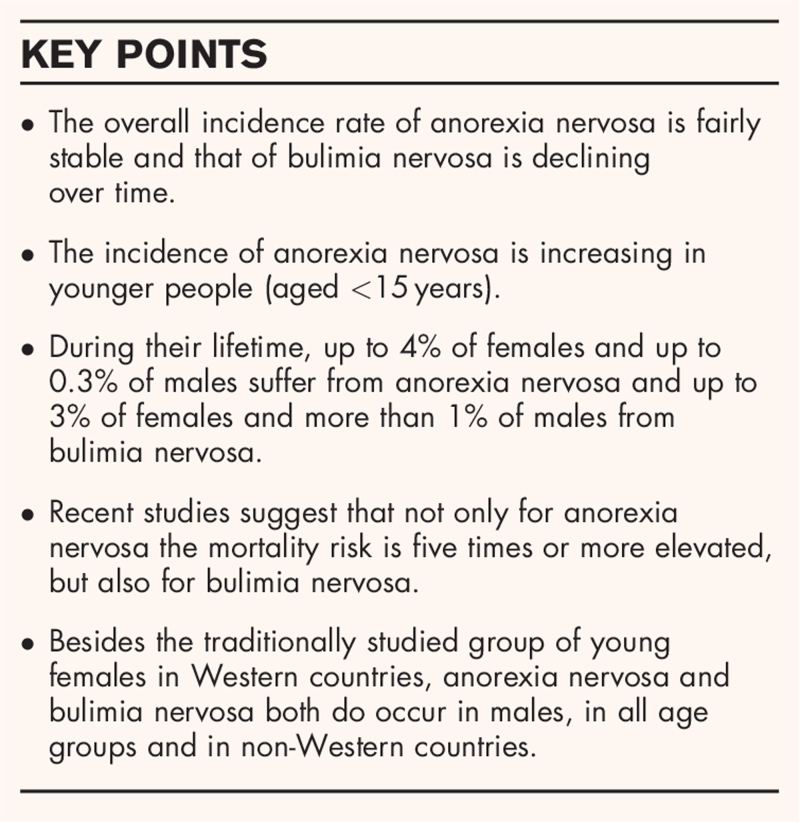
Purpose of review: To review the recent literature on the epidemiology of anorexia nervosa and bulimia nervosa in terms of incidence, prevalence and mortality. Recent findings: Although the overall incidence rate of anorexia nervosa is considerably stable over the past decades, the incidence among younger persons (aged <15 years) has increased. It is unclear whether this reflects earlier detection or earlier age of onset. Nevertheless, it has implications for future research into risk factors and for prevention programs. For bulimia nervosa, there has been a decline in overall incidence rate over time. The lifetime prevalence rates of anorexia nervosa might be up to 4% among females and 0.3% among males. Regarding bulimia nervosa, up to 3% of females and more than 1% of males suffer from this disorder during their lifetime. While epidemiological studies in the past mainly focused on young females from Western countries, anorexia nervosa and bulimia nervosa are reported worldwide among males and females from all ages. Both eating disorders may carry a five or more times increased mortality risk. Summary: Anorexia nervosa and bulimia nervosa occur worldwide among females and males of all age groups and are associated with an increased mortality risk.
Overview
The claims and statistics of this paper haven’t been checked yet.
Free: it reads the open-access text and checks the first 5 claims that cite a source we can check. Create a free account to check every claim.
Integrity signals
Registry
Cites
Statistics
Figures
Verification
Claims the paper makes
The claims and statistics of this paper haven’t been checked yet.
Free: it reads the open-access text and checks the first 5 claims that cite a source we can check. Create a free account to check every claim.
Claims other papers make about this one
Each is checked against this paper’s own text: does it say what the citing paper says it does?
The source backs part of the claim, not all of it — or backs it for a different population, condition or comparison.
In the citing paper
“Among them, patients with SE-AN have higher mortality risks. [8, 9].”
From Eating disorders and palliative care specialists require definitional consensus and clinical guidance regarding terminal anorexia nervosa: addressing concerns and moving forward (2022) · cites this paper as [9]
Experimental — accuracy not yet measured
Self-check
Percentages, sums and reported differences re-computed from the paper’s own numbers.
The self-check needs the paper’s full text.
Citations
Cites
Arcelus, J., Mitchell, A. J., Wales, J., & Nielsen, S. (2011) · Archives of General Psychiatry · doi:10.1001/archgenpsychiatry.2011.74 · Cited by 2,864 · cited 2×
“[50] the CMR of anorexia nervosa patients was 5.”
ResultEpidemiology of Eating Disorders: Incidence, Prevalence and Mortality Rates
Smink, F. R. E., van Hoeken, D., & Hoek, H. W. (2012) · Current Psychiatry Reports · doi:10.1007/s11920-012-0282-y · Cited by 1,978
Self-citationPrevalence of eating disorders over the 2000–2018 period: a systematic literature review
Galmiche, M., Déchelotte, P., Lambert, G., & Tavolacci, M. P. (2019) · The American Journal of Clinical Nutrition · doi:10.1093/ajcn/nqy342 · Cited by 1,712 · cited 3×
“The three previously discussed systematic reviews and meta-analyses [28,29,35] also reported prevalence rates for bulimia nervosa.”
BackgroundResultReview of the prevalence and incidence of eating disorders
Hoek, H. W., & van Hoeken, D. (2003) · International Journal of Eating Disorders · doi:10.1002/eat.10222 · Cited by 1,458
Self-citationIncidence, prevalence and mortality of anorexia nervosa and other eating disorders
Hoek, H. W. (2006) · Current Opinion in Psychiatry · doi:10.1097/01.yco.0000228759.95237.78 · Cited by 891 · cited 1×
“over because of the fact that only a small proportion of community ‘cases’ present to (primary) care [3,5].”
BackgroundSelf-citationStice, E., Marti, C. N., & Rohde, P. (2013) · Journal of Abnormal Psychology · doi:10.1037/a0030679 · Cited by 822 · cited 1×
“6% among females in one interview-based study [49].”
BackgroundUdo, T., & Grilo, C. M. (2018) · Biological Psychiatry · doi:10.1016/j.biopsych.2018.03.014 · Cited by 799
van Hoeken, D., & Hoek, H. W. (2020) · Current Opinion in Psychiatry · doi:10.1097/yco.0000000000000641 · Cited by 716
Self-citationEpidemiology, course, and outcome of eating disorders
Smink, F. R. E., van Hoeken, D., & Hoek, H. W. (2013) · Current Opinion in Psychiatry · doi:10.1097/yco.0b013e328365a24f · Cited by 507
Self-citationEpidemiology and course of anorexia nervosa in the community
Keski-Rahkonen, A., Hoek, H. W., Susser, E. S., Linna, M. S., Sihvola, E., Raevuori, A., Bulik, C. M., Kaprio, J., & Rissanen, A. (2007) · American Journal of Psychiatry · doi:10.1176/appi.ajp.2007.06081388 · Cited by 504 · cited 1×
“com 32 years [8], 200 per 100 000 person-years among Spanish females between the age of 12 and 22 years [9] and 270 per 100 000 person-years in Finnish twin females aged 15–19 years [10].”
BackgroundSelf-citationMortality in eating disorders ‐ results of a large prospective clinical longitudinal study
Fichter, M. M., & Quadflieg, N. (2016) · International Journal of Eating Disorders · doi:10.1002/eat.22501 · Cited by 475
Qian, J., Wu, Y., Liu, F., Zhu, Y., Jin, H., Zhang, H., Wan, Y., Li, C., & Yu, D. (2022) · Eating and Weight Disorders - Studies on Anorexia, Bulimia and Obesity · doi:10.1007/s40519-021-01162-z · Cited by 431 · cited 6×
“The results were in the same order as found in the systematic reviews [28,29], with lifetime prevalence rates ranging between 0.”
BackgroundMethodResultInfluentialPrevalence and severity of DSM‐5 eating disorders in a community cohort of adolescents
Smink, F. R. E., van Hoeken, D., Oldehinkel, A. J., & Hoek, H. W. (2014) · International Journal of Eating Disorders · doi:10.1002/eat.22316 · Cited by 415
Self-citationSantomauro, D. F., Melen, S., Mitchison, D., Vos, T., Whiteford, H., & Ferrari, A. J. (2021) · The Lancet Psychiatry · doi:10.1016/s2215-0366(21)00040-7 · Cited by 391 · cited 1×
“Because of methodological issues related to the low prevalence and lack of global coverage of epidemiological studies for eating disorders, GBD calculations on these data must be interpreted with caution [26,27].”
Hay, P., Mitchison, D., Collado, A. E. L., González-Chica, D. A., Stocks, N., & Touyz, S. (2017) · Journal of Eating Disorders · doi:10.1186/s40337-017-0149-z · Cited by 325
Review of the worldwide epidemiology of eating disorders
Hoek, H. W. (2016) · Current Opinion in Psychiatry · doi:10.1097/yco.0000000000000282 · Cited by 269
Self-citationMicali, N., Martini, M. G., Thomas, J. J., Eddy, K. T., Kothari, R., Russell, E., Bulik, C. M., & Treasure, J. (2017) · BMC Medicine · doi:10.1186/s12916-016-0766-4 · Cited by 245
Mitchison, D., Mond, J., Bussey, K., Griffiths, S., Trompeter, N., Lonergan, A., Pike, K. M., Murray, S. B., & Hay, P. (2020) · Psychological Medicine · doi:10.1017/s0033291719000898 · Cited by 237
A review of eating disorders in males
Raevuori, A., Keski-Rahkonen, A., & Hoek, H. W. (2014) · Current Opinion in Psychiatry · doi:10.1097/yco.0000000000000113 · Cited by 201
Self-citationPrevalence, incidence and prospective risk factors for eating disorders
Ghaderi, A., & Scott, B. (2001) · Acta Psychiatrica Scandinavica · doi:10.1034/j.1600-0447.2001.00298.x · Cited by 176
Lindvall Dahlgren, C., Wisting, L., & Rø, Ø. (2017) · Journal of Eating Disorders · doi:10.1186/s40337-017-0186-7 · Cited by 176
Epidemiology of binge eating disorder: prevalence, course, comorbidity, and risk factors
Keski-Rahkonen, A. (2021) · Current Opinion in Psychiatry · doi:10.1097/yco.0000000000000750 · Cited by 175
Cybulski, L., Ashcroft, D. M., Carr, M. J., Garg, S., Chew-Graham, C. A., Kapur, N., & Webb, R. T. (2021) · BMC Psychiatry · doi:10.1186/s12888-021-03235-w · Cited by 170 · cited 1×
“Another primary care study among 10to 19-year-olds in the UK reported an increased incidence rate in the age group of 13–16 years for all eating disorders combined, comparing 2018 rates to those in 2003 [15].”
BackgroundChen, Y.-L., Chen, W. J., Lin, K.-C., Shen, L.-J., & Gau, S. S.-F. (2020) · Epidemiology and Psychiatric Sciences · doi:10.1017/s2045796018000793 · Cited by 168
Severe and enduring anorexia nervosa: Update and observations about the current clinical reality
Wonderlich, S. A., Bulik, C. M., Schmidt, U., Steiger, H., & Hoek, H. W. (2020) · International Journal of Eating Disorders · doi:10.1002/eat.23283 · Cited by 143 · cited 1×
“The highest lifetime prevalence rates are found in adults, because of the accumulation of anorexia nervosa first emerging in the peak age period of adolescence [44] combined with incidence later in adulthood.”
BackgroundSelf-citationWu, J., Liu, J., Li, S., Ma, H., & Wang, Y. (2020) · Epidemiology and Psychiatric Sciences · doi:10.1017/s2045796020001055 · Cited by 143
Demmler, J. C., Brophy, S. T., Marchant, A. L., John, A. M., & Tan, J. O. A. (2019) · The British Journal of Psychiatry · doi:10.1192/bjp.2019.153 · Cited by 133
Epidemiology and treatment of eating disorders in men and women of middle and older age
Mangweth-Matzek, B., & Hoek, H. W. (2017) · Current Opinion in Psychiatry · doi:10.1097/yco.0000000000000356 · Cited by 131
Self-citationSmink, F. R. E., van Hoeken, D., Donker, G., Susser, E., Oldehinkel, A. J., & Hoek, H. W. (2015) · Psychological Medicine · doi:10.1017/s003329171500272x · Cited by 118
Self-citationJavaras, K. N., Runfola, C. D., Thornton, L. M., Agerbo, E., Birgegård, A., Norring, C., Yao, S., Råstam, M., Larsson, H., Lichtenstein, P., et al. (2015) · International Journal of Eating Disorders · doi:10.1002/eat.22467 · Cited by 111
Disordered Eating, Eating Disorders, and Body Image in Midlife and Older Women
Samuels, K. L., Maine, M. D., & Tantillo, M. (2019) · Current Psychiatry Reports · doi:10.1007/s11920-019-1057-5 · Cited by 111
DSM‐5 reduces the proportion of ednos cases: Evidence from community samples
Machado, P. P. P., Gonçalves, S., & Hoek, H. W. (2013) · International Journal of Eating Disorders · doi:10.1002/eat.22040 · Cited by 107
Self-citationIncidence of anorexia nervosa in young people in the UK and Ireland: a national surveillance study
Petkova, H., Simic, M., Nicholls, D., Ford, T. J., Prina, M. A., Stuart, R., Livingstone, N., Kelly, G. P., Macdonald, G. M., Eisler, I., et al. (2019) · BMJ Open · doi:10.1136/bmjopen-2018-027339 · Cited by 105
Excess mortality associated with eating disorders: population-based cohort study
Iwajomo, T., Bondy, S. J., de Oliveira, C., Colton, P., Trottier, K., & Kurdyak, P. (2021) · The British Journal of Psychiatry · doi:10.1192/bjp.2020.197 · Cited by 103
Wu, J., Lin, Z., Liu, Z., He, H., Bai, L., & Lyu, J. (2020) · Psychological Medicine · doi:10.1017/s0033291720002706 · Cited by 95
DSM‐5 eating disorders among adolescents and young adults in Finland: A public health concern
Silén, Y., Sipilä, P. N., Raevuori, A., Mustelin, L., Marttunen, M., Kaprio, J., & Keski‐Rahkonen, A. (2020) · International Journal of Eating Disorders · doi:10.1002/eat.23236 · Cited by 90
Glazer, K. B., Sonneville, K. R., Micali, N., Swanson, S. A., Crosby, R., Horton, N. J., Eddy, K. T., & Field, A. E. (2019) · Journal of Adolescent Health · doi:10.1016/j.jadohealth.2018.09.023 · Cited by 85
Incidence of Anorexia Nervosa in Women: A Systematic Review and Meta-Analysis
González, L. M., Fernández‐Villa, T., Molina, A. J., Delgado‐Rodríguez, M., & Martín, V. (2020) · International Journal of Environmental Research and Public Health · doi:10.3390/ijerph17113824 · Cited by 83
Tith, R. M., Paradis, G., Potter, B. J., Low, N., Healy-Profitós, J., He, S., & Auger, N. (2020) · JAMA Psychiatry · doi:10.1001/jamapsychiatry.2019.2914 · Cited by 81
Flament, M. F., Buchholz, A., Henderson, K., Obeid, N., Maras, D., Schubert, N., Paterniti, S., & Goldfield, G. (2015) · European Eating Disorders Review · doi:10.1002/erv.2339 · Cited by 76
Brown, T. A., Forney, K. J., Klein, K. M., Grillot, C., & Keel, P. K. (2020) · Journal of Abnormal Psychology · doi:10.1037/abn0000519 · Cited by 72
Edakubo, S., & Fushimi, K. (2020) · BMC Psychiatry · doi:10.1186/s12888-020-2433-8 · Cited by 69
Mortality in males treated for an eating disorder—A large prospective study
Quadflieg, N., Strobel, C., Naab, S., Voderholzer, U., & Fichter, M. M. (2019) · International Journal of Eating Disorders · doi:10.1002/eat.23135 · Cited by 68
Reas, D. L., & Rø, Ø. (2018) · International Journal of Eating Disorders · doi:10.1002/eat.22949 · Cited by 67
Mohammadi, M. R., Mostafavi, S., Hooshyari, Z., Khaleghi, A., Ahmadi, N., Molavi, P., Kian, A. A., Safavi, P., Delpisheh, A., Talepasand, S., et al. (2019) · International Journal of Eating Disorders · doi:10.1002/eat.23197 · Cited by 66
Guinhut, M., Godart, N., Benadjaoud, M., Melchior, J., & Hanachi, M. (2021) · Acta Psychiatrica Scandinavica · doi:10.1111/acps.13261 · Cited by 53
Fichter, M. M., Naab, S., Voderholzer, U., & Quadflieg, N. (2020) · Eating and Weight Disorders - Studies on Anorexia Bulimia and Obesity · doi:10.1007/s40519-020-00960-1 · Cited by 46
Psychiatric comorbidity as a risk factor for the mortality of people with bulimia nervosa
Himmerich, H., Hotopf, M., Shetty, H., Schmidt, U., Treasure, J., Hayes, R. D., Stewart, R., & Chang, C.-K. (2019) · Social Psychiatry and Psychiatric Epidemiology · doi:10.1007/s00127-019-01667-0 · Cited by 44
van Eeden, A. E., Oldehinkel, A. J., van Hoeken, D., & Hoek, H. W. (2021) · International Journal of Eating Disorders · doi:10.1002/eat.23496 · Cited by 43
Self-citationWood, S., Marchant, A., Allsopp, M., Wilkinson, K., Bethel, J., Jones, H., & John, A. (2019) · BMJ Open · doi:10.1136/bmjopen-2018-026691 · Cited by 39
Bagaric, M., Touyz, S. W., Heriseanu, A. I., Conti, J., & Hay, P. (2020) · European Eating Disorders Review · doi:10.1002/erv.2726 · Cited by 37
Incidence of eating disorders in Navarra (Spain)
Lahortiga‐Ramos, F., de Irala, J., Prous, A. C., García, P. G., Martínez‐González, M. Á., & Cervera‐Enguix, S. (2004) · European Psychiatry · doi:10.1016/j.eurpsy.2004.07.008 · Cited by 36
Introduction to a special issue on eating disorders in Asia
Kim, Y., Nakai, Y., & Thomas, J. J. (2020) · International Journal of Eating Disorders · doi:10.1002/eat.23444 · Cited by 35
Tsai, M., Gan, S., Lee, C., Liang, Y., Lee, L., & Lin, S. (2018) · International Journal of Eating Disorders · doi:10.1002/eat.22970 · Cited by 32
Nakai, Y., Nin, K., & Goel, N. J. (2020) · International Journal of Eating Disorders · doi:10.1002/eat.23439 · Cited by 27
Eating Disorders in Males: An 8-Year Population-Based Observational Study
Jaworski, M., Pańczyk, M., Śliwczyński, A. M., Brzozowska, M., Janaszek, K., Małkowski, P., & Gotlib, J. (2019) · American Journal of Men s Health · doi:10.1177/1557988319860970 · Cited by 22
Ernst, V., Bürger, A., & Hammerle, F. (2017) · International Journal of Eating Disorders · doi:10.1002/eat.22780 · Cited by 20
Tseng, M. M., Tu, C., Hsieh, S., & Chang, C. (2019) · International Journal of Eating Disorders · doi:10.1002/eat.23203 · Cited by 19
Cited by
Solmi, M., Monaco, F., Højlund, M., Monteleone, A. M., Trott, M., Firth, J., Carfagno, M., Eaton, M., De Toffol, M., Vergine, M., et al. (2024) · World Psychiatry · doi:10.1002/wps.21182 · Cited by 274
Psilocybin therapy for females with anorexia nervosa: a phase 1, open-label feasibility study
Peck, S. K., Shao, S., Gruen, T., Yang, K., Babakanian, A., Trim, J., Finn, D. M., & Kaye, W. (2023) · Nature Medicine · doi:10.1038/s41591-023-02455-9 · Cited by 144
Pediatric Mental Health Hospitalizations at Acute Care Hospitals in the US, 2009-2019
Arakelyan, M., Freyleue, S., Avula, D., McLaren, J. L., O’Malley, A. J., & Leyenaar, J. K. (2023) · JAMA · doi:10.1001/jama.2023.1992 · Cited by 127
Cultural Differences and Information Technology Acceptance
Zakour, A. B. (2004) · Cited by 155
Horovitz, O., & Argyrides, M. (2023) · Nutrients · doi:10.3390/nu15173851 · Cited by 134
“Of particular concern is the rise in the prevalence of eating disorders such as anorexia nervosa, bulimia nervosa, and binge eating disorder, which pose significant health risks and can be life-threatening if left untreated [3,4].”
Background
Metadata
- Authors
- van Eeden, A. E., van Hoeken, D., & Hoek, H. W.
- Affiliations
- Parnassia Psychiatric Institute, The Hague, The Netherlands
- University Medical Center Groningen (NL)
- ORCID
- Hoek, Hans W.
- Venue
- Current Opinion in Psychiatry
- Published
- 2021-09-16
- Volume
- 34
- Issue
- 6
- Pages
- 515-524
- ISSN
- 0951-7367 (ISSN-L)
- 1473-6578
- PMC
- PMC8500372
- OpenAlex
- W3195156262
- Semantic Scholar
- 506afa54bc89d698ef6a312277efcfd526953576
- Cited by
- 698
- References
- 59
- Citations by year
- 2026: 121 · 2025: 177 · 2024: 175 · 2023: 155 · 2022: 66
- FWCI
- 13.24
- Type
- journal article
- Language
- en
- Open access
- hybrid
- doi.org
- Locations
- Current Opinion in Psychiatry (publishedVersion, cc-by)
- PubMed Central (publishedVersion, cc-by)
- PubMed (publishedVersion)
- University of Groningen research database (University of Groningen / Centre for Information Technology) (submittedVersion, cc-by)
- Topics
- Social Sciences › Psychology › Clinical Psychology › Eating Disorders and Behaviors
- Health Sciences › Nursing › Nutrition and Dietetics › Nutrition, Health and Food Behavior
- Health Sciences › Medicine › Psychiatry and Mental health › Child Nutrition and Feeding Issues
- Keywords
- anorexia nervosa, bulimia nervosa, eating disorders, incidence, prevalence, mortality, lifetime prevalence, age of onset, sex differences, global epidemiology
- MeSH terms
- Anorexia Nervosa, Feeding and Eating Disorders, Female, Humans, Male, Incidence, Prevalence, Bulimia Nervosa
About these checks
Registry, retraction, Cites and statistics results are computed, not judged, with one exception: a printed reference that no index lists is read once by a model before it counts as a citation error. Claims are extracted by a model and kept only when their quote appears verbatim in the text; each cited source is then checked, with a model’s help, for whether it says what the claim relies on. Those verdicts can be wrong — read the claim’s quote and the cited source before relying on one.
Statistics and arithmetic are recomputed, not judged.
Confidence bands are shown only for fields calibrated on our annotated test set. None is calibrated yet, so no band is shown.
What counts as a claim ›How we measure confidence ›How we check this ›
Are you an author, or do you see a problem with this page? Request a review
Data sources
Bibliographic data: Semantic Scholar, OpenAlex, Crossref.
Contains information from the Semantic Scholar Academic Graph Datasets, made available under the ODC Attribution License (ODC-BY 1.0).
Semantic Scholar’s data is described in: Kinney, R., et al. (2023). The Semantic Scholar Open Data Platform. arXiv:2301.10140.
