

Incidence, prevalence and mortality of anorexia nervosa and bulimia nervosa
Open accessThe DOI matches its Crossref record; 58 of the 59 references it cites were found in a registry or an index.
Abstract
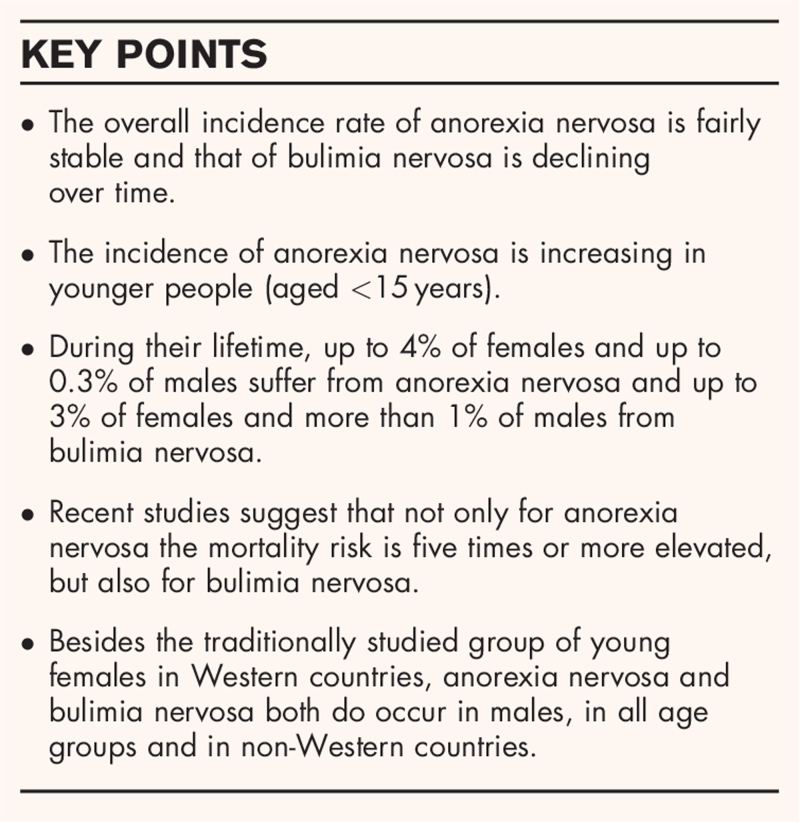
Purpose of review: To review the recent literature on the epidemiology of anorexia nervosa and bulimia nervosa in terms of incidence, prevalence and mortality. Recent findings: Although the overall incidence rate of anorexia nervosa is considerably stable over the past decades, the incidence among younger persons (aged <15 years) has increased. It is unclear whether this reflects earlier detection or earlier age of onset. Nevertheless, it has implications for future research into risk factors and for prevention programs. For bulimia nervosa, there has been a decline in overall incidence rate over time. The lifetime prevalence rates of anorexia nervosa might be up to 4% among females and 0.3% among males. Regarding bulimia nervosa, up to 3% of females and more than 1% of males suffer from this disorder during their lifetime. While epidemiological studies in the past mainly focused on young females from Western countries, anorexia nervosa and bulimia nervosa are reported worldwide among males and females from all ages. Both eating disorders may carry a five or more times increased mortality risk. Summary: Anorexia nervosa and bulimia nervosa occur worldwide among females and males of all age groups and are associated with an increased mortality risk.
Overview
The claims and statistics of this paper haven’t been checked yet.
Free: it reads the open-access text and checks the first 5 claims that cite a source we can check. Create a free account to check every claim.
Integrity signals
Registry
Cites
Statistics
Figures
Verification
Claims the paper makes
The claims and statistics of this paper haven’t been checked yet.
Free: it reads the open-access text and checks the first 5 claims that cite a source we can check. Create a free account to check every claim.
Claims other papers make about this one
Each is checked against this paper’s own text: does it say what the citing paper says it does?
The source backs part of the claim, not all of it — or backs it for a different population, condition or comparison.
In the citing paper
“Among them, patients with SE-AN have higher mortality risks. [8, 9].”
From Eating disorders and palliative care specialists require definitional consensus and clinical guidance regarding terminal anorexia nervosa: addressing concerns and moving forward (2022) · cites this paper as [9]
Experimental — accuracy not yet measured
Self-check
Percentages, sums and reported differences re-computed from the paper’s own numbers.
The self-check needs the paper’s full text.
Citations
Cites
Arcelus, J., Mitchell, A. J., Wales, J., & Nielsen, S. (2011) · Archives of General Psychiatry · doi:10.1001/archgenpsychiatry.2011.74 · Cited by 2,864 · cited 2×
“[50] the CMR of anorexia nervosa patients was 5.”
ResultEpidemiology of Eating Disorders: Incidence, Prevalence and Mortality Rates
Smink, F. R. E., van Hoeken, D., & Hoek, H. W. (2012) · Current Psychiatry Reports · doi:10.1007/s11920-012-0282-y · Cited by 1,978
Self-citationPrevalence of eating disorders over the 2000–2018 period: a systematic literature review
Galmiche, M., Déchelotte, P., Lambert, G., & Tavolacci, M. P. (2019) · The American Journal of Clinical Nutrition · doi:10.1093/ajcn/nqy342 · Cited by 1,712 · cited 3×
“The three previously discussed systematic reviews and meta-analyses [28,29,35] also reported prevalence rates for bulimia nervosa.”
BackgroundResultReview of the prevalence and incidence of eating disorders
Hoek, H. W., & van Hoeken, D. (2003) · International Journal of Eating Disorders · doi:10.1002/eat.10222 · Cited by 1,458
Self-citationIncidence, prevalence and mortality of anorexia nervosa and other eating disorders
Hoek, H. W. (2006) · Current Opinion in Psychiatry · doi:10.1097/01.yco.0000228759.95237.78 · Cited by 891 · cited 1×
“over because of the fact that only a small proportion of community ‘cases’ present to (primary) care [3,5].”
BackgroundSelf-citationStice, E., Marti, C. N., & Rohde, P. (2013) · Journal of Abnormal Psychology · doi:10.1037/a0030679 · Cited by 822 · cited 1×
“6% among females in one interview-based study [49].”
BackgroundUdo, T., & Grilo, C. M. (2018) · Biological Psychiatry · doi:10.1016/j.biopsych.2018.03.014 · Cited by 799
van Hoeken, D., & Hoek, H. W. (2020) · Current Opinion in Psychiatry · doi:10.1097/yco.0000000000000641 · Cited by 716
Self-citationEpidemiology, course, and outcome of eating disorders
Smink, F. R. E., van Hoeken, D., & Hoek, H. W. (2013) · Current Opinion in Psychiatry · doi:10.1097/yco.0b013e328365a24f · Cited by 507
Self-citationEpidemiology and course of anorexia nervosa in the community
Keski-Rahkonen, A., Hoek, H. W., Susser, E. S., Linna, M. S., Sihvola, E., Raevuori, A., Bulik, C. M., Kaprio, J., & Rissanen, A. (2007) · American Journal of Psychiatry · doi:10.1176/appi.ajp.2007.06081388 · Cited by 504 · cited 1×
“com 32 years [8], 200 per 100 000 person-years among Spanish females between the age of 12 and 22 years [9] and 270 per 100 000 person-years in Finnish twin females aged 15–19 years [10].”
BackgroundSelf-citation
Cited by
Solmi, M., Monaco, F., Højlund, M., Monteleone, A. M., Trott, M., Firth, J., Carfagno, M., Eaton, M., De Toffol, M., Vergine, M., et al. (2024) · World Psychiatry · doi:10.1002/wps.21182 · Cited by 274
Psilocybin therapy for females with anorexia nervosa: a phase 1, open-label feasibility study
Peck, S. K., Shao, S., Gruen, T., Yang, K. H., Babakanian, A., Trim, J., Finn, D. M., & Kaye, W. H. (2023) · Nature Medicine · doi:10.1038/s41591-023-02455-9 · Cited by 184
Pediatric Mental Health Hospitalizations at Acute Care Hospitals in the US, 2009-2019
Arakelyan, M., Freyleue, S., Avula, D., McLaren, J. L., O’Malley, A. J., & Leyenaar, J. K. (2023) · JAMA · doi:10.1001/jama.2023.1992 · Cited by 127
Cultural Differences and Information Technology Acceptance
Zakour, A. B. (2004) · Cited by 153
Horovitz, O., & Argyrides, M. (2023) · Nutrients · doi:10.3390/nu15173851 · Cited by 98
“Of particular concern is the rise in the prevalence of eating disorders such as anorexia nervosa, bulimia nervosa, and binge eating disorder, which pose significant health risks and can be life-threatening if left untreated [3,4].”
BackgroundAlhaj, O. A., Fekih‐Romdhane, F., Sweidan, D. H., Saif, Z., Khudhair, M. F., Ghazzawi, H., Nadar, M. S., Alhajeri, S. S., Levine, M. P., & Jahrami, H. (2022) · Eating and Weight Disorders - Studies on Anorexia Bulimia and Obesity · doi:10.1007/s40519-022-01452-0 · Cited by 133
“The overall screen-based prevalence rate of disordered eating (nearly 20%) is approximately twice the global prevalence of eating disorders estimates of around (approximately 10) [53, 54].”
BackgroundResultTerminal anorexia nervosa: three cases and proposed clinical characteristics
Gaudiani, J. L., Bogetz, A., & Yager, J. (2022) · Journal of Eating Disorders · doi:10.1186/s40337-022-00548-3 · Cited by 82
Schmidt, U. H., Claudino, A. M., Fernández‐Aranda, F., Giel, K. E., Griffiths, J., Hay, P., Kim, Y., Marshall, J., Micali, N., Monteleone, A. M., et al. (2025) · World Psychiatry · doi:10.1002/wps.21263 · Cited by 101
“Large national register studies confirm these findings 138 , with some pointing to a gender difference, i.e., with higher mortality in men than women with AN or BN 139 .”
Gliwińska, A., Czubilińska-Łada, J., Więckiewicz, G., Świętochowska, E., Badeński, A., Dworak, M., & Szczepańska, M. (2023) · Brain Sciences · doi:10.3390/brainsci13020163 · Cited by 93
Eating Disorders and Metabolic Diseases
Yu, Z., & Muehleman, V. (2023) · International Journal of Environmental Research and Public Health · doi:10.3390/ijerph20032446 · Cited by 116
“More importantly, eating disorders can cause a wide variety of health problems such as obesity, type-2 diabetes, hypertension, high cholesterol, heart disease, gallbladder disease, or even death [8,9].”
BackgroundGallant, T. L., Ong, L. F., Wong, L., Sparks, M., Wilson, E., Puglisi, J. L., & Gerriets, V. A. (2025) · Sports Medicine · doi:10.1007/s40279-024-02130-0 · Cited by 118
“Rights reserved.”
Papini, N. M., Jung, M., Cook, A., Lopez, N. V., Ptomey, L. T., Herrmann, S. D., & Kang, M. (2022) · Journal of Eating Disorders · doi:10.1186/s40337-022-00580-3 · Cited by 85
“Removal of items 9 and 25 could be a result of a known decline in bulimia nervosa incidence rate over time [57].”
BackgroundTFOS Lifestyle: Impact of societal challenges on the ocular surface
Stapleton, F. J., Abad, J. C., Barabino, S., Burnett, A. M., Iyer, G. K., Lekhanont, K., Li, T., Liu, Y., Navas, A., Obinwanne, C. J., et al. (2023) · The Ocular Surface · doi:10.1016/j.jtos.2023.04.006 · Cited by 78
“5%–2%, respectively [194,195], with a remarkable increase among young females over the past two decades [196].”
BackgroundCurrent Discoveries and Future Implications of Eating Disorders
Feng, B. C., Harms, J., Chen, E., Gao, P., Xu, P., & He, Y. (2023) · International Journal of Environmental Research and Public Health · doi:10.3390/ijerph20146325 · Cited by 88
Dhopatkar, N., Keeler, J. L., Mutwalli, H., Whelan, K., Treasure, J. L., & Himmerich, H. (2022) · Psychoneuroendocrinology · doi:10.1016/j.psyneuen.2022.105959 · Cited by 65
The Role of the Human Hypothalamus in Food Intake Networks: An MRI Perspective
Roger, C., Lasbleiz, A., Guye, M., Dutour, A., Gaborit, B., & Ranjeva, J. (2022) · Frontiers in Nutrition · doi:10.3389/fnut.2021.760914 · Cited by 66
Brizzi, G., Sansoni, M., Lernia, D. D., Frisone, F., Tuena, C., & Riva, G. (2023) · Journal of Eating Disorders · doi:10.1186/s40337-023-00930-9 · Cited by 54
“Indeed, these conditions are associated with serious consequences for the well-being of the individual [2], and high mortality rates [3].”
BackgroundConn, K., Milton, L. K., Huang, K., Munguba, H., Ruuska, J., Lemus, M. B., Greaves, E., Homman‐Ludiye, J., Oldfield, B. J., & Foldi, C. J. (2024) · Molecular Psychiatry · doi:10.1038/s41380-024-02575-9 · Cited by 68
ADHD and eating disorders in childhood and adolescence: An updated minireview
Villa, F. M., Crippa, A., Rosi, E., Nobile, M., Brambilla, P., & Delvecchio, G. (2022) · Journal of Affective Disorders · doi:10.1016/j.jad.2022.10.016 · Cited by 58
Prevalence and Etiology of Eating Disorders in Polycystic Ovary Syndrome: A Scoping Review
Lalonde-Bester, S., Malik, M., Masoumi, R., Ng, K., Sidhu, S., Ghosh, M., & Vine, D. F. (2024) · Advances in Nutrition · doi:10.1016/j.advnut.2024.100193 · Cited by 63
The Follow-Up of Eating Disorders from Adolescence to Early Adulthood: A Systematic Review
Filipponi, C., Visentini, C., Filippini, T., Cutino, A., Ferri, P., Rovesti, S., Latella, E., & Lorenzo, R. D. (2022) · International Journal of Environmental Research and Public Health · doi:10.3390/ijerph192316237 · Cited by 84
“[16] reported an ED percentage of 4% in girls and only 0.”
BackgroundAnorexia nervosa and autoimmune comorbidities: A bidirectional route?
Sirufo, M. M., Magnanimi, L. M., Ginaldi, L., & Martinis, M. D. (2022) · CNS Neuroscience & Therapeutics · doi:10.1111/cns.13953 · Cited by 46
Zanella, E., & Lee, E. (2022) · Heliyon · doi:10.1016/j.heliyon.2022.e11422 · Cited by 61
Gender differences in eating disorders
Capuano, E. I., Ruocco, A., Scazzocchio, B., Zanchi, G., Lombardo, C., Silenzi, A., Ortona, E., & Varí, R. (2025) · Frontiers in Nutrition · doi:10.3389/fnut.2025.1583672 · Cited by 52
“While epidemiological studies from Western countries, in the past, mainly focused on young females, AN and BN are reported worldwide among males (26).”
Prevention and Early Identification of Eating Disorders
Attia, E., & Guarda, Á. S. (2022) · JAMA · doi:10.1001/jama.2022.2458 · Cited by 54
Eating disorders and diabetes: facing the dual challenge
Dziewa, M., Bańka, B., Herbet, M., & Piątkowska-Chmiel, I. (2023) · Nutrients · doi:10.3390/nu15183955 · Cited by 45
“Studies have shown that up to 3% of females and more than 1% of males may be affected by bulimia nervosa [60].”
BackgroundEthical Concerns in Managing Anorexia Nervosa: A Content Analysis of Ethics Consultation Records
Salem, H. M., Watanabe, S., & Chang, A. H. (2025) · Asian Journal of Ethics in Health and Medicine · doi:10.51847/ohei6fgl3v · Cited by 41
Treatment of Eating Disorders: Current Status, Challenges, and Future Directions
Grilo, C. M. (2024) · Annual Review of Clinical Psychology · doi:10.1146/annurev-clinpsy-080822-043256 · Cited by 67
Austin, A., Anderson, A. G., Jc, L., Steen, H. V., Savard, C., Bergmann, C., Singh, M., Devoe, D. J. A., Gorrell, S., Patten, S. B., et al. (2024) · International Journal of Eating Disorders · doi:10.1002/eat.24252 · Cited by 53
“Anorexia nervosa (AN) is a life-threatening and disabling illness which impairs physical health and psychological functioning (Treasure et al. 2020) and has an age-and sex-standardized mortality rate approximately five times higher than the general population (van Eeden, van Hoeken, and Hoek 2021).”
Review of the unprecedented impact of the COVID-19 pandemic on the occurrence of eating disorders
Meier, K., van Hoeken, D., & Hoek, H. W. (2022) · Current Opinion in Psychiatry · doi:10.1097/yco.0000000000000815 · Cited by 46
Self-citationMortality and care of eating disorders
Castellini, G., Caini, S., Cassioli, E., Rossi, E., Marchesoni, G., Rotella, F., Cavalcabo’, N. D. B., Fontana, M., Mezzani, B., Alterini, B., et al. (2022) · Acta Psychiatrica Scandinavica · doi:10.1111/acps.13487 · Cited by 47
“In general, recent findings showed that patients with AN and BN who received inpatient treatment had the highest mortality rates.(3) There is a general agreement that patients with EDs are best treated in specialized care centers, in consideration of the great difficulties and specific challenges that they pose in ter…”
BackgroundResultHerpertz‐Dahlmann, B., Dempfle, A., & Eckardt, S. (2022) · European Psychiatry · doi:10.1192/j.eurpsy.2022.2345 · Cited by 42
“A very recent literature review on the incidence and prevalence of AN confirmed an increase in the disorder in children below 15 years of age [25].”
BackgroundPelc, A., Winiarska, M., Polak-Szczybyło, E., Godula, J., & Stępień, A. E. (2023) · Nutrients · doi:10.3390/nu15071603 · Cited by 52
de Rijk, E. S. J., Almirabi, D., Robinson, L., Schmidt, U. H., van Furth, E. F., & Landt, M. (2023) · International Journal of Eating Disorders · doi:10.1002/eat.24059 · Cited by 47
Søeby, M., Gribsholt, S. B., Clausen, L., & Richelsen, B. (2024) · International Journal of Eating Disorders · doi:10.1002/eat.24223 · Cited by 54
Cooney, L. G., Gyorfi, K. M., Sanneh, A., Bui, L. M., Mousa, A., Tay, C. T., Teede, H. J., Stener‐Victorin, E., & Brennan, L. (2024) · The Journal of Clinical Endocrinology & Metabolism · doi:10.1210/clinem/dgae462 · Cited by 45
Inal-Kaleli, I., Doğan, N., Köse, S., & Bora, E. (2024) · International Journal of Eating Disorders · doi:10.1002/eat.24307 · Cited by 44
Alsheweir, A., Goyder, E., Alnooh, G., & Caton, S. J. (2023) · Nutrients · doi:10.3390/nu15214643 · Cited by 41
“A recent review of epidemiological studies confirmed that the incidence of AN is increasing in young individuals worldwide, particularly those who are below 15 years of age, with a peak age of 13–18 years at onset [8,9].”
BackgroundPsychedelic-Assisted Therapy for People with Eating Disorders
Gukasyan, N., Schreyer, C. C., Griffiths, R. R., & Guarda, Á. S. (2022) · Current Psychiatry Reports · doi:10.1007/s11920-022-01394-5 · Cited by 35
The Impact of Anorexia Nervosa and the Basis for Non-Pharmacological Interventions
Clemente‐Suárez, V. J., Ramírez-Goercke, M. I., Redondo-Flórez, L., Beltrán-Velasco, A. I., Martín-Rodríguez, A., Ramos‐Campo, D. J., Navarro-Jiménez, E., Sepulveda, R. A. Y., & Tornero-Aguilera, J. F. (2023) · Nutrients · doi:10.3390/nu15112594 · Cited by 52
The Role of Circadian Rhythms and Sleep in Anorexia Nervosa
Wilcox, H., Paz, V., Saxena, R., Winkelman, J. W., Garfield, V., & Dashti, H. S. (2024) · JAMA Network Open · doi:10.1001/jamanetworkopen.2023.50358 · Cited by 33
Ethical tensions in the treatment of youth with severe anorexia nervosa
Tsiandoulas, K., McSheffrey, G., Fleming, L. A., Rawal, V., Fadel, M. P., Katzman, D. K., & McCradden, M. D. (2022) · The Lancet Child & Adolescent Health · doi:10.1016/s2352-4642(22)00236-x · Cited by 30
Weighing in: qualitative explorations of weight restoration as recovery in anorexia nervosa
Barko, E. B., & Moorman, S. M. (2023) · Journal of Eating Disorders · doi:10.1186/s40337-023-00736-9 · Cited by 37
“Individuals may experience a mortality rate at least five times greater than the general population [10], with some estimates as high as a 16-fold [11].”
BackgroundBarakat, S., Burton, A. L., Cunich, M. M., Hay, P., Hazelton, J. L., Kim, M., Lymer, S. J., Madden, S., Maloney, D., Miskovic‐Wheatley, J., et al. (2023) · Psychiatry Research · doi:10.1016/j.psychres.2023.115534 · Cited by 32
“Bulimia nervosa (BN) is an eating disorder (ED) associated with substantial psychological burden, chronicity, and comorbidity (Udo and Grilo, 2019; van Eeden et al., 2021).”
Adams, K. L., Murphy, J., Catmur, C., & Bird, G. (2022) · European Eating Disorders Review · doi:10.1002/erv.2905 · Cited by 32
Tanner, A. B. (2023) · Journal of Eating Disorders · doi:10.1186/s40337-023-00759-2 · Cited by 31
Sex Differences and the Risk of Kidney Stones
Ferraro, P. M., Cunha, T. D. S., & Curhan, G. C. (2022) · Seminars in Nephrology · doi:10.1016/j.semnephrol.2022.04.012 · Cited by 28
Terminal anorexia nervosa cannot currently be identified
Crow, S. J. (2023) · International Journal of Eating Disorders · doi:10.1002/eat.23957 · Cited by 26
Hsu, T. I., Nguyen, A., Gupta, N. K., Godbole, N. B., Perisetla, N., Hatter, M. J., Beyer, R. S., Bui, N. E., Jagan, J., Yang, C., et al. (2022) · World Neurosurgery · doi:10.1016/j.wneu.2022.09.114 · Cited by 33
So, B. P.-H., Lai, D. K.-H., Cheung, D. S. K., Lam, W., Cheung, J. C., & Wong, D. W. (2022) · International Journal of Environmental Research and Public Health · doi:10.3390/ijerph19105821 · Cited by 37
“In this review, the application of VR in immersive virtual rehabilitation has been demonstrated on AN and BED, which were among the prevalent types of cognitive- or behavioralrelated eating disorders and carried more than a five-time increase in mortality [43,47].”
BackgroundTriggers for eating disorder onset in youth with anorexia nervosa across the weight spectrum
Lin, J., Jhe, G., Adhikari, R., Vitagliano, J. A., Rose, K. L., Freizinger, M., & Richmond, T. K. (2023) · Eating Disorders · doi:10.1080/10640266.2023.2201988 · Cited by 33
“Lastly, the incidence of AN has been increasing for youth early in adolescence (Van Eeden et al., 2021), and more evidence has documented the prevalence of AN in children younger than 10 years old (Merikangas et al., 2010; Rozzell et al., 2019).”
Backgroundvan Eeden, A. E., van Hoeken, D., Hendriksen, J. M. T., & Hoek, H. W. (2023) · International Journal of Eating Disorders · doi:10.1002/eat.24064 · Cited by 35
Self-citationYager, J., Gaudiani, J. L., & Treem, J. (2022) · Journal of Eating Disorders · doi:10.1186/s40337-022-00659-x · Cited by 24
Celeghin, A., Palermo, S., Giampaolo, R., Fini, G. D., Gandino, G., & Civilotti, C. (2023) · Brain Sciences · doi:10.3390/brainsci13030465 · Cited by 29
Lynch, S., McDonnell, T., Leahy, D., Gavin, B. E., & McNicholas, F. (2022) · Irish Journal of Psychological Medicine · doi:10.1017/ipm.2022.46 · Cited by 28
“UK studies using an interview format found lower rates of 0.4% (Sadler et al. 2018) and more recent studies suggest this has increased, especially under age 15, with lifetime prevalence rates of AN up to 4% among females and 0.3% among males (van Eeden et al. 2021).”
InfluentialCostandache, G., Munteanu, O., Salaru, A., Oroian, B. A., & Cozmin, M. (2023) · Postępy Psychiatrii i Neurologii · doi:10.5114/ppn.2023.127237 · Cited by 47
Anorexia Nervosa—Facts, Frustrations, and the Future
Phillipou, A., Schmidt, U. H., Neill, E., Miles, S., McGorry, P. D., & Eddy, K. T. (2025) · JAMA Psychiatry · doi:10.1001/jamapsychiatry.2025.0812 · Cited by 25
The role of the brain-derived neurotrophic factor (BDNF) in anorexia nervosa
Trinh, S., Keller, L., Herpertz‐Dahlmann, B., & Seitz, J. (2023) · Psychoneuroendocrinology · doi:10.1016/j.psyneuen.2023.106069 · Cited by 26
Taking better advantage of the activity-based anorexia model
Foldi, C. J. (2023) · Trends in Molecular Medicine · doi:10.1016/j.molmed.2023.11.011 · Cited by 20
Ragnhildstveit, A., Tuteja, N., Seli, P., Smart, L., Uzun, N., Bass, L. C., Miranda, A. C., Ford, T. J., & Neufeld, S. (2024) · Journal of Eating Disorders · doi:10.1186/s40337-024-00984-3 · Cited by 37
Marzola, E., Panero, M., Longo, P., Martini, M., Fernández‐Aranda, F., Kaye, W. H., & Daga, G. A. (2022) · Eating and Weight Disorders - Studies on Anorexia Bulimia and Obesity · doi:10.1007/s40519-022-01473-9 · Cited by 23
“Second, when looking at the disability-adjusted life years (DALYs), EDs and schizophrenia showed the closest DALYs across psychiatric disorders (179 for EDs versus 262 for schizophrenia) and overall similar prevalence worldwide [21] although EDs are even more common in western countries [22].”
Diagnosis and treatment of eating disorders in children and adolescents
Robatto, A. P., Cunha, C. D. M., & Moreira, L. A. C. (2024) · Jornal de Pediatria · doi:10.1016/j.jped.2023.12.001 · Cited by 21
Toutain, M., Gauthier, A., & Leconte, P. (2022) · Frontiers in Psychiatry · doi:10.3389/fpsyt.2022.939856 · Cited by 38
“Regarding the aim of this systematic review, the 27 studies selected were divided into four categories according to the type of PE in the ET: (1) aerobic exercise (1 study) (64), (2) resistance exercise (7 studies) (49–53, 56, 57), (3) MBPE (11 studies) (8, 54, 55, 58–60, 65–67, 71–73), and (4) combined PE (8 studies)…”
BackgroundRETRACTED ARTICLE: Causes of death in patients with a history of severe anorexia nervosa
Westmoreland, P., Duffy, A., Rienecke, R. D., Grange, D. L., Joiner, T. E., Manwaring, J. L., Watters, A., & Mehler, P. S. (2022) · Journal of Eating Disorders · doi:10.1186/s40337-022-00716-5 · Cited by 25
RetractedA small-molecule degrader of TET3 as treatment for anorexia nervosa in an animal model
Lv, H., Catarino, J. D. S., Li, D., Liu, B., Gao, X., Horváth, T. L., & Huang, Y. (2023) · Proceedings of the National Academy of Sciences · doi:10.1073/pnas.2300015120 · Cited by 23
“Females are nine times more often affected by AN than males; the highest incidence rate of AN in females is during adolescence (1, 4).”
InfluentialCarpinelli, L., Savarese, G., Pascale, B. D., Milano, W. D., & Iovino, P. (2023) · Nutrients · doi:10.3390/nu15112501 · Cited by 24
“and often ineffective, leading to a probable underestimation of the occurrence of eating disorders in the community [3].”
Cuntz, U., Quadflieg, N., & Voderholzer, U. (2023) · Nutrients · doi:10.3390/nu15143262 · Cited by 32
“As the health risk associated with being underweight is very high (the diagnosis is associated with a higher mortality risk than in the normal population [39,43]), the assessment of the health risk associated with the degree of underweight is very important for the management of this group of people.”
BackgroundLarsen, J. T., Yılmaz, Z., Bulik, C. M., Albiñana, C., Vilhjálmsson, B. J., Mortensen, P. B., & Petersen, L. V. (2024) · Psychiatry Research · doi:10.1016/j.psychres.2024.115927 · Cited by 26
Riddle, M. C., Robertson, L., Blalock, D. V., Duffy, A., Grange, D. L., Mehler, P. S., Rienecke, R. D., & Joiner, T. E. (2022) · International Journal of Eating Disorders · doi:10.1002/eat.23812 · Cited by 22
Curzio, O., Billeci, L., Belmonti, V., Colantonio, S., Cotrozzi, L., Pasquale, C. F. D., Morales, M. A., Nali, C., Pascali, M. A., Venturi, F., et al. (2022) · Nutrients · doi:10.3390/nu14245198 · Cited by 23
LaMarre, A., Levine, M. P., Holmes, S., & Malson, H. M. (2022) · Journal of Eating Disorders · doi:10.1186/s40337-022-00532-x · Cited by 36
“[63] and to the very recent review by van Eeden, van Hoeken, & Hoek, [64]), in many studies, particularly of adolescents and young adults, there are consistent and sometimes extraordinarily large women-to-men disparities in body dissatisfaction, disordered eating, and eating disorders.”
BackgroundCalcaterra, V., Magenes, V. C., Siccardo, F., Hruby, C., Basso, M., Conte, V., Maggioni, G., Fabiano, V., Russo, S., Veggiotti, P., et al. (2023) · Frontiers in Nutrition · doi:10.3389/fnut.2023.1205331 · Cited by 23
Pruccoli, J., Bergonzini, L., Tempa, A. L., & Parmeggiani, A. (2022) · Biomedicines · doi:10.3390/biomedicines10123167 · Cited by 19
“Incidence rates in females may reach their peaks at the age of 15 years [2].”
BackgroundDissecting the biology of feeding and eating disorders
Huckins, L. M., Brennand, K., & Bulik, C. M. (2024) · Trends in Molecular Medicine · doi:10.1016/j.molmed.2024.01.009 · Cited by 22
Early-onset anorexia nervosa: a scoping review and management guidelines
Ayrolles, A., Clarke, J., Godart, N. T., André-Carletti, C., Barbe, C., Bargiacchi, A., Blanchet, C., Bergametti, F., Bertrand, V., Caldagues, E., et al. (2024) · Journal of Eating Disorders · doi:10.1186/s40337-024-01130-9 · Cited by 27
“…decades, a decreased age of diagnosis has been reported, with rare forms occurring as early as 8 years old, leading to the definition of “early onset”, “prepubertal” or “premenarchal” anorexia nervosa (EOAN), with a maximum age at onset of 13 years (or 14 years, depending on the study) [2, 3].”
InfluentialPhysical Therapy Interventions in Patients with Anorexia Nervosa: A Systematic Review
Minano-Garrido, E., Catalán-Matamoros, D., & Gómez‐Conesa, A. (2022) · International Journal of Environmental Research and Public Health · doi:10.3390/ijerph192113921 · Cited by 38
“9% and 3% in the general population [3], while incidence is ten times higher in women [4].”
BackgroundWu, K., Lo, Y. T., Cavaleri, J., Bergosh, M., Ipe, J., Briggs, R. G., Jann, K., Murray, S. B., Mason, X. L., Liu, C. Y., et al. (2024) · Brain Sciences · doi:10.3390/brainsci14030200 · Cited by 23
Systematic review of the epidemiology of eating disorders in the Arab world
Melisse, B., van Furth, E. F., & Hoek, H. W. (2024) · Current Opinion in Psychiatry · doi:10.1097/yco.0000000000000960 · Cited by 21
Self-citationButler, R. M., Crumby, E. K., Christian, C., Brosof, L. C., Vanzhula, I. A., & Levinson, C. A. (2024) · Behavior Therapy · doi:10.1016/j.beth.2023.07.008 · Cited by 17
Is eating disorders a risk agent for all-cause mortality: a meta-analysis
Amiri, S., & Khan, M. A. (2024) · Eating Disorders · doi:10.1080/10640266.2024.2402634 · Cited by 21
“One of the serious consequences of eating disorders is mortality, which has attracted a lot of attention, especially in recent years (Arcelus et al., 2011a; van Eeden et al., 2021).”
Anorexia nervosa and familial risk factors: a systematic review of the literature
CASALE, A. D., Adriani, B., Modesti, M. N., Virzì, S., Parmigiani, G., Vento, A. E., & Speranza, A. M. (2022) · Current Psychology · doi:10.1007/s12144-022-03563-4 · Cited by 17
Ketamine and Zinc: Treatment of Anorexia Nervosa Via Dual NMDA Receptor Modulation
Mitchell, J., Hermens, D. F., Bennett, M. R., Can, A., & Lagopoulos, J. (2023) · CNS Drugs · doi:10.1007/s40263-022-00984-4 · Cited by 23
“Anorexia nervosa (AN) is an eating disorder sub-type diagnosed in around 1% of the population today [1], which is clinically defined by severe malnutrition, ritualised and restrictive eating behaviours, an overwhelming fear of gaining weight and excessive physical activity [2].”
BackgroundAnimal-based ketogenic diet puts severe anorexia nervosa into multi-year remission: A case series
Norwitz, N. G., Hurn, M., & Forcén, F. E. (2023) · Journal of Metabolic Health · doi:10.4102/jir.v6i1.84 · Cited by 17
Gumz, A., Reuter, L., Löwe, B., Voderholzer, U., Schwennen, B., Fehrs, H., Wünsch‐Leiteritz, W., Brunner, R. M., Kästner, D., Zapf, A., et al. (2023) · International Journal of Eating Disorders · doi:10.1002/eat.24069 · Cited by 20
Efficacy of pharmacotherapies for bulimia nervosa: a systematic review and meta-analysis
Yu, S., Zhang, Y., Shen, C., & Shao, F. (2023) · BMC Pharmacology and Toxicology · doi:10.1186/s40360-023-00713-7 · Cited by 26
“Approximately 3% of females and more than 1% of males suffer from BN. Researchers have mainly observed that BN affects young, western females, but it has also been reported in males and females world-wide [3].”
BackgroundWeb-Based Cognitive Behavioral Treatment for Bulimia Nervosa: A Randomized Clinical Trial
Hartmann, S. F., Timm, C., Barnow, S., Rubel, J. A., Lalk, C., & Pruessner, L. (2024) · JAMA Network Open · doi:10.1001/jamanetworkopen.2024.19019 · Cited by 27
Kałas, M., Stępniewska, E., Gniedziejko, M., Leszczyński-Czeczatka, J., & Siemiński, M. (2025) · Journal of Clinical Medicine · doi:10.3390/jcm14093122 · Cited by 24
“In case of AN prevalence in men is around 0.3% [43].”
InfluentialToigo, S., Katzman, D. K., Vyver, E., McFaull, S. R., Iynkkaran, I., & Thompson, W. (2024) · Journal of Eating Disorders · doi:10.1186/s40337-023-00957-y · Cited by 21
“Research estimates that the lifetime prevalence of anorexia nervosa (AN) is up to 4% in females and 0.3% in males, whereas the prevalence of bulimia nervosa (BN) can be up to 3% in females and 1% in males [7, 10].”
BackgroundResultInfluentialKerr, J. A., Paine, J., Thrower, E., Hoq, M., Mollica, C. M., Sawyer, S. M., Azzopardi, P. S., & Pang, K. C. (2024) · Journal of Adolescent Health · doi:10.1016/j.jadohealth.2023.11.396 · Cited by 18
Plasma Concentrations of Short-Chain Fatty Acids in Active and Recovered Anorexia Nervosa
Nilsson, I. A. K., Xu, J., Landberg, R., Lavebratt, C., Bulik, C. M., & Landén, M. (2022) · Nutrients · doi:10.3390/nu14245247 · Cited by 19
“3% of males are estimated to be diagnosed with the psychiatric disorder anorexia nervosa (AN) during their lifetime [1], a disorder with both high mortality (up to 10%) and relapse rates [2–4], illustrative of its severity.”
BackgroundAhasan, M. M., Patwari, M. S. Q., & Yamaguchi, M. (2023) · BMC Women s Health · doi:10.1186/s12905-023-02186-6 · Cited by 16
“The lifetime prevalence rates of anorexia nervosa and bulimia nervosa are up to 4% and 3%, respectively, in Western countries [4].”
BackgroundGut Microbiota and Brain Alterations after Refeeding in a Translational Anorexia Nervosa Rat Model
Trinh, S., Kogel, V., Kneisel, L., Müller-Limberger, E., Herpertz‐Dahlmann, B., Beyer, C., & Seitz, J. (2023) · International Journal of Molecular Sciences · doi:10.3390/ijms24119496 · Cited by 18
Sleep Profiles in Eating Disorders: A Scientometric Study on 50 Years of Clinical Research
Carollo, A., Zhang, P., Yin, P., Jawed, A., Dimitriou, D., Esposito, G., & Mangar, S. A. (2023) · Healthcare · doi:10.3390/healthcare11142090 · Cited by 17
Bommen, S., Nicholls, H., & Billings, J. (2023) · Journal of Eating Disorders · doi:10.1186/s40337-023-00938-1 · Cited by 23
Li, J., Temizer, R., Chen, Y.-W., & Aoki, C. J. (2024) · Brain Structure and Function · doi:10.1007/s00429-023-02740-w · Cited by 13
“AN is experienced by approximately 1% of females, and is reported to occur once or more in a lifetime of as many as 3.6% of females (Hudson et al. 2007; Keski-Rahkonen et al. 2007; Smink et al. 2014; van Eeden et al. 2021).”
InfluentialYu, X., Zhang, Z., Herle, M., Banaschewski, T., Barker, G. J., Bokde, A. L. W., Flor, H., Grigis, A., Garavan, H., Gowland, P. A., et al. (2025) · Nature Mental Health · doi:10.1038/s44220-024-00354-7 · Cited by 17
Herbrich, L., Bentz, L. K., Correll, C. U., Kappel, V., & van Noort, B. M. (2022) · European Eating Disorders Review · doi:10.1002/erv.2921 · Cited by 16
Reas, D. L., Rø, G., & Rø, Ø. (2025) · International Journal of Eating Disorders · doi:10.1002/eat.24443 · Cited by 21
Serious mental illness in women
Almeida, M., & Fletcher, S. J. (2022) · Current Opinion in Psychiatry · doi:10.1097/yco.0000000000000786 · Cited by 18
Sfeir, M., Rahme, C., Obeïd, S., & Hallit, S. R. (2023) · Journal of Eating Disorders · doi:10.1186/s40337-023-00776-1 · Cited by 19
“Worldwide, both males and females of all ages exhibit BN, which is linked to increased mortality risk [2].”
BackgroundInfluential
Metadata
- Authors
- van Eeden, A. E., van Hoeken, D., & Hoek, H. W.
- Affiliations
- Parnassia Psychiatric Institute, The Hague, The Netherlands
- University Medical Center Groningen (NL)
- ORCID
- Hoek, Hans W.
- Venue
- Current Opinion in Psychiatry
- Published
- 2021-09-16
- Volume
- 34
- Issue
- 6
- Pages
- 515-524
- ISSN
- 0951-7367 (ISSN-L)
- 1473-6578
- PMC
- PMC8500372
- OpenAlex
- W3195156262
- Cited by
- 698
- References
- 59
- Citations by year
- 2026: 121 · 2025: 177 · 2024: 175 · 2023: 155 · 2022: 66
- FWCI
- 13.24
- Type
- journal article
- Language
- en
- Open access
- hybrid
- doi.org
- Locations
- Current Opinion in Psychiatry (publishedVersion, cc-by)
- PubMed Central (publishedVersion, cc-by)
- PubMed (publishedVersion)
- University of Groningen research database (University of Groningen / Centre for Information Technology) (submittedVersion, cc-by)
- Topics
- Social Sciences › Psychology › Clinical Psychology › Eating Disorders and Behaviors
- Health Sciences › Nursing › Nutrition and Dietetics › Nutrition, Health and Food Behavior
- Health Sciences › Medicine › Psychiatry and Mental health › Child Nutrition and Feeding Issues
- Keywords
- anorexia nervosa, bulimia nervosa, eating disorders, incidence, prevalence, mortality, lifetime prevalence, age of onset, sex differences, global epidemiology
- MeSH terms
- Anorexia Nervosa, Feeding and Eating Disorders, Female, Humans, Male, Incidence, Prevalence, Bulimia Nervosa
About these checks
Registry, retraction, Cites and statistics results are computed, not judged, with one exception: a printed reference that no index lists is read once by a model before it counts as a citation error. Claims are extracted by a model and kept only when their quote appears verbatim in the text; each cited source is then checked, with a model’s help, for whether it says what the claim relies on. Those verdicts can be wrong — read the claim’s quote and the cited source before relying on one.
Statistics and arithmetic are recomputed, not judged.
Confidence bands are shown only for fields calibrated on our annotated test set. None is calibrated yet, so no band is shown.
What counts as a claim ›How we measure confidence ›How we check this ›
Are you an author, or do you see a problem with this page? Request a review
Data sources
Bibliographic data: Semantic Scholar, OpenAlex, Crossref.
Contains information from the Semantic Scholar Academic Graph Datasets, made available under the ODC Attribution License (ODC-BY 1.0).
Semantic Scholar’s data is described in: Kinney, R., et al. (2023). The Semantic Scholar Open Data Platform. arXiv:2301.10140.
