

The DOI matches its Crossref record; 98 of the 101 references it cites were found in a registry or an index.
A human coronavirus evolves antigenically to escape antibody immunity
Open accessPreprint — published as 10.1371/journal.ppat.1009453
Abstract
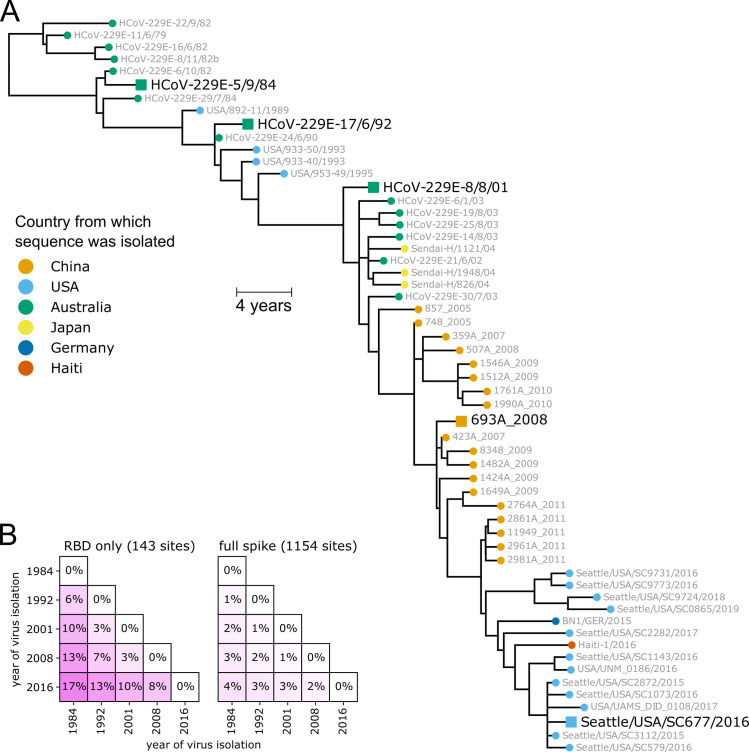
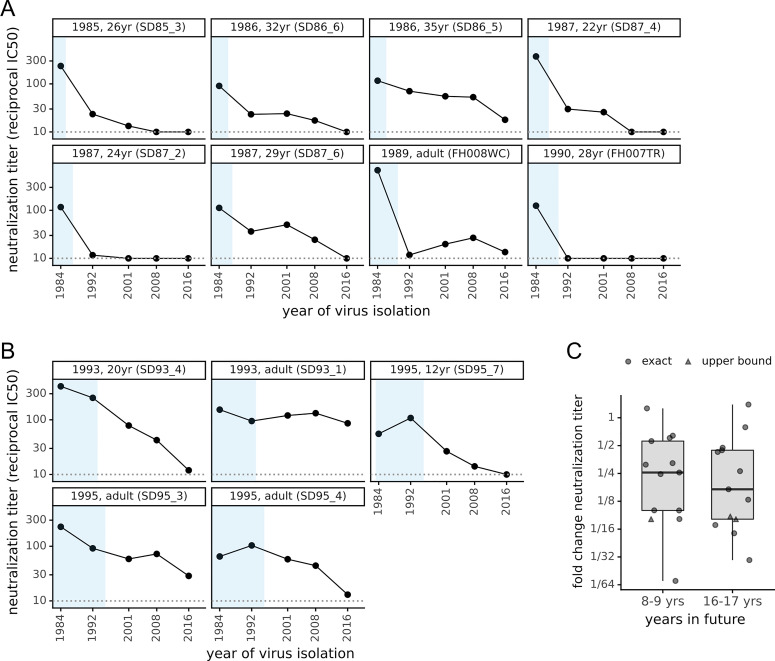
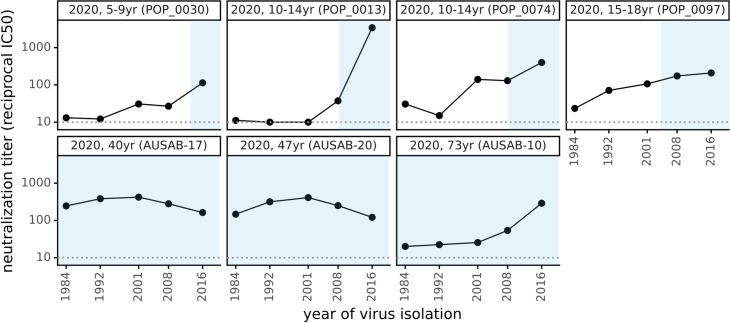
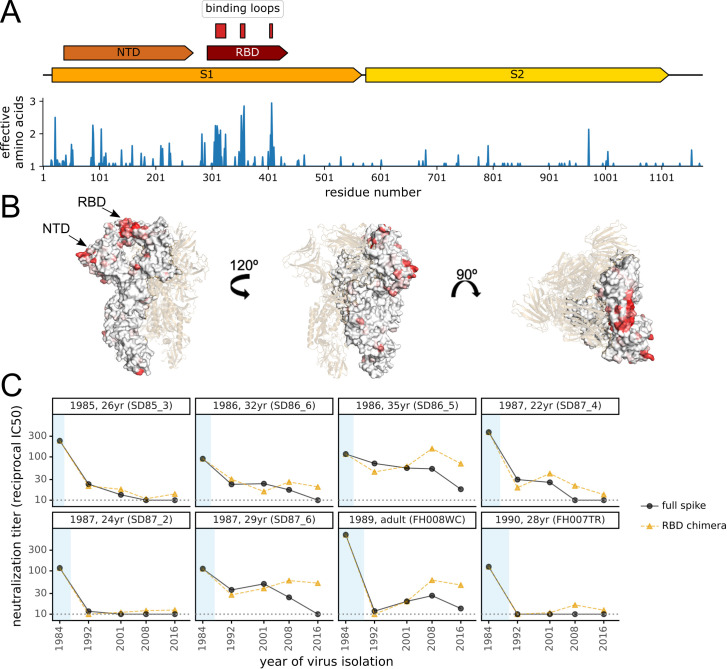
There is intense interest in antibody immunity to coronaviruses. However, it is unknown if coronaviruses evolve to escape such immunity, and if so, how rapidly. Here we address this question by characterizing the historical evolution of human coronavirus 229E. We identify human sera from the 1980s and 1990s that have neutralizing titers against contemporaneous 229E that are comparable to the anti-SARS-CoV-2 titers induced by SARS-CoV-2 infection or vaccination. We test these sera against 229E strains isolated after sera collection, and find that neutralizing titers are lower against these “future” viruses. In some cases, sera that neutralize contemporaneous 229E viral strains with titers >1:100 do not detectably neutralize strains isolated 8–17 years later. The decreased neutralization of “future” viruses is due to antigenic evolution of the viral spike, especially in the receptor-binding domain. If these results extrapolate to other coronaviruses, then it may be advisable to periodically update SARS-CoV-2 vaccines.
Overview
The claims and statistics of this paper haven’t been checked yet.
Run the check — free, no account needed. It reads the open-access text and checks the sources it cites.
Integrity signals
Registry
Cites
Statistics
Figures
Verification
Claims the paper makes
The claims and statistics of this paper haven’t been checked yet.
Run the check — free, no account needed. It reads the open-access text and checks the sources it cites.
Claims other papers make about this one
Each is checked against this paper’s own text: does it say what the citing paper says it does?
The source backs part of the claim, not all of it — or backs it for a different population, condition or comparison.
In the citing paper
“In addition, similar results have been reported by others using vaccinee and convalescent plasmas and a variety of different pseudotype and authentic virus assays15,31,45–49.”
From mRNA vaccine-elicited antibodies to SARS-CoV-2 and circulating variants (2021) · cites this paper as [49]
Experimental — accuracy not yet measured
Self-check
Percentages, sums and reported differences re-computed from the paper’s own numbers.
The self-check needs the paper’s full text.
Citations
Cites
MAFFT Multiple Sequence Alignment Software Version 7: Improvements in Performance and Usability
Katoh, K., & Standley, D. M. (2013) · Molecular Biology and Evolution · doi:10.1093/molbev/mst010 · Cited by 46,209
IQ-TREE 2: New Models and Efficient Methods for Phylogenetic Inference in the Genomic Era
Minh, B. Q., Schmidt, H. A., Chernomor, O., Schrempf, D., Woodhams, M. D., von Haeseler, A., & Lanfear, R. (2020) · Molecular Biology and Evolution · doi:10.1093/molbev/msaa015 · Cited by 16,873
Safety and Efficacy of the BNT162b2 mRNA Covid-19 Vaccine
Polack, F. P., Thomas, S. J., Kitchin, N., Absalon, J., Gurtman, A., Lockhart, S., Perez, J. L., Pérez Marc, G., Moreira, E. D., Zerbini, C., et al. (2020) · New England Journal of Medicine · doi:10.1056/nejmoa2034577 · Cited by 14,592
Structure, function and antigenicity of the SARS-CoV-2 spike glycoprotein
Walls, A. C., Park, Y.-J., Tortorici, M. A., Wall, A., McGuire, A. T., & Veesler, D. (2020) · doi:10.1101/2020.02.19.956581 · Cited by 8,586
ETE 3: Reconstruction, Analysis, and Visualization of Phylogenomic Data
Huerta‐Cepas, J., Serra, F., & Bork, P. (2016) · Molecular Biology and Evolution · doi:10.1093/molbev/msw046 · Cited by 2,255
SARS-CoV-2 vaccines in development
Krammer, F. (2020) · Nature · doi:10.1038/s41586-020-2798-3 · Cited by 2,098
Starr, T. N., Greaney, A. J., Hilton, S. K., Ellis, D., Crawford, K. H. D., Dingens, A. S., Navarro, M. J., Bowen, J. E., Tortorici, M. A., Walls, A. C., et al. (2020) · Cell · doi:10.1016/j.cell.2020.08.012 · Cited by 1,956
Self-citationIdentification of a new human coronavirus
van der Hoek, L., Pyrć, K., Jebbink, M. F., Vermeulen-Oost, W., Berkhout, R. J. M., Wolthers, K. C., Dillen, P. M. E. W., Kaandorp, J. C., Spaargaren, J., & Berkhout, B. (2004) · Nature Medicine · doi:10.1038/nm1024 · Cited by 1,868
Mapping the Antigenic and Genetic Evolution of Influenza Virus
Smith, D. J., Lapedes, A. S., de Jong, J. C., Bestebroer, T. M., Rimmelzwaan, G. F., Osterhaus, A. D. M. E., & Fouchier, R. A. M. (2004) · Science · doi:10.1126/science.1097211 · Cited by 1,868
dendextend: an R package for visualizing, adjusting and comparing trees of hierarchical clustering
Galili, T. (2015) · Bioinformatics · doi:10.1093/bioinformatics/btv428 · Cited by 1,826
Research works printed but not linked: 6
- Crawford, K.H.D. , Dingens, A.S. , Eguia, R. , Wolf, C.R. , Wilcox, N. , Logue, J.K. , Shuey, K. , Casto, A.M. , Fiala, B. , Wrenn, S. , et al. (2020a). Dynamics of neutralizing antibody titers in the months after SARS-CoV-2 infection. J. Infect. Dis. · DOI
- Kemp, S. (2020). Neutralising antibodies drive Spike mediated SARS-CoV-2 evasion | medRxiv. BioRxiv.
- Kemp, S.A. , Collier, D.A. , Datir, R. , Gayed, S. , Jahun, A. , Hosmillo, M. , Ferreira, I. , Rees-Spear, C. , Mlcochova, P. , Lumb, I.U. , et al. (2020). Neutralising antibodies drive Spike mediated SARS-CoV-2 evasion. MedRxiv 2020.12.05.20241927.
- Lumley, S.F. , O’Donnell, D. , Stoesser, N.E. , Matthews, P.C. , Howarth, A. , Hatch, S.B. , Marsden, B.D. , Cox, S. , James, T. , Warren, F. , et al. (2020). Antibodies to SARS-CoV-2 are associated with protection against reinfection. MedRxiv 2020.11.18.20234369. · DOI
- Muñoz-Alía, M.Á. , Nace, R.A. , Zhang, L. , and Russell, S.J. (2020). Pathogenic measles viruses cannot evolve to bypass vaccine-induced neutralizing antibodies. BioRxiv 2020.10.22.351189. · DOI
- Thomson, E. (2020). The circulating SARS-CoV-2 spike variant N439K maintains fitness while evading antibody-mediated immunity | bioRxiv. BioRxiv.
Cited by
Sorted by citations
Items 201–257 of 257
WITHDRAWNPreprint
Datta, S. (2020) · ChemRxiv · doi:10.26434/chemrxiv.13102877.v15 · Cited by 1
WITHDRAWNPreprint
Datta, S. (2021) · ChemRxiv · doi:10.26434/chemrxiv-2021-l393t-v33 · Cited by 1
Lakhera, S., Devlal, K., Rana, M. M., & Ghosh, A. (2022) · Research Square · doi:10.21203/rs.3.rs-1675533/v1 · Cited by 1
The Effect of Hindlimb Studs on Movement Symmetry in Horses During Lungeing
Sharp, H., Pfau, T., & Hopkins, S. (2014) · Equine Veterinary Journal · doi:10.1111/evj.12323_45
P.8.8 Basement membrane deposition during muscle development in the FKRP Deficient Mouse
Kim, J., Fuente-Fernandez, M., Kavishwar, M., & Brown, S. (2013) · Neuromuscular Disorders · doi:10.1016/j.nmd.2013.06.509
Read, J., Cabrera-Sharp, V., Mirczuk, S. M., Fowkes, R. C., & de, M. A. (2015) · Endocrine Abstracts · doi:10.1530/endoabs.38.p373
Deakin, C. T., Cornish, G. H., Ng, K. W., Faulkner, N., Bolland, W., Panova, V., Hope, J., Rosa, A., Harvey, R., Hussain, S., et al. (2021) · bioRxiv (Cold Spring Harbor Laboratory) · doi:10.1101/2021.02.15.431291
WITHDRAWNPreprint
Datta, S. (2021) · ChemRxiv · doi:10.26434/chemrxiv.13102877.v32
Blast from the past for coronavirus immunity
Hofer, U. (2021) · Nature Reviews Microbiology · doi:10.1038/s41579-021-00566-z
Attenuated Cd8+ T Cell Activation and Infiltration of the Lungs in Severe COVID-19Preprint
Kaneko, N., Boucau, J., Kuo, H.-H., Perugino, C. A., Mahajan, V. S., Farmer, J. R., Liu, H., Diefenbach, T. J., Trocha, A. K., Lefteri, K., et al. (2021) · SSRN Electronic Journal · doi:10.2139/ssrn.3866846
Datta, S. (2021) · doi:10.33774/chemrxiv-2021-l393t-v35
La ética de la autenticidad en el nuevo marco cultural: pensando a Taylor
Esquíroz, S., & Pilar, M. (2014) · LA Referencia (Red Federada de Repositorios Institucionales de Publicaciones Científicas)
Gan, S. K., Phua, S.-X., & Yeo, J. Y. (2021) · Preprints.org · doi:10.20944/preprints202109.0501.v2
WITHDRAWNPreprint
Datta, S. (2021) · ChemRxiv · doi:10.26434/chemrxiv.13102877.v31
Datta, S. (2021) · doi:10.33774/chemrxiv-2021-l393t-v33
COVID-19 Vaccine Hesitancy among Health Workers in Surgical Departments in Port Harcourt, Nigeria
Promise, N. W., Rex, F. O. A. I., & Friday, E. A. (2022) · African Journal of Biology and Medical Research · doi:10.52589/ajbmr-nyieprr0
Aktuelle Informationen zur Omicron-Variante
Hasibeder, W. R. (2022) · Anästhesie Nachrichten · doi:10.1007/s44179-022-00008-y
Štetje ovinkov do endemičnosti
Praznik, A. (2022) · Alternator · doi:10.3986/alternator.2022.08
WITHDRAWNPreprint
Datta, S. (2021) · ChemRxiv · doi:10.26434/chemrxiv.13102877.v19
Datta, S. (2021) · doi:10.33774/chemrxiv-2021-l393t-v36
WITHDRAWNPreprint
Datta, S. (2021) · ChemRxiv · doi:10.26434/chemrxiv.13102877.v20
WITHDRAWNPreprint
Datta, S. (2021) · ChemRxiv · doi:10.26434/chemrxiv.13102877.v25
WITHDRAWNPreprint
Datta, S. (2021) · ChemRxiv · doi:10.26434/chemrxiv.13102877.v26
WITHDRAWNPreprint
Datta, S. (2021) · ChemRxiv · doi:10.26434/chemrxiv.13102877.v28
WITHDRAWNPreprint
Datta, S. (2020) · ChemRxiv · doi:10.26434/chemrxiv.13102877.v14
WITHDRAWNPreprint
Datta, S. (2021) · ChemRxiv · doi:10.26434/chemrxiv.13102877.v24
WITHDRAWNPreprint
Datta, S. (2021) · ChemRxiv · doi:10.26434/chemrxiv.13102877.v18
WITHDRAWNPreprint
Datta, S. (2021) · ChemRxiv · doi:10.26434/chemrxiv.13102877.v17
WITHDRAWNPreprint
Datta, S. (2021) · ChemRxiv · doi:10.26434/chemrxiv.13102877.v29
WITHDRAWNPreprint
Datta, S. (2021) · ChemRxiv · doi:10.26434/chemrxiv-2021-l393t-v34
WITHDRAWNPreprint
Datta, S. (2021) · ChemRxiv · doi:10.26434/chemrxiv.13102877.v22
WITHDRAWNPreprint
Datta, S. (2021) · ChemRxiv · doi:10.26434/chemrxiv.13102877.v27
WITHDRAWNPreprint
Datta, S. (2021) · ChemRxiv · doi:10.26434/chemrxiv.13102877.v23
Datta, S. (2021) · doi:10.33774/chemrxiv-2021-l393t-v34
British Society for Matrix Biology Autumn 2017 Meeting: Translating the Matrix
Juskaite, V, Corcoran, D., & Leitinger, B. (2017) · International Journal of Experimental Pathology · doi:10.1111/iep.12256
Lakhera, S., Devlal, K., Rana, M. M., & Ghosh, A. (2022) · Research Square · doi:10.21203/rs.3.rs-1637533/v1
Louten, J. (2022) · Elsevier eBooks · doi:10.1016/b978-0-323-90565-7.00014-9
Perspective Chapter: Bioinformatics Study of the Evolution of SARS-CoV-2 Spike Protein
Podlipnik, Č., Alexandrova, R., Pleško, S., Bren, U., & Jukič, M. (2022) · Infectious diseases · doi:10.5772/intechopen.105915
What are the prospects for durable immune control?
Lelièvre, J., & Bauer, J. (2022) · Infectious Diseases Now · doi:10.1016/j.idnow.2022.09.010
Long-range Hill-Robertson effect in adapting populations with recombination and standing variationPreprint
Rouzine, I. M. (2022) · bioRxiv (Cold Spring Harbor Laboratory) · doi:10.1101/2022.11.07.515399
Covid-19 for the Primary Care Clinician: Current Recommendations—Don’t Blink!
Love, M. (2022) · Springer eBooks · doi:10.1007/978-3-031-15353-2_2
Does the SARS-CoV-2 spike really have an Achilles heel?
Pillai, S. S. (2023) · Journal of Clinical Investigation · doi:10.1172/jci168080
An ACE2 decamer viral trap as a durable intervention solution for current and future SARS-CoVPreprint
Guo, H., Cho, B., Hinton, P. R., He, S., Yu, Y., Ramesh, A. K., Sivaccumar, J. P., Ku, Z., Campo, K., Holland, S., et al. (2023) · bioRxiv (Cold Spring Harbor Laboratory) · doi:10.1101/2023.07.10.548424
Neerukonda, S. N., Vassell, R. A., Lusvarghi, S., Liu, S., Akue, A. D., KuKuruga, M. A., Wang, T. T., Weiss, C. D., & Wang, W. (2024) · bioRxiv (Cold Spring Harbor Laboratory) · doi:10.1101/2024.04.12.589332
Dissecting serum polyclonal antibody escape to SARS-CoV-2 variants by deep mutational learning
Shlesinger, D., Sadílek, V., Minot, M., Stamkopoulos, E. T., Bikias, T., Kuhn, R., Agrafiotis, A., Taft, J. M., Yermanos, A., & Reddy, S. T. (2025) · bioRxiv · doi:10.1016/j.crmeth.2026.101417 · Cited by 1
Englund, J. A., Kim, Y.-J., McIntosh, K., Maurice, A. D. S., Freeman, M. C., & Denison, M. R. (2025) · Elsevier eBooks · doi:10.1016/b978-0-323-82763-8.00201-6
Self-citationLeung, C., Su, L., Zdanowicz, A., Collins, L., & Silva, A. C. S. E. (2025) · Human Vaccines & Immunotherapeutics · doi:10.1080/21645515.2025.2516314
Jung, I., Sriramulu, D. K., Yoon, J. H., Lee, J., Kim, T. W., Kweon, D., Lee, S., & Jung, S. T. (2025) · Molecular Pharmaceutics · doi:10.1021/acs.molpharmaceut.4c01169
The evolutionary battle: data-driven analysis of SARS-CoV-2 virulence
Yin, K., Wang, Y., & Meng, X. (2025) · Computer Methods in Biomechanics & Biomedical Engineering · doi:10.1080/10255842.2025.2582765
Habibzadeh, F. (2023) · Figshare · doi:10.6084/m9.figshare.23498119
A neutralizing human antibody induces movement of the HCoV-229E receptor binding domain
Liccione, M. F., Scobey, T., Froggatt, H. M., Pajon, C., Yount, B. L., Yin, Q., Spence, T. N., Walter, E. B., Saunders, K. O., Edwards, R. J., et al. (2025) · Communications Biology · doi:10.1038/s42003-025-09446-1 · Cited by 1
Oh, M.-R., Han, J. S., Jang, S. H., Kim, G.-Y., & Kim, J. K. (2026) · Pathogens · doi:10.3390/pathogens15020231
Cueno, M. E., Tamura, H., & Imai, K. (2026) · In Silico Research in Biomedicine · doi:10.1016/j.insi.2026.100282
Lin, S., Zhang, G., Wang, Q., Niu, K., & Liu, Q. (2026) · Viruses · doi:10.3390/v18070745
Santos, A. D. S., de Araújo, L. P., Orts, D. J. B., da Costa, H. H. M., Matteucci, K. C., Silva, E. N., Oliveira, K. C., Galdino, G., Prudêncio, C. R., Corsetti, P. P., et al. (2026) · Frontiers in Immunology · doi:10.3389/fimmu.2026.1775087
Vaccination accelerates the race of influenza virus against collective immunity
Rouzine, I. M. (2026) · PLoS Pathogens · doi:10.1371/journal.ppat.1014311
Metadata
- Authors
- Eguia, R., Crawford, K. H. D., Stevens-Ayers, T., Kelnhofer-Millevolte, L., Greninger, A. L., Englund, J. A., Boeckh, M. J., & Bloom, J. D.
- Affiliations
- Fred Hutch Cancer Center (US)
- University of Washington (US)
- Howard Hughes Medical Institute (US)
- Corresponding author
- Bloom, Jesse D.
- ORCID
- Venue
- PLoS Pathogens
- Publisher
- openRxiv
- Published
- 2020-12-18
- Volume
- 17
- Issue
- 4
- Pages
- e1009453-e1009453
- ISSN
- 1553-7366 (ISSN-L)
- PMC
- PMC8031418
- OpenAlex
- W3144378969
- Cited by
- 258
- References
- 101
- Citations by year
- 2026: 7 · 2025: 21 · 2024: 11 · 2023: 33 · 2022: 69 · 2021: 103 · 2020: 2
- FWCI
- 17.09
- Type
- journal article
- Language
- en
- Open access
- gold
- doi.org
- Licence
- cc-by
- Locations
- PLoS Pathogens (publishedVersion, cc-by)
- bioRxiv (Cold Spring Harbor Laboratory) (acceptedVersion, cc-by)
- PubMed Central (publishedVersion, cc-by)
- PubMed (publishedVersion)
- DOAJ (DOAJ: Directory of Open Access Journals) (submittedVersion, cc-by-sa)
- Funders
- Howard Hughes Medical Institute
- Pfizer
- AstraZeneca
- GlaxoSmithKline
- Sanofi
- Fred Hutchinson Cancer Research Center
- Regeneron Pharmaceuticals
- Moderna
- National Institutes of Health
- Sanofi Pasteur
- National Institute of General Medical Sciences (T32GM007266)
- National Institute of Allergy and Infectious Diseases (R01AI127893, F30AI149928, R01AI141707)
- Topics
- Health Sciences › Medicine › Infectious Diseases › SARS-CoV-2 and COVID-19 Research
- Life Sciences › Agricultural and Biological Sciences › Animal Science and Zoology › Animal Virus Infections Studies
- Life Sciences › Biochemistry, Genetics and Molecular Biology › Molecular Biology › vaccines and immunoinformatics approaches
- Keywords
- HCoV-229E, antigenic evolution, antibody escape, neutralizing antibodies, spike protein, receptor binding domain, coronavirus evolution
- MeSH terms
- SARS-CoV-2, Antibodies, Viral, Humans, Coronavirus 229E, Human, Immune Evasion, Antibodies, Neutralizing
About these checks
Registry, retraction, Cites and statistics results are computed, not judged, with one exception: a printed reference that no index lists is read once by a model before it counts as a citation error. Claims are extracted by a model and kept only when their quote appears verbatim in the text; each cited source is then checked, with a model’s help, for whether it says what the claim relies on. Those verdicts can be wrong — read the claim’s quote and the cited source before relying on one.
Statistics and arithmetic are recomputed, not judged.
Confidence bands are shown only for fields calibrated on our annotated test set. None is calibrated yet, so no band is shown.
What counts as a claim ›How we measure confidence ›How we check this ›
Are you an author, or do you see a problem with this page? Request a review
