

The DOI matches its Crossref record; 123 of the 124 references it cites were found in a registry or an index, and 1 are not checked yet.
Structural and functional ramifications of antigenic drift in recent SARS-CoV-2 variants
Open accessAbstract
The protective efficacy of neutralizing antibodies (nAbs) elicited during natural infection with SARS-CoV-2 and by vaccination based on its spike protein has been compromised with emergence of the recent SARS-CoV-2 variants. Residues E484 and K417 in the receptor-binding site (RBS) are both mutated in lineages first described in South Africa (B.1.351) and Brazil (B.1.1.28.1). The nAbs isolated from SARS-CoV-2 patients are preferentially encoded by certain heavy-chain germline genes and the two most frequently elicited antibody families (IGHV3-53/3-66 and IGHV1-2) can each bind the RBS in two different binding modes. However, their binding and neutralization are abrogated by either the E484K or K417N mutation, whereas nAbs to the cross-reactive CR3022 and S309 sites are largely unaffected. This structural and functional analysis illustrates why mutations at E484 and K417 adversely affect major classes of nAbs to SARS-CoV-2 with consequences for next-generation COVID-19 vaccines.
Overview
The claims and statistics of this paper haven’t been checked yet.
Run the check — free, no account needed. It reads the open-access text and checks the sources it cites.
Integrity signals
Registry
Cites
Statistics
Figures
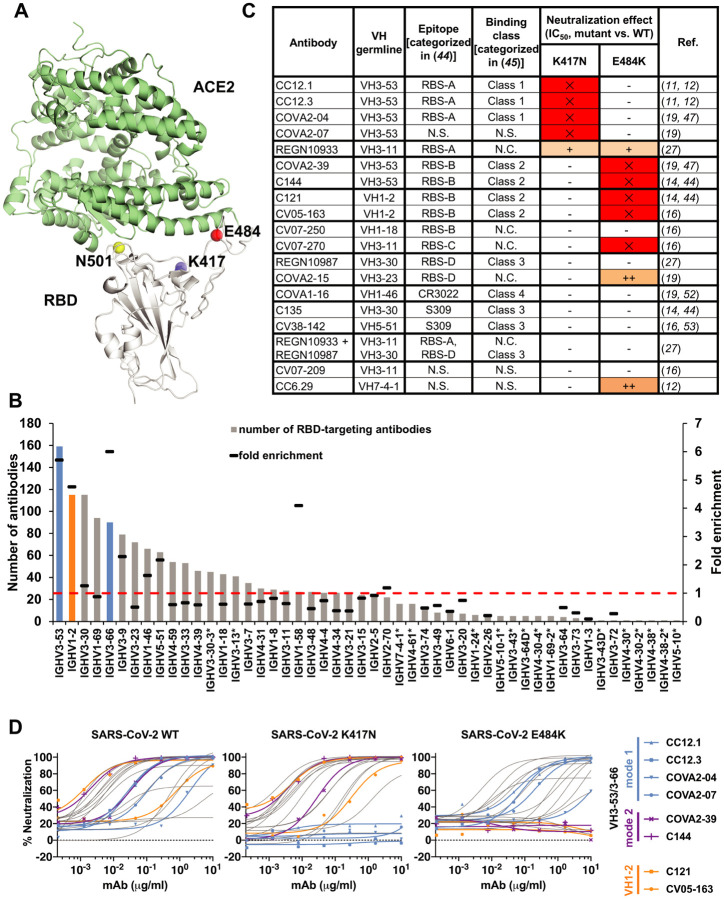
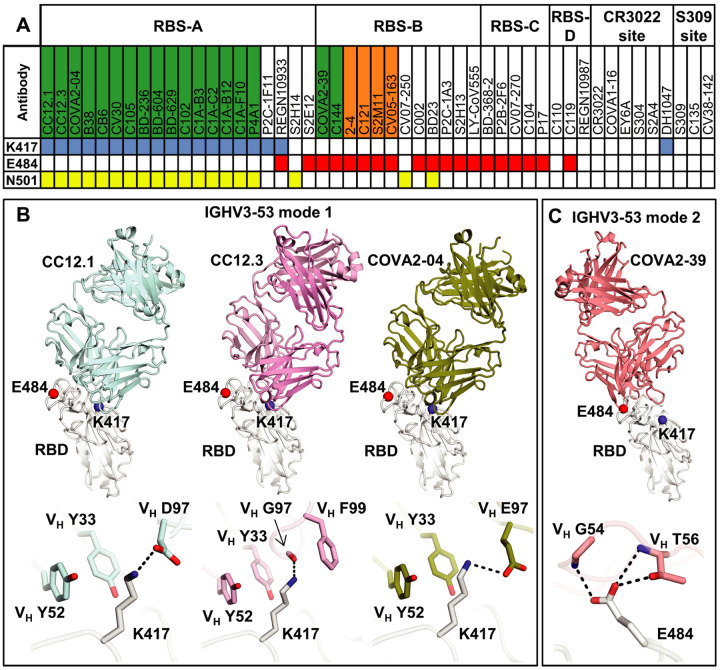
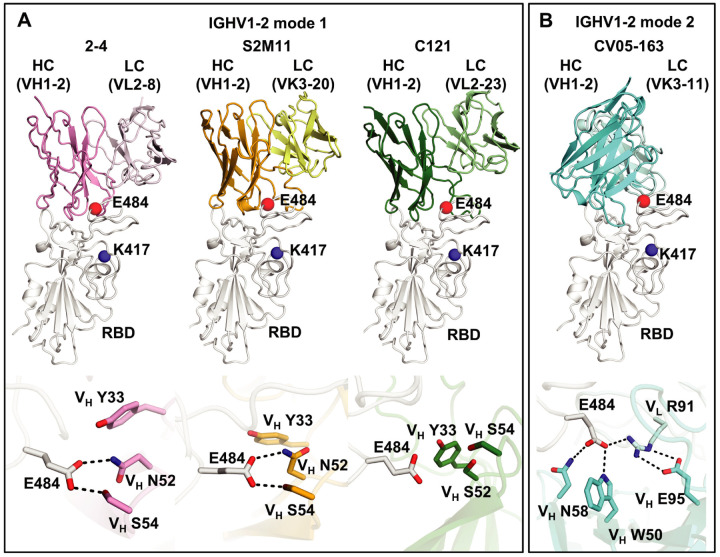
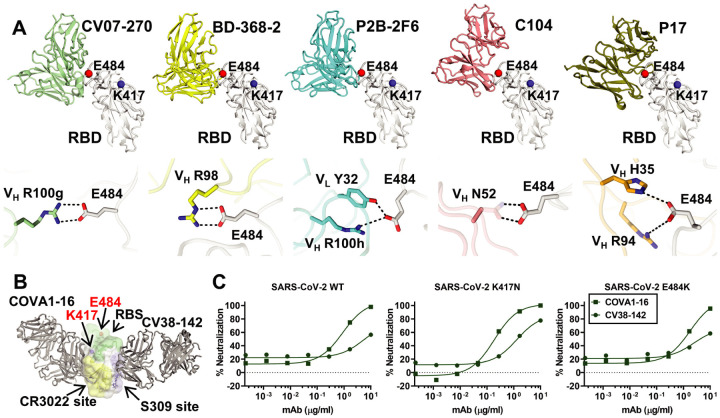
Verification
Claims the paper makes
The claims and statistics of this paper haven’t been checked yet.
Run the check — free, no account needed. It reads the open-access text and checks the sources it cites.
Claims other papers make about this one
Each is checked against this paper’s own text: does it say what the citing paper says it does?
In the citing paper
“The B.1.351 and P.1 variants have a glutamate (E) to lysine (K) mutation at position 484 (E484K) in the receptor-binding domain of the spike protein, which promotes immune evasion207.”
From mRNA vaccines for infectious diseases: principles, delivery and clinical translation (2021) · cites this paper as [207]
Self-check
Percentages, sums and reported differences re-computed from the paper’s own numbers.
The self-check needs the paper’s full text.
Citations
Cites
UCSF Chimera—A visualization system for exploratory research and analysis
Pettersen, E. F., Goddard, T. D., Huang, C. C., Couch, G. S., Greenblatt, D. M., Meng, E. C., & Ferrin, T. E. (2004) · Journal of Computational Chemistry · doi:10.1002/jcc.20084 · Cited by 45,882
[20] Processing of X-ray diffraction data collected in oscillation mode
Otwinowski, Z., & Minor, W. (1997) · Methods in Enzymology · doi:10.1016/s0076-6879(97)76066-x · Cited by 33,475
Features and development of Coot
Emsley, P., Lohkamp, B., Scott, W. G., & Cowtan, K. (2010) · Acta Crystallographica Section D Biological Crystallography · doi:10.1107/s0907444910007493 · Cited by 29,915
PHENIX : a comprehensive Python-based system for macromolecular structure solution
Adams, P. D., Afonine, P. V., Bunkóczi, G., Chen, V. B., Davis, I. W., Echols, N., Headd, J. J., Hung, L.-W., Kapral, G. J., Grosse-Kunstleve, R. W., et al. (2010) · Acta Crystallographica Section D Biological Crystallography · doi:10.1107/s0907444909052925 · Cited by 23,716
Phaser crystallographic software
McCoy, A. J., Grosse-Kunstleve, R. W., Adams, P. D., Winn, M. D., Storoni, L. C., & Read, R. J. (2007) · Journal of Applied Crystallography · doi:10.1107/s0021889807021206 · Cited by 20,612
NMRPipe: A multidimensional spectral processing system based on UNIX pipes
Delaglio, F., Grzesiek, S., Vuister, G. W., Zhu, G., Pfeifer, J., & Bax, A. (1995) · Journal of Biomolecular NMR · doi:10.1007/bf00197809 · Cited by 15,961
Inference of Macromolecular Assemblies from Crystalline State
Krissinel, E., & Henrick, K. (2007) · Journal of Molecular Biology · doi:10.1016/j.jmb.2007.05.022 · Cited by 10,007
Structure, function and antigenicity of the SARS-CoV-2 spike glycoprotein
Walls, A. C., Park, Y.-J., Tortorici, M. A., Wall, A., McGuire, A. T., & Veesler, D. (2020) · doi:10.1101/2020.02.19.956581 · Cited by 8,586
PHENIX: a comprehensive Python-based system for macromolecular structure solution
Adams, P. D., Afonine, P. V., Bunkòczi, G., Chen, V. B., Davis, I., Echols, N., Headd, J. J., Hung, L., Kapral, G. J., Grosse‐Kunstleve, R. W., et al. (2012) · International Tables for Crystallography · doi:10.1107/97809553602060000865 · Cited by 7,334
Structure of the SARS-CoV-2 spike receptor-binding domain bound to the ACE2 receptor
Lan, J., Ge, J., Yu, J., Shan, S., Zhou, H., Fan, S., Zhang, Q., Shi, X., Wang, Q., Zhang, L., et al. (2020) · Nature · doi:10.1038/s41586-020-2180-5 · Cited by 5,983
Research works printed but not linked: 20
- 10.1101/2020.08.19.253369 · DOI
- 10.1101/2020.10.06.323634 · DOI
- 10.1101/2020.12.31.424987 · DOI
- 10.1126/science.abb7269 · DOI
- 10.1126/science.abc7520 · DOI · Paper page
- 10.1016/j.bbrc.2020.10.012 · DOI
- 10.1126/science.abd2321 · DOI · Paper page
- 10.1126/science.abc2241 · DOI
- 2020, A human neutralizing antibody targets the receptor-binding site of SARS-CoV-2, Nature, 584, 120, 10.1038/s41586-020-2381-y · DOI · Paper page
- 10.1038/s41467-020-19231-9 · DOI
- 10.1016/j.cell.2020.06.025 · DOI · Paper page
- 2020, Structurally resolved SARS-CoV-2 antibody shows high efficacy in severely infected hamsters and provides a potent cocktail pairing strategy, Cell, 183, 1013, 10.1016/j.cell.2020.09.035 · DOI
- 2020, SARS-CoV-2 neutralizing antibody structures inform therapeutic strategies, Nature, 588, 682, 10.1038/s41586-020-2852-1 · DOI · Paper page
- 10.1101/2020.11.13.381533 · DOI
- 10.21203/rs.3.rs-78945/v1 · DOI
- 10.1038/s41586-020-2571-7 · DOI · Paper page
- 10.1126/science.abe3354 · DOI · Paper page
- 2020, Structure of the SARS-CoV-2 spike receptor-binding domain bound to the ACE2 receptor, Nature, 581, 215, 10.1038/s41586-020-2180-5 · DOI · Paper page
- 2020, Convergent antibody responses to SARS-CoV-2 in convalescent individuals, Nature, 584, 437, 10.1038/s41586-020-2456-9 · DOI · Paper page
- 10.1126/science.abd0827 · DOI · Paper page
Cited by
Sorted by citations
Omicron escapes the majority of existing SARS-CoV-2 neutralizing antibodies
Cao, Y., Wang, J., Jian, F., Xiao, T., Song, W., Yisimayi, A., Huang, W., Li, Q., Wang, P., An, R., et al. (2022) · Nature · doi:10.1038/s41586-021-04385-3 · Cited by 2,006
mRNA vaccines for infectious diseases: principles, delivery and clinical translation
Chaudhary, N., Weissman, D., & Whitehead, K. A. (2021) · Nature Reviews Drug Discovery · doi:10.1038/s41573-021-00283-5 · Cited by 1,555
BA.2.12.1, BA.4 and BA.5 escape antibodies elicited by Omicron infection
Cao, Y., Yisimayi, A., Jian, F., Song, W., Xiao, T., Wang, L., Du, S., Wang, J., Li, Q., Chen, X., et al. (2022) · Nature · doi:10.1038/s41586-022-04980-y · Cited by 1,306
Structural basis of SARS-CoV-2 Omicron immune evasion and receptor engagement
McCallum, M., Czudnochowski, N., Rosen, L. E., Zepeda, S. K., Bowen, J. E., Walls, A. C., Hauser, K., Joshi, A., Stewart, C., Dillen, J. R., et al. (2022) · Science · doi:10.1126/science.abn8652 · Cited by 535
“The K417N mutation dampens receptor recognition by about 3-fold ( 2 , 6 , 39 , 45 ) likely through loss of a salt bridge with ACE2 D30 (Fig.”
Mapping mutations to the SARS-CoV-2 RBD that escape binding by different classes of antibodies
Greaney, A. J., Starr, T. N., Barnes, C. O., Weisblum, Y., Schmidt, F., Caskey, M., Gaebler, C., Cho, A., Agudelo, M., Finkin, S., et al. (2021) · Nature Communications · doi:10.1038/s41467-021-24435-8 · Cited by 433
Metadata
- Authors
- Yuan, M., Huang, D., Lee, C.-C. D., Wu, N. C., Jackson, A. M., Zhu, X., Liu, H., Peng, L., van Gils, M. J., Sanders, R. W., Burton, D. R., Reincke, S. M., Prüss, H., Kreye, J., Nemazee, D., Ward, A. B., & Wilson, I. A.
- Affiliations
- Scripps Research Institute (US)
- University of Illinois Urbana-Champaign (US)
- Cornell University (US)
- German Center for Neurodegenerative Diseases (DE)
- Corresponding author
- Wilson, Ian A.
- ORCID
- Venue
- Science
- Publisher
- openRxiv
- Published
- 2021-02-17
- Volume
- 373
- Issue
- 6556
- Pages
- 818-823
- ISSN
- 0036-8075 (ISSN-L)
- PMC
- PMC7899451
- OpenAlex
- W3160471157
- Cited by
- 364
- References
- 112
- Citations by year
- 2026: 11 · 2025: 27 · 2024: 35 · 2023: 60 · 2022: 138 · 2021: 92
- FWCI
- 25.73
- Type
- journal article
- Language
- en
- Open access
- hybrid
- doi.org
- Licence
- cc-by
- Locations
- Science (publishedVersion, cc-by)
- bioRxiv (Cold Spring Harbor Laboratory) (acceptedVersion, cc-by-nc)
- PubMed Central (publishedVersion, cc-by)
- PubMed (publishedVersion)
- Pure Amsterdam UMC (submittedVersion, cc-by)
- PubMed Central (submittedVersion, cc-by-nc)
- Data Archiving and Networked Services (DANS) (submittedVersion, other-oa)
- OSTI OAI (U.S. Department of Energy Office of Scientific and Technical Information) (submittedVersion)
- DZNE Pub (submittedVersion)
- Funders
- U.S. Department of Energy (DE‐ AC02‐06CH11357, COVID-19, Contract No. DE-AC02-06CH11357., AC02‐06CH11357, 06CH11357, No. DE-AC02-06CH11357, DE-AC02-)
- Bill and Melinda Gates Foundation (INV-004923, OPP1170236, OPP1170236 and INV-004923)
- Helmholtz-Gemeinschaft (HIL-A03 and SO-097)
- Deutsche Forschungsgemeinschaft (PR1274/5–1, and PR 1274/5-1, DE-AC02-06CH11357, PR1274/3–1, PR 1274/3-1, and PR 1274/5-1)
- Bundesministerium für Bildung und Forschung (01GM1908D)
- Nederlandse Organisatie voor Wetenschappelijk Onderzoek
- National Institutes of Health (COVID-19, DE-AC02–06CH11357, AI110657)
- Office of Science (Contract No. DE-AC02-06CH11357, AC02‐06CH11357, DE-AC02, No. DE-AC02-06CH11357., 06CH11357, DE-AC02-06CH11357)
- National Institute of Allergy and Infectious Diseases (R01AI142945, R01AI132317, P01AI110657, R00AI139445)
- Argonne National Laboratory (DE- AC02-06-CH11357, DE-AC02, AC02–06CH11357, No. DE-AC02-06CH11357, 06CH11357, Contract No. DE-AC02-06CH11357.)
- Topics
- Health Sciences › Medicine › Infectious Diseases › SARS-CoV-2 and COVID-19 Research
- Life Sciences › Biochemistry, Genetics and Molecular Biology › Molecular Biology › vaccines and immunoinformatics approaches
- Life Sciences › Agricultural and Biological Sciences › Animal Science and Zoology › Animal Virus Infections Studies
- Keywords
- SARS-CoV-2, antigenic drift, Beta variant, P.1, spike protein mutations, K417N, E484K, receptor binding sites, ACE2 binding, neutralizing antibodies, CR3022, vaccine design, antibody therapy
About these checks
Registry, retraction, Cites and statistics results are computed, not judged, with one exception: a printed reference that no index lists is read once by a model before it counts as a citation error. Claims are extracted by a model and kept only when their quote appears verbatim in the text; each cited source is then checked, with a model’s help, for whether it says what the claim relies on. Those verdicts can be wrong — read the claim’s quote and the cited source before relying on one.
Statistics and arithmetic are recomputed, not judged.
Confidence bands are shown only for fields calibrated on our annotated test set. None is calibrated yet, so no band is shown.
What counts as a claim ›How we measure confidence ›How we check this ›
Are you an author, or do you see a problem with this page? Request a review
