

Structural Coverage of the Human Interactome
Open accessPreprint — published as 10.1093/bib/bbad496 · Paper page
The DOI matches its Crossref record; 1 of the 1 references it cites were found in a registry or an index.
Abstract
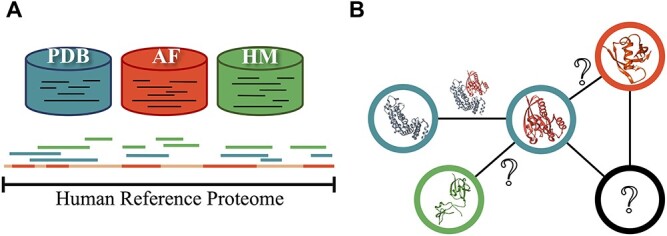
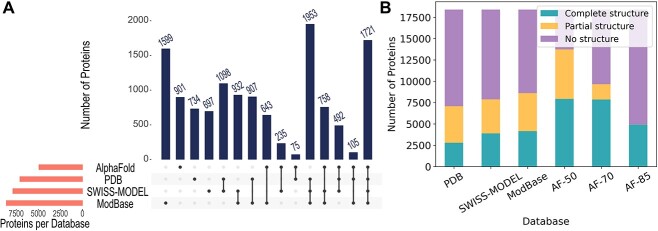
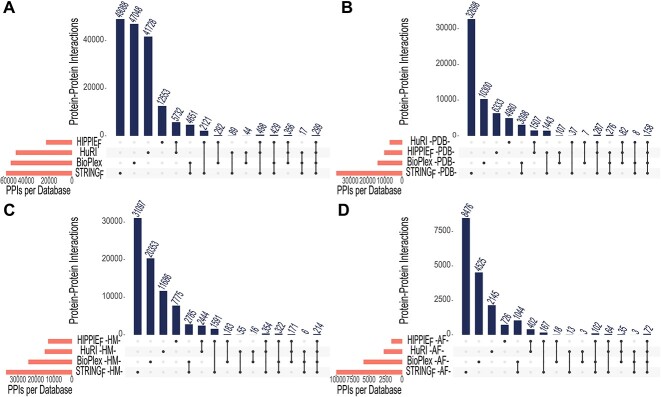
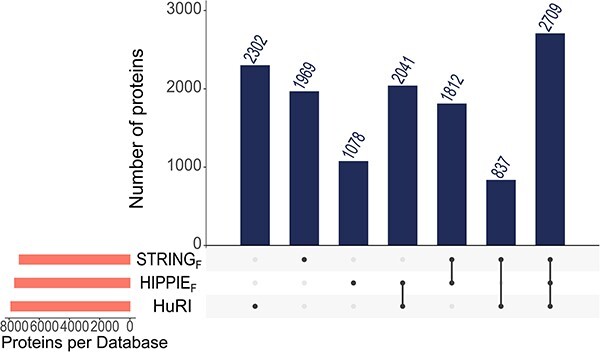
Complex biological processes in cells are embedded in the interactome, representing the complete set of protein-protein interactions. Mapping and analyzing the protein structures are essential to fully comprehending these processes’ molecular details. Therefore, knowing the structural coverage of the interactome is essential to show the current limitations. Structural modeling of protein-protein interactions requires accurate protein structures. In this study, we mapped all experimental structures to the reference human proteome. Later, we found the enrichment in structural coverage when complementary methods such as homology modeling and deep learning (AlphaFold) are included. We then collected the interactions from the literature and databases to form the reference human interactome resulting in 117,897 non-redundant interactions. When we analyzed the structural coverage of the interactome, we found that the number of experimentally determined protein complex structures is scarce, corresponding to 3.95% of all binary interactions. We also analyzed known and modeled structures to potentially construct the structural interactome with a docking method. Our analysis showed that 12.97% of the interactions from HuRI, 73.62%, and 32.94% from the filtered versions of STRING and HIPPIE could potentially be modeled with a high structural coverage or accuracy, respectively. Overall, this paper provides an overview of the current state of structural coverage of the human proteome and interactome. Significance Statement: We gathered binary protein-protein interactions from three prominent interactome databases to create a comprehensive human reference interactome. We quantified the structural coverage of the human interactome using already available structural data from four different sources. We further evaluate the percentage of interactions that can be accurately predicted using docking methods.
Overview
The claims and statistics of this paper haven’t been checked yet.
Free: it reads the open-access text and checks the first 5 claims that cite a source we can check. Create a free account to check every claim.
Integrity signals
Registry
Cites
Statistics
Figures
Verification
Claims the paper makes
The claims and statistics of this paper haven’t been checked yet.
Free: it reads the open-access text and checks the first 5 claims that cite a source we can check. Create a free account to check every claim.
Self-check
Percentages, sums and reported differences re-computed from the paper’s own numbers.
The self-check needs the paper’s full text.
Citations
Cites
Highly accurate protein structure prediction with AlphaFold
Jumper, J., Evans, R., Pritzel, A., Green, T., Figurnov, M., Ronneberger, O., Tunyasuvunakool, K., Bates, R., Žídek, A., Potapenko, A., et al. (2021) · Nature · doi:10.1038/s41586-021-03819-2 · Cited by 43,764
Research works printed but not linked: 56
- 10.1371/journal.pcbi.0030042 · DOI · Paper page
- 10.1016/B978-0-12-417150-3.00015-6 · DOI
- 10.1038/nmeth.4540 · DOI · Paper page
- 10.1038/nmeth.2289 · DOI · Paper page
- 10.1016/j.cell.2015.06.043 · DOI · Paper page
- 10.1093/database/baz005 · DOI · Paper page
- 10.1093/NAR/GKAB1034 · DOI · Paper page
- 10.1093/database/baab036 · DOI
- 10.1093/nar/gky1131 · DOI · Paper page
- 10.1093/nar/gkw985 · DOI · Paper page
- 10.1093/nar/28.1.289 · DOI · Paper page
- 10.1093/bioinformatics/btaa1070 · DOI
- 10.1093/nar/gkl950 · DOI · Paper page
- 10.1093/nar/gkj109 · DOI · Paper page
- 10.1038/s41586-020-2188-x · DOI · Paper page
- 10.15252/msb.202010016 · DOI · Paper page
- 10.1101/2023.04.24.538110 · DOI
- 2023, Protein complexes in cells by AI-assisted structural proteomics, Molecular Systems Biology, 19, e11544, 10.15252/msb.202311544 · doi:10.15252/msb.202311544
- 10.1093/nar/gks1231 · DOI · Paper page
- 10.1038/nrm1859 · DOI · Paper page
- 10.1002/prot.24235 · DOI · Paper page
- 10.1016/j.sbi.2021.11.012 · DOI · Paper page
- 10.1016/j.molcel.2013.01.003 · DOI · Paper page
- 10.1146/annurev-biophys-051013-022726 · DOI · Paper page
- 10.1038/nprot.2011.367 · DOI · Paper page
- 10.1021/acs.chemrev.5b00683 · DOI · Paper page
- 10.1016/j.pbiomolbio.2014.06.003 · DOI · Paper page
- 10.1021/ci300072q · DOI
- 2012, Protein-protein Interfaces Integrated into Interaction Networks: Implications on Drug Design, Current Pharmaceutical Design, 18, 4697, 10.2174/138161212802651643 · DOI
- 10.1007/978-1-4939-6783-4_12 · DOI
- 10.1038/srep13128 · DOI
- 10.1371/journal.pone.0081035 · DOI · Paper page
- 10.1186/1471-2164-15-S9-S2 · DOI
- 10.1371/journal.pcbi.1003470 · DOI · Paper page
- 10.1016/j.bpj.2015.06.048 · DOI
- 10.1021/acs.jproteome.2c00498 · DOI
- 10.1038/nsb1203-980 · DOI · Paper page
- 10.1093/nar/gkt1144 · DOI · Paper page
- 10.1093/nar/gkw1132 · DOI · Paper page
- 10.1038/s41467-022-29394-2 · DOI · Paper page
- 10.1038/s41467-022-28865-w · doi:10.1038/s41467-022-28865-w · Paper page
- 10.1093/bioinformatics/btab353 · DOI · Paper page
- 10.1038/s41594-022-00910-8 · DOI · Paper page
- 10.1371/journal.pcbi.1009818 · DOI · Paper page
- 10.1186/1748-7188-5-34 · DOI
- 10.1016/bs.mcb.2015.03.012 · DOI
- 10.1093/nar/gky1015 · DOI · Paper page
- 10.1038/s41467-023-38063-x · DOI · Paper page
- 10.1093/bioinformatics/btp163 · DOI · Paper page
- 10.1093/nar/gkab1061 · DOI · Paper page
- 10.1093/bioinformatics/btz828 · DOI · Paper page
- 10.1110/ps.036061.108 · DOI · Paper page
- 10.1126/sciadv.abh2169 · DOI · Paper page
- 10.1186/2041-1480-4-20 · DOI · Paper page
- 10.1093/nar/gkx1153 · DOI · Paper page
- 10.1093/nar/gkab1010 · DOI · Paper page
Metadata
- Authors
- Kosoglu, K., Aydin, Z., Tuncbag, N., Gursoy, A., & Keskin, O.
- Affiliations
- Koç University (TR)
- Venue
- Briefings in Bioinformatics
- Publisher
- openRxiv
- Published
- 2023-07-26
- Volume
- 25
- Issue
- 1
- ISSN
- 1467-5463 (ISSN-L)
- PMC
- PMC10768791
- OpenAlex
- W4390621084
- Cited by
- 21
- References
- 1
- Citations by year
- 2026: 9 · 2025: 7 · 2024: 5
- FWCI
- 1.87
- Type
- journal article
- Language
- en
- Open access
- hybrid
- doi.org
- Licence
- cc-by-nc
- Locations
- Briefings in Bioinformatics (publishedVersion, cc-by-nc)
- bioRxiv (Cold Spring Harbor Laboratory) (acceptedVersion)
- PubMed Central (publishedVersion, cc-by-nc)
- PubMed (publishedVersion)
- Funders
- Türkiye Bilimsel ve Teknolojik Araştırma Kurumu (120C120)
- Topics
- Life Sciences › Biochemistry, Genetics and Molecular Biology › Molecular Biology › Protein Structure and Dynamics
- Life Sciences › Biochemistry, Genetics and Molecular Biology › Molecular Biology › Bioinformatics and Genomic Networks
- Life Sciences › Biochemistry, Genetics and Molecular Biology › Structural Biology › Enzyme Structure and Function
- Keywords
- human interactome, protein-protein interaction, structural coverage, protein structure mapping, protein complex structure, homology modeling, AlphaFold, molecular docking, strings, hippies, binary interaction
- MeSH terms
- Humans, Databases, Factual, Proteome
About these checks
Registry, retraction, Cites and statistics results are computed, not judged, with one exception: a printed reference that no index lists is read once by a model before it counts as a citation error. Claims are extracted by a model and kept only when their quote appears verbatim in the text; each cited source is then checked, with a model’s help, for whether it says what the claim relies on. Those verdicts can be wrong — read the claim’s quote and the cited source before relying on one.
Statistics and arithmetic are recomputed, not judged.
Confidence bands are shown only for fields calibrated on our annotated test set. None is calibrated yet, so no band is shown.
What counts as a claim ›How we measure confidence ›How we check this ›
Are you an author, or do you see a problem with this page? Request a review
Data sources
Bibliographic data: Semantic Scholar, OpenAlex, Crossref.
Contains information from the Semantic Scholar Academic Graph Datasets, made available under the ODC Attribution License (ODC-BY 1.0).
Semantic Scholar’s data is described in: Kinney, R., et al. (2023). The Semantic Scholar Open Data Platform. arXiv:2301.10140.
