

BRCA2 stabilises RAD51 and DMC1 nucleoprotein filaments through a conserved interaction mode
Open accessPreprint — published as 10.1038/s41467-024-52699-3
The DOI matches its Crossref record; 1 of the 1 references it cites were found in a registry or an index.
Abstract
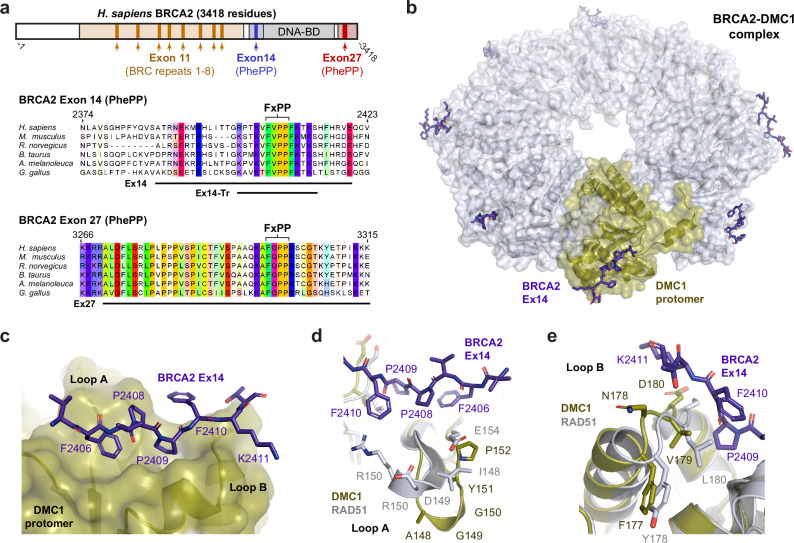
BRCA2 is essential for DNA repair by homologous recombination in mitosis and meiosis. It interacts with recombinases RAD51 and DMC1 to facilitate the formation of nucleoprotein filaments on resected DNA ends that catalyse recombination-mediated repair. BRCA2’s BRC repeats bind and disrupt RAD51 and DMC1 filaments, whereas its PhePP motifs binds to recombinases in a manner that stabilises their nucleoprotein filaments. However, the mechanism of filament stabilisation has hitherto remained unknown. Here, we report the crystal structure of a BRCA2-DMC1 complex, revealing how PhePP motifs bind to recombinases. This novel mode of interaction is conserved for RAD51 and DMC1, which selectively bind to BRCA2’s two distinct PhePP motifs. In both cases, BRCA2 PhePP motifs enhance the stability of nucleoprotein filaments, protecting them from BRC-mediated disruption. Hence, we report the structural basis of how BRCA2’s PhePP motifs stabilise RAD51 and DMC1 nucleoprotein filaments for their essential roles in mitotic and meiotic recombination.
Overview
The claims and statistics of this paper haven’t been checked yet.
Free: it reads the open-access text and checks the first 5 claims that cite a source we can check. Create a free account to check every claim.
Integrity signals
Registry
Cites
Statistics
Figures
Verification
Claims the paper makes
The claims and statistics of this paper haven’t been checked yet.
Free: it reads the open-access text and checks the first 5 claims that cite a source we can check. Create a free account to check every claim.
Self-check
Percentages, sums and reported differences re-computed from the paper’s own numbers.
The self-check needs the paper’s full text.
Citations
Cites
Highly accurate protein structure prediction with AlphaFold
Jumper, J., Evans, R., Pritzel, A., Green, T., Figurnov, M., Ronneberger, O., Tunyasuvunakool, K., Bates, R., Žídek, A., Potapenko, A., et al. (2021) · Nature · doi:10.1038/s41586-021-03819-2 · Cited by 43,764
Research works printed but not linked: 72
- Adams, I. R. & Davies, O. R. Meiotic chromosome structure, the synaptonemal complex, and infertility. Annu. Rev. Genomics Hum. Genet. 24, 35–61 (2023). 37159901 · DOI
- Adams, P. D. et al. PHENIX: a comprehensive Python-based system for macromolecular structure solution. Acta Crystallogr. D Biol. Crystallogr. 66, 213–221 (2010). 20124702 PMC2815670 · DOI · Paper page
- Appleby, R., Bollschweiler, D., Chirgadze, D. Y., Joudeh, L. & Pellegrini, L. A metal ion-dependent mechanism of RAD51 nucleoprotein filament disassembly. iScience 26, 106689 (2023). 37216117 PMC10192527 · DOI
- Appleby, R., Joudeh, L., Cobbett, K. & Pellegrini, L. Structural basis for stabilisation of the RAD51 nucleoprotein filament by BRCA2. Nat. Commun. 14, 7003 (2023). 37919288 PMC10622577 · DOI
- Bell, J. C., Dombrowski, C. C., Plank, J. L., Jensen, R. B. & Kowalczykowski, S. C. BRCA2 chaperones RAD51 to single molecules of RPA-coated ssDNA. Proc. Natl Acad. Sci. USA 120, e2221971120 (2023). 36976771 PMC10083600 · DOI
- Brouwer, I. , Moschetti, T. , Candelli, A. , Garcin, E. B. , Modesti, M. , Pellegrini, L. , Wuite, G. J. & Peterman, E. J . 2018. Two distinct conformational states define the interaction of human RAD51-Atp with single-stranded DNA. Embo J, 37. · DOI
- Carreira, A. & Kowalczykowski, S. C. Two classes of BRC repeats in BRCA2 promote RAD51 nucleoprotein filament function by distinct mechanisms. Proc. Natl Acad. Sci. USA 108, 10448–10453 (2011). 21670257 PMC3127913 · DOI · Paper page
- Chen, V. B. et al. MolProbity: all-atom structure validation for macromolecular crystallography. Acta Crystallogr. D 66, 12–21 (2010). 20057044 PMC2803126 · DOI · Paper page
- 10.1038/s41594-022-00909-1 · DOI
- Dai, J., Voloshin, O., Potapova, S. & Camerini-Otero, R. D. Meiotic knockdown and complementation reveals essential role of RAD51 in mouse spermatogenesis. Cell Rep. 18, 1383–1394 (2017). 28178517 PMC5358547 · DOI
- Davies, A. A. et al. Role of BRCA2 in control of the RAD51 recombination and DNA repair protein. Mol. Cell 7, 273–282 (2001). 11239456 · DOI · Paper page
- Davies, O. R. & Pellegrini, L. Interaction with the BRCA2 C terminus protects RAD51-DNA filaments from disassembly by BRC repeats. Nat. Struct. Mol. Biol. 14, 475–483 (2007). 17515903 PMC2096194 · DOI · Paper page
- Diederichs, K., McSweeney, S. & Ravelli, R. B. Zero-dose extrapolation as part of macromolecular synchrotron data reduction. Acta Crystallogr. D Biol. Crystallogr. 59, 903–909 (2003). 12777808 · DOI · Paper page
- Du, L. & Luo, Y. Structure of a filament of stacked octamers of human DMC1 recombinase. Acta Crystallogr. Sect. F Struct. Biol. Cryst. Commun. 69, 382–386 (2013). 23545642 PMC3614161 · DOI
- Lan, W. H. et al. Rad51 facilitates filament assembly of meiosis-specific Dmc1 recombinase. Proc. Natl Acad. Sci. USA 117, 11257–11264 (2020). 32404423 PMC7260962 · DOI
- Sheridan, S. D. et al. A comparative analysis of Dmc1 and Rad51 nucleoprotein filaments. Nucleic Acids Res. 36, 4057–4066 (2008). 18535008 PMC2475612 · DOI
- Luo, S. C. et al. Identification of fidelity-governing factors in human recombinases DMC1 and RAD51 from cryo-EM structures. Nat. Commun. 12, 115 (2021). 33446654 PMC7809202 · DOI
- Dunlop, M. H. et al. RAD51-associated protein 1 (RAD51AP1) interacts with the meiotic recombinase DMC1 through a conserved motif. J. Biol. Chem. 286, 37328–37334 (2011). 21903585 PMC3199480 · DOI
- Emsley, P., Lohkamp, B., Scott, W. G. & Cowtan, K. Features and development of Coot. Acta Crystallogr. D Biol. Crystallogr. 66, 486–501 (2010). 20383002 PMC2852313 · DOI · Paper page
- Esashi, F. et al. CDK-dependent phosphorylation of BRCA2 as a regulatory mechanism for recombinational repair. Nature 434, 598–604 (2005). 15800615 · DOI · Paper page
- Esashi, F., Galkin, V. E., Yu, X., Egelman, E. H. & West, S. C. Stabilization of RAD51 nucleoprotein filaments by the C-terminal region of BRCA2. Nat. Struct. Mol. Biol. 14, 468–474 (2007). 17515904 · DOI · Paper page
- Evans, P. R. An introduction to data reduction: space-group determination, scaling and intensity statistics. Acta Crystallogr. D Biol. Crystallogr. 67, 282–292 (2011). 21460446 PMC3069743 · DOI · Paper page
- Feng, W. & Jasin, M. Homologous recombination and replication fork protection: BRCA2 and More! Cold Spring Harb. Symp. Quant. Biol. 82, 329–338 (2017). 29686033 PMC6333483
- Gurusaran, M., Zhang, J., Zhang, K., Shibuya, H. & Davies, O. R. MEILB2-BRME1 forms a V-shaped DNA clamp upon BRCA2-binding in meiotic recombination. Nat. Commun. 15, 6552 (2024). 39095423 PMC11297322 · DOI
- Hall, J. M. et al. Linkage of early-onset familial breast cancer to chromosome 17q21. Science 250, 1684–1689 (1990). 2270482 · DOI · Paper page
- Hunter N. Meiotic recombination: the essence of heredity. Cold Spring Harb. Perspect. Biol.7, a016618 (2015). PMC4665078 26511629 · DOI · Paper page
- 10.1074/jbc.M112.375014 · DOI · Paper page
- Jensen, R. B., Carreira, A. & Kowalczykowski, S. C. Purified human BRCA2 stimulates RAD51-mediated recombination. Nature 467, 678–683 (2010). 20729832 PMC2952063 · DOI · Paper page
- Kabsch, W. Xds. Acta Crystallogr. D Biol. Crystallogr. 66, 125–132 (2010). 20124692 PMC2815665 · DOI · Paper page
- Kwon, Y. et al. DNA binding and RAD51 engagement by the BRCA2 C-terminus orchestrate DNA repair and replication fork preservation. Nat. Commun. 14, 432 (2023). 36702902 PMC9879961 · DOI · Paper page
- Lee, J. Y. et al. DNA RECOMBINATION. Base triplet stepping by the Rad51/RecA family of recombinases. Science 349, 977–981 (2015). 26315438 PMC4580133 · DOI · Paper page
- Liu, J., Doty, T., Gibson, B. & Heyer, W. D. Human BRCA2 protein promotes RAD51 filament formation on RPA-covered single-stranded DNA. Nat. Struct. Mol. Biol. 17, 1260–1262 (2010). 20729859 PMC2952495 · DOI · Paper page
- Martinez, J. S. et al. BRCA2 regulates DMC1-mediated recombination through the BRC repeats. Proc. Natl Acad. Sci. USA 113, 3515–3520 (2016). 26976601 PMC4822569 · DOI · Paper page
- McCoy, A. J. et al. Phaser crystallographic software. J. Appl. Crystallogr. 40, 658–674 (2007). 19461840 PMC2483472 · DOI · Paper page
- Page, S. L. & Hawley, R. S. Chromosome choreography: the meiotic ballet. Science 301, 785–789 (2003). 12907787 · DOI · Paper page
- Patel, K. J. et al. Involvement of Brca2 in DNA repair. Mol. Cell 1, 347–357 (1998). 9660919 · DOI · Paper page
- Pellegrini, L. et al. Insights into DNA recombination from the structure of a RAD51-BRCA2 complex. Nature 420, 287–293 (2002). 12442171 · DOI · Paper page
- Peranen, J., Rikkonen, M., Hyvonen, M. & Kaariainen, L. T7 vectors with modified T7lac promoter for expression of proteins in Escherichia coli. Anal. Biochem 236, 371–373 (1996). 8660525 · DOI · Paper page
- Pittman, D. L. et al. Meiotic prophase arrest with failure of chromosome synapsis in mice deficient for Dmc1, a germline-specific RecA homolog. Mol. Cell 1, 697–705 (1998). 9660953 · DOI · Paper page
- Shahid, T. et al. Structure and mechanism of action of the BRCA2 breast cancer tumor suppressor. Nat. Struct. Mol. Biol. 21, 962–968 (2014). 25282148 PMC4222816 · DOI
- Sharan, S. K. et al. Embryonic lethality and radiation hypersensitivity mediated by Rad51 in mice lacking Brca2. Nature 386, 804–810 (1997). 9126738 · DOI · Paper page
- Sharan, S. K. et al. BRCA2 deficiency in mice leads to meiotic impairment and infertility. Development 131, 131–142 (2004). 14660434 · DOI · Paper page
- Sonoda, E. et al. Rad51-deficient vertebrate cells accumulate chromosomal breaks prior to cell death. EMBO J. 17, 598–608 (1998). 9430650 PMC1170409 · DOI · Paper page
- Sun, Y., McCorvie, T. J., Yates, L. A. & Zhang, X. Structural basis of homologous recombination. Cell Mol. Life Sci. 77, 3–18 (2020). 31748913 PMC6957567 · DOI · Paper page
- Thorslund, T., Esashi, F. & West, S. C. Interactions between human BRCA2 protein and the meiosis-specific recombinase DMC1. EMBO J. 26, 2915–2922 (2007). 17541404 PMC1894777 · DOI
- Thorslund, T. et al. The breast cancer tumor suppressor BRCA2 promotes the specific targeting of RAD51 to single-stranded DNA. Nat. Struct. Mol. Biol. 17, 1263–1265 (2010). 20729858 PMC4041013 · DOI · Paper page
- Thorslund, T. & West, S. C. BRCA2: a universal recombinase regulator. Oncogene 26, 7720–7730 (2007). 18066084 · DOI
- P.V.Konarev, V. V. V., Sokolova, A. V., Koch, M. H. J. & Svergun, D. I. PRIMUS - a Windows-PC based system for small-angle scattering data analysis. J. Appl. Cryst. 36, 1277–1282 (2003). · DOI · Paper page
- Petoukhov, M. V. et al. New developments in the ATSAS program package for small-angle scattering data analysis. J. Appl. Crystallogr. 45, 342–350 (2012). 25484842 PMC4233345 · DOI · Paper page
- Svergun, D. I., Petoukhov, M. V. & Koch, M. H. Determination of domain structure of proteins from X-ray solution scattering. Biophys. J. 80, 2946–2953 (2001). 11371467 PMC1301478 · DOI · Paper page
- Sali, A. & Blundell, T. L. Comparative protein modelling by satisfaction of spatial restraints. J. Mol. Biol. 234, 779–815 (1993). 8254673 · DOI · Paper page
- Kozin, M. B. & Svergun, D. I. Automated matching of high- and low-resolution structural models. J. Appl. Crystallogr. 34, 33–41 (2001). · DOI · Paper page
- Svergun, D. I. BCKMHJ. CRYSOL – a program to evaluate X-ray solution scattering of biological macromolecules from atomic coordinates. J. Appl. Cryst. 28, 768–773 (1995). · DOI · Paper page
- Tsuzuki, T. et al. Targeted disruption of the Rad51 gene leads to lethality in embryonic mice. Proc. Natl Acad. Sci. USA 93, 6236–6240 (1996). 8692798 PMC39005 · DOI · Paper page
- Tye, S., Ronson, G. E. & Morris, J. R. A fork in the road: where homologous recombination and stalled replication fork protection part ways. Semin. Cell Dev. Biol. 113, 14–26 (2021). 32653304 PMC8082280 · DOI · Paper page
- Vonrhein, C. et al. Data processing and analysis with the autoPROC toolbox. Acta Crystallogr. D Biol. Crystallogr. 67, 293–302 (2011). 21460447 PMC3069744 · DOI · Paper page
- Waterhouse, A. M., Procter, J. B., Martin, D. M., Clamp, M. & Barton, G. J. Jalview Version 2-a multiple sequence alignment editor and analysis workbench. Bioinformatics 25, 1189–1191 (2009). 19151095 PMC2672624 · DOI · Paper page
- Wong, A. K., Pero, R., Ormonde, P. A., Tavtigian, S. V. & Bartel, P. L. RAD51 interacts with the evolutionarily conserved BRC motifs in the human breast cancer susceptibility gene brca2. J. Biol. Chem. 272, 31941–31944 (1997). 9405383 · DOI · Paper page
- Wright, W. D., Shah, S. S. & Heyer, W. D. Homologous recombination and the repair of DNA double-strand breaks. J. Biol. Chem. 293, 10524–10535 (2018). 29599286 PMC6036207 · DOI · Paper page
- Yang, H. et al. BRCA2 function in DNA binding and recombination from a BRCA2-DSS1-ssDNA structure. Science 297, 1837–1848 (2002). 12228710 · DOI · Paper page
- Yoshida, K. et al. The mouse RecA-like gene Dmc1 is required for homologous chromosome synapsis during meiosis. Mol. Cell 1, 707–718 (1998). 9660954 · DOI · Paper page
- Yu, V. P. et al. Gross chromosomal rearrangements and genetic exchange between nonhomologous chromosomes following BRCA2 inactivation. Genes Dev. 14, 1400–1406 (2000). 10837032 PMC316655 · DOI · Paper page
- Yuan, J. & Chen, J. FIGNL1-containing protein complex is required for efficient homologous recombination repair. Proc. Natl Acad. Sci. USA 110, 10640–10645 (2013). 23754376 PMC3696823 · DOI · Paper page
- Morimatsu, M., Donoho, G. & Hasty, P. Cells deleted for Brca2 COOH terminus exhibit hypersensitivity to gamma-radiation and premature senescence. Cancer Res. 58, 3441–3447 (1998). 9699678
- Donoho, G. et al. Deletion of Brca2 exon 27 causes hypersensitivity to DNA crosslinks, chromosomal instability, and reduced life span in mice. Genes Chromosomes Cancer 36, 317–331 (2003). 12619154 · DOI · Paper page
- Biswas, K. et al. Functional evaluation of BRCA2 variants mapping to the PALB2-binding and C-terminal DNA-binding domains using a mouse ES cell-based assay. Hum. Mol. Genet. 21, 3993–4006 (2012). 22678057 PMC3428152 · DOI · Paper page
- Koornneef, L. et al. Chromosome pairing through tensioned DNA tethers revealed by BRCA2 meiotic domain deletion. bioRxiv10.1101/2023.10.06.561239 (2023).
- Ghouil, R. et al. BRCA2 binding through a cryptic repeated motif to HSF2BP oligomers does not impact meiotic recombination. Nat. Commun. 12, 4605 (2021). 34326328 PMC8322138 · DOI
- Zhang, J., Fujiwara, Y., Yamamoto, S. & Shibuya, H. A meiosis-specific BRCA2 binding protein recruits recombinases to DNA double-strand breaks to ensure homologous recombination. Nat. Commun. 10, 722 (2019). 30760716 PMC6374363 · DOI · Paper page
- Zhang, J. et al. The BRCA2-MEILB2-BRME1 complex governs meiotic recombination and impairs the mitotic BRCA2-RAD51 function in cancer cells. Nat. Commun. 11, 2055 (2020). 32345962 PMC7188823 · DOI · Paper page
- Zhang, J., Nandakumar, J. & Shibuya, H. BRCA2 in mammalian meiosis. Trends Cell Biol. 32, 281–284 (2022). 34625364 · DOI
- Zickler D. & Kleckner N. Recombination, pairing, and synapsis of homologs during meiosis. Cold Spring Harb. Perspect. Biol.7, a016626 (2015). PMC4448610 25986558 · DOI · Paper page
Metadata
- Authors
- Dunce, J. M., & Davies, O. R.
- Affiliations
- University of Cambridge (GB)
- Wellcome Centre for Cell Biology (GB)
- Corresponding author
- Davies, Owen R.
- Venue
- Nature Communications
- Publisher
- openRxiv
- Published
- 2023-11-21
- Volume
- 15
- Issue
- 1
- Pages
- 8292-8292
- ISSN
- 2041-1723 (ISSN-L)
- PMC
- PMC11436757
- OpenAlex
- W4402923329
- Cited by
- 21
- References
- 1
- Citations by year
- 2026: 9 · 2025: 9 · 2024: 2 · 2023: 1
- FWCI
- 2.71
- Type
- journal article
- Language
- en
- Open access
- gold
- doi.org
- Licence
- cc-by
- Locations
- Nature Communications (publishedVersion, cc-by)
- bioRxiv (Cold Spring Harbor Laboratory) (acceptedVersion, cc-by)
- PubMed Central (publishedVersion, cc-by)
- PubMed (publishedVersion)
- Apollo (University of Cambridge) (submittedVersion, cc-by)
- RePEc: Research Papers in Economics (submittedVersion)
- DOAJ (DOAJ: Directory of Open Access Journals) (submittedVersion)
- Edinburgh Research Explorer (University of Edinburgh) (submittedVersion, cc-by)
- Funders
- Wellcome Trust (219413/Z/19/Z, 226791)
- Diamond Light Source (mx13587, mx18598)
- Topics
- Life Sciences › Biochemistry, Genetics and Molecular Biology › Molecular Biology › DNA Repair Mechanisms
- Life Sciences › Biochemistry, Genetics and Molecular Biology › Genetics › BRCA gene mutations in cancer
- Health Sciences › Medicine › Oncology › PARP inhibition in cancer therapy
- Keywords
- BRCA2, RAD51, DMC1, BRC repeats, homologous recombination, DNA repair, crystal structure, meiotic recombination, mitotic recombination
- MeSH terms
- Binding Sites, DNA-Binding Proteins, Humans, Meiosis, Mitosis, Models, Molecular, Nucleoproteins, Protein Binding, Crystallography, X-Ray, Cell Cycle Proteins, Amino Acid Motifs, BRCA2 Protein, Rad51 Recombinase
About these checks
Registry, retraction, Cites and statistics results are computed, not judged, with one exception: a printed reference that no index lists is read once by a model before it counts as a citation error. Claims are extracted by a model and kept only when their quote appears verbatim in the text; each cited source is then checked, with a model’s help, for whether it says what the claim relies on. Those verdicts can be wrong — read the claim’s quote and the cited source before relying on one.
Statistics and arithmetic are recomputed, not judged.
Confidence bands are shown only for fields calibrated on our annotated test set. None is calibrated yet, so no band is shown.
What counts as a claim ›How we measure confidence ›How we check this ›
Are you an author, or do you see a problem with this page? Request a review
How to cite
Cite CoChat for the checks on this page, and the paper for its own findings.
- This page
- CoChat. (2026). Citation check: BRCA2 stabilises RAD51 and DMC1 nucleoprotein filaments through a conserved interaction mode. https://app.cochat.ai/papers/10.1101/2023.11.20.567968
- The paper
- Dunce, J. M., & Davies, O. R. (2023). BRCA2 stabilises RAD51 and DMC1 nucleoprotein filaments through a conserved interaction mode. Nature Communications. https://doi.org/10.1101/2023.11.20.567968
Data sources
Bibliographic data: Semantic Scholar, OpenAlex, Crossref.
Contains information from the Semantic Scholar Academic Graph Datasets, made available under the ODC Attribution License (ODC-BY 1.0).
Semantic Scholar’s data is described in: Kinney, R., et al. (2023). The Semantic Scholar Open Data Platform. arXiv:2301.10140.
