

Comprehensive deletion scan of anti-CRISPR AcrIIA4 reveals essential and dispensable domains for Cas9 inhibition
Open accessPreprint — published as 10.1073/pnas.2413743121
The DOI matches its Crossref record; 41 of the 41 references it cites were found in a registry or an index.
Abstract
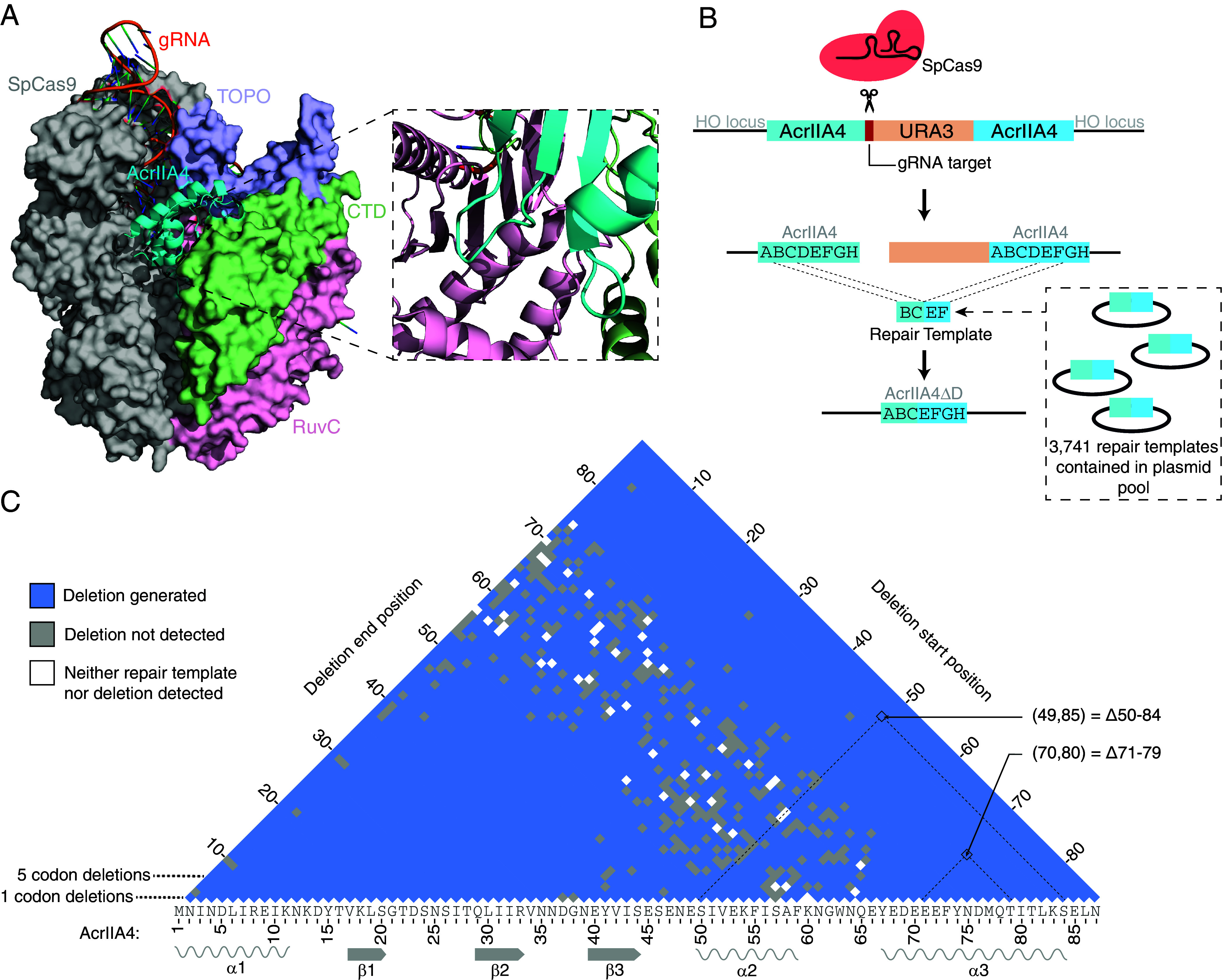
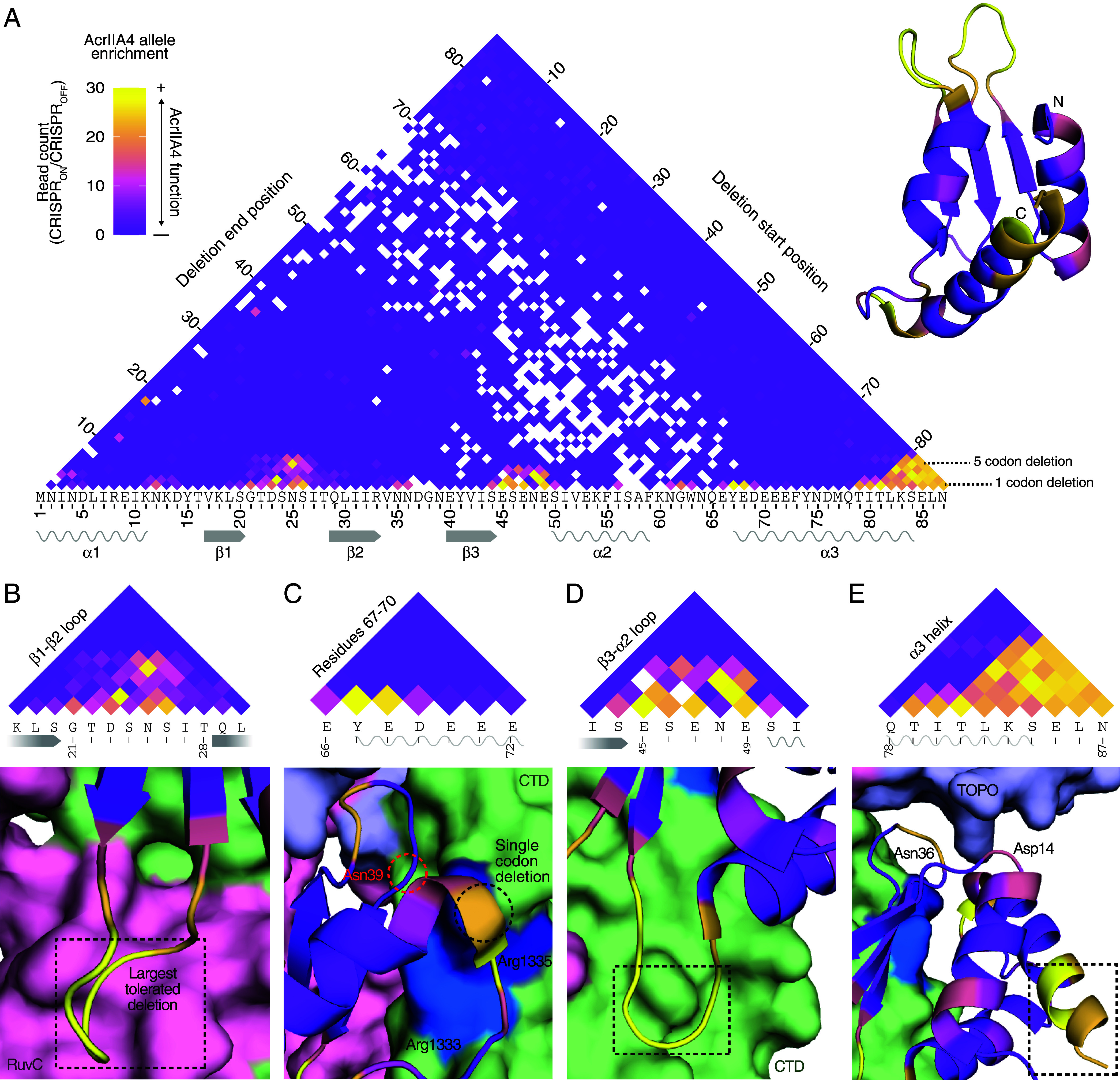
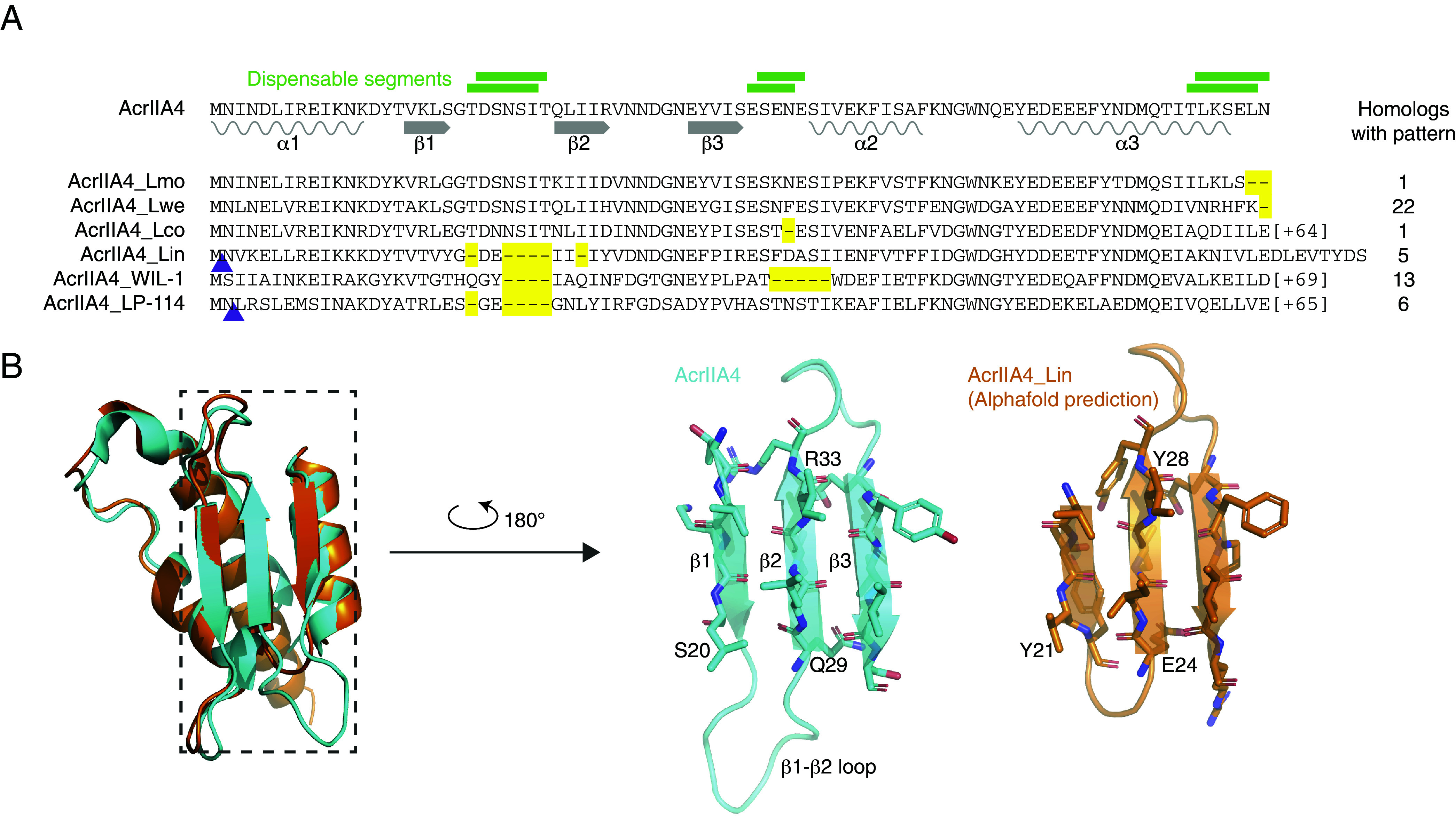
Delineating a protein’s essential and dispensable domains provides critical insight into how it carries out its function. Here, we developed a high-throughput method to synthesize and test the functionality of all possible in-frame and continuous deletions in a gene of interest, enabling rapid and unbiased determination of protein domain importance. Our approach generates precise deletions using a CRISPR library framework that is free from constraints of gRNA target site availability and efficacy. We applied our method to AcrIIA4, a phage-encoded anti-CRISPR protein that robustly inhibits SpCas9. Extensive structural characterization has shown that AcrIIA4 physically occupies the DNA-binding interfaces of several SpCas9 domains; nonetheless, the importance of each AcrIIA4 interaction for SpCas9 inhibition is unknown. We used our approach to determine the essential and dispensable regions of AcrIIA4. Surprisingly, not all contacts with SpCas9 were required, and in particular, we found that the AcrIIA4 loop that inserts into SpCas9’s RuvC catalytic domain can be deleted. Our results show that AcrIIA4 inhibits SpCas9 primarily by blocking PAM binding, and that its interaction with the SpCas9 catalytic domain is inessential.
Overview
The claims and statistics of this paper haven’t been checked yet.
Free: it reads the open-access text and checks the first 5 claims that cite a source we can check. Create a free account to check every claim.
Integrity signals
Registry
Cites
Statistics
Figures
Verification
Claims the paper makes
The claims and statistics of this paper haven’t been checked yet.
Free: it reads the open-access text and checks the first 5 claims that cite a source we can check. Create a free account to check every claim.
Self-check
Percentages, sums and reported differences re-computed from the paper’s own numbers.
The self-check needs the paper’s full text.
Citations
Cites
Highly accurate protein structure prediction with AlphaFold
Jumper, J., Evans, R., Pritzel, A., Green, T., Figurnov, M., Ronneberger, O., Tunyasuvunakool, K., Bates, R., Žídek, A., Potapenko, A., et al. (2021) · Nature · doi:10.1038/s41586-021-03819-2 · Cited by 43,764
A map of human genome variation from population-scale sequencing.
The 1000 Genomes Project Consortium (2010) · Nature · doi:10.1038/nature09534 · Cited by 7,877
Genome-scale CRISPR-Cas9 knockout screening in human cells
Shalem, O., Sanjana, N. E., Hartenian, E., Shi, X., Scott, D. A., Mikkelsen, T. S., Heckl, D., Ebert, B. L., Root, D. E., Doench, J. G., et al. (2014) · Science · doi:10.1126/science.1247005 · Cited by 5,234
UCSF ChimeraX: Tools for structure building and analysis
Meng, E. C., Goddard, T. D., Pettersen, E. F., Couch, G. S., Pearson, Z. J., Morris, J. H., & Ferrin, T. E. (2023) · Protein Science · doi:10.1002/pro.4792 · Cited by 4,442
ClinVar: improving access to variant interpretations and supporting evidence
Landrum, M. J., Lee, J. M., Benson, M., Brown, G. R., Chao, C., Chitipiralla, S., Gu, B., Hart, J., Hoffman, D., Jang, W., et al. (2018) · Nucleic Acids Research · doi:10.1093/nar/gkx1153 · Cited by 4,196
Boeke, J. D., La Croute, F., & Fink, G. R. (1984) · Molecular and General Genetics MGG · doi:10.1007/bf00330984 · Cited by 2,318
Structures of Cas9 endonucleases reveal RNA-mediated conformational activation
Jinek, M., Jiang, F., Taylor, D. W., Sternberg, S. H., Kaya, E., Ma, E., Anders, C., Hauer, M., Zhou, K., Lin, S., et al. (2014) · Science · doi:10.1126/science.1247997 · Cited by 1,230
Mumberg, D., Muller, R., & Funk, M. (1994) · Nucleic Acids Research · doi:10.1093/nar/22.25.5767 · Cited by 955
Accurate classification of BRCA1 variants with saturation genome editing
Findlay, G. M., Daza, R. M., Martin, B., Zhang, M. D., Leith, A. P., Gasperini, M., Janizek, J. D., Huang, X., Starita, L. M., & Shendure, J. (2018) · Nature · doi:10.1038/s41586-018-0461-z · Cited by 843
Sawyer, S. L., Wu, L. I., Emerman, M., & Malik, H. S. (2005) · Proceedings of the National Academy of Sciences · doi:10.1073/pnas.0409853102 · Cited by 688
Recurrent deletions in the SARS-CoV-2 spike glycoprotein drive antibody escape
McCarthy, K. R., Rennick, L. J., Nambulli, S., Robinson-McCarthy, L. R., Bain, W. G., Haidar, G., & Duprex, W. P. (2021) · Science · doi:10.1126/science.abf6950 · Cited by 535
Inhibition of CRISPR-Cas9 with Bacteriophage Proteins
Rauch, B. J., Silvis, M. R., Hultquist, J. F., Waters, C. S., McGregor, M. J., Krogan, N. J., & Bondy-Denomy, J. (2017) · Cell · doi:10.1016/j.cell.2016.12.009 · Cited by 460
A Single Amino Acid Change in the SPRY Domain of Human Trim5α Leads to HIV-1 Restriction
Yap, M. W., Nisole, S., & Stoye, J. P. (2005) · Current Biology · doi:10.1016/j.cub.2004.12.042 · Cited by 408
Stremlau, M., Perron, M., Welikala, S., & Sodroski, J. (2005) · Journal of Virology · doi:10.1128/jvi.79.5.3139-3145.2005 · Cited by 373
Disabling Cas9 by an anti-CRISPR DNA mimic
Shin, J., Jiang, F., Liu, J.-J., Bray, N. L., Rauch, B. J., Baik, S. H., Nogales, E., Bondy-Denomy, J., Corn, J. E., & Doudna, J. A. (2017) · Science Advances · doi:10.1126/sciadv.1701620 · Cited by 354
Structural basis of CRISPR–SpyCas9 inhibition by an anti-CRISPR protein
Dong, D., Guo, M., Wang, S., Zhu, Y., Wang, S., Xiong, Z., Yang, J., Xu, Z., & Huang, Z. (2017) · Nature · doi:10.1038/nature22377 · Cited by 259
Montgomery, S. B., Goode, D. L., Kvikstad, E., Albers, C. A., Zhang, Z. D., Mu, X. J., Ananda, G., Howie, B., Karczewski, K. J., Smith, K. S., et al. (2013) · Genome Research · doi:10.1101/gr.148718.112 · Cited by 253
Human Tripartite Motif 5α Domains Responsible for Retrovirus Restriction Activity and Specificity
Perez-Caballero, D., Hatziioannou, T., Yang, A., Cowan, S., & Bieniasz, P. D. (2005) · Journal of Virology · doi:10.1128/jvi.79.14.8969-8978.2005 · Cited by 245
Analysis of insertions/deletions in protein structures
Pascarella, S., & Argos, P. (1992) · Journal of Molecular Biology · doi:10.1016/0022-2836(92)91008-d · Cited by 238
NEJ1 controls non-homologous end joining in Saccharomyces cerevisiae
Valencia, M., Bentele, M., Vaze, M. B., Herrmann, G., Kraus, E., Lee, S. E., Schär, P., & Haber, J. E. (2001) · Nature · doi:10.1038/414666a · Cited by 228
Short Synthetic Terminators for Improved Heterologous Gene Expression in Yeast
Curran, K. A., Morse, N. J., Markham, K. A., Wagman, A. M., Gupta, A., & Alper, H. S. (2015) · ACS Synthetic Biology · doi:10.1021/sb5003357 · Cited by 227
Transcription in Living Cells: Molecular Mechanisms of Bursting
Rodriguez, J., & Larson, D. R. (2020) · Annual Review of Biochemistry · doi:10.1146/annurev-biochem-011520-105250 · Cited by 224
Interactions of three domains distinguishing the Ras-related GTP-binding proteins Ypt1 and Sec4
Brennwald, P., & Novick, P. (1993) · Nature · doi:10.1038/362560a0 · Cited by 190
Inhibition Mechanism of an Anti-CRISPR Suppressor AcrIIA4 Targeting SpyCas9
Yang, H., & Patel, D. J. (2017) · Molecular Cell · doi:10.1016/j.molcel.2017.05.024 · Cited by 177
Munro, S., & Pelham, H. R. (1984) · The EMBO Journal · doi:10.1002/j.1460-2075.1984.tb02263.x · Cited by 173
Gene drive inhibition by the anti-CRISPR proteins AcrIIA2 and AcrIIA4 in Saccharomyces cerevisiae
Basgall, E. M., Goetting, S. C., Goeckel, M. E., Giersch, R. M., Roggenkamp, E., Schrock, M. N., Halloran, M., & Finnigan, G. C. (2018) · Microbiology · doi:10.1099/mic.0.000635 · Cited by 107
Guo, X., Chavez, A., Tung, A., Chan, Y., Kaas, C. S., Yin, Y. A., Cecchi, R. J., Lopez, S. C., Kelsic, E. D., Schubert, M. G., et al. (2018) · Nature Biotechnology · doi:10.1038/nbt.4147 · Cited by 106
Specificity domains distinguish the Ras-related GTPases Ypt1 and Sec4
Dunn, B. L., Stearns, T., & Botstein, D. (1993) · Nature · doi:10.1038/362563a0 · Cited by 106
Tissue-restricted genome editing in vivo specified by microRNA-repressible anti-CRISPR proteins
Lee, J., Mou, H., Ibraheim, R., Liang, S.-Q., Liu, P., Xue, W., & Sontheimer, E. J. (2019) · RNA · doi:10.1261/rna.071704.119 · Cited by 100
Highly parallel genome variant engineering with CRISPR–Cas9
Sadhu, M. J., Bloom, J. S., Day, L., Siegel, J. J., Kosuri, S., & Kruglyak, L. (2018) · Nature Genetics · doi:10.1038/s41588-018-0087-y · Cited by 86
Self-citationLi, C., Psatha, N., Gil, S., Wang, H., Papayannopoulou, T., & Lieber, A. (2018) · Molecular Therapy - Methods & Clinical Development · doi:10.1016/j.omtm.2018.04.008 · Cited by 71
Emond, S., Petek, M., Kay, E. J., Heames, B., Devenish, S. R. A., Tokuriki, N., & Hollfelder, F. (2020) · Nature Communications · doi:10.1038/s41467-020-17061-3 · Cited by 69
Macdonald, C. B., Nedrud, D., Grimes, P. R., Trinidad, D., Fraser, J. S., & Coyote-Maestas, W. (2023) · Genome Biology · doi:10.1186/s13059-023-02880-6 · Cited by 66
Seuma, M., Lehner, B., & Bolognesi, B. (2022) · Nature Communications · doi:10.1038/s41467-022-34742-3 · Cited by 63
Solution structure and dynamics of anti-CRISPR AcrIIA4, the Cas9 inhibitor
Kim, I., Jeong, M., Ka, D., Han, M., Kim, N., Bae, E., & Suh, J. (2018) · Scientific Reports · doi:10.1038/s41598-018-22177-0 · Cited by 53
Comprehensive deletion landscape of CRISPR-Cas9 identifies minimal RNA-guided DNA-binding modules
Shams, A., Higgins, S. A., Fellmann, C., Laughlin, T. G., Oakes, B. L., Lew, R., Kim, S., Lukarska, M., Arnold, M. L., Staahl, B. T., et al. (2021) · Nature Communications · doi:10.1038/s41467-021-25992-8 · Cited by 52
Gibson, A. W., Wojciechowicz, L. A., Danzi, S. E., Zhang, B., Kim, J. H., Hu, Z., & Michels, C. A. (1997) · Genetics · doi:10.1093/genetics/146.4.1287 · Cited by 33
Finley, R. L., Zhang, H., Zhong, J., & Stanyon, C. A. (2002) · Gene · doi:10.1016/s0378-1119(02)00420-1 · Cited by 20
Topolska, M., Beltran, T., & Lehner, B. (2023) · bioRxiv (Cold Spring Harbor Laboratory) · doi:10.1101/2023.10.06.561180 · Cited by 18
Highly complete long-read genomes reveal pangenomic variation underlying yeast phenotypic diversity
Weller, C. A., Andreev, I., Chambers, M. J., Park, M., Program, N. C. S., Bloom, J. S., & Sadhu, M. J. (2023) · Genome Research · doi:10.1101/gr.277515.122 · Cited by 14
Self-citationIndels allow antiviral proteins to evolve functional novelty inaccessible by missense mutations
Tenthorey, J. L., del Banco, S., Ramzan, I., Klingenberg, H., Liu, C., Emerman, M., & Malik, H. S. (2024) · doi:10.1101/2024.05.07.592993
Research works printed but not linked: 11
- A. R. Davidson, Anti-CRISPRs: Protein inhibitors of CRISPR-Cas systems. Annu. Rev. Biochem. 89, 309– 332 (2020). 32186918 PMC9718424
- E. W. Sayers, Database resources of the National Center for Biotechnology Information. Nucleic Acids Res. 52, D33– D43 (2024). 37994677 PMC10767890
- T. Stadelmann, A deep mutational scanning platform to characterize the fitness landscape of anti-CRISPR proteins. bioRxiv [Preprint] (2021). 10.1101/2021.08.21.457204 (Accessed 26 September 2024). PMC11662660 39558174 · DOI
- D. M. Becker, V. Lundblad, Introduction of DNA into yeast cells. Curr. Protoc. Mol. Biol. Chapter 13, Unit 13.7 (2001). 18265102
- M. Mirdita, ColabFold: making protein folding accessible to all. Nat. Methods 19, 679– 682 (2022). 35637307 PMC9184281
- L. Gerasimavicius, X. Liu, J.A. Marsh, Identification of pathogenic missense mutations using protein sability predictors. Sci. Rep. 10, 15387 (2020). 32958805 PMC7506547
- J. Schymkowitz, The FoldX web server: an online force field. Nucleic Acids Res. 33, W382– W388 (2005). 15980494 PMC1160148
- G. R. Buel, K. J. Walters, Can AlphaFold2 predict the impact of missense mutations on structure? Nat. Struct. Mol. Biol. 29, 1– 2 (2022). 35046575 PMC11218004
- N. Brandes, G. Goldman, C. H. Wang, C. J. Ye, V. Ntranos, Genome-wide prediction of disease variant effects with a deep protein language model. Nat. Genet. 55, 1512– 1522 (2023). 37563329 PMC10484790
- Y. Choi, G. E. Sims, S. Murphy, J. R. Miller, A. P. Chan, Predicting the functional effect of amino acid substitutions and indels. Plos One 7, e46688 (2012). 23056405 PMC3466303
- Y. Choi, A. P. Chan, PROVEAN web server: a tool to predict the functional effect of amino acid substitutions and indels. Bioinformatics 31, 2745– 2747 (2015). 25851949 PMC4528627
Metadata
- Authors
- Iturralde, A. B., Weller, C. A., & Sadhu, M. J.
- Affiliations
- National Institutes of Health (US)
- Corresponding author
- Sadhu, Meru J
- Venue
- Proceedings of the National Academy of Sciences
- Publisher
- openRxiv
- Published
- 2024-07-09
- Volume
- 121
- Issue
- 48
- Pages
- e2413743121-e2413743121
- ISSN
- 0027-8424 (ISSN-L)
- PMC
- PMC11621469
- OpenAlex
- W4404587503
- Cited by
- 4
- References
- 41
- Citations by year
- 2026: 3 · 2025: 1
- FWCI
- 0.54
- Type
- journal article
- Language
- en
- Open access
- hybrid
- doi.org
- Licence
- cc-by-nc-nd
- Locations
- Proceedings of the National Academy of Sciences (publishedVersion, cc-by-nc-nd)
- bioRxiv (Cold Spring Harbor Laboratory) (acceptedVersion)
- PubMed Central (publishedVersion, cc-by-nc-nd)
- PubMed (publishedVersion)
- PubMed Central (submittedVersion, public-domain)
- Funders
- National Institutes of Health (1ziahg200401-03, 1ZIAHG200401, ZIA HG200401)
- National Human Genome Research Institute (1ZIAHG200401)
- Topics
- Life Sciences › Biochemistry, Genetics and Molecular Biology › Molecular Biology › CRISPR and Genetic Engineering
- Life Sciences › Biochemistry, Genetics and Molecular Biology › Genetics › Bacterial Genetics and Biotechnology
- Life Sciences › Biochemistry, Genetics and Molecular Biology › Molecular Biology › Biochemical and Structural Characterization
- Keywords
- deletion mutagenesis, phage defense, CRISPR/Cas9
About these checks
Registry, retraction, Cites and statistics results are computed, not judged, with one exception: a printed reference that no index lists is read once by a model before it counts as a citation error. Claims are extracted by a model and kept only when their quote appears verbatim in the text; each cited source is then checked, with a model’s help, for whether it says what the claim relies on. Those verdicts can be wrong — read the claim’s quote and the cited source before relying on one.
Statistics and arithmetic are recomputed, not judged.
Confidence bands are shown only for fields calibrated on our annotated test set. None is calibrated yet, so no band is shown.
What counts as a claim ›How we measure confidence ›How we check this ›
Are you an author, or do you see a problem with this page? Request a review
Data sources
Bibliographic data: Semantic Scholar, OpenAlex, Crossref.
Contains information from the Semantic Scholar Academic Graph Datasets, made available under the ODC Attribution License (ODC-BY 1.0).
Semantic Scholar’s data is described in: Kinney, R., et al. (2023). The Semantic Scholar Open Data Platform. arXiv:2301.10140.
