

The DOI matches its Crossref record; 10 of the 10 references it cites were found in a registry or an index.
A widespread sequence-specific mRNA decay pathway mediated by hnRNPs A1 and A2/B1
Abstract
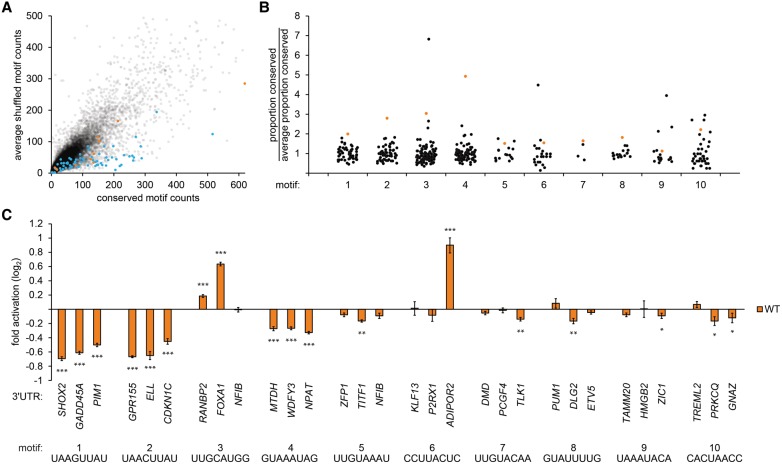
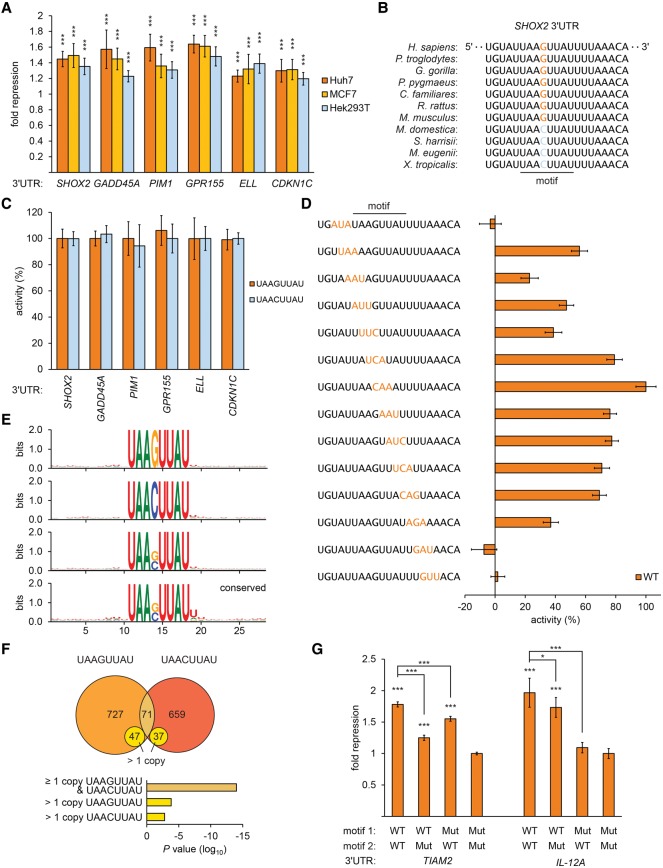
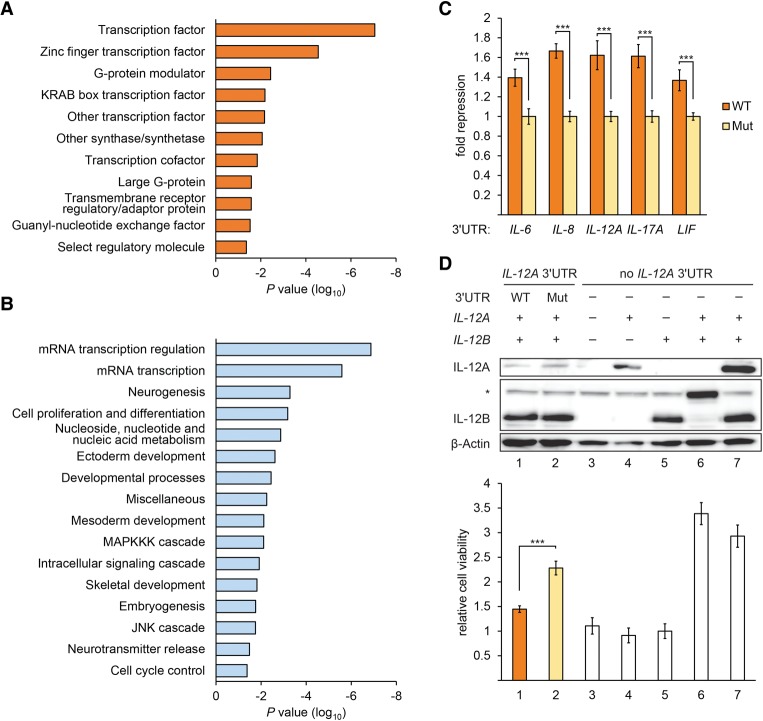
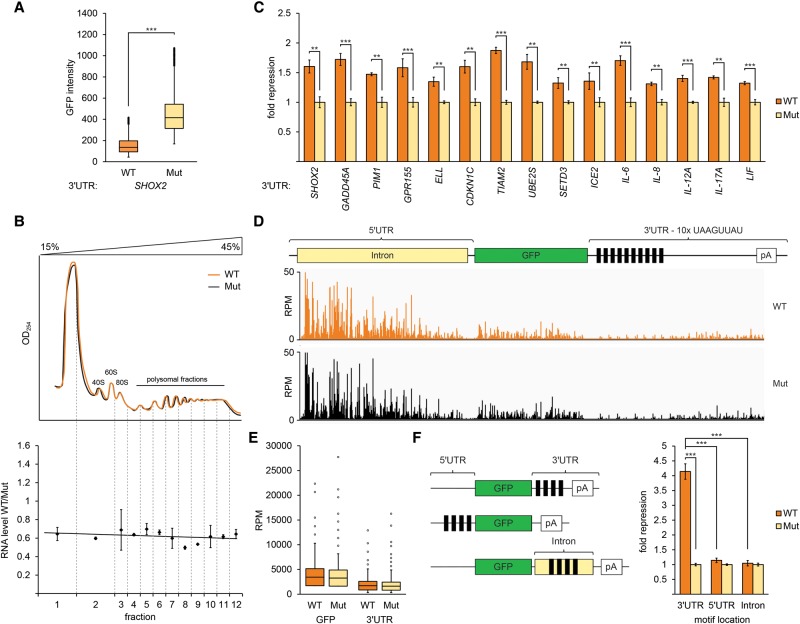
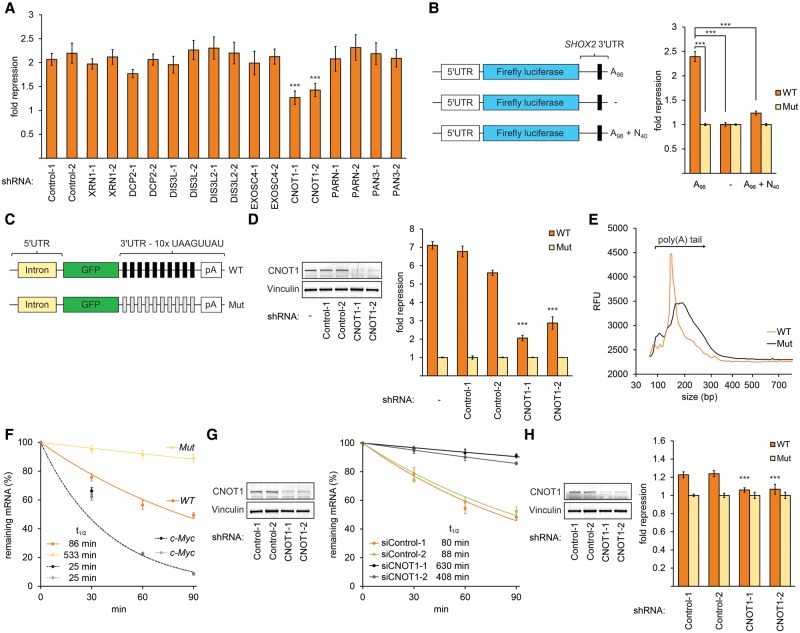
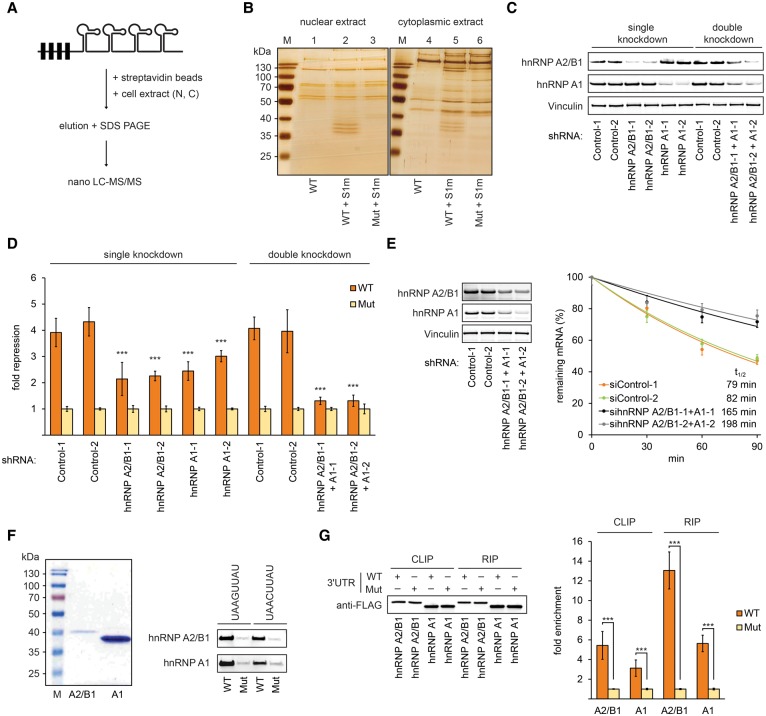
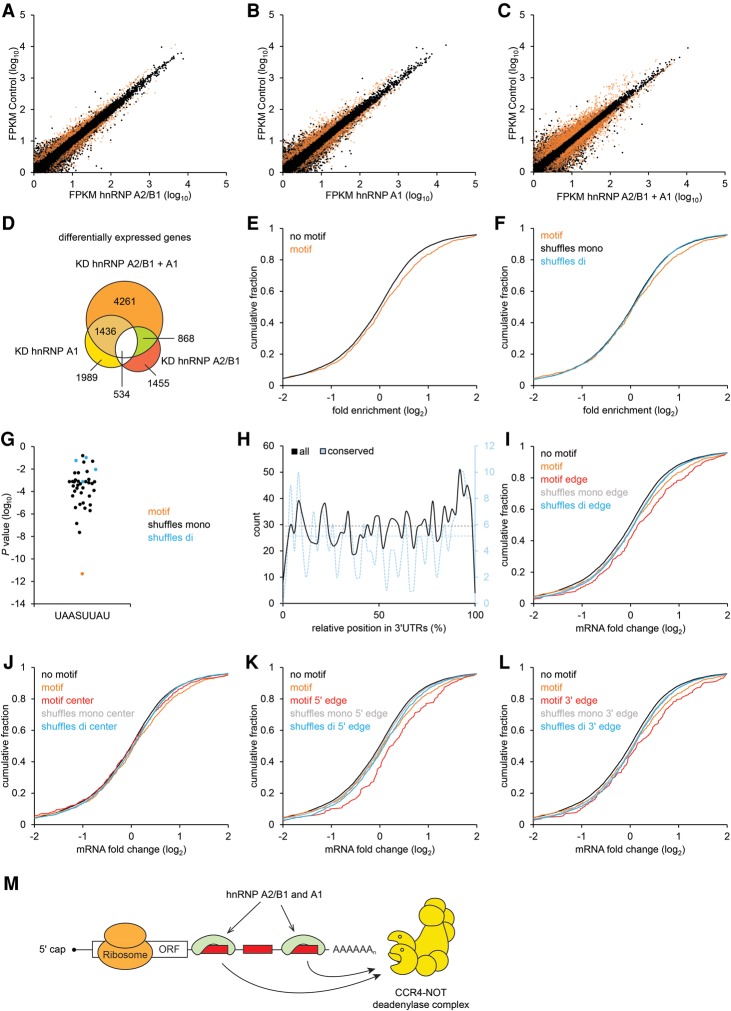
3′-untranslated regions (UTRs) specify post-transcriptional fates of mammalian messenger RNAs (mRNAs), yet knowledge of the underlying sequences and mechanisms is largely incomplete. Here, we identify two related novel 3′ UTR motifs in mammals that specify transcript degradation. These motifs are interchangeable and active only within 3′ UTRs, where they are often preferentially conserved; furthermore, they are found in hundreds of transcripts, many encoding regulatory proteins. We found that degradation occurs via mRNA deadenylation, mediated by the CCR4–NOT complex. We purified trans factors that recognize the motifs and identified heterogeneous nuclear ribonucleoproteins (hnRNPs) A1 and A2/B1, which are required for transcript degradation, acting in a previously unknown manner. We used RNA sequencing (RNA-seq) to confirm hnRNP A1 and A2/B1 motif-dependent roles genome-wide, profiling cells depleted of these factors singly and in combination. Interestingly, the motifs are most active within the distal portion of 3′ UTRs, suggesting that their role in gene regulation can be modulated by alternative processing, resulting in shorter 3′ UTRs.
Overview
The claims and statistics of this paper haven’t been checked yet.
Run the check — free, no account needed. It reads the open-access text and checks the sources it cites.
Integrity signals
Registry
Cites
Statistics
Figures
Verification
Claims the paper makes
The claims and statistics of this paper haven’t been checked yet.
Run the check — free, no account needed. It reads the open-access text and checks the sources it cites.
Claims other papers make about this one
Each is checked against this paper’s own text: does it say what the citing paper says it does?
In the citing paper
“hnRNPA2B1 can promote cytoplasmic RNA decay 43 , consistent with our observation that decreased binding of hnRNPA2B1 at the 3'UTR can correlate with increased cytoplasmic mRNA abundance.”
From Tau is an m 6 A-associated RNA binding protein that causes RNA dysregulation in disease (2026) · cites this paper as [43]
Self-check
Percentages, sums and reported differences re-computed from the paper’s own numbers.
The self-check needs the paper’s full text.
Citations
Cites
miRBase: annotating high confidence microRNAs using deep sequencing data
Kozomara, A., & Griffiths-Jones, S. (2014) · Nucleic Acids Research · doi:10.1093/nar/gkt1181 · Cited by 5,073
Evolutionarily conserved elements in vertebrate, insect, worm, and yeast genomes
Siepel, A., Bejerano, G., Pedersen, J. S., Hinrichs, A. S., Hou, M., Rosenbloom, K., Clawson, H., Spieth, J., Hillier, L. W., Richards, S., et al. (2005) · Genome Research · doi:10.1101/gr.3715005 · Cited by 3,971 · cited 2×
“Consistent with previous studies (Siepel et al. 2005; Xie et al. 2005), many motifs that do not correspond to miRNA-binding sites or other known elements also exhibited strong evidence of selection.”
BackgroundResultDifferential analysis of gene regulation at transcript resolution with RNA-seq
Trapnell, C., Hendrickson, D. G., Sauvageau, M., Goff, L., Rinn, J. L., & Pachter, L. (2013) · Nature Biotechnology · doi:10.1038/nbt.2450 · Cited by 3,492
Xie, X., Lu, J., Kulbokas, E. J., Golub, T. R., Mootha, V., Lindblad-Toh, K., Lander, E. S., & Kellis, M. (2005) · Nature · doi:10.1038/nature03441 · Cited by 1,872
Mayr, C., & Bartel, D. P. (2009) · Cell · doi:10.1016/j.cell.2009.06.016 · Cited by 1,613
HNRNPA2B1 Is a Mediator of m6A-Dependent Nuclear RNA Processing Events
Alarcón, C. R., Goodarzi, H., Lee, H., Liu, X., Tavazoie, S., & Tavazoie, S. F. (2015) · Cell · doi:10.1016/j.cell.2015.08.011 · Cited by 1,514
The highways and byways of mRNA decay
Garneau, N. L., Wilusz, J., & Wilusz, C. J. (2007) · Nature Reviews Molecular Cell Biology · doi:10.1038/nrm2104 · Cited by 1,294
Concurrent versus individual binding of HuR and AUF1 to common labile target mRNAs
Lal, A., Mazan‐Mamczarz, K., Kawai, T., Yang, X., Martindale, J. L., & Gorospe, M. (2004) · The EMBO Journal · doi:10.1038/sj.emboj.7600305 · Cited by 461
Human Pumilio Proteins Recruit Multiple Deadenylases to Efficiently Repress Messenger RNAs
Van Etten, J., Schagat, T. L., Hrit, J., Weidmann, C. A., Brumbaugh, J., Coon, J. J., & Goldstrohm, A. C. (2012) · Journal of Biological Chemistry · doi:10.1074/jbc.m112.373522 · Cited by 205
Systematic discovery of structural elements governing stability of mammalian messenger RNAs
Goodarzi, H., Najafabadi, H. S., Oikonomou, P., Greco, T. M., Fish, L., Salavati, R., Cristea, I. M., & Tavazoie, S. (2012) · Nature · doi:10.1038/nature11013 · Cited by 187
Research works printed but not linked: 44
- 10.1016/j.molcel.2012.05.021 · DOI
- 10.1093/nar/gki1012 · DOI · Paper page
- 10.1007/s00018-012-0990-9 · DOI
- 10.1016/j.cell.2009.01.002 · DOI · Paper page
- 10.1101/gr.10.7.1001 · DOI
- 10.1101/gad.237289.113 · DOI
- 10.1016/j.molcel.2011.09.007 · DOI
- 10.1038/nsmb.2166 · DOI
- 10.1016/S0092-8674(01)00578-5 · DOI · Paper page
- 10.1016/j.molcel.2014.03.034 · DOI
- 10.1002/wrna.1332 · DOI
- 10.1093/nar/gkq1069 · DOI · Paper page
- 10.1261/rna.1082708 · DOI
- 10.1093/nar/11.5.1475 · DOI
- 10.1101/gr.082701.108 · DOI · Paper page
- 10.1016/j.molcel.2014.09.005 · DOI
- 10.1016/j.molcel.2004.05.002 · DOI
- 10.1016/j.molcel.2007.06.017 · DOI · Paper page
- 10.1007/s00018-008-8532-1 · DOI
- 10.1016/j.celrep.2012.02.001 · DOI · Paper page
- 10.1261/rna.031898.111 · DOI
- 10.1261/rna.051177.115 · DOI
- 10.1126/science.1229386 · DOI · Paper page
- 10.1128/MCB.14.12.7984 · DOI
- 10.1093/nar/gkt956 · DOI
- 10.1016/j.cell.2013.04.016 · DOI
- 10.1016/j.cell.2004.12.035 · DOI · Paper page
- 10.1261/rna.2017210 · DOI
- 10.1006/meth.2001.1262 · DOI · Paper page
- 10.1101/gad.1282305 · DOI
- 10.1016/j.molcel.2014.03.036 · DOI
- 10.4161/rna.20231 · DOI · Paper page
- 2015, Evolution and biological roles of alternative 3′UTRs, Trends Cell Biol, 26, 227
- 10.1038/nature07201 · DOI · Paper page
- 10.1101/gr.156612.113 · DOI
- 10.1038/355730a0 · DOI
- 10.1074/jbc.272.44.27493 · DOI
- 1996, General RNA binding proteins render translation cap dependent, EMBO J, 15, 7147, 10.1002/j.1460-2075.1996.tb01106.x · DOI
- 10.1128/MCB.00845-15 · DOI
- 10.1038/nm.3895 · DOI
- 10.1093/bioinformatics/btp120 · DOI
- 10.1016/j.bbagrm.2013.01.003 · DOI
- 10.1038/sj.emboj.7601194 · DOI
- 10.1002/elps.200600524 · DOI
Cited by
Tau is an m 6 A-associated RNA binding protein that causes RNA dysregulation in disease
Dixon, G., Keys, A., Rothamel, K., McKetney, J., Jiang, Y. X., Gordon, L. A., Page, M. L., Liu, C., Hou, K., Flanagan, K., et al. (2026) · doi:10.64898/2026.10.26.762095
Metadata
- Authors
- Geissler, R., Simkin, A., Floss, D., Patel, R., Fogarty, E. A., Scheller, J., & Grimson, A.
- Venue
- Genes & Development
- Publisher
- Cold Spring Harbor Laboratory
- Published
- 2016-05-01
- Volume
- 30
- Issue
- 9
- Pages
- 1070-1085
- ISSN
- 0890-9369
- 1549-5477
- PMC
- PMC4863738
- Cited by
- 62
- References
- 10
- Language
- en
- Funders
- American Cancer Society
- Deutsche Forschungsgemeinschaft (GE 2529/1-1, SFB1116)
- Core B (P50HD076210)
About these checks
Registry, retraction, Cites and statistics results are computed, not judged, with one exception: a printed reference that no index lists is read once by a model before it counts as a citation error. Claims are extracted by a model and kept only when their quote appears verbatim in the text; each cited source is then checked, with a model’s help, for whether it says what the claim relies on. Those verdicts can be wrong — read the claim’s quote and the cited source before relying on one.
Statistics and arithmetic are recomputed, not judged.
Confidence bands are shown only for fields calibrated on our annotated test set. None is calibrated yet, so no band is shown.
What counts as a claim ›How we measure confidence ›How we check this ›
Are you an author, or do you see a problem with this page? Request a review
How to cite
Cite CoChat for the checks on this page, and the paper for its own findings.
- This page
- CoChat. (2026). Citation check: A widespread sequence-specific mRNA decay pathway mediated by hnRNPs A1 and A2/B1. https://app.cochat.ai/papers/10.1101/gad.277392.116
- The paper
- Geissler, R., Simkin, A., Floss, D., Patel, R., Fogarty, E. A., Scheller, J., & Grimson, A. (2016). A widespread sequence-specific mRNA decay pathway mediated by hnRNPs A1 and A2/B1. Genes & Development. https://doi.org/10.1101/gad.277392.116
Data sources
Bibliographic data: Semantic Scholar, OpenAlex, Crossref.
Contains information from the Semantic Scholar Academic Graph Datasets, made available under the ODC Attribution License (ODC-BY 1.0).
Semantic Scholar’s data is described in: Kinney, R., et al. (2023). The Semantic Scholar Open Data Platform. arXiv:2301.10140.
