

Service quality of Islamic banks: satisfaction, loyalty and the mediating role of trust
Open accessThe DOI matches its Crossref record; 57 of the 57 references it cites were found in a registry or an index; 1 of the 69 sources its claims cite were checked for support.
Abstract
The study examined the impact of service quality dimensions on customer satisfaction, loyalty and trust in Malaysian Islamic banks.
Overview
CoChat Summary
## TL;DR
This study tests the PAKSERV service-quality model in Malaysian Islamic banks using survey data from 401 customers and finds that service quality dimensions positively affect satisfaction, which in turn predicts loyalty. It also finds that trust partially mediates the satisfaction–loyalty relationship.
## Key findings
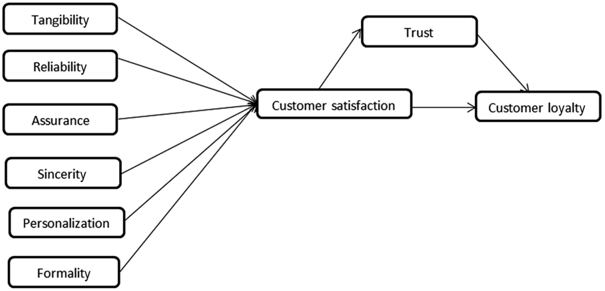
- The survey of 401 Islamic bank customers in Kuala Lumpur and Selangor found positive relationships among PAKSERV service-quality dimensions, customer satisfaction, customer loyalty, and trust.
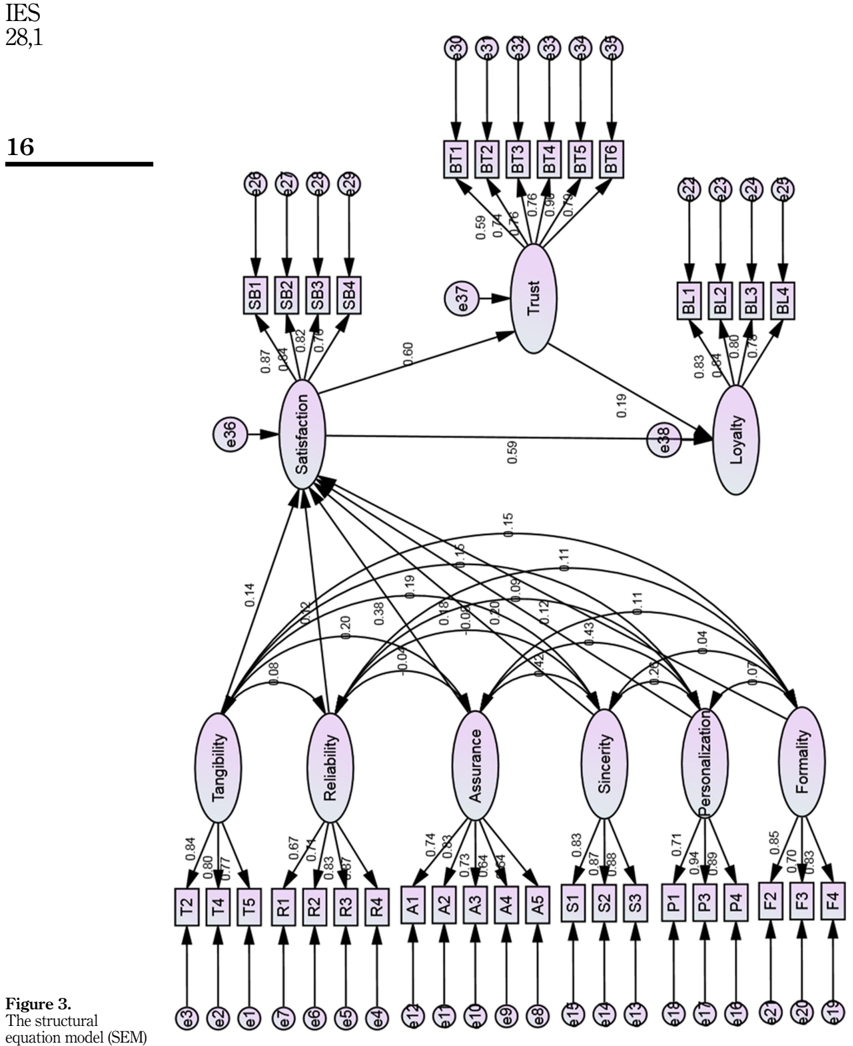
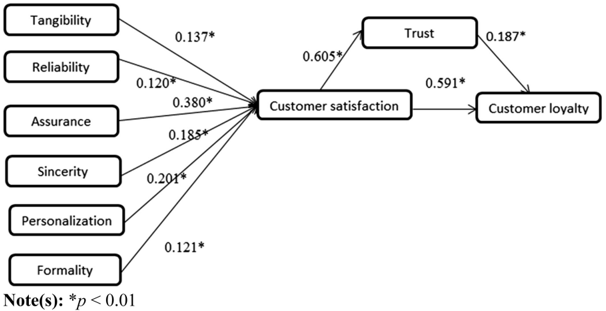
- In the structural model, the service-quality dimensions had significant positive effects on satisfaction: assurance (0.380, p < 0.01), personalization (0.201, p < 0.01), sincerity (0.185, p < 0.01), tangibility (0.140, p < 0.01), formality (0.121, p < 0.01), and reliability (0.120, p < 0.01).
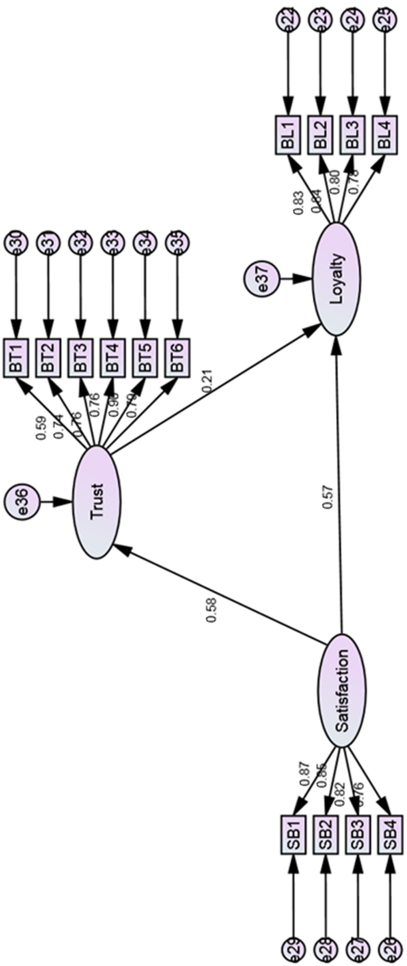
- Satisfaction significantly predicted loyalty (0.591, p < 0.01) and trust (0.605, p < 0.01); trust also significantly predicted loyalty (0.187, p < 0.01).
- Trust was a partial mediator between satisfaction and loyalty; the indirect effect on loyalty through trust was significant (0.122, p = 0.004), while the direct effect of satisfaction on loyalty remained significant (0.574, p = 0.001).
## Methods
- The study used a survey design with random convenience sampling of Islamic bank customers in Kuala Lumpur and Shah Alam/Selangor, conducted over three weeks in March 2019.
- Out of 500 questionnaires, 410 were returned, 9 were unusable, and the final sample was 401 respondents; the questionnaire was in English and used a five-point Likert scale.
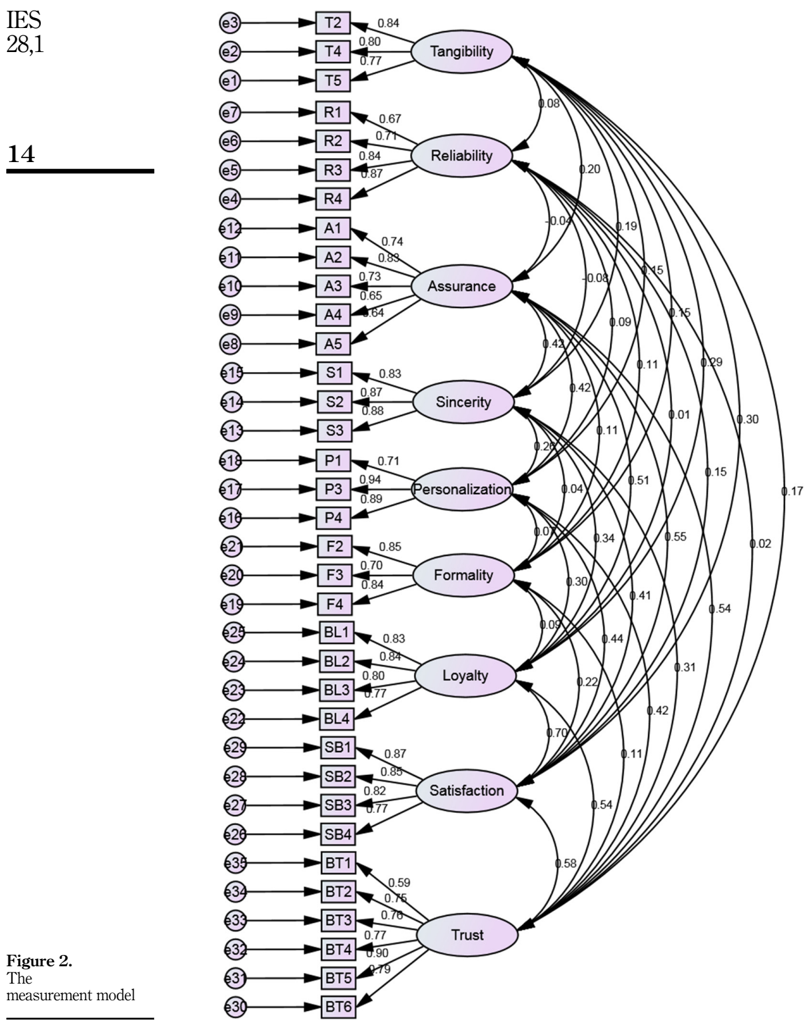
- Analysis used exploratory factor analysis, confirmatory factor analysis, and structural equation modeling in SPSS 23 and AMOS 23; bootstrapping with bias-corrected percentile methods was used for mediation testing.
## Limitations
- Not stated in the paper.
- Evident from the text: the sample is limited to customers in Kuala Lumpur and Selangor, so the findings may not generalize beyond these locations.
Model-written summary. Check it against the paper before relying on it.
Integrity signals
Registry
Cites
Statistics
Figures
Verification
Claims the paper makes
1 Valid · 0 Not valid · 45 Not checked · 41 Own results and interpretations
The sources with a verdict support this claim; the rest weren’t checked yet, have no full text we could read, or their verdicts aren’t rated yet.
In the paper
“Therefore, trust has become one of the most important aspects for customer-Islamic bank relationships (Amin et al., 2013;Ashraf et al., 2015;Sumaedi et al., 2015;Tabrani et al., 2018).”
§ Service quality of Islamic banks: satisfaction, loyalty and the mediating role of trust > 3. Data and methodology
What the sources say
- Not checked — no full text of the sourcecites Amin et al., 2013 matched to “Islamic banks: Contrasting the drivers of customer satisfaction on image, trust, and loyalty of Muslim and non‐Muslim customers in Malaysia” (2013) source
- Supportedcites Ashraf et al., 2015 matched to “Consumer trust and confidence in the compliance of Islamic banks” (2015) source
The Introduction says the importance of trust and confidence is well established in banking and applies both to Islamic banks as financial providers and to their religious compliance. The ‘Trust and confidence in Islamic Banking’ section explicitly calls them important in consumer choice. This supports the citing sentence’s broad claim about trust in customer–Islamic bank relationships, without requiring trust to be a prerequisite for every customer. (LLM, conf=0.88)
- Not checked — no full text of the sourcecites Sumaedi et al., 2015 matched to “Understanding trust & commitment of individual saving customers in Islamic banking: The role of ego involvement” (2015) source
plain- Asserted: passes — The authors put it forward as true.
- Checkable: passes — It can be checked against evidence.
- Load-bearing: passes — The paper’s conclusions depend on it.
- Based: passes — The paper gives a reason why it holds.
A result the paper reports from its own data — it cites no other source for it, so there is none to check. The quote shows it is in the paper.
In the paper
“The relationship between personalization and satisfaction is significant (0.201; p < 0.01), which is an important contributor toward satisfaction on services of Islamic banks.”
§ Service quality of Islamic banks: satisfaction, loyalty and the mediating role of trust > 4.2 Hypotheses testing
plainstates an association- Asserted: passes — The authors put it forward as true.
- Checkable: passes — It can be checked against evidence.
- Load-bearing: passes — The paper’s conclusions depend on it.
- Based: passes — The paper gives a reason why it holds.
- Rests on an assumption not shown here.
A result the paper reports from its own data — it cites no other source for it, so there is none to check. The quote shows it is in the paper.
In the paper
“The results of the direct and indirect path parameters reveal that trust acts as a partial mediator between customers' satisfaction and loyalty.”
§ Service quality of Islamic banks: satisfaction, loyalty and the mediating role of trust > 4.2 Hypotheses testing
plainstates a cause- Asserted: passes — The authors put it forward as true.
- Checkable: passes — It can be checked against evidence.
- Load-bearing: passes — The paper’s conclusions depend on it.
- Based: passes — The paper gives a reason why it holds.
- Rests on an assumption not shown here.
A result the paper reports from its own data — it cites no other source for it, so there is none to check. The quote shows it is in the paper.
In the paper
“Meanwhile, path coefficient of the relationship between customers' satisfaction and loyalty is 0.591 (p < 0.01).This indicates that customers' satisfaction is positively and significantly contributing toward customers' loyalty in services of Islamic banks.Thus, H7 is supported.”
§ Service quality of Islamic banks: satisfaction, loyalty and the mediating role of trust > 4.2 Hypotheses testing
hedgedstates a cause- Asserted: passes — The authors put it forward as true.
- Checkable: passes — It can be checked against evidence.
- Load-bearing: passes — The paper’s conclusions depend on it.
- Based: passes — The paper gives a reason why it holds.
- Rests on an assumption not shown here.
A result the paper reports from its own data — it cites no other source for it, so there is none to check. The quote shows it is in the paper.
In the paper
“The relationship between reliability and customers' satisfaction on services of Islamic banks is also significant and positive (0.120; p < 0.01), supporting H2.”
§ Service quality of Islamic banks: satisfaction, loyalty and the mediating role of trust > 4.2 Hypotheses testing
plainstates an association- Asserted: passes — The authors put it forward as true.
- Checkable: passes — It can be checked against evidence.
- Load-bearing: passes — The paper’s conclusions depend on it.
- Based: passes — The paper gives a reason why it holds.
- Rests on an assumption not shown here.
30 more claims
Create a free account to see all 87 claims and to verify the 5 references still open.
- It may state two separate claims as one. 28
- Probably not a substantial claim. 35
- The quote only partly states this claim. 2
Citations
Cites
SERVQUAL: A multiple-Item Scale for measuring consumer perceptions of service quality
Parasuraman, A., Berry, L. L., & Zeithaml, V. A. (1988) · Zenodo · doi:10.5281/zenodo.14579729 · Cited by 21,118
An updated paradigm for scale development incorporating unidimensionality and its assessment
Gerbing, D. W., & Anderson, J. C. (1988) · Journal of Marketing Research · doi:10.1177/002224378802500207 · Cited by 6,293 · cited 2×
“For the next step, CFA was employed in this study to assess the measurement model and to test data quality (Gerbing and Anderson, 1988).”
BackgroundMethodAn Updated Paradigm for Scale Development Incorporating Unidimensionality and Its Assessment
Gerbing, D. W., & Anderson, J. C. (1988) · Journal of Marketing Research · doi:10.2307/3172650 · Cited by 6,293
Kim, D. J., Ferrin, D. L., & Rao, H. R. (2008) · Decision Support Systems · doi:10.1016/j.dss.2007.07.001 · Cited by 3,613 · cited 1×
“In order to guarantee the validity of the instrument, a thorough review of the existing literature is conducted, followed by a pilot test among experts on the subject, and then a confirmatory pilot test is undertaken involving a group of respondents (Kim et al., 2008; Alnaser et al., 2018).”
MethodChau, P. Y. K. (1997) · Decision Sciences · doi:10.1111/j.1540-5915.1997.tb01313.x · Cited by 854
Brand equity, brand loyalty and consumer satisfaction
Nam, J., Ekinci, Y., & Whyatt, G. (2011) · Annals of Tourism Research · doi:10.1016/j.annals.2011.01.015 · Cited by 830
Furrer, O., Liu, B. S.-C., & Sudharshan, D. (2000) · Journal of Service Research · doi:10.1177/109467050024004 · Cited by 797
Kassim, N., & Asiah Abdullah, N. (2010) · Asia Pacific Journal of Marketing and Logistics · doi:10.1108/13555851011062269 · Cited by 685
Why do Malaysian customers patronise Islamic banks?
Wajdi Dusuki, A., & Irwani Abdullah, N. (2007) · International Journal of Bank Marketing · doi:10.1108/02652320710739850 · Cited by 635 · cited 2×
“…were distributed during various working hours of the same day (morning and evening), along with the various days of the week, to lessen any potential bias due to high concentration of banks’ customers during certain hours of the day or certain days of the week or month (Dusuki and Abdullah, 2007).”
BackgroundKaura, V., Durga Prasad, C. S., & Sharma, S. (2015) · International Journal of Bank Marketing · doi:10.1108/ijbm-04-2014-0048 · Cited by 451
Research works printed but not linked: 6
- 6. Bank Negara Malaysia (2018), List of Licensed Financial Institutions, Bank Negara Malaysia, Kuala Lumpur.
- 14. Child, D. (2006), The Essentials of Factor Analysis, Continuum International Publishing, New York.
- 18. Eze, B.U., Adelekan, A.S., Ojo, O.J. and Erigbe, P.A., (2019), "Emotional intelligence and job performance of frontline employees of selected microfinance banks in Lagos, Nigeria", Management Science Review, Vol. 10 No. 1, pp. 99-106.
- 22. Gaur, S.S. and Agrawal, R. (2006), "Service quality measurement in retail store context: a review of advances made using SERVQUAL and RSQS", The Marketing Review, Vol. 6 No. 4, pp. 317-330.
- 25. Hair, J.E., Black, W.C., Babin, B.J., Anderson, R.E. and Tatham, R.L. (2006), Multivariate Data Analysis, Pearson Prentice-Hall. Upper Saddle River, NJ.
- 27. Hofstede, G.H. (2003), Cultures and Organizations -Software of the Mind, Profile Books, London.
Cited by
Items 101–131 of 131
Investigating the Role of Service Quality and Satisfaction on Debtor Loyalty Behavior
Wibowo, E. B., & Suryandari, R. T. (2021) · International Journal of Business and Applied Social Science · doi:10.33642/ijbass.v7n4p2 · Cited by 1
“Previous studies by Haron et al., (2020) found that satisfaction is a key post-consumption to construct loyalty.”
ResultAI-Driven Personalization In E-Commerce and Building Impact to Repurchase Intention
Ardanta, M. A., Patimah, P., & Candra, S. (2026) · International Conference on ICT for Smart Society (ICISS) · doi:10.1109/iciss71466.2026.11715407
Helen, & Kurniawan, R. (2025) · International Conference on Informatics, Multimedia, Cyber and Information System (ICIMCIS) · doi:10.1109/icimcis68501.2025.11327383
Country Equity: An Integrative Review, Conceptualization, and a Proposed Model
Abbas, A., & Enaba, H. M. L. (2023) · The Academic Journal of Contemporary Commerical Research · doi:10.21608/ajccr.2023.318184 · Cited by 1
Makki, M., Jafari, M., & Parsanejad, M. (2026) · SAGE Open · doi:10.1177/21582440261426462 · Cited by 1
Satisfaction and Trust in Banks on the Housing Loan Market
Czechowska, I. D., & Paduszyńska, M. (2026) · Contemporary Economics · doi:10.5709/ce.1897-9254.583
Does the Shariah Supervisory Board in Islamic banks matter? A systematic literature review
Bintoro, M. I., Hanafi, M. M., & Wardhana, L. I. (2026) · Journal of Islamic accounting and business research · doi:10.1108/jiabr-01-2025-0059
Justicia Percibida, Lealtad y Confianza en Fallos en el Servicio
Martínez-Garcia, M. E., Hernández, M. L. O., & Flores, J. I. A. (2025) · Investigación Administrativa · doi:10.35426/iav54n135.01
Ferdiansyah, A. R., & Suprapti, N. W. S. (2021) · Russian Journal of Agricultural and Socio-Economic Sciences · doi:10.18551/rjoas.2021-08.03
The Preliminary Study of E-Commerce Loyalty Among Generation Z in Indonesia
Ardanta, M. A., Patimah, P., & Candra, S. (2025) · International Conference on Informatics, Multimedia, Cyber and Information System (ICIMCIS) · doi:10.1109/icimcis68501.2025.11327413
Islamic Marketing: A Catalyst In Enhancing Customer Decision-Making In Islamic Banks
Siyamto, Y., Budiyanto, B., & Khuzaini, K. (2024) · Journal Research of Social Science Economics and Management · doi:10.59141/jrssem.v4i5.761 · Cited by 2
The Impact of Service Quality on University Students’ Satisfaction with Islamic Banks
Nooh, M. N., & Nazri, F. N. (2025) · GATR Journal of Management and Marketing Review · doi:10.35609/jmmr.2025.10.1(3
Unveiling trust as a mediator in distributor loyalty within South African multi-level marketing
Williams, C. C., & Kleynhans, M. (2024) · South African Journal of Economic and Management Sciences · doi:10.4102/sajems.v27i1.5269
Shao, S. P., Marjerison, R. K., & Kim, J. M. (2026) · Journal of theoretical and applied electronic commerce research · doi:10.3390/jtaer21010008 · Cited by 1
Ibrahim, M. (2025) · Communications in computer and information science · doi:10.1007/978-3-032-04225-5_25 · Cited by 7
JAO, P., Shurong, Z., Darko, D. A., Luo, A., & Yang, Y. (2026) · Innovation The European Journal of Social Science Research · doi:10.1080/13511610.2025.2591139
Sinaga, J. M., Hidayah, R. T., & Hendayani, R. (2025) · Studies in big data · doi:10.1007/978-3-031-75095-3_5 · Cited by 1
abdillah, L., Asnawi, N., & Yuliana, I. (2024) · El Dinar Jurnal Keuangan dan Perbankan Syariah · doi:10.18860/ed.v12i1.25431 · Cited by 11
Moon, Z. K., & Hasan, M. M. (2026) · Journal of Islamic marketing · doi:10.1108/jima-02-2023-0046 · Cited by 5
Fraud Prevention Analysis: Perceptions of Bank Sumsel-Babel Employees
Putra, B., Adam, M., & Meutıa, I. (2023) · Jurnal Ilmu Ekonomi Terapan · doi:10.20473/jiet.v8i2.45169 · Cited by 2
The impact of service quality on student satisfaction and retention in higher education
Alsadi, M. M., Alghababsheh, M., & Gupta, B. (2026) · Learning and Teaching in Higher Education Gulf Perspectives · doi:10.1108/lthe-09-2025-0068
Iqbal, J., Ashraf, H. A., Kurshid, S. K., Shahzadi, F., & Azeem, M. (2023) · International Journal of Social Science & Entrepreneurship · doi:10.58661/ijsse.v3i2.189 · Cited by 17
“In the banking industry, customers are a very important source of business like any other industry (Haron et al., 2020).”
BackgroundSaputri, D. A., Istanto, Y., & Wisnalmawati, W. (2024) · World Journal of Advanced Research and Reviews · doi:10.30574/wjarr.2024.22.2.1630 · Cited by 3
Ansory, S. M., & Jamal, A. (2026) · International Journal of Emerging Markets · doi:10.1108/ijoem-03-2026-0689
Metadata
- Authors
- Haron, R., Abdul Subar, N., & Ibrahim, K.
- Affiliations
- International Islamic University Malaysia (MY)
- Venue
- Islamic Economic Studies
- Publisher
- Emerald
- Published
- 2020-07-02
- Volume
- 28
- Issue
- 1
- Pages
- 3-23
- ISSN
- 1319-1608 (ISSN-L)
- 1319-1616
- 2411-3395
- OpenAlex
- W3039338010
- Semantic Scholar
- a42fd5dfb80876617f336ec47e04aa3dc4b601a7
- Cited by
- 130
- References
- 55
- Citations by year
- 2026: 10 · 2025: 17 · 2024: 30 · 2023: 34 · 2022: 24 · 2021: 13 · 2020: 3
- FWCI
- 23.36
- Type
- journal article
- Language
- en
- Open access
- diamond
- doi.org
- Licence
- cc-by
- www.emerald.com/insight/site-policies (tdm)
- Locations
- Islamic Economic Studies (publishedVersion, cc-by)
- DOAJ (DOAJ: Directory of Open Access Journals) (submittedVersion)
- Econstor (Econstor) (submittedVersion, cc-by)
- Topics
- Social Sciences › Business, Management and Accounting › Accounting › Islamic Finance and Banking Studies
- Social Sciences › Business, Management and Accounting › Marketing › Customer Service Quality and Loyalty
- Social Sciences › Business, Management and Accounting › Marketing › Halal products and consumer behavior
- Keywords
- Islamic banking, service quality, customer satisfaction, customer loyalty, trust, mediating effect of trust, Malaysian Islamic banks, Islamic financial institutions
About these checks
Registry, retraction, Cites and statistics results are computed, not judged, with one exception: a printed reference that no index lists is read once by a model before it counts as a citation error. Claims are extracted by a model and kept only when their quote appears verbatim in the text; each cited source is then checked, with a model’s help, for whether it says what the claim relies on. Those verdicts can be wrong — read the claim’s quote and the cited source before relying on one.
A language model drew the claims from the paper on 2026-10-10, under version 3 of the claim definition (model deepseek-v4.1-flash, prompt extract-v3).
A second model labelled each claim on 2026-10-10 (model jev-1.13-20260917, definition revision gold-guideline-v0.2).
Cited sources are checked with a language model’s help (gpt-6-sol).
Statistics and arithmetic are recomputed, not judged.
Confidence bands are shown only for fields calibrated on our annotated test set. None is calibrated yet, so no band is shown.
What counts as a claim ›How we measure confidence ›How we check this ›
Are you an author, or do you see a problem with this page? Request a review
Data sources
Bibliographic data: Semantic Scholar, OpenAlex, Crossref.
Contains information from the Semantic Scholar Academic Graph Datasets, made available under the ODC Attribution License (ODC-BY 1.0).
Semantic Scholar’s data is described in: Kinney, R., et al. (2023). The Semantic Scholar Open Data Platform. arXiv:2301.10140.
