

Service quality of Islamic banks: satisfaction, loyalty and the mediating role of trust
Open accessThe DOI matches its Crossref record; 57 of the 57 references it cites were found in a registry or an index; 1 of the 69 sources its claims cite were checked for support.
Abstract
The study examined the impact of service quality dimensions on customer satisfaction, loyalty and trust in Malaysian Islamic banks.
Overview
CoChat Summary
## TL;DR
This study tests the PAKSERV service-quality model in Malaysian Islamic banks using survey data from 401 customers and finds that service quality dimensions positively affect satisfaction, which in turn predicts loyalty. It also finds that trust partially mediates the satisfaction–loyalty relationship.
## Key findings
- The survey of 401 Islamic bank customers in Kuala Lumpur and Selangor found positive relationships among PAKSERV service-quality dimensions, customer satisfaction, customer loyalty, and trust.
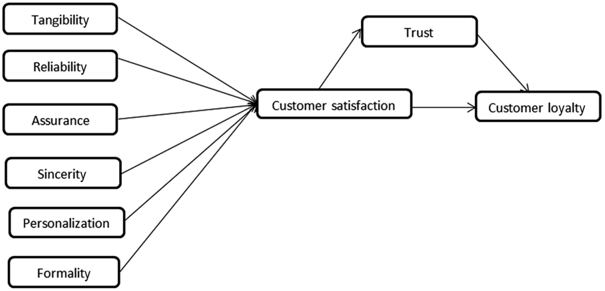
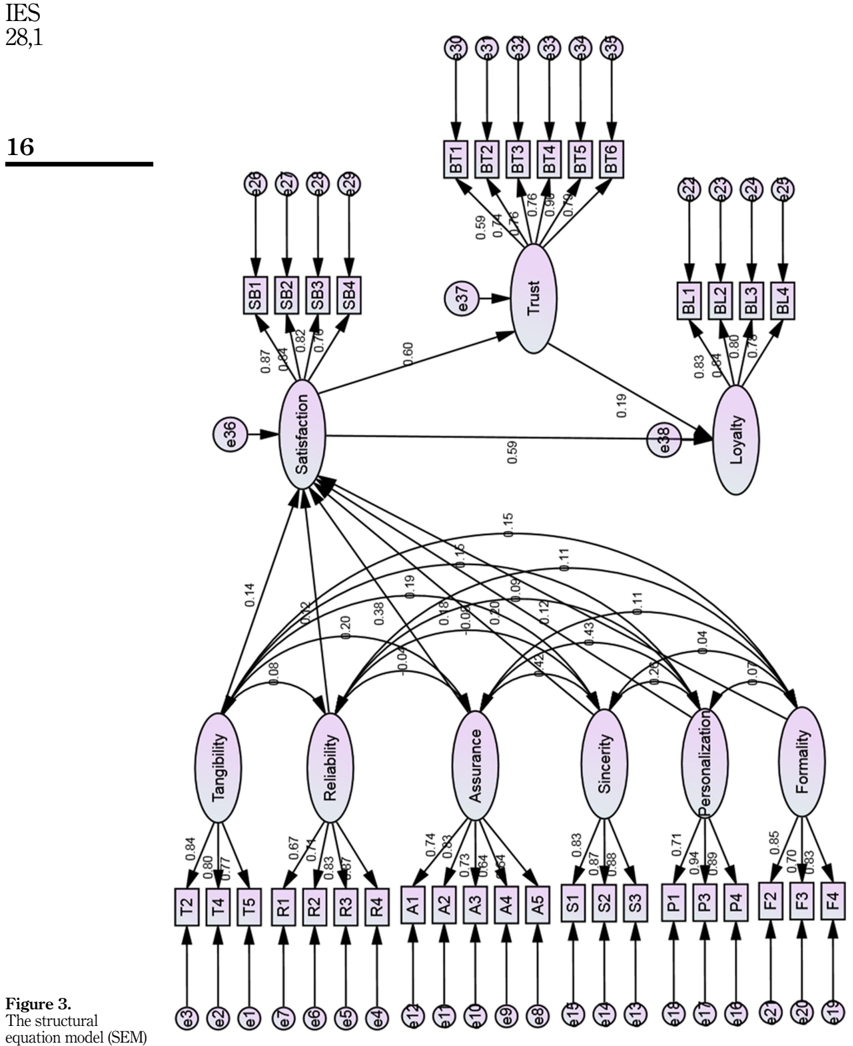
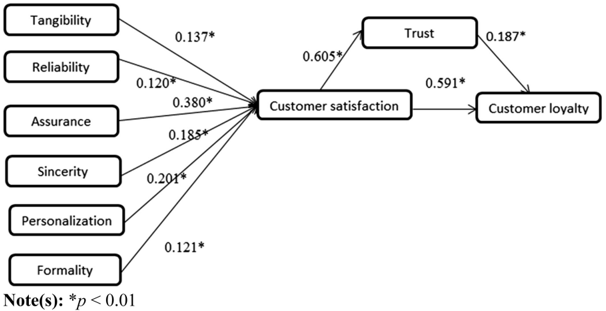
- In the structural model, the service-quality dimensions had significant positive effects on satisfaction: assurance (0.380, p < 0.01), personalization (0.201, p < 0.01), sincerity (0.185, p < 0.01), tangibility (0.140, p < 0.01), formality (0.121, p < 0.01), and reliability (0.120, p < 0.01).
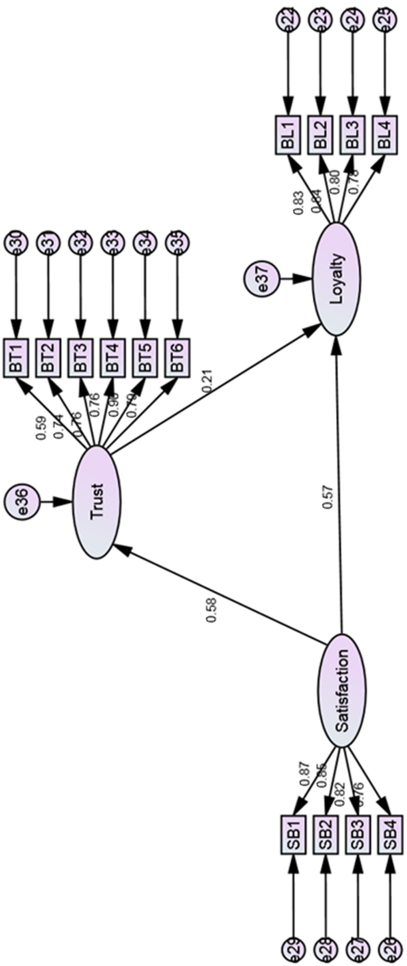
- Satisfaction significantly predicted loyalty (0.591, p < 0.01) and trust (0.605, p < 0.01); trust also significantly predicted loyalty (0.187, p < 0.01).
- Trust was a partial mediator between satisfaction and loyalty; the indirect effect on loyalty through trust was significant (0.122, p = 0.004), while the direct effect of satisfaction on loyalty remained significant (0.574, p = 0.001).
## Methods
- The study used a survey design with random convenience sampling of Islamic bank customers in Kuala Lumpur and Shah Alam/Selangor, conducted over three weeks in March 2019.
- Out of 500 questionnaires, 410 were returned, 9 were unusable, and the final sample was 401 respondents; the questionnaire was in English and used a five-point Likert scale.
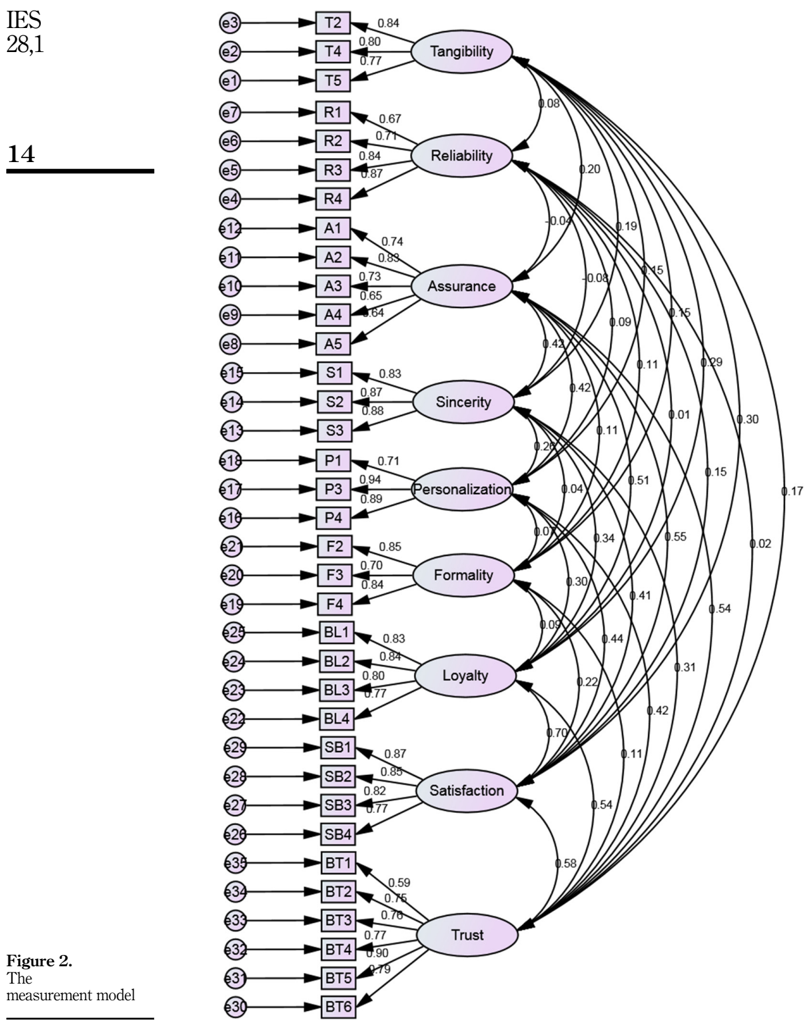
- Analysis used exploratory factor analysis, confirmatory factor analysis, and structural equation modeling in SPSS 23 and AMOS 23; bootstrapping with bias-corrected percentile methods was used for mediation testing.
## Limitations
- Not stated in the paper.
- Evident from the text: the sample is limited to customers in Kuala Lumpur and Selangor, so the findings may not generalize beyond these locations.
Model-written summary. Check it against the paper before relying on it.
Integrity signals
Registry
Cites
Statistics
Figures
Verification
Claims the paper makes
1 Valid · 0 Not valid · 45 Not checked · 41 Own results and interpretations
The sources with a verdict support this claim; the rest weren’t checked yet, have no full text we could read, or their verdicts aren’t rated yet.
In the paper
“Therefore, trust has become one of the most important aspects for customer-Islamic bank relationships (Amin et al., 2013;Ashraf et al., 2015;Sumaedi et al., 2015;Tabrani et al., 2018).”
§ Service quality of Islamic banks: satisfaction, loyalty and the mediating role of trust > 3. Data and methodology
What the sources say
- Not checked — no full text of the sourcecites Amin et al., 2013 matched to “Islamic banks: Contrasting the drivers of customer satisfaction on image, trust, and loyalty of Muslim and non‐Muslim customers in Malaysia” (2013) source
- Supportedcites Ashraf et al., 2015 matched to “Consumer trust and confidence in the compliance of Islamic banks” (2015) source
The Introduction says the importance of trust and confidence is well established in banking and applies both to Islamic banks as financial providers and to their religious compliance. The ‘Trust and confidence in Islamic Banking’ section explicitly calls them important in consumer choice. This supports the citing sentence’s broad claim about trust in customer–Islamic bank relationships, without requiring trust to be a prerequisite for every customer. (LLM, conf=0.88)
- Not checked — no full text of the sourcecites Sumaedi et al., 2015 matched to “Understanding trust & commitment of individual saving customers in Islamic banking: The role of ego involvement” (2015) source
plain- Asserted: passes — The authors put it forward as true.
- Checkable: passes — It can be checked against evidence.
- Load-bearing: passes — The paper’s conclusions depend on it.
- Based: passes — The paper gives a reason why it holds.
A result the paper reports from its own data — it cites no other source for it, so there is none to check. The quote shows it is in the paper.
In the paper
“The relationship between personalization and satisfaction is significant (0.201; p < 0.01), which is an important contributor toward satisfaction on services of Islamic banks.”
§ Service quality of Islamic banks: satisfaction, loyalty and the mediating role of trust > 4.2 Hypotheses testing
plainstates an association- Asserted: passes — The authors put it forward as true.
- Checkable: passes — It can be checked against evidence.
- Load-bearing: passes — The paper’s conclusions depend on it.
- Based: passes — The paper gives a reason why it holds.
- Rests on an assumption not shown here.
A result the paper reports from its own data — it cites no other source for it, so there is none to check. The quote shows it is in the paper.
In the paper
“The results of the direct and indirect path parameters reveal that trust acts as a partial mediator between customers' satisfaction and loyalty.”
§ Service quality of Islamic banks: satisfaction, loyalty and the mediating role of trust > 4.2 Hypotheses testing
plainstates a cause- Asserted: passes — The authors put it forward as true.
- Checkable: passes — It can be checked against evidence.
- Load-bearing: passes — The paper’s conclusions depend on it.
- Based: passes — The paper gives a reason why it holds.
- Rests on an assumption not shown here.
A result the paper reports from its own data — it cites no other source for it, so there is none to check. The quote shows it is in the paper.
In the paper
“Meanwhile, path coefficient of the relationship between customers' satisfaction and loyalty is 0.591 (p < 0.01).This indicates that customers' satisfaction is positively and significantly contributing toward customers' loyalty in services of Islamic banks.Thus, H7 is supported.”
§ Service quality of Islamic banks: satisfaction, loyalty and the mediating role of trust > 4.2 Hypotheses testing
hedgedstates a cause- Asserted: passes — The authors put it forward as true.
- Checkable: passes — It can be checked against evidence.
- Load-bearing: passes — The paper’s conclusions depend on it.
- Based: passes — The paper gives a reason why it holds.
- Rests on an assumption not shown here.
A result the paper reports from its own data — it cites no other source for it, so there is none to check. The quote shows it is in the paper.
In the paper
“The relationship between reliability and customers' satisfaction on services of Islamic banks is also significant and positive (0.120; p < 0.01), supporting H2.”
§ Service quality of Islamic banks: satisfaction, loyalty and the mediating role of trust > 4.2 Hypotheses testing
plainstates an association- Asserted: passes — The authors put it forward as true.
- Checkable: passes — It can be checked against evidence.
- Load-bearing: passes — The paper’s conclusions depend on it.
- Based: passes — The paper gives a reason why it holds.
- Rests on an assumption not shown here.
30 more claims
Create a free account to see all 87 claims and to verify the 5 references still open.
- It may state two separate claims as one. 28
- Probably not a substantial claim. 35
- The quote only partly states this claim. 2
Citations
Cites
SERVQUAL: A multiple-Item Scale for measuring consumer perceptions of service quality
Parasuraman, A., Berry, L. L., & Zeithaml, V. A. (1988) · Zenodo · doi:10.5281/zenodo.14579729 · Cited by 21,118
An updated paradigm for scale development incorporating unidimensionality and its assessment
Gerbing, D. W., & Anderson, J. C. (1988) · Journal of Marketing Research · doi:10.1177/002224378802500207 · Cited by 6,293 · cited 2×
“For the next step, CFA was employed in this study to assess the measurement model and to test data quality (Gerbing and Anderson, 1988).”
BackgroundMethodAn Updated Paradigm for Scale Development Incorporating Unidimensionality and Its Assessment
Gerbing, D. W., & Anderson, J. C. (1988) · Journal of Marketing Research · doi:10.2307/3172650 · Cited by 6,293
Kim, D. J., Ferrin, D. L., & Rao, H. R. (2008) · Decision Support Systems · doi:10.1016/j.dss.2007.07.001 · Cited by 3,613 · cited 1×
“In order to guarantee the validity of the instrument, a thorough review of the existing literature is conducted, followed by a pilot test among experts on the subject, and then a confirmatory pilot test is undertaken involving a group of respondents (Kim et al., 2008; Alnaser et al., 2018).”
MethodChau, P. Y. K. (1997) · Decision Sciences · doi:10.1111/j.1540-5915.1997.tb01313.x · Cited by 854
Brand equity, brand loyalty and consumer satisfaction
Nam, J., Ekinci, Y., & Whyatt, G. (2011) · Annals of Tourism Research · doi:10.1016/j.annals.2011.01.015 · Cited by 830
Furrer, O., Liu, B. S.-C., & Sudharshan, D. (2000) · Journal of Service Research · doi:10.1177/109467050024004 · Cited by 797
Kassim, N., & Asiah Abdullah, N. (2010) · Asia Pacific Journal of Marketing and Logistics · doi:10.1108/13555851011062269 · Cited by 685
Why do Malaysian customers patronise Islamic banks?
Wajdi Dusuki, A., & Irwani Abdullah, N. (2007) · International Journal of Bank Marketing · doi:10.1108/02652320710739850 · Cited by 635 · cited 2×
“…were distributed during various working hours of the same day (morning and evening), along with the various days of the week, to lessen any potential bias due to high concentration of banks’ customers during certain hours of the day or certain days of the week or month (Dusuki and Abdullah, 2007).”
BackgroundKaura, V., Durga Prasad, C. S., & Sharma, S. (2015) · International Journal of Bank Marketing · doi:10.1108/ijbm-04-2014-0048 · Cited by 451
Measuring service quality of banks: Scale development and validation
Karatepe, O. M., Yavas, U., & Babakus, E. (2005) · Journal of Retailing and Consumer Services · doi:10.1016/j.jretconser.2005.01.001 · Cited by 426
Ganguli, S., & Roy, S. K. (2011) · International Journal of Bank Marketing · doi:10.1108/02652321111107648 · Cited by 357 · cited 2×
“The measurement model IES exploit culturally sensitive service quality (Ganguli and Roy, 2011); hence it confirms that service quality and customers’ satisfaction is a cultural phenomenon and is essential to be grounded in a local cultural context (Raajpoot, 2004; Malhotra et al., 2005; Moghavvemi…”
BackgroundThe antecedents of consumer loyalty in retail banking
Lewis, B. R., & Soureli, M. (2006) · Journal of Consumer Behaviour · doi:10.1002/cb.46 · Cited by 339 · cited 2×
“Furthermore, Lewis and Soureli (2006) argued that SERVQUAL is not a reliablemodel to employ in different cultural settings as customers’ perceptions on quality vary and the extent to which cultures are individualistic and significant impacts customers’ evaluation on service providers.”
BackgroundMalhotra, N. K., Ulgado, F. M., Agarwal, J., Shainesh, G., & Wu, L. (2005) · International Marketing Review · doi:10.1108/02651330510602204 · Cited by 319 · cited 3×
“…model IES exploit culturally sensitive service quality (Ganguli and Roy, 2011); hence it confirms that service quality and customers’ satisfaction is a cultural phenomenon and is essential to be grounded in a local cultural context (Raajpoot, 2004; Malhotra et al., 2005; Moghavvemi et al., 2018).”
BackgroundResultBoonlertvanich, K. (2019) · International Journal of Bank Marketing · doi:10.1108/ijbm-02-2018-0021 · Cited by 319
Amin, M., Isa, Z., & Fontaine, R. (2013) · International Journal of Bank Marketing · doi:10.1108/02652321311298627 · Cited by 310 · cited 5×
“customer–Islamic bank relationships (Amin et al., 2013; Ashraf et al., 2015; Sumaedi et al., 2015; Tabrani et al., 2018).”
BackgroundResultInfluentialCustomer service quality in the Greek Cypriot banking industry
Arasli, H., Mehtap‐Smadi, S., & Turan Katircioglu, S. (2005) · Managing Service Quality: An International Journal · doi:10.1108/09604520510575254 · Cited by 295
Development and validation of the hospitality emotional labor scale
Chu, K. H.-L., & Murrmann, S. K. (2006) · Tourism Management · doi:10.1016/j.tourman.2005.12.011 · Cited by 293
Trust, commitment, customer intimacy and customer loyalty in Islamic banking relationships
Tabrani, M., Amin, M., & Nizam, A. (2018) · International Journal of Bank Marketing · doi:10.1108/ijbm-03-2017-0054 · Cited by 257
Bank service quality: comparing Canadian and Tunisian customer perceptions
Ladhari, R., Ladhari, I., & Morales, M. (2011) · International Journal of Bank Marketing · doi:10.1108/02652321111117502 · Cited by 204 · cited 3×
“The significant influence of customers’ satisfaction on loyalty is also recorded in both Islamic and conventional banks by Ladhari et al. (2011); Saleem et al. (2016); Saleh et al. (2017) and Ali and Naeem (2019).”
BackgroundMethodPrediction of attitude and behavioural intentions in retail banking
Baumann, C., Burton, S., Elliott, G., & Kehr, H. M. (2007) · International Journal of Bank Marketing · doi:10.1108/02652320710728438 · Cited by 180
Reconceptualizing Service Encounter Quality in a Non-Western Context
Raajpoot, N. (2004) · Journal of Service Research · doi:10.1177/1094670504268450 · Cited by 177 · cited 12×
“This study employs PAKSERV due to the influence of culture on service dimensions in Asia as proposed by Raajpoot (2004) and the adoption of the model by many past studies in Asian service setting.”
BackgroundMethodResultInfluentialNomran, N. M., Haron, R., & Hassan, R. (2018) · International Journal of Bank Marketing · doi:10.1108/ijbm-12-2016-0197 · Cited by 169
Self-citationA Comparison of Native Culture, Non‐Native Culture and New Management Ideology
Redpath, L., & Nielsen, M. O. (1997) · Canadian Journal of Administrative Sciences / Revue Canadienne des Sciences de l Administration · doi:10.1111/j.1936-4490.1997.tb00139.x · Cited by 140
Customer satisfaction and loyalty in Malaysian Islamic banks:a PAKSERV investigation
Kashif, M., Wan Shukran, S. S., Rehman, M. A., & Sarifuddin, S. (2015) · International Journal of Bank Marketing · doi:10.1108/ijbm-08-2013-0084 · Cited by 137
Relationship Between Customer Satisfaction and Loyalty on the Internet
García, J. A. C. (2010) · Journal of Business and Psychology · doi:10.1007/s10869-010-9196-z · Cited by 135
The service quality construct on a global stage
Imrie, B. C., Cadogan, J. W., & McNaughton, R. (2002) · Managing Service Quality: An International Journal · doi:10.1108/09604520210415353 · Cited by 121
Camarero, C. (2007) · International Journal of Bank Marketing · doi:10.1108/02652320710820354 · Cited by 118
Hassan, H. A., & Abbas, S. K. (2019) · Journal of Islamic marketing · doi:10.1108/jima-03-2018-0064 · Cited by 102
How cultural differences in uncertainty avoidance affect product perceptions
Anne Lee, J., Garbarino, E., & Lerman, D. (2007) · International Marketing Review · doi:10.1108/02651330710755320 · Cited by 100 · cited 1×
“As Asians are not prepared to take higher risks in many decisions, it can slow down the service consumption progression in such societies (Lee et al., 2007).”
BackgroundQuality and image of banking services: a comparative study of conventional and Islamic banks
Saleh, M. A., Quazi, A., Keating, B., & Gaur, S. S. (2017) · International Journal of Bank Marketing · doi:10.1108/ijbm-08-2016-0111 · Cited by 99 · cited 6×
“The significant influence of customers’ satisfaction on loyalty is also recorded in both Islamic and conventional banks by Ladhari et al. (2011); Saleem et al. (2016); Saleh et al. (2017) and Ali and Naeem (2019).”
BackgroundResultInfluentialRehman, A. A. (2012) · Qualitative Research in Financial Markets · doi:10.1108/17554171211252501 · Cited by 98
Supplier‐customer relationship management and customer loyalty: The banking industry perspective
Oly Ndubisi, N., Kok Wah, C., & Ndubisi, G. C. (2007) · Journal of Enterprise Information Management · doi:10.1108/17410390710725797 · Cited by 98
Kitapci, O., Taylan Dortyol, I., Yaman, Z., & Gulmez, M. (2013) · Management Research Review · doi:10.1108/01409171311306391 · Cited by 82
Moghavvemi, S., Lee, S. T., & Lee, S. P. (2018) · International Journal of Bank Marketing · doi:10.1108/ijbm-06-2017-0114 · Cited by 81 · cited 6×
“…customers’ defection, enhances customers’ loyalty, delivers chances for crossselling, encourages word-of-mouth suggestion and enhances corporate appearances are the outcomes of offering excellent service quality (Baumann et al., 2007; Moghavvemi et al., 2018; Shayestehfar and Yazdani, 2019).”
BackgroundInfluentialModelling customer loyalty in financial services: A hybrid of formative and reflective constructs
Baumann, C., Elliott, G., & Hamin, H. (2011) · International Journal of Bank Marketing · doi:10.1108/02652321111117511 · Cited by 79
Trust‐based segmentation: Preliminary evidence from technology‐enabled bank channels
Dimitriadis, S., Kouremenos, A., & Kyrezis, N. (2011) · International Journal of Bank Marketing · doi:10.1108/02652321111101356 · Cited by 71
Consumer trust and confidence in the compliance of Islamic banks
Ashraf, S., Robson, J., & Sekhon, Y. (2015) · Journal of Financial Services Marketing · doi:10.1057/fsm.2015.8 · Cited by 63
Predictors of customer loyalty in the Pakistani banking industry: a moderated-mediation study
Saleem, M. A., Zahra, S., Ahmad, R., & Ismail, H. (2016) · International Journal of Bank Marketing · doi:10.1108/ijbm-12-2014-0172 · Cited by 60 · cited 2×
“Researchers have studied the concept of SERVQUALmodel and adopted themeasurement in examining different industries as claimed by Gaur and Agrawal (2006) and Saleem et al. (2016).”
BackgroundMethodCustomer perceived service quality and loyalty in Islamic banks: A collectivist cultural perspective
Kashif, M., Abdur Rehman, M., & Pileliene, L. (2016) · The TQM Journal · doi:10.1108/tqm-01-2014-0006 · Cited by 57
Cultural influences on expectations and evaluations of service quality in emerging markets
Guesalaga, R., Pierce, M. E., & Scaraboto, D. (2016) · International Marketing Review · doi:10.1108/imr-08-2014-0283 · Cited by 57
Consumers’ switching motivations and intention in the case of bank mergers: a cross-cultural study
Farah, M. F. (2017) · International Journal of Bank Marketing · doi:10.1108/ijbm-05-2016-0067 · Cited by 55
Bank service quality: A comparison of service quality between BSI branches in Isfahan and Dubai
Shayestehfar, R., & Yazdani, B. (2018) · The TQM Journal · doi:10.1108/tqm-04-2018-0052 · Cited by 53
Sumaedi, S., Juniarti, R. P., & Bakti, I. G. M. Y. (2015) · Journal of Islamic Marketing · doi:10.1108/jima-06-2013-0045 · Cited by 52
Shainesh, G. (2012) · International Journal of Bank Marketing · doi:10.1108/02652321211236905 · Cited by 50
Admin, A., Osman, Z., & Sentosa, I. (2013) · European Journal of Tourism Research · doi:10.54055/ejtr.v6i2.132 · Cited by 49
Bank selection criteria and satisfaction of retail customers of Islamic banks in Bangladesh
Iqbal, M., Nisha, N., & Rashid, M. (2018) · International Journal of Bank Marketing · doi:10.1108/ijbm-01-2017-0007 · Cited by 45
Measuring the service quality of BPJS health in Indonesia: a sharia perspective
Ratnawati, A., & Kholis, N. (2019) · Journal of Islamic marketing · doi:10.1108/jima-07-2018-0121 · Cited by 41
Mutonyi, S., Beukel, K., Gyau, A., & Hjortsø, C. N. (2016) · British Food Journal · doi:10.1108/bfj-09-2015-0319 · Cited by 36 · cited 1×
“According to Mutonyi et al. (2016), trust is a mediator between satisfaction and loyalty of producers in a fresh fruit supply chain.”
BackgroundGraham Saunders, S. (2008) · Managing Service Quality: An International Journal · doi:10.1108/09604520810898820 · Cited by 28
The Early Pathways: Theory to Practice—a Continuum
(2005) · doi:10.1016/b978-0-7506-7878-0.50006-5 · Cited by 25
Ali, S. F., & Naeem, M. (2019) · Journal of Management Development · doi:10.1108/jmd-05-2018-0149 · Cited by 25
Alnaser, F. M. I., Abd Ghani, M., & Rahi, S. (2018) · Accounting · doi:10.5267/j.ac.2017.8.001 · Cited by 19
(2016) · Intellectual Discourse · Cited by 16
Self-citationPasha, M. A., & Razashah, M. (2018) · Researchers World – Journal of Arts Science & Commerce · doi:10.18843/rwjasc/v9i1/08 · Cited by 12
Shari'ah Governance for Islamic Banking: Evidence From Diverse Regulatory Environments
Nomran, N. M., & Haron, R. (2020) · Advances in finance, accounting, and economics book series · doi:10.4018/978-1-7998-1611-9.ch012 · Cited by 11
Self-citationNjau, F. W., Mutungi, M. M., & Mutinda, R. (2019) · International Journal of Current Aspects · doi:10.35942/ijcab.v3iii.6 · Cited by 9
Research works printed but not linked: 6
- 6. Bank Negara Malaysia (2018), List of Licensed Financial Institutions, Bank Negara Malaysia, Kuala Lumpur.
- 14. Child, D. (2006), The Essentials of Factor Analysis, Continuum International Publishing, New York.
- 18. Eze, B.U., Adelekan, A.S., Ojo, O.J. and Erigbe, P.A., (2019), "Emotional intelligence and job performance of frontline employees of selected microfinance banks in Lagos, Nigeria", Management Science Review, Vol. 10 No. 1, pp. 99-106.
- 22. Gaur, S.S. and Agrawal, R. (2006), "Service quality measurement in retail store context: a review of advances made using SERVQUAL and RSQS", The Marketing Review, Vol. 6 No. 4, pp. 317-330.
- 25. Hair, J.E., Black, W.C., Babin, B.J., Anderson, R.E. and Tatham, R.L. (2006), Multivariate Data Analysis, Pearson Prentice-Hall. Upper Saddle River, NJ.
- 27. Hofstede, G.H. (2003), Cultures and Organizations -Software of the Mind, Profile Books, London.
Cited by
Ahmed, S., Al Asheq, A., Ahmed, E., Chowdhury, U. Y., Sufi, T., & Mostofa, M. G. (2023) · The TQM Journal · doi:10.1108/tqm-06-2021-0158 · Cited by 162
Customer Loyalty towards Islamic Banks: The Mediating Role of Trust and Attitude
Albaity, M. S. A., & Rahman, M. (2021) · Sustainability · doi:10.3390/su131910758 · Cited by 160
“[78] studied how trust and satisfaction influence customer loyalty of Islamic banks in Malaysia.”
BackgroundResultBibliometric network analysis of thirty years of islamic banking and finance scholarly research
Hassanein, A., & Mostafa, M. M. (2022) · Quality & Quantity · doi:10.1007/s11135-022-01453-2 · Cited by 95
“Representative research includes Taap et al. (2011), who investigate the quality of services in Islamic banks relative to conventional ones, and Haron et al. (2020), who examine the customers’ satisfaction, loyalty, and trust in Islamic banks.”
BackgroundCustomer loyalty to Islamic banks: Evidence from Indonesia
Fianto, B. A., Gan, C. E. C., Widiastuti, T., & Sukmana, R. (2020) · Cogent Business & Management · doi:10.1080/23311975.2020.1859849 · Cited by 91
“Haron et al. (2020) and Garepasha et al. (2020) use Malaysian and Iranian Islamic banking data to ascertain that service quality positively affects customer loyalty.”
BackgroundCustomer loyalty in the banking sector: a meta-analytic study
Bühler, R. N., Santini, F. D. O., Ladeira, W. J., Rasul, T., Perin, M. G., & Kumar, S. (2023) · International Journal of Bank Marketing · doi:10.1108/ijbm-08-2023-0484 · Cited by 70
Metadata
- Authors
- Haron, R., Abdul Subar, N., & Ibrahim, K.
- Affiliations
- International Islamic University Malaysia (MY)
- Venue
- Islamic Economic Studies
- Publisher
- Emerald
- Published
- 2020-07-02
- Volume
- 28
- Issue
- 1
- Pages
- 3-23
- ISSN
- 1319-1608 (ISSN-L)
- 1319-1616
- 2411-3395
- OpenAlex
- W3039338010
- Semantic Scholar
- a42fd5dfb80876617f336ec47e04aa3dc4b601a7
- Cited by
- 130
- References
- 55
- Citations by year
- 2026: 10 · 2025: 17 · 2024: 30 · 2023: 34 · 2022: 24 · 2021: 13 · 2020: 3
- FWCI
- 23.36
- Type
- journal article
- Language
- en
- Open access
- diamond
- doi.org
- Licence
- cc-by
- www.emerald.com/insight/site-policies (tdm)
- Locations
- Islamic Economic Studies (publishedVersion, cc-by)
- DOAJ (DOAJ: Directory of Open Access Journals) (submittedVersion)
- Econstor (Econstor) (submittedVersion, cc-by)
- Topics
- Social Sciences › Business, Management and Accounting › Accounting › Islamic Finance and Banking Studies
- Social Sciences › Business, Management and Accounting › Marketing › Customer Service Quality and Loyalty
- Social Sciences › Business, Management and Accounting › Marketing › Halal products and consumer behavior
- Keywords
- Islamic banking, service quality, customer satisfaction, customer loyalty, trust, mediating effect of trust, Malaysian Islamic banks, Islamic financial institutions
About these checks
Registry, retraction, Cites and statistics results are computed, not judged, with one exception: a printed reference that no index lists is read once by a model before it counts as a citation error. Claims are extracted by a model and kept only when their quote appears verbatim in the text; each cited source is then checked, with a model’s help, for whether it says what the claim relies on. Those verdicts can be wrong — read the claim’s quote and the cited source before relying on one.
A language model drew the claims from the paper on 2026-10-10, under version 3 of the claim definition (model deepseek-v4.1-flash, prompt extract-v3).
A second model labelled each claim on 2026-10-10 (model jev-1.13-20260917, definition revision gold-guideline-v0.2).
Cited sources are checked with a language model’s help (gpt-6-sol).
Statistics and arithmetic are recomputed, not judged.
Confidence bands are shown only for fields calibrated on our annotated test set. None is calibrated yet, so no band is shown.
What counts as a claim ›How we measure confidence ›How we check this ›
Are you an author, or do you see a problem with this page? Request a review
Data sources
Bibliographic data: Semantic Scholar, OpenAlex, Crossref.
Contains information from the Semantic Scholar Academic Graph Datasets, made available under the ODC Attribution License (ODC-BY 1.0).
Semantic Scholar’s data is described in: Kinney, R., et al. (2023). The Semantic Scholar Open Data Platform. arXiv:2301.10140.
