

LSTM-Based Battery Remaining Useful Life Prediction With Multi-Channel Charging Profiles
Open accessThe DOI matches its Crossref record; 32 of the 33 references it cites were found in a registry or an index.
Abstract
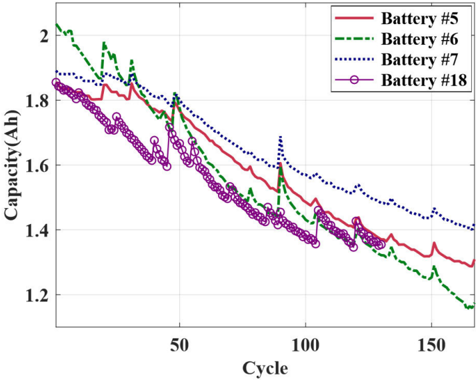
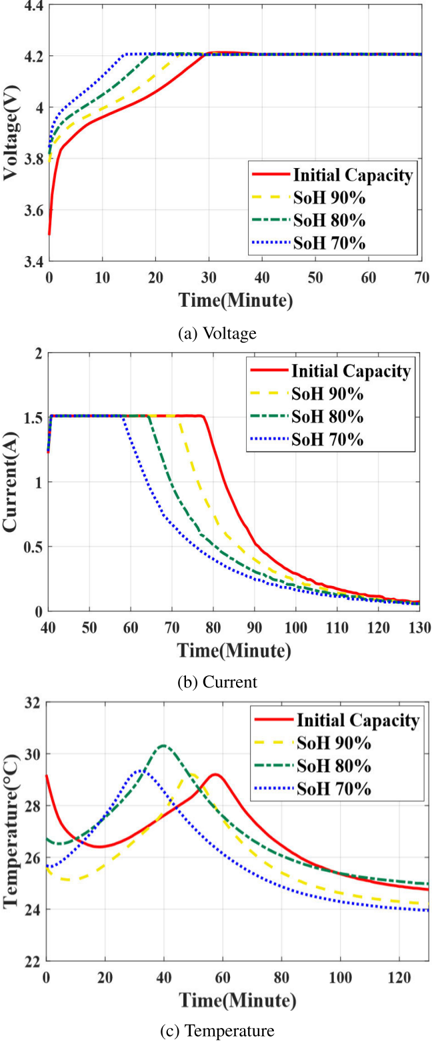
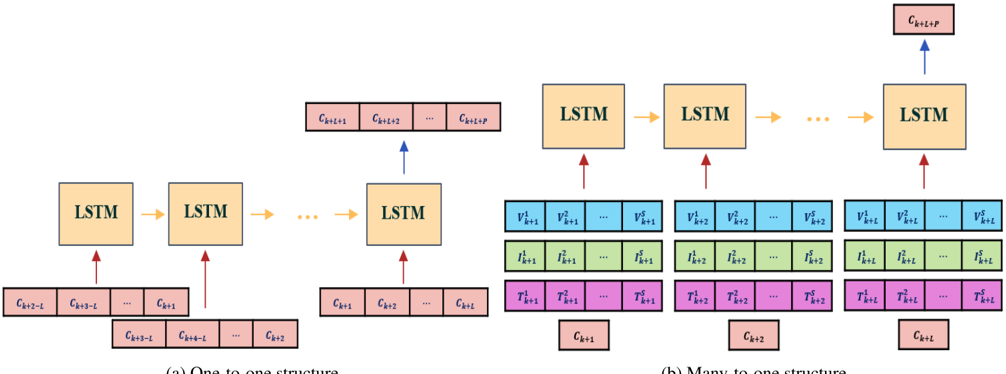
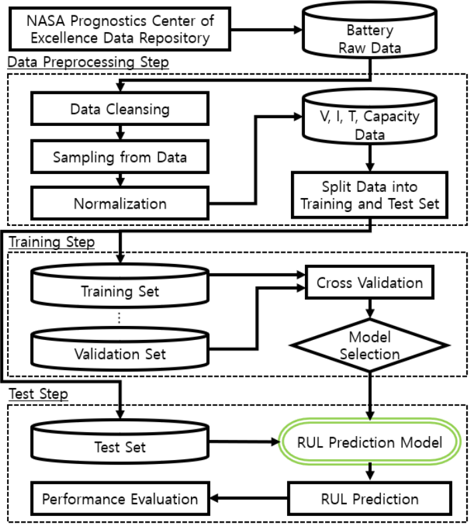
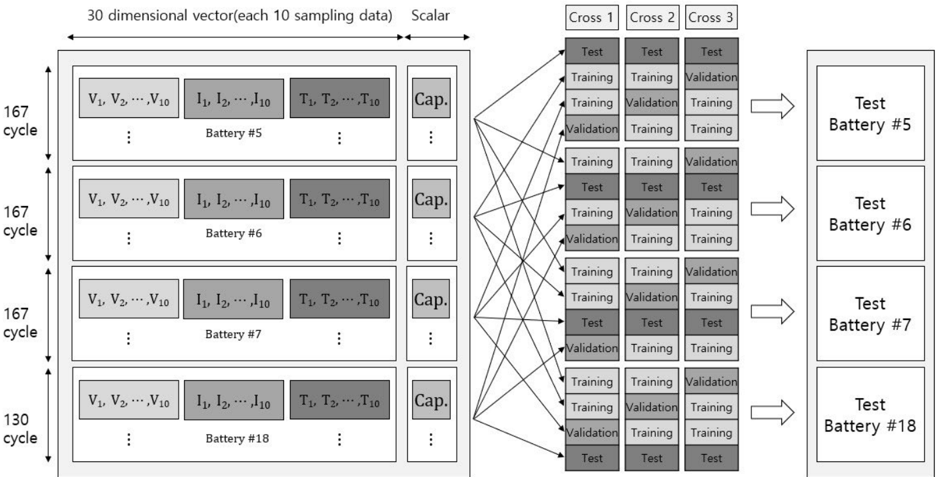
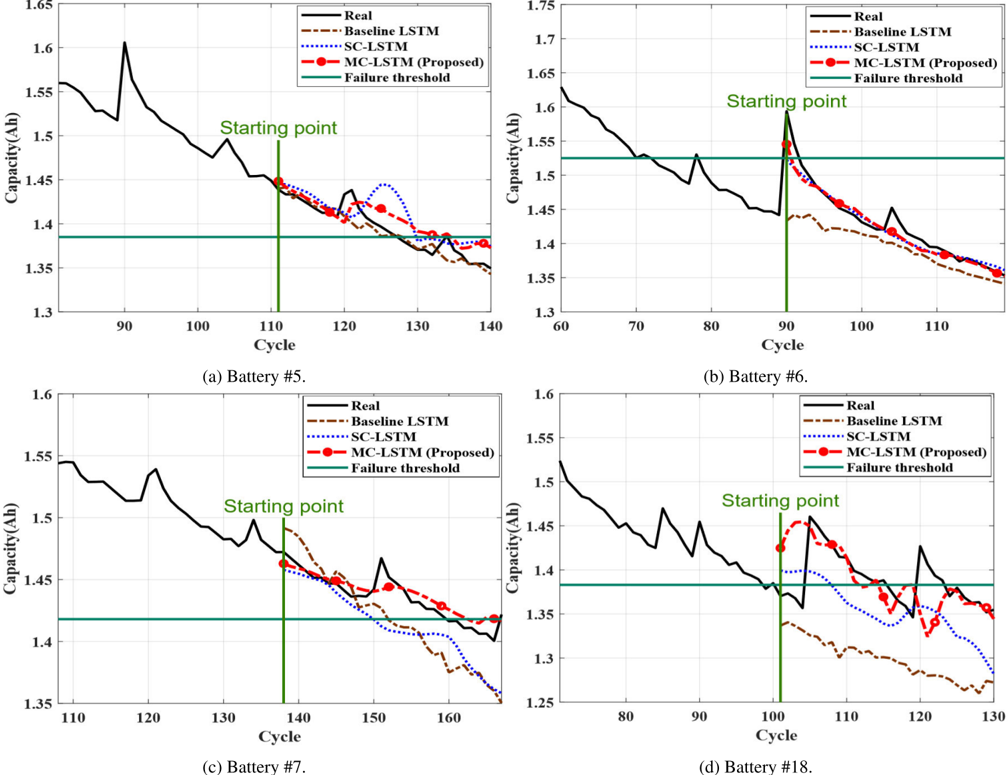
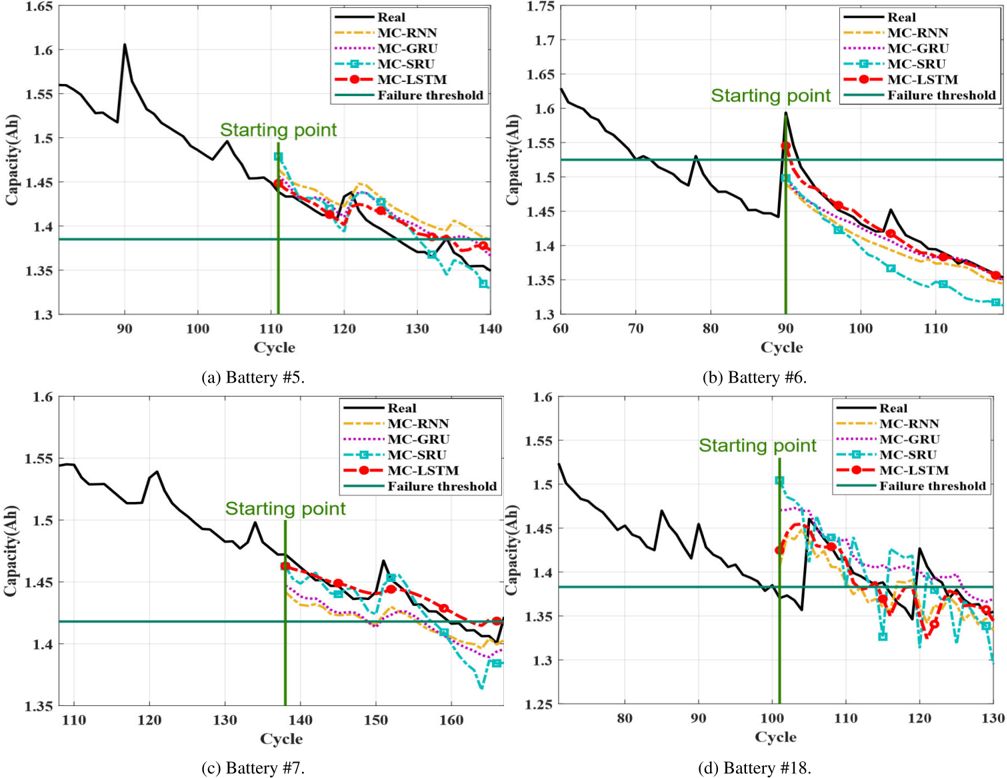
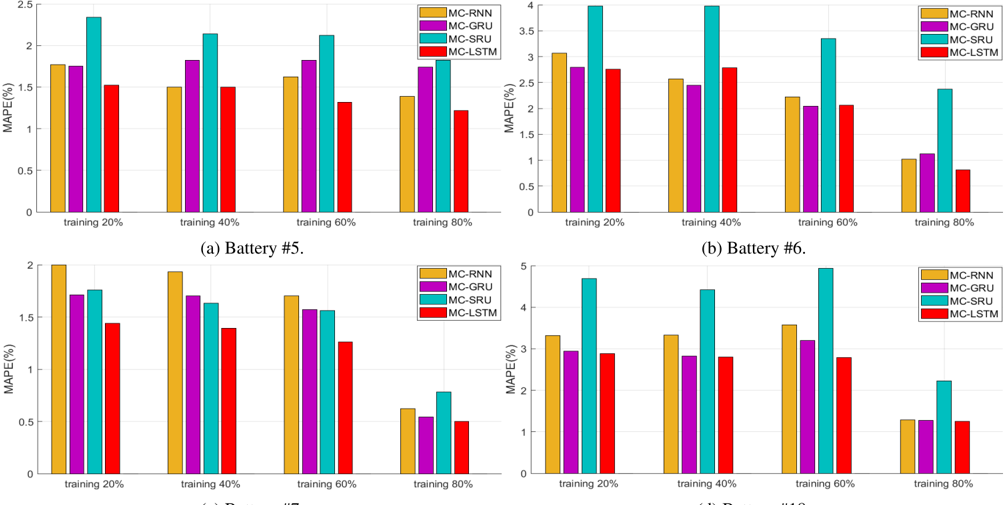
Remaining useful life (RUL) prediction of lithium-ion batteries can reduce the risk of battery failure by predicting the end of life. In this paper, we propose novel RUL prediction techniques based on long short-term memory (LSTM). To estimate RUL even in the presence of capacity regeneration phenomenon, we consider multiple measurable data from battery management system such as voltage, current and temperature charging profiles whose patterns vary as aging. Unlike the traditional LSTM prediction that matches input layer with output layer as one-to-one structure, we leverage many-to-one structure to be flexible for various input types and to substantially reduce the number of parameters for better generalization. Using the NASA lithium-ion battery datasets, we verify the accuracy of the proposed LSTM-based RUL prediction. The experimental results show that the proposed single-channel LSTM model improves the mean absolute percentage error (MAPE) by 39.2% compared to the baseline LSTM model. Furthermore, the proposed multi-channel LSTM model significantly improves the MAPE, e.g., by 63.7% compared to the baseline; the proposed model achieves 0.47-1.88% of MAPE while the state-of-the-art baseline LSTM shows 0.6-6.45% of MAPE.
Overview
The claims and statistics of this paper haven’t been checked yet.
Free: it reads the open-access text and checks the first 5 claims that cite a source we can check. Create a free account to check every claim.
Integrity signals
Registry
Cites
Statistics
Figures



Verification
Claims the paper makes
The claims and statistics of this paper haven’t been checked yet.
Free: it reads the open-access text and checks the first 5 claims that cite a source we can check. Create a free account to check every claim.
Claims other papers make about this one
Each is checked against this paper’s own text: does it say what the citing paper says it does?
The source backs part of the claim, not all of it — or backs it for a different population, condition or comparison.
In the citing paper
“The direct capacity measurement method (the remaining capacity measurement) for SOH estimation is one of the most straightforward and most accurate methods if the battery's current is measured accurately to count the columns and if the measurements are performed under a controlled set of parameters, such as temperature.”
From An Electrochemical Impedance Spectrum-Based State of Health Differential Indicator with Reduced Sensitivity to Measurement Errors for Lithium–Ion Batteries (2024) · cites this paper as [23]
Experimental — accuracy not yet measured
Self-check
Percentages, sums and reported differences re-computed from the paper’s own numbers.
The self-check needs the paper’s full text.
Citations
Cites
Adam: A Method for Stochastic Optimization
Kingma, D. P., & Ba, J. (2014) · arXiv · doi:10.48550/arxiv.1412.6980 · Cited by 98,946 · cited 1×
“001 [32].”
(2010) · International Conference on Machine Learning · Cited by 13,995
TensorFlow: A system for large-scale machine learning
Abadi, M., Barham, P., Chen, J., Chen, Z., Davis, A., Dean, J., Devin, M., Ghemawat, S., Irving, G., Isard, M., et al. (2016) · arXiv (Cornell University) · doi:10.48550/arxiv.1605.08695 · Cited by 11,822
Learning long-term dependencies with gradient descent is difficult
Bengio, Y., Simard, P., & Frasconi, P. (1994) · IEEE Transactions on Neural Networks · doi:10.1109/72.279181 · Cited by 8,542 · cited 1×
“However, RNN has the long-term dependency problem [16] as the number of cycles (i.”
BackgroundScore normalization in multimodal biometric systems
Jain, A., Nandakumar, K., & Ross, A. (2005) · Pattern Recognition · doi:10.1016/j.patcog.2005.01.012 · Cited by 2,154 · cited 1×
“In our work, min-max normalization is used as follows [26]:”
MethodZhang, Y., Xiong, R., He, H., & Pecht, M. G. (2018) · IEEE Transactions on Vehicular Technology · doi:10.1109/tvt.2018.2805189 · Cited by 1,326
Prechelt, L. (2012) · Lecture Notes in Computer Science · doi:10.1007/978-3-642-35289-8_5 · Cited by 951
A review on prognostics and health monitoring of Li-ion battery
Zhang, J., & Lee, J. (2011) · Journal of Power Sources · doi:10.1016/j.jpowsour.2011.03.101 · Cited by 792 · cited 1×
“However, battery degradation begins immediately after batteries are manufactured, and when 70% or 80% of initial capacity remains, batteries need be replaced for safe operation [3].”
Nuhic, A., Terzimehic, T., Soczka-Guth, T., Buchholz, M., & Dietmayer, K. (2013) · Journal of Power Sources · doi:10.1016/j.jpowsour.2012.11.146 · Cited by 664 · cited 2×
“Specifically, data-driven methods rely solely on historical capacity degradation data rather than requiring explicit mathematical models of battery degradation or internal mechanisms of the battery [10]–[12].”
MethodPatil, M. A., Tagade, P., Hariharan, K. S., Kolake, S. M., Song, T., Yeo, T., & Doo, S. (2015) · Applied Energy · doi:10.1016/j.apenergy.2015.08.119 · Cited by 626 · cited 2×
“Specifically, data-driven methods rely solely on historical capacity degradation data rather than requiring explicit mathematical models of battery degradation or internal mechanisms of the battery [10]–[12].”
Method
Cited by
Items 201–300 of 402
Chen, H., Yuan, B., Lu, Q., Shah, B. A., Hu, R., Wu, H., Zhou, X., Han, Q., & Li, S. (2025) · Journal of Energy Storage · doi:10.1016/j.est.2025.117813 · Cited by 8
Zhao, T., Zhang, Y., Wang, M., Feng, W., Cao, S., & Wang, G. (2025) · Frontiers in Electronics · doi:10.3389/felec.2025.1654344 · Cited by 7
Yao, J., Zhao, H., & Kowal, J. (2025) · Journal of Power Sources · doi:10.1016/j.jpowsour.2025.238569 · Cited by 13
Bu, W., Liang, H., Gu, W. P., & Zheng, M. (2025) · Journal of Power Sources · doi:10.1016/j.jpowsour.2025.239073 · Cited by 8
Sifat, M. S. I., Sawda, U., Kabir, M. A., Ahmed, M. U., Lipu, M. S. H., & Islam, M. M. M. (2026) · Journal of Energy Storage · doi:10.1016/j.est.2026.121006 · Cited by 11
A method for predictive maintenance of mechanical equipment based on Transferable CNN-LSTM
Du, J., Gui, X., Song, L., Gao, S., Zhang, C., & Li, X. (2022) · Global Reliability and Prognostics and Health Management Conference (PHM) · doi:10.1109/phm-yantai55411.2022.9941744 · Cited by 8
An Improved Approach Based on Transformer Network for Remaining Useful Life of Lithium-ion Battery
Mao, J., Yin, X., Chen, R., Ding, K., Jiang, L., Lai, J., & Yin, X. (2023) · Asia Conference on Power and Electrical Engineering (ACPEE) · doi:10.1109/acpee56931.2023.10135655 · Cited by 8
“model with single-channel and multi-channel was presented to demonstrate that the latter has better performance[12].”
A new data-driven diagnostic technique for in-situ capacity prediction of lithium-ion batteries
Li, L., Chen, X., Guo, D., Yuan, Q., & Wang, Q. (2023) · Journal of Energy Storage · doi:10.1016/j.est.2023.109885 · Cited by 7
Lithium Battery Degradation Prediction Model Based on Capacity
Lin, M. (2024) · IEEE Transactions on Vehicular Technology · doi:10.1109/tvt.2024.3373632 · Cited by 7
Salek, F., Resalati, S., Azizi, A., Babaie, M., Henshall, P., & Morrey, D. (2024) · Mathematics · doi:10.3390/math12071051 · Cited by 9
A novel AI-powered method for robust identification of operational phases in refrigerators
Papaioannou, A., Dimara, A., Krinidis, S., Tzitziou, G., Papaioannou, I., Michailidis, I., Anagnostopoulos, C., Ioannidis, D., Kosmatopoulos, E. B., & Tzovaras, D. K. (2024) · Sustainable Energy Grids and Networks · doi:10.1016/j.segan.2024.101405 · Cited by 7
Liu, Y., Han, L., Wang, Y., Zhu, J., Zhang, B., & Guo, J. (2025) · Electronics · doi:10.3390/electronics14020400 · Cited by 7
A hybrid-driven method for predicting the remaining useful life of lithium-ion batteries
Huang, X., Mao, Y., Li, L., & Li, Y. G. (2025) · Measurement Science and Technology · doi:10.1088/1361-6501/add042 · Cited by 7
“Its main components consist of convolutional, pooling, and fully connected layers [32].”
The Dawn of Metamaterial Engineering Predicted via Hyperdimensional Keyword Pool and Memory Learning
Cha, Y., & Hao, Y. (2022) · Advanced Optical Materials · doi:10.1002/adom.202102444 · Cited by 8
Qu, Z., Zhu, L., Ma, S., & Zhang, B. (2024) · Arabian Journal for Science and Engineering · doi:10.1007/s13369-024-08854-5 · Cited by 7
Choi, S., Jang, H., Han, H., Park, S., Choi, M.-I., & Park, S. (2022) · IEEE/IAS Industrial and Commercial Power Systems Technical Conference · doi:10.1109/icps54075.2022.9773913 · Cited by 7
Edge-based Battery Remaining Useful Life Estimation Using Deep Learning
Adducul, C. J. C., Macasaet, J. R. I., & Tiglao, N. M. C. (2023) · International Conference on Smart Applications, Communications and Networking (SmartNets) · doi:10.1109/smartnets58706.2023.10215733 · Cited by 7
“3) Long Short-Term Memory: The Long-Short Term Memory is a special kind of RNN designed to learn long-term dependencies to address the vanishing gradients drawback of a standard RNN [16].”
BackgroundResultInfluentialRemaining Useful Life Prediction of Turbofan Engines based on CNN-LSTM Hybrid Model
Wei, J., Meng, L., Du, J., & Yin, Z. (2024) · International Conference on Cloud Computing, Big Data Application and Software Engineering (CBASE) · doi:10.1109/cbase64041.2024.10824495 · Cited by 7
“It can learn the long-term dependency relationships of time series and retain important information in the sequence, and has good modeling ability for high-dimensional time series data[13].”
Li, H., Meng, X., ZHANG, W., Zhou, X.-Y., & Yang, X. (2026) · Reliability Engineering & System Safety · doi:10.1016/j.ress.2026.112233 · Cited by 6
Health status prediction of lithium ion batteries based on zero-shot learning
Ge, Y., Ma, J., & Sun, G. (2023) · Journal of Energy Storage · doi:10.1016/j.est.2023.108494 · Cited by 6
Remaining useful life prediction of lithium-ion batteries based on FEEMD-LSTM-TAM-OKELM
Yu, J., Cai, Y., Huang, Y., & Yang, X. (2024) · AIP Advances · doi:10.1063/5.0236673 · Cited by 7
Hu, T., Zhang, X., Sun, J., & Wang, J. (2025) · Measurement Science and Technology · doi:10.1088/1361-6501/ada849 · Cited by 9
“The prediction SPs for Chen et al [1] and Park et al [18] were 100 cycles and 110 cycles, respectively.”
Yang, J., Zhang, M., & Wang, X. (2025) · Energy · doi:10.1016/j.energy.2025.135648 · Cited by 7
Wu, J., Du, J., Yang, C., Yang, C., & Zhang, M. (2025) · Journal of Information and Intelligence · doi:10.1016/j.jiixd.2025.08.001 · Cited by 6
Bi-LSTM-Based Dynamic Prediction Model for Pulling Speed of Czochralski Single-Crystal Furnace
Feng, Z., Hu, X., Tian, Z., Jiang, B., Zhang, H., & Zhang, W. (2022) · Journal of Computing and Information Science in Engineering · doi:10.1115/1.4056138 · Cited by 8
Atsafack, B. M., Kabiri, C., & Rushingabigwi, G. (2025) · IEEE Access · doi:10.1109/access.2025.3607733 · Cited by 6
State-of-health classification of redox flow batteries using neural networks
Cantera, M., Rivas, F., Lubián, L., Rubio‐Presa, R., Ventosa, E., & Cámara, J. M. (2025) · Journal of Energy Storage · doi:10.1016/j.est.2025.118605 · Cited by 5
Hu, Z., Ye, X., Luo, X., Zhang, H., He, M., Li, J., & Li, Q. (2024) · Energies · doi:10.3390/en17092127 · Cited by 5
Sim, M.-S., Kim, D.-Y., Yoon, Y., Kang, S., & Baek, J. D. (2024) · IEEE Access · doi:10.1109/access.2024.3419009 · Cited by 5
“Therefore, a combination of LSTM with other models has been proposed [32], [33].”
BackgroundDual Siamese transformer-encoder-based network for remaining useful life prediction
Lin, C.-S. (2024) · The Journal of Supercomputing · doi:10.1007/s11227-024-06396-z · Cited by 6
“• BiLSTM [5]: The BiLSTM network is commonly employed as a straightforward baseline in the context of time series prediction because of its capability of capturing sequential dependencies.”
InfluentialPrediction of the Remaining Useful Life of Lithium-Ion Battery Using Multilayer Perceptron
Pancha, B., Paudel, S., Thapaliya, B., Siewierski, T., & Niraula, D. (2024) · International Journal of Electrical Components and Energy Conversion · doi:10.11648/j.ijecec.20241001.11 · Cited by 6
RNN and CNN Based Ensemble Models for State-of-Health Prediction of Li-Ion Batteries
Mohan, A., & Thosar, A. (2024) · IEEE International Conference on Intelligent Systems, Smart and Green Technologies (ICISSGT) · doi:10.1109/icissgt58904.2024.00035 · Cited by 7
“The author in [10] presents a data-driven LSTM-based method for predicting the Remaining Useful Life (RUL) of lithium-ion batteries, using a many-to-one structure to capture the capacity regeneration phenomenon and reduce parameters for better generalization.”
Luo, X., Bu, W., Han, L., & Zheng, M. (2025) · Eksploatacja i Niezawodnosc - Maintenance and Reliability · doi:10.17531/ein/202184 · Cited by 6
He, K., Dai, X., Li, X., Zhou, R., Lin, F., Zhang, W., & Ma, H. (2025) · Ionics · doi:10.1007/s11581-025-06711-5 · Cited by 6
Comparative Study on Relative Fossil Energy Carrying Capacity in China and the United States
Zuo, Z., Cheng, J., Guo, H., & Li, Y. (2021) · Energies · doi:10.3390/en14102972 · Cited by 5
“The smaller the MAPE, the better the prediction accuracy [54,55].”
BackgroundMultiple Object Tracking using YOLO-based Detector
Lin, S. D., Chang, T., & Chen, W. (2021) · Journal of Imaging Science and Technology · doi:10.2352/j.imagingsci.technol.2021.65.4.040401 · Cited by 5
Synthetic battery attribute generation to surmount data scarcity using auto‐correlation mechanism
Channegowda, J., Urs, V. R., & Lingaraj, C. (2022) · International Journal of Energy Research · doi:10.1002/er.7784 · Cited by 5
“Improving on the performance of RNNs, the long short-term memory (LSTM) network has been predominantly employed for forecasting purposes.(24) The input fed to an LSTM module is from the preceding layer than the present time instance.”
TensorRT Powered Model for Ultra-Fast Li-Ion Battery Capacity Prediction on Embedded Devices
Zhu, C., Qian, J., & Gao, M. (2024) · Energies · doi:10.3390/en17122797 · Cited by 7
Feng, R., Wang, S., Yu, C., & Fernández, C. (2024) · Ionics · doi:10.1007/s11581-024-05740-w · Cited by 5
“Model-based methods include Kalman filtering (KF), particle filtering (PF), and their extended algorithms [14–17].”
Wang, H., Dai, X., Cui, L., & Gao, M. (2024) · Ionics · doi:10.1007/s11581-024-05981-9 · Cited by 6
“The State of Health (SOH), which represents the aging state of batteries throughout each charge/discharge cycle, needs to be controlled by a battery management system (BMS) to properly assess their condition [35, 36].”
Lixin, E., Wang, J., Sun, Y., Shen, W., & Xiong, R. (2025) · Journal of The Electrochemical Society · doi:10.1149/1945-7111/addd4e · Cited by 10
An LSTM-Based Approach For Capacity Estimation on Lithium-ion Battery
Cao, M., Zhang, Y., Hui, J., & Liu, Y. (2021) · Chinese Control and Decision Conference (CCDC) · doi:10.1109/ccdc52312.2021.9602083 · Cited by 5
Research on Minimization of Data Set for State of Charge Prediction
Liu, T., Zhao, J., Xiang, C., & Cheng, S. (2022) · Sensors · doi:10.3390/s22031101 · Cited by 5
“The typical deep learning algorithms include long short‐ term memory (LSTM) [24,25], convolutional neural networks (CNN) [26–29], and complex CNN‐LSTM [30,31].”
BackgroundSu, Z., Yu, Z., Ma, L., Tang, J., Qian, B., Lin, X., & Zhang, F. (2023) · International Conference on Computer Engineering and Intelligent Control (ICCEIC) · doi:10.1109/icceic60201.2023.10426741 · Cited by 4
“Literature [6] combines noise-reducing self-encoder, singular spectrum analysis and long and short-term memory neural network to construct a comprehensive power prediction model, which reduces the noise interference and improves the prediction accuracy, but the model is more complex, and it has…”
BackgroundGao, Z. W., Dai, R., Yi, N., & Guo, X. (2024) · Journal of The Electrochemical Society · doi:10.1149/1945-7111/ad9353 · Cited by 5
Chen, M., Chen, X., Fang, W., Hou, Y., Liu, L., Ye, J., & Wu, Y. (2025) · Energy · doi:10.1016/j.energy.2025.139103 · Cited by 4
Ibrahim, M., Ansari, S., Ayob, A., Lipu, M. S. H., Abdolrasol, M. G. M., Khawaja, A. W., Khalil, M. A., & Stroe, D. (2025) · Scientific Reports · doi:10.1038/s41598-025-26743-1 · Cited by 5
“During JFO-FNN testing for each LIB, the model training was performed on the dataset from the other three LIBs.”
InfluentialMACHINE LEARNING AND IOT-BASED LI-ION BATTERY CLOUD MONITORING SYSTEM FOR 5G BASE STATIONS
Li, X., LI, B., Su-fen, G., Sun, Z., WANG, Q., DU, T., Peng, L., & Zhang, D. (2023) · Fractals · doi:10.1142/s0218348x23401102 · Cited by 4
Mun, T., Han, D., Lee, P., & Kim, J. (2023) · Journal of Energy Storage · doi:10.1016/j.est.2023.108592 · Cited by 4
Chen, H., & Yongliang, H. (2023) · IEEE International Conference on Sensors, Electronics and Computer Engineering (ICSECE) · doi:10.1109/icsece58870.2023.10263317 · Cited by 5
Time series online forecasting based on sequence decomposition learning networks
Ma, Y., Xu, C., Wang, H., Liu, S., & Gu, X. (2023) · Applied Soft Computing · doi:10.1016/j.asoc.2023.110907 · Cited by 5
Senthilkumar, D., & Vijayakumar, K. (2024) · IETE Journal of Research · doi:10.1080/03772063.2024.2372349 · Cited by 4
“The battery power system is essential for the long driving range of electric vehicles and reliable performance in a variety of driving situations, including turns and acceleration [3,4].”
He, Z., Kong, Z., Chen, Z., Zhan, Y., Que, Z., & Xu, Z. (2024) · China Automation Congress (CAC) · doi:10.1109/cac63892.2024.10865626 · Cited by 4
“The encoder contains three 1D CNN layers for channel feature extraction and utilizes an LSTM module for temporal dimension feature aggregation.”
InfluentialZhou, Y., Shao, Z., Li, H., Chen, J., Sun, H., Wang, Y., Wang, N., Pei, L., Wang, Z., Zhang, H., et al. (2025) · Energies · doi:10.3390/en18143842 · Cited by 4
Convolution and Long Short-Term Memory Neural Network for PECVD Process Quality Prediction
Sun, M., Zhang, Z., Zhou, Y., Xia, Z., Zhou, Z., & Zhang, L. (2021) · Global Reliability and Prognostics and Health Management Conference (PHM) · doi:10.1109/phm-nanjing52125.2021.9612756 · Cited by 4
A Multitask Data-Driven Model for Battery Remaining Useful Life Prediction
Pham, T., Truong, L., Bui, A., Nguyen, D. M., Nguyen, D. Q., Garg, A., Gao, L., & Quan, T. (2022) · REV Journal on Electronics and Communications · doi:10.21553/rev-jec.290 · Cited by 4
El-Dalahmeh, M., Bashir, I., Al‐Greer, M., & El‐Dalahmeh, M. (2022) · International Universities Power Engineering Conference (UPEC) · doi:10.1109/upec55022.2022.9917597 · Cited by 6
“For example, the authors in [18] developed many-to-one long short-term memory (LSTM) algorithm to predict the RUL of the LIB; the charging current, voltage, temperature, and capacity were used as an input to the LSTM.”
MethodMin, H., Yan, Y., Sun, W., Yu, Y., Jiang, R., & Meng, F. (2023) · Energies · doi:10.3390/en16248088 · Cited by 6
Zhang, Q., 廖强强, Chen, X., Yongxiang, C. A. I., Yongxiang, C. A. I., & Liu, W. (2024) · Electrochemistry · doi:10.5796/electrochemistry.24-00042 · Cited by 4
Accurate RUL Prediction Based on Sliding Window with Sparse Sampling
Song, C., & Lee, S. (2021) · International Conference on Ubiquitous Information Management and Communication (IMCOM) · doi:10.1109/imcom51814.2021.9377402 · Cited by 5
“Unlike other methods, the difference is that charging and discharging data are used with SOH [17].”
MethodResearch on temperature prediction of subway transformer based on LSTM
Mengrong, G., & Liu, H. (2022) · IEEE International Conference on Artificial Intelligence and Computer Applications (ICAICA) · doi:10.1109/icaica54878.2022.9844506 · Cited by 4
Mykhailenko, O. Y. (2021) · E3S Web of Conferences · doi:10.1051/e3sconf/202128005004 · Cited by 4
Wan, A., Yin, C., Li, W., Zhang, M., Wu, M., Li, J., Li, T., Ma, Z., & Yang, J. (2025) · Journal of Energy Storage · doi:10.1016/j.est.2025.119373 · Cited by 4
Sah, B. K., Yadav, A. K., & Verma, O. P. (2026) · The European Physical Journal Plus · doi:10.1140/epjp/s13360-026-07295-3 · Cited by 3
Wang, M., Feng, S., Andriukaitis, D., Li, Z., Chauhan, S., & Vashishtha, G. (2026) · Automotive Innovation · doi:10.1007/s42154-025-00385-5 · Cited by 6
“According to literature [46], the model-based methods [106], data driven-based methods [107] and hybrid-based methods [108] have been developed, as shown in Fig.”
Lithium-Ion Battery State of Health Estimation Based on LSTM-Transformer
Meng, F., Wang, P., & Wang, J. (2024) · IEEE International Conference on Communication Systems and Network Technologies (CSNT) · doi:10.1109/csnt60213.2024.10545710 · Cited by 4
“Therefore, it is critical to accurately assess the available capacity of lithium-ion batteries in real time [5].”
BackgroundYuliani, A. R., Pardede, H. F., Ramdan, A., Zilvan, V., Yuwana, R. S., Amri, M. F., Kusumo, R. B. S., & Pramanik, S. (2024) · Mechatronics Electrical Power and Vehicular Technology · doi:10.55981/j.mev.2024.905 · Cited by 5
Pham, T., Bui, H. N., Nguyen, M., Le, T. N., Vu, V., Pham, Q., & Quan, T. (2024) · Energy Reports · doi:10.1016/j.egyr.2024.10.048 · Cited by 3
Classification models for identifying Pterocarpus santalinus L.f. using NIR spectroscopy data
Qi, Y., Li, Y., Zhang, Z., Zhou, J., Qin, Z., Li, Y., & Chen, C. (2024) · Holzforschung · doi:10.1515/hf-2024-0066 · Cited by 3
Yang, J., & Dang, Y. (2025) · ACS Applied Energy Materials · doi:10.1021/acsaem.5c01927 · Cited by 3
Mathematical Characterization of Experimental Aging Data for Designing Battery Degradation Model
Abbas, M., Cho, I., & Kim, J. (2022) · Journal of Electrical Engineering and Technology · doi:10.1007/s42835-022-01271-4 · Cited by 4
“The study in [13] utilizes a many-to-one structure of LSTM to reduce the burden on the model.”
BackgroundMachine Learning Robustness in Predictive Maintenance Under Adversarial Attacks
Dionisopoulos, N., Vrochidou, Ε., & Papakostas, G. A. (2023) · Smart innovation, systems and technologies · doi:10.1007/978-981-99-5180-2_21 · Cited by 4
Multi-step prediction of roof pressure based on multi-scale contextual fusion network
Zhang, Y., Yu, Q., Tang, G., & Wu, Q. (2024) · Sensors and Actuators A Physical · doi:10.1016/j.sna.2024.115130 · Cited by 3
Darwish, A. (2024) · Information Sciences with Applications · doi:10.61356/j.iswa.2024.2224 · Cited by 3
“Park et al. [29] introduced a many-to-one architecture of LSTM for precise prediction of the RUL for lithium-ion batteries.”
BackgroundMethodAlexprabu, S. P., & Sathiyasekar (2024) · Journal of New Materials for Electrochemical Systems · doi:10.14447/jnmes.v27i2.a02 · Cited by 3
“Kyungnam Park et al [16] offered a new long short-term memory (LSTM)-based RUL prediction algorithm in which a variety of quantifiable variables were used from the battery management system, such as the voltage, current, and temperature charging profiles, which patterns change with battery ageing,…”
BackgroundMethodVillegas-Ch, W. E., Gutierrez, R., Navarro, A. M., & Mera-Navarrete, A. (2024) · IEEE Access · doi:10.1109/access.2024.3486188 · Cited by 3
Xu, B., Ge, X., Ji, S., & Wu, Q. (2025) · Ionics · doi:10.1007/s11581-024-05992-6 · Cited by 3
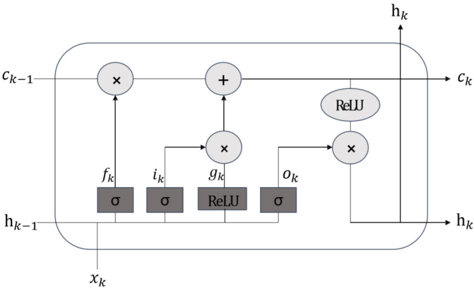
“Long short-term memory network (LSTM) address the issues of gradient vanishing and gradient explosion faced by traditional RNNs when handling long sequential data by introducing gating mechanisms: input gates, forget gates, and output gates [34], as shown in Fig.”
Bae, Y. S., Lee, S., & Moon, J. (2024) · Batteries · doi:10.3390/batteries10110389 · Cited by 3
“In this study, we employ the fundamental LSTM unit architecture as outlined by Park et al. [31].”
Park, J., Lee, G. H., Kim, J., Yoo, Y.-S., & Lee, I. (2025) · IEEE Access · doi:10.1109/access.2025.3549402 · Cited by 3
Comparative Analysis of Algorithms for Predicting the Remaining Useful Life of Lithium-Ion Batteries
Pratumgul, W., Pratumgul, W., & Phramala, S. (2025) · International Electrical Engineering Congress (iEECON) · doi:10.1109/ieecon64081.2025.10987695 · Cited by 2
Ramdan, A., Zilvan, V., Yuliani, A. R., Pardede, H. F., Hadiana, A., Suryawati, E., Ihsan, C. N., Yuwana, R. S., Rozie, A. F., & Sugiarto, B. (2025) · Journal of King Saud University - Engineering Sciences · doi:10.1007/s44444-025-00035-5 · Cited by 2
“…evaluated by measuring computational complexity using floating point operations (FLOPs), the number of parameters, and the accuracy of the prediction model using error evaluation metrics, specifically the Mean Absolute Percentage Error (MAPE) and the Root Mean Square Error (RMSE) (Park et al. 2020).”
InfluentialDeep learning model for remaining useful life prediction with reduced labeling data dependency
Chen, J., Wang, Y., Guo, D., Shen, Y., Sun, T., Han, X., Zheng, Y., & Ouyang, M. (2025) · Applied Energy · doi:10.1016/j.apenergy.2025.126885 · Cited by 2
Robustness of CNN-augmented sequential models for Li-ion battery RUL prediction under data scarcity
Zhang, J. (2025) · PLoS ONE · doi:10.1371/journal.pone.0339528 · Cited by 3
Chaturvedi, V., Venkatesan, M., Lanke, S., Subramaniam, A., Karle, M. L., Pandit, R. A., Gupta, D., & Karle, U. S. (2026) · SAE technical papers on CD-ROM/SAE technical paper series · doi:10.4271/2026-26-0382 · Cited by 2
Velugula, R., Mittal, K., & Mittal, M. (2026) · Journal of Electrochemical Energy Conversion and Storage · doi:10.1115/1.4071584 · Cited by 2
Remaining useful life prediction of lithium-ion batteries using a CEEMDAN–Bi-LSTM hybrid model
Li, H., Cao, Y., Ren, X., Zhang, D., Xu, T., Su, Z., Jiang, Y., Wang, Y., Chen, B., Zhang, H., et al. (2026) · International Journal of Electrochemical Science · doi:10.1016/j.ijoes.2026.101427 · Cited by 2
Bayoumi, E. H. E., Nassar, Y. F., Eltohamy, M. S., & Awad, H. E.-S. (2026) · Global Energy Interconnection · doi:10.1016/j.gloei.2026.05.004 · Cited by 6
Kim, G., Wong, E., Irugalbandara, A., & Kang, M. (2026) · Current Opinion in Electrochemistry · doi:10.1016/j.coelec.2026.101902 · Cited by 2
Adaptation of the Automotive Product Development Process for AI Development
Grundstein, S., Burger, B., & Schöck, J. (2024) · Applied Computer Systems · doi:10.2478/acss-2024-0002 · Cited by 2
“AI systems promise better or better tuned/online tuneable controllers, for example, in the classification of the battery and charging status of an electric vehicle, where conventional control mechanisms (e.g., PID controllers) are currently used [3], [4].”
BackgroundAn HI Extraction Framework for Lithium-Ion Battery Prognostics Based on SAE-VMD
Wang, Z., Guo, Y., & Xu, C. (2020) · Xibei Gongye Daxue Xuebao/Journal of Northwestern Polytechnical University · doi:10.1051/jnwpu/20203840814 · Cited by 3
Sequence-in-Sequence Learning for SOH Estimation of Lithium-Ion Battery
Pham, T., Truong, L., Nguyen, M., Garg, A., Gao, L., & Quan, T. (2021) · Frontiers in artificial intelligence and applications · doi:10.3233/faia210385 · Cited by 3
“Sampling-based features for SOH estimation [2].”
BackgroundMethodInfluentialBui, H. N., Pham, T., & Quan, T. (2023) · Lecture notes in networks and systems · doi:10.1007/978-981-99-3236-8_50 · Cited by 2
Reza, M. S., Hannan, M. A., Mansor, M., Ker, P. J., Tiong, S. K., & Hossain, M. J. (2023) · IEEE International Conference on Energy Technologies for Future Grids (ETFG) · doi:10.1109/etfg55873.2023.10407732 · Cited by 2
“For instance, for LIBs, Park et al. [14] introduced LSTM-based RUL prediction algorithms where capacity regeneration was efficiently captured utilizing a many-to-one structure instead of one-to-one.”
BackgroundRemaining useful life prediction of lithium battery based on CEEMD-SE-IPSO-LSSVM hybrid model
Feng, Z., Li, M., & Liu, H. (2024) · International Journal of Low-Carbon Technologies · doi:10.1093/ijlct/ctae120 · Cited by 2
Predicting CO levels using LSTM and Rolling-Features
Salsabila, A., Sari, A. P., & Junaidi, A. (2025) · Journal of Artificial Intelligence and Engineering Applications (JAIEA) · doi:10.59934/jaiea.v4i3.1126 · Cited by 2
Sari, A. W., Yuliani, A. R., Pardede, H. F., Ramdan, A., Sulandari, W., Zilvan, V., & Adhi, P. (2023) · International Conference on Radar, Antenna, Microwave, Electronics, and Telecommunications (ICRAMET) · doi:10.1109/icramet60171.2023.10366687 · Cited by 2
“In accordance with recent studies [27], [28], there is an event called capacity regeneration.”
BackgroundA MDA-LSTM network for remaining useful life estimation of lithium batteries
Wang, X., Ni, N., Hu, M. Q., & Dai, K. (2024) · Signal Image and Video Processing · doi:10.1007/s11760-024-03136-x · Cited by 2
Artificial Neural Networks Applied to Power Management in Low Power MicroprocessorsPreprint
Freitas, C., & de Carvalho, R. A. (2021) · Preprints.org · doi:10.20944/preprints202109.0033.v1 · Cited by 2
Adversarial robustness of deep learning enabled industry 4.0 prognostics
Mode, G. R. (2020) · MOspace Institutional Repository (University of Missouri) · doi:10.32469/10355/88952 · Cited by 5
Metadata
- Authors
- Park, K., Choi, Y., Choi, W. J., Ryu, H.-Y., & Kim, H.
- Affiliations
- Sogang University (KR)
- Hyundai Motor Group (South Korea) (KR)
- Venue
- IEEE Access
- Published
- 2020
- Volume
- 8
- Pages
- 20786-20798
- ISSN
- 2169-3536 (ISSN-L)
- OpenAlex
- W3001479960
- Cited by
- 397
- References
- 33
- Citations by year
- 2026: 52 · 2025: 73 · 2024: 95 · 2023: 65 · 2022: 66 · 2021: 34 · 2020: 12
- FWCI
- 16.37
- Type
- journal article
- Language
- en
- Open access
- gold
- doi.org
- Locations
- IEEE Access (publishedVersion, cc-by)
- DOAJ (DOAJ: Directory of Open Access Journals) (submittedVersion, cc-by-sa)
- Funders
- National Research Foundation of Korea
- Ministry of Science, ICT and Future Planning (NRF-2017R1A1A1A05001377)
- Hyundai Motors
- Topics
- Physical Sciences › Engineering › Automotive Engineering › Battery Modeling and Management
- Physical Sciences › Engineering › Electrical and Electronic Engineering › Advancements in Battery Materials
- Physical Sciences › Engineering › Safety, Risk, Reliability and Quality › Reliability and Maintenance Optimization
- Keywords
- remaining useful life prediction, lithium-ion batteries, long short-term memory, battery degradation, capacity recovery, charging profiles, NASA battery dataset
About these checks
Registry, retraction, Cites and statistics results are computed, not judged, with one exception: a printed reference that no index lists is read once by a model before it counts as a citation error. Claims are extracted by a model and kept only when their quote appears verbatim in the text; each cited source is then checked, with a model’s help, for whether it says what the claim relies on. Those verdicts can be wrong — read the claim’s quote and the cited source before relying on one.
Statistics and arithmetic are recomputed, not judged.
Confidence bands are shown only for fields calibrated on our annotated test set. None is calibrated yet, so no band is shown.
What counts as a claim ›How we measure confidence ›How we check this ›
Are you an author, or do you see a problem with this page? Request a review
Data sources
Bibliographic data: Semantic Scholar, OpenAlex, Crossref.
Contains information from the Semantic Scholar Academic Graph Datasets, made available under the ODC Attribution License (ODC-BY 1.0).
Semantic Scholar’s data is described in: Kinney, R., et al. (2023). The Semantic Scholar Open Data Platform. arXiv:2301.10140.
