

LSTM-Based Battery Remaining Useful Life Prediction With Multi-Channel Charging Profiles
Open accessThe DOI matches its Crossref record; 32 of the 33 references it cites were found in a registry or an index.
Abstract
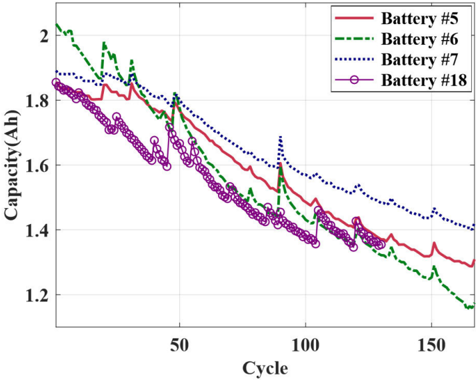
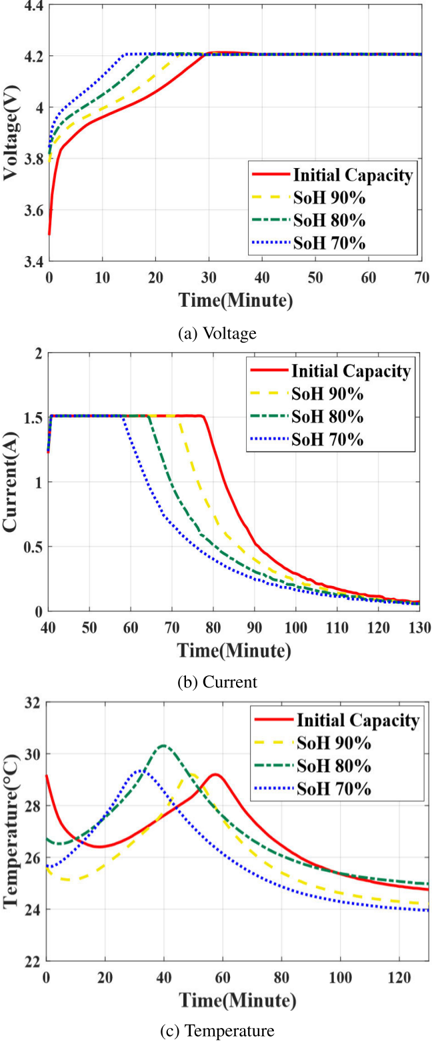
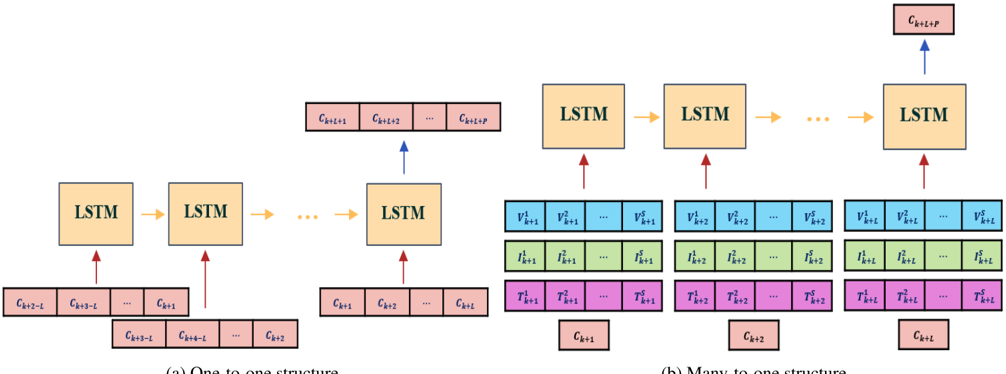
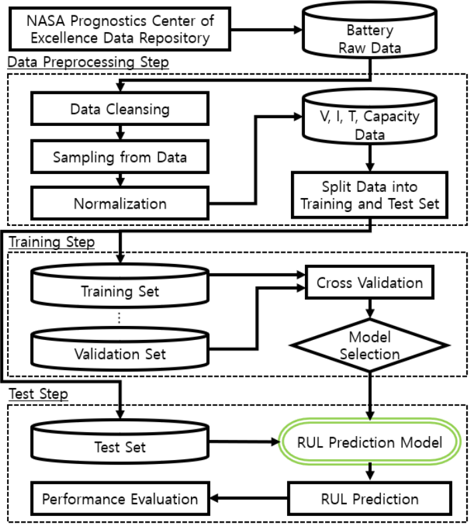
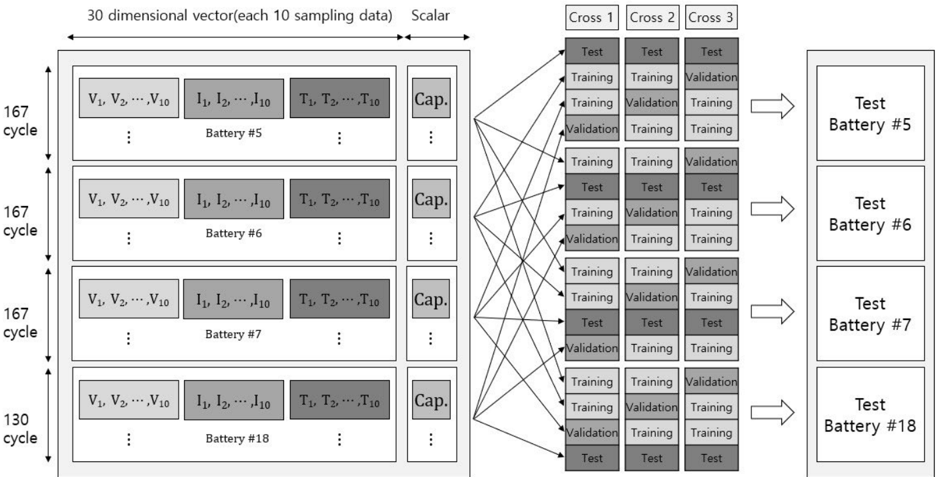
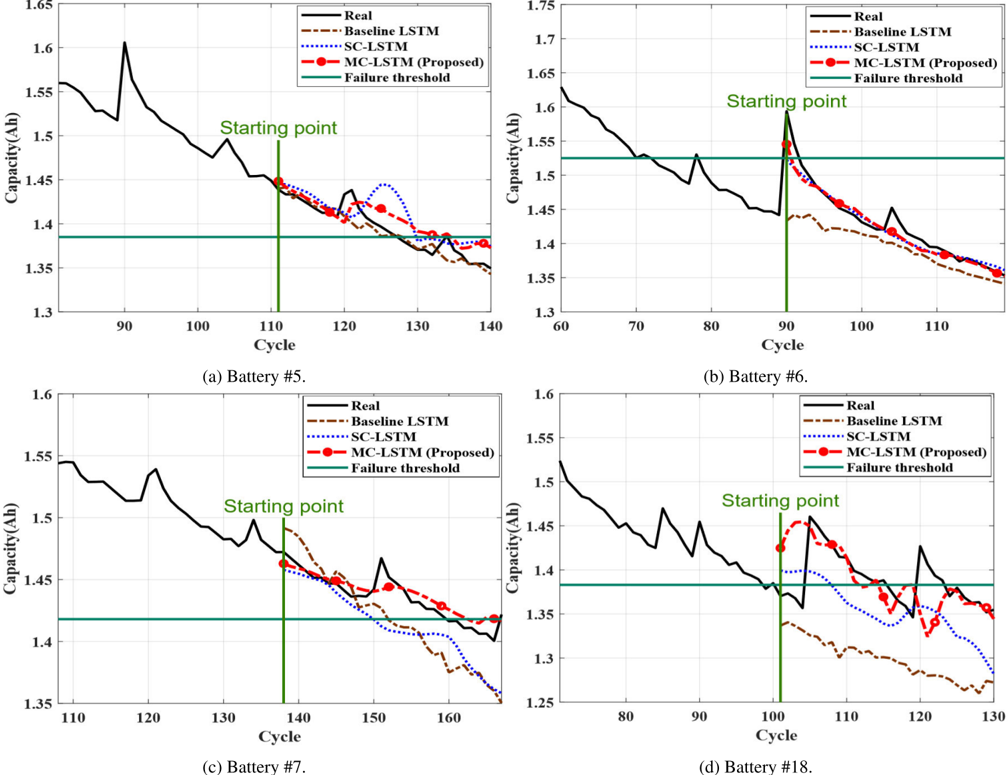
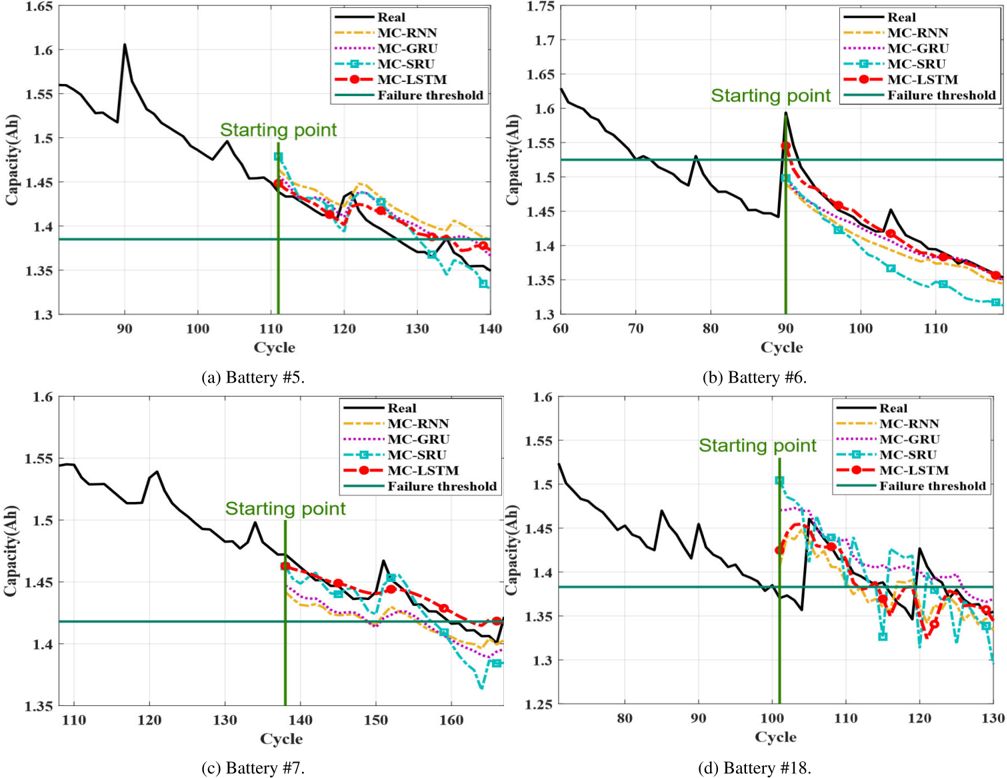
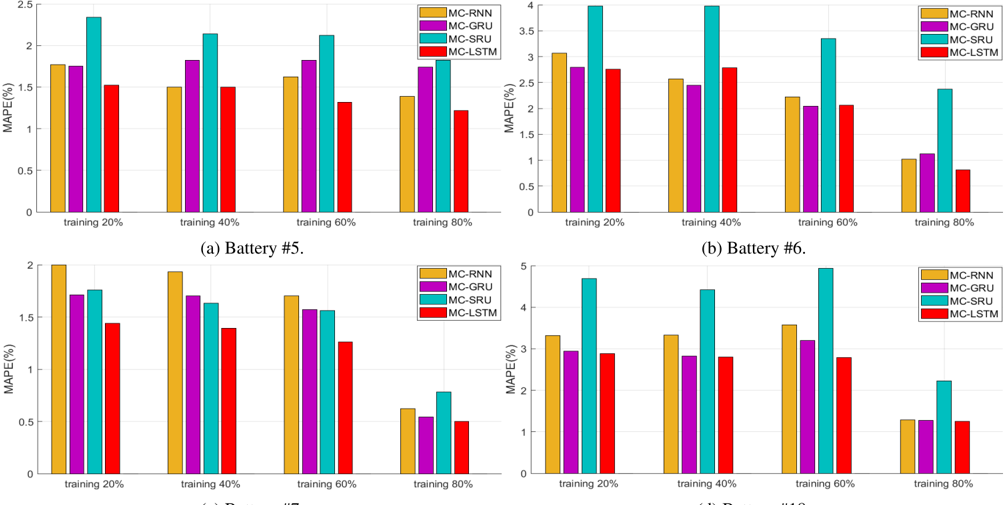
Remaining useful life (RUL) prediction of lithium-ion batteries can reduce the risk of battery failure by predicting the end of life. In this paper, we propose novel RUL prediction techniques based on long short-term memory (LSTM). To estimate RUL even in the presence of capacity regeneration phenomenon, we consider multiple measurable data from battery management system such as voltage, current and temperature charging profiles whose patterns vary as aging. Unlike the traditional LSTM prediction that matches input layer with output layer as one-to-one structure, we leverage many-to-one structure to be flexible for various input types and to substantially reduce the number of parameters for better generalization. Using the NASA lithium-ion battery datasets, we verify the accuracy of the proposed LSTM-based RUL prediction. The experimental results show that the proposed single-channel LSTM model improves the mean absolute percentage error (MAPE) by 39.2% compared to the baseline LSTM model. Furthermore, the proposed multi-channel LSTM model significantly improves the MAPE, e.g., by 63.7% compared to the baseline; the proposed model achieves 0.47-1.88% of MAPE while the state-of-the-art baseline LSTM shows 0.6-6.45% of MAPE.
Overview
The claims and statistics of this paper haven’t been checked yet.
Free: it reads the open-access text and checks the first 5 claims that cite a source we can check. Create a free account to check every claim.
Integrity signals
Registry
Cites
Statistics
Figures



Verification
Claims the paper makes
The claims and statistics of this paper haven’t been checked yet.
Free: it reads the open-access text and checks the first 5 claims that cite a source we can check. Create a free account to check every claim.
Claims other papers make about this one
Each is checked against this paper’s own text: does it say what the citing paper says it does?
The source backs part of the claim, not all of it — or backs it for a different population, condition or comparison.
In the citing paper
“The direct capacity measurement method (the remaining capacity measurement) for SOH estimation is one of the most straightforward and most accurate methods if the battery's current is measured accurately to count the columns and if the measurements are performed under a controlled set of parameters, such as temperature.”
From An Electrochemical Impedance Spectrum-Based State of Health Differential Indicator with Reduced Sensitivity to Measurement Errors for Lithium–Ion Batteries (2024) · cites this paper as [23]
Experimental — accuracy not yet measured
Self-check
Percentages, sums and reported differences re-computed from the paper’s own numbers.
The self-check needs the paper’s full text.
Citations
Cites
Adam: A Method for Stochastic Optimization
Kingma, D. P., & Ba, J. (2014) · arXiv · doi:10.48550/arxiv.1412.6980 · Cited by 98,946 · cited 1×
“001 [32].”
(2010) · International Conference on Machine Learning · Cited by 13,995
TensorFlow: A system for large-scale machine learning
Abadi, M., Barham, P., Chen, J., Chen, Z., Davis, A., Dean, J., Devin, M., Ghemawat, S., Irving, G., Isard, M., et al. (2016) · arXiv (Cornell University) · doi:10.48550/arxiv.1605.08695 · Cited by 11,822
Learning long-term dependencies with gradient descent is difficult
Bengio, Y., Simard, P., & Frasconi, P. (1994) · IEEE Transactions on Neural Networks · doi:10.1109/72.279181 · Cited by 8,542 · cited 1×
“However, RNN has the long-term dependency problem [16] as the number of cycles (i.”
BackgroundScore normalization in multimodal biometric systems
Jain, A., Nandakumar, K., & Ross, A. (2005) · Pattern Recognition · doi:10.1016/j.patcog.2005.01.012 · Cited by 2,154 · cited 1×
“In our work, min-max normalization is used as follows [26]:”
MethodZhang, Y., Xiong, R., He, H., & Pecht, M. G. (2018) · IEEE Transactions on Vehicular Technology · doi:10.1109/tvt.2018.2805189 · Cited by 1,326
Prechelt, L. (2012) · Lecture Notes in Computer Science · doi:10.1007/978-3-642-35289-8_5 · Cited by 951
A review on prognostics and health monitoring of Li-ion battery
Zhang, J., & Lee, J. (2011) · Journal of Power Sources · doi:10.1016/j.jpowsour.2011.03.101 · Cited by 792 · cited 1×
“However, battery degradation begins immediately after batteries are manufactured, and when 70% or 80% of initial capacity remains, batteries need be replaced for safe operation [3].”
Nuhic, A., Terzimehic, T., Soczka-Guth, T., Buchholz, M., & Dietmayer, K. (2013) · Journal of Power Sources · doi:10.1016/j.jpowsour.2012.11.146 · Cited by 664 · cited 2×
“Specifically, data-driven methods rely solely on historical capacity degradation data rather than requiring explicit mathematical models of battery degradation or internal mechanisms of the battery [10]–[12].”
MethodPatil, M. A., Tagade, P., Hariharan, K. S., Kolake, S. M., Song, T., Yeo, T., & Doo, S. (2015) · Applied Energy · doi:10.1016/j.apenergy.2015.08.119 · Cited by 626 · cited 2×
“Specifically, data-driven methods rely solely on historical capacity degradation data rather than requiring explicit mathematical models of battery degradation or internal mechanisms of the battery [10]–[12].”
Method
Cited by
Transformer Network for Remaining Useful Life Prediction of Lithium-Ion Batteries
Chen, D., Hong, W., & Zhou, X. (2022) · IEEE Access · doi:10.1109/access.2022.3151975 · Cited by 408
Rauf, H., Khalid, M., & Arshad, N. (2022) · Renewable and Sustainable Energy Reviews · doi:10.1016/j.rser.2021.111903 · Cited by 326
Remaining Useful Life Assessment for Lithium-Ion Batteries Using CNN-LSTM-DNN Hybrid Method
Zraibi, B., Okar, C., Chaoui, H., & Mansouri, M. (2021) · IEEE Transactions on Vehicular Technology · doi:10.1109/tvt.2021.3071622 · Cited by 321
“If the SP of RUL prediction shifts to early cycles, RUL prediction becomes harder because the model leverage a small training set [45].”
BackgroundLuo, K., Chen, X., Zheng, H., & Shi, Z. (2022) · Journal of Energy Chemistry · doi:10.1016/j.jechem.2022.06.049 · Cited by 292
Hasib, S. A., Islam, S., Chakrabortty, R. K., Ryan, M. J., Saha, D. K., Ahamed, M. H., Moyeen, S. I., Das, S. K., Ali, M. F., Islam, M. R., et al. (2021) · IEEE Access · doi:10.1109/access.2021.3089032 · Cited by 272
“A new RUL prediction process dependent on LSTM was proposed in [221] to predict RUL in the comportment”
MethodA Review on Battery Modelling Techniques
Tamilselvi, S., Gunasundari, S., Karuppiah, N., Razak RK, A., Madhusudan, S., Nagarajan, V. M., Sathish, T., Shamim, M. Z. M., Saleel, C. A., & Afzal, A. (2021) · Sustainability · doi:10.3390/su131810042 · Cited by 255
“Therefore, under the constant current, the battery terminal voltage for charging (Vbc) and discharging scenario (Vbd) with respect to time is as given [88].”
BackgroundCheng, G., Wang, X., & He, Y. (2021) · Energy · doi:10.1016/j.energy.2021.121022 · Cited by 258
Elmahallawy, M., Elfouly, T., Alouani, A., & Massoud, A. M. (2022) · IEEE Access · doi:10.1109/access.2022.3221137 · Cited by 253
“Several other research studies that employ RNNs, LSTMs, or a hybrid model can be found in [166], [167], [168], [169], and [170]”
Zhao, S., Zhang, C., & Wang, Y. (2022) · Journal of Energy Storage · doi:10.1016/j.est.2022.104901 · Cited by 259
The development of machine learning-based remaining useful life prediction for lithium-ion batteries
Li, X., Yu, D., Søren Byg, V., & Daniel Ioan, S. (2023) · Journal of Energy Chemistry · doi:10.1016/j.jechem.2023.03.026 · Cited by 227
Rahman, T., & Alharbi, T. (2024) · Batteries · doi:10.3390/batteries10070220 · Cited by 200
“Battery degradation also affects EV batteries.”
Machine learning toward advanced energy storage devices and systems
Gao, T., & Lu, W. (2021) · iScience · doi:10.1016/j.isci.2020.101936 · Cited by 199
Hossain Lipu, M. S., Ansari, S., Miah, M. S., Meraj, S. T., Hasan, K., Shihavuddin, A. S. M., Hannan, M. A., Muttaqi, K. M., & Hussain, A. (2022) · Journal of Energy Storage · doi:10.1016/j.est.2022.105752 · Cited by 193
Li, L., Li, Y., Mao, R., Li, L., Hua, W., & Zhang, J. (2023) · IEEE Transactions on Transportation Electrification · doi:10.1109/tte.2023.3247614 · Cited by 192
Connecting battery technologies for electric vehicles from battery materials to management
Zhao, G., Wang, X., & Negnevitsky, M. (2022) · iScience · doi:10.1016/j.isci.2022.103744 · Cited by 180
“Kyungnam et al. (Park et al., 2020) proposed a data-driven long short-term memory-based model to predict the RUL more accurately using a novel many-to-one structure.”
MethodShi, J., Rivera, A., & Wu, D. (2022) · Mechanical Systems and Signal Processing · doi:10.1016/j.ymssp.2022.109347 · Cited by 176
“The remaining useful life (RUL) of a lithium-ion battery is the number of charge – discharge cycles that remain before the capacity fade reaches the end-of-life (EOL) threshold, typically in the range of 70% to 80% of its initial rated capacity [19,20].”
Wei, Y., & Wu, D. (2023) · Reliability Engineering & System Safety · doi:10.1016/j.ress.2022.108947 · Cited by 179
Zhang, J., Jiang, Y., Li, X., Huo, M., Luo, H., & Yin, S. (2022) · Reliability Engineering & System Safety · doi:10.1016/j.ress.2022.108357 · Cited by 178
Zhang, J., Jiang, Y., Li, X., Luo, H., Yin, S., & Kaynak, O. (2023) · IEEE/ASME Transactions on Mechatronics · doi:10.1109/tmech.2022.3202642 · Cited by 170
“proposed an long short-term memory (LSTM)-based battery RUL prediction with multiple channel charging profiles [28].”
BackgroundAging mechanisms, prognostics and management for lithium-ion batteries: Recent advances
Wang, Y., Xiang, H., Soo, Y.-Y., & Fan, X. (2025) · Renewable and Sustainable Energy Reviews · doi:10.1016/j.rser.2024.114915 · Cited by 142
Toughzaoui, Y., Bamati, S., Chaoui, H., Louahlia, H., Petrone, R., Masson, S. L., & Gualous, H. (2022) · Journal of Energy Storage · doi:10.1016/j.est.2022.104520 · Cited by 148
Data-Driven ICA-Bi-LSTM-Combined Lithium Battery SOH Estimation
Sun, H., Sun, J., Zhao, K., Wang, L., & Wang, K. (2022) · Mathematical Problems in Engineering · doi:10.1155/2022/9645892 · Cited by 129
Yalçın, S., Panchal, S., & Herdem, M. S. (2022) · International Journal of Heat and Mass Transfer · doi:10.1016/j.ijheatmasstransfer.2022.123486 · Cited by 133
Recent Advances in Thermal Management Strategies for Lithium-Ion Batteries: A Comprehensive Review
Ortíz-González, Y. M., Arévalo-Cordero, P., Banegas, D. P. P., & Jurado, F. (2024) · Batteries · doi:10.3390/batteries10030083 · Cited by 131
“Machine learning approaches offer new opportunities to predict and prevent battery failures in practical applications, addressing multi-sector and multi-scale challenges [84,90].”
BackgroundMethodAnsari, S., Ayob, A., Lipu, M. S. H., Hussain, A., & Saad, M. H. M. (2022) · Energy Reports · doi:10.1016/j.egyr.2022.09.043 · Cited by 125
Chen, D., & Zhou, X. (2024) · Journal of Energy Storage · doi:10.1016/j.est.2024.110780 · Cited by 125
Remaining Useful Life Prediction Based on Deep Learning: A Survey
Wu, F., Wu, Q., Tan, Y., & Xu, X. (2024) · Sensors · doi:10.3390/s24113454 · Cited by 159
“Other application fields include PEMFC [77], hard disk drivers (HDDs) [90], lithium-ion battery [78–81], jet engines [84], aero engines [85], and rolling bearing [86].”
BackgroundA Critical Review of Online Battery Remaining Useful Lifetime Prediction Methods
Wang, S., Jin, S., Deng, D., & Fernandez, C. (2021) · Frontiers in Mechanical Engineering · doi:10.3389/fmech.2021.719718 · Cited by 103
Xu, Z., Chen, Z., Yang, L., & Zhang, S. (2024) · Applied Soft Computing · doi:10.1016/j.asoc.2024.112072 · Cited by 126
Overview of Machine Learning Methods for Lithium-Ion Battery Remaining Useful Lifetime Prediction
Jin, S., Sui, X., Huang, X., Wang, S., Teodorescu, R., & Stroe, D. (2021) · Electronics · doi:10.3390/electronics10243126 · Cited by 107
“[75] proposed a many-to-one framework based on LSTM to adapt to various input types.”
BackgroundReza, M. S., Mannan, M., Mansor, M., Ker, P. J., Mahlia, T. M. I., & Hannan, M. A. (2024) · Energy Reports · doi:10.1016/j.egyr.2024.04.039 · Cited by 89
Long Short-Term Memory Approach to Estimate Battery Remaining Useful Life Using Partial Data
Chinomona, B., Chung, C., Chang, L.-K., Su, W.-C., & Tsai, M. (2020) · IEEE Access · doi:10.1109/access.2020.3022505 · Cited by 94
“Despite some success of model-basedmethods, in practice, it is difficult to have a precise and well-established model that would allow tuning and updating the parameters during the prediction phase with different operational conditions [17], and there are not well-established failure physical models [3].”
MethodInfluentialKim, E., Kim, M., Kim, J., Kim, J., Park, J., Kim, K., Park, J., Kim, T., & Min, K. (2023) · International Journal of Precision Engineering and Manufacturing · doi:10.1007/s12541-023-00832-5 · Cited by 96
“LSTM is frequently employed to predict the SOC and SOH owing to its capacity to learn long-term dependencies; for example, it accurately predicts the battery life based on previous cyclic information [71].”
BackgroundA Systematic Guide for Predicting Remaining Useful Life with Machine Learning
Berghout, T., & Benbouzid, M. (2022) · Electronics · doi:10.3390/electronics11071125 · Cited by 105
“By following the same mathematical representation methodology, which was previously used in (5), the DL process could be presented as in (7), where g is a series of DL nonlinear mappings, such as convolutional mapping, autoencoding, recurrent mapping, etc. Recently, DL has emerged in all…”
MethodHaraz, A., Abualsaud, K., & Massoud, A. M. (2024) · IEEE Access · doi:10.1109/access.2024.3486989 · Cited by 101
“The study in [85] was introduced to forecast the remaining useful life (RUL) of LiBs utilizing LSTM networks.”
Abbassi, R., Arzaghi, E., Yazdi, M., Aryai, V., Garaniya, V., & Rahnamayiezekavat, P. (2022) · Process Safety and Environmental Protection · doi:10.1016/j.psep.2022.07.046 · Cited by 97
Jo, S., Jung, S., & Roh, T. (2021) · Energies · doi:10.3390/en14217206 · Cited by 76
“Park et al. [31] combined multichannel charging profiles and a long short-term memory (LSTM) model to improve the accuracy of an RUL prediction.”
BackgroundAnsari, S., Ayob, A., Lipu, M. S. H., Hussain, A., & Saad, M. H. M. (2021) · Energies · doi:10.3390/en14227521 · Cited by 81
“It is preferable to Hence, 10 sample values of voltage, current, and temperature were selected from each charging profile along with discharge capacity, as performed in [37,38].”
BackgroundMethodArunan, A., Qin, Y., Li, X., & Yuen, C. (2023) · IEEE Transactions on Automation Science and Engineering · doi:10.1109/tase.2023.3274648 · Cited by 99
“Index Terms —Federated learning, similarity matching, long short-term memory network, human-cyber-physical systems, industrial health prognostics.”
BackgroundWang, X., Dai, K., Hu, M., & Ni, N. (2024) · Journal of Energy Storage · doi:10.1016/j.est.2024.112442 · Cited by 72
Wang, Y., Hei, C., Liu, H., Zhang, S., & Wang, J. (2022) · IEEE Transactions on Power Electronics · doi:10.1109/tpel.2022.3182135 · Cited by 77
“expansion [16]–[18], but there are still shortcomings such as unsatisfactory long-term prediction performance and the need for large amount of high-quality historical data for training [13], [19].”
BackgroundMethodBattery Remaining Useful Life Prediction Using Machine Learning Models: A Comparative Study
Safavi, V., Vaniar, A. M., Bazmohammadi, N., Vásquez, J. C., & Guerrero, J. M. (2024) · Information · doi:10.3390/info15030124 · Cited by 77
Moradian, J. M., Ali, A., Yan, X., Pei, G., Zhang, S., Naveed, A., Shehzad, K., Shahnavaz, Z., Ahmad, F., & Yousaf, B. (2025) · Nano-Micro Letters · doi:10.1007/s40820-025-01786-1 · Cited by 90
Ansari, S., Ayob, A., Lipu, M. S. H., Hussain, A., & Saad, M. H. M. (2022) · Journal of Energy Storage · doi:10.1016/j.est.2022.106050 · Cited by 67
Xia, Z., & Qahouq, J. A. A. (2021) · IEEE Access · doi:10.1109/access.2021.3092743 · Cited by 64
Remaining Useful Life Prediction for Lithium-Ion Batteries Based on CS-VMD and GRU
Ding, G., Wang, W., & Zhu, T. (2022) · IEEE Access · doi:10.1109/access.2022.3167759 · Cited by 72
“The data-driven RUL prediction model allows exploring the relationship between the externally measured parameters and the internal state of the battery without studying the complex battery principles [7], [8], [9].”
MethodLipu, M. S. H., Miah, M. S., Ansari, S., Wali, S. B., Jamal, T., Elavarasan, R. M., Kumar, S., Ali, M. M. N., Sarker, M. R., Aljanad, A., et al. (2022) · Batteries · doi:10.3390/batteries8110219 · Cited by 74
Jafari, S., & Byun, Y.-C. (2022) · Sensors · doi:10.3390/s22239522 · Cited by 68
“Additionally, many-to-one designs were adaptable to various input sources, which allowed for a reduction in the number of parameters for improved generalization [56].”
BackgroundJin, Z., Li, X., Qiu, Z., Fei, L., Kong, E., & Li, B. (2024) · Energy · doi:10.1016/j.energy.2024.134229 · Cited by 68
Tang, A., Jiang, Y., Nie, Y., Yu, Q., Shen, W., & PECHT, M. G. (2023) · Energy · doi:10.1016/j.energy.2023.128137 · Cited by 61
Predicting the Remaining Useful Life of Supercapacitors under Different Operating Conditions
Qi, G., Ma, N., & Wang, K. (2024) · Energies · doi:10.3390/en17112585 · Cited by 58
“The LSTM effectively solves the problem of gradient explosion and vanishing in RNNs [41,42].”
A Comprehensive Review of Remaining Useful Life Estimation Approaches for Rotating Machinery
Kumar, S., Raj, K. K., Cirrincione, M., Cirrincione, G., Franzitta, V., & Kumar, R. (2024) · Energies · doi:10.3390/en17225538 · Cited by 68
“Sequential data play a crucial role in the prediction of RUL, and to effectively handle such data, numerous frameworks based on RNNs, including RNN, LSTM, and gated recurrent units, have been developed [126,127].”
Battery monitoring system using machine learning
Thomas, J. K., Crasta, H. R., Kausthubha, K., Gowda, C. S., & Rao, A. (2021) · Journal of Energy Storage · doi:10.1016/j.est.2021.102741 · Cited by 60
Song, W., Wu, D., Shen, W., & Boulet, B. (2023) · Procedia Computer Science · doi:10.1016/j.procs.2022.12.383 · Cited by 61
Hybrid Data-Driven Approach for Predicting the Remaining Useful Life of Lithium-Ion Batteries
Li, Y. G., Li, L., Mao, R., Zhang, Y., Xu, S., & Zhang, J. (2023) · IEEE Transactions on Transportation Electrification · doi:10.1109/tte.2023.3305555 · Cited by 64
“For example, Park et al. [17] used long short-term memory (LSTM) to predict the RUL of LIBs for multiple measurable variables and many-to-one input types; they demonstrated that multichannel LSTM outperformed single-channel LSTM in terms of RUL prediction accuracy, but the prediction accuracy was…”
BackgroundApribowo, C. H. B., Hadi, S. P., Wijaya, F. D., Setyonegoro, M. I. B., & Sarjiya, S. (2023) · Results in Engineering · doi:10.1016/j.rineng.2023.101709 · Cited by 71
Sun, T., Zhu, H., Xu, Y., Jin, C., Zhu, G., Han, X., Lai, X., & Zheng, Y. (2024) · Journal of Cleaner Production · doi:10.1016/j.jclepro.2024.141224 · Cited by 56
Wang, S., Liu, J.-C., Song, X., Xu, H., Gu, Y., Fan, J., Sun, B., & Yu, L. (2025) · Nano-Micro Letters · doi:10.1007/s40820-025-01797-y · Cited by 71
“Complementary to graph-based models, recurrent neural networks offer temporal modeling capabilities.”
Xia, F., Wang, K., & Chen, J. (2022) · Energy Technology · doi:10.1002/ente.202100767 · Cited by 56
Zhang, X., Hu, Y., Deng, J., Xu, H., & Wen, H. (2022) · IEEE Access · doi:10.1109/access.2022.3157820 · Cited by 61
“Neural network-based models such as LSTM and GRU in RNN variants are the first choice of researchers, especially LSTM [176-178].”
MethodNguyen, C. D., & Bae, S. J. (2023) · Journal of Energy Storage · doi:10.1016/j.est.2023.108042 · Cited by 62
Lixin, E., Wang, J., Yang, R., Wang, C., Li, H., & Xiong, R. (2025) · Green Energy and Intelligent Transportation · doi:10.1016/j.geits.2025.100291 · Cited by 78
Hierarchical Energy-Efficient Mobile-Edge Computing in IoT Networks
Wang, Q., Tan, L. T., Hu, R. Q., & Qian, Y. (2020) · IEEE Internet of Things Journal · doi:10.1109/jiot.2020.3000193 · Cited by 65
Investigation on lithium ion battery equivalent circuit models for dynamic load profiles
Bairwa, B., Pareek, K., & Hampannavar, S. (2021) · Energy Storage · doi:10.1002/est2.231 · Cited by 56
“ECM model estimated voltage and SoC data were validated using experimental data mean absolute error (MAE), mean square error (MSE), root mean square error (RMSE), and mean absolute percentage error were calculated by Equations (12) to (15).(31,72,73)”
MethodWang, H., Yi, C. X., & Song, K. (2021) · Computational Intelligence and Neuroscience · doi:10.1155/2021/5185938 · Cited by 60
“RNN-based prediction approaches are limited by the recurrent mode, which fundamentally limits their computing speed [36].”
BackgroundRUL-Mamba: Mamba-based remaining useful life prediction for lithium-ion batteries
Huang, J., Liu, L., Zhao, H., Li, T., & Li, B. (2025) · Journal of Energy Storage · doi:10.1016/j.est.2025.116376 · Cited by 60
Repurposing Second-Life EV Batteries to Advance Sustainable Development: A Comprehensive Review
Akram, M. N., & Abdul-Kader, W. (2024) · Batteries · doi:10.3390/batteries10120452 · Cited by 50
Ansari, S., Ayob, A., Lipu, M. S. H., Hussain, A., & Saad, M. H. M. (2021) · Sustainability · doi:10.3390/su132313333 · Cited by 58
“With regards to data sampling, 10 samples of voltage, current, and temperature from each charging cycle are extracted at equal intervals systematically to reconstitute charging profile parameters [42].”
MethodKröger, T., Belnarsch, A., Bilfinger, P., Ratzke, W., & Lienkamp, M. (2023) · eTransportation · doi:10.1016/j.etran.2023.100294 · Cited by 51
Jafari, S., & Byun, Y.-C. (2023) · Computers · doi:10.3390/computers12110219 · Cited by 58
Liu, Q., Shang, Z., Lu, S., Liu, Y., Liu, Y., & Sheng, Y. (2024) · Journal of Energy Storage · doi:10.1016/j.est.2024.114736 · Cited by 56
Jing, Z., Liu, J., Ibrahim, M. S., Fan, J., Fan, X., & Zhang, G. (2020) · IEEE Electron Device Letters · doi:10.1109/led.2020.3034567 · Cited by 47
“and batteries [12], [13]; however, there have been few efforts”
BackgroundThe machine learning in lithium-ion batteries: A review
Zhang, L., Shen, Z., Sajadi, S. M., Prabuwono, A. S., Mahmoud, M. Z., Cheraghian, G., & Din, E. M. T. E. (2022) · Engineering Analysis with Boundary Elements · doi:10.1016/j.enganabound.2022.04.035 · Cited by 47
Battery State-of-Health Estimation: A Step towards Battery Digital Twins
Safavi, V., Bazmohammadi, N., Vásquez, J. C., & Guerrero, J. M. (2024) · Electronics · doi:10.3390/electronics13030587 · Cited by 52
A Multioutput Convolved Gaussian Process for Capacity Forecasting of Li-Ion Battery Cells
Chehade, A., & Hussein, A. A.-H. (2021) · IEEE Transactions on Power Electronics · doi:10.1109/tpel.2021.3096164 · Cited by 49
Zhang, X., Hu, Y., Gong, C., Deng, J., & Wang, G. (2023) · IEEE Sensors Journal · doi:10.1109/jsen.2023.3285531 · Cited by 48
“In addition, professional time-series data processing neural networks, such as LSTM and GRU, are still the first choice for RUL estimation tasks [114], [115], [116].”
MethodGuo, C. Y., Muhieldeen, M. W., Teng, K. H., Ang, C. K., & Lim, W. H. (2024) · Journal of Energy Storage · doi:10.1016/j.est.2024.112434 · Cited by 45
Machine Learning-Based Lithium Battery State of Health Prediction Research
Li, K., & Chen, X. (2025) · Applied Sciences · doi:10.3390/app15020516 · Cited by 44
Sparse Self-Attentive Transformer With Multiscale Feature Fusion on Long-Term SOH Forecasting
Zhu, X., Xu, C., Song, T., Huang, Z., & Zhang, Y. (2024) · IEEE Transactions on Power Electronics · doi:10.1109/tpel.2024.3395180 · Cited by 55
Adamu, H., Abba, S. I., Anyin, P. B., Sani, Y., & Qamar, M. (2023) · Energy Advances · doi:10.1039/d3ya00104k · Cited by 48
Hossain Lipu, M. S., Rahman, M. S. A., Mansor, M., Rahman, T., Ansari, S., Fuad, A. M., & Hannan, M. A. (2024) · Journal of Energy Storage · doi:10.1016/j.est.2024.113172 · Cited by 41
Yang, G., Ma, J., & Sun, G. (2024) · Journal of Energy Storage · doi:10.1016/j.est.2024.111396 · Cited by 48
Innovations and prognostics in battery degradation and longevity for energy storage systems
Tebbe, J., Hartwig, A., Jamali, A., Senobar, H., Wahab, A., Kabak, M., Kemper, H., & Khayyam, H. (2025) · Journal of Energy Storage · doi:10.1016/j.est.2025.115724 · Cited by 47
Krishna, G., Singh, R., Gehlot, A., Almogren, A., Altameem, A., Rehman, A. U., & Hussen, S. (2024) · Scientific Reports · doi:10.1038/s41598-024-80719-1 · Cited by 50
Xiao, W., Liu, C., Wang, H., Zhou, M. L., Hossain, M. S., Alrashoud, M. R., & Muhammad, G. (2020) · IEEE Internet of Things Journal · doi:10.1109/jiot.2020.3028773 · Cited by 37
“LSTMs is a special recurrent neural network (RNNs), which is used to solve the problem of information prediction affected by time series [13].”
Rezaei, M. A., Fathollahi, A., Rezaei, S., Hu, J., Gheisarnejad, M., Teimouri, A. R., Rituraj, R., Mosavi, A. H., & Khooban, M. H. (2022) · IEEE Access · doi:10.1109/access.2022.3228916 · Cited by 43
“Mostof the predictions made by the LSTM in studies [16], [17], [18], [19] are based on past data, and sudden failures are disregarded.”
BackgroundInfluentialLi, A., Tian, H., & Li, K. (2023) · Journal of Energy Storage · doi:10.1016/j.est.2023.107557 · Cited by 39
Li, X., Wang, P., Wang, J., Xiu, F., & Xia, Y. (2023) · Journal of Energy Storage · doi:10.1016/j.est.2023.108247 · Cited by 43
Missing-Insensitive Short-Term Load Forecasting Leveraging Autoencoder and LSTM
Park, K., Jeong, J., Kim, D., & Kim, H. (2020) · IEEE Access · doi:10.1109/access.2020.3036885 · Cited by 33
“In [12], long short-term memory (LSTM) is used to solve the vanishing gradient problem of RNN and outperforms other neural network methods.”
MethodResultSelf-citationKwon, S., Han, D., Park, J., Lee, P., & Kim, J. (2022) · Journal of Energy Storage · doi:10.1016/j.est.2022.105731 · Cited by 34
Attention based trajectory prediction method under the air combat environment
Zhang, A., Zhang, B., Bi, W., & Mao, Z. (2022) · Applied Intelligence · doi:10.1007/s10489-022-03292-y · Cited by 32
“Up to now, researchers have proposed many single-target trajectory prediction algorithms, such as Kalman filtering methods [17, 48], meta-heuristic optimization algorithms[10, 27, 53], deep neural networks [5, 6, 9, 34, 42], etc.”
BackgroundDigital Twin-Driven Remaining Useful Life Prediction for Rolling Element Bearing
Lu, Q., & Li, M. (2023) · Machines · doi:10.3390/machines11070678 · Cited by 36
Ansari, S., Zainuri, M. A. A. M., Ayob, A., Lipu, M. S. H., Rahman, M. S., Ibrahim, M., & Hannan, M. A. (2024) · Expert Systems with Applications · doi:10.1016/j.eswa.2024.125163 · Cited by 30
Reza, M. S., Hannan, M. A., Mansor, M., Ker, P. J., Rahman, M. S. A., Jang, G., & Mahlia, T. M. I. (2024) · Journal of Energy Storage · doi:10.1016/j.est.2024.113056 · Cited by 36
Yao, X., Su, K. X., Zhang, S., Zhang, H., Zhang, H., & Zhang, J. (2025) · Energy · doi:10.1016/j.energy.2025.135719 · Cited by 36
Wu, J., He, D., Jin, Z., Zhao, M., Sun, H., & Wang, Y. (2025) · Renewable Energy · doi:10.1016/j.renene.2025.123641 · Cited by 33
Remaining Useful Life Prediction of Lithium-Ion Battery Using ICC-CNN-LSTM Methodology
Rincón-Maya, C., Carazas, F. J. G., Barajas, F. H., Rodríguez, C. E. P., & Manco, O. C. Ú. (2023) · Energies · doi:10.3390/en16207081 · Cited by 29
Indirect Prediction of Lithium-Ion Battery RUL Based on CEEMDAN and CNN-BiGRU
Lv, K., Ma, Z., Bao, C., & Liu, G. (2024) · Energies · doi:10.3390/en17071704 · Cited by 34
Research Progress on Data-Driven Methods for Battery States Estimation of Electric Buses
Zhao, D., Li, H., Zhou, F., Zhong, Y., Zhang, G., Liu, Z., & Hou, J. (2023) · World Electric Vehicle Journal · doi:10.3390/wevj14060145 · Cited by 30
“RUL [34,92,96,103,107,110,112,118] Used to estimate the remaining battery life”
MethodTiane, A., Okar, C., Alzayed, M., & Chaoui, H. (2024) · IEEE Access · doi:10.1109/access.2024.3394843 · Cited by 28
“It is evident that [16] and [30] exhibit superior performance compared to [5], [15], [28], [29], and [31].”
BackgroundMethod
Metadata
- Authors
- Park, K., Choi, Y., Choi, W. J., Ryu, H.-Y., & Kim, H.
- Affiliations
- Sogang University (KR)
- Hyundai Motor Group (South Korea) (KR)
- Venue
- IEEE Access
- Published
- 2020
- Volume
- 8
- Pages
- 20786-20798
- ISSN
- 2169-3536 (ISSN-L)
- OpenAlex
- W3001479960
- Cited by
- 397
- References
- 33
- Citations by year
- 2026: 52 · 2025: 73 · 2024: 95 · 2023: 65 · 2022: 66 · 2021: 34 · 2020: 12
- FWCI
- 16.37
- Type
- journal article
- Language
- en
- Open access
- gold
- doi.org
- Locations
- IEEE Access (publishedVersion, cc-by)
- DOAJ (DOAJ: Directory of Open Access Journals) (submittedVersion, cc-by-sa)
- Funders
- National Research Foundation of Korea
- Ministry of Science, ICT and Future Planning (NRF-2017R1A1A1A05001377)
- Hyundai Motors
- Topics
- Physical Sciences › Engineering › Automotive Engineering › Battery Modeling and Management
- Physical Sciences › Engineering › Electrical and Electronic Engineering › Advancements in Battery Materials
- Physical Sciences › Engineering › Safety, Risk, Reliability and Quality › Reliability and Maintenance Optimization
- Keywords
- remaining useful life prediction, lithium-ion batteries, long short-term memory, battery degradation, capacity recovery, charging profiles, NASA battery dataset
About these checks
Registry, retraction, Cites and statistics results are computed, not judged, with one exception: a printed reference that no index lists is read once by a model before it counts as a citation error. Claims are extracted by a model and kept only when their quote appears verbatim in the text; each cited source is then checked, with a model’s help, for whether it says what the claim relies on. Those verdicts can be wrong — read the claim’s quote and the cited source before relying on one.
Statistics and arithmetic are recomputed, not judged.
Confidence bands are shown only for fields calibrated on our annotated test set. None is calibrated yet, so no band is shown.
What counts as a claim ›How we measure confidence ›How we check this ›
Are you an author, or do you see a problem with this page? Request a review
Data sources
Bibliographic data: Semantic Scholar, OpenAlex, Crossref.
Contains information from the Semantic Scholar Academic Graph Datasets, made available under the ODC Attribution License (ODC-BY 1.0).
Semantic Scholar’s data is described in: Kinney, R., et al. (2023). The Semantic Scholar Open Data Platform. arXiv:2301.10140.
