

LSTM-Based Battery Remaining Useful Life Prediction With Multi-Channel Charging Profiles
Open accessThe DOI matches its Crossref record; 32 of the 33 references it cites were found in a registry or an index.
Abstract
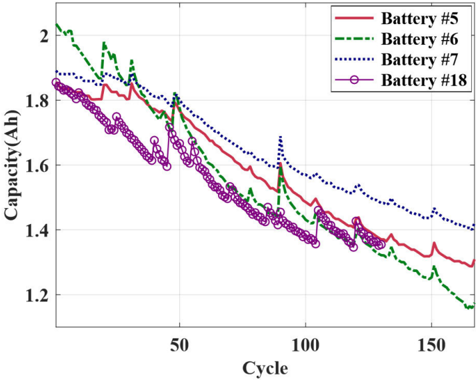
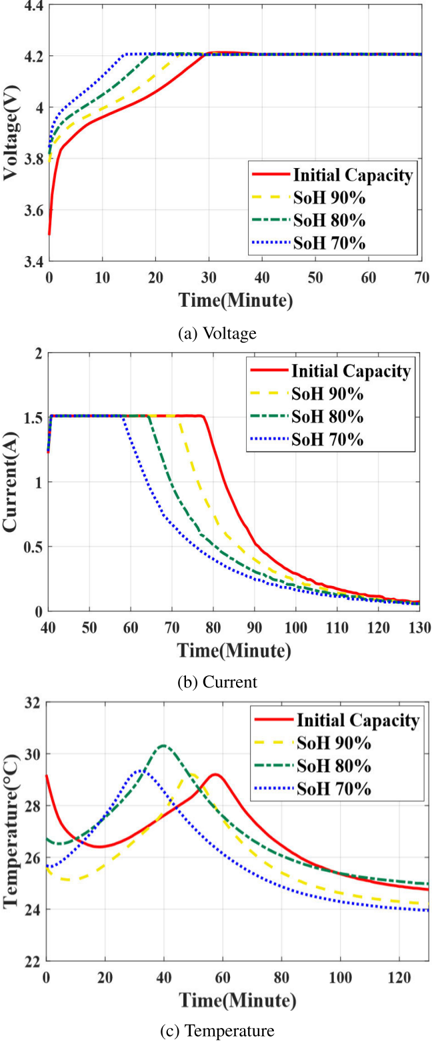
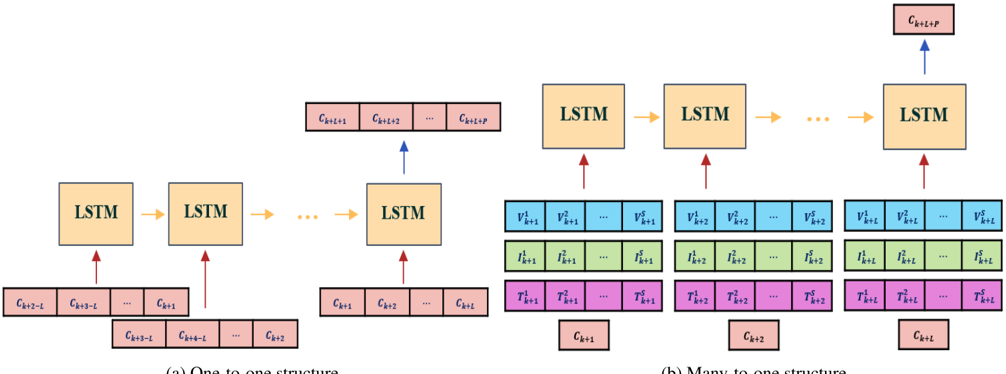
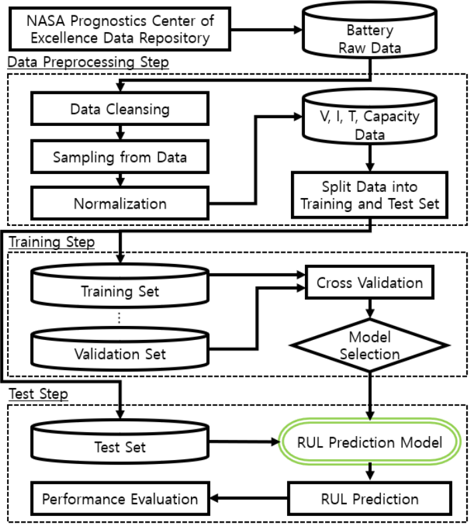
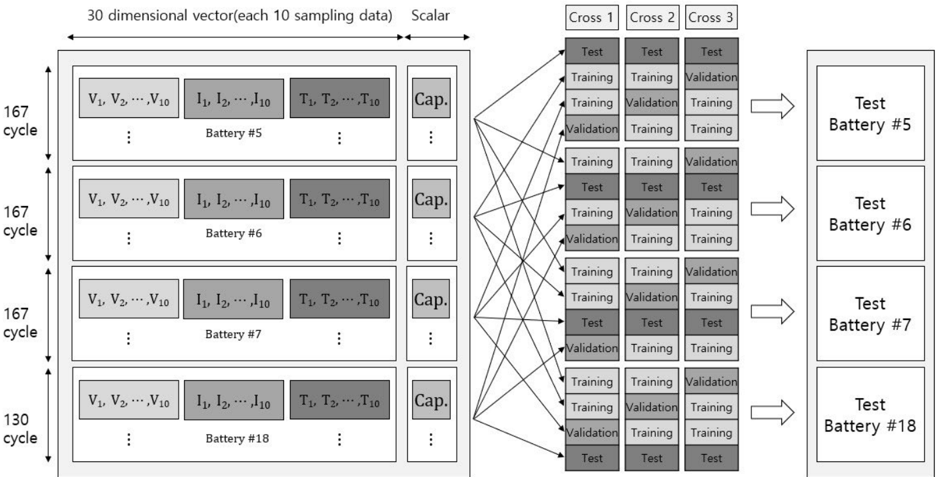
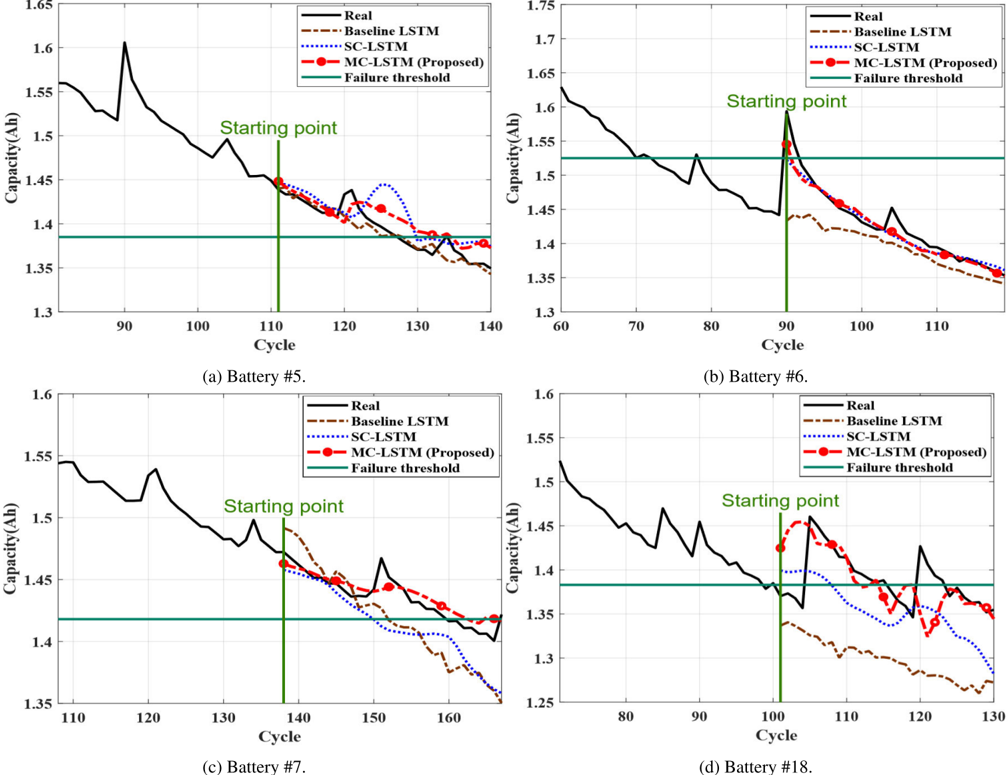
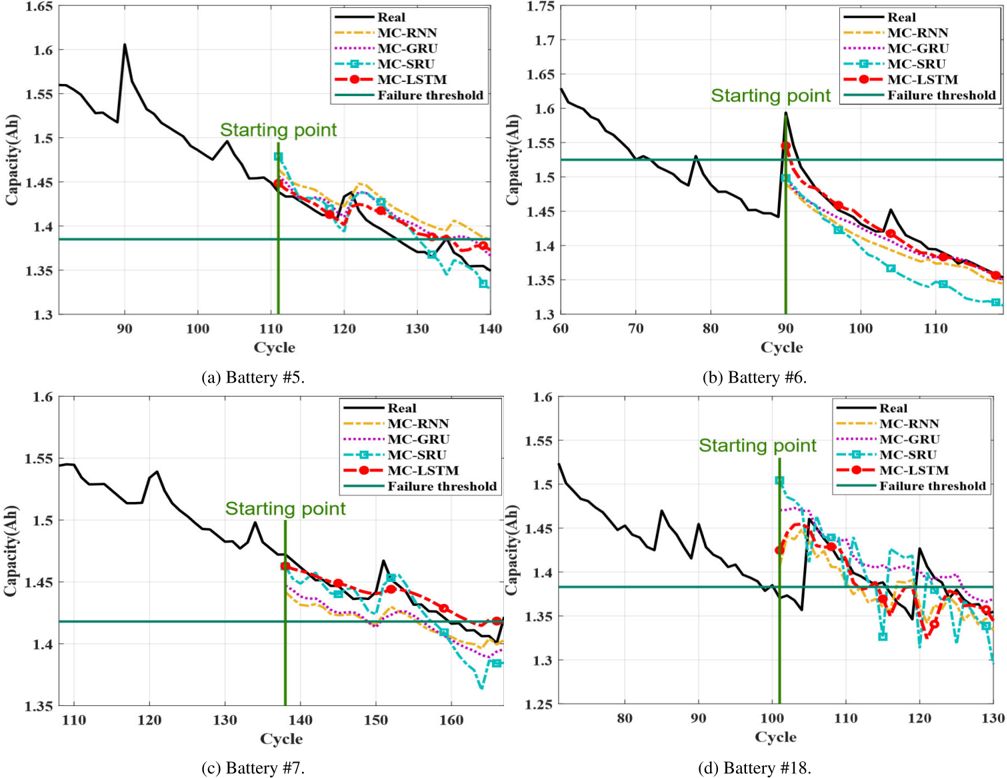
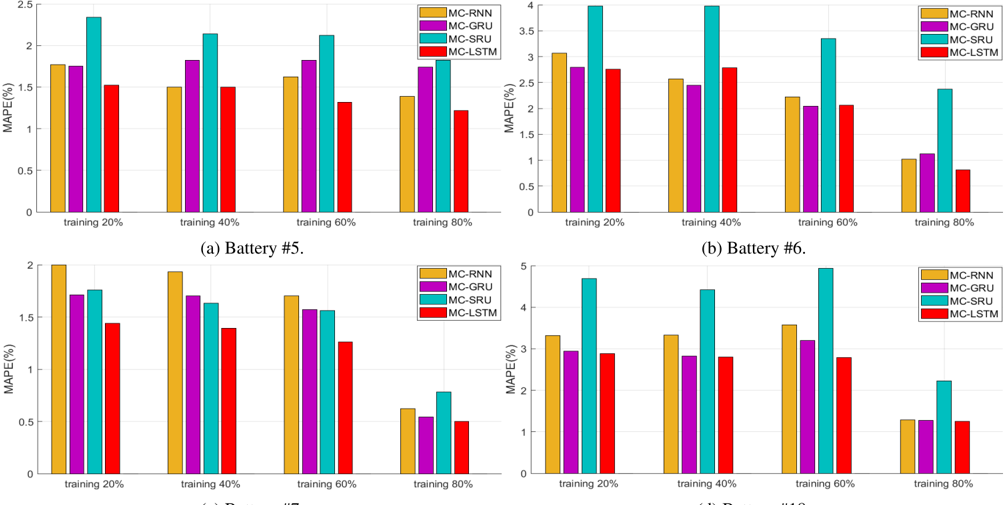
Remaining useful life (RUL) prediction of lithium-ion batteries can reduce the risk of battery failure by predicting the end of life. In this paper, we propose novel RUL prediction techniques based on long short-term memory (LSTM). To estimate RUL even in the presence of capacity regeneration phenomenon, we consider multiple measurable data from battery management system such as voltage, current and temperature charging profiles whose patterns vary as aging. Unlike the traditional LSTM prediction that matches input layer with output layer as one-to-one structure, we leverage many-to-one structure to be flexible for various input types and to substantially reduce the number of parameters for better generalization. Using the NASA lithium-ion battery datasets, we verify the accuracy of the proposed LSTM-based RUL prediction. The experimental results show that the proposed single-channel LSTM model improves the mean absolute percentage error (MAPE) by 39.2% compared to the baseline LSTM model. Furthermore, the proposed multi-channel LSTM model significantly improves the MAPE, e.g., by 63.7% compared to the baseline; the proposed model achieves 0.47-1.88% of MAPE while the state-of-the-art baseline LSTM shows 0.6-6.45% of MAPE.
Overview
The claims and statistics of this paper haven’t been checked yet.
Free: it reads the open-access text and checks the first 5 claims that cite a source we can check. Create a free account to check every claim.
Integrity signals
Registry
Cites
Statistics
Figures



Verification
Claims the paper makes
The claims and statistics of this paper haven’t been checked yet.
Free: it reads the open-access text and checks the first 5 claims that cite a source we can check. Create a free account to check every claim.
Claims other papers make about this one
Each is checked against this paper’s own text: does it say what the citing paper says it does?
The source backs part of the claim, not all of it — or backs it for a different population, condition or comparison.
In the citing paper
“The direct capacity measurement method (the remaining capacity measurement) for SOH estimation is one of the most straightforward and most accurate methods if the battery's current is measured accurately to count the columns and if the measurements are performed under a controlled set of parameters, such as temperature.”
From An Electrochemical Impedance Spectrum-Based State of Health Differential Indicator with Reduced Sensitivity to Measurement Errors for Lithium–Ion Batteries (2024) · cites this paper as [23]
Experimental — accuracy not yet measured
Self-check
Percentages, sums and reported differences re-computed from the paper’s own numbers.
The self-check needs the paper’s full text.
Citations
Cites
Adam: A Method for Stochastic Optimization
Kingma, D. P., & Ba, J. (2014) · arXiv · doi:10.48550/arxiv.1412.6980 · Cited by 98,946 · cited 1×
“001 [32].”
(2010) · International Conference on Machine Learning · Cited by 13,995
TensorFlow: A system for large-scale machine learning
Abadi, M., Barham, P., Chen, J., Chen, Z., Davis, A., Dean, J., Devin, M., Ghemawat, S., Irving, G., Isard, M., et al. (2016) · arXiv (Cornell University) · doi:10.48550/arxiv.1605.08695 · Cited by 11,822
Learning long-term dependencies with gradient descent is difficult
Bengio, Y., Simard, P., & Frasconi, P. (1994) · IEEE Transactions on Neural Networks · doi:10.1109/72.279181 · Cited by 8,542 · cited 1×
“However, RNN has the long-term dependency problem [16] as the number of cycles (i.”
BackgroundScore normalization in multimodal biometric systems
Jain, A., Nandakumar, K., & Ross, A. (2005) · Pattern Recognition · doi:10.1016/j.patcog.2005.01.012 · Cited by 2,154 · cited 1×
“In our work, min-max normalization is used as follows [26]:”
MethodZhang, Y., Xiong, R., He, H., & Pecht, M. G. (2018) · IEEE Transactions on Vehicular Technology · doi:10.1109/tvt.2018.2805189 · Cited by 1,326
Prechelt, L. (2012) · Lecture Notes in Computer Science · doi:10.1007/978-3-642-35289-8_5 · Cited by 951
A review on prognostics and health monitoring of Li-ion battery
Zhang, J., & Lee, J. (2011) · Journal of Power Sources · doi:10.1016/j.jpowsour.2011.03.101 · Cited by 792 · cited 1×
“However, battery degradation begins immediately after batteries are manufactured, and when 70% or 80% of initial capacity remains, batteries need be replaced for safe operation [3].”
Nuhic, A., Terzimehic, T., Soczka-Guth, T., Buchholz, M., & Dietmayer, K. (2013) · Journal of Power Sources · doi:10.1016/j.jpowsour.2012.11.146 · Cited by 664 · cited 2×
“Specifically, data-driven methods rely solely on historical capacity degradation data rather than requiring explicit mathematical models of battery degradation or internal mechanisms of the battery [10]–[12].”
MethodPatil, M. A., Tagade, P., Hariharan, K. S., Kolake, S. M., Song, T., Yeo, T., & Doo, S. (2015) · Applied Energy · doi:10.1016/j.apenergy.2015.08.119 · Cited by 626 · cited 2×
“Specifically, data-driven methods rely solely on historical capacity degradation data rather than requiring explicit mathematical models of battery degradation or internal mechanisms of the battery [10]–[12].”
Method
Cited by
Items 301–400 of 402
Reliability Estimation for Relay Protection Devices with Long Short-Term Memory Recurrent Network
Zhou, J., Dai, B., Wang, R., Liu, S., Jiang, Z., & Chen, G. (2023) · International Conference on Power System Technology (POWERCON) · doi:10.1109/powercon58120.2023.10331285 · Cited by 1
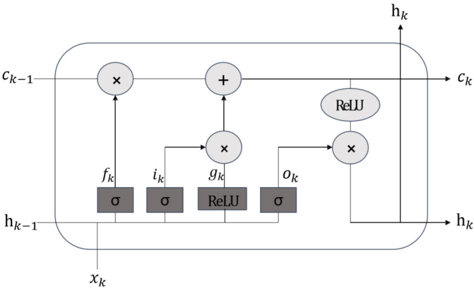
“The repeated chain module in the LSTM network contains four interactive layers, and there are special input and output functions in this hidden layer module [8] .”
BackgroundPredicting TSV depth using laser drilling by simulation model and neural network
Hsu, C.-W., Yang, H., & Lo, Y. (2025) · Expert Systems with Applications · doi:10.1016/j.eswa.2025.130018 · Cited by 1
Mathematical analysis of battery data for development of data-driven degradation model
Abbas, M., Cho, I., & Kim, J. (2021) · International Conference on Electrical Machines and Systems (ICEMS) · doi:10.23919/icems52562.2021.9634440 · Cited by 1
“Time series data containing voltage, current and temperature were input to model as a sliding window with window stride size of 2 steps [8].”
MethodRemaining Useful Life Prediction of Lithium Battery with Enhanced Bi-LSTM Network
Zhang, H., Du, D., Hu, C., Zhang, J., Zhang, S., & Xing, Y. (2021) · CAA Symposium on Fault Detection, Supervision and Safety for Technical Processes (SAFEPROCESS) · doi:10.1109/safeprocess52771.2021.9693738 · Cited by 2
Sahay, R., Pugalenthi, K., & Raghavan, N. (2023) · Global Reliability and Prognostics and Health Management Conference (PHM) · doi:10.1109/phm-hangzhou58797.2023.10482631 · Cited by 1
Yang, P., Yan, W., Li, R., Chen, L., & Guo, L. (2025) · Computers, materials & continua/Computers, materials & continua (Print) · doi:10.32604/cmc.2025.064947 · Cited by 2
“Park et al. [13] employed a Long Short-Term Memory (LSTM) network to solve the prediction accuracy problem caused by capacity regeneration in the Remaining Useful Life (RUL) prediction of LIBs, and the prediction accuracy is significantly improved.”
AutoDS: a de-stationary transformer method for lithium-ion battery remaining useful life prediction
Zhang, X., Chen, Z., Li, Y., Zhang, C., Chai, X., Ye, M., & Zhu, M. (2025) · Signal Image and Video Processing · doi:10.1007/s11760-025-04720-5 · Cited by 1
Leveraging artificial intelligence for predictive health assessment of Lithium-Ion batteries
Alqaryuti, A., Moawad, K., & Mayyas, A. T. (2025) · Transportation Engineering · doi:10.1016/j.treng.2025.100391 · Cited by 4
Remaining Useful Life Prediction of Lithium-Ion Batteries Using Stacked Long Short-Term Memory
Jang, Y. J., & Jeon, D. H. (2025) · Journal of The Electrochemical Society · doi:10.1149/1945-7111/ae1b41 · Cited by 2
Soo, Y., Wang, Y., Jiang, C. F., & Chen, Z. (2026) · Journal of Energy Storage · doi:10.1016/j.est.2026.120866 · Cited by 1
El-Dalahmeh, M., Hui, Z., Zhang, J. M., & Mamlouk, M. (2026) · Journal of Energy Storage · doi:10.1016/j.est.2026.121714 · Cited by 1
Deep Learning-Based Early Prediction of Lithium-Ion Battery State-of-Health
Velugula, R., Mittal, K., & Mittal, M. (2025) · International Conference on Electrical, Computer and Energy Technologies (ICECET) · doi:10.1109/icecet63943.2025.11471901 · Cited by 2
“A dropout layer follows each hidden layer, with a dropout rate of 0.3 to mitigate overfitting [16].”
InfluentialRaju, V. A. G., Nayak, J., Dash, P. B., & Mishra, M. (2026) · Applications in Energy and Combustion Science · doi:10.1016/j.jaecs.2026.100527 · Cited by 1
Haghighi, M., Mohammadi, M., & Allahbakhshi, M. (2026) · Results in Engineering · doi:10.1016/j.rineng.2026.111961 · Cited by 1
Prakash, S. V. J., Ravisankar, B., Jayanthi, G., Sudha, G., Sabarish, P., Sakthidasan, A., & Durga Devi, R. (2026) · Results in Engineering · doi:10.1016/j.rineng.2026.112115 · Cited by 2
Zhang, Y., Zhang, W., Zhou, W., Chen, X. S., Song, Y., & Hu, C. (2026) · Journal of Energy Storage · doi:10.1016/j.est.2026.123648 · Cited by 1
Fault prognostics of lithium-ion batteries in industrial battery management systems
Boudraa, N., Toubakh, H., Salem, H., Kafi, M. R., Noureddine Zerhouni, A., & Amghar, B. (2026) · Journal of Power Sources · doi:10.1016/j.jpowsour.2026.240873 · Cited by 1
Spectrum Occupancy Prediction via Bidirectional Long Short-Term Memory Network
Feng, L., Ding, X., & Zhang, G. (2021) · Lecture notes in electrical engineering · doi:10.1007/978-981-15-8411-4_64 · Cited by 1
Song, K., Choi, S., & Lee, H. (2021) · Applied Sciences · doi:10.3390/app11188676 · Cited by 1
“In the forward propagation stage, the forward propagation consists of forget gate, input gate, and output gate, as shown in Figure 4, and then fine-tuning employs a back-propagation technique to update the parameters, which include the weight matrix and the bias vector [23].”
MethodGupta, Y. (2020) · Bioscience Biotechnology Research Communications · doi:10.21786/bbrc/13.14/114 · Cited by 1
Prediction of Battery Capacity Based on Deep Residual Network
Wang, Y., Yao, W., Dong, M., Li, Y., Zhu, L., & Bi, S. (2022) · IEEE International Conference on Cyber Technology in Automation, Control, and Intelligent Systems · doi:10.1109/cyber55403.2022.9907034 · Cited by 1
“Based on long short-term memory (LSTM), Park et al. [11] propose an end-to-end model to predict RUL.”
BackgroundFeature Selection for Cycle Life Prediction of Fast-Charged Lithium-ion Batteries
Mohammed, R., Le, V., Creighton, D., & Hosen, M. A. (2023) · IEEE International Conference on Industry 4.0, Artificial Intelligence, and Communications Technology (IAICT) · doi:10.1109/iaict59002.2023.10205862 · Cited by 3
Automatic Fetal Motion Detection from Trajectory of US Videos Based on YOLOv5 and LSTM
Turkan, M., Urfalı, F. E., & Dandıl, E. (2023) · Springer eBooks · doi:10.1007/978-3-031-38036-5_1 · Cited by 2
Ni, D., Liu, X., Ge, Q., Chen, Y., & Zhang, D. (2023) · IEEE Conference on Industrial Electronics and Applications (ICIEA) · doi:10.1109/iciea58696.2023.10241868 · Cited by 1
Zhang, Z., Liu, P., Ge, W., & Lai, Y. (2023) · International Conference on Deep Learning Technologies (ICDLT) · doi:10.1145/3613330.3613333 · Cited by 2
“LSTM is a good solution to this problem [9].”
BackgroundDevice to Device Caching Delivery Using Predicted Demand on Trajectory
Tsunekiyo, M., & Kamiyama, N. (2023) · IEEE International Conference on Metaverse Computing, Networking and Applications (MetaCom) · doi:10.1109/metacom57706.2023.00104 · Cited by 1
Kuo, T.-J., & Chao, W.-T. (2023) · Gels · doi:10.3390/gels9120989 · Cited by 2
“Its architecture consists of gateways, including the forget gate, input gate, and output gate [33–35], as shown in Figure 9.”
BackgroundHawsawi, T., & Zohdy, M. A. (2024) · Journal of Power and Energy Engineering · doi:10.4236/jpee.2024.126001 · Cited by 2
Yang, Y. G., Wang, W., Qin, J., Wang, M., Xia, Y., Li, Y., & Jia, Q. (2024) · International Journal of Low-Carbon Technologies · doi:10.1093/ijlct/ctae139 · Cited by 1
SOH Estimation of Lithium-ion Batteries using LSTM Model with Deconvoluted EIS Parameters
Akram, A. S., Sohaib, M., & Choi, W. (2025) · IEEE ECCE Asia Downunder · doi:10.1109/ecce-asia63110.2025.11112296 · Cited by 1
“The Long Short-Term Memory (LSTM) network is a type of recurrent neural network well suited for handling sequential data by selectively remembering and forgetting information over time [19-21].”
Self-citationBattery Health Prognosis: Discharging Capacity Prediction at All Operating Voltage Levels
Zhao, C., Andersen, P. B., Træholt, C., & Hashemi, S. (2023) · IEEE Power Engineering Society General Meeting · doi:10.1109/pesgm52003.2023.10252691 · Cited by 1
A Multi-Channel Deep-Learning Prediction Algorithm for Battery State-of-Health Indicator
Patrizi, G., Catelani, M., Ciani, L., Song, Y., & Liu, D. (2023) · IEEE International Conference on Metrology for eXtended Reality, Artificial Intelligence and Neural Engineering (MetroXRAINE) · doi:10.1109/metroxraine58569.2023.10405745 · Cited by 1
“Several types of neural network have been used in recent literature for prognostic of lithium-ion batteries (see for instance Echo-State network [18], LSTM [19], Nonlinear Autoregressive Exogenous Neural Network [20], Recurrent Neural Network [13], Autoencoder neural network [21]).”
MethodYang, L., Chen, Z., Xu, Z., Shi, N., & Wang, Y. (2024) · SSRN Electronic Journal · doi:10.2139/ssrn.4753969 · Cited by 1
Ma, H., Liu, W., Li, T., & Zhang, H. (2022) · Asia Conference on Electrical, Power and Computer Engineering (EPCE) · doi:10.1145/3529299.3531510
“Kyungnam Park et al.[6] perform the battery remaining useful life prediction based on LSTM algorithm.”
MethodReconstruction-based Anomaly Detection for Health Indicator Construction of Machinery
Song, S., Hwang, W. Y., Lee, Y., & Baek, J. (2022) · Journal of Korean Institute of Industrial Engineers · doi:10.7232/jkiie.2022.48.4.367
Lei, Y., Li, N., & Li, X. (2022) · Springer eBooks · doi:10.1007/978-981-16-9131-7_5
A flexible battery capacity estimation method using a portion of charging curve
Cao, M., Zhang, T., Wang, Y., Zhu, W., & Liu, Y. (2022) · Global Reliability and Prognostics and Health Management Conference (PHM) · doi:10.1109/phm-yantai55411.2022.9942077
Research on Server Activity of Power Grid System Based on Deep Learning
Zhang, P., Liu, J., Zhou, L., Li, M., Shao, J., Xie, Z., Liu, S., Zhou, L., & Ji, Y. (2022) · Communications in computer and information science · doi:10.1007/978-981-19-7946-0_27
Zhang, X., Gong, C., Hu, Y., Xu, H., & Deng, J. (2022) · Lecture notes in electrical engineering · doi:10.1007/978-981-19-3171-0_38
A Product Development Process for Ai FunctionalitiesPreprint
Grundstein, S., Burger, B., & Schöck, J. (2023) · SSRN Electronic Journal · doi:10.2139/ssrn.4536608
A Legendre Projection Unit Based Framework for Effective Synthetic Battery Dataset Generation
Channegowda, J., Joshi, N., & Lingaraj, C. (2023) · IEEE International Conference on Electronics, Computing and Communication Technologies (CONECCT) · doi:10.1109/conecct57959.2023.10234684
“Long ShortTerm Memory (LSTM) has been used in the past to compute Remaining Useful Life (RUL) estimation [11].”
MethodPark, J.-E., & Chung, J. (2023) · SSRN Electronic Journal · doi:10.2139/ssrn.4659601
Application of Long Short-Term Memory Networks for Natural Gas Demand Prediction
Soni, N., & Singh, P. K. (2023) · IEEE Conference on Information and Communication Technology (CICT) · doi:10.1109/cict59886.2023.10455229
“The RNNs can only learn a short time dependent information [18].”
BackgroundMiao, C., & Liang, T. (2023) · International Academic Exchange Conference on Science and Technology Innovation (IAECST) · doi:10.1109/iaecst60924.2023.10503516
“Park et al. developed an RUL prediction method using LSTM to capture the degraded capacity trajectory of batteries [12].”
MethodResearch on trade quantity prediction on ARIMA and Long Short-Term Memory Networks
Guo, Z., Yang, Y., Wu, X., Zheng, Z., & Liu, W. (2024) · Highlights in Science Engineering and Technology · doi:10.54097/kb95a961
“(Park et al., 2020) [5] proposed a novel RUL prediction technique based on long short-term memory (LSTM).”
MethodWei, Z. (2024) · Key Technologies on New Energy Vehicles · doi:10.1007/978-981-97-4639-2_4
Theory-Guided Data-Science for Battery Modeling: Insights from a Comparative Study
Bielski, P., Denner, N., Bischof, S., Rzepka, B., & Böhm, K. (2024) · IEEE International Conference on Data Science and Advanced Analytics (DSAA) · doi:10.1109/dsaa61799.2024.10722776
“We leverage a LSTM network which excel in learning long-term dependencies through their memory cell mechanism and are commonly commonly used in time series prediction tasks related to lithium-ion batteries [21]–[23].”
MethodVillegas-Ch, W. E., Govea, J., Gaibor-Naranjo, W., & Sánchez-Viteri, S. (2024) · Frontiers in Artificial Intelligence · doi:10.3389/frai.2024.1398126
Word embedding attention and balanced cross entropy technique for sentiment analysis
Sagvekar, V. R., & Sharma, P. (2023) · Multiagent and Grid Systems · doi:10.3233/mgs-221511
“The LSTM model is widely used in sentiment prediction because it provides superior performance on data sequences [33].”
Prognostics and Health Management Technology for Aircraft Assembly Production Lines
Dong, Z., Liu, B., Pan, X., & Wang, H. (2024) · Global Reliability and Prognostics and Health Management Conference (PHM) · doi:10.1109/phm-beijing63284.2024.10874654
“P ark [8] proposed an LSTM-based RUL prediction technique, utili zing a many-to-one input-output structure to handle various inp ut types and significantly reducing the number of parameters fo r better generalization, validating model optimality with mean a bsolute percentage error as an indicator.”
Life Prediction of Lithium-Ion Batteries Based on Fusion Techniques
Wu, P., Liu, P., Hu, X., Zhang, Z., Wang, X., & Ma, N. (2024) · International Conference on Artificial Intelligence and Automation Control (AIAC) · doi:10.1109/aiac63745.2024.10899715
“…learning ability and is very effective for data with sequential characteristics [8], but in the application of RNN, the phenomena of high cost of training time, gradient disappearance, and long time dependence occur [9], and the long short-term memory network (LSTM) solves this problem well[10].”
Hassan, M. K., Katrib, J., Mostafa, H., Natarajan, S., & Almustafa, K. M. (2025) · SSRN Electronic Journal · doi:10.2139/ssrn.5219617
Battery Health Diagnosis via Neural Surrogate Model: From Lab to Field
Cheon, H., Jeon, J., Jung, B., & Kim, H. (2025) · Energies · doi:10.3390/en18092405
Self-citationBabu, C. R., Swapna, T., Lakshmi, R. S. N., Sankar, A. D., & Reddy, B. N. V. (2025) · Springer proceedings in business and economics · doi:10.1007/978-981-96-2548-2_12
Towards Learning to Rank Deep-Learning Models for Multivariate Time-Series Transfer Learning
Sigl, M. B., & Meyer-Wegener, K. (2025) · Workshop on Data Management for End-to-End Machine Learning (DEEM) · doi:10.1145/3735654.3735938
“Similar to [27], we train an LSTM model.”
Liu, H., Cheng, F., & Li, Y. (2025) · Springer eBooks · doi:10.1007/978-981-96-7218-9_1
Muta'alimah, M., Setiawati, E., Kwok, J., & Hasysya, H. (2025) · Public Research Journal of Engineering Data Technology and Computer Science · doi:10.57152/predatecs.v2i2.1627
Jeon, Y., Jeong, S., Noh, I., & Lee, S. W. (2025) · International Journal of Precision Engineering and Manufacturing · doi:10.1007/s12541-025-01346-y
“11, 12, 13, 14, 15, 16) [11]: The welding experiments were conducted under the conditions specified in Table 1, And they were continued until sufficient electrode tip degradation had occurred.”
Remaining Useful Life (RUL) Prediction for EV Batteries
Mathivanan, A., Palaniswamy, S., & Mozhi, M. A. (2025) · Wiley eBooks · doi:10.1002/9781394303021.ch6
Gregor, M., Bauder, M., de Oliveira, A. K. V., Mast, P., Rüther, R., & Schweiger, H. (2025) · World Electric Vehicle Journal · doi:10.3390/wevj17010003
Tefera, E. T., Qiao, H., Moses, A., Juanyun, L., Alberto, A., Xuefeng, W., & Chen, D. (2025) · SSRN Electronic Journal · doi:10.2139/ssrn.5848172
Machine Learning-Based framework for battery Remaining Useful Life Prediction
Cusack, M. M. T., B, M. P., T, K. E., Musademba, D., C, R. M., Palaniappan, R., & Vijean, V. (2025) · South Asian Journal of Engineering and Technology · doi:10.26524/sajet.2025.15.20
Souidi, D., Chrouta, J., & Telmoudi, A. J. (2025) · SSRN Electronic Journal · doi:10.2139/ssrn.5984924
Fault Prognosis of Gearbox Based on Convolutional LSTM Autoencoder using Current Signal Data
Nguyen, B. V., & Jeon, J. W. (2025) · International Conference on Control, Automation and Systems (ICCAS) · doi:10.23919/iccas66577.2025.11301226
“LSTM networks were able to learn long-sort term dependencies in sequential data [10], which are important for accurately predicting the RUL of the gearbox.”
Choi, Y., Jang, P., & Yun, J.-J. (2026) · International Journal of Energy Research · doi:10.1155/er/5535455
Self-citationChen, M. (2026) · PeerJ Computer Science · doi:10.7717/peerj-cs.3440
M, K. T. E., Parimi, A. M., Deshmukh, S. S., Bhattacharjee, A., & Sahatiya, P. (2026) · SSRN Electronic Journal · doi:10.2139/ssrn.6109364
Su, C., & Xia, R. (2026) · Proceedings of the Institution of Mechanical Engineers Part O Journal of Risk and Reliability · doi:10.1177/1748006x251414177
“Park et al. 23 adopted a multi-channel LSTM to predict the RUL of lithium-ion battery.”
(2026) · Elsevier eBooks · doi:10.1016/b978-0-443-27578-4.05028-x
State of charge estimation of energy storage battery based on long short-term memory neural network
Wang, S., Xie, Y., Liu, G., Huang, Q., Wang, Y., Zhang, G., & Fernández, C. (2026) · Elsevier eBooks · doi:10.1016/b978-0-443-27578-4.00013-6
Wang, S., Ma, Z., & Chen, Y. (2025) · International Conference on Smart Grid and Energy (ICSGE) · doi:10.1109/icsge68440.2025.11441934
“On the one hand, most studies treat the battery pack as a "black box" or a homogenized whole, ignoring the interactions and dynamic evolution among individual batteries within the pack [9].”
Nguyen, D. A., Jeon, Y., Nguyen, V. B., Im, H., Kim, T., & Jang, A. (2026) · SSRN Electronic Journal · doi:10.2139/ssrn.6591053
An Intelligent Prognostic Framework for Lithium-Ion Batteries Using IoT-Enabled Learning Models
Sathishkumar, S., & Yogesh Rajkumar, R. (2026) · International Conference on Innovative Computing, Intelligent Communication and Smart Electrical Systems (ICSES) · doi:10.1109/icses66558.2026.11478949
Nguyen, C. D., & Ta, V. K. (2026) · Lecture notes in networks and systems · doi:10.1007/978-3-032-14935-0_14
Charge or Discharge Cycle Signatures for RUL-based Protection of Lithium-Ion Battery Packs
Hosseini, O., Shokripour, A., Ghanbari, T., & Farjah, E. (2026) · International Conference on Protection and Automation of Power Systems (IPAPS) · doi:10.1109/ipaps69408.2026.11499659
“In [8], a many-to-one structure with LSTM has been introduced for improvement of the accuracy of the RUL prediction.”
Hu, H., Liu, Y., Jin, X., & Hu, B. (2026) · Algorithms · doi:10.3390/a19050376
谷玉昌, Lu, T., & Liu, B. (2026) · Ionics · doi:10.1007/s11581-026-07194-8
“Hybrid architectures such as GRU [19], bidirectional LSTM [20], and CNN-BiLSTM [21] were subsequently proposed and significantly improved prediction accuracy.”
Yang, S., Meng, H., Ling, L., Gao, X., Li, X., Lin, X., & Tong, S. (2026) · IEEE Transactions on Transportation Electrification · doi:10.1109/tte.2026.3695061 · Cited by 1
“…vector machine (SVM), relevance vector machine (RVM), Gaussian process regression (GPR), and recurrent neural network (RNN) [18], [19], [20], [21], [22], do not depend on a predefined system model and can handle large datasets to provide accurate prognostics, although they are heavily reliant…”
Dang, Y., & yang, J. (2026) · SSRN Electronic Journal · doi:10.2139/ssrn.6854661
Filtering techniques for lithium-ion battery state of health and remaining useful life prediction
Ibrahim, M., Hasan, M. Z., Salman, M., Lipu, M. S. H., Sarker, I. A., Ansari, S., & Bordin, C. (2026) · npj Thermal Science and Engineering · doi:10.1038/s44435-026-00010-9 · Cited by 1
“Presently, single models for SOH and RUL estimation have been signi fi cantly proposed 34,35 .”
Sahdev, G., Agarwal, S., Ojha, E., Kumari, R., & Bhati, P. (2026) · AIP conference proceedings · doi:10.1063/5.0340418
Zhang, X., Hu, T., Li, Z., & Wang, J. (2026) · Engineering Applications of Artificial Intelligence · doi:10.1016/j.engappai.2026.115446 · Cited by 1
Hybrid ECM and LSTM Approach for State-of-Health Estimation of Lithium-ion Batteries
Yomjinda, C., & Fakkao, M. (2026) · International Conference on Business and Industrial Research (ICBIR) · doi:10.1109/icbir69932.2026.11584807
“These extracted features serve as inputs for the LSTM network, which is inherently designed to capture long-term dependencies in time-series data [17-19].”
Abbas, M., Kim, G., Lambert, S., & Kim, J. (2026) · Journal of Energy Storage · doi:10.1016/j.est.2026.123404
Verghese, M. A., Columbus, C. C., & Elakiya, E. (2026) · Scientific Reports · doi:10.1038/s41598-026-60633-4
A Hybrid MC-BiTCN-N-BEATS Model for Predicting the Remaining Useful Life of Lithium-Ion Batteries
Zhang, P., Zhao, J., & Yu, H. (2026) · IEEE Data Driven Control and Learning Systems Conference (DDCLS) · doi:10.1109/ddcls71227.2026.11610046
“Recurrent neural networks (RNN)[10] and their variants like LSTM[11] and GRU[12] capture long-term dependencies but face gradient vanishing and parallelization challenges.”
Ebrahimi, H., Mozafari, N., Arefi, M. M., Khayatian, A., & Luo, H. (2026) · Advanced Engineering Informatics · doi:10.1016/j.aei.2026.105099
Zhang, Z., Jiang, W., Chen, X., Zhang, D., & Yin, J. (2026) · IEEE China Conference on System Simulation Technology and its Applications (CCSSTA) · doi:10.1109/ccssta69471.2026.11635460
“We compare against three baselines under the identical experimental protocol: a standard 2-layer LSTM with hidden size 64 [1][13], a single-scale CNN-LSTM (kernel size 3) , and a 2-layer Transformer encoder with 4 attention heads [3].”
Zhang, X. (2026) · International Journal of Pattern Recognition and Artificial Intelligence · doi:10.1142/s0218001426400331
AI for EV battery health: Statistical meta-analysis and Autonomous Intelligence Pyramid
Tanala, S., & Venkatesh, A. (2026) · Next Sustainability · doi:10.1016/j.nxsust.2026.100461
Brando, G., Franzese, P., Iannuzzi, D., Ribera, M., & Stefanopoulou, A. G. (2026) · Journal of Energy Storage · doi:10.1016/j.est.2026.124345
Xiao, M., Qin, H., Yu, J., Li, H., & Wang, L. (2026) · Journal of Energy Storage · doi:10.1016/j.est.2026.124343
Ulfat, M. A. B., Begum, A., Mamun, M. A. A., Azam, S. N. A. E., Hassan, M. M., Mahmud, I., Sadi, A. H. M. S., & Sayeed, M. S. (2026) · Data in Brief · doi:10.1016/j.dib.2026.113252
Fu, S., Chen, R., He, X., Guo, H., Zhang, B., Wu, Q., & Zhang, W. (2026) · Journal of Advanced Computational Intelligence and Intelligent Informatics · doi:10.20965/jaciii.2026.p1487
Usman, M., Dutta, M., Hasan, M. R., Rim, S. I., Mahmud, M. Z. A., Mobarak, M. H., Refati, F. A. D., & Rimon, I. H. (2026) · Journal of Energy Storage · doi:10.1016/j.est.2026.124507
Wang, J., Si, W., Munna, M. A., Deng, Z., & Zhang, L. (2026) · Batteries · doi:10.3390/batteries12100387
Di, Z., Hu, X., Leung Yuk Frank, L. A. M., & Zakharov, A. P. (2026) · Journal of Energy Chemistry · doi:10.1016/j.jechem.2026.09.065
Yang, D., 冯春, Cao, J., Lu, J., Tang, Z., Wei, W., & Wang, K. (2026) · SSRN Electronic Journal · doi:10.2139/ssrn.7624745
Metadata
- Authors
- Park, K., Choi, Y., Choi, W. J., Ryu, H.-Y., & Kim, H.
- Affiliations
- Sogang University (KR)
- Hyundai Motor Group (South Korea) (KR)
- Venue
- IEEE Access
- Published
- 2020
- Volume
- 8
- Pages
- 20786-20798
- ISSN
- 2169-3536 (ISSN-L)
- OpenAlex
- W3001479960
- Cited by
- 397
- References
- 33
- Citations by year
- 2026: 52 · 2025: 73 · 2024: 95 · 2023: 65 · 2022: 66 · 2021: 34 · 2020: 12
- FWCI
- 16.37
- Type
- journal article
- Language
- en
- Open access
- gold
- doi.org
- Locations
- IEEE Access (publishedVersion, cc-by)
- DOAJ (DOAJ: Directory of Open Access Journals) (submittedVersion, cc-by-sa)
- Funders
- National Research Foundation of Korea
- Ministry of Science, ICT and Future Planning (NRF-2017R1A1A1A05001377)
- Hyundai Motors
- Topics
- Physical Sciences › Engineering › Automotive Engineering › Battery Modeling and Management
- Physical Sciences › Engineering › Electrical and Electronic Engineering › Advancements in Battery Materials
- Physical Sciences › Engineering › Safety, Risk, Reliability and Quality › Reliability and Maintenance Optimization
- Keywords
- remaining useful life prediction, lithium-ion batteries, long short-term memory, battery degradation, capacity recovery, charging profiles, NASA battery dataset
About these checks
Registry, retraction, Cites and statistics results are computed, not judged, with one exception: a printed reference that no index lists is read once by a model before it counts as a citation error. Claims are extracted by a model and kept only when their quote appears verbatim in the text; each cited source is then checked, with a model’s help, for whether it says what the claim relies on. Those verdicts can be wrong — read the claim’s quote and the cited source before relying on one.
Statistics and arithmetic are recomputed, not judged.
Confidence bands are shown only for fields calibrated on our annotated test set. None is calibrated yet, so no band is shown.
What counts as a claim ›How we measure confidence ›How we check this ›
Are you an author, or do you see a problem with this page? Request a review
Data sources
Bibliographic data: Semantic Scholar, OpenAlex, Crossref.
Contains information from the Semantic Scholar Academic Graph Datasets, made available under the ODC Attribution License (ODC-BY 1.0).
Semantic Scholar’s data is described in: Kinney, R., et al. (2023). The Semantic Scholar Open Data Platform. arXiv:2301.10140.
