

A Machine Learning Security Framework for Iot Systems
Open accessThe DOI matches its Crossref record; 47 of the 47 references it cites were found in a registry or an index.
Abstract
Internet of Things security is attracting a growing attention from both academic and industry communities. Indeed, IoT devices are prone to various security attacks varying from Denial of Service (DoS) to network intrusion and data leakage. This paper presents a novel machine learning (ML) based security framework that automatically copes with the expanding security aspects related to IoT domain. This framework leverages both Software Defined Networking (SDN) and Network Function Virtualization (NFV) enablers for mitigating different threats. This AI framework combines monitoring agent and AI-based reaction agent that use ML-Models divided into network patterns analysis, along with anomaly-based intrusion detection in IoT systems. The framework exploits the supervised learning, distributed data mining system and neural network for achieving its goals. Experiments results demonstrate the efficiency of the proposed scheme. In particular, the distribution of the attacks using the data mining approach is highly successful in detecting the attacks with high performance and low cost. Regarding our anomaly-based intrusion detection system (IDS) for IoT, we have evaluated the experiment in a real Smart building scenario using one-class SVM. The detection accuracy of anomalies achieved 99.71%. A feasibility study is conducted to identify the current potential solutions to be adopted and to promote the research towards the open challenges.
Overview
The claims and statistics of this paper haven’t been checked yet.
Free: it reads the open-access text and checks the first 5 claims that cite a source we can check. Create a free account to check every claim.
Integrity signals
Registry
Cites
Statistics
Figures




Verification
Claims the paper makes
The claims and statistics of this paper haven’t been checked yet.
Free: it reads the open-access text and checks the first 5 claims that cite a source we can check. Create a free account to check every claim.
Claims other papers make about this one
Each is checked against this paper’s own text: does it say what the citing paper says it does?
The source backs part of the claim, not all of it — or backs it for a different population, condition or comparison.
In the citing paper
“In [170], authors deployed a machine learning based security orchestration function which uses monitoring agents to identify IoT attacks and dynamic reaction module that deploys a virtual security function to secure the IoT devices.”
From Zero Trust Architecture (ZTA): A Comprehensive Survey (2022) · cites this paper as [170]
Experimental — accuracy not yet measuredThe check wasn’t confident either way, so it gives no verdict — never disputed.
In the citing paper
“Duan et al. [103] proposed a privacy and availability data clustering scheme based on the K-means algorithm and differential privacy to solve the privacy problem in IoT big data analysis and mining.”
From A Survey of IoT Privacy Security: Architecture, Technology, Challenges, and Trends (2024) · cites this paper as [103]
Experimental — accuracy not yet measured
Self-check
Percentages, sums and reported differences re-computed from the paper’s own numbers.
The self-check needs the paper’s full text.
Citations
Cites
Data mining: concepts and techniques
(2012) · Choice Reviews Online · doi:10.5860/choice.49-3305 · Cited by 28,531
Chandola, V., Banerjee, A., & Kumar, V. (2009) · ACM Computing Surveys · doi:10.1145/1541880.1541882 · Cited by 11,687 · cited 1×
“Nonetheless, our AI framework is intended to cope with not only anomalous-based IDS [21], but also knowledge-based IDS, by checking continuously signatures and patterns of previously known vulnerabilities and attacks [22].”
BackgroundA detailed analysis of the KDD CUP 99 data set
Tavallaee, M., Bagheri, E., Lu, W., & Ghorbani, A. A. (2009) · 2009 IEEE Symposium on Computational Intelligence for Security and Defense Applications · doi:10.1109/cisda.2009.5356528 · Cited by 5,396 · cited 1×
“Based on a work done on [32] the new NSL KDD dataset solved several serious problems, in which it eliminates about 77 of redundant records.”
A Survey of Data Mining and Machine Learning Methods for Cyber Security Intrusion Detection
Buczak, A. L., & Guven, E. (2016) · IEEE Communications Surveys & Tutorials · doi:10.1109/comst.2015.2494502 · Cited by 3,332
A Deep Learning Approach for Intrusion Detection Using Recurrent Neural Networks
Yin, C., Zhu, Y., Fei, J., & He, X. (2017) · IEEE Access · doi:10.1109/access.2017.2762418 · Cited by 2,100 · cited 1×
“…Machine (F-SVM) [38], Dirichlet Mixture Model (DMM) [39], Triangle Area Nearest Neighbors (TANN) [40], Deep Belief Networks (DBN) [41], Recurrent Neural Network (RNN) [42], Deep Neural Network (DNN) [43], [45], [46], Ensemble-DNN [44], Support Vector Machine based Dimensionality Reduction [47].”
A Deep Learning Approach to Network Intrusion Detection
Shone, N., Ngoc, T. N., Phai, V. D., & Shi, Q. (2018) · IEEE Transactions on Emerging Topics in Computational Intelligence · doi:10.1109/tetci.2017.2772792 · Cited by 1,819 · cited 2×
“namely, the Filter-based Support Vector Machine (FSVM) [38], Dirichlet Mixture Model (DMM) [39], Triangle Area Nearest Neighbors (TANN) [40], Deep Belief Networks (DBN) [41] , Recurrent Neural Network (RNN) [42], Deep Neural Network (DNN) [43], [45], [46] , Ensemble-DNN [44], Support Vector Machine”
MethodConvergence of Edge Computing and Deep Learning: A Comprehensive Survey
Wang, X., Han, Y., Leung, V. C. M., Niyato, D., Yan, X., & Chen, X. (2020) · IEEE Communications Surveys & Tutorials · doi:10.1109/comst.2020.2970550 · Cited by 1,498 · cited 1×
“Authors in [17] have investigated the use of Artificial Neural Networks in order to detect abnormal network traffic going from the gateway to the edge devices [18].”
MethodToward developing a systematic approach to generate benchmark datasets for intrusion detection
Shiravi, A., Shiravi, H., Tavallaee, M., & Ghorbani, A. A. (2012) · Computers & Security · doi:10.1016/j.cose.2011.12.012 · Cited by 1,345 · cited 1×
“There are several data sets widely used for this purpose, such as DARPA [29], KDD99 [30] and DEFCON [31].”
MethodA survey of intrusion detection in Internet of Things
Zarpelão, B. B., Miani, R. S., Kawakani, C. T., & de Alvarenga, S. C. (2017) · Journal of Network and Computer Applications · doi:10.1016/j.jnca.2017.02.009 · Cited by 1,022 · cited 1×
“Nonetheless, our AI framework is intended to cope with not only anomalous-based IDS [21], but also knowledge-based IDS, by checking continuously signatures and patterns of previously known vulnerabilities and attacks [22].”
BackgroundThe 1999 DARPA off-line intrusion detection evaluation
Lippmann, R., Haines, J. W., Fried, D. J., Korba, J., & Das, K. (2000) · Computer Networks · doi:10.1016/s1389-1286(00)00139-0 · Cited by 876 · cited 1×
“There are several data sets widely used for this purpose, such as DARPA [29], KDD99 [30] and DEFCON [31].”
Method
Research works printed but not linked: 1
- fayyad, 2000, ACM SIGKDD Explorations Newsletter, 2
Cited by
Zero Trust Architecture (ZTA): A Comprehensive Survey
Syed, N. F., Shah, S. W., Shaghaghi, A., Anwar, A., Baig, Z., & Doss, R. (2022) · IEEE Access · doi:10.1109/access.2022.3174679 · Cited by 406
“In [170], authors deployed a machine learning based security orchestration function which uses monitoring agents to identify IoT attacks and dynamic reaction module that deploys a virtual security function to secure the IoT devices.”
BackgroundAbdullahi, M., Baashar, Y., Alhussian, H., Alwadain, A., Aziz, N., Capretz, L. F., & Abdulkadir, S. J. (2022) · Electronics · doi:10.3390/electronics11020198 · Cited by 361
“[88], a novel SVM model was proposed based on a security framework to enable mitigating different threats such as U2R in IoT systems.”
MethodA Survey on Intelligent Internet of Things: Applications, Security, Privacy, and Future Directions
Aouedi, O., Vu, T.-H., Sacco, A., Nguyen, D. C., Piamrat, K., Marchetto, G., & Pham, Q.-V. (2025) · IEEE Communications Surveys & Tutorials · doi:10.1109/comst.2024.3430368 · Cited by 277
Alwahedi, F., Aldhaheri, A., Ferrag, M. A., Battah, A., & Tihanyi, N. (2024) · Internet of Things and Cyber-Physical Systems · doi:10.1016/j.iotcps.2023.12.003 · Cited by 259
“Bagaa et al. (2020) [42] applied CFS in their distributed and semi-distributed models for feature selection, resulting in satisfactory outcomes.”
BackgroundMethodInfluentialA Survey of IoT Privacy Security: Architecture, Technology, Challenges, and Trends
Sun, P., Shen, S., Wan, Y., Wu, Z., Fang, Z., & Gao, X.-Z. (2024) · IEEE Internet of Things Journal · doi:10.1109/jiot.2024.3372518 · Cited by 172
“Bagaa et al. [103] proposed an IoT security framework based on machine learning, which realized the transfer of security threats through the combination of SDN and NFV and tested the performance of the new model through a self-developed intrusion detection system.”
MethodA deep learning approach for intrusion detection in Internet of Things using focal loss function
Dina, A. S., Siddique, A. B., & Manivannan, D. (2023) · Internet of Things · doi:10.1016/j.iot.2023.100699 · Cited by 159
The applications of Internet of Things (IoT) in industrial management: a science mapping review
Mu, X., & Antwi‐Afari, M. F. (2023) · International Journal of Production Research · doi:10.1080/00207543.2023.2290229 · Cited by 209
“Where AI is deployed in IoT devices, the possibility of data leakage can be effectively reduced (Bagaa et al. 2020; Radanliev and De Roure 2022).”
BackgroundKeserwani, P. K., Govil, M. C., Pilli, E. S., & Govil, P. (2021) · Journal of Reliable Intelligent Environments · doi:10.1007/s40860-020-00126-x · Cited by 159
Review of artificial intelligence for enhancing intrusion detection in the internet of things
Saied, M., Guirguis, S. K., & Madbouly, M. M. (2023) · Engineering Applications of Artificial Intelligence · doi:10.1016/j.engappai.2023.107231 · Cited by 171
Khedr, W. I., Gouda, A. E., & Mohamed, E. R. (2023) · IEEE Access · doi:10.1109/access.2023.3260256 · Cited by 175
“In [21], a new SVM-based security mechanism for IoT networks was proposed.”
Nazir, A., He, J., Zhu, N., Wajahat, A., Ullah, F., Qureshi, S., Ma, X., & Pathan, M. S. (2024) · Journal of King Saud University - Computer and Information Sciences · doi:10.1016/j.jksuci.2024.101939 · Cited by 134
“Bagaa et al. (2020) proposed a hybrid ML approach that combines supervised and unsupervised learning techniques to detect anomalies and intrusions in IoT networks (Bagaa et al., 2020).”
Gugueoth, V., Safavat, S., & Shetty, S. S. (2023) · ICT Express · doi:10.1016/j.icte.2023.03.006 · Cited by 127
“Several research works have implemented and validated the effectiveness of ML algorithms for the security of IoT in recent times [58,59].”
Application of Large Language Models in Cybersecurity: A Systematic Literature Review
Hasanov, I. J., Virtanen, S., Hakkala, A., & Isoaho, J. (2024) · IEEE Access · doi:10.1109/access.2024.3505983 · Cited by 168
“For example, Bagaa et al. [55] propose a ML-based security framework for Internet of Things (IoT) systems that leverage Software Defined Networking (SDN) and Network Function Virtualization (NFV) to provide dynamic and efficient threat detection and mitigation.”
Recent Security Trends in Internet of Things: A Comprehensive Survey
Harbi, Y., Aliouat, Z., Refoufi, A., & Harous, S. (2021) · IEEE Access · doi:10.1109/access.2021.3103725 · Cited by 104
“The schemes presented in [102]–[107] were recently proposed to detect various IoT attacks and anomalies using different ML algorithms.”
BackgroundMethodMishra, A. K., & Paliwal, S. (2022) · Cluster Computing · doi:10.1007/s10586-022-03735-8 · Cited by 77
“[28]; 2020 One Class SVM for Intrusion Detection Software-Defined Network, IOT KDD dataset”
BackgroundRecent endeavors in machine learning-powered intrusion detection systems for the Internet of Things
Manivannan, D. (2024) · Journal of Network and Computer Applications · doi:10.1016/j.jnca.2024.103925 · Cited by 93
Machine learning and the Internet of Things security: Solutions and open challenges
Farooq, U., Tariq, N., Asim, M., Baker, T., & Al-Shamma'a, A. I. (2022) · Journal of Parallel and Distributed Computing · doi:10.1016/j.jpdc.2022.01.015 · Cited by 85
Toward Secured IoT-Based Smart Systems Using Machine Learning
Abdalzaher, M. S., Fouda, M. M., Elsayed, H. A. E. A., & Salim, M. M. (2023) · IEEE Access · doi:10.1109/access.2023.3250235 · Cited by 85
“The study in [44] introduced a novel ML-based security framework that was automatically adapted to the evolving security needs of the IoT domain.”
BackgroundSystematic review of deep learning solutions for malware detection and forensic analysis in IoT
Qureshi, S., He, J., Tunio, S., Zhu, N., Nazir, A., Wajahat, A., Ullah, F., & Wadud, A. (2024) · Journal of King Saud University - Computer and Information Sciences · doi:10.1016/j.jksuci.2024.102164 · Cited by 109
Centralized and Distributed Intrusion Detection for Resource-Constrained Wireless SDN Networks
Segura, G. A. N., Chorti, A., & Margi, C. B. (2021) · IEEE Internet of Things Journal · doi:10.1109/jiot.2021.3114270 · Cited by 71
Semantic-Aware Security Orchestration in SDN/NFV-Enabled IoT Systems
Molina Zarca, A., Bagaa, M., Bernal Bernabe, J., Taleb, T., & Skarmeta, A. F. (2020) · Sensors · doi:10.3390/s20133622 · Cited by 55
“In this sense, novel zero-touch network security management architectures and frameworks [6,14] for IoT are emerging, which aims to optimize the deployment and (re-)configuration of virtualized and softwarized network security appliances, such as vFirewalls, vHoneynets, vAAA, vChannelProtection,…”
BackgroundSelf-citationTON-IoT: Detection of Attacks on Internet of Things in Vehicular Networks
Sharma, A., Babbar, H., & Sharma, A. (2022) · 2022 6th International Conference on Electronics, Communication and Aerospace Technology · doi:10.1109/iceca55336.2022.10009070 · Cited by 55
“Recently, ML has become a powerful tool for accelerating security and improving attack prediction accuracy [5].”
Wang, J., Jin, H., Chen, J., Tan, J., & Zhong, K. (2022) · Information Sciences · doi:10.1016/j.ins.2022.10.060 · Cited by 65
Detection of Security Attacks in Industrial IoT Networks: A Blockchain and Machine Learning Approach
Vargas, H., Lozano-Garzón, C., Montoya, G. A., & Donoso, Y. (2021) · Electronics · doi:10.3390/electronics10212662 · Cited by 59
“A machine learning security framework for IoT systems is proposed in [15].”
BackgroundAnomaly Detection for Industrial Internet of Things Cyberattacks
Alanazi, R., & Aljuhani, A. (2022) · Computer Systems Science and Engineering · doi:10.32604/csse.2023.026712 · Cited by 53
Machine Learning for IoT based networks intrusion detection: a comparative study
Baich, M., Hamim, T., Sael, N., & Chemlal, Y. (2022) · Procedia Computer Science · doi:10.1016/j.procs.2022.12.076 · Cited by 46
Quincozes, V. E., Quincozes, S. E., Kazienko, J. F., Gama, S. D., Cheikhrouhou, O., & Koubâa, A. (2024) · International Journal of Information Security · doi:10.1007/s10207-024-00828-w · Cited by 56
“By extracting complex models through analysis of experiences without being explicitly programmed, ML can help mitigate several issues in IoT, such as anomaly/intrusion detection by employing data analytics and mitigating (re)actions [24].”
Leveraging AI for Intrusion Detection in IoT Ecosystems: A Comprehensive Study
Sharma, S. B., & Bairwa, A. K. (2025) · IEEE Access · doi:10.1109/access.2025.3550392 · Cited by 74
“Bagaa et al. [50] present an ML-based security framework for IoT, leveraging Software Defined Networking (SDN) and Network Function Virtualization (NFV) for threat mitigation.”
Resilient Security Framework Using TNN and Blockchain for IoMT
Alsemmeari, R. A., Dahab, M. Y., Alsulami, A. A., Alturki, B., & Algarni, S. A. (2023) · Electronics · doi:10.3390/electronics12102252 · Cited by 45
Current Research Trends in IoT Security: A Systematic Mapping Study
Lee, J. Y., & Lee, J. (2021) · Mobile Information Systems · doi:10.1155/2021/8847099 · Cited by 53
Frankó, A., Hollósi, G., Ficzere, D., & Varga, P. (2022) · Sensors · doi:10.3390/s22239148 · Cited by 60
“The dataset was prepared using the DARPA project, and contains 4 GB of network traffic from a period of seven weeks, containing attacks of four categories (DOS, R2L, U2R, probing).”
MethodFouda, M., Ksantini, R., & Elmedany, W. M. (2022) · IEEE Internet of Things Journal · doi:10.1109/jiot.2022.3230694 · Cited by 38
“The one-class classifier was used by [15], [17], [18], [21], [22], and [23] for their intrusion detection systems.”
MethodIntelligent VNF Placement to Mitigate DDoS Attacks on Industrial IoT
de Oliveira, G. W., Nogueira, M., dos Santos, A. L., & Batista, D. M. (2023) · IEEE Transactions on Network and Service Management · doi:10.1109/tnsm.2023.3274364 · Cited by 43
“The module also contains a database of attack signatures and another component based on artificial intelligence, which applies ML techniques to detect behavioral anomalies, a component developed by [27].”
MethodShahzadi, S., Ahmad, F. B., Basharat, A., Alruwaili, M., Alanazi, S., Humayun, M., Rizwan, M., & Naseem, S. (2021) · Computers, materials & continua/Computers, materials & continua (Print) · doi:10.32604/cmc.2021.014594 · Cited by 41
Aljrees, T., Kumar, A., Singh, K. U., & Singh, T. (2023) · Sensors · doi:10.3390/s23198090 · Cited by 56
“Therefore, an identification protocol is required for delivering the key agreement, identifier ownership, and the locator/identifier split.”
Artificial Intelligence‐Based Security Protocols to Resist Attacks in Internet of Things
Khilar, R., Mariyappan, K., Christo, M. S., Amutharaj, J., Anitha, T., Rajendran, T., & Batu, A. (2022) · Wireless Communications and Mobile Computing · doi:10.1155/2022/1440538 · Cited by 40
“Threats to IoT protection can cause serious privacy problems and economic damage [1].”
BackgroundResultReview on intrusion detection system for IoT/IIoT -brief study
Bansal, K., & Singhrova, A. (2023) · Multimedia Tools and Applications · doi:10.1007/s11042-023-16395-6 · Cited by 41
“The results validated that the methodology propounded yielded excellent detection accuracy nevertheless the prime negativity was that the approach propounded consumes added training time [48].”
Leveraging AI for Network Threat Detection—A Conceptual Overview
Paracha, M. A., Jamil, S. U., Shahzad, K., Khan, M. A., & Rasheed, A. (2024) · Electronics · doi:10.3390/electronics13234611 · Cited by 51
Virtual IoT Service Slice Functions for Multiaccess Edge Computing Platform
Nkenyereye, L., Hwang, J.-Y., Pham, Q., & Song, J. (2021) · IEEE Internet of Things Journal · doi:10.1109/jiot.2021.3051652 · Cited by 35
Advanced Persistent Threats and Their Defense Methods in Industrial Internet of Things: A Survey
Gan, C., Lin, J., Huang, D.-W., Zhu, Q., & Tian, L. (2023) · Mathematics · doi:10.3390/math11143115 · Cited by 47
A Survey of Using Machine Learning in IoT Security and the Challenges Faced by Researchers
Harahsheh, K., & Chen, C. (2023) · Informatica · doi:10.31449/inf.v47i6.4635 · Cited by 49
Hassan, A., Nizam‐Uddin, N., Quddus, A., Hassan, S. R., Rehman, A. U., & Bharany, S. (2024) · Computers, materials & continua/Computers, materials & continua (Print) · doi:10.32604/cmc.2024.057877 · Cited by 55
Anand, N., Saifulla, M. A., Ponnuru, R. B., Reddy, A. G., Patan, R., & Gandomi, A. H. (2024) · IEEE Access · doi:10.1109/access.2024.3520478 · Cited by 43
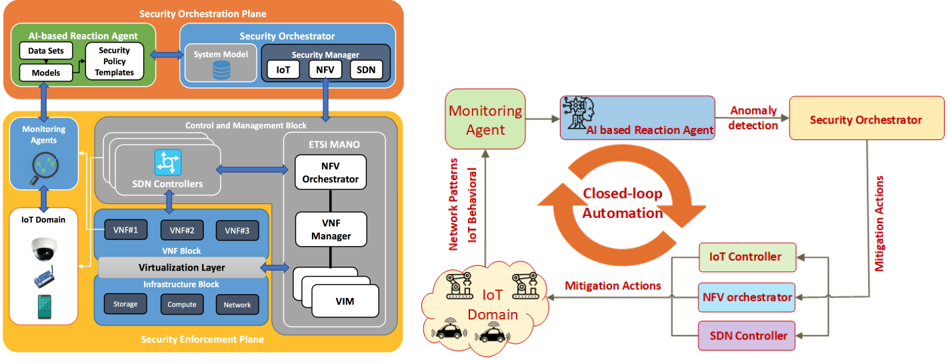
“The control and management blocks include ETSI and MANO stack modules along with SDN controllers, while the infrastructure block implements IaaS and is responsible for traffic forwarding [134].”
Dutta, A., & Kant, S. (2021) · International Conference on Electrical, Computer, Communications and Mechatronics Engineering (ICECCME) · doi:10.1109/iceccme52200.2021.9590959 · Cited by 37
Sharma, A., & Babbar, H. (2023) · International Conference on Intelligent and Innovative Technologies in Computing, Electrical and Electronics (IITCEE) · doi:10.1109/iitcee57236.2023.10090917 · Cited by 28
“A threat of attack on those IoT devices could lead to data leakage and can interrupt the user’s system [2].”
BackgroundMogadem, M. M., Li, Y., & Meheretie, D. L. (2021) · Cluster Computing · doi:10.1007/s10586-021-03423-z · Cited by 42
“Furthermore [133] put a novel ML framework based on SDN and Network Function Virtualization (NFV), which can adapt to many scenarios with anomaly-based IDS; the anomaly detection rate was 99.”
MethodMonitoring and Detection Time Optimization of Man in the Middle Attacks using Machine Learning
Toutsop, O., Harvey, P., & Kornegay, K. (2020) · IEEE Applied Imagery Pattern Recognition Workshop · doi:10.1109/aipr50011.2020.9425304 · Cited by 30
“Bagaa et al. [30] has designed a machine learning security framework to leverage cyber threats in Software Defined Networking systems, which again barely detect attacks from the Internet of Things devices in the network.”
BackgroundSecuring IoT-Empowered Fog Computing Systems: Machine Learning Perspective
Ahanger, T. A., Tariq, U., Ibrahim, A., Ullah, I., Bouteraa, Y., & Gebali, F. (2022) · Mathematics · doi:10.3390/math10081298 · Cited by 33
“[40] suggested utilizing ML within an IoT gateway to enable system security.”
MethodIntrusion Detection and Prevention in Industrial IoT: A Technological Survey
Alruwaili, F. F. (2021) · International Conference on Electrical, Computer, Communications and Mechatronics Engineering (ICECCME) · doi:10.1109/iceccme52200.2021.9590961 · Cited by 28
“[28] introduced a new framework for both Software-Defined Networking (SDN) and Network Function Virtualization (NFV) to detect different threats and attacks.”
A new intrusion detection system based on SVM–GWO algorithms for Internet of Things
Ghasemi, H., & Babaie, S. (2024) · Wireless Networks · doi:10.1007/s11276-023-03637-6 · Cited by 34
“The authors claimed that the evaluations conducted in the Weka tool indicated that the detection accuracy of their approach on NSL-KDD is 99.71% [23].”
InfluentialShkarupylo, V. V., Alsayaydeh, J. A. J., Yusof, M. F., Oliinyk, А., Артемчук, В. О., & Herawan, S. G. (2024) · IEEE Access · doi:10.1109/access.2024.3474861 · Cited by 33
“The detection accuracy performed well and classified the outcome as malicious or normal behavior based on the implemented techniques. are taken from [28] for various attribute types of attack types with model-train and model-test to solve the bias-variance trade-off.”
MethodInfluentialRetracted March 9, 2026: ISF: Security Analysis and Assessment of Smart Home IoT-based Firmware
Bhardwaj, A., Kaushik, K., Alshehri, M., Mohamed, A. A., & Keshta, I. M. (2023) · ACM Transactions on Sensor Networks · doi:10.1145/3578363 · Cited by 23
“[25] established an end-to-end security evaluation methodology based on a software-defined network (SDN) to evaluate the security levels for Cloud IoT offerings to tackle this challenge, taking into account the value of corporate data in Cloud IoT.”
MethodRetractedAhmed, B., Shuja, M., Mishra, H. M., Qtaishat, A., & Kumar, M. (2023) · International Conference on Information Systems and Computer Networks (ISCON) · doi:10.1109/iscon57294.2023.10112093 · Cited by 26
“Mobile agents have a wide variety of applications in this scenario [3], some of which include autonomous diagnosis, data collection, configuration, and the maintenance of signal quality.”
BackgroundAdvancements in intrusion detection: A lightweight hybrid RNN-RF model
Khan, N., Mohmand, M. I., Rehman, S. U., Ullah, Z., Khan, Z., & Boulila, W. (2024) · PLoS ONE · doi:10.1371/journal.pone.0299666 · Cited by 32
RetractedTraffic-Aware Secured Cooperative Framework for IoT-Based Smart Monitoring in Precision Agriculture
Abunadi, I., Rehman, A., Haseeb, K., Parra, L., & Lloret, J. (2022) · Sensors · doi:10.3390/s22176676 · Cited by 28
“Such a technique also focuses on making the system smart so that additional overhead can be reduced on the IoT devices [16,17].”
BackgroundAnomaly Detection for IOT Systems Using Active Learning
Zakariah, M., & Almazyad, A. S. (2023) · Applied Sciences · doi:10.3390/app132112029 · Cited by 35
“Anomaly detection is critical to IoT security systems’ identification and mitigation of network threats and abnormalities [4,5].”
BackgroundWITHDRAWN: Improved security using machine learning for IoT intrusion detection system
Mandal, K., Rajkumar, M., Ezhumalai, P., Jayakumar, D., & Yuvarani, R. (2020) · Materials Today Proceedings · doi:10.1016/j.matpr.2020.10.187 · Cited by 31
RetractedThaseen, I. S., Vanitha, M., Sakthivel, R., Sanapala, K., & Yeo, S.-S. (2021) · Electronics · doi:10.3390/electronics10161955 · Cited by 25
“An integrated AI security framework which exploits machine learning approaches to detect new kind of cyber-attacks in IoT is implemented [38].”
BackgroundCrucial attacks in internet of things via artificial intelligence techniques: The security survey
Thavamani, S., Mahesh, D., Sinthuja, U., & Manoharan, G. (2022) · AIP conference proceedings · doi:10.1063/5.0083617 · Cited by 20
Machine learning and deep learning approaches in IoT
Javed, A., Awais, M., Shoaib, M. A., Khurshid, S. K., & Othman, M. (2023) · PeerJ Computer Science · doi:10.7717/peerj-cs.1204 · Cited by 26
Abbas, Z., & Myeong, S. (2023) · Electronics · doi:10.3390/electronics12122650 · Cited by 25
Next Generation AI-Based Firewalls: A Comparative StudyPreprint
Ahmadi, S. (2024) · OSF Preprints (OSF Preprints) · doi:10.31219/osf.io/3kg6f · Cited by 29
Security Challenges and Solutions for Internet of Things based Smart Agriculture: A Review
Basharat, A., & Mohamad, M. M. (2022) · International Conference on Smart Sensors and Application (ICSSA) · doi:10.1109/icssa54161.2022.9870979 · Cited by 19
“[26] 2020 Intrusion detection system (IDS) for IoT Machine learning (ML) based security framework using one-class SVM Perekebode Amangele et al.”
MethodMultidomain blockchain-based intelligent routing in UAV-IoT networks
Aldaej, A., Atiquzzaman, M., Ahanger, T. A., & Shukla, P. K. (2023) · Computer Communications · doi:10.1016/j.comcom.2023.04.016 · Cited by 22
Alshammari, B. M. (2023) · Electronics · doi:10.3390/electronics12234806 · Cited by 26
Addressing Security Orchestration Challenges in Next-Generation Networks: A Comprehensive Overview
Batewela, S., Ranaweera, P. S., Liyanage, M., Zeydan, E., & Ylianttila, M. (2025) · IEEE Open Journal of the Computer Society · doi:10.1109/ojcs.2025.3564788 · Cited by 23
“Novel AI/ML techniques can be used to support essential security functions such as efficient prediction of security anomalies and intelligent decision making [38], [42].”
InfluentialTD-RA policy-enforcement framework for an SDN-based IoT architecture
Lahlou, S., Moukafih, Y., Sebbar, A., Zkik, K., Boulmalf, M., & Ghogho, M. (2022) · Journal of Network and Computer Applications · doi:10.1016/j.jnca.2022.103390 · Cited by 24
CoralMatrix: A Scalable and Robust Secure Framework for Enhancing IoT Cybersecurity
Vutukuru, S. R., & Lade, S. C. (2025) · International Journal of Computational and Experimental Science and Engineering · doi:10.22399/ijcesen.825 · Cited by 17
“SecIoT [14] integrates machine-learning techniques for anomaly detection and threat prediction in IoT environments.”
Challenges for Security in IoT, Emerging Solutions, and Research Directions
Reshi, I. A., & Sholla, S. (2022) · International Journal of Computing and Digital Systems · doi:10.12785/ijcds/120198 · Cited by 19
Dina, A. S., Siddique, A. B., & Manivannan, D. (2023) · Annual Computer Security Applications Conference · doi:10.1145/3627106.3627193 · Cited by 36
“Several ML frameworks have been proposed by researchers to address security issues in IoT [2, 4, 27, 30, 56].”
BackgroundMethodÖzer, E., İskefiyeli, M., & Azimjonov, J. (2021) · International Journal of Distributed Sensor Networks · doi:10.1177/15501477211052202 · Cited by 26
“Intrusion detection in IoT networks aims to classify network traffic according to the normal or attack classes with a trained classifier, maximum accuracy, and minimum false alarms (FAR).(39) The classifier’s high performance in terms of accuracy and FAR depends solely on the chosen lightweight algorithms and the choi…”
BackgroundDeep learning techniques to detect cybersecurity attacks: a systematic mapping study
Torre, D., Mesadieu, F., & Chennamaneni, A. (2023) · Empirical Software Engineering · doi:10.1007/s10664-023-10302-1 · Cited by 27
“…values for each DL technique according to each one of the four considered datasets are: – NSL-KDD dataset (Table 13): AE by Kasim (2020) and CNN by Bagaa et al. (2020); – CICIDS dataset (Table 14): AE by Kasim (2020), CNN by Farukee et al. (2020), LSTM by Lee et al. (2019) and DNN by Ibor et…”
MethodInfluentialRansomware Attack Detection in the Internet of Things using Machine Learning Approaches
Sharma, A., Babbar, H., & Vats, A. K. (2023) · International Conference on Applied Artificial Intelligence and Computing (ICAAIC) · doi:10.1109/icaaic56838.2023.10141036 · Cited by 19
“The LR and KNN have precision rates of 89.56% and 96.02%, respectively, while the XGB classifier has the highest precision of 96.09%.”
MethodInfluentialExplainable Intrusion Detection for Internet of Medical Things
Memon, S. A., Wiil, U. K., & Shaikh, M. (2023) · International Joint Conference on Knowledge Discovery, Knowledge Engineering and Knowledge Management · doi:10.5220/0012210300003598 · Cited by 15
“The intruders can take advantage of these weaknesses by targeting them and can cause severe damages in terms of compromised data availability and data integrity (Jan et al., 2019), (Vargas et al., 2021), (Bagaa et al., 2020).”
BackgroundSurvey of deep learning approaches for securing industrial control systems: A comparative analysis
Aslam, M. M., Tufail, A., & Irshad, M. N. (2025) · Cyber Security and Applications · doi:10.1016/j.csa.2025.100096 · Cited by 14
All Predict Wisest Decides: A Novel Ensemble Method to Detect Intrusive Traffic in IoT Networks
Chen, Z., Şimşek, M., Kantarcı, B., & Djukic, P. (2021) · Globecom · doi:10.1109/globecom46510.2021.9685318 · Cited by 14
“ML-based intrusion detection has been investigated by several studies in IoT networks [14] [15] [16].”
MethodAlshammari, N. O., Shahzadi, S., Alanazi, S., Naseem, S., Anwar, M., Alruwaili, M., Abid, M. R., Alruwaili, O., Alsayat, A., & Ahmad, F. B. (2024) · Computer Systems Science and Engineering · doi:10.32604/csse.2023.040721 · Cited by 15
Patel, S. K. (2022) · Computer Methods in Biomechanics & Biomedical Engineering · doi:10.1080/10255842.2022.2045585 · Cited by 15
“Miloud Bagaa et al. (2020) introduced a method based on Software Defined Networking (SDN) and Network Function Virtualization (NFV) enablers that showed enhanced performance in terms of attack detection; however the cost of operation was high.”
MethodInfluentialAn Intelligent Machine Learning based Intrusion Detection System (IDS) for Smart cities networks
Ayub, M. Y., Haider, U., Haider, A., Tashfeen, M. T. A., Shoukat, H., & Basit, A. (2023) · EAI Endorsed Transactions on Smart Cities · doi:10.4108/eetsc.v7i1.2825 · Cited by 14
“Therefore, Intrusion detection system (IDS) plays an important role in identification of various attacks on IoTnetworks [13].”
BackgroundKnowledge-based systems for blockchain-based cognitive cloud computing model for security purposes
Zhang, H., Zang, Z., & Muthu, B. (2021) · Advances in Complex Systems · doi:10.1142/s1793962322410021 · Cited by 19
Carrillo-Mondéjar, J., Turtiainen, H., Costin, A., Martínez, J. L., & Suárez‐Tangil, G. (2022) · IEEE Internet of Things Journal · doi:10.1109/jiot.2022.3224649 · Cited by 15
“[88] Presents a framework that combines ML with software defined networking and network function virtualization technology for the detection of IoT attacks.”
BackgroundMethodIntrusion detection system using distributed multilevel discriminator in GAN for IoT system
Poongodi, M., & Hamdi, M. (2023) · Transactions on Emerging Telecommunications Technologies · doi:10.1002/ett.4815 · Cited by 19
“40,41 Although, these time series work, using centralized GANs that grants access to the data.”
BackgroundIdouglid, L., Tkatek, S., Fayq, K. E., & Guezzaz, A. (2024) · RADIOELECTRONIC AND COMPUTER SYSTEMS · doi:10.32620/reks.2024.1.12 · Cited by 16
Subramanian, N., Nikkath Bushra, S., Shobana, G., & Radhika, S. (2024) · Cybernetics & Systems · doi:10.1080/01969722.2024.2343988 · Cited by 12
“Machine Learning (ML) based security framework was developed by M. Bagaa et al. (2020) to enhance the robustness of the Internet Of Things field.”
Application of data mining technology in detecting network intrusion and security maintenance
Zhu, Y., Gaba, G. S., Almansour, F. M., Alroobaea, R., & Masud, M. (2021) · Journal of Intelligent Systems · doi:10.1515/jisys-2020-0146 · Cited by 12
“A feasibility study was conducted to determine the current potential solutions to be adopted and to promote the development of the study in the direction of open challenges [13].”
BackgroundA systematic literature review of machine learning applications in IoT
Gherbi, C., Senouci, O., Harbi, Y., Medani, K., & Aliouat, Z. (2023) · International Journal of Communication Systems · doi:10.1002/dac.5500 · Cited by 13
“It is frequently used as a procedure to discover the underlying interpretative processes, generating characteristics, and groupings that underlie a set of samples and their underlying meaningful structures.(48) The act of grouping a population or set of data points into smaller groups, or clusters, ensures that the da…”
BackgroundPacket Loss Optimization in Router Forwarding Tasks Based on the Particle Swarm Algorithm
Ghani, R. F., & Al-Jobouri, L. (2023) · Electronics · doi:10.3390/electronics12020462 · Cited by 17
Towards a software‐defined networking model for consumer‐centric content delivery network for IoT
Bhardwaj, S., Harit, S., & Yadav, A. (2023) · Transactions on Emerging Telecommunications Technologies · doi:10.1002/ett.4903 · Cited by 12
“Bagaa et al. 12 The authors present a brand-new security architecture powered by machine learning (ML) that automatically adjusts to the evolving security needs of the IoT domain.”
BackgroundSecurity Trends in Internet-of-things for Ambient Assistive Living: A Review
Patel, A. D., Jhaveri, R. H., Shah, K. A., Patel, A. D., Rathore, R. S., Paliwal, M., Abhishek, K., & Thakker, D. (2023) · Recent Advances in Computer Science and Communications · doi:10.2174/0126662558270314231129051456 · Cited by 17
Farea, A. H., Alhazmi, O. H., Samet, R., & Güzel, M. S. (2024) · IEEE Access · doi:10.1109/access.2024.3449630 · Cited by 16
“However, AI-based IDS leverage machine learning to detect anomalies and adapt to novel attacks promptly [9], [10].”
BackgroundZSM Framework for Autonomous Security Service Level Agreement Life-Cycle Management in B5G Networks
Asensio-Garriga, R., Zarca, A. M., Ortiz, J., Hermosilla, A., Pascual, H. R., Pastor, A., & Skármeta, A. (2025) · Future Internet · doi:10.3390/fi17020086 · Cited by 11
Leveraging Random Forest for Intelligent IoT Systems in Industrial Environments
Ponnuviji, N. P., Begum, A. S., Gnanasekaran, T., Rajendiran, M., & Ezhil, S. S. (2025) · Communications in computer and information science · doi:10.1007/978-3-031-85666-2_5 · Cited by 11
Collaborative Cross System AI: Toward 5G System and Beyond
Bagaa, M., Taleb, T., Riekki, J. P., & Song, J. (2021) · IEEE Network · doi:10.1109/mnet.011.2000607 · Cited by 11
“Moreover, the emerging advancements in computation and networking enable AI techniques for managing the complexity and heterogeneity in the 5G and beyond systems [1].”
BackgroundSelf-citationIoT-Based Intrusion Detection Systems: A Review
Mohamed, T. S., & Aydin, S. (2021) · Smart Science · doi:10.1080/23080477.2021.1972914 · Cited by 18
“Bagaa et al. [43] proposed a new machine learning-based security architecture that combines a monitoring agent and an AI-based reaction agent.”
BackgroundAbdussami, A. A., & Farooqui, M. F. (2021) · Indian Journal of Computer Science and Engineering · doi:10.21817/indjcse/2021/v12i6/211206191 · Cited by 15
“The entropy describes the impurities of data, and it computes the heterogeneity of input data regarding its classification [6].”
BackgroundMethodInfluentialLUFlow: Attack Detection in the Internet of Things Using Machine Learning Approaches
Sharma, A., & Babbar, H. (2023) · International Conference on Distributed Computing and Electrical Circuits and Electronics (ICDCECE) · doi:10.1109/icdcece57866.2023.10150813 · Cited by 12
“The goal of ML, a subset of artificial intelligence (AI), is to use techniques to learn from data and generate predictions using that data [9], [10].”
MethodAnomaly Detection in IoT Environment Using Machine Learning: A Survey
Umar, A., & Jordanov, I. (2026) · IEEE Internet of Things Journal · doi:10.1109/jiot.2026.3671102 · Cited by 13
“Similarly, Moustafa et al. [258] enhanced detection performance through Gaussian mixture combined with maximum cross-entropy techniques, demonstrating superiority over conventional meth-ods like multivariate correlation analysis [261] and triangle area nearest neighbors [262], [263].”
Urs, P. M., Reddy, A. T. N., Srikantaswamy, M., & Lakshminarayan, U. M. (2025) · Engineering Technology & Applied Science Research · doi:10.48084/etasr.9597 · Cited by 15
Toward Secure and Private Federated Learning for IoT using Blockchain
Moudoud, H., & Cherkaoui, S. (2022) · Globecom · doi:10.1109/globecom48099.2022.10000623 · Cited by 13
“Most of the existing techniques/methods have been developed using supervised [3], semi-supervised [4], and unsupervised models [5].”
MethodIoTGeM: Generalizable models for behaviour-based IoT attack detection
Kostas, K., Just, M., & Lones, M. A. (2025) · Computer Networks · doi:10.1016/j.comnet.2025.111550 · Cited by 16
“Unlike features from individual packets, flow features [18, 98, 105, 81, 7, 124, 88, 34, 103, 62, 42, 13, 102, 29, 95, 114, 6, 53, 106, 90, 21, 115] are sufficient for attack detection, but they have some drawbacks.”
Metadata
- Authors
- Bagaa, M., Taleb, T., Bernabe, J. B., & Skarmeta, A.
- Affiliations
- Aalto University (FI)
- Sejong University (KR)
- Venue
- IEEE Access
- Published
- 2020
- Volume
- 8
- Pages
- 114066-114077
- ISSN
- 2169-3536 (ISSN-L)
- OpenAlex
- W3026477862
- Semantic Scholar
- 69f4813f4c66f6b2078b98f8f3748151993d5bb5
- Cited by
- 271
- References
- 47
- Citations by year
- 2026: 25 · 2025: 53 · 2024: 53 · 2023: 62 · 2022: 40 · 2021: 34 · 2020: 4
- FWCI
- 16.45
- Type
- journal article
- Language
- en
- Open access
- gold
- doi.org
- Locations
- IEEE Access (publishedVersion, cc-by)
- Aaltodoc (Aalto University) (submittedVersion, cc-by)
- Le dépôt institutionnel (Université du Québec à Trois-Rivières) (submittedVersion)
- DOAJ (DOAJ: Directory of Open Access Journals) (submittedVersion, cc-by-sa)
- Funders
- European Research Project H2020 ANASTACIA (GA 731558)
- H2020 INSPIRE-5Gplus Project (GA 871808)
- AXA Postdoctoral Scholarship
- AXA Research Fund
- Academy of Finland 6Genesis Project (318927)
- Academy of Finland CSN Project (311654)
- Topics
- Physical Sciences › Computer Science › Computer Networks and Communications › Network Security and Intrusion Detection
- Physical Sciences › Computer Science › Information Systems › Internet of Things and AI
- Physical Sciences › Computer Science › Computer Networks and Communications › IoT and Edge/Fog Computing
- Keywords
- Internet of Things security, anomaly-based intrusion detection, software-defined networking, network function virtualization, denial-of-service attacks, network intrusion, data leakage, one-class support vector machine, smart buildings, distributed data mining
About these checks
Registry, retraction, Cites and statistics results are computed, not judged, with one exception: a printed reference that no index lists is read once by a model before it counts as a citation error. Claims are extracted by a model and kept only when their quote appears verbatim in the text; each cited source is then checked, with a model’s help, for whether it says what the claim relies on. Those verdicts can be wrong — read the claim’s quote and the cited source before relying on one.
Statistics and arithmetic are recomputed, not judged.
Confidence bands are shown only for fields calibrated on our annotated test set. None is calibrated yet, so no band is shown.
What counts as a claim ›How we measure confidence ›How we check this ›
Are you an author, or do you see a problem with this page? Request a review
Data sources
Bibliographic data: Semantic Scholar, OpenAlex, Crossref.
Contains information from the Semantic Scholar Academic Graph Datasets, made available under the ODC Attribution License (ODC-BY 1.0).
Semantic Scholar’s data is described in: Kinney, R., et al. (2023). The Semantic Scholar Open Data Platform. arXiv:2301.10140.
